Temas de relações internacionais, de política externa e de diplomacia brasileira, com ênfase em políticas econômicas, viagens, livros e cultura em geral. Um quilombo de resistência intelectual em defesa da racionalidade, da inteligência e das liberdades democráticas. Ver também minha página: www.pralmeida.net (em construção).
segunda-feira, 9 de outubro de 2017
Simon Schama: Historia dos Judeus, da era moderna a nossos dias
Simon Schama’s book reveals a tension between his own fizzing exuberance and the ultimate bleakness of the material.
Photograph: Teri Pengilley for the Guardian
Simon Schama
is erudite to the point of self-parody. A conversation with him will
range across continents and epochs at breakneck speed, the references to
kings, painters, writers and scholars coming so fast that just as
you’ve placed one, another has taken its place. When we meet, in the
Academicians’ Room at the Royal Academy – the closest the New York-based
Schama has to a London club – we have barely sat down before he has
recommended The Five, a novel by Vladimir Jabotinsky,
the intellectual godfather of Likud-style “revisionist” Zionism who
died in 1940 (“It’s frighteningly good. It’s strangely
sub-Dostoevskian”) and offered a description of the architecture visible
in the demilitarised zone that separates North and South Korea
(“pseudo-Mussolini, neoclassical, colossalist columns”).
Such range befits the university professor of art history and history
at Columbia University, who also writes for the Financial Times and is a
frequent contributor to Question Time,
the man who has made more than 40 TV documentaries and is the face of
three landmark BBC series, each aiming to tell the definitive television
history of, respectively, Britain, art and the Jews.
He was in Prague this week, filming Civilisations,
the long-awaited successor to the Kenneth Clark series still regarded
as a milestone in TV history. That is due to air in early 2018, with
Schama fronting five of the nine programmes (Mary Beard and David Olusoga will present two each). But although The Story of the Jews
was broadcast in 2013, that project is also ongoing. The original
commission to write a single, stand-alone companion to the TV series has
ballooned into something much bigger: this week the second instalment
of what will be a three-volume survey of 3,000 years of Jewish history
will be published. Belonging: The Story of the Jews 1492-1900 is a magnificent
achievement, shortlisted yesterday for the Baillie Gifford prize for
non-fiction. It is an 800-page parade of bustlingly vital characters
from across the globe, assorted scholars and charlatans, rabbis and
impresarios, mystics and mavericks, all painted in luminous colour. We
meet Leone de Sommi Portaleone of Mantua, a 16th-century
actor-manager-impresario in the Donald Wolfit mould,
thought to be the author of the first book of stagecraft, whom Schama
anoints as “the first unapologetically Jewish showman we know anything
about”. We are introduced to Daniel Mendoza, the prizefighter who was
the champion of England in the 1790s, and to Captain Uriah Levy, who
became the owner of Monticello, the derelict home of Thomas Jefferson,
and who spent the 1840s fighting a lonely campaign to end flogging as
the punishment of choice in the US navy.
Advertisement
As
befits a historian of the visual arts, Schama’s eye is drawn again and
again to colour. In 19th-century Poland, we learn that “Jews thronged
the marketplace, smoking, gossiping and dispatching lads and girls out
to sleeve-tug passing custom … The market women of Galicia, wives and
grandmothers, presided over their shops and stalls in black velvet
‘coronets’ coiled at the brim with ropes of glittering crystals and faux
pearls.” Clothes are a particular interest, as is furniture and food.
(Schama is a serious cook.) If our mouth isn’t watering at the “pigeon
dainties baked in rose water and sugar” served along with “goose livers
chopped with Corinth raisins” in Galata, across the Golden Horn from
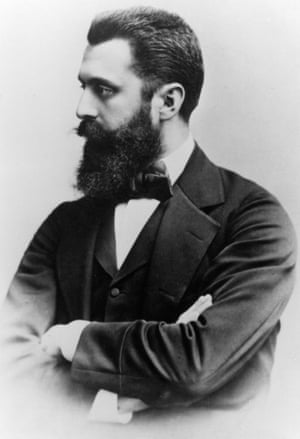
Constantinople in the 16th century, then we are gazing at the dandyish Theodor Herzl, founder of modern political Zionism, as he pulls on a pair of “‘delicate’ grey gloves” for his meeting with Kaiser Wilhelm.
For anyone raised on traditional Jewish histories, especially those
of the textbook variety, this is a radical departure. In place of
abstractions and –isms, Schama uses individual tales, often drawn from
surviving memoirs and autobiographies, to point to the larger eddies and
currents that swirled in the Jewish world. The great intellectual
movements – Kabbalah, Hassidism, the Enlightenment, communism or early
Zionism – are all here. But they are rooted in the stories of real human
beings, who work and love and mourn and die like anyone else.
Theodor Herzl, the founder of modern political Zionism. Photograph: Zionistisches Archiv/AP
This goes deeper than a mere matter of narrative style. By offering
such a throbbing cavalcade of characters, Schama is defying several key
assumptions, even stereotypes, about Jewish history and Jews themselves.
For one thing, his is painstakingly a story of the whole Jewish world
rather than just the Ashkenazi or European end of it that dominates most
scholarship. Belonging takes us to Turkey, to Syria, even to
China, as well as treading the more familiar terrain of Germany, Poland
and France. (Schama tells me the third and final volume will begin with
the Jews of Ethiopia.) He shows us Jews who are physical as well as
cerebral, boxers as well as rabbis.
Above all, while much Jewish history can read like a sorrowful trudge
through disaster, plague and pogrom, Schama’s book teems with life
rather than death. “I didn’t actually wear a smiley face on my lapel
while I was writing it,” he says, but “there are just naturally moments
of pure, in-your-face, relentless vitality”.
Meanwhile, those who imagine that the Jewish longing for Jerusalem
and Zion began in the 20th century, if not as a post-1945 response to
the Holocaust, might be shocked to learn that not only was there a
substantial Jewish population in Palestine throughout this period –
Schama introduces us to the Arabic-speaking Musta’arabi Jews of Safed –
but, at intervals, “messianic electrical surges” would pulse through the
wider diaspora, “the travelling tribe, telling them they needed to get
to Jerusalem asap”. The book closes with Herzl, but he is only the last
of a long line of would-be heirs to Moses that pop up, each itching to
lead the Jews to Zion.
Why, I ask Schama, did he decide to call this volume Belonging?
“I suppose it’s about: should we stay or should we go?” he says. In
each time and each place, Schama discovers Jews who put down deep roots,
some of which remained planted for many centuries. He focuses on the
surprisingly close relationships they often enjoyed with their
non-Jewish neighbours, on their great adventures and improbable
successes, the favour they found in the eyes of dukes and princesses,
sultans and generals. One chapter is called “Cohabitations”, and his
interest is in those Jewish communities that came up with a viable,
comfortable answer to that perennial question: can you become part of
wider society without losing those things that bind you together and
make you who you are?
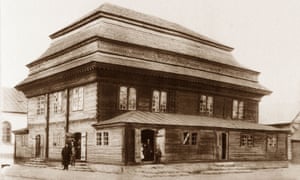
The synagogue in Jedwabne, Poland, in the 1930s. Photograph: East News/Getty Images
“That’s why the little eccentric Chinese chapter is important to me,”
he says. “I wanted to test the waters about where actually it was
possible to bring off that trick of cohabitation, where you’re allowed
to have two allegiances simultaneously, if not completely
unproblematically.” Jewish life flourished in Holland, for example, for
two and a half centuries: “It was a struggle, but it was a struggle that
was more or less won.”
Advertisement
Still,
there are shadows that the book can never escape. The Dutch Jewish
story was snuffed out with astonishing efficiency following the Nazi
invasion. “The percentage of Jews who survived the Dutch occupation was
one of the smallest in Europe,” he notes glumly.
Such facts can’t help but shape the lens through which the reader
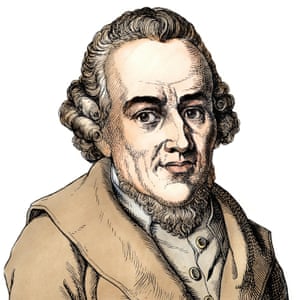
views what Schama reveals. He gives a full portrait, for instance, of Moses Mendelssohn, the 18th-century German-Jewish philosopher who came to symbolise the haskalah,
or Jewish enlightenment. Mendelssohn successfully married traditional
Jewish faith to the emerging modern spirit of inquiry. He was lionised
in his day (he beat Immanuel Kant
into second place in an essay-writing competition), and was fervent in
his conviction that devout Judaism and patriotic loyalty to Germany were
wholly compatible. To that end, Mendelssohn set about the monumental
task of translating the core Jewish text – the five books of Moses or Chumash – into German.
A century later, and before he had arrived at Zionism, Herzl would go
a stage further. In 1893, Schama reports, Herzl set out what he
believed was the logical next step for Jews who felt undeniably at home
among the German-speaking peoples. He suggested a negotiation with the
pope to bring about the wholesale conversion of Austria’s Jews. Always
the showman, Herzl did not imagine this being done on the quiet: “There
would be a procession in broad daylight to St Stephen’s Cathedral where a
mass baptism would take place,” Schama writes.
Wood engraving of Moses Mendelssohn, Germany 1854, Photograph: Alamy
The author does not labour the point because he does not need to. You
read about a Mendelssohn or (early) Herzl, and their earnest faith in
the Germans’ (or Austrians’) close embrace, and the poignancy is sharp
and bitter. Because we know how that story ended.
And this, surely, is the terrible challenge of writing the history of
the Jews, especially European Jews, before the 20th century. How to
make it read like something other than a heartbreaking prelude to the
horror of the Shoah?
“The Death Star is of course orbiting the show,” concedes Schama.
“It’s just orbiting around. You’re never going to get away from it. But I
wanted it not to be driven by the Death Star. I always say this is a
book about ... vitality more than mortality.”
Still, even if he doesn’t linger on that Death Star, he lets you know
it’s there. So in the opening chapter, when a skinny stranger “fetches
up in Venice” in 1523, claiming to be David, the lost king of Israel and
possibly the messiah, Schama mentions, as if in an aside, that the Jews
of Venice were at that time confined to a ghetto, constructed just
seven years earlier.
Advertisement
Later,
he dwells longer on the deliberations of the French revolutionaries as
they debated whether to emancipate the Jews among them than he does on
the way the great terror of 1793 hit the Jews hard. Only briefly does he
let us know that Strasbourg hosted a book burning; that in Metz, Torah
scrolls were publicly destroyed; that Jewish men were dragged from their
beds at night, so that their beards might be ritually shaved off in
public. All of this is an eerie pre-echo of the Nazi calamity to come,
but Schama lets us make that connection for ourselves.
The result is a tension between Schama’s own fizzing exuberance and
the ultimate bleakness of the material. Surely the lesson that emerges
from the four centuries he’s recorded in Belonging is that, one
way or another, the Jewish attempt to live as a minority proved doomed
to failure – maybe not right away, but eventually. After all, again and
again, a Jewish community settled in a new land, felt at home and was
then uprooted, often violently. I put to him the image evoked by the
Israeli novelist Amos Oz: that the Jewish project of living for 2,000
years like almost no other people on earth – permanently stateless, in a
shifting diaspora – was a performance that the rest of the world
watched, sometimes with amusement, occasionally hurling cabbages at the
stage, until, in the middle of the 20th century, they decided they’d had
enough and slaughtered the actor.
A demonstrator at the White House after the protests in Charlottesville. Photograph: Mark Wilson/Getty Images
“You’re right. All the parameters, all the outlines are saddening.
Wherever you look, the dawns are false. But the morning that follows the
dawn can last a very long time.” And those dawns are not just long;
they can be dazzlingly beautiful. “We’ll take them,” Schama says.
Advertisement
Besides,
he adds, “There is one huge exception.” He means America, the place
Jews called the Goldene Medina, the golden land. Isn’t this where Jews
have, at long last, been fully accepted, integrated and welcomed on an
equal footing with their fellow citizens? Then Schama stops himself.
“Except we did see swastikas in Charlottesville a few weeks ago.”
He thinks about that for a while. Schama has been a vociferous critic
of Donald Trump, dispensing with all academic restraint and unloading
on the US president in tweets of relentless bile. He regularly refers to
the Trump White House as a “kakistocracy”:
rule by the worst and least qualified citizens. After this week’s Las
Vegas shooting, Schama tweeted: “Trump signed bill allowing mentally ill
to buy guns thus becoming an enabler of massacre. For this alone he
should be driven from office.”
Yet, when we meet, he hesitates at the thought that Trump’s ascent
means American Jews’ trust in their country could one day be thought as
naive as the faith Mendelssohn and the others placed long ago in the
land they called home.
“I do worry about something like that. But look: Trump is not writing Mein Kampf,
he has not actually built a movement around the annihilation of the
Jews. That is not the case. He’s a stumbling, lazy, egomaniacal
opportunist … I think it’ll end up being fine. I’m not being Pollyanna
about that.”
He locates the danger posed by Trump elsewhere. “The slippage into an
authoritarian state, that I’m much more pessimistic about … the attacks
on the press and the dumb notion that congressional procedure is too
trivial and frustrating … the prospect of some real upheaval or
challenge to the US constitution – that is extremely serious.”
These are not abstract considerations for Schama, who has lived in
the US since 1979. He already had plenty of relatives in New York and St
Louis, but what lured him from Oxford, England, to Cambridge,
Massachusetts, was an offer he couldn’t refuse. “I had a try-out at
Harvard and was working on what would become The Embarrassment of Riches[subtitled An Interpretation of Dutch Culture in the Golden Age].
What I really wanted to do was combine history, art history and a bit
of anthropology and actually teach my enthusiasms across the
disciplines. And I remember one of the most astonishing things that was
ever said to me; the chairman of the history department at Harvard said:
‘And what would you like to teach?’ All those years in Oxford and
Cambridge – it’s not as bad now, I think, as it was then – you were told
what you had to cover: it was repeal of the Corn Laws coming out of
your every orifice.” The “cross-disciplinary freedom” that Harvard
offered him felt, he says, like “a great exhilaration”.
Advertisement
He
moved from Harvard to Columbia in 1993, after his wife, the
California-born geneticist Virginia Papaioannou, was offered a job
there. At Columbia, the “teaching is really when I want to do it” –
mainly narrative non-fiction in the creative writing school, combined
with “a bit of art history. I haven’t taught in the history department
for a long time”.
He does most of his writing at home in Westchester, outside the city,
in a small study with a view of the Hudson valley. He was able to do
that, in part, because this new book did not entail “deep archival
burrowing”, but rather ploughing his way through published diaries,
biographies and histories. Surely a TV historian has armies of
researchers generating crates of material, leaving him simply to knit it
all together into elegant prose? Not a bit of it.
“The reason why that never works for me, is that everything is about
improbable free associations. No researchers would have come up with
Abraham Colorni,” the Jew from 16th-century Mantua who was an engineer,
statistician, magician and, crucially, escapologist. “Such a perfect
metaphor,” Schama says. “If you have a great library like Columbia, an
open stacks library, I mean that’s fantastic, because so often it’s the
book next to the one you’re hunting for that suddenly wags, crooks the
fingers and says: ‘Come hither, I’m what you’re actually looking for.’”
Which is why he prefers the London Library to the British Library,
because he can creep along the stacks: “shelf-cruising”, he calls it.
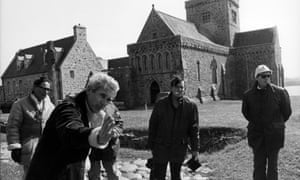
Pinterest The production team at the abbey of Iona filming the BBC series
Civilisation in 1969. Photograph: BBC
The Butler Library at Columbia is Schama’s regular haunt, not least
because he can borrow the books he finds. He takes them home, filling
his study with tottering piles. “My dad said – one of the best wisdoms
of Arthur Schama that I took much too seriously – ‘Never trust a man
with a tidy desk’.”
For a book of this scope, that has serious logistical implications.
“I have a holding station. Literally, I have a mini book repository in
our garage. And so I move Renaissance Italy out and move Hassidism in.”
And while he’s reading, he’s constantly filling dozens of small jotters
with notes, all of them methodically colour-coded. “One colour would be
for quotations, one colour would be for the analytic structure.” For the
chapter on Hassidism, he filled 30 such notebooks. Only then comes the
writing: “The structure and shape and thoughts and first pages are
handwritten,” he says. “And then you hit the laptop.” Belonging took three years, on and off, as he juggled
Columbia, his newspaper columns and TV. (Schama is 72, but his energy
seems to be infinite.) Nevertheless, I tell him, it reads as if it was
written at a clip. The pace suggests it came easily. He nods. “Sometimes
the thing writes itself: you’re just a ventriloquist. And there are
plenty of times where you can’t find a sentence to put together, you get
stuck. I didn’t get stuck very much in this book because it’s a room
full of Jews shouting at each other. So, it’s the easiest thing in the
world.”
I ask him about Britain. With his 15-part TV history and his role as
historical oracle during BBC coverage of royal funerals and the like,
he’s become the de facto national chronicler. Will he ever come back to
stay?
“Ah, Britain!” he writes, when we exchange emails later. “Old
elephant syndrome, so heart and head yearn to return, notwithstanding
the self-mutilation called Brexit. BUT my children and grandchildren in
USA, so the vicinity of my grandsons’ smiles is where I must be. But who
knows, when the new Spurs stadium opens …”
And where does Britain stand in his rollcall of “cohabitations”? How
have British Jews managed to reconcile their different identities? Could
Britain be the place where Jews have finally made it work?
Advertisement
He
returns to his father who, the book tells us, yearned to be an actor,
but was denied his ambition by his parents. “We would go to shul [synagogue] every Shabbat
[Saturday] and we certainly wouldn’t get in a car or a bus [prohibited
on the Sabbath], and the next day, not every Sunday, we would take a
little boat ride. My dad would turn into something like Mr Toad from Wind in the Willows,
and we’d take a launch down the Thames, and he would – from the back,
at the steering wheel – recite Shakespeare off by heart. He read Dickens
to my sister and me on Sundays as well.”
His feelings for the old country endure, but Brexit and the swelling
of nationalism have clearly come as a blow. Is his opposition partly a
Jewish thing? “Well yeah,” he says, with something like a sigh. “It
presses all the tribal psychological buttons really. It’s bound to. We
are suitcase people.” •Belonging: The Story of the Jews 1492–1900 is published by Bodley Head. To order a copy for £21.25 (RRP £25) go to bookshop.theguardian.com or call 0330 333 6846. Free UK p&p over £10, online orders only. Phone orders min p&p of £1.99.



 Pinterest


Nenhum comentário:
Postar um comentário