Temas de relações internacionais, de política externa e de diplomacia brasileira, com ênfase em políticas econômicas, viagens, livros e cultura em geral. Um quilombo de resistência intelectual em defesa da racionalidade, da inteligência e das liberdades democráticas. Ver também minha página: www.pralmeida.net (em construção).
Anne Applebaum sobre os "amores" (se essa é a palavra) de Trump por Putin:
Russia, Russia, Russia Trump’s relationship with Moscow remains very weird OCT 14 In the past few days, Donald Trump has dropped all pretense, torched a couple decades of American policy, and undermined 18 months of his own diplomacy. I summed up his new policy in the Atlantic:
He has threatened to stop sharing intelligence with Ukraine, unless Ukraine agrees not to target Russian refineries, thus demanding that Kyiv give up its most effective weapon while asking nothing from Russia in exchange. He has not criticized Russian attacks on Ukrainian power plants or factories, even those owned by American companies. He has offered no condolences for the recent deaths of Ukrainian children in Russian bombing raids.
He has lied repeatedly. He declared that Ukraine and Russia had agreed to an “energy cease-fire,” an announcement that surprised the Ukrainians and that in any case the Russians immediately broke, hitting a power plant in Kharkiv only hours later. He accused Ukraine of blocking negotiations, when in reality the Ukrainians have repeatedly proposed cease-fires and Russia has never agreed to a cease-fire or any meaningful negotiation at all.
He has described Ukraine’s democratically elected president as an obstacle to negotiations and told him to leave office. But on Friday, before making these new decisions, he held yet another long, friendly telephone conversation with the Russian dictator, who really could end the war today. All Vladimir Putin has to do is tell his soldiers to stop fighting, and then the war is over, bar some territorial negotiations. The Ukrainians cannot stop fighting because, if they do, their country will be conquered and they will suffer the fate of their occupied territories: leaders murdered, children kidnapped, repression and concentration camps for everyone else. If Trump knows this, then he does not care.
And yet…large parts of this story don’t make sense:
The president has implied that the point of his new policy is to lower fuel prices for Americans. Perhaps he wants to convince voters that the cause of high prices is Ukraine and not his own war of choice in Iran. But this is not a sufficient explanation or justification for these dramatic actions. The amount of fuel that Russia could export is too small, the impact on pricing too slight, the narrative too late to shape electoral outcomes.
This looks, instead, like something very different: an abrupt, Hail Mary attempt to force Ukraine to surrender and to save the Russian economy, perhaps in order to finally complete the multiple business deals that the Russians are known to have discussed with American negotiators and others in Trump’s orbit. These include deals involving the Nord Stream gas pipelines, mineral mining in the Arctic, the Russian assets frozen in European banks, and more.
But Trump cannot make things happen simply by saying them, and he cannot make Ukraine stop fighting either. The US gives no weapons to Ukraine, except those that are purchased by Europeans. I am told that the US intelligence contribution to Ukraine is now minimal, mostly involving defensive, not offensive operations. Certainly the Ukrainians do not need American intelligence, or Starlink, to hit Russian refineries. If Elon Musk limits the range of Starlink inside Ukraine (some say he did so on Wednesday morning) he will pay a high price. European governments and other big customers will take this as a warning: Musk’s technology is unreliable because Musk is unreliable, and they should end their contracts and not sign new ones.
But if this diesel deal won’t stop the Ukrainian strikes on refineries, won’t have an impact on the election, isn’t popular among Americans, will further alienate allies and won’t stop the Ukrainians, why is Trump doing it? There can only be one answer: because Russia has been so important to him for so long.
Periodically, an interviewer or interlocutor asks me why Donald Trump is so obsessed with Russia. Why does he allow himself to be humiliated by Putin, who did not even pretend to respect his “ceasefire”? Why does he parrot Russian propaganda? I don’t really understand why anyone still poses these questions, because they were answered long ago.
I wrote about Trump’s Russian connections as long ago as July 2016, in the Washington Post. In subsequent months and years, there were multiple investigations into Trump’s business links with Russia, extending back to the 1980s. These include links to people affiliated with the Russian mafia, some of whom owned condos in his buildings; his broader reliance on Russian clients, as well as anonymous purchasers of condos, many of whom are believed to come from Russia. Famously, a Russian oligarch purchased a property from Trump for tens of millions of dollars over the previous price, at a time when Trump needed the money.
Equally well documented is Trump’s fondness for Russian propaganda narratives. Upon returning from his first trip to Moscow in 1987, he took out full-page advertisements in three newspapers, attacking American alliances in Europe and Asia:
For nearly 40 years, he has been saying much the same thing. He has changed his mind about abortion and crypto, he has supported different political parties at different times, but his dislike of America’s democratic allies and his preference for Russia have remained remarkably consistent.
The Mueller report and a subsequent bipartisan Senate Select Committee on Intelligence demonstrated multiple Russian attempts to contact Trump during the 2016 campaign and to sway the election, through the release of hacked data from the DNC as well as major investments into American social media. But because Trump succesfully mocked and minimized this story (“Russia, Russia, Russia,” he says, as if that were an argument) and because the Republican party went along with this lie, it seems as if Americans have to be constantly reminded anew: yes, Trump’s relationship with Russia is intense, longstanding, and deeply weird.
It also contradicts the views of the American military and American intelligence, as well as majorities in the country and in Congress. Immediately after his statement on diesel and his comments about Volodymyr Zelensky, a bipartisan cohort of U.S. representatives and senators attacked the deal and vowed to reverse it. On Monday, U.S. Air Force General Alexus Grynkewich, America’s highest-ranking soldier in Europe and the top NATO commander—a job always held by an American—delivered a very different message to Russia.
Speaking at a security conference in Warsaw, Grynkewich said that any attack on NATO, something many now genuinely fear, would be met with overwhelming force: “We will stop the attack and deny them the ability to achieve their objectives, whatever those might be. We will, in short, ensure any attack, against any ally, proves utterly futile.” He implied that there would be massive retaliation targeting “anything and everything that supports, sustains, and controls” an aggressive force.
This is the kind of language that, if it also came from the White House, might deter Russia from expanding its current campaign of sabotage and cyberattacks in Europe, from continuing to aid Iran, or from committing war crimes in Ukraine. But this president absolutely refuses to use it, and at this point, we have to assume he never will.
Em 1984 publiquei na Ciência Hoje “A Árvore da Ciência”, um artigo sobre a formação da comunidade científica brasileira, baseado em entrevistas com 56 cientistas nascidos entre 1892 e 1931. Pedi agora ao Claude, o sistema de inteligência artificial da Anthropic, que revisitasse aquelas hipóteses com os dados que a Academia Brasileira de Ciências divulga sobre seus membros, ativos e falecidos. O resultado é o texto anexo, escrito por ele e não revisado por pares, que me parece de interesse. A análise cobre 1.107 acadêmicos residentes no Brasil.
A principal mudança é a incorporação das ciências aplicadas a uma academia que, até o final do século XX, era essencialmente de ciência básica.
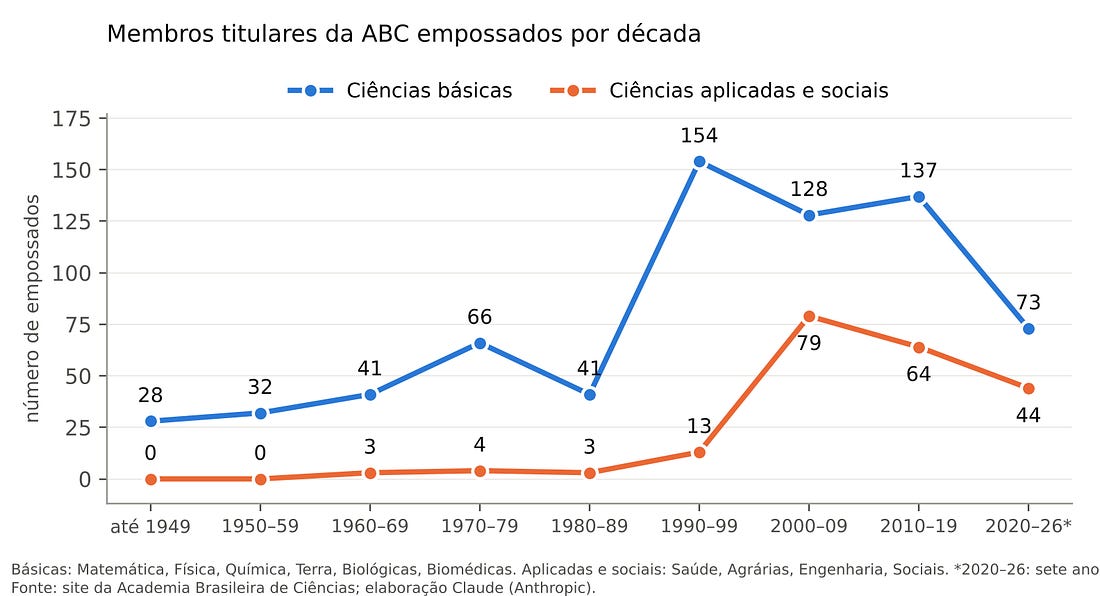
Até os anos 1990, matemática, física, química, ciências da Terra, biologia e ciências biomédicas recebiam mais de 90% dos membros empossados. Dentro desse conjunto, o grande movimento foi o crescimento das ciências biomédicas, que chegaram a 36% das posses nos anos 1980 e 1990.
A partir de 2000 o quadro muda. As seções de ciências da saúde, agrárias, da engenharia e sociais, que tiveram 13 empossados em toda a década de 1990, passam a 79 nos anos 2000 e mantêm um ritmo semelhante desde então. As ciências básicas, por sua vez, não diminuíram: depois do salto dos anos 1990, quando tiveram 154 empossados, seguem acima de 125 por década. A Academia não trocou a ciência básica pela aplicada; cresceu e abriu espaço para as áreas aplicadas. Em proporção, as básicas passaram de mais de 90% para cerca de dois terços das novas eleições, e as dez seções ficaram com participações semelhantes, em torno de 10% cada.
Antes de 1990 os números do gráfico estão subestimados, porque faltam no site da ABC as datas de posse de muitos acadêmicos falecidos. A última década, 2020–26, tem só sete anos.
A mudança de áreas traz consigo uma mudança de perfil. Os membros das áreas aplicadas vêm quase todos de escolas profissionais: 94% na saúde, 89% na engenharia, 77% nas agrárias. É um retorno, em outro patamar, à origem da ciência brasileira nas escolas de medicina e engenharia. Nas ciências básicas, a ligação com as escolas profissionais tinha diminuído desde a geração nascida entre 1921 e 1931, a primeira que pôde entrar diretamente em um curso de ciências.
Os dados mostram outras transformações. O doutorado no exterior, que chegou a cerca de 45% entre os acadêmicos nascidos de 1932 a 1975, caiu para 15% entre os mais jovens: a pós-graduação brasileira passou a formar a elite científica do país. O centro da formação deslocou-se do Rio de Janeiro, onde se graduaram 70% dos acadêmicos mais antigos, para São Paulo, e depois veio a dispersão: entre os jovens membros afiliados, só um terço estudou no Rio ou em São Paulo. E as mulheres chegaram a 47% dos titulares empossados nos anos 2020.
A Academia de hoje se parece muito mais com o sistema de ensino superior e pesquisa que o país construiu nas últimas décadas: mais aplicado, mais disperso, formado no Brasil. Fica em aberto se essa mudança reflete o crescimento real da pesquisa aplicada ou uma decisão institucional de equilibrar as áreas. Provavelmente as duas coisas.
This week, my train in Ukraine was almost hit by a Russian drone. It sent the same message that aggressors have been sending since the earliest days of siege warfare: Be afraid.
KYIV, Ukraine — I did not take it personally that a Russian drone destroyed the train behind ours as we neared the Polish border with Ukraine on Sunday. Indeed, I wasn’t aware of what had happened until a few hours later. I had taken it for granted that going to Ukraine amid a relentless aerial bombardment would have its risks. But I had also assumed that I’d probably be all right if I was traveling with such luminaries as the former UK prime minister Boris Johnson, the former director of the CIA David Petraeus, and multiple current or former leaders of Scandinavian and Baltic states—not forgetting the editor of The Economist.
I don’t think the Russians intended to hit our train. I do think they intended to send us all a message. And it is the same message that aggressors have been sending since the earliest days of siege warfare: Be afraid. It says much about the war in Ukraine that President Vladimir Putin believes he can send such a message to eminent Westerners with impunity. He is probably right about that. It dovetails with his current strategy of drone incursions, sabotage, and cyberattacks directed at multiple NATO (North Atlantic Treaty Organization) members.
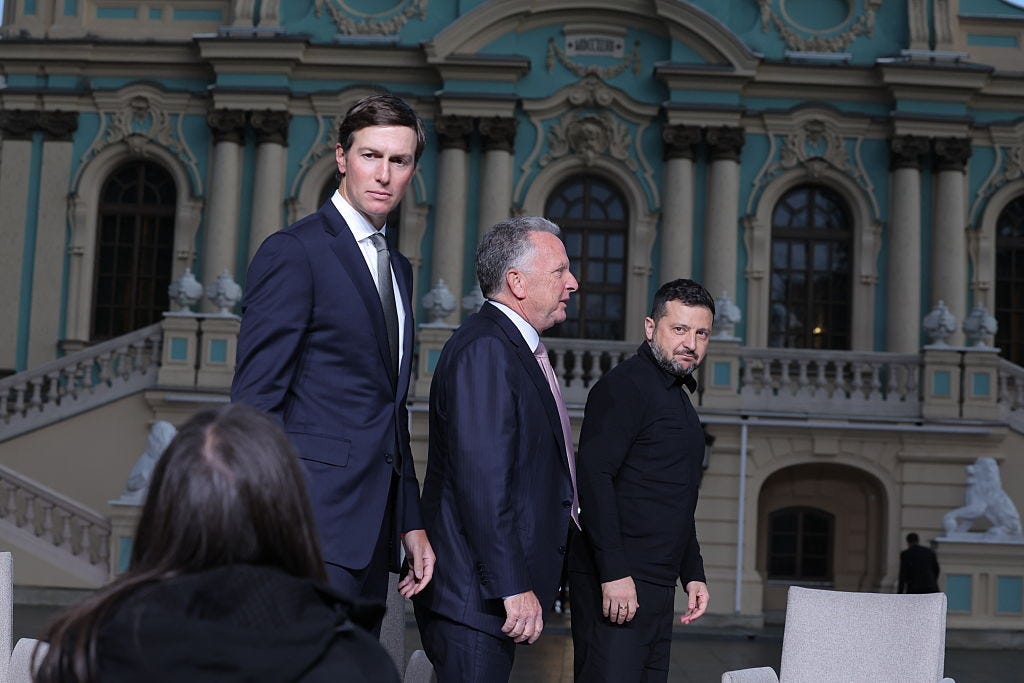
My annual visit to Kyiv for the Yalta European Strategy (YES) meeting was faintly encouraging about the chances of some diplomatic progress, but grimly sobering about Ukraine’s economic and political situation. Just over a week ago, President Donald Trump’s diplomatic representatives, his son-in-law Jared Kushner, and his friend Steve Witkoff, visited Moscow and Kyiv for meetings with the leaders of Russia and Ukraine, President Putin, and President Volodymyr Zelensky. This was not long after Director of Central Intelligence John Ratcliffe had also visited Moscow on August 26.
Contrary to generally negative media coverage, some progress was made. Speaking via video link at the opening of the YES conference in Kyiv on Friday, Kushner said that the key elements of a peace agreement were largely in place, with the exception of “territory,” an allusion to the Donbas region.The other elements—security guarantees for Ukraine and a “deconfliction mechanism”—had been in place since the last trilateral meeting of Russian, Ukrainian, and U.S. representatives in Abu Dhabi in January.“If Ukraine were willing to move back to Putin’s desired line,” Kushner said, “the rest of the deal would be ready.”
That is, of course, a very big “if,” given the consistent refusal of the Ukrainian government to accept territorial cessions. Kushner said he expected there to be new trilateral talks, again in Abu Dhabi, later this month or in early October, following the Russian Duma elections on September 18 to 20. He elicited incredulous laughter when he said Putin was sincere about peace talks. However, he responded: “Everything looks impossible until right before it’s achieved.”
I have no illusions that Zelensky is eager to cede the remaining 21 to 22 percent of Donetsk that Ukraine still controls. This is not out of sentimentality about square miles. The territory in question includes the so-called “Fortress Belt,” anchored by the key cities of Sloviansk, Kramatorsk, Druzhkivka, and Kostyantynivka. On the other hand, both sides do appear to have stronger incentives to end their war than at any time since late 2022, the nadir of Russia’s fortunes, when Western leaders misguidedly urged Ukraine to keep fighting rather than seek peace.
A year ago, I was quite concerned about Ukraine’s thinly stretched armed forces. However, Ukraine’s advances in military technology have more than compensated for these vulnerabilities. The evidence is visible in Russian casualty figures, running at more than 40,000 in July and August according to the Ukrainian General Staff, as well as in the minimal territorial gains Russia made this spring and summer, compared with March through August last year. It is also apparent in the damage done by Ukrainian deep strikes on Russian energy infrastructure, especially oil refineries.
A year ago, I was quite concerned about Ukraine’s thinly stretched armed forces. (Diego Herrera Carcedo/Anadolu via Getty Images)
On September 9, Ukrainian forces struck the Novy Urengoy Gas Condensate Treatment Plant and the Purovsky Gas Processing Plant in Yamalo-Nenets Autonomous Okrug—both more than 2,700 kilometers from the Ukrainian border. On the same night, Ukraine hit Russian ports along the Black and Caspian Sea coasts. Ukrainian successes have been partly due to assistance from U.S. intelligence in targeting. However, the principal credit goes to the speed and creativity with which the Ukrainian Armed Forces have innovated in their use of drones, software, and artificial intelligence. Asked if Ukraine already had autonomous AI weapons systems in which no human decision-maker played a part, Artem Martynenko, deputy commander in chief of Armed Forces of Ukraine, conspicuously avoided giving a reply.
Nevertheless, Russia has responded in ways that dispel any notion of a Ukrainian victory. Russia continues to strike Ukrainian cities every day with drones and missiles, while Ukraine’s air defenses are much less effective than a year ago. Not only is there a shortage of Patriot interceptors; Russia has also switched to jet-powered strike drones that are much harder to intercept. Moreover, the Ukrainians are fearful that Russia is close to deploying its own version of Starlink. At the same time, Russian attacks on Ukraine’s biggest port on the Danube and on cargo ships in the Black Sea have brought Ukrainian agricultural exports from its Black Sea ports to a standstill.
Both the Ukrainian and Russian economies are showing signs of strain, but the strain is greater in Ukraine.
From the outset, this war has been a contest between David and Goliath. The International Monetary Fund estimates that the Russian population is 4.4 times larger than Ukraine’s and the Russian economy is 11.8 times larger (on a current dollar basis). Ukraine’s growth has stalled this year. The Black Sea escalation began in July. According to Ukraine’s Infrastructure Ministry, in July, Russia carried out 67 attacks on port infrastructure, 35 attacks on civilian vessels in ports, and 22 attacks on vessels using Ukraine’s maritime corridor. The result has been an effective commercial blockade of Ukraine’s Black Sea ports. Ukraine is trying to reroute agricultural exports to the Danube, but capacity is far lower. Russia has also started attacking Ukraine’s overland export routes. At the same time, Russian air raids on power infrastructure and commercial distribution nodes are causing severe disruption to both the manufacturing and the retail sectors. Last winter was bitter in Ukraine. This one will be worse.
As in Ukraine, the costs of war have caused an economic slowdown in Russia. High interest rates are the main reason for the slowdown. Fixed capital investment declined sharply in the first half of the year. Overall industrial production flatlined. Preliminary estimates suggest Russian seaborne grain exports fell 62 percent in August compared with a year ago. However, the decline in agricultural exports is far less significant for Russia than for Ukraine.
Russia’s fiscal situation is ugly but workable. Despite higher oil prices from the Gulf crisis, oil and gas revenues are down. But the budget deficit is currently 2.5 percent of GDP. Unemployment was just 2.3 percent in July. Inflation peaked at 10.3 percent in March 2025 and is now 6.3 percent. Real wage growth remains robust. Although there are signs of financial stress (e.g., signs of trouble at VTB Bank; the sharp decline of Gazprom’s share price), those who continue to talk about the outcome of the war being determined by a Russian economic crisis are missing the point. It is Ukraine that is much closer to a crisis.
Both sides appear to have stronger incentives to end their war than at any time since late 2022.
Both combatants rely on foreign support, though it takes different forms. Calculating all aid allocations (financial, humanitarian, and military) to Ukraine by the EU and its member states since 2022, the total comes to €195 billion ($224 billion)—52 percent of the amount from all donors—compared with the U.S. figure of €115.4 billion ($132.6 billion). Including committed (but not yet allocated) aid, the EU’s contribution is €326.5 billion ($375 billion)—59 percent of the total—compared with a U.S. figure of €119 billion ($136.7 billion). In other words, total EU aid to Ukraine is now nearly three times more than U.S. aid to Ukraine. And that gap will only widen as U.S. aid to Ukraine effectively ceased early last year, following President Trump’s second inauguration.
Europe will continue to prop up Ukraine’s budget through at least the first half of next year. The EU’s main financing vehicle, the €90 billion ($103.4 billion) Ukraine Support Loan, runs through 2027 but will need to be front-loaded to cover Ukraine’s faster-than-anticipated spending. Thereafter, Ukraine will be at the mercy of European politics.
By contrast, Russia’s war effort relies increasingly on China, but it is made available on commercial terms, not as aid. Bilateral trade between Moscow and Beijing is on track to hit an all-time high of roughly $280 billion this year. Russia now relies on China for roughly 57 percent of its total imports, compared with 13 to 14 percent before the war. China supplies around 90 percent of Russia’s sanctioned tech imports. While Beijing stops short of sending finished military hardware, it provides billions in dual-use goods—microchips, drones, and tools. And China buys about 50 percent of all Russian crude oil exports, 37 percent of its exported coal, and 31 percent of its pipeline gas. It has even defied U.S. sanctions by ramping up imports from Russia’s newer Arctic LNG 2 project. Over the last two decades, Russia has also accumulated $169.3 billion in total debt to China.
To an extent that is underappreciated, the war in Ukraine is now a proxy war between the EU and China. The difference is that China makes a profit from backing Russia.
Intertwined with Ukraine’s deteriorating economic situation is the unraveling of wartime political unity. This is a war between a fledgling democratic nation-state and a fascist empire. In this regard, too, it is not a fair fight. Putin’s opposition is either dead, in jail, or in exile. Not so Zelensky’s.
Russia’s full-scale invasion came roughly halfway through Volodymyr Zelensky’s first term, several months after his party, Servant of the People (Sluha Narodu), lost its parliamentary majority. The invasion prevented a rebalancing of parliamentary power. The war has also postponed the next presidential election. The result has been a narrowing political upper echelon, growing friction between its more powerful members, and a series of conflicts that are impossible to solve without an election. Yet holding an election in wartime is legally and logistically extremely difficult.
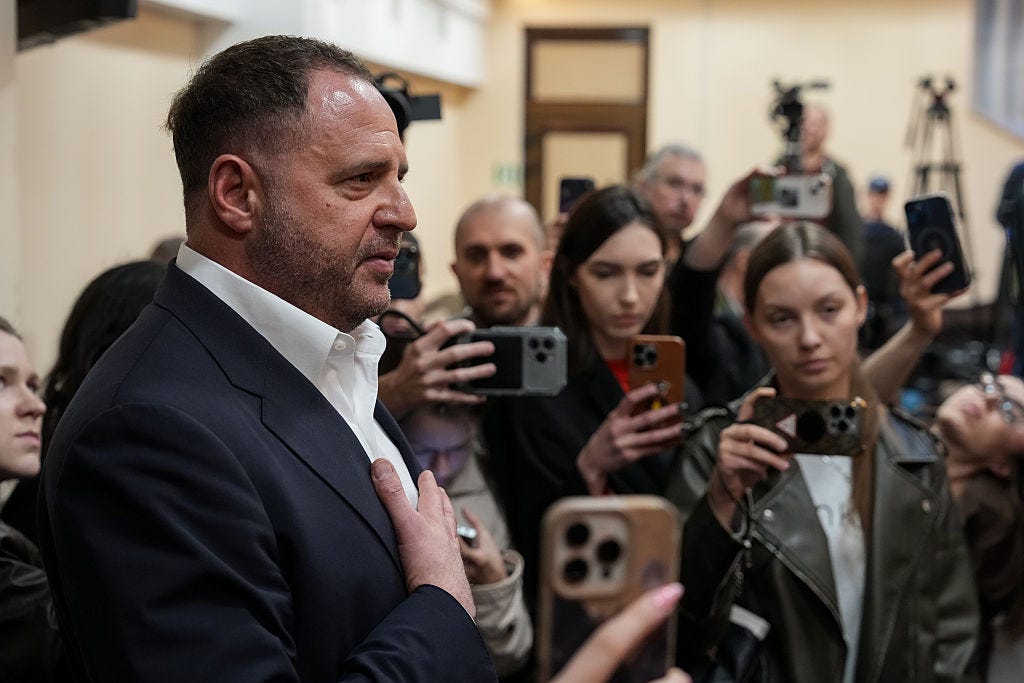
The main opposition to Zelensky is now the Anti-Corruption Bloc, a coalition of disparate elements that includes Ukraine’s anti-corruption institutions, civil-society activists, and individual members of parliament. Last November they claimed the scalp of Andriy Yermak, the head of the Office of the President of Ukraine (OPU). As Zelensky’s right-hand man, Yermak was feared, not loved. But his system ensured all key decisions were taken, delegated, and executed quite effectively. That system collapsed when Zelensky was forced to remove Yermak after he became implicated in the widening corruption investigation known as Operation Midas.
As Zelensky’s right-hand man, Andriy Yermak was feared, not loved. (Ivan Antypenko/Suspilne Ukraine/JSC “UA:PBC”/Global Images Ukraine via Getty Images)
Following Yermak’s removal, Zelensky tried to create a team of rivals. Kyrylo Budanov came from the Main Directorate of Intelligence (HUR) to OPU. Denys Shmyhal moved from defense to energy. Rustem Umerov, Yermak’s last surviving protégé, moved to the Ukrainian National Security Council. And the mercurial Mykhailo Fedorov went from minister for digital transformation to defense minister. However, Fedorov had wanted to run the OPU, aspiring to take over Yermak’s old role—and perhaps even to replace Zelensky. He repeatedly pressed for elections, even in wartime, during multiple strategy meetings in the early summer. His removal from government in July and his subsequent attack on Zelensky has created a situation of extreme tension.
Earlier this week, allegations of money laundering surfaced against Budanov. If Ukraine’s anti-corruption institutions were to release evidence of Zelensky’s direct knowledge of the corruption scheme exposed by Midas over the winter, there could be protests. Kyiv mayor Vitali Klitschko and former president Petro Poroshenko would likely support them.
Ordinary Ukrainians are thoroughly sick of this war and filled with foreboding as winter approaches. The government continues to insist that Ukraine will fight on to victory. In the words of Yuri Fedorenko, the handsome, decorated commander of the Brigade Achilles, “The war will continue as long as Russia exists.” But I heard very different views at a rehabilitation center for war wounded at one of Kyiv’s municipal hospitals.
One officer—a big, bearded, powerful man, his body covered in tattoos—had lost a leg when he stepped on a Russian land mine. He said the war would end only when “they” (meaning the Ukrainian oligarchs) could make no more money out of it. And yet he said he would return to the army after his rehabilitation was complete. A second younger man, whose foot had been severely damaged by a mine, said the war would only end when Putin decided to end it. A third, who had lost an arm to a Russian drone and was confined to a wheelchair by his leg injuries, said the war would be ended with negotiation, and Ukraine would have to make concessions.
Ukraine has never published credible statistics on its military casualties. As Russia’s now likely exceed 1.5 million, of which roughly one-third were killed in action or died of wounds, a reasonable estimate would put Ukraine’s mutilés de guerre at above 200,000. Mass bereavement and disability are the less obvious costs of a large-scale conventional war such as this.
Under these circumstances, the obvious path for Putin is simply to press on through the winter, waging total war against Ukraine and exploiting his advantages, as Eric Schmidt has recently warned. However, there are other forces at work.
First, as the situation in the Gulf deteriorates—with exchanges of fire between U.S. and Iranian forces disrupting the Strait of Hormuz, and Houthi attacks compromising the Red Sea route for Saudi oil—the Trump administration is casting around for any kind of relief for energy markets.
Second, progress toward ending the Russia-Ukraine conflict, no matter how tentative, could be presented by Trump as a major diplomatic breakthrough—a modest October surprise ahead of the November midterms.
Third, the U.S. has worked out a better way of involving European countries in the Russia-Ukraine peace process. Rather than being exposed to the divergent arguments of all the various EU member states, which derailed diplomatic efforts last year, Washington now appears to be dealing only with Berlin, London, and Paris. National security advisers from those capitals, France’s Emmanuel Bonne, the UK’s Jonathan Powell, and Germany’s Günter Sautter, were directly involved in the recent U.S.-led talks in Kyiv. How far they were working alongside Kushner and Witkoff and how far they were merely “props” was unclear.
How far France and Germany were working alongside Kushner and Witkoff in negotiations was unclear. (Yan Dobronosov/Global Images Ukraine via Getty Images)
This is a striking turn of events. Now that they are the principal source of aid and lending to Ukraine, the Europeans ought to have much more diplomatic leverage. In practice, however, the British, French, and German governments prefer to let the U.S. take the lead in negotiations. Other European governments may well view this development with unease, as Kersti Kaljulaid, the former president of Estonia, pointed out—especially if they find themselves committed by the “E3” to security guarantees for Ukraine as part of a trilateral peace deal. The problem is that European initiatives such as the “Coalition of the Willing”—an Anglo-French initiative launched last year—lack the military resources to make credible commitments to the proposed postwar multinational force in Ukraine.
Moreover, the trends in European politics are not friendly to Ukraine. In France, Rassemblement National leader Marine Le Pen is the favorite to succeed Emmanuel Macron as French president. In Germany, the chancellorship of Friedrich Merz is crumbling as the Alternative für Deutschland gains ground in regional elections. In Italy, Giorgia Meloni risks being outflanked by the neo-fascist Roberto Vannacci’s Futuro Nazionale. All the European populist parties are skeptical about the war in Ukraine, if not overtly pro-Russian.
The recent U.S. visitors to Moscow offered Putin a stark choice: “Press on with the war and we will continue to provide the Ukrainians with targeting intelligence; or settle this diplomatically and we can give you the kind of economic rehabilitation you will not get from anyone else.” As usual, the Kushner-Witkoff team approaches a classic diplomatic problem—how to end a war—with the techniques of the New York real estate market. In effect, the Ukrainians are being told to sell the remaining territory they control in Donetsk at an attractive price in the form of postwar funding for reconstruction and investment. Note that much of this is supposed to come from private-sector entities such as Blackrock, whose CEO, Larry Fink, has not been reticent in pledging to invest in Ukraine.
The Russians, meanwhile, will get sanctions relief if they renounce their earlier demands for regime change in Ukraine. The presence of a representative of the U.S. Treasury in Moscow and Kyiv was significant in this regard: Gene Lange, who accompanied Kushner and Witkoff, is the acting head of the U.S. Treasury Department’s sanctions unit.
The Americans believe Putin is more open to this argument than previously. They are also hoping to secure European support for a compromise peace by offering a path to lower natural gas prices. At least some in Kyiv share his assessment. Davyd Arakhamia, who was Ukraine’s negotiator in Istanbul early in the war, stated confidently at YES that the Russians would come to the negotiating table after their Duma elections.
The backdrop for the YES stage this year was a Banksy mural of a David versus Goliath judo contest, with the heroic boy easily tossing the giant over his shoulder. Certainly, Ukraine has done some serious defense-technology judo to Russia in the past year. But the sheer economic preponderance of Russia, and its leader’s seeming readiness to ramp up his military mobilization, are exerting strong pressure on Ukraine to negotiate a compromise peace. The Americans seem to think Putin is finally ready for serious talks in which he would effectively concede the rump Ukraine’s right to a continued independent existence, minus Crimea and Donbas.
I remain doubtful that such a compromise peace can be signed and successfully implemented. Putin may play along, but he will continue to hammer the Ukrainians in the belief that further battlefield gains are achievable. Zelensky may need a ceasefire, but he would surely not survive politically if he relinquished territory Ukraine has succeeded in defending. Nevertheless, I would not be surprised by an announcement that “peace is at hand.” As my train made it across the Polish border, I recollected that Henry Kissinger used that phrase in October 1972—about Vietnam.
This essay was first published in The Free Press on September 17, 2026.
A vitória da extrema-direita na Saxônia da Alemanha: chanceler pode estar com seus dias, ou semanas contados. Consequências para o BRASIL e para a FRANÇA?
Germany’s Chancellor Has No Authority Left Extreme parties on the right and left just cemented the death of the country’s traditional establishment. YASCHA MOUNK Substack, SEP 20, 2026
Chancellor Friedrich Merz following the regional elections on September 20.
Two weeks ago, a seemingly minor election in Germany made global headlines: The Alternative for Germany (AfD) took 44 percent of the vote in state elections in Saxony-Anhalt, putting the far right within a stone’s throw of government for the first time since World War II.
A series of elections held today are unlikely to receive the same attention but may be even more revelatory about Germany’s dire state. The AfD once again had a very strong night in the northeastern state of Mecklenburg-Vorpommern. Just as strikingly, the Christian Democrats fell short of five percent of the vote. As a result, the party of Chancellor Friedrich Merz will be denied any representation in the state’s parliament, the first time this has happened in the history of the Federal Republic.
For Merz, this is the last nail in the coffin: He may cling to office for another few weeks or months. But his authority is now gone, his ability to shape the country totally depleted. In political terms, he is a dead man walking.
The importance of this historic rout extends beyond one person. The Christian Democrats are by far and away the most important party in the history of postwar Germany. Its members have ruled the Federal Republic for 53 out of the last 77 years. From Konrad Adenauer to Helmut Kohl to Angela Merkel, they put their imprimatur on every aspect of the country. But the era in which catch-all parties like the Christian Democrats could shape the political landscape is rapidly coming to an end. The void they are leaving behind is quickly filling with extremists of every stripe—not just in Germany, but all around the democratic world.
Here’s the single question I have been asked most often over the course of the last ten years: “Is the populist wave here to stay—or is it about to crest?”
The answer seemed obvious to me in the summer of 2016, when Donald Trump became the Republican nominee and Britain voted to leave the European Union. Now, it has grown undeniable: The populists are here to stay. What seemed abnormal a few years ago has—like it or hate it—become mainstream. Populists are no longer a fringe phenomenon; they are the most important force in today’s politics.
Politicians who fall into this bucket are now in power in the United States, in India, in Turkey, and in many other parts of the democratic world. They have a high chance of taking office in France and Brazil over the course of the coming months.¹ Even in places where they are likely to remain in the opposition for at least a few years, they have now grown sufficiently powerful to destroy any sense of business-as-usual.
The best recent illustration of that reality comes from the country that has resisted the trend the longest. Back in the fall of 2016, leading politicians in Berlin were still privately assuring me that the Alternative for Germany would never manage to enter the Bundestag. Today, the AfD is leading in national polls. In Mecklenburg-Vorpommern, the party once again came out on top, taking about 38 percent of the vote. Because a panoply of other parties failed to clear the five percent hurdle for representation in parliament, a broad left-wing coalition obtained just enough votes to govern the state. But this is an electoral accident which is unlikely to be repeated in the future—and a difference of a few thousand votes would have made the state completely ungovernable.
As in many other countries, the rise of one extreme party is fueling the rise of another. The Linke (Left), which was the big winner in another election held today in the city-state of Berlin, descends from the Socialist Unity Party (SED) which governed East Germany with an iron fist. In the first years after reunification, it mostly spoke to older voters who were nostalgic for the security of the communist regime. Over recent years, the party has refashioned itself in the image of the global illiberal left. It is now broadly comparable to the Green Party of Zack Polanski in the United Kingdom or the more extreme parts of America’s DSA. During the recent electoral campaign in Berlin, some of its supporters were filmed chanting “Yalla, Yalla Intifada!” On the night of the election, the head of an infamous criminal clan visited the Left’s election party, gleefully telling the media about his feeling of kinship with it.
On Sunday, the Left Party won 26 percent of the vote. Though a variety of coalitions remains arithmetically possible, the party’s leader is now likely to become the next mayor of Berlin, the first time that the successors of the SED have captured power in the nation’s capital.
Another notable feature of both elections is the age distribution. Most of the support for the Social Democrats and Christian Democrats who once dominated Germany’s political landscape came from pensioners. Among voters below 35, The Left and the AfD held an unassailable majority in both Berlin and Mecklenburg-Vorpommern. This suggests that an even greater lurch to the extremes is likely in the offing over the course of the coming years.
At the beginning of the 2000s, there was a litany of articles and books about the “crisis of social democracy.” While Germany’s Social Democrats had once enjoyed over 40 percent of support, for example, they were going from record low to record low. In retrospect, it is clear that the fate of the major center-left parties was but a leading indicator for a much broader crisis of the political center: in time, the Christian Democrats duly followed suit.
The era of what Germans still call Volksparteien—catch-all parties capable of mobilizing a large portion of the vote—is effectively over. Instead, the country is now polarizing at rapid speed, with different stripes of populists capturing power in different parts of the country.
Some will be tempted to respond to these developments by counseling surrender. If the political center cannot hold, then perhaps moderates on both the left and the right should finally read the signs of the times—and cast their lot in with the extremists “on their side.”
That is not the right response to these developments. Neither the Linke nor the AfD are capable of solving the very real problems that Germany now faces. In fact, for all of their massive differences, both have some conspicuous similarities—from their flirtations with Moscow to their persistent inability to give the boot to the anti-Semites in their midst.
But nor will it do to deny the gravity of the situation or to keep holding on to the certainties of a bygone era. For ten years, large parts of the political center have told themselves that the success of the extremes is down to foreign interference or social media algorithms or the tactical failings of this or that candidate or perhaps the stupidity or the sexism or the racism of voters.
Those attempts to blind oneself to what is in front of one’s nose may be comforting. But they are also dangerous. Those of us who seek to preserve the values of a free society must stick to our principles. But we must also recognize that there are real reasons why millions upon millions of our compatriots are losing faith in the ability of existing parties and institutions to get to grips with genuine problems. They won’t change their minds unless these parties and institutions show a willingness to listen and learn.
1 The outcome of both the presidential elections in Brazil and in France remains wide open. But according to betting markets, Flávio Bolsonaro is lightly favored to win upcoming presidential elections in Brazil, as is Marine Le Pen in France.
Edmar Bacha possui algo precioso, talvez raro na atualidade, no ambiente contaminado dos meios financeiros por atores políticos oportunistas: honestidade intelectual, dignidade pessoal, para aprofundar a pesquisa e resgatar a verdade factual sobre um dos casos mais tristes na história do Banco Central: a injustiça que fizeram com Francisco Lopes. Eis a história.
O caso Marka–FonteCindam e Francisco Lopes A amarga história de um réu da estabilidade EDMAR BACHA SEP 8, 2026
Em 7 de maio deste ano morreu, no Rio de Janeiro, o economista Francisco Lafaiete de Pádua Lopes — o Chico Lopes. Escrevo aqui sobre o episódio que lhe devastou a vida: o chamado caso Marka–FonteCindam, de janeiro de 1999. Trata-se de resumo de artigo mais extenso que publiquei no número de setembro de 2026 da revista piauí. A pesquisa documental que empreendi para esse texto autoriza uma conclusão que enuncio desde já: o crime pelo qual Chico Lopes foi condenado, preso e humilhado — o peculato, que é o desvio de dinheiro público em proveito próprio ou de terceiros — absolutamente não ocorreu. E não houve “socorro aos bancos”. Ninguém embolsou recurso público. Nenhum banqueiro saiu beneficiado.
Recordo o cenário. Janeiro de 1999: o momento mais frágil da história monetária recente do país, a transição do câmbio administrado, que ancorava o Plano Real, para o câmbio flutuante. Em 13 de janeiro, com a saída de Gustavo Franco, Chico Lopes assumiu interinamente a presidência do Banco Central, com o encargo de conduzir essa travessia. No próprio dia 13, o dólar saltou de R$ 1,21 para R$ 1,32, e seguiu subindo, até quase dois reais no fim do mês.
Revelou-se então que dois pequenos bancos — o Marka, de Salvatore Cacciola, e o FonteCindam — haviam apostado muito mais do que podiam na continuidade da política cambial sob Gustavo Franco. Na Bolsa de Mercadorias e Futuros, a BM&F, haviam se comprometido a vender dólares a preço fixo, o do câmbio administrado. Do outro lado desses contratos estava a maior parte do mercado, apostando exatamente no contrário, e foi ela que ganhou. Quando o câmbio cedeu, o dólar que os dois teriam de entregar tornou-se muito mais caro do que o preço pelo qual haviam se comprometido a vendê-lo, e a diferença virou prejuízo — a ser pago em dinheiro, dia após dia, como manda a bolsa. Prejuízo maior do que eles podiam suportar: o Marka apostara vinte vezes o seu patrimônio. Os dois não tinham como pagar.
O problema não era a sobrevivência de dois pequenos bancos. Era a confiança. A BM&F era a contraparte central do mercado: todas as posições, compradas e vendidas, eram contratadas com ela. Se os dois bancos inadimplissem, esgotadas as margens e os fundos de garantia, a Bolsa teria que ratear o prejuízo restante entre todos os seus membros. Uma inadimplência de dimensão desconhecida, ali, no coração do sistema, poderia disparar o que mais se temia: o pânico, com as quebras recentes da Tailândia, da Coreia, da Rússia ainda na memória de todos. Foi a própria BM&F que telefonou ao Banco Central, pedindo que interviesse.
Em 14 de janeiro, a diretoria do BC decidiu agir. E aqui está o que jamais ficou claro para o público. Naquele dia, o dólar estava em 1,32, colado no teto da banda cambial. Ao FonteCindam, que era ilíquido mas solvente — tinha com que pagar, só não naquele momento —, o BC vendeu dólar futuro no teto, sem lhe conferir vantagem alguma. Ao Marka, insolvente, vendeu a 1,275, abaixo do teto, mas dentro da banda, e friamente calculado para zerar o patrimônio do banco. Condicionou, ademais, a operação à extinção do Marka como banco.
A acusação exibiu por vinte anos um documento como prova do favorecimento. Naquela manhã, Cacciola escrevera um bilhete pedindo que o diretor de Fiscalização fosse “menos rigoroso”: o ideal, dizia, seria o dólar a 1,25. Pediu, mas não obteve. Saiu com preço pior do que o que implorava, e sem o banco. Um pedido negado não é um favor concedido. O documento que a acusação usou como prova do crime é a prova de que ele não houve.
E o pânico? O pânico não houve, precisamente porque a intervenção o conteve. Quinze dias depois, já sob câmbio flutuante, um simples boato de bloqueio de ativos bastou para deflagrar uma corrida aos bancos, a chamada sexta-feira negra. Se um boato produziu uma corrida bancária, o que não faria uma inadimplência real na contraparte central do mercado? Julgar aquela decisão do BC pela calma que se seguiu é avaliar o trabalho dos bombeiros pela casa que não pegou fogo, quando foi precisamente a sua atuação que conteve o incêndio.
Pois bem. Em toda parte do mundo, intervenções de emergência como essa se trataram como episódios de política econômica. No Brasil, transformou-se em caso de polícia.
A acusação partiu do próprio Cacciola, que alegou ter pago por informações privilegiadas a pessoas ligadas a Lopes. Em artigo recente na Folha de São Paulo, Candido Bracher resumiu o paradoxo com precisão: como quebrar dispondo de informação privilegiada? Há uma única resposta: dispondo da informação errada, comprada de quem não a tinha. O banco que mais perdeu com a desvalorização era a prova viva de que dela não fora informado.
Seguiu-se a via-crúcis. Busca e apreensão na casa de Chico Lopes, com vazamento seletivo. A CPI. E o episódio mais dramático: em 26 de abril de 1999, orientado por seus advogados, Lopes recusou-se no Senado a assinar o termo de compromisso de testemunha. No tumulto, uma senadora gritou “esteja preso”, antecipando-se ao presidente da comissão, que lhe deu voz de prisão. Chico Lopes passou a noite detido. De madrugada, o Supremo concedeu o habeas corpus que se tornou referência, até hoje, do direito ao silêncio perante CPIs.
Permito-me um testemunho pessoal. Havia advogados que recomendavam o oposto do silêncio: que Lopes falasse, pois era a autoridade mais qualificada do país para explicar, em rede nacional, por que a operação fora necessária. Mas a defesa tratou como matéria penal o que era um evento político. O próprio Chico me reconheceria, anos depois, o erro de julgamento. Venceu no Supremo; perdeu na opinião pública, onde a versão de Cacciola reinou sem contraditório.
Há de se notar que o escândalo oferecia, ao mesmo tempo, algo a interesses que raramente convergem: a magistrados e procuradores de primeira instância, projeção pública e canal direto com a imprensa; à oposição, munição para desgastar a gestão de Fernando Henrique Cardoso; e ao próprio governo, a possibilidade de descarregar sobre um nome o ônus da implosão da política cambial anterior. Uma confluência de interesses que ajuda a explicar a violência e a duração da perseguição que se abateu sobre Chico Lopes.
Em 2005, veio a sentença de primeira instância: dez anos de reclusão, em regime fechado, para Lopes, para Demosthenes Madureira de Pinho Neto e para Claudio Mauch; seis anos para Tereza Grossi, que viria a ser a primeira mulher na diretoria do Banco Central. Condenados por peculato, sem que jamais se comprovasse que um único centavo chegara ao bolso de qualquer deles ou ao dos banqueiros supostamente beneficiados.
O tempo, e a Justiça, desfizeram tudo. Em 2016, a prescrição extinguiu a ação penal sem trânsito em julgado. Perante a lei, é como se a condenação jamais houvesse existido. Em 2017, o Tribunal Regional Federal da 1ª Região, por quatro votos a um, declarou que as operações foram legais e não causaram prejuízo ao erário. Nessa ação, tanto o Banco Central como a BM&F litigaram ao lado dos réus. Em 2018 e 2019, o Tribunal de Contas da União, por unanimidade, julgou regulares as contas de todos.
Mas a que preço. Bens bloqueados por décadas, em foros distintos, liberados ao fim cartório a cartório. Aposentadorias cassadas em sentença. Uma dívida imputada de quase cinco bilhões de reais. Tereza, Mauch, Demosthenes — carreiras marcadas por anos a fio pela condição de réus. E Chico, naturalmente tímido, fez-se recluso. Um ano depois do escândalo, dizia a amigos que “estou até bem, considerando ter sido atropelado por um ônibus”. Guardou a mágoa pelo resto da vida. Como disse em seu depoimento à história oral do Banco Central: “nunca há absolvição. Quando há um escândalo e a imprensa vem como um predador, você já está condenado”.
E no entanto, o teste dos resultados fala por ele. A transição para o câmbio flutuante se fez sem crise bancária, sem recessão, com inflação baixa: uma das mais bem-sucedidas do mundo. Quando a Argentina fez a sua, três anos depois, teve cinco presidentes em duas semanas. E a flutuação abriu caminho para o regime de metas de inflação, operado pelo Copom, o comitê que o próprio Chico Lopes criara em 1996 e que o Banco Central, em sua nota de pesar, apontou como a sua contribuição mais duradoura ao país.
Fica a lição institucional. Quando o Estado pune por vinte anos os servidores que, numa madrugada de crise, tomaram a decisão que a seu juízo evitaria a ruptura do sistema financeiro, a mensagem aos futuros ocupantes desses cargos é inequívoca: na próxima crise, não decidam. O custo do caso Marka–FonteCindam não se mede apenas nas vidas que devastou; mede-se no medo que legou.
Este texto, escrito quando Chico Lopes já não pode lê-lo, é a reparação possível, que aqui se lega à história.
Edmar Bacha é uma mente privilegiada, desde seus primeiros trabalhos (li textos dos tempos da UnB) e um pesquisador prodigioso, revisando dados empíricos e fundamentos teóricos. Cabe ler e refletir sobre seus argumentos... PRAlmeida
A economia mundial passou por profundas transformações nas últimas oito décadas. Desde o pós-guerra, assistimos a um crescimento sem precedentes do PIB global, a um intenso processo de urbanização e à emergência de novos centros de poder econômico.
Este texto, derivado de palestra apresentada na Academia Brasileira de Letras, propõe uma breve reflexão sobre essas mudanças estruturais, a erosão da hegemonia econômica dos Estados Unidos e os cenários para a economia mundial pós-Trump.
Principais Transformações Econômicas Globais
A partir de 1950, o mundo experimentou um crescimento econômico sem paralelo na história. Segundo estimativas do Maddison Project Database, o PIB global em termos reais é hoje cerca de cinco vezes maior do que em meados do século XX.
Esse crescimento não foi uniforme entre as regiões, mas foi suficientemente amplo para retirar centenas de milhões de pessoas da pobreza extrema. Os extremamente pobres (com renda inferior a US$2.15 por dia), que eram mais de 40% da população mundial em 1980, reduziram-se para 10% em 2024. Essa transformação econômica esteve associada a processos simultâneos de urbanização e expansão do comércio internacional.
A população mundial, que era de cerca de 2,5 bilhões em 1950, ultrapassou 8 bilhões em 2024. O fenômeno demográfico trouxe consigo desafios e oportunidades. De um lado, a urbanização acelerada proporcionou ganhos de produtividade, com a concentração de atividades econômicas em grandes centros urbanos. De outro, a pressão sobre os recursos naturais e o meio ambiente tornou-se cada vez mais evidente.
Outro aspecto fundamental foi a queda expressiva da taxa de fecundidade. Fora da África, os demais continentes já apresentam taxas abaixo da de reposição populacional (2,1 filhos por mulher). A transição demográfica, além de reduzir o crescimento da população, está agora conduzindo a um fenômeno de envelhecimento generalizado, especialmente na Europa, no Japão e na China.
A globalização consolidou-se como força motriz da economia mundial. Entre 1950 e 2008, a participação do comércio internacional no PIB mundial mais do que triplicou, refletindo não apenas a liberalização comercial e a integração de cadeias produtivas, mas também os avanços logísticos e tecnológicos. No entanto, após a crise financeira global de 2008, o comércio perdeu dinamismo, sinalizando uma mudança estrutural na economia internacional.
A financeirização é outro fenômeno marcante: ativos bancários e financeiros cresceram a taxas muito superiores às do PIB global, refletindo tanto a sofisticação dos mercados quanto a crescente intermediação financeira da economia. Antes da crise de 2008, os ativos bancários chegaram a representar 3/4 do PIB mundial, gerando preocupações sobre riscos sistêmicos. Outros componentes do mercado de capitais cresceram ainda mais: entre 1985 e 2023 o valor das ações transacionadas nos mercados globais sextuplicaram em relação ao PIB mundial, mais recentemente em função da valorização das grandes empresas de tecnologia.
A imigração internacional dobrou, em termos relativos, desde 1950, sobretudo dos países pobres para os países ricos: em 1950 os imigrantes nos países do G7 eram 6% da população, hoje em dia são 12%.
A par disso, a desigualdade de renda entre países vem diminuindo desde a década de 1960, em parte graças ao crescimento acelerado da Ásia. A Ásia, que respondia por apenas 16% do PIB mundial em 1950, em 2022 assumiu uma posição dominante com 42% do total, ao passo que a Europa e as Américas detêm atualmente, cada uma, menos do que 13% do PIB mundial.
Com o impulso da Ásia, as emissões globais de gases de efeito estufa continuaram a crescer, apesar de estarem contidas na Europa e nos EUA, sugerindo ser muito difícil ao mundo atingir a meta de emissão zero em 2050.
Erosão da Hegemonia Econômica dos EUA
Os Estados Unidos, desde o fim da Segunda Guerra Mundial, mantiveram uma posição de destaque como a maior economia do mundo e como centro financeiro global. No entanto, essa hegemonia vem sendo desafiada pela ascensão da China e, em menor medida, pela maior integração da União Europeia.
Levando em conta os menores preços relativos, ou seja, em termos de paridade de poder de compra, a China já ultrapassou o PIB dos EUA. No comércio internacional, o país asiático alcançou volumes semelhantes aos americanos, tornando-se o principal parceiro comercial de boa parte do mundo.
O dólar continua sendo a moeda dominante, presente em mais de 85% das transações cambiais em cerca de 60% das reservas internacionais, mas há sinais de uma lenta diversificação com o crescimento do euro, do yuan e de outras moedas.
Nos EUA, a desigualdade de renda vem aumentando desde os anos 1970, impulsionada pela estagnação salarial das classes médias e a concentração de riqueza no topo. Ao mesmo tempo, a imigração atingiu níveis não vistos desde o final do século 19: em 1970 os imigrantes eram apenas 2% da população americana; hoje em dia chegam a 14%. A dívida pública do governo central atingiu níveis historicamente elevados, aproximando-se de 100% do PIB, podendo chegar a 135% em 2035. E o déficit do comércio exterior americano é persistente, indicando desafios estruturais de competitividade.
Cenários para a Economia Mundial Pós-Trump
As políticas de Trump com relação à imigração e ao comércio internacional são respostas equivocadas para a erosão da hegemonia econômica americana. Como estão em estado de fluxo, é impossível analisá-las em algum detalhe. É plausível admitir que até o final de 2028, ou mesmo antes disso, após as eleições demid-termem 2026, serão amenizadas e não levarão a desastres internos ou conflitos insolúveis com o resto do mundo. De qualquer modo, o período pós-Trump apresenta grandes incertezas. Há diversos caminhos possíveis para a reorganização da economia mundial.
O primeiro cenário, improvável, é de um retorno ao modelo anterior de integração, improvável porque existe um consenso bipartidário nos EUA em torno da contenção da China, da proteção da indústria nacional e do controle mais rígido da imigração, como visto no governo Biden.
O segundo cenário seria uma globalização sem os Estados Unidos, com a China e a União Europeia assumindo a liderança econômica global. Esse cenário parece também bastante improvável, dado o peso do dólar e a continuada influência militar e financeira dos EUA.
O terceiro cenário, também improvável, seria o de uma nova Guerra Fria, com a formação de blocos estanques (EUA, UE e China/Rússia). A interdependência global e os riscos existenciais compartilhados dificultam uma ruptura tão profunda. O aquecimento global, a ameaça de conflitos nucleares, a revolução da inteligência artificial e o envelhecimento populacional são fatores que exigem cooperação internacional.
A atuação da China será crucial para definir o futuro da economia mundial.
Se a China persistir em seu modelo baseado em alto investimento, baixo consumo interno e política mercantilista agressiva, tenderemos a ver maior regionalização do comércio, mais protecionismo e crescimento global mais lento.
Caso contrário, um ajuste estrutural na China, com maior foco no consumo interno e na inovação, poderia resultar em uma globalização mais equilibrada e multipolar.
Conclusão
A economia mundial, longe de caminhar para o fim da globalização, tende a uma reorganização em múltiplos polos econômicos. O futuro dependerá de como os EUA e a China administrarão suas relações de competição e cooperação, bem como da capacidade da União Europeia de responder aos desafios comuns. O Brasil, por sua vez, precisa se preparar para um cenário de maior complexidade, buscando diversificar parceiros e inserir-se ativamente nas novas cadeias globais de valor.