O que é este blog?

Este blog trata basicamente de ideias, se possível inteligentes, para pessoas inteligentes. Ele também se ocupa de ideias aplicadas à política, em especial à política econômica. Ele constitui uma tentativa de manter um pensamento crítico e independente sobre livros, sobre questões culturais em geral, focando numa discussão bem informada sobre temas de relações internacionais e de política externa do Brasil. Meus livros podem ser vistos nas páginas da Amazon. Outras opiniões rápidas podem ser encontradas no Facebook ou no Threads. Grande parte de meus ensaios e artigos, inclusive livros inteiros, estão disponíveis em Academia.edu: https://unb.academia.edu/PauloRobertodeAlmeida

Site pessoal: www.pralmeida.net.

segunda-feira, 28 de julho de 2025

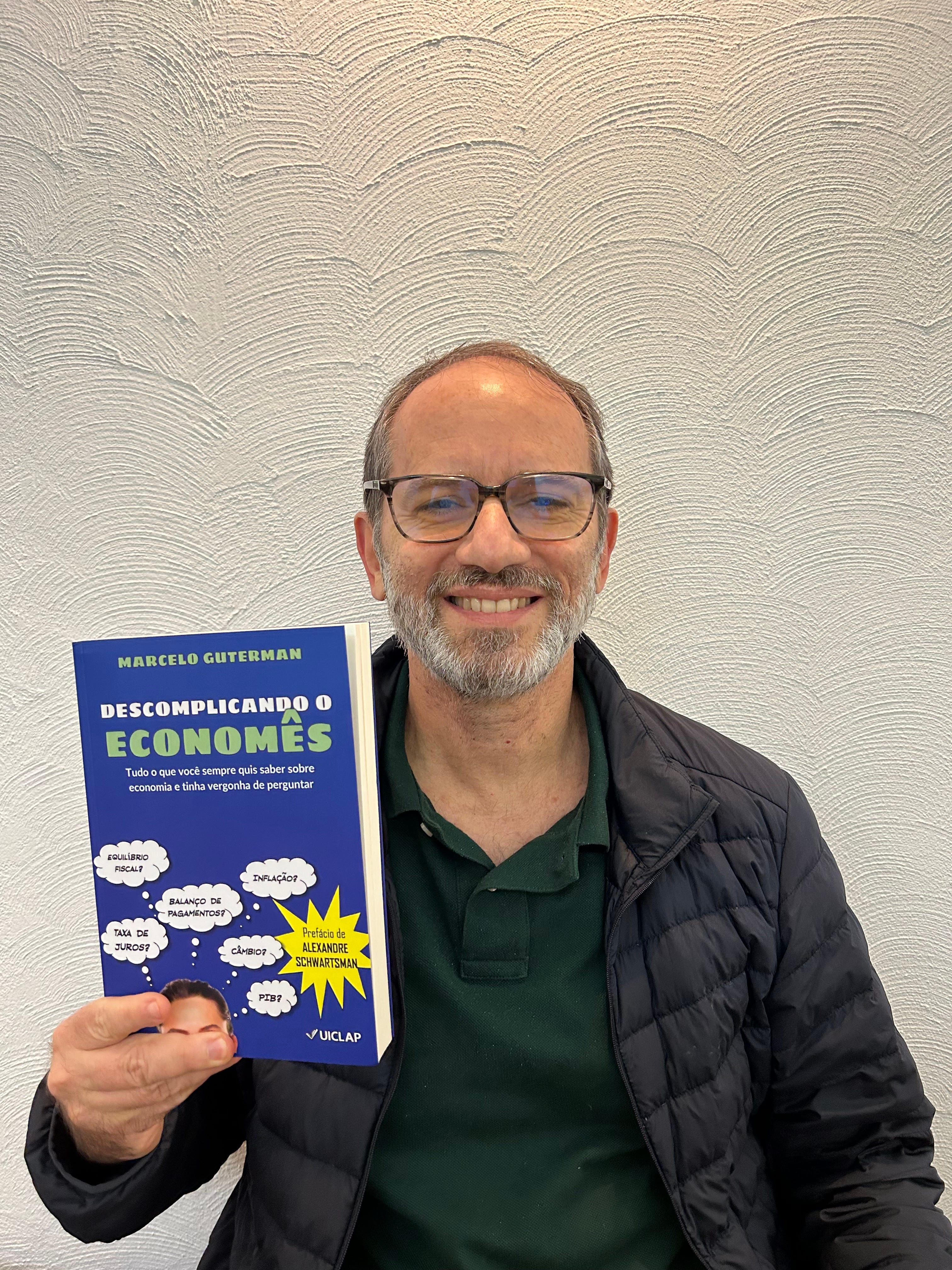
Boa notícia na educação: o país avança, como diria Galileu (eppur si muove) - Marcelo Guterman

 O copo meio cheio


É sempre mais fácil enxergar e criticar o copo meio vazio. É claro que é triste constatar que mais de 40% das crianças brasileiras de 7 anos são analfabetas funcionais, mesmo já tendo atendido a dois anos de cursos de alfabetização. Mas aqui vou preferir enxergar o copo meio cheio.

Pela primeira vez temos um indicador sério de alfabetização, e não um me-engana-que-eu-gosto. A barra do teste é alta para uma criança de 7 anos, e tem muito adulto no Brasil que não a ultrapassaria. Além disso, há meta para os Estados, de acordo com suas próprias condições, e os gestores estaduais podem, se quiserem, atrelar a remuneração dos professores a essa meta.

É incrível saber que um indicador básico como esse só foi implementado no ano passado, e esse é só o 2o ano de sua aplicação. Camilo Santana, ministro da educação, participou do esforço que colocou o Ceará no topo de todos os rankings nacionais de educação, certamente implementando ideias como essa. Trata-se de um trabalho de longo prazo, que exige foco e continuidade.

Cheguei a escrever aqui, quando Camilo Santana foi indicado para o ministério da Educação, que o grande selo de qualidade havia sido uma crítica de um professor aposentado de uma Federal qualquer, que afirmava que o Ceará “treinava os alunos para irem bem nas provas” e abria mão de uma “educação cidadã”. Concluí que estávamos no caminho certo, e este índice é uma prova disso.

Blog do Marcelo Guterman é uma publicação apoiada pelos leitores. 

Slogans para dar e vender - Marcelo Guterman e Paulo Roberto de Almeida

 Governo populistas, ou popularescos, adoram criar slogans, que por vezes são criados espontaneamente – tipo "o petróleo é nosso" – mas geralmente são ativados pela propaganda dos governos (nos tempos do Getúlio Vargas era "o pai dos pobres"; depois veio JK, com "50 anos em 5", Jânio atacou de "vassourinha" que iria "varrer a corrupção do Brasil", durou 6 meses). Até na ditadura teve o "Brasil Ame-o ou Deixe-o" nos quatro duríssimos anos do Medici.

Agora, Marcelo Guterman faz o resumo do que andou por aí desde os tempos pós-ditadura:

"Foram os governos da Nova República, com exceção do governo Collor, que começaram a incluir o slogan no próprio logotipo do governo federal, como que a traduzir a sua missão. Tivemos então os seguintes slogans:

Sarney: Tudo pelo Social
Itamar: União de Todos
FHC: Trabalhando em todo o Brasil
Lula 1 e 2: Um País de Todos
Dilma 1: País Rico é País sem Pobreza
Dilma 2: Brasil, Pátria Educadora
Temer: Ordem e Progresso
Bolsonaro: Pátria Amada, Brasil
Lula 3: União e Reconstrução "

PRA: O que virá no próximo governo? Chega de polarização?
Acho que seria pedir demais...

O assalto do alto mandarinato ao orçamento público no Brasil, com destaque para a aristocracia do Judiciário - Marcelo Guterman

Esse é o Brasil


O Brasil é um país perfeito no papel. Sua constituição, mais do que um livro de regras, é uma carta de boas intenções. Até tabelar os juros tabelamos. No entanto, a sociedade brasileira, principalmente suas elites, convivem bem com a ideia de que o que está escrito não é o que realmente vale na vida real, ideia esta incompreensível para alemães ou japoneses, por exemplo. Trata-se de um arranjo conveniente: os legisladores respondem aos anseios purificadores da sociedade e, ao mesmo tempo, sabem que aquilo que escrevem não será implementado na realidade.

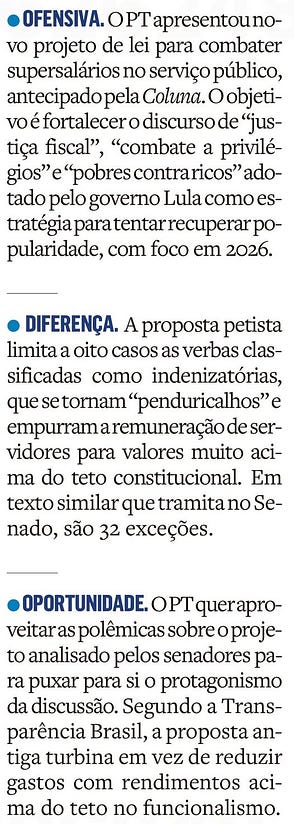
Os supersalários do serviço público encaixam-se nesse modus operandi que caracteriza a alma nacional. Já existe um teto remuneratório do funcionalismo público inscrito na Constituição. Portanto, essa questão sobre supersalários, a rigor, nem deveria estar sendo discutida. R$ 46 mil mensais são insuficientes? Então, que se aumente o teto de maneira transparente para a sociedade.

Ao invés disso, para não passar pelo desgaste junto à opinião pública, preferimos fazer puxadinhos. São vários, sendo que os penduricalhos do judiciário são apenas a ponta do iceberg. No Legislativo, aqueles que não conseguem sinecuras em estatais patrocinam rachadinhas em seus gabinetes. No Executivo, cargos em Conselhos de empresas complementam os salários, e advogados da AGU, por exemplo, participam dos honorários de sucumbência. E isso é o que vem a público, certamente há muito mais jeitinhos de complementar o salário.

Discutir se são 8, 32 ou 1.500 penduricalhos permitidos é dessas perdas de tempo a que se dedicam os nossos legisladores quando a tampa da panela de pressão da opinião pública começa a apitar. Cabe questionar, afinal, porque este novo “extra-teto” seria cumprido se o anterior, igualmente inscrito na Constituição, não o foi. Somos o país em que a regra escrita não vale de fato, mas quando exageramos na esculhambação, rasgamos as vestes e corremos a escrever uma nova regra que torna legal a esculhambação. Esse é o Brasil.

Blog do Marcelo Guterman é uma publicação apoiada pelos leitores.

Answering the Needham Question with Neuroscience - Kaiser Y Kuo (Podcasts and Essays on China)

PRA: Uma das questões mais intrigantes da história econômica mundial: por que a China, tendo liderado várias revoluções científicas e econômicas séculos atrás, não conseguiu, a partir do século XVII (momento da revolução científica na Europa), avançar decisivamente para uma economia avançada, como a Europa o fez a partir do século XVIII e depois todo o Ocidente?

Mas, ela parece já ter recuperado o atraso e disparou rapidamente na frente do Ocidente. Leiam esta postagem muito interessante:

"Podcasts and Essays on China
Answering the Needham Question with Neuroscience
Does Iain McGlichrists's work on the brain's hemispheres explain why the Scientific Revolution didn't happen first in China? A guest post by Heidi Berg
KAISER Y KUO
JUL 17, 2025

Interest in Chinese innovation and technology has returned to levels comparable to those of the pre-COVID era. New EVs, batteries, perovskite solar panels, and the “DeepSeek moment” have fueled the demand for “China Tech Tours” among Western executives. They come to experience the shiny and fancy, and to gain some understanding of how Chinese technology development differs from “The West”. They are indeed not the first to seek such insights. The Jesuit missionaries arriving in the 16th century brought new knowledge to China, but they also spent much of their time understanding local technologies. However, the one person who stands out related to this interest is Dr. Joseph Needham (1900-1995), who in 1969 phrased the question that now bears his name.¹ The so-called Needham Question, in his own words, was this: “the essential problem [is] why modern science had not developed in Chinese civilization but only in Europe.”

Medieval China was undoubtedly technologically advanced, with the Tang and Song dynasties (618-1279) particularly notable for their advancements on multiple fronts. As the organizers of the 2008 Beijing Olympics opening ceremony were eager to make clear, critically important inventions such as paper, printing, gunpowder, and the compass were developed in ancient China.

But despite all the advancements, traditional Chinese civilization never developed modern science. The Scientific Revolution took place in Europe, hundreds of years later than the highly innovative periods in China. This is the background for Needham’s central question. His work on Science and Civilization in China, a project to catalogue technologies developed in China, is still ongoing at the Needham Archive at Cambridge University 30 years after his death.

Needham’s main hypothesis for an answer is related to religion: “There was no confidence that the codes of nature could be read because there was no assurance that a divine being had formulated a code capable of being read.” Others have discussed reasons related to the geography of China, or its governance system, or its incentive structures. Albert Einstein pointed to “the lack of formal logical system (in Euclidean geometry) and the practice of scientific experiments.” In a paper form 2023, Lui Lam at San Jose University builds on Einstein in his answer: “The ancient Chinese had picked the complex system of humans to study while breakthroughs in Western modern science happened in the study of simple systems.”

I believe a new answer to the Needham question can be found through the work of Dr. Iain McGilchrist. McGilchrist is a renowned neuroscientist, now turned philosopher, who practiced psychiatry for 35 years, working at institutions such as the Bethlem Royal Hospital and Johns Hopkins University. In his book The Master and His Emissary: The Divided Brain and the Making of the Western World, he combines his deep knowledge of neuroscience with a grounding in the humanities and history to discuss the development of European cultures from the ancient Greeks to today.

The book is more than 460 pages long, and the following summary is well documented through scientific studies (there are about 100 pages of notes and academic references in the book). McGilchrist’s starting point is the fact that all animals have two distinct brain hemispheres, with the clear purpose of ensuring two very different capacities: Focusing on the thing we need to grab (e.g., the food) and paying attention to our surroundings (e.g., so that we do not become someone else’s food). The only way to let us do both simultaneously is to have one part of the brain in charge of each. Put simply, the first — narrowly focused on grabbing — is controlled by the left hemisphere, while the second — big picture, watching out for new things on the horizon— is controlled by the right. The differences can be observed in stroke patients: Those with a left hemisphere stroke (for whom only the right hemisphere works properly) often lose the ability to read letters and deal with numbers, both narrow focus tasks, while a right hemisphere stroke can make it impossible to comprehend complex concepts such as empathy and metaphors. Recent technology enables researchers to “turn off” one side of the brain, and these experiments confirm the specialized functions.

The two hemispheres work together in highly complex ways, but individuals are ordinarily “dominated” by one hemisphere’s approach to the world. A simplified example is that people with a dominant left hemisphere are typically attracted to money and structure (owning and controlling), while those with a right-hemisphere worldview are more inclined towards the arts and nature (enjoying the broad picture and being part of something). Which hemisphere is dominant is not genetically determined: both are accessible to all neurological “normal” individuals. (McGilchrist even likens it to two radio channels you can chose between).

There will be a mix of “left and right hemisphere thinkers” in every culture, but often an overweight of one dominant worldview within a group. McGilchrist discusses this by looking at European history: Starting from the ancient Greeks, he argues that there have been several notable shifts in the power-balance between the left and the right hemispheres, impacting culture and societies in Europe. In his view, the right hemisphere was dominant in early ancient Greece (hence the rich arts and culture), while the military strong and vast Roman empire correlated with a left hemisphere dominance. The Renaissance was the next period when a right hemisphere understanding of the world dominated, again leading to an extremely culturally rich period.

What is the connection between the divided brain and the Needham question? Already in the title of the book, The Master and his Emissary: The Making of the Western World, there is a hint at a difference between the “Western World” and other cultures. McGilchrist provides numerous examples of the right hemisphere's strong position in East Asian cultures. He mentions examples such as Taoism and Japanese kintsugi pottery, which he argues can only be understood by the right hemisphere: The first principle of Taoism is “The Tao that can be told is not the eternal Tao” — a contradiction the left hemisphere cannot understand. Kintsugi pottery is valued for imperfections, while the left hemisphere seeks symmetry and perfection. Further, the right hemisphere is the more pragmatic of the two. This might at first not be intuitive but relates to the “real life” perspective of the right hemisphere compared to the “in theory” approach of the left (here the famous Chinese quotes ‘crossing the river by feeling the stones’ and ‘it doesn’t matter if the cat is black or white’ come to mind).

McGilchrist takes us directly towards the Needham Question when he discusses the scientific revolution as a child of left hemisphere dominance, precisely for its affinity for theory: A reductionist approach was necessary to establish and work with the scientific and philosophical principles introduced by Newton, Descartes and others. Only the left hemisphere will approach the world as a collection of elements or a machine and try to derive concepts such as “laws of nature.” In his concluding chapter, McGilchrist references Needham’s observations to emphasize the different tendencies in Western and Eastern uses of the brain. Where East Asian cultures tend to use strategies of both hemispheres more evenly, he says, modern Western approaches are steeply skewed towards the left hemisphere. Hence, the work by McGilchrist suggests the following answer to the Needham question: ‘Chinese civilization never developed modern science because there was not a time period in China when the left hemisphere of the brain dominated thinking and society’. This answer implies that the hypotheses of Einstein, Lam, and Needham himself are in fact all valid: The right hemisphere is neither attracted to a cosmology with a one creator and “a code to be read” (Needham’s main point), nor to a structured formal logical system (Einstein’s point). Finally, the right hemisphere cares more about people and complex systems compared to the left (Lam’s hypothesis).

Is the Needham Question relevant for a Western executive on a “tech tour” to China in 2025? Scholars of history and science in China have moved beyond simplistic views of Chinese civilization and the people, as well as the narrow focus on the European scientific revolution as a point of departure. But the question is in itself a reminder of the long history of interest in the different approaches to problem solving and innovation. McGilchrist’s work offers new perspectives to what we often end up referring to as “cultural differences”. If, in fact, Western “tech tour” participants rely more on the left hemisphere in their understanding of the world, an explanation found in neuroscience should also be appealing to them. Further, the divided brain theory introduces some interesting perspectives related to AI: Simplistically said, artificial intelligence is based on a left-hemisphere worldview as it depends on algorithms (i.e. it can reference all the writings existing about the Tao, but it will never understand the eternal Tao). Maybe a culture where the right hemisphere stands stronger is better positioned to work alongside the left hemisphere-based AI? The Needham question itself does not demand a long lecture during the “tech tour.” But one might well consider adding some neuroscience to the agenda.

Heidi Berg is leading the work at the Danish Confederation of Industries’ China office related to ESG and sustainability services for Danish member companies and local partners. She has worked with projects related to sustainability and ESG over the last fifteen years, both in Europe, Africa, South Asia, and China. Her experience includes investment projects in renewable energy and sustainable agriculture, financial inclusion, the textile industry, and low-emission real estate. She is a recognized keynote speaker, educator, and discussion facilitator. She holds a master’s degree in international management with a specialization in finance.

1 Formulated in J. Needham, The Grand Titration: Science and Society in East and West, 1969

SINICA, and Adam Tooze - Podcasts and Essays on China: The Thing We Still Can’t Say KAISER Y KUO

 SINICA, and Adam Tooze

Podcasts and Essays on China
The Thing We Still Can’t Say
KAISER Y KUO

JUL 17, 2025

SHAXI, 18 July 2025 — Adam Tooze came to visit me recently here in Shaxi, the little town in Yunnan where I spent the last month. We talked over meals and drinks, went mushroom picking in the hills, he met my bandmates and listened to us rehearse, and we taped an episode of the Sinica Podcast together:

Our conversations left me uneasy — not because I disagreed with him, but because I didn’t. I kept thinking about how rarely I’ve allowed myself to say, out loud, the thing he said. The thing I’ve thought privately for years. The thing that now feels almost undeniable.

In the interview, Adam put it plainly: China isn’t just an analytical problem. It’s the defining political reality of our time. He called it the “master key” to understanding modernity. The “biggest laboratory of organized modernization that has ever been or ever will be.” A place where the industrial histories of the West now read like prefaces to something larger.

He wasn’t saying any of this for effect. These weren’t hot takes or provocations. He was articulating something many of us who’ve spent years thinking about China have felt building for a while but still shy away from naming.

After the episode came out, I noticed a Twitter thread from David Wallace-Wells — best known for his writing on the climate crisis — highlighting long excerpts from the conversation, including the remarks above. His response didn’t feel performative. It felt like recognition. The kind that comes when someone who has tried for years to shake people out of climate complacency hears another slow-moving, system-level transformation being laid bare — and sees how few are metabolizing it.

That reaction stayed with me. It forced me to ask a harder question: Why haven’t I said the thing myself? Why have I hedged, deferred, watered down the implications, stayed in safer territory — even when the evidence has been pointing in this direction for some time?

I’ve been as susceptible to the usual hesitations as anyone. Part of it is temperamental: I try to avoid stridency. I don’t want to be misunderstood or misrepresented. I know how easily even a measured take on China can be distorted. I know how quickly any recognition of its accomplishments or capabilities can be spun into charges of apologism or naïveté. So I’ve held back.

But I wonder now whether the greater risk lies in saying too little.

Because Adam’s observations weren’t really about China alone. They were about how poorly we’ve come to terms with the world as it is. And that failure extends well beyond governments, media narratives, or expert consensus. It includes people who’ve spent years thinking about these issues — myself included.

Back when Sinica was still part of The China Project, I used to include in the intro to each episode a line of boilerplate, describing our coverage as being about “a nation that is reshaping the world.” I meant it, of course. But like any phrase repeated often enough, it lost some of its force for me. And meanwhile, China kept reshaping the world — through astonishing progress in infrastructure, manufacturing, digital platforms, and, as Adam emphasized, energy.

He pointed out that roughly three-quarters of all renewable energy projects currently underway are Chinese. That about a third of global emissions come from China. And that much of the growth in both emissions and decarbonization stems from one country’s development trajectory. Those are the sorts of figures I keep at the ready, can summon in debate. But I’ve been guilty, like many, of not really letting their full meaning sink in. That’s something I need to start doing more of.

This isn’t about celebration or condemnation. It’s about scale and structure. About recognizing when rapid change adds up to a shift in paradigm.

And yet most of the people I know — friends, colleagues, former classmates, fellow travelers in the China space — still speak about China with caution, or in some cases, with reflexive dismissal or deliberate deflatus. Yes, they’ll concede the infrastructure, the tech adoption, the industrial muscle. But something in the framing always pulls back. There’s always a “but.”

And it’s not only Western observers. Even some of my more patriotic and optimistic Chinese friends — people who take pride in the country’s accomplishments and see its system as resilient — seem unprepared to reckon with the full implications of what Adam laid out in the conversation. The idea that China is no longer just catching up, but redefining the arc of development itself, is hard to absorb — especially for those conditioned to see the West as a permanent reference point, even when viewed critically.

I don’t mean to sound holier-than-thou. I’ve been conditioned, like many, to temper big claims, to second-guess myself. Most of us came of age professionally during a time when certain assumptions were still foundational: that China was rising, yes, but still playing catch-up. That its system would hit structural limits. That liberal democratic capitalism, though battered, still set the normative horizon.

Letting go of those assumptions isn’t easy — not just intellectually, but emotionally. For some, it means rethinking the frameworks they’ve built careers on. For others, it means facing the prospect of a world in which liberal institutions are no longer the default engine of transformation. That’s a hard thing to sit with.

And maybe this isn’t just about ideas or career positioning. Maybe it’s something closer to denial. A reluctance to accept the implications of a world that no longer orbits the same cultural or institutional center.

We’ve seen this kind of reaction before. Climate change offers a familiar pattern: the science has been robust for decades, yet serious recognition came slowly, hesitantly, often wrapped in equivocation. It’s often not the facts we struggle with, but the scale of their implication.

With China, I sense a similar dissonance. We see the numbers, the breakthroughs, the pace, the policy coordination. And we reach for caveats: internal contradictions, looming crises, moral failings that will surely derail the trajectory. Some of that may be true. But it can also serve as a way to avoid admitting something harder — that the center of gravity has already shifted, and we haven’t yet found the language to reckon with it.

I don’t have a neat conclusion. Only a growing sense that clearer language is long overdue. Not to valorize or excuse, but to describe. To acknowledge the transformation underway. To stop waiting for someone else to say it first.

Adam Tooze said the thing. I’m trying to say it now too.

You’re currently a free subscriber to Sinica. Please support the work that I’m doing and upgrade to paid. 非常感谢!


==========

Here is the Podcast mentioned above:


I'm in Shaxi, a wonderful little town in the Dali Bai Autonomous Prefecture, and I was joined here by the Columbia economic historian Adam Tooze, who shared his thoughts on what he sees happening on the ground in China. Adam's been in China for the last month and reflects on his experiences learning about the country — and even attempting the language!

03:49 - The economic situation in China

10:42 - Patterns of consumption in China

14:38 - China’s industrial policy and renewable energy

18:52 - China vs. the U.S. on renewables

26:15 - China’s economic engagement with the Global South

33:13- Beijing’s strategic shift and Europe’s rethinking

37:49- The recent European Parliament paper

42:43 - Learning about China as an “Outsider”

51:31 - Adam’s evolving views on China

59:30 - Paying it Forward

01:01:07 - Recommendations

Paying it ForwardKyle ChanPekingology.

Recommendations: Adam: Caught by the Tide, Jia Zhangke (movie).

Kaiser: Empire of AI: Dreams and Nightmares in Sam Altman’s OpenAI, Karen Hao (book), Vera, or Faith, Gary Shteyngart (book).

O Brasil e o seu grande desafio, a partir de uma releitura de H. G. Wells - Paulo Roberto de Almeida (Portal Interesse Nacional)

 Meu segundo artigo no portal Interesse Nacional, um dos muitos empreendimentos do embaixador Rubens Barbosa, no qual eu vejo elementos dos anos 1930 na presente atualidade, a partir de um livro do escritor britânico H. G. Wells, de 1935, traduzido e publicado por Monteiro Lobato, em 1940, sob o titulo de “História do Futuro”. Esse futuro chegou, mas ele é preocupante. Leiam:

O Brasil e o seu grande desafio, a partir de uma releitura de H. G. Wells

Paulo Roberto de Almeida
Portal Interesse Nacional, 28/07/2025
        O escritor britânico H. G. Wells, o sucessor de Jules Verne na ficção científica, ficou famoso na passagem do século XX por ter publicado romances distopicamente provocadores: A Máquina do Tempo (1895), O Homem Invisível (1897) e A Guerra dos Mundos (1898), este o mais assustador, usado anos depois por Orson Welles numa famosa emissão […]
Cartaz do filme The Shape of Things to Come, inspirado na obra de H. G. Wells

        O escritor britânico H. G. Wells, o sucessor de Jules Verne na ficção científica, ficou famoso na passagem do século XX por ter publicado romances distopicamente provocadores: A Máquina do Tempo (1895), O Homem Invisível (1897) e A Guerra dos Mundos (1898), este o mais assustador, usado anos depois por Orson Welles numa famosa emissão radiofônica que despertou o pânico nos ouvintes americanos.         Ele continuou enveredando por predições ainda mais desafiantes, como o advento de um Estado Mundial e até a probabilidade de uma guerra nuclear. Em 1933, ele publicou um livro futurista de feitura menos fantástica, ainda que também relativamente pessimista, pois que combinando eventos do seu tempo, como o fascismo e o comunismo, com projeções para o século XXI: The Shape of Things to Come, que Monteiro Lobato traduziu e publicou sob o título de História do Futuro (1940).
        As duas primeiras partes já indicavam um futuro pouco otimista: “Hoje e Amanhã: prenúncios do desapontamento” – tratando da Grande Guerra, da indústria de armas e da “interrupção do progresso” –, seguida de “Depois de Amanhã: a era do desapontamento”, falando da “falência dos velhos governos”, do “marasmo da velha educação”, de “ódio e crueldade” e até da “liquidação da América”. As três partes finais já eram resolutamente pessimistas: “Nascimento do Estado moderno” (profetas, fanáticos e assassinos); “O Estado moderno militante” (interlúdio dramático) e “O Estado moderno no controle da vida” (com “manejamento geogônico). Naquela altura, não se pode dizer que Wells tenha inventado coisas tão fantásticas quanto seus primeiros romances, uma vez que o mundo e os Estados pareciam realmente se encaminhar para uma nova confrontação global, ainda mais terrível que aquela que tinha ocorrido na Europa entre 1914 e 1918.
        ‘Pode-se dizer que passamos largamente dos “prenúncios de desapontamento” e já enfrentamos a “era do desapontamento”, em face de um cenário geopolítico que jornalistas e observadores acadêmicos não hesitam em chamar de “segunda Guerra Fria”’
        Relendo agora, mais de 90 anos depois, alguns dos 52 capítulos distribuídos por suas cinco partes, já na perspectiva dos desenvolvimentos com os quais nos defrontamos na atualidade, pode-se dizer, sem qualquer hesitação, que passamos largamente dos “prenúncios de desapontamento” e já enfrentamos a “era do desapontamento”, em face de um cenário geopolítico que jornalistas e observadores acadêmicos não hesitam em chamar de “segunda Guerra Fria”.
        Em 1931 o Japão já tinha invadido a Manchúria, prenunciando o ataque a toda a China seis anos depois; quando o livro teve a sua primeira edição, Hitler já tinha conquistado o poder na República de Weimar e iniciado o rearmamento alemão; numa segunda edição, Mussolini já tinha ordenado a invasão da Abissínia (Etiópia) e uma terceira foi contemporânea da guerra civil espanhola.
        Na edição de 1935, ele relatava com desalento o fracasso da conferência financeira e monetária de Londres de 1934, quando Franklin Roosevelt decepcionou o mundo inteiro, recusando-se a aceitar as recomendações da Liga das Nações para um esforço multilateral de estabilização cambial, tendo, ao contrário, promovido uma desvalorização do dólar superior a 40%: a moeda foi de 20 a 35 dólares por onça de ouro, e assim ficou até Bretton Woods, em 1944, de fato até 1971.
        A Liga já tinha fracassado na conferência monetária de Gênova, em 1922, destinada a restabelecer o padrão ouro; também falhou espetacularmente na conferência comercial de Genebra, em 1927, voltada para fazer retroceder o protecionismo tarifário; o insucesso da conferência de Londres, em 1934, reforçou e “estabilizou” a depressão, ao estimular novas desvalorizações agressivas.
        ‘Já não se tratava de um simples “desapontamento” com o estado do mundo, mas de um mundo em que Estados agressivamente expansionistas ensaiavam a conquista de novos territórios’

        Já não se tratava de um simples “desapontamento” com o estado do mundo, mas de um mundo em que Estados agressivamente expansionistas ensaiavam a conquista de novos territórios, na Europa, na África e na Ásia. As três potências fascistas e militaristas – Alemanha, Itália e Japão – aceleraram os testes de novas armas e, sobretudo, a “novidade” de bombardeios aéreos sobre cidades, uma das previsões feitas por H. G. Wells desde seus primeiros artigos na Grande Guerra, quando relatou o uso dos pequenos aviões para finalidades devastadoras. Americanos e ingleses acabaram fazendo igual, ao extremo.
        O cenário atual já ultrapassou a fase de “desapontamento” dos anos 1930 e ingressou no cenário de “ódio e crueldade” de que falava Wells: a invasão da Crimeia, em 2014, seguida da cruel guerra de agressão contra a Ucrânia, em fevereiro de 2022, revelaram um mix de Hitler e Stalin, com o que foram rompidas não só as velhas intenções da Liga das Nações, como todos os novos valores e princípios das Nações Unidas.
        ‘Não há nada mais parecido com os anos 1930 do que o atual panorama de derrocada do sistema mundial de comércio, de fragmentação do multilateralismo político, de competição agressiva entre moedas e, sobretudo, de afirmação do direito da força em lugar da força do direito’
        Com efeito, não há nada mais parecido com os anos 1930 do que o atual panorama de derrocada do sistema mundial de comércio, de fragmentação do multilateralismo político, de competição agressiva entre moedas e, sobretudo, de afirmação do direito da força em lugar da força do direito.
        O “Estado Moderno Militante”, no dizer de Wells, aspirava ser um Estado no “controle da vida”, fechando a última parte do seu livro. O futuro distópico que ele sugeria, nessa parte conclusiva, tinha uma única virtude: “a revolução do Estado Moderno fora primacialmente educativa, e só secundariamente política” (p. 321). Essa curiosa afirmação de Wells talvez seja a chave explicativa da única grande estratégia que caberia ao Brasil adotar para libertá-lo, decisivamente, dos “desapontamentos” do seu passado para colocá-lo no compasso do segundo capítulo da obra, “Como a Ideia e a Esperança do Estado Moderno apareceram” (p. 5-13), do qual retiro uma única frase ilustrativa do imenso desafio que ainda se coloca ao Brasil: “unicamente quando os chineses desenvolveram a manufatura barata de folhas de papel é que o livro se tornou possível – e consequentemente, a sua influência na expansão do conhecimento” (p. 7).
        Pode-se dizer que os chineses inventaram tudo o que aconteceu de moderno e útil para a humanidade nos albores da era moderna; depois, a letargia do Império do Meio em se abrir às revoluções educacionais do Ocidente, a partir dos livros, fez com que ele perdesse a primeira, a segunda e até a terceira revolução industrial, com a nação já imersa na revolução “cultural” demencial do maoísmo militante. Mas, os mandarins educados e atentos ao que o Ocidente produziu nesse intervalo, recompuseram rapidamente as forças produtivas da nação, ao passo que a energia do povo chinês nos avanços educacionais produziu as maravilhas da quarta e da quinta revoluções industriais no gigante asiático, colocando-o na vanguarda tecnológica do mundo.
        ‘O Brasil tem na China o seu primeiro parceiro comercial, mas ainda não seguiu a China na única grande virtude que ela teve durante toda a sua história secular: implementar um “modo inventivo de produção”, com base numa educação de alta qualidade para o seu povo’

        O Brasil tem na China o seu primeiro parceiro comercial, suplantando os três outros imediatamente seguintes (e possivelmente também o será nos investimentos tecnológicos), mas ainda não seguiu a China na única grande virtude que ela teve durante toda a sua história secular: implementar um “modo inventivo de produção”, com base numa educação de alta qualidade para o seu povo, explorando suas vantagens comparativas e competitivas, aquelas existentes e, justamente, as adquiridas por meio da educação.
        Eugênio Gudin repetia, dos anos 1930 aos 60, que cabia ao Brasil explorar suas vantagens comparativas, situadas na agricultura, mas que caberia empreender um gigantesco esforço educacional para construir produtividade em todos os setores da economia, além de manter sólidas políticas macro e setoriais. Os chineses aprenderam as lições de Adam Smith; os brasileiros poderiam seguir as recomendações dos dois êmulos de Adam Smith no Brasil: Cairu e Eugênio Gudin.

Paulo Roberto de Almeida é diplomata de carreira, doutor em ciências sociais pela Université Libre de Bruxelles, mestre em Planejamento Econômico pela Universidade de Antuérpia, licenciado em ciências sociais pela Université Libre de Bruxelles, 1975). Atua como professor de economia política no Programa de Pós-Graduação em direito do Centro Universitário de Brasília (Uniceub). É editor adjunto da Revista Brasileira de Política Internacional. Site: www.pralmeida.org; blog: http://diplomatizzando.blogspot.com