Mostrando postagens com marcador Economic Freeedom of the World. Mostrar todas as postagens
Mostrando postagens com marcador Economic Freeedom of the World. Mostrar todas as postagens
segunda-feira, 2 de outubro de 2017


quarta-feira, 15 de dezembro de 2010
Liberdade economica no mundo: relatorios de think tanks...
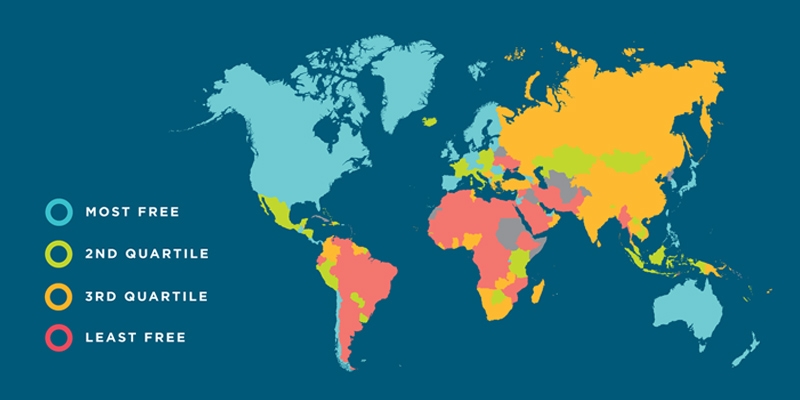
O mundo hoje é um lugar muito mais livre do que no passado, mas mesmo algumas "democracias" são especialmente "socialistas" quando se fala de direitos de propriedade e ambiente para o sistema produtivo.
Aqui alguns relatórios que podem ajudar a medir o grau de liberdade no mundo.
Por eles se fica sabendo, por exemplo, que a China, que está longe, muito longe, de ser um Estado democrático, é um país mais "livre" do que o Brasil, pelo menos economicamente.
1. "Index of Economic Freedom World Rankings" da The Heritage Foundation:
http://www.heritage.org/index/ranking.aspx
2. "Economic Freedom of the World: 2010 Annual Report" do The Cato Institute:
http://www.cato.org/pubs/efw/
3. "Economic Freedom of the World: 2010 Annual Report" do Fraser Institute
http://www.freetheworld.com/release.html
Divirtam-se, mas não fiquem muito frustrados. O Brasil é assim mesmo...
Aqui alguns relatórios que podem ajudar a medir o grau de liberdade no mundo.
Por eles se fica sabendo, por exemplo, que a China, que está longe, muito longe, de ser um Estado democrático, é um país mais "livre" do que o Brasil, pelo menos economicamente.
1. "Index of Economic Freedom World Rankings" da The Heritage Foundation:
http://www.heritage.org/index/ranking.aspx
2. "Economic Freedom of the World: 2010 Annual Report" do The Cato Institute:
http://www.cato.org/pubs/efw/
3. "Economic Freedom of the World: 2010 Annual Report" do Fraser Institute
http://www.freetheworld.com/release.html
Divirtam-se, mas não fiquem muito frustrados. O Brasil é assim mesmo...
sexta-feira, 24 de setembro de 2010
Liberdade economica no mundo em recuo...
Economic Freedom Suffers Global Setback
Brief presentation:
The Economic Freedom of the World: 2010 Annual Report, released this week, revealed the very first regression in economic freedom since the inception of the index:
This year's report notes that economic freedom suffered its first setback in decades. The average economic freedom score rose from 5.55 (out of 10) in 1980 to 6.70 in 2007, but fell back to 6.67 in 2008, the most recent year for which data are available. Of the 123 countries with chain-linked ratings in 2007 and 2008, 88 exhibited rating decreases and only 35 recorded rating increases. In this year's index, Hong Kong retains the highest rating for economic freedom, 9.05 out of 10, followed by Singapore, New Zealand, Switzerland, Chile, the United States, Canada, Australia, Mauritius, and the United Kingdom.
Individual chapters are available for download for free in PDF format at our website, where you can also find an interactive map and PDF versions of previous editions.
Overall presentation:
Economic Freedom of the World: 2010 Annual Report
By James Gwartney, Joshua Hall, and Robert Lawson and contributions from Christopher J. Coyne, John W. Dawson, Horst Feldmann, John Levendis, Russell L. Stobel, and Edward Peter Stringham This year's report notes that economic freedom suffered its first setback in decades. The average economic freedom score rose from 5.55 (out of 10) in 1980 to 6.70 in 2007, but fell back to 6.67 in 2008, the most recent year for which data are available. Of the 123 countries with chain-linked ratings in 2007 and 2008, 88 exhibited rating decreases and only 35 recorded rating increases. In this year’s index, Hong Kong retains the highest rating for economic freedom, 9.05 out of 10, followed by Singapore, New Zealand, Switzerland, Chile, the United States, Canada, Australia, Mauritius, and the United Kingdom.
This year's report also contains new research showing the impact of economic freedom on unemployment rates and homicides. According to Horst Feldmann, more economic freedom appears to reduce joblessness, and the magnitude of the effect seems to be substantial, especially among young people. Edward Peter Stringham and John Levendis examine the effect of economic freedom on rates of homicide in Venezuela, Colombia, South Africa, Latvia, and Lithuania. The results suggest that increases in economic freedom lead to decreases in homicides.
The first Economic Freedom of the World Report, published in 1996, was the result of a decade of research by a team which included several Nobel Laureates and over 60 other leading scholars in a broad range of fields, from economics to political science, and from law to philosophy. This is the 14th edition of Economic Freedom of the World and this year's publication ranks 141 nations for 2008, the most recent year for which data are available.
Contents:
Table of Contents [pdf, 36.6Kb]
Executive Summary [pdf, 93.5Kb]
Chapter 1 [pdf, 588Kb]
Chapter 2, Country Data Tables [pdf, 954Kb]
Chapter 3 [pdf, 234Kb]
Chapter 4 [pdf, 472Kb]
Chapter 5 [pdf, 345Kb]
Chapter 6 [pdf, 337Kb]
Appendix [pdf, 196Kb]
Acknowledgments [pdf, 61.8Kb]
Brief presentation:
The Economic Freedom of the World: 2010 Annual Report, released this week, revealed the very first regression in economic freedom since the inception of the index:
This year's report notes that economic freedom suffered its first setback in decades. The average economic freedom score rose from 5.55 (out of 10) in 1980 to 6.70 in 2007, but fell back to 6.67 in 2008, the most recent year for which data are available. Of the 123 countries with chain-linked ratings in 2007 and 2008, 88 exhibited rating decreases and only 35 recorded rating increases. In this year's index, Hong Kong retains the highest rating for economic freedom, 9.05 out of 10, followed by Singapore, New Zealand, Switzerland, Chile, the United States, Canada, Australia, Mauritius, and the United Kingdom.
Individual chapters are available for download for free in PDF format at our website, where you can also find an interactive map and PDF versions of previous editions.
Overall presentation:
Economic Freedom of the World: 2010 Annual Report
By James Gwartney, Joshua Hall, and Robert Lawson and contributions from Christopher J. Coyne, John W. Dawson, Horst Feldmann, John Levendis, Russell L. Stobel, and Edward Peter Stringham This year's report notes that economic freedom suffered its first setback in decades. The average economic freedom score rose from 5.55 (out of 10) in 1980 to 6.70 in 2007, but fell back to 6.67 in 2008, the most recent year for which data are available. Of the 123 countries with chain-linked ratings in 2007 and 2008, 88 exhibited rating decreases and only 35 recorded rating increases. In this year’s index, Hong Kong retains the highest rating for economic freedom, 9.05 out of 10, followed by Singapore, New Zealand, Switzerland, Chile, the United States, Canada, Australia, Mauritius, and the United Kingdom.
This year's report also contains new research showing the impact of economic freedom on unemployment rates and homicides. According to Horst Feldmann, more economic freedom appears to reduce joblessness, and the magnitude of the effect seems to be substantial, especially among young people. Edward Peter Stringham and John Levendis examine the effect of economic freedom on rates of homicide in Venezuela, Colombia, South Africa, Latvia, and Lithuania. The results suggest that increases in economic freedom lead to decreases in homicides.
The first Economic Freedom of the World Report, published in 1996, was the result of a decade of research by a team which included several Nobel Laureates and over 60 other leading scholars in a broad range of fields, from economics to political science, and from law to philosophy. This is the 14th edition of Economic Freedom of the World and this year's publication ranks 141 nations for 2008, the most recent year for which data are available.
Contents:
Table of Contents [pdf, 36.6Kb]
Executive Summary [pdf, 93.5Kb]
Chapter 1 [pdf, 588Kb]
Chapter 2, Country Data Tables [pdf, 954Kb]
Chapter 3 [pdf, 234Kb]
Chapter 4 [pdf, 472Kb]
Chapter 5 [pdf, 345Kb]
Chapter 6 [pdf, 337Kb]
Appendix [pdf, 196Kb]
Acknowledgments [pdf, 61.8Kb]
Assinar:
Postagens (Atom)
-
Minha entrevista desta sexta-feira 25/02/2022, sobre a dramática situação da Ucrânia no canal +BrasilNews. 1437. “ Entrevista sobre a Ucrân...
-
FAQ do Candidato a Diplomata por Renato Domith Godinho TEMAS: Concurso do Instituto Rio Branco, Itamaraty, Carreira Diplomática, MRE, Diplom...
-
Carreira Diplomática: respondendo a um questionário Paulo Roberto de Almeida ( www.pralmeida.org ) Respostas a questões colocadas por gradua...
-
Uma preparação de longo curso e uma vida nômade Paulo Roberto de Almeida A carreira diplomática tem atraído número crescente de jovens, em ...
-
Um horror perpetrado por um Estado aliado da atual diplomacia lulopetista não é um horror: apenas casos a serem desprezados e ignorados. Cr...
-
Lula e Flavio Bolsonaro na TV Globo, quinta e sexta feira, 27 e 28/08/2026 === No primeiro debate eleitoral de 2026 entre os candidatos à ...
-
Nota preliminar ulterior (se isso não é contradição, não sei o que é): Coloquei aqui uma aparente matéria de -- digo aparente pois foi dessa...
-
Tá explicado! O texto é de 2009, e se refere a matéria ainda mais antiga, mas certas coisas moldam o caráter, não é mesmo? Paulo Roberto de ...
-
Aprimorar o parlamento O maior ganho sistêmico que o Brasil precisa INTELIGÊNCIA DEMOCRÁTICA AGO 15 LEIA NO APP Valdir Santos, Intelig...
-
 Autocracy Inc. de Anne Applebaum Inteligência Democrática , 4/08/2024 Reproduzimos abaixo, numa tradução automática do ChatGPT4, a intr...


