O que é este blog?

Este blog trata basicamente de ideias, se possível inteligentes, para pessoas inteligentes. Ele também se ocupa de ideias aplicadas à política, em especial à política econômica. Ele constitui uma tentativa de manter um pensamento crítico e independente sobre livros, sobre questões culturais em geral, focando numa discussão bem informada sobre temas de relações internacionais e de política externa do Brasil. Meus livros podem ser vistos nas páginas da Amazon. Outras opiniões rápidas podem ser encontradas no Facebook ou no Threads. Grande parte de meus ensaios e artigos, inclusive livros inteiros, estão disponíveis em Academia.edu: https://unb.academia.edu/PauloRobertodeAlmeida

Site pessoal: www.pralmeida.net.
Mostrando postagens com marcador The Atlantic. Mostrar todas as postagens

terça-feira, 20 de maio de 2025

NINGUÉM NA UCRÂNIA ACREDITA QUE A GUERRA VAI TERMINAR EM BREVE - Anne Applebaum (The Atlantic)

NINGUÉM NA UCRÂNIA ACREDITA QUE A GUERRA VAI TERMINAR EM BREVE

Os ucranianos estão confiantes de que podem continuar lutando, mesmo sem o mesmo nível de apoio americano.

Por Anne Applebaum

The Atlantic, 19 de maio de 2025

No sábado, perguntei a Andriy Sadovyi, prefeito de Lviv, no oeste da Ucrânia, se ele esperava que as negociações russo-ucranianas em Istambul levassem a um cessar-fogo. “Não”, ele me respondeu. Mais tarde, perguntei à plateia do Fórum de Mídia de Lviv se alguém esperava um cessar-fogo em breve. Havia cerca de 200 jornalistas e editores na sala. Ninguém levantou a mão. Muitos riram.

Durante vários dias em Lviv, não conheci uma única pessoa que acreditasse que o presidente russo quer encerrar a guerra, ou que ele vá negociar para isso em Istambul. O raciocínio ucraniano é direto: Vladimir Putin nunca disse que quer encerrar a guerra. Os propagandistas da televisão estatal russa nunca disseram que querem encerrar a guerra. A equipe de negociação russa em Istambul não disse que queria encerrar a guerra. Pelo contrário, o chefe da delegação russa, Vladimir Medinsky, disse aos ucranianos: “Lutamos contra a Suécia por 21 anos. Quanto tempo vocês estão dispostos a lutar?” (A Grande Guerra do Norte, à qual Medinsky se referia, terminou em 1721. Além disso, Medinsky é mais conhecido não por feitos heroicos em batalhas, mas por reescrever livros escolares).

Na mesma reunião, os russos exigiram que a Ucrânia se retirasse de terras que controla; ameaçaram anexar mais províncias — algo que tentam e falham em fazer há três anos; e insultaram um membro da delegação ucraniana que perdeu um sobrinho nos combates. “Talvez alguns aqui sentados à mesa percam mais entes queridos”, zombou Medinsky.

Os ucranianos não acham nada disso surpreendente, pois ouvem esse tipo de discurso há três anos. O que os surpreende é a tolerância do presidente americano diante do que lhes parece uma zombaria aberta. O presidente Donald Trump diz que quer uma negociação de paz. O presidente ucraniano Volodymyr Zelensky preparou-se para uma negociação de paz. O presidente russo a transformou em uma farsa — e provavelmente continuará com essa farsa, enrolando Trump o máximo possível, aceitando mais telefonemas e reuniões para evitar novas sanções, desviar a atenção dos crimes de guerra em curso e fazer os EUA parecerem fracos.

Não vou aqui oferecer uma explicação completa sobre por que Trump não entende o jogo que Putin está jogando — um jogo óbvio para todos os demais. Apenas observo que Trump continuamente interpreta mal Putin, superestima sua suposta amizade com ele e frequentemente atribui a Putin motivos que, na verdade, são seus próprios. “Putin está cansado de tudo isso”, disse Trump à Fox News. “Ele não está com boa aparência. E quer parecer bem.” Na realidade, é Trump quem está cansado “de tudo isso”, é Trump quem não está com boa aparência — e é Trump quem quer parecer bem.

Putin, por sua vez, redirecionou toda sua economia para a produção militar, ao estilo da União Soviética ou da Alemanha nazista. Criou um regime tão repressivo que as pessoas têm medo até de usar a palavra “guerra” em público. Sacrifica regularmente centenas ou até milhares de homens para conquistar 100 metros de território. O que os outros pensam disso pouco lhe importa.

Por todas essas razões, os ucranianos acreditam que a guerra vai continuar — e essa perspectiva já não os assusta. Em parte, porque não têm outra escolha. Ao contrário dos russos, que podem abandonar o campo de batalha e voltar para casa a qualquer momento, os ucranianos não podem se retirar. Se o fizerem, perderão sua civilização, sua língua e sua liberdade. Sob ocupação russa, o prefeito de Lviv e os jornalistas do Fórum de Mídia estariam presos ou mortos — assim como seus colegas assassinados ou presos nas regiões ocupadas da Ucrânia.

Mais do que isso, os ucranianos estão confiantes de que podem continuar lutando, mesmo sem o mesmo nível de apoio americano. O exército ucraniano não está reconquistando território, como fez no outono de 2022, nem planeja uma nova grande contraofensiva. Mas também não está perdendo. Os tanques e equipamentos pesados que a Ucrânia precisava de outros países já não importam tanto como há dois anos. Os ucranianos ainda precisam da inteligência americana e das defesas antimísseis para proteger civis nas cidades. Ainda recebem armas e munição da Europa. Mas na linha de frente, o conflito se tornou uma guerra de drones — e a Ucrânia tanto produz drones (mais de 2 milhões no ano passado, provavelmente o dobro neste ano) quanto desenvolve o software e os sistemas para operá-los. Em fevereiro, uma unidade ucraniana implantou o primeiro de uma série de robôs de combate. No mês passado, um drone naval ucraniano derrubou um avião russo. Uma brigada projetou um drone que consegue neutralizar com eficácia um Shahed, os drones iranianos usados para matar civis ucranianos.

Os russos também aumentaram sua produção de drones, e nesse sentido, esta guerra é realmente uma corrida armamentista. Mas, por ora, os ucranianos estão compensando seus recursos mais escassos com maior precisão. Em abril, brigadas de drones ucranianas relataram ter atingido 83 mil alvos russos — veículos, pessoas, artilharia, radares e outros —, o que representa 5% a mais do que em março. O exército agora realiza concursos, premiando as brigadas que atingem mais alvos com maior precisão. Mais recursos vão para os vencedores, criando mais incentivos para inovar.

Os resultados são visíveis no terreno. Lembre-se, se puder, do pânico causado pelas notícias de nove meses atrás: a cidade de Pokrovsk estava prestes a cair, o que muitos acreditavam que poderia provocar o colapso de toda a linha de frente. Mas Pokrovsk não caiu. Os russos continuam a atacar a região: só em 15 de maio, soldados ucranianos na linha de frente de Pokrovsk repeliram 74 ataques e ações ofensivas diferentes. Mas, nos últimos meses, a linha de frente mal se moveu.

Tudo isso ajuda a explicar a naturalidade, até o humor, com que muitos ucranianos agora falam sobre a guerra — bem como sua suposição de que continuarão lutando, aconteça o que acontecer. Enquanto estava em Lviv, visitei também o Superhumans, um dos dois centros de reabilitação para veteranos e vítimas da guerra na cidade. Tal como a linha de frente, este também é um lugar de inovação e ambição. Talvez soe estranho, mas também achei um lugar de otimismo e esperança: uma instalação nova, bem projetada, onde técnicos produzem próteses sob medida, cirurgiões restauram audição e visão, e especialistas em movimento e psicologia ajudam pessoas gravemente feridas a se readaptar.

O restante da sociedade ucraniana também se readaptou. Até os guardas de fronteira se readaptaram. Três anos atrás, na primavera de 2022, a viagem de trem de Varsóvia a Kyiv era longa e estressante. O trem parava e arrancava, fazendo um trajeto em zigue-zague para evitar trilhos bombardeados. Oficiais da alfândega falavam de forma seca e tensa, fazendo perguntas sobre passaportes e propósito. Na volta, voluntários aguardavam para ajudar a processar refugiados ucranianos, alguns entrando nos vagões para distribuir sanduíches.

Na semana passada, cruzei novamente a fronteira polaco-ucraniana duas vezes, desta vez de carro. Na entrada na Ucrânia, esperamos alguns minutos para que os guardas verificassem os passaportes e seus computadores. Eles contaram piadas, sorriram e nos deixaram passar. Ninguém foi seco ou tenso, porque ninguém está ansioso ou com medo. Na volta, não havia refugiados nem voluntários. Ninguém ofereceu sanduíches.

quinta-feira, 9 de maio de 2024

A máquina de propaganda mentirosa das autocracias - Anne Applebaum (The Atlantic)

 Trecho de seu artigo na The Atlantic deste mês, "The Propaganda War":

“In 2013, as Chinese President Xi Jinping was beginning his rise to power, an internal Chinese memo, known enigmatically as Document No. 9—or, more formally, as the Communiqué on the Current State of the Ideological Sphere—listed “seven perils” faced by the Chinese Communist Party. “Western constitutional democracy” led the list, followed by “universal human rights,” “media independence,” “judicial independence,” and “civic participation.” The document concluded that “Western forces hostile to China,” together with dissidents inside the country, “are still constantly infiltrating the ideological sphere,” and instructed party leaders to push back against these ideas wherever they found them, especially online, inside China and around the world.

(…)

This is the core problem for autocracies: The Russians, the Chinese, the Iranians, and others all know that the language of transparency, accountability, justice, and democracy appeals to some of their citizens, as it does to many people who live in dictatorships. Even the most sophisticated surveillance can’t wholly suppress it. The very ideas of democracy and freedom must be discredited—especially in the places where they have historically flourished.“

(...)

The Atlantic, may 8, 2024

quarta-feira, 8 de novembro de 2023

The Secretive Industry Devouring the U.S. Economy - Rogé Karma (The Atlantic)

The Secretive Industry Devouring the U.S. Economy

Private equity has made one-fifth of the market effectively invisible to investors, the media, and regulators.

By Rogé Karma 

The Atlantic, November 8, 2023

https://www.theatlantic.com/ideas/archive/2023/10/private-equity-publicly-traded-companies/675788/?utm_source=apple_new

The publicly traded company is disappearing. In 1996, about 8,000 firms were listed in the U.S. stock market. Since then, the national economy has grown by nearly $20 trillion. The population has increased by 70 million people. And yet, today, the number of American public companies stands at fewer than 4,000. How can that be?

One answer is that the private-equity industry is devouring them. When a private-equity fund buys a publicly traded company, it takes the company private—hence the name. (If the company has not yet gone public, the acquisition keeps that from happening.) This gives the fund total control, which in theory allows it to find ways to boost profits so that it can sell the company for a big payday a few years later. In practice, going private can have more troubling consequences. The thing about public companies is that they’re, well, public. By law, they have to disclose information about their finances, operations, business risks, and legal liabilities. Taking a company private exempts it from those requirements.

That may not have been such a big deal when private equity was a niche industry. Today, however, it’s anything but. In 2000, private-equity firms managed about 4 percent of total U.S. corporate equity. By 2021, that number was closer to 20 percent. In other words, private equity has been growing nearly five times faster than the U.S. economy as a whole.

Elisabeth de Fontenay, a law professor at Duke University who studies corporate finance, told me that if current trends continue, “we could end up with a completely opaque economy.”

This should alarm you even if you’ve never bought a stock in your life. One-fifth of the market has been made effectively invisible to investors, the media, and regulators. Information as basic as who actually owns a company, how it makes its money, or whether it is profitable is “disappearing indefinitely into private equity darkness,” as the Harvard Law professor John Coates writes in his book The Problem of Twelve. This is not a recipe for corporate responsibility or economic stability. A private economy is one in which companies can more easily get away with wrongdoing and an economic crisis can take everyone by surprise. And to a startling degree, a private economy is what we already have.

(...)

(...)

In the roaring ’20s, the lack of corporate disclosure allowed a massive financial crisis to build up without anyone noticing. A century later, the growth of a new shadow economy could pose similar risks.

The hallmark of a private-equity deal is the so-called leveraged buyout. Funds take on massive amounts of debt to buy companies, with the goal of reselling in a few years at a profit. If all of that debt becomes hard to pay back—because of, say, an economic downturn or rising interest rates—a wave of defaults could ripple through the financial system. In fact, this has happened before: The original leveraged buyout mania of the 1980s helped spark the 1989 stock-market crash. Since then, private equity has grown into a $12 trillion industry and has begun raising much of its money from unregulated, nonbank lenders, many of which are owned by the same private-equity funds taking out loans in the first place.


terça-feira, 8 de novembro de 2022

Fear of Nuclear War Has Warped the West’s Ukraine Strategy - Anne Applebaum (The Atlantic)


Fear of Nuclear War Has Warped the West’s Ukraine Strategy

Leaders shouldn’t give in to Putin’s nuclear rhetoric.

Most of the time, when heads of state talk about nuclear war, they speak in careful, measured tones, acknowledging the gravity of the nuclear taboo and the consequences of breaking it. The Russian president takes a different approach. Speaking at his annual foreign-policy conference a few years ago, Vladimir Putin reflected, without smiling, on the consequences of a nuclear war. “We will go to heaven as martyrs,” he said, “and they will just drop dead.”

At the same conference last month, a regime insider, Fyodor Lukyanov, asked him about this remark: “You said that we would all go to heaven, but we’re in no hurry to get there, right?” Putin did not answer. The seconds ticked by. Lukyanov said, “You’ve stopped to think. That’s disconcerting.” Putin responded, “I did it on purpose to make you worry a little.”

I did it on purpose to make you worry a little? Why does he want anyone to worry? Because fear is not just a feeling or an ephemeral emotion; it is a physical sensation. It can grip your stomach, freeze your limbs, make your heart beat faster. Fear can distort the way you think and act. Because it can be so paralyzing, human beings have always tried to make other human beings feel fear. If you can make your enemies afraid, they will not oppose you, because they cannot oppose you. You can then win the argument, the battle, or the war without ever having to fight.


Putin is a KGB officer who knows about the manipulation of emotions, fear most of all. For two decades, he has sought to evoke fear inside Russia. Unlike his Soviet predecessors, he doesn’t shoot or arrest millions of people. Instead, he uses targeted violence, specially designed to create fear. When the investigative reporter Anna Politkovskaya was gunned downin her Moscow stairwell, and when the businessman Mikhail Khodorkovsky was sent to prison for a decade, other journalists and other businessmen got the message. When the opposition politicians Boris Nemtsov and Alexei Navalny were murdered and poisoned, respectively, those incidents sent a message too. This isn’t mass terror, but it is just as effective. Fear keeps Putin in power by rendering people too frightened to report news, protest government actions, or conduct independent business or even independent activity of any kind.


Putin also seeks to create fear in the outside world, especially the democratic world. He does this, above all, by bantering about nuclear weapons, at conferences and everywhere else. Indeed, this has been a central subject of his public commentary, and of Russian propaganda more broadly, for many years. Pictures of mushroom clouds appear regularly on the evening news. Threats of nuclear strikes against Ukraine have been made repeatedly, as far back as 2014. Russia’s armed forces practice nuclear strikes as a routine part of military exercises. Back in 2009, they played out a war game that included dropping a nuclear bomb on Poland. This constant, repetitive nuclear signaling, which long predates the current war, has a purpose: to make NATO countries afraid to defend Poland, afraid to defend Ukraine, and afraid to provoke or anger Russia in any way at all.

In the past few weeks, Putin and those who echo Putin have been seeking to pump up fear once again. Russian television journalists now regularly allude to nuclear war in the same half-serious, half-sinister tone, coolly referring to World War III as “realistic” and saying “It is what it is,” because “we’re all going to die someday.” The Russian defense minister, Sergei Shoigu, has called his American, British, and French counterparts to accuse the Ukrainians of preparing a nuclear attack despite the fact that they don’t have nuclear weapons—immediately triggering the suspicion that he is planning one himself. Russian nuclear threats are now habitually echoed and amplified by proxies as disparate as the British politician Jeremy Corbyn and the tech billionaire Elon Musk, growing louder with each Ukrainian military victory. Unsurprisingly, the anxiety created by these repeated threats has already shaped American and European policy toward Ukraine, exactly as it was supposed to do.


Fear certainly explains why we in the West have given Ukraine some weapons but not others. Why no airplanes?  Why no advanced tanks? Because the White House, the German government, and other governments are afraid that one of these weapons would cross an invisible red line and inspire a nuclear retaliation by Russia. Fear also shapes tactics. Why don’t the Ukrainians more often target the military bases or infrastructure on Russian territory that are being used to attack them? Because Ukraine’s Western partners have asked its leaders not to do so, for fear, again, of escalation.

Fear also causes us to treat nonnuclear acts of mass violence and terror as if they are less important, less frightening, less deserving of a response. Right now, Russia is targeting Ukrainian utilities, openly seeking to deprive millions of Ukrainians of electricity and water. This policy could lead to mass evacuations, even mass death, maybe even on the same scale as a tactical nuclear weapon. The Ukrainians have accused the Russians of preparing to dynamite a dam that, if burst, would flood Kherson and other settlements. If a small terrorist or extremist group were even hinting at a similarly devastating blow, people in the West would already be arguing about how to force them to stop. But because this is Russia, and because these are just conventional weapons, we don’t think in terms of retaliation or response. We feel relieved, somehow, that people will die because they have frozen in unheated apartments or drowned in an artificial flood, and not from nuclear fallout.


Yet even as we feel this fear, even as we act on this fear, even as we let this fear shape our perceptions of the war, we still have no idea whether our anxious responses are effective. We don’t know whether our refusal to transfer sophisticated tanks to Ukraine is preventing nuclear war. We don’t know whether loaning an F-16 would lead to Armageddon. We don’t know whether holding back the longest-range ammunition is stopping Putin from dropping a tactical nuclear weapon or any other kind of weapon.


On the contrary, some of these decisions may have had precisely the opposite impact. Our self-imposed limitations may well have encouraged Putin to believe that American support for Ukraine is limited and will soon end. Our insistence that Ukraine not harm Russia or Russians in its own defense might explain why he keeps fighting. Perhaps our nuclear anxiety actually encourages him to carry out nonnuclear mass atrocities; he does so because he believes he will not face any consequences, because we will not escalate.

Given the growing popularity of the word restraint, we must consider how that concept might not only prolong the war but lead to a nuclear catastrophe. What if calls for peace actually reinforce Putin’s deep belief, one he has expressed many times, that the West is weak and degenerate? Before the war, Western shipments of weapons to Ukraine were limited because of similar fears. No one wanted to provoke Russia by offering the Ukrainians anything too sophisticated. In retrospect, this caution was disastrous. It meant that Putin thought the West would not come to Ukraine’s aid; it left Ukraine less prepared than it could have been. Had we armed Ukraine, we might have prevented the many tragedies that have unfolded on occupied territory. Had we helped make Ukraine into a difficult target, the invasion might never have taken place at all.

I can’t prove this to be true, of course, because no one can. We can’t consult a rule book, published military doctrine, or any other document to explain these issues, because Russia has no institutions governing the use of nuclear weapons, indeed no institutions that can check or balance the president. In a one-man dictatorship, the decision whether to use nuclear weapons lies in that one man’s head. Because no one else lives inside that head, no one else knows what would really provoke him or where his red lines really are.

The only guide we have is the past, and given Putin’s behavior in the past, we should at least consider the possibility that by arming Ukraine, by supporting Ukraine, we will also prevent the use of nuclear weapons in Ukraine. Notwithstanding his bravado about martyrdom, if Putin genuinely believes that a Russian nuclear attack will carry “catastrophic consequences,” to use National Security Adviser Jake Sullivan’s language, then he is much less likely to carry one out. The less fear we show, the more Putin himself will be afraid.

The Ukrainians are already ahead of us. One Ukrainian friend recently told me that she is having the windows on her house changed to make them more airtight—just in case. But she isn’t moving. She has learned not to let fear deform her decisions, and we should learn the same. Here is the only thing we know: As long as Putin believes that the use of nuclear weapons won’t win the war—as long as he believes that to do so would call down an unprecedented international and Western response, perhaps including the destruction of his navy, of his communications system, of his economic model—then he won’t use them.

He has to believe that a nuclear strike would be the beginning of the end of his regime. And we have to believe it too.

Anne Applebaum is a staff writer of The Atlantic.


sábado, 1 de outubro de 2022

Putin’s Newest Annexation Is Dire for Russia Too - Anne Applebaum (The Atlantic)

 O mais poderoso indiciamento do tirano de Moscou por sua contravenção direta à ordem internacional e pelos crimes de guerra, contra a paz e contra a humanidade perpetrados em sua guerra de agressão contra a Ucrânia.

Putin’s Newest Annexation Is Dire for Russia Too

His baldly illegitimate claim to four Ukrainian provinces shows contempt for the global order—and his own subjects.

segunda-feira, 12 de setembro de 2022

It’s Time to Prepare for a Ukrainian Victory - Anne Applebaum (The Atlantic)

Uma vitória ucraniana significa uma derrota de Putin. Mas é cedo ainda para prever sua queda como tirano  de Moscou, o neoczar russo. Não existem forças ou candidatos a essa sucessão, com exceção do líder de oposição Alexis Navalny, que se encontra em prisão.

Paulo Roberto de Almeida 

It’s Time to Prepare for a Ukrainian Victory

The liberation of Russian-occupied territory might bring down Vladimir Putin.

terça-feira, 15 de fevereiro de 2022

Why the West’s Diplomacy With Russia Keeps Failing - Anne Applebaum (The Atlantic)

 Putin trouxe a Europa de volta a 1938-39, como Hitler, pois ele pensa que a OTAN vai fazer como Hitler em junho de 1941, e tudo isso porque ele não é um czar normal, mas um autocrata desvairado, como o próprio Hitler e também Stalin. Infelizmente, o "Ocidente" – um conceito dotado de escasso significado no terreno econômico, mas que ainda tem certo peso no terreno político e dos valores – não vai fazer o que sugere Anne Appebaum em seu artigo: confrontar os autocratas russos e expor sua prepotência, suas mentiras, sua lavagem de dinheiro no Ocidente, suas tentações totalitárias. Nem mesmo Bolsonaro vai fazer qualquer coisa a esse respeito: está muito satisfeito de ter sido recebido pelo autocrata, mesmo confinado em seu hotel até o momento. A Rússia é um Terceiro Reich em projeto, mas não vai conseguir, embora tenha recebido agora o respaldo do grande Império do Meio, que ainda vai colonizar a Rússia economicamente.

Paulo Roberto de Almeida

Why the West’s Diplomacy With Russia Keeps Failing

American and European leaders’ profound lack of imagination has brought the world to the brink of war.

About the author: Anne Applebaum is a staff writer at The Atlantic, a fellow at the SNF Agora Institute at Johns Hopkins University, and the author of Twilight of Democracy: The Seductive Lure of Authoritarianism.


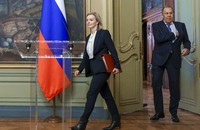
Oh, how I envy Liz Truss her opportunity! Oh, how I regret her utter failure to make use of it! For those who have never heard of her, Truss is the lightweight British foreign secretary who went to Moscow this week to tell her Russian counterpart, Sergey Lavrov, that his country should not invade Ukraine. This trip was not a success. At a glacial press conference he likened their conversation to “the mute” speaking with “the deaf”; later, he leaked the fact that she had confused some Russian regions with Ukrainian regions, to add a little insult to the general injury.

Lavrov has done this many times before. He was vile to the European Union’s foreign-policy chief, Josep Borrell, last year. He has been unpleasant at international conferences and rude to journalists. His behavior is not an accident. Lavrov, like Russian President Vladimir Putin, uses aggression and sarcasm as tools to demonstrate his scorn for his interlocutor, to frame negotiations as useless even before they begin, to create dread and apathy. The point is to put other diplomats on the defensive, or else to cause them to give up in disgust.

But the fact that Lavrov is disrespectful and disagreeable is old news. So is the fact that Putin lectures foreign leaders for hours and hours on his personal and political grievances. He did that the first time he met President Barack Obama, more than a decade ago; he did exactly the same thing last week to French President Emmanuel Macron. Truss should have known all of this. Instead of offering empty language about rules and values, she could have started the press conference like this:

Good evening, ladies and gentlemen of the press. I am delighted to join you after meeting my Russian counterpart, Sergey Lavrov. This time, we have not bothered to discuss treaties he won’t respect and promises he won’t keep. We have told him, instead, that an invasion of Ukraine will carry very, very high costs—higher than he has ever imagined. We are now planning to cut off Russian gas exports completely—Europe will find its energy supplies somewhere else. We are now preparing to assist the Ukrainian resistance, for a decade if need be. We are quadrupling our support for the Russian opposition, and for Russian media too. We want to make sure that Russians will start hearing the truth about this invasion, and as loudly as possible. And if you want to do regime change in Ukraine, we’ll get to work on regime change in Russia. 

Truss, or Borrell before her, could have added just a touch of personal insult, in the style of Lavrov himself, and wondered out loud just how it is that Lavrov’s official salary pays for the lavish properties that his family makes use of in London. She could have listed the names of the many other Russian public servants who send their children to schools in Paris or Lugano. She could have announced that these children are now, all of them, on their way home, along with their parents: No more American School in Switzerland! No more pied-à-terres in Knightsbridge! No more Mediterranean yachts!

Of course Truss—like Borrell, like Macron, like the German chancellor who is headed for Moscow this week—would never say anything like this, not even in private. Tragically, the Western leaders and diplomats who are right now trying to stave off a Russian invasion of Ukraine still think they live in a world where rules matter, where diplomatic protocol is useful, where polite speech is valued. All of them think that when they go to Russia, they are talking to people whose minds can be changed by argument or debate. They think the Russian elite cares about things like its “reputation.” It does not.

In fact, when talking to the new breed of autocrats, whether in Russia, China, Venezuela, or Iran, we are now dealing with something very different: people who aren’t interested in treaties and documents, people who only respect hard power. Russia is in violation of the Budapest Memorandum, signed in 1994, guaranteeing Ukrainian security. Do you ever hear Putin talk about that? Of course not. He isn’t concerned about his untrustworthy reputation either: Lying keeps opponents on their toes. Nor does Lavrov mind if he is hated, because hatred gives him an aura of power.

Their intentions are different from ours too. Putin’s goal is not a flourishing, peaceful, prosperous Russia, but a Russia where he remains in charge. Lavrov’s goal is to maintain his position in the murky world of the Russian elite and, of course, to keep his money. What we mean by “interests” and what they mean by “interests” are not the same. When they listen to our diplomats, they don’t hear anything that really threatens their position, their power, their personal fortunes.

Despite all of our talk, no one has ever seriously tried to end, rather than simply limit, Russian money laundering in the West, or Russian political or financial influence in the West. No one has taken seriously the idea that Germans should now make themselves independent of Russian gas, or that France should ban political parties that accept Russian money, or that the U.K. and the U.S. should stop Russian oligarchs from buying property in London or Miami. No one has suggested that the proper response to Putin’s information war on our political system would be an information war on his.

Now we are on the brink of what could be a catastrophic conflict. American, British, and European embassies in Ukraine are evacuating; citizens have been warned to leave. But this terrible moment represents not just a failure of diplomacy; it also reflects a failure of the Western imagination, a generation-long refusal, on the part of diplomats, politicians, journalists, and intellectuals, to understand what kind of state Russia was becoming and to prepare accordingly. We have refused to see the representatives of this state for what they are. We have refused to speak to them in a way that might have mattered. Now it might be too late.

Anne Applebaum is a staff writer at The Atlantic, a fellow at the SNF Agora Institute at Johns Hopkins University, and the author of Twilight of Democracy: The Seductive Lure of Authoritarianism.