Temas de relações internacionais, de política externa e de diplomacia brasileira, com ênfase em políticas econômicas, viagens, livros e cultura em geral. Um quilombo de resistência intelectual em defesa da racionalidade, da inteligência e das liberdades democráticas. Ver também minha página: www.pralmeida.net (em construção).
Russia’s Deputy Foreign Minister recently stated that, in order to achieve peace, NATO must “withdraw” from the Baltic states. Many found this shocking—but the demand is not new.
As early as the 1990s, when it became clear that newly independent states from the former Warsaw Pact and the Soviet Union might join NATO, the Alliance sought to assuage Russian concerns by signing the NATO-Russia Founding Act in 1997. The document aimed to mitigate Russian objections to NATO’s enlargement.
One of its key political commitments was that NATO would refrain from deploying “substantial” permanent combat forces in the territory of new member states. In return, the Act reaffirmed core international principles, including respect for sovereignty, territorial integrity, and the UN Charter.
Russia has since repeatedly violated these very principles - most notably with its full-scale invasion of Ukraine in 2022.
🧵2/4
Just prior to that invasion, Russia issued a list of demands to Ukraine and the West. Its central demand to NATO: a rollback to the Alliance’s 1997 borders - effectively requiring the withdrawal of NATO forces and infrastructure from all countries that joined after that year.
While NATO declared the Founding Act “dead” in political terms following the invasion, it never formally repudiated or denounced it. So de jure, the document still stands. And one could argue it remains de facto in force as well, since there are still no substantial (i.e., larger than brigade-level) permanent NATO deployments in Eastern Europe. U.S. forces in Poland remain on a rotational basis, and the forthcoming German brigade, even if permanently stationed in Lithuania, is still presented as a non-substantial force, within agreed limits.
Eastern flank members have repeatedly called for the Act to be formally declared null and void, arguing that it creates a two-tiered NATO in which where some countries are less defended than others. Their calls have met stiff resistance from certain allies, and the Act still remains.
🧵3/4
Why is the dead agreement not being binned? Maybe because some Western policymakers still believe that maintaining the optics of restraint might help by avoiding escalation. The extension of the de-escalation doctrine seems to be that if NATO avoids provoking Russia, Moscow might be persuaded to limit its aggression to Ukraine and refrain from challenging NATO directly.
But Russia’s actions—and its own public declarations—show this conflict is not just about Ukraine. It is a broader imperial project aimed at resurrecting Russia’s sphere of influence and undermining the West. Moscow has said this explicitly and repeatedly - yet the West still acts surprised. And whenever the West gives ground - Russia just takes it and asks for more, calling it "justified grievances". And it will just continue like that until Russia is stopped.
During the Cold War, NATO stationed 400,000 troops along the border with the Warsaw Pact. Such numbers were considered essential to credible deterrence. Today, we cannot expect to deter Russia effectively while self-imposing limitations - especially when Moscow imposes none on itself.
🧵4/4
The only viable strategy toward Russia is one of deterrence and defense—not appeasement based on obsolete agreements. Germany’s intelligence chief has again warned that Russia may soon test NATO’s resolve—with some little green men.
That warning must be followed not with business as usual or slow deliberation, but with fast and decisive action that strengthens deterrence—not five or ten years from now, but immediately.
The NATO - Russia Founding act was a naive idea to begin with. Keeping it on life-support now is a dangerous choice, allowing Russia to push the narrative that the West is violating all the agreements it signed, not Russia. Russia’s demand that NATO must return to its 1997 borders is implying that the West has in some way violated the agreement of 1997, which it has not.
And by allowing this agreement to continue existing de jure we are giving this narrative credibility and life.
The NATO - Russia Founding act should be declared null and void. NATO defence should have never been two-tier and Vilnius should be defended as defiantly as Berlin or London.
NATO: next meeting in Washington, for its 75th year
Foreign Policy
The best of times and the worst of times: In many ways, NATO is going through both right now. The trans-Atlantic defense alliance, which is preparing to celebrate its 75th anniversary at a summit in Washington next month, has strengthened its collective will following Russian President Vladimir Putin’s invasion of Ukraine. It has welcomed new members Sweden and Finland. And arecord numberof member states, more than 20 in all, will this year meet the alliance’s 2 percent defense spending goal—up from just three countries a decade ago, when the targets were first put in place.
Yet NATO also faces challenges, some existential in nature. For a long time the alliance has struggled with not enough troops, and as FP’s Jack Detsch reported, the problem is only getting worse. “NATO basically forgot about its military,” one senior NATO diplomat told Detsch, who also talked to the chair of NATO’s Military Committee about urgent plans to ramp up capacity. (Russia, Detsch noted, is having no such troubles in its ongoing war in Ukraine.)
Meanwhile, leadership of the alliance is about to change. In October of this year, current Secretary-General Jens Stoltenberg will be succeeded by outgoing Dutch Prime Minister Mark Rutte. FP doesn’t often take on personalities in our analysis of geopolitics, but afascinating profile of Rutte by FP columnist Caroline de Gruyter exemplifies how the personal can reveal the political. In surveying many of those who know Rutte best, de Gruyter paints a portrait of the next “sec-gen”: the kind of guy who has been staying in the same no-frills Chinatown hotel on New York trips for the last 30 years, and who on every visit dines with legendary journalist Robert Caro at the same restaurant, will likely run a tight, disciplined ship at NATO. “Probably the most important thing to know about Rutte,” de Gruyter writes, “is that he is a very controlled person.”
Today, NATO Secretary General @jensstoltenberg and I discussed in detail the situation on the battlefield in Ukraine, our capabilities, and the capabilities of our partners to support our soldiers.
The Russian army is now trying to take advantage of the situation while we are waiting for deliveries from our partners, and first of all, from the United States. Therefore, rapid delivery literally means frontline stabilization.
155-mm artillery, long-range weapons, and air defense systems, first and foremost “Patriots”. This is what our partners posses, and this is what should be working now in Ukraine to destroy Russia’s terrorist ambitions. The Russian army is preparing for further offensive actions. Together, we must thwart these plans. Our partners have all the necessary tools for this.
Ukrainian President Volodymyr Zelensky enjoyed a reception akin to that of a Roman conqueror during his brief but packed visit to Washington. He made a pitch for more aid with a carefully crafted speech that touched multiple American emotions. Congress responded by approving another $45 billion in aid—more than most NATO countries spend on their militaries in a year or, in some cases, in a decade.
The Wall Street Journal, which has never covered a war that it did not favor, lauded Capitol Hill’s response, arguing: “The U.S. would be far worse off today if Putin had conquered Ukraine.” That’s true, but incomplete. It would have been much better had the U.S. not helped set the stage for the terrible war now raging between Ukraine and Russia. And it would be so much better if the U.S. and Russia don’t end up lobbing nuclear weapons at each other before the current conflict ends.
Where to start with the “what ifs?”
The U.S. would be far better off today had successive administrations lived up to the promises made to both Mikhail Gorbachev and Boris Yeltsin that NATO would not expand forever eastward.Although much obviously went into Putin’s decision to attack Ukraine, there is no evidence that he is a Hitler wannabe bent on world conquest, or even on reassembling the Soviet Union. Adolf Hitler hit the zenith of his conquests within a decade; Putin’s territorial acquisitions after two decades in power were Crimea and influence over a handful of statelets: Abkhazia, South Ossetia, and separatist states in the Donbas. He is no friend of liberty or democracy, but compare Putin’s conciliatory 2001 speech to Germany’s Bundestag with his accusatory tone at the Munich Security Dialogue in 2007. Much changed in his attitude toward the West, without which February’s action is highly unlikely, if not inconceivable.
The U.S. would be far better off today had Washington used the collapse of the Soviet Union as an opportunity to transfer responsibility to Europe for its own defense.With the Russian military retreating eastward even as it rapidly deteriorated, the allies could have safely adjusted to defense adulthood. Moscow’s nationalists would have had difficulty claiming a threat from the West, while the allies would have had a strong incentive to construct a new security order that included Russia. America’s remaining role would have been much smaller, allowing more serious military retrenchment.
The U.S. could have begun the complex process of becoming a “normal” country again, shifting military responsibilities in Asia and the Middle East as well. There would have been no arrogant and reckless unipolar moment – with the invasion of Iraq, intervention in Libya, and decades of conflict in Afghanistan – during which thousands of American and allied troops died and tens of thousands were wounded, while hundreds of thousands of civilians were killed and millions were displaced. More money would have been invested in the U.S. economy and gone to meet Americans’ needs. They would have been most proud of what they were doing at home, rather than about their government’s dubious activities abroad.
The U.S. would be far better off today had it not promised NATO membership to Georgia and Ukraine.President George W. Bush – the leader responsible for the disastrous Iraq War, perhaps America’s worst foreign policy mistake of the last 60 years – heedlessly challenged Moscow’s red lines. His officials were aware of the risks of antagonizing Russia. Fiona Hill, made famous by her recent stint with the Trump administration, warned the Bush administration that bringing Kyiv toward NATO “would likely provoke pre-emptive Russian military action.” Having foolishly turned Russia hostile, Washington still had a chance to back away. Had Georgia’s Mikheil Saakashvili not appeared to be a U.S. lackey in 2008, and had NATO not spent six more years promising membership to Kyiv and Tbilisi, Moscow might have exhibited more military forbearance in 2014.
The U.S. would have been far better off today had it exhibited strategic empathy then, and considered how its support for the forcible overthrow of an elected government friendly to Russia in Ukraine would be received by Moscow. Imagine China establishing the South Pacific Treaty Organization in Latin America, promoting a street putsch against the elected, pro-American government in Mexico, sending officials to Mexico City to express their preferences for the new president and Cabinet, and inviting the new administration to join the alliance, with Chinese troop deployments expected to follow. The response of U.S. policymakers would have been pure hysteria. They would have made no pretense of accepting the democratic decision of the Mexican people to exercise their right to join the international organizations of their choice.
Had the U.S. informally treated Russia’s sphere of influence like America’s Monroe Doctrine, Ukraine might have come through what was the latest of many political crises with its territory intact. Had the allies also not previously put NATO membership forward for Kyiv, it almost certainly would have avoided Moscow’s wrath. That would have meant no seizure of Crimea, no intervention in the Donbas, and no full-scale invasion eight years later.
The U.S. would have been far better off today had it taken seriously Putin’s demands. There was still time for Washington to negotiate, admitting what it claimed to be obvious – that Ukraine would not enter NATO any time soon, and probably never – since in reality neither Washington nor its European allies wanted to fight for Kyiv.
Alas, Moscow had no confidence in any informal quasi-assurances. As noted earlier, the allies had shamelessly broken a gaggle of earlier promises to successive governments. Moreover, the reassurances for Ukraine (and Georgia) never stopped coming. When Defense Secretary Lloyd Austin went to both countries in late 2021, the Pentagon ostentatiously publicized its plan to reassure them that NATO was, of course, continuing to enthusiastically await their entrance.
Putin was not the sucker the allies seemed to assume. Although in February 2022 his demands went much further than NATO expansion, granting his most serious, longstanding condition would have demonstrated the value of diplomacy and encouraged continued negotiation. This would have tipped the balance in the Kremlin against a decision for war – a decision that intelligence reports indicate remained in doubt until the end.
In short, there were many crucial points at which different U.S. and allied decisions likely would have left Europe at peace. That would have been better for America, Europe, and especially Ukraine. The latter is bearing the brunt of the cost of the war. The price of the West’s many mistakes is terrible, as described in Foreign Affairs:
“[A] grinding war of attrition has already been hugely damaging for Ukraine and the West, as well as for Russia. Over six million Ukrainians have been forced to flee, the Ukrainian economy is in freefall, and the widespread destruction of the country’s energy infrastructure threatens a humanitarian catastrophe this winter. Even now, Kyiv is on financial life support, maintaining its operations only through billions of dollars of aid from the United States and Europe. The costs of energy in Europe have risen dramatically because of the disruption of usual oil and gas flows. Meanwhile, despite significant setbacks, Russian forces have regrouped and have not collapsed.”
Vladimir Putin bears responsibility for initiating hostilities and the horrors that have resulted. However, blame for this conflict is widely shared. Western officials cannot escape their role in making war likely, and perhaps even inevitable. Allied governments, especially Washington, should learn from their mistakes.
We should not have to suffer such catastrophic consequences from such an avoidable conflict again.
A 19FortyFive Contributing Editor, Doug Bandow is a Senior Fellow at the Cato Institute. A former Special Assistant to President Ronald Reagan, he is the author of Foreign Follies: America’s New Global Empire.
Não está claro quais são as obrigações que decorrem da atual situação do País, convidado para ser parceiro estratégico do tratado.
Rubens Barbosa, O Estado de S.Paulo
26 de julho de 2022 | 03h00
Por inspiração dos EUA, a Organização do Tratado do Atlântico Norte (Otan) foi criada em 1949 como parte de uma rede de defesa do Ocidente, no início da guerra fria com a URSS. Em 1955, surgiu o Pacto de Varsóvia, que, comandado pela URSS para se contrapor à Otan, foi extinto com o fim da União Soviética. Ao longo de sete décadas a Otan atravessou várias fases e implementou diversos conceitos estratégicos, passando de uma aliança militar dissuasória, destinada à defesa coletiva territorial, para um instrumento político-militar, voltado para a defesa dos interesses dos países-membros além de seus limites originais. A expansão da Otan nos anos recentes – ao contrário das conversações mantidas pelo secretário de Estado James Baker e pelo primeiro-ministro Helmut Kohl, da Alemanha, com Mikhail Gorbachev em 1991, quando do desaparecimento da URSS – coloca desafios para todos os países, agravados a partir da guerra da Rússia contra a Ucrânia.
A inclusão de novos membros a partir de 1997, a intervenção na Iugoslávia em 1999, a inclusão da Suécia e da Finlândia e a redefinição de sua estratégia em junho de 2022 evidenciam a expansão dos limites de atuação da Otan e a ampliação de seus interesses, vistos como ameaçados, o que já vem acarretando um aumento das despesas militares de todos os países-membros e a mudança da política de Defesa da Alemanha, depois de quase 70 anos.
Cabe mencionar algumas decisões tomadas pela Otan que afetam ou podem afetar interesses brasileiros, a começar pela diretriz estratégica de 2010, seguida de decisões recentes tomadas na reunião de alto nível de Madri, em junho de 2022.
Na definição do Conceito Estratégico da Otan em 2010, o Atlântico Sul não foi incluído como área geoestratégica prioritária, o que não exclui totalmente a possibilidade da atuação da organização “onde possível e quando necessário”, caso os interesses dos membros sejam ameaçados. Portugal, nessa discussão, apoiou a Iniciativa da Bacia do Atlântico, que previa a unificação dos oceanos, com a incorporação dos assuntos do Atlântico Sul no escopo estratégico da organização. O Brasil sempre deixou clara sua reserva no tocante às iniciativas que incluam também a Bacia Atlântica e, via de consequência, o Atlântico Sul, como área de atuação da Otan. O sul do Atlântico é área geoestratégica de interesse vital para o Brasil. A Política Nacional de Defesa menciona o Atlântico Sul como uma das áreas prioritárias para a defesa nacional e amplia o horizonte estratégico para incluir a parte oriental do Atlântico Sul, mais a África Ocidental e Meridional.
Na reunião de cúpula em Madri, em junho passado, os países-membros, na maior revisão estratégica dos últimos 30 anos, redefiniram a estratégia da Otan e declararam a Rússia como sendo a ameaça mais direta e significativa à paz e à segurança. E incluíram a China como um desafio aos interesses de seus membros, além de terem dado prioridade a novas questões, como a de mudança de clima. A redução das emissões de gás de efeito estufa passou a ser um objetivo que estará presente em todas as tarefas essenciais da Otan, por meio de suas estruturas políticas e militares.
A inclusão da China como um desafio justificou o convite, pela primeira vez na História, do Japão, da Coreia do Sul, da Austrália e da Nova Zelândia para participar do encontro e assinar dois acordos sobre defesa cibernética e segurança marítima. A esse importante desenvolvimento junte-se o pacto estratégico entre os EUA, Reino Unido e Austrália para a aquisição de submarinos, inclusive nucleares, e o acordo entre os EUA, Índia, Emirados Árabes Unidos e Israel (I2U2) para mostrar presença no Mar do Sul da China e na defesa de Taiwan. Na prática, com esse novo conceito estratégico, a Otan ampliou ainda mais sua expansão e retomou a doutrina da guerra fria, que, para muitos setores dos EUA e da Europa, nunca havia desaparecido.
A nova guerra fria, agora contra a China e a Rússia, poderá levar a uma nova divisão do mundo entre o Ocidente e a Eurásia.
Qual a repercussão deste novo quadro geopolítico para o Brasil? Nos últimos anos, o Brasil vem sendo associado à Otan, com a designação, pelo presidente Donald Trump no início do atual governo brasileiro, como um aliado prioritário dos EUA extra-Otan, e, posteriormente, convidado para ser parceiro estratégico do tratado, podendo ter acesso aos seus equipamentos militares de forma preferencial e tornar o País elegível para maiores oportunidades de intercâmbio, assistência militar, treinamentos conjuntos e participação em projetos.
Não está claro quais são as obrigações que decorrem dessa situação nem se houve entendimentos posteriores do governo brasileiro com as autoridades da Otan. Não há informação sobre se a nova política de segurança em relação à mudança de clima voltará sua atenção também para a Amazônia, nem se a Otan reagirá em relação ao transporte de combustível no Atlântico Sul para o submarino nuclear brasileiro em exame na Agência Internacional de Energia Atômica. Fica a questão, ainda, se a Otan ou os EUA (na próxima visita do secretário de Defesa ao Brasil) vão reagir ao anunciado exercício naval de Rússia, China e Irã na América Latina e no Caribe, com base na Venezuela, em agosto.
*
PRESIDENTE DO IRICE, É MEMBRO DA ACADEMIA PAULISTA DE LETRAS
Cúpula da Otan marca aumento do efetivo militar no Leste Europeu e mudança de tom com Rússia
Número de soldados vai de 40 mil para mais de 300 mil, e Moscou vira 'ameaça direta', diz secretário-geral
Folha de S. Paulo, 27.jun.2022
A cúpula da Otan, a ser realizada em Madri, na Espanha, a partir desta terça (28) até quinta-feira (30), deve assinalar uma espécie de refundação da aliança militar ocidental diante do prolongamento da Guerra da Ucrânia e marcar o endurecimento do tom com o qual a Rússia é tratada pelos países membros do grupo.
"Esta cúpula será um ponto de virada, e várias decisões importantes serão tomadas", afirmou o secretário-geral do clube militar, Jens Stoltenberg, em entrevista coletiva em Bruxelas nesta segunda (27).
O número de soldados de prontidão na parte leste da Europa, disse ele, passará dos atuais 40 mil para mais de 300 mil, num contexto em que a invasão da Ucrânia se encaminha para o quinto mês, um conflito que assinala o momento de maior tensão bélica no continente desde a Segunda Guerra Mundial.
O efetivo será espalhado por Lituânia, Estônia, Letônia, Polônia, Romênia, Hungria, Eslováquia e Bulgária. Militares na Alemanha também ficarão de prontidão, na maior revisão da defesa coletiva da aliança desde a Guerra Fria. O encontro também deve mudar a linguagem com a qual a Otan trata Moscou —pela redação atual, consagrada na cúpula de Lisboa, em 2010, a Rússia é descrita como parceiro estratégico.
"Espero que os aliados afirmem claramente que a Rússia representa uma ameaça direta à nossa segurança, aos nossos valores e à ordem internacional baseada em regras", afirmou o secretário.
"A Rússia abandonou a parceria e o diálogo que a Otan tenta estabelecer há muitos anos. Escolheram o confronto em vez do diálogo. Lamentamos isso —mas é claro que precisamos responder a essa realidade."
A cúpula ocorre num momento crucial para o grupo, após desavenças internas geradas pelo ex-presidente dos EUA Donald Trump, que ameaçou retirar Washington do clube. Mas a invasão russa da Ucrânia, no final de fevereiro, desencadeou uma mudança geopolítica, levando dois países antes neutros, Finlândia e Suécia, a pedirem a adesão à Otan, e à Ucrânia, a iniciar o processo para virar membro da União Europeia.
Os líderes da aliança também intensificarão o apoio a Kiev —o presidente Volodimir Zelenski participará do encontro por meio de videoconferência. Segundo Stoltenberg, a Otan fornecerá armas pesadas ao país e quer ajudar na modernização do arsenal ucraniano, ainda baseado em equipamentos da era soviética.
Os aliados da Otan se comprometeram a dedicar 2% de seu PIB aos gastos com defesa em 2024, mas só nove dos 30 membros atingiram essa meta em 2022 —Grécia, EUA, Polônia, Lituânia, Estônia, Reino Unido, Letônia, Croácia e Eslováquia. A França investe 1,90%, a Itália, 1,54%, a Alemanha, 1,44% e a Espanha, com 1,01%, é o penúltimo da lista, à frente de Luxemburgo (0,58%), segundo dados divulgados pela Otan.
"Para responder à ameaça, esta meta de 2% torna-se um piso, não mais um teto", afirmou Stoltenberg.
Russia may be getting whacked hard in Ukraine, but Putin has the Western world exactly where he wants it.
Am I set to receive a swarm of comments insisting that I’m either a Putin or NATO stooge? Most likely! Information war is like that. :)
But remember: war is not sport.
Which side you root for is irrelevant. It’s the people who bleed that determine the outcome, and what the fighters across Ukraine are trying to tell the rest of the world is that they still need a lot of help.
Putin’s non-announcement on Victory Day was telling. Most analysts expected he would either declare victory or total war, the latter allowing for a more substantial mobilization across Russia.
In the end, neither happened. Putin has reverted to being cagey — the clearest sign yet a long war in Ukraine was always fine with him.
In fact, I’m now certain this is exactly what he wanted. Sure he’d have preferred to seize the country without a fight. But the failure of the gut punch into Kyiv at the start of the war did not deter him. Nor have arms shipments to Ukraine.
The hard truth is that Putin started this war for the sake of having one. When countries go to war, leaders and rich people benefit while regular people die. This never changes.
Despite all the hot air on CNN, Putin is never going to be put on trial any more than Bush was after dragging America into Iraq. He’s not going to fall to a coup or revolution unless the world figures out how to separate him from regular Russian people. The best case outcome is Russia’s final breakup, and the worst is a global nuclear conflagration.
This does not mean that Ukraine should sit down and accept Putin’s terms. Far from it.
Ukraine is the closest thing to a good guy in this fight, cruelly used as a pawn both by Putin and NATO.
It doesn’t matter how many times Biden or Johnson blear that NATO has nothing to do with Ukraine — it most certainly does. Had Ukraine not flirted with NATO membership Russia would never have attacked, and the fact NATO didn’t let Ukraine in set Kyiv up for a fall.
Everyone seems to forget that American and Russian intelligence thought Ukraine would go down in days.
Ukraine’s defenders proved them all wrong — Героям слава!
Ukraine holds the sacred right of vengeance. For its unconscionable crimes in Ukraine, Russia deserves to be destroyed — forever. Just like America deserves harsh justice for the utterly criminal War on Terror.
But the hard truth NATO trolls won’t admit is that Russia is bloodied but unbowed. Putin is winning at the strategic levelbecause America and Britain are letting him.
They are and have been using Ukraine for domestic political benefit, Biden trying to deflect from the fact he’s less popular than Trump right now and Johnson fighting to avoid criminal charges over his failure to follow his own government’s Covid rules.
The military debacle around Kyiv has been a massive distraction from what was always the heart of the war — Donbas. Why is it key? Because you win a war by destroying your opponent’s ability to resist.
Not through occupation or regime change alone, but the destruction of opposing forces capable of fighting back. Russia’s FSB forgot this critical lesson in planning the knife thrust into Kyiv that could only have worked if the Zelensky government didn’t bother to fight.
Unfortunately for Ukraine the regular Russian military has not, which is why their operations in the south have been more careful, deliberate, and generally successful. Kyiv has lost control over a huge chunk of its territory there and what counteroffensives it has launched have made only slow progress.
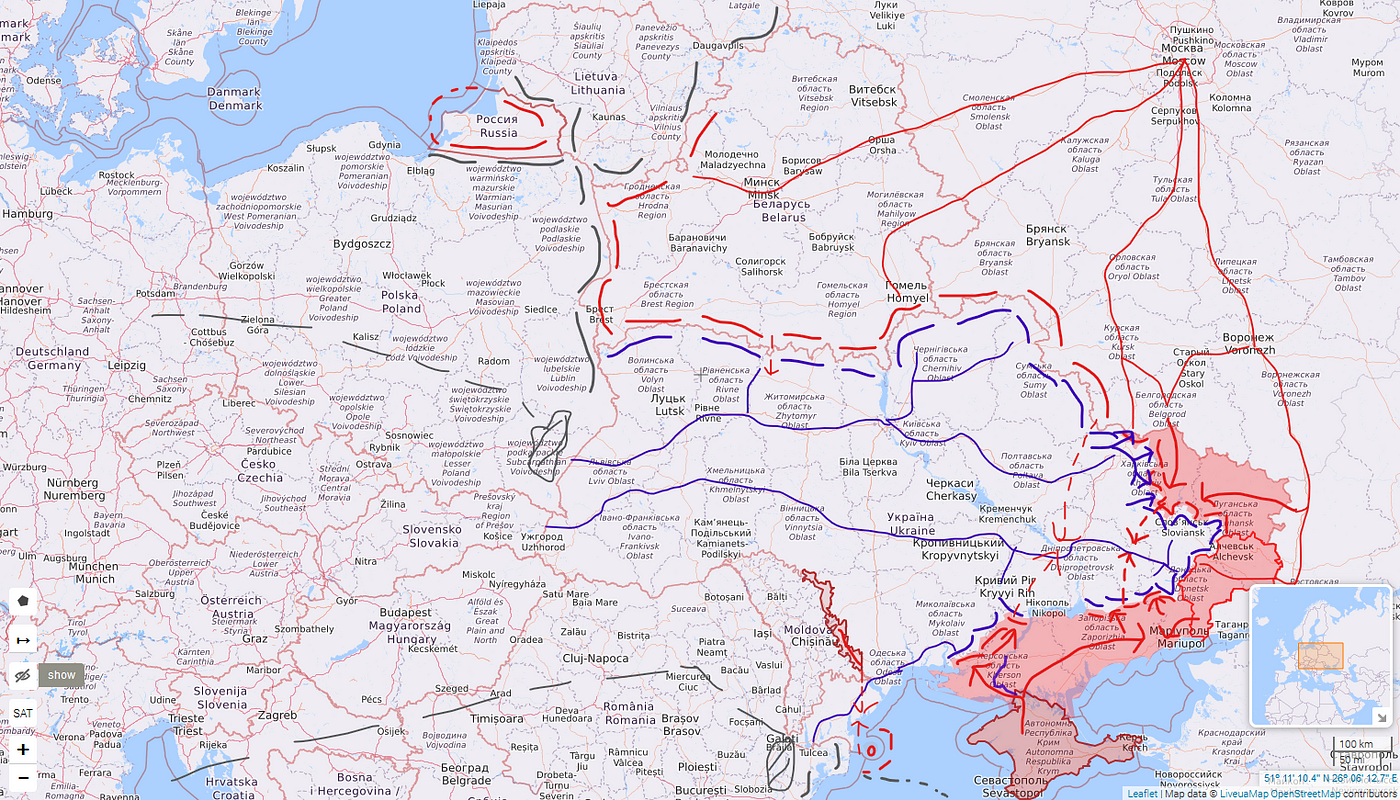
Eastern Front May 10, 2022. Supply lines and approximate front line positions marked in Blue (Ukraine), Red (Russia), Grey (NATO). Red arrows mark Russian offensives so far, partial arrows mark potential offensives. Blue near Kharkiv show Ukraine’s efforts since April to push Russia out of artillery range of the city. Base image from Liveuamap, markups mine.
In the West commentators try to keep score using casualties or military equipment losses as a proxy for winning and losing. But this is a mistake because Putin doesn’t care about Russian casualties. He doesn’t care if NATO military talking heads insist that he’s losing because Russia can’t dominate all of Ukraine’s skies or seize major cities — neither of which is a viable objective in modern warfare anyway.
Unlike most folks in the English-speaking world, I analyze military matters from a systems science perspective that identifies where a fighting force should focus its efforts to achieve its aims at minimum cost. Russia made the catastrophic decision to use military science itself as part of a Maskirovka, a broad deception effort deployed to cloak its true intentions.
This is the kind of too-cute thinking optimistic you expect from intelligence service types and a big part of why Russia’s initial plan went awry in a matter of days. But what most Western analysts are adamantly determined to miss is the fact overall command of the war shifted from the FSB to the regular military about a week after the attack kicked off.
From the moment Putin realized Ukraine was actually going to put up a fight his immediate war aims changed. Kyiv stopped being the primary target and the Russian effort in the south turned deliberately towards isolating Donbas.
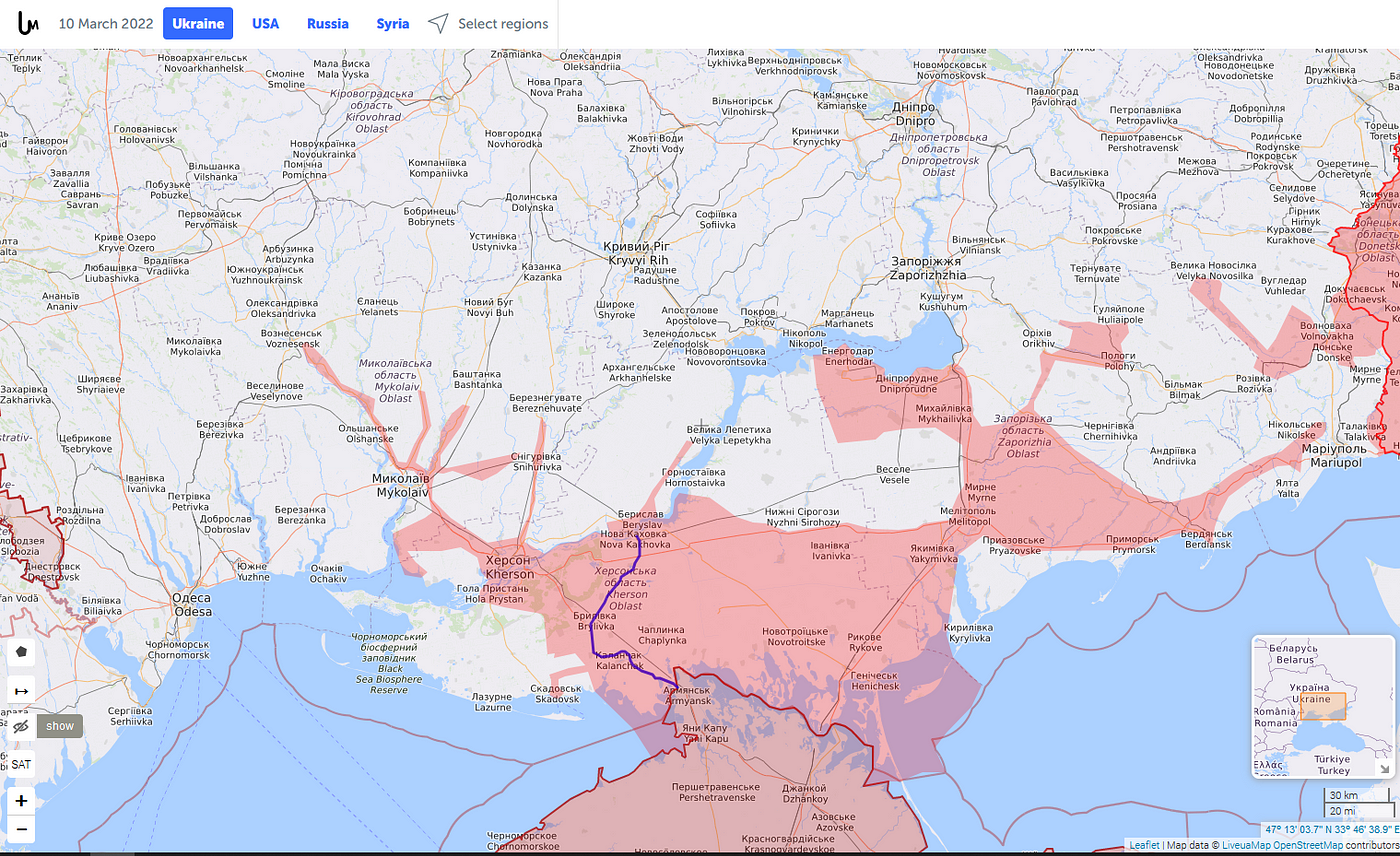
You can see this in the evolution of maps showing how Russian forces changed their direction of advance in Kherson province in the south. After making a reconnaissance in force seeking a path around Mykolaiv to Odesa — the original plan likely being to link up with Transnistria —Russia’s units in Kherson turned east towards Kryviy Rih to threaten the supply lines leading to Donbas.
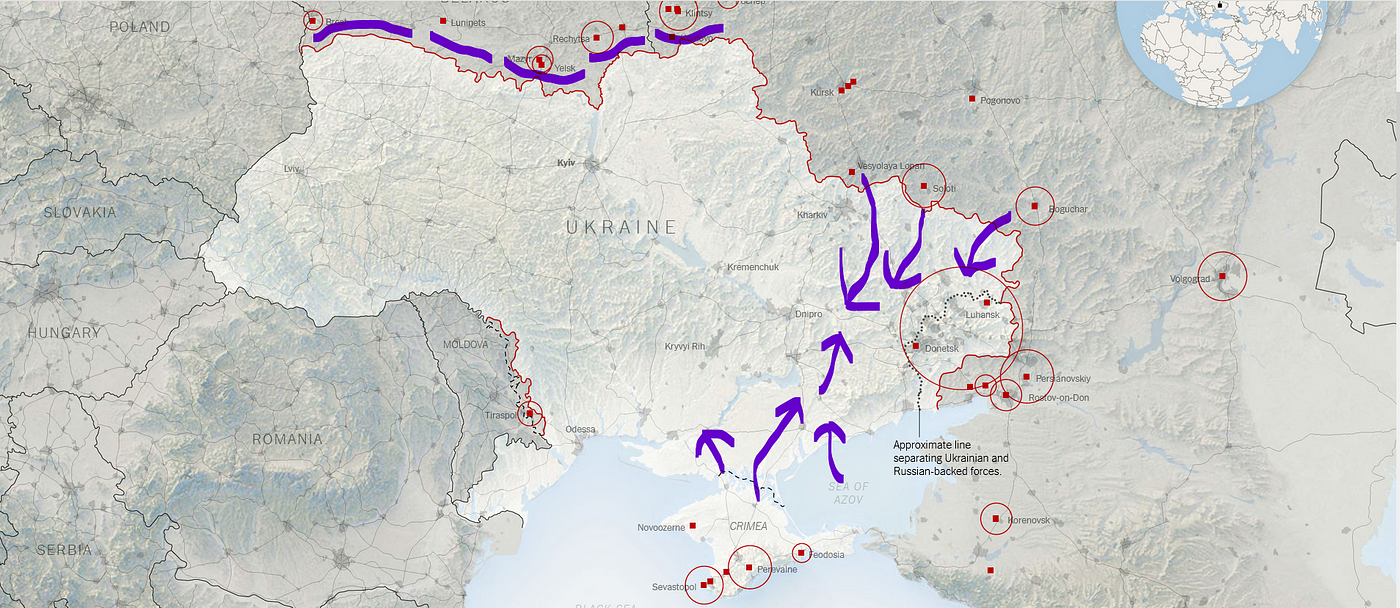
Ukraine was able to stop block this by deploying reserves, but could not halt the march of Russian forces to Melitopol and Mariupol near the coast and through Izyum on the Don river. In these sectors Russian advances have generally tracked my prewar predictions. Here’s what I thought would happen:
Where I thought Russia would attack in the south, broadly speaking. Background image from New York Times, purple marks mine.
Russia got a little further across the Dnieper in Kherson and Ukraine has held on in Donbas, but the shape of the operation in the south is mostly as predicted by terrain and logistics considerations.
As soon as Putin realized the Kyiv op was a bust, encircling Donbas became Russia’s primary military objective. He allowed the forces fighting near Kyiv to try and encircle the city in a secondary attack meant to strain Ukraine’s defense, but it was clear by mid-March that the city was too well protected to take by siege or storm.
It is vitally important to understand that the Russian retreat from the north was well organized, quick, and efficient. This was not a defeated army pulling back in the face of an overwhelming counterattack. It marked the shift from a terrible war strategy to a military campaign dominated by simple rational recognition that Ukraine as a whole could not be occupied with Russia’s available forces.
Since then Russia has been back to its maskirovka games, giving the impression of being caught in a stalemate while commanders train their forces properly and build up for the next big assault. Fighting has been hard along the front lines in Donbas, but Russia has not committed to the kind of all-out assault I anticipated before Victory Day.
Instead Putin used May 9th to mess with his enemies’ desire to gain insight into his thinking. Russia’s military effort is no longer driven by symbolic dates, but by the grim desire to cause as much harm to Ukraine as possible.
A major difference between the Russian and Ukrainian situations is that Russia has a far deeper well of reserves. Sure, it has lost over 600 tanks, up to half of what it committed to the fight in February.
But Russia keeps over 10,000 tanks in storage. Not most modern, perhaps, but most Russian forces can be given junk equipment and essentially sacrificed to clear the way for elite formations equipped with better gear. In fact, only one of Russia’s hundred or so modern T90M tanks has been confirmed destroyed — most losses have been of older Cold War style gear designed to be simple enough for conscripts to use in mass attacks.
The constant information war being waged against citizens of Western countries by our own leadership is blinding people to the harsh reality of what’s happening in Ukraine. Over the past fifty years military and security experts around the world have become positively obsessed with narratives at the expense of hard factors like terrain, supply, and execution.
In their worldview, tainted by the obsession with their own institutional heritage and the demand for officers to act like warrior-scholars, wars are lost when the population on one side loses the will to fight. Morale is what matters, and morale is bolstered, they think, by telling people not in the know happy lies.
In reality. bad morale is an age-old excuse made by failed leaders whenever their plans go awry. After America’s debacle in Vietnam, for example, many military officers and government officials blamed the media for ginning up public opposition to the fight.
But let’s state the truth baldly: information war is a delusion.
It’s just a nice way of saying propaganda, like collateral damage means oops, murdered some civilians. By making military affairs a sacred intellectual space only designated experts are allowed to inhabit, true civilian control over the military is severed and myths replace real military science in the public mind.
This is why, in America, Constitutional rights are always subordinated to the will of the national security state. People like Edward Snowden and Chelsea Manning are treated worse than even foreign agents simply for revealing to Americans what the federal government would prefer to keep hidden from its population.
In a real democracy the people have control over their military — it’s why the Founders originally intended that Congress declare war before raising standing military forces. Defense is truly about defense — protecting the territory of the country from attack, not picking fights abroad. Of course, America is not a real democracy, but an oligarchic anocracy, which explains a lot.
A nonstop information war is underway against quality science by people and outlets like the Institute for the Study of War, Michael Kofman, and Jomini of the West. Their role is to give the news media and general public sound bites and quotes that masquerade as scientific analysis while pushing a convenient narrative powerful people need us to believe is true.
Just as Russian trolls are actively trying to shape how we think about the war, NATO trolls are too.
Information war is fundamentally self-destructive and anti-democratic because it erodes trust between civilians and the military when the former realize they’re getting played, as they eventually do — check out the Pentagon Paperssometime. Information warfare has become an excuse for individuals willing to toe the establishment line to boost their career prospects and audition for jobs in future administrations.
Adherents to the D.C. foreign policy Blob adamantly refuses to admit a simple, awful truth: Putin is winning his war.
Not the broader war to subdue Ukraine — but that was always just an excuse for old Vlad anyway.
No, in his mind this has always been a fight between NATO and Russia. And in this epic contest Putin is more than happy to trade a few tens of thousands of dead young Russians if this means blowing up the world system his enemy’s power depends upon.
The American century is over. Pax Americana is dead. It’s a multi-polar world now, and America’s leaders are woefully unprepared for the complexity of this kind of operating environment
What pundits in the Anglosphere don’t seem to understand is that the effort to push a united global front against Russia has failed. Most countries around the world are looking at rapidly rising food and fuel prices with horror, not Mariupol. Sri Lanka’s government appears to have fallen already and more are sure to follow —people in most of the world don’t care about Russia’s war on Ukraine because they can’t.
Meanwhile the Western sanctions regime is disproportionately harming regular Russians and people in poorer countries Russia has long traded with, not the regime. Just as Iran’s government has found workarounds to sanctions, Russia’s will too, because too much of the world needs Russian exports — for all Europe’s anger at Russia, note how slowly most European countries are to pull back from Russian oil.
The unprecedented act of freezing Russian assets abroad has had the unintended effect of destabilizing the US dollar. The days of the dollar serving as the global reserve currency are almost done in part because countries are now justifiably worried about a future American government deciding to wage financial war against them.
Add to this the rank hypocrisy of the Biden Administration and NATO, which refused to give Ukraine enough support to deter Putin’s attack over winter then slow-played the delivery of major military gear for over two months. Even worse, efforts to speed deliveries of new aircraft to NATO allies so they could give Ukraine their old Mig-29 fighters went nowhere in part because production of American combat jets can’t ramp up fast enough to cover the shortfall.
NATO unity? Paper thin, and you can tell by how often officials insists otherwise — sure, Sweden and Finland are joining but both have been NATO partners already for a long time. Only once members realized Russia can’t sustain major operations against the Baltics or Scandinavia at the same time it’s bogged down in Ukraine did they start pushing heavy equipment to Kyiv. Almost three months into this war, Ukrainian troops and pilots could have been completing training on NATO-standard tanks and jets by now had a pipeline been set up back when I advocated for it.
Meanwhile, in Russia, Putin reigns supreme. Russians feel attacked by the rest of the world, Moscow’s information war capturing their minds just as Washington’s has taken over America’s. The Russian military appears bitterly angry by the loss of so many soldiers, dramatically hardening its stance towards NATO. Neither Putin nor the Russian military can afford to lose, meaning Donbas must be taken whatever the cost.
The Battle for Donbas has been underway for a few weeks now, and the lack of Russian progress on the ground is being taken as a sign of military exhaustion by the usual talking heads. I suspect this is a grave error, however.
It now appears the upswing in violence after Orthodox Easter was at least partly a feint: Russian forces have been conducting an extended effort to shape the battlefield ahead of the big push. Rochan Consulting published an assessment about a week ago showing that the area southwest of Izyum is being blanketed by Russian drones.
Fighting has been raging nonstop and probing attacks continue all along the front lines, but these could well be only intended to hold Ukrainian forces in place and exhaust them, slowly draining their supplies. What people don’t realize about warfare is that rest is absolutely critical. Most soldiers on the front lines aren’t standing there in the mud staring over rifle sights all day long. A few keep watch while the others rest or work on improving their positions. Some raids are launched to gain intelligence and disrupt the enemy’s plans to the degree possible, but otherwise, defenders have to sit and wait.
Only when they believe an attack is imminent do all the soldiers in a unit rush to their fighting positions. Forcing them to go through this over and over before the main fight begins is part of a typical assault plan assuming you have the time to spare, because it exhausts the defenders as well as forces them to make movements that reveal where their fighting positions are hidden.
That lets artillery and aircraft pound them night and day, which wears on even the most veteran fighter. This appears to have been Russia’s main focus across Donbas, especially near Izyum, where Ukraine has been holding the line with admirable skill.
I hope that their efforts are wearing Russian forces out. But I am concerned the Russian military is reverting to form: maintain constant pressure along a long line before an overwhelming assault breaches it along a narrow front. Air strikes are not intended to maintain constant control of the skies, but to hit targets of opportunity and suppress the opposition. Missile attacks hit deep in the enemy’s rear areas to degrade defenses and organization.
It is impossible to know with any certainty what is happening locally or the shape the combatants are in. Russian operations won’t follow any schedule western officials lay out. They have every incentive to disguise their plans to the degree possible. The fairly fixed nature of the lines over the past couple weeks is less evidence of Ukraine stopping the main Russian attack cold and more that Russian forces playing a deliberate game to gain the element of operational surprise before committing fully to any particular axis of attack.
A lot is being made of Ukraine’s counterattacks near Kharkiv, but these are only pushing back Russian forces whose main job keeping Kharkiv’s defenders busy away from Donbas and are vulnerable to counterattack the closer they get to the border. Russian operations around Snake Island and the threats of new attacks from Belarus or Moldova being dragged into the war are most likely serving the same purpose.
The simple truth is that as hard as Ukraine has been fighting, its defenders are still outgunned and outnumbered. Talk of broad counteroffensives to reclaim lost territories in the south and east is just that for the time being— talk. Ukraine has clearly been fighting very hard to disrupt Russia’s plans through artillery strikes on command centers, but this alone can not be decisive.
Defending is just much, much easier than attacking, and Ukraine needs a different class of gear to win. To successfully throw Russian forces out of Ukraine Kyiv has to get the full arsenal of modern, high tech equipment. Ukraine’s allies have to stop playing this weird mod of Command & Conquer where each subsequent level-up gives fighters access to a fancy new weapon with the good stuff being withheld until the final mission.
Despite receiving some howitzers and old armored personnel carriers Ukraine needs so much more to actually win. Every now and again a journalist interviews a soldier fighting in Ukraine and every one asks for better weapons.
Why aren’t they getting them? Because NATO leaders, particularly Joe Biden, are still terrified of Putin.
They know full well he retains the ability to end the world at a moment’s notice. Despite his overthrow or death being now necessary for the war to ever end, NATO won’t go there. Truth be told Biden and Johnson want Putin to stay right where he is. They really do want Ukraine to bleed forever without letting it into NATO or the EU. It’s all a sick game to these hacks, which is why Eastern Europe and Scandinavia need to be prepared to go it alone in the near future.
You do not want to be dependent on the United States. Its future is bleak and its leaders utterly craven — Perfidious Albion 2.0.
The leaders of the Anglosphere have completely lost the initiative, too caught up in their own self-congratulatory nonsense to understand that, for Putin, the outbreak war itself was a major victory.
Putin is well aware that domestic political strife in the lands of his enemies is all but guaranteed as prices rise for basic goods. He knows that most countries not already firmly allied to Russia or NATO don’t trust either — and he will weaponize that mistrust.
All he has to do is hang on, drag out the fighting indefinitely, and not lose. Chaos benefits Putin, plain and simple. The world is in a place thanks to the Covid pandemic and climate change where chaos will more likely than not magnify itself throughout the coming decade.
I predicted back in early 2021 that Russia or China would press the United States hard during Biden’s term. They almost had to — America’s covid disaster has done more to its reputation around the world than Americans realize, too happy to forget it ever happened and bury the trauma of the survivors.
China doesn’t want to destroy the world — it can arrange a showdown in the South China Sea or over Taiwan to prove its might over fading America if that proves necessary. However, Russia is more than happy to burn everything down.
If Putin can’t have his restored Soviet Union, then he’ll do exactly what Hitler did: destroy his own country to get back at the rest of the planet. Dragging the world down with you is the very soul of Pyrrhic victory, and Putin will accept no less.
The simple truth is that this conflict has been building for a very long time. Ukraine was trapped and has been shattered by the games of great powers as has occurred so many times across history. Now all of Ukraine is a murder scene.
And even the CIA is right for once: this war has only just begun. Russia is digging in for a long fight because it has no place to go, and if Russia is to fall then its leaders are certain to take America with it, one way or another.
Oft-told these days is the story of Putin, as a boy, cornering a rat that turns around and attacks him. Western pundits completely miss the point of this tale.
Putin identifies with the rat not because he personally feels his back is to the wall. No, he identifies with it because he knows that in the moment a creature commits to violence it gains power. Small as it might be, its enemies experience a moment of terror because they don’t know if its rabid or willing to fight to the death. The rat thereby gains a degree of freedom it can achieve no other way — the same lust for power drives school shooters, too, who attack not random people in the street, but their own peers.
Putin reigns supreme in the sole realm he cares about: Russia. No opposition threatens him — his only peers are those with the power to rebuff him. Russia’s military is bound to him through this war, even more so now that it has been revealed to all the world they are no less cruel than the Wehrmacht was.
It can’t lose, so neither can he, and so the war will go on. It may never end.
Sadly, the violence only gets worse from here. If Putin truly is the new Hitler then he must be defeated at any cost. He’ll never stop coming after the countries he doesn’t think should exist to build his sick farcical Russian World.
But NATO will never go this far. Its military power is almost as much of a bluff as Russia’s. A single wave of missile strikes hitting the right targets would cripple it for months if not years. NATO stocks of precision weapons aren’t that much deeper than Russia’s and take months if not years to replenish once used.
And Putin can always go nuclear. If he’s truly ill, that may even be inevitable now.
The bottom line is this: Putin has lost Ukraine, but as far as the broader war with NATO goes, he’s winning. Or at least, he thinks he is. And this makes him far more dangerous than he was before a quarter of his army got blown up on the road to Kyiv.