Temas de relações internacionais, de política externa e de diplomacia brasileira, com ênfase em políticas econômicas, viagens, livros e cultura em geral. Um quilombo de resistência intelectual em defesa da racionalidade, da inteligência e das liberdades democráticas. Ver também minha página: www.pralmeida.net (em construção).
Dependência ocidental da China no tocante a minerais críticos:
China's Other Minerals Monopoly: autonomous mining!
LILY OTTINGER
China Talk, JUL 30
Today’s guest post was authored by Nima Khorrami, a Stockholm-based Research Associate at the Arctic Institute, Centre for Circumpolar Security Studies.
After decades of neglect, Washington has adopted a coherent and “forceful” response to China’s dominance over critical minerals. China controls an estimated 91 percent of global rare earth refining, dominates the processing of a wide range of minerals, and has demonstrated repeatedly that it is willing to weaponise that position. The United States has responded through a range of initiatives and policy packages including Executive Order 14241, the One Big Beautiful Bill Act, and Pax Silica. Add bilateral deals with Australia, Japan, the DRC, and Saudi Arabia, and the result is undeniably a more aggressive and cohesive mineral strategy than the United States has attempted in decades.
The problem is not with any of these agreements and frameworks. Instead, it is with what is systematically absent from them. The entire architecture of American mineral strategy, and indeed the EU’s parallel effort under its Critical Raw Materials Act and RESourceEU, is built around two variables: where minerals are located and who processes them. What it consistently underweights is a third variable that will most likely prove equally consequential over the medium term: who controls the technology that operates the mines themselves. This constitutes the central strategic blind spot in the West’s mineral autonomy agenda because China is not just dominant in mineral processing. Beijing is also rapidly establishing dominance in the operational technology of extraction; the autonomous systems, industrial AI, connectivity infrastructure, and integrated machine intelligence that will define how the world’s future mines will run. Today, we’ll explore China’s dominance in autonomous mining technology and what to do about it.
If that dominance goes unchecked, the US and its allies could succeed in securing access to mineral deposits across friendly jurisdictions and still find those mines dependent on Chinese operational technology to function.
A história pouco edificante, da qual tomei conhecimento quando ainda vivia na China em 2010, e segui (pela imprensa ocidental) o extraordinário "crescimento financeiro" das elites do PCC, pouco depois abatidas pela nova administração de Xi Jinping. PRA
Anon contributor “Soon Kueh” occasionally writes about China and delights in bureaucracy.
Disclaimer: All the quotes and information are obtained directly from Pin Ho and Wenguang Huang’sA Death in the Lucky Holiday Hotel: Murder, Money, and an Epic Power Struggle in Chinaunless stated otherwise.
Under Xi’s regime, CCP purges have been exceptional in terms of quantity and quality. Xi hasnow purged more officials than Maoever did, and he isnot stopping. While purging is now a normalised feature of Xi’s rule, fresh rounds of purges always invite new political divinations, rumours of succession politics, and new speculations on the cabinet’s factional alignments.
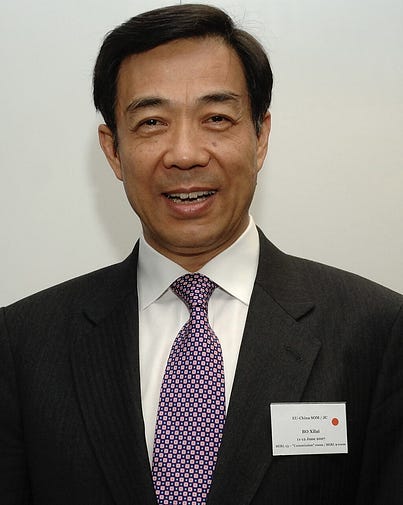
While understanding realpolitik is fun, what about the fanfare, the drama, the campiness associated with purges? Unfortunately, because of the party’s opaque politics, we are rarely privy to the internal processes of a successful purge and can only debate about the outcomes once the dust settles. Alas, we can only imagine what it’s like being a fly on the wall in the recent PLA purge, but we can draw from memory to extrapolate. So far, the only crack that allowed us a rare glimpse into the party’s shrouded political intrigue occurred 13 years ago, during the purge of Bo Xilai. For longtime party watchers, it was a strangely serendipitous time to witness how the chipsfell out of place— from Wang Lijun’s 王立军botched defectionat the American embassy, to Gu Kailai’s 谷开来 shoddymurderof British businessmanNeil Heywood, and the resulting purge of Bo’s faction. Borrowing mainly from Pin Ho 何頻 and Wenguang Huang’s 黃聞光A Death in the Lucky Holiday Hotel: Murder, Money, and an Epic Power Struggle in China,this article takes a trip down memory lane to revisit Bo’s fantastical downfall and indulges in a campiness rarely associated with the CCP.
Our tale begins as awǔxiá 武侠novel, with Bo Xilai as our main protagonist, attempting a return to greatness. The revenge trope of the fallen prince is a common theme in the wǔxiá genre and Chinese historical dramas. Forced into exile, the disgraced noble prince swears to bide his time in the shadows as he slowly accumulates resources(韬光养晦andplans for his return to glory.
As the son of former high-ranking revolutionary Bo Yibo 薄一波, Bo Xilai’s life fundamentally embodies this trope (although he is obviously not a conventional hero). Princeling by birth, his playmates included Xi Jinping and Liu Yuan 刘源, son of Liu Shaoqi. However, Bo’s life soon took a downturn when his father was purged during the Cultural Revolution and languished in jail for twelve years. As a result, Bo and his brothers were detained in a youth delinquency center for 5 years from 1967-1972. Bo’s life improved in his thirties, when his father was finally reinstated as vice premier. His father’s return to power signaled that young Bo’s exile was over and that it was finally appropriate for him to enter politics.
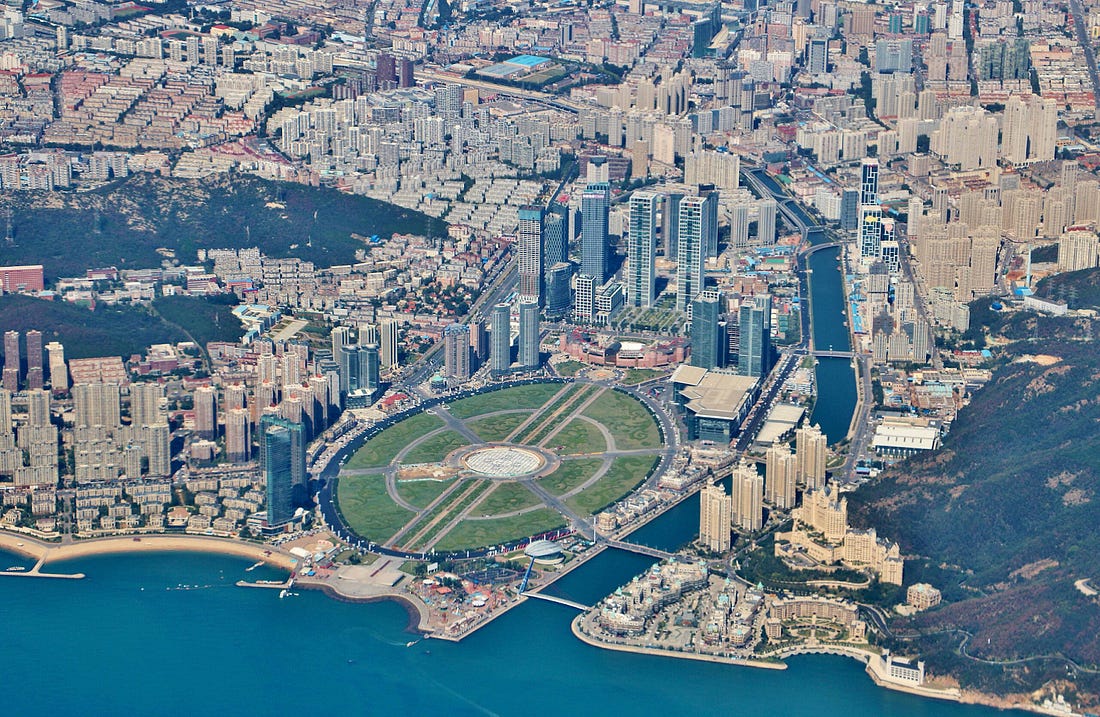
Tired of quietly lurking in the shadows, Bo’s political ambitions were obvious from the start. In 1982, he joined the Party Central Committee Secretariat as a research assistant. Following the playbook of elite officials who forged their careers by conducting revitalization efforts in the rural countryside, Bo requested a transfer in 1984 and was ultimately posted to Jin county金县in Liaoning. His career progressed steadily afterwards, alongside his vanity and flamboyance. In 1987, Bo became district party chief in Dalian, where he sought to beautify the city through extensive greenification (which was a questionable priority given the region’s severe water shortage) and heavy redevelopment. He was both an ambitious princeling and a debauched ruler. He had an unabashed love for beautiful women. At one point, he usedgovernment money to host fashion shows with gorgeous young womento demonstrate Dalian’s immense beauty, and evenordered the police department to create a squad of policewomen who patrolled on horseback. He was also aptly nicknamed “Bo Qilai” 薄起来, which translates to “Get-it-Up Bo” because of his lustfulness.
During his ascent, his burgeoning political ambitions ruffled many feathers. In 1994, he builtXinghai Square星海广场,the largest city square in the world, to celebrate the handover of Hong Kong.
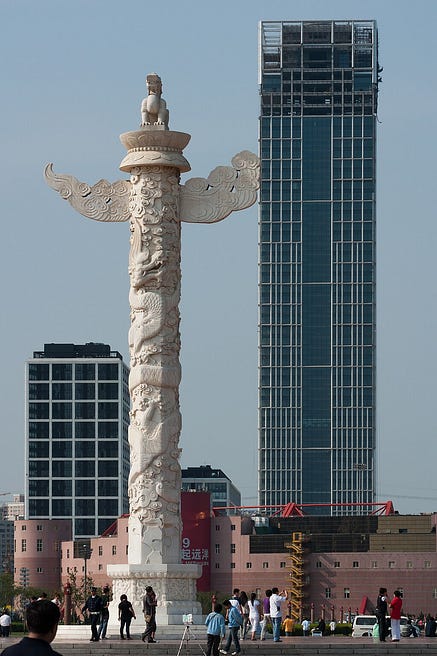
It wasn’t just the size that caught people’s attention, but thehuábiǎo华表 that was erected there.As ahuábiǎois a ceremonial column traditionally placed in front of tombs or palaces that usually signified imperial authority, many observers thought that this artistic decision revealed Bo’s thirst for influence — especially since thehuábiǎoin Dalian was much larger than the one in Beijing. Rumors even alleged that Jiang Zemin was shocked when he first saw thehuábiǎoin Dalian during a visit.
The now-demolishedhuábiǎoin Xinghai Square (Source)
Like a classicwǔxiánovel where the protagonist must undergo many trials and tribulations, Bo’s career was not all smooth sailing. In fact, his final posting, Chongqing, was initially viewed as a demotion. But to be fair, Bo is no hero. In fact, it was his domineering personality that led to his Chongqing reassignment.
Bo was initially promoted to deputy party secretary and interim governor of Liaoning in 2001 after he left Dalian. (He was given a huge sendoff by residents, although some eventually disclosed that they were promised free KFC by local officials if they attended). However, because his strong-headed personality did not gel with the Liaoning leadership, President Hu Jintao brought him to Beijing to succeed ailing Commerce Minister Lu Fuyan 吕福源 in 2002. His stint at the Commerce Ministryearned him the unpleasant nickname “Mao Zedong Jr. 小毛泽东”and he clashed with his superior, Vice Premier Wu Yi 吴仪, who oversaw the ministry. Bo sought to replace Wu Yi when she announced her imminent retirement in 2008, but was thwarted by Wu’s objections. Against his will, Bo was posted to Chongqing as party secretary — although he eventually looked at it as an opportunity to exercise more political autonomy to implement his own policies.
Act 2: Every Hero Needs a Sidekick
Bo’s narrative arc is fascinating because of its capacity for genre-shifting. While his story initially resembles the return arc ofThe Dark Knight Rises, where Batman painstakingly crawls out of the underground prison to defeat Bane, Bo’s stint in Chongqing embodies the spirit of a classic buddy cop film, with a twist of tragicomedy.
Bo Xilai’s stint in Chongqing was unforgettable. His year-long “Smashing Black, Singing Red” 打黑唱红 anti-corruption campaign was implemented by 10,000 police, divided into 329 investigation teams. Allegedly, nearly 5,000 arrests were made and 3,273 people were prosecuted; 520 of these cases resulted in a conviction, with 65 people executed or sentenced to life imprisonment. In the same time frame, the “police successfully captured 4,172 previously unsolved cases and broke up 128 crime rings.” While later reports claimed that the numbers were heavily exaggerated, the operation’s massive scale was enough for Beijing to become wary of Bo.
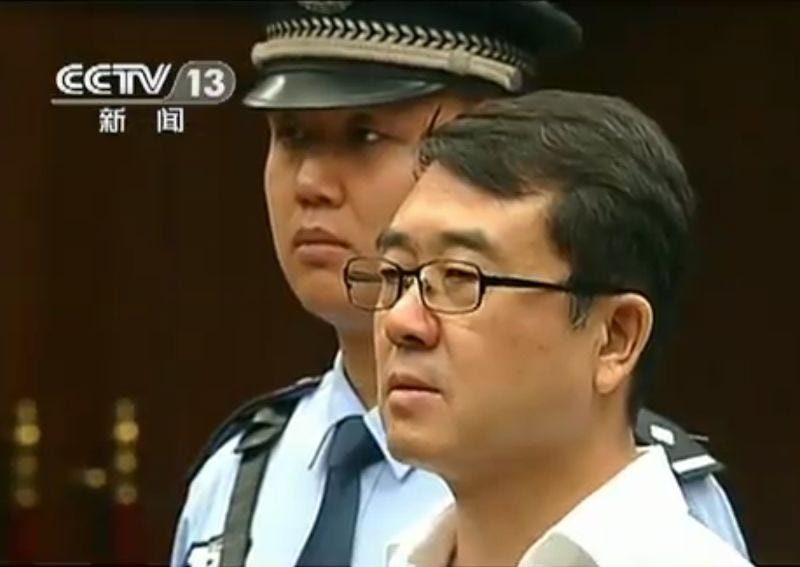
In comes Bo’s loyal sidekick and fellow buddy cop Wang Lijun, who was responsible for executing much of the campaign. Wang was the former Chongqing police chief and deputy mayor. Bo and Wang’s initial connection has been the subject of much speculation, which often veers towards the fantastical. Supposedly, Wang was an elite cop who cracked the mysterious attempted mercury poisoning of Bo’s wife Gu Kailai after he was enlisted by family friend and billionaire Xu Ming 徐明. Unfortunately, the most realistic story is also the most boring: Wang was introduced to Bo by former security czar, Zhou Yongkang 周永康, who owed Wang a favour.
In many ways, Wang was as narcissistic as Bo, if not more. He always “had an entourage of more than twenty camera-carrying assistants” who followed him everywhere and recorded his every word and action. Quotes and pictures deemed good enough were then either “compiled into a book which included lavish praise from subordinates,” or posted on the news. If the photos taken were too ugly, the photographer needed to Photoshop them until Wang was satisfied. Wang was also a terrible boss. He once jailed his secretary for “talking back to him over a trivial matter.” In just two years in Chongqing, he burned through fifty-one personal secretaries; one was even fired on his first day. And like Bo, Wang had a love for women — his bodyguard posse mainly consisted of women decked in red uniforms.
But Wang was no princeling, a fact which clearly haunted him. He started from scratch as a volunteer in a neighbourhood watch group before becoming a police officer in Tieling 铁岭, Liaoning. Thereafter, he was posted to Jinzhou 锦州, Liaoning, and finally Chongqing. Much of Wang’s career involved a dash of deceit and savviness that easily rivalled Anna Delvy and Elizabeth Holmes. To take advantage of theaffirmative action policies that benefit ethnic minorities, Wang switched his ethnicity from Han to Mongolian to contest for a delegate spot at the 14thCommunist Party Congress in 1992. To make up for his lack of college credentials, Wang embarked on a retroactive crusade to collect them all:
“His official résumé indicates that he obtained an [MBA]…at something called “California University” … Wang also obtained an eMBA from the China Northeastern Finance University between 2004 and 2006, when he was deputy mayor of Jinzhou. A professor at Beijing University said Wang’s eMBA degree has no academic value because the program is a revenue-generating engine for the university.”
Despite his suspicious credentials, “more than ten of China’s prestigious universities have made Wang an adjunct professor and doctoral supervisor.” The president of Beijing University of Posts and Telecommunications even claimed that Wang had a PhD in law. Chinese state media also reported that “Wang was an expert on forensics, criminal psychology, and law; had written five books on law; and had presided over eighteen legal-research projects.” Wang was supposedly also a genius inventor: he has filed more than 119 patents on China’s State Intellectual Property Office website, “from police equipment and alarm systems to police raincoats and policewomen’s boots.”
Wang’s inferiority complex found refuge in Bo’s princeling status. With Bo’s backing, Wang confidently unleashed Chongqing’s anti-corruption campaign that terrorized the city and madeexcessive surveillance and paranoiathe new normal.
However, this camaraderie did not last long.
Act 3: The Slap that Ended it All
The genre shifts again. We are now regressing in time and now reside in the genre of the Chinese historical period drama, where political intrigue, murder, and petty catfights — alongside the occasional gender bender — unfold.
To say that a slap ended it all would be an exaggeration. But it is not entirely false to say that the slapdidcreate the fissure that caused the cataclysmic fallout between Bo and Wang. But first, we must return to the catalyst:Neil Heywood’s murder.
Out of all the career switches an ESL tutor can make, Neil Heywood chose the riskiest option. He started working as an English tutor to affluent families in 1998. However, with the suave confidence of a white man in early reform China, Heywood reached out to Bo Xilai’s wife, Gu Kailai, and introduced himself as an alumnus of Harrow — an elite UK private school where Gu’s son Bo Guagua 薄瓜瓜 was studying. Gu agreed to meet Heywood in London thereafter, and the rest was history. Heywood successfully transitioned out of his teaching gig to become a part-time nanny and part-time money launderer — arguably the most successful ESL career switch in history.
Heywood and Gu’s relationship had always been intense, but their relationship became severely strained when Heywood ran out of money in 2011 and started harassing Bo Guagua. (Heywood even forcibly detained Bo Guagua in his apartment once.) Consequently, Gu viewed Heywood as a threat that needed to be neutralised. In choosing between framing Heywood for drug trafficking and poisoning him to death, Gu eventually preferred the latter for its simplicity. Throughout this process, Wang was actively assisting Gu and brainstorming ideas to get rid of Heywood. (Wang even suggested killing Heywood in a shootout and planting drugs on him, but this idea was eventually rejected as it would have caused a massive international scandal and risked damaging Chongqing’s reputation.)
However, Wang’s assistance eventually turned into blackmail. Around the same time, Wang feared that his career was coming to an end because his political opponents were zeroing in on him; many of his old friends in Tieling were investigated by the Central Disciplinary Inspection Commission and prosecuted. Wang feared that he would be next. When Wang realised that Bo remained unconcerned, he took things into his own hands. After Gu double-crossed Wang and tried to destroy evidence of Heywood’s murder behind his back, Wang reached out to Bo directly and informed him of Gu’s role in Heywood’s murder. However, this did not end well: when Gu falsely denied her role, Bo slapped Wang for his ungratefulness and betraying him.
This slap was the turning point that “shattered the last shreds of [Wang’s] illusions about dignity,” according to a police officer in Chongqing. Realising that he was “merely Bo Xilai’s hound dog,” Wang reopened the investigation into Heywood’s murder. Unfortunately, Wang was soon fired by Bo thereafter. Although Wang and Gu had a brief reconciliation — during which he “allegedly slapped his own face in repentance” — Bo still sought to “eliminate” him, prompting Wang to find new exit options.
Drawing on his talent for self-reinvention, Wang cosplayed twice — once as an old woman, and the other as an old man — and started embassy shopping. Unfortunately, his undercover trip to the Guangzhou British Embassy as an old woman was unsuccessful; visa officials ignored him when he probed the possibility of political asylum. His second expedition became aninternational scandal, except this time Wang cosplayed as an old man in the American embassy in Chengdu. Indeed, Wang’s strategy of causing massive political damage at his own expense 杀敌一千自损八百 ensured that Bo could not easily kill him, albeit at the cost of the party’s reputation.
There is a conspiracy theory that Wang’s brazenness in entering the US consulate was a result of working with the anti-Bo faction in Beijing, but this cannot be fully proven. Either way, it was a win-win situation for both parties: Bo got taken down, and Wang saved his skin.
Act 4: Schadenfreude and Old Debts
We are still in a historical period drama. The genre has not shifted, except that most of the drama now unfolds in the imperial court, where backstabbing and political intrigue are the norm. Occasionally, petty disputes arise and old debts are settled.
Initially, many of Bo’s political opponents delighted in the convenient opportunity to get rid of him. After all, his tremendous anti-corruption campaign implicated many in Beijing. It was rumoured that even former Premier Wen Jiabao secretly ordered “the deputy minister of state security to dig up dirt on Bo” in 2009 because he was against the latter’s anti-corruption crusade. Bo’s association with Heywood’s murder, alongside the international ruckus it caused, was thus a perfect opportunity to drag all the skeletons out of the closet. The family’s routine money laundering, close relationship with Heywood (who was a suspected British spy), chummy relationships with billionaires such as Xu Ming, the murder allegations, and other accusations of corruption became prime fodder to eliminate Bo from the party for good.
It was also a time to settle petty debts. Remember the time when Jiang Zemin visited Dalian and was shocked by thehuábiǎothat rivalled Beijing’s? During that visit, Bo covered the city with life-size posters of Jiang, only to tear them down immediately after Jiang left. This apparently upset Jiang, who began to view Bo as a “mere sycophant,” “deceptive,” and overly politically ambitious. Unfortunately, for Bo, it was Jiang, his former mentor, who denounced him as morally unscrupulous and deserving of punishment. (We can only guess how many more petty incidents like these played a part in Bo’s fall from grace.)
Nonetheless, the attack against Bo became too much of a good thing as it brought increased scrutiny to other party members. On October 25th, 2012, the very same day Bo lost his position as a delegate to the National People’s Congress, aNew York Times articledivulged that Wen Jiabao’s 温家宝 family had a startling estimated net worth of $2.7 billion. Correspondent David Barboza reported that the wealth was “hidden behind layers of partnership and investment vehicles involving friends, work colleagues, and business partners.” Bloomberg alsopublished an articleon the sprawling elite fortunes of the descendants of former revolutionaries shortly after.
To avoid disrupting the leadership transition by kicking up more dirt, punishment was swiftly meted out. Gu was given a suspended death sentence on August 9th, 2012, while Bo was issued a life sentence the year after. Bo Guagua escaped unscathed and now resides in Canada, where hespends time writing long eulogies about his dead dog. Hemarried a Taiwanese hospital heiressin 2024.
Conclusion: C is for Camp
CCP politics are inherently campy because of their strong affinity for theatrical excess. Campy politics are only a natural outcome when so much weight is placed on slogans, performativity, and backroom gestures. Add in the fact that many party members have feuds that trace back to the Cultural Revolution, and the opportunities for camp and petty drama are endless. While the dust is settled for now, nothing stays buried for long. Maybe in the next few decades, we’ll see a political comeback by Bo’s faction.
But for now, we wait.
ChinaTalk is a reader-supported publication. To receive new posts and support our work, consider becoming a free or paid subscriber.
How has Chinese hegemony shaped power relations in East Asia? Why did imperial China conquer Tibet and Xinjiang but not Vietnam or Korea? Can learning from history help maintain peace in the Taiwan Strait?
Today’s interview begins with a striking observation — while medieval Europe suffered under near-constant war, East Asia were defined more by great power peace.
To discuss, ChinaTalk interviewed Professor David C. Kang, director of the Korean Studies Institute at USC and co-author of Beyond Power Transitions:The Lessons of East Asian History and the Future of U.S.-China Relations.
We discuss…
· How East Asian nations managed to peacefully coexist for centuries,
· Why lessons from European history don’t always apply,
· How to interpret outbreaks of violence in Asia — including conflicts with the Mongols, China’s meddling in Vietnam, and Japan’s early attempts at empire,
· Whether the Thucydides trap makes U.S.-China war inevitable,
· Old school methods for managing cross-strait relations.
Co-hosting today is Ilari Mäkelä of the On Humans podcast.
Historical Evolution of China
A discussion with Yasheng Huang
Led by Lily Ottinger and Jordan Schneider
China Talk
In three parts:
1. Autocracy and Stagnation: How Imperial Exams Shaped China's Destiny
2. Imperial Legacy: 1949 to Xi's Rise
3. Imperial Legacy Part 2: 1949 to Xi's Death
Conclusion of the First Part:
For those concerned with economic growth, development, technology, and science, China should celebrate diversity rather than suppress it. The evidence from China’s own history supports this conclusion.
Read the complete Discussion in this file of my Academia.edu:
https://www.academia.edu/124962688/Historical_Evolution_of_China_Yasheng_Huang_Lily_Ottinger_Jordan_Schneider_China_Talk_
Is China’s model of economic development compatible with democracy? Were events like Tiananmen Square and the rise of Xi Jinping inevitable under China’s governance structure?
Welcome back to part 2 of our interview with Yasheng Huang 黄亚生, the author of The Rise and Fall of the EAST: How Exams, Autocracy, Stability, and Technology Brought China Success and Why They Might Lead to Its Decline.
In this installment, we discuss…
The aspects of imperial China’s governance Mao chose to embrace, and those he chose to abandon,
The factors enabling Mao’s radical policies compared to imperial rulers,
Why China was able to grow so much faster than India, despite the setbacks of the Cultural Revolution,
Statistical approaches for evaluating the effectiveness of autocratic development models,
China’s economic reforms and rural development policies in the 1980s,
How the events of 1989 permanently altered China’s trajectory,
Whether the rise of Xi Jinping was inevitable.
Apple Podcasts:
Imperial Legacy Part 2: 1949 to Xi's Death
ChinaTalk
2:04:32
Spotify:
Imperial Legacy Part 2: 1949 to Xi's Death
Jordan Schneider
Episode
Co-hosting today is Ilari Mäkelä of the On Humans podcast. Here’s part one if you missed it.
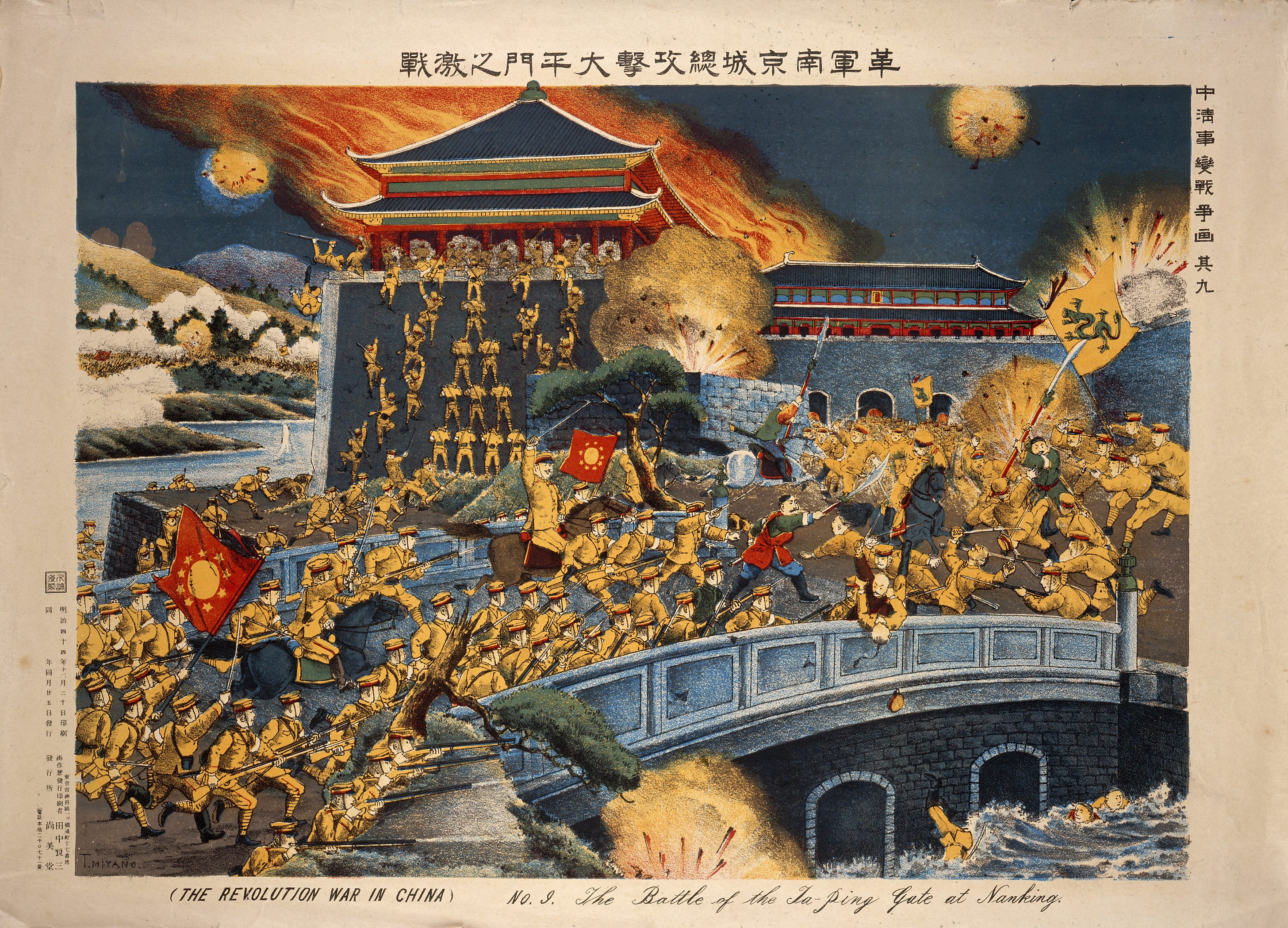
Xinhai revolutionaries ambush Qing forces at Nanking in 1911. Painting by T. Miyano.
Mao’s China — Dynastic Traditions and Leninist Innovations
Jordan Schneider: Last week, we discussed Chinese history up to 1949. Ilari, could you give us a brief recap of our first episode?
Ilari Mäkelä: To understand China’s history, Yasheng Huang emphasizes the importance of focusing on the little-studied period after the collapse of the Han dynasty in the third century. During the next few centuries, China resembled Europe, with no single power base and competing ideologies. Huang’s studies have shown that this was also when China was at its most inventive.
Unlike Europe, this political fragmentation ended when China was unified again in the 6th century under the Sui dynasty. Everything changed with the introduction of civil service exams on a large scale. These exams allowed a significant portion of the population to participate and created stability. Many Chinese believed that through hard work, they could gain political power.
While this system prevented the development of a European-style aristocracy, it funneled all intellectual efforts into serving the emperor. Consequently, there were no power struggles like Henry VIII versus the pope, nor was there an Enlightenment-style intelligentsia. Instead, China produced numerous Confucian-educated civil servants.
Jordan Schneider: Professor Huang, what aspects of this imperial tradition did Mao adopt or reject when he began to rule in 1949?
Yasheng Huang: Mao took over China in 1949, inheriting certain aspects of imperial China while departing from others. He maintained and extended autocratic controls, implementing strong economic controls through central planning, state ownership, and government price-setting. Politically, communist China’s power reached beyond the county level, extending to villages through land reforms and the communist system.
However, Mao actively went against imperial tradition by de-emphasizing bureaucracy and meritocracy. This shift began in 1957 and intensified during the Cultural Revolution in 1966. Universities were closed, examinations and expertise were downplayed, and ideology was elevated. While ideology was important in imperial China, Mao’s approach differed significantly, relying on political and ideological studies rather than the traditional examination system.
Jordan Schneider: It’s interesting that you argue the more codified a system is and the fewer power bases that exist, the more important the leader’s actions become. However, even powerful Ming or Song dynasty emperors couldn’t have executed the level of radical changes that Mao implemented from the mid-1950s through the end of his reign. Mao seemed to combine the worst of both worlds — centralized personal power without bureaucratic and cultural safeguards that would have prevented disasters like the Great Leap Forward or the Cultural Revolution.
Yasheng Huang: Excellent observation, Jordan. Two additional factors contributed to this difference.
Modernity — imperial China lacked modern means of transportation and communication. Indoctrination was the primary tool, and once officials were dispatched to remote regions, central control diminished. In contrast, modern systems allow for instantaneous and ongoing control through air travel, trains, and buses, facilitating frequent indoctrination sessions in Beijing.
Transformative agenda — imperial China, like many traditional polities, focused on maintaining the status quo. They often lacked knowledge of potential transformations or how to preempt them. Mao, however, had a highly transformative agenda. In 1958, he famously aimed to surpass Britain and America in steel production — a concept foreign to Ming dynasty emperors.
Communist China was more ambitious and transformative, aided by Leninist techniques and organizational capacity. It wasn’t a carbon copy of imperial China, but incorporated elements borrowed mostly from the Soviet Union.
Vladimir Lenin’s theory of the vanguard of the revolution emphasized the ability of political elites to rapidly transform society. While Karl Marx predicted that communist revolutions would occur after capitalism, Lenin argued they could be launched directly from feudalism. This transformative agenda was absent in imperial China but central to Mao’s rule.
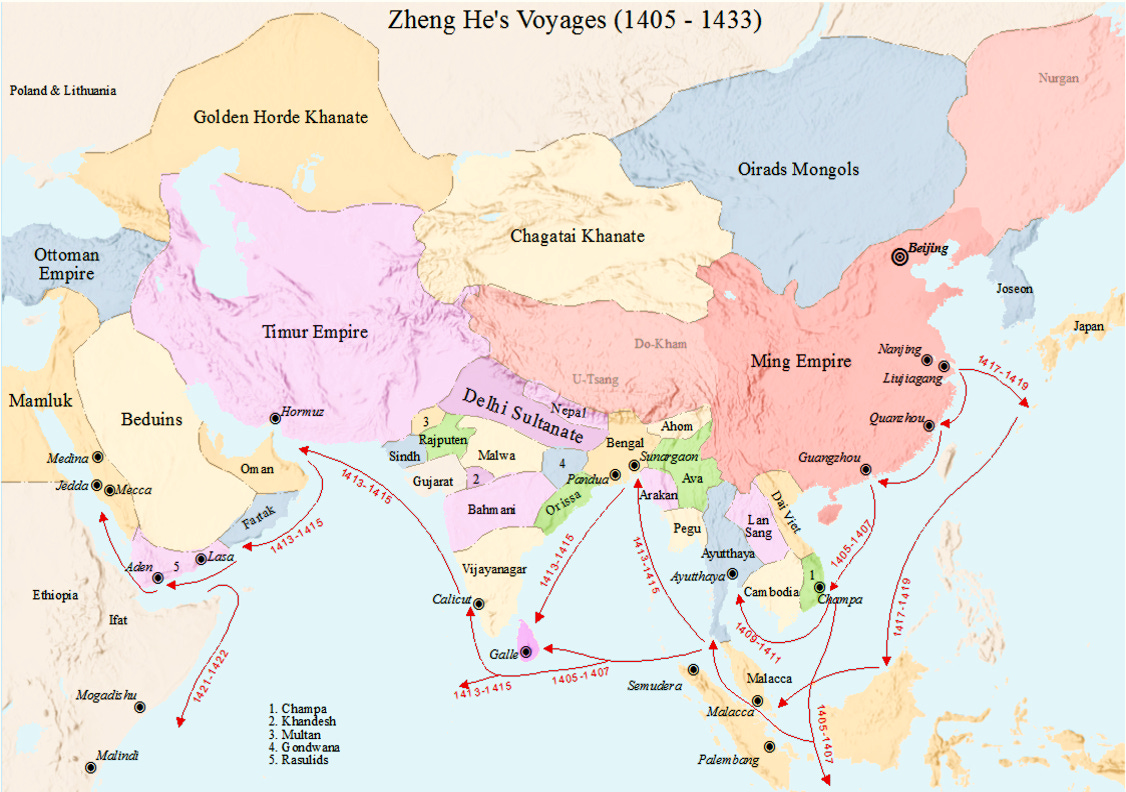
Jordan Schneider: The contrast between the Ming dynasty and Mao’s Leninism is fascinating. You argue that when Marco Polo arrived in Yuan Dynasty China, he felt transported 500 years into the future. During the voyages of Zheng He 鄭和, the Chinese viewed other cultures as backward and lacking.
Human nature may play a role here. When elites feel they’re at the top and things are stable, they may be less inclined to explore, change their minds, or question whether their system has all the answers. In contrast, from the fall of the Qing dynasty through the Republican period to Mao’s era, there was a keen awareness that China needed to catch up with the rest of the world.
To what extent is this perspective determined by China’s relative position as more or less advanced than other societies?
Yasheng Huang: I agree that the factor I mentioned is one of many contributing to this perspective. However, even given the disparity between East and West 500 years ago, it doesn’t fully explain China’s isolationist stance. The mental model you describe likely applies to the political elite who, upon seeing nothing impressive abroad, decided to remain insular.
Today, people from wealthy countries often explore poorer regions out of curiosity. When Christopher Columbus embarked on his voyages, he had personal motivations and potential gains alongside nationalistic agendas. This personal stake was entirely absent in Zheng He’s voyages, which were purely state-sponsored activities with national objectives.
Jordan Schneider: That’s an apt comparison. European colonization in the 18th, 19th, and 20th centuries — despite the lack of respect for native populations — still involved scientists and observers who documented their experiences. This information flowed back into the broader ecosystem. In contrast, China lacked this type of engagement for over a thousand years.
Autocratic vs Democratic Development Strategies
Jordan Schneider: Ilari, would you like to bring us back to Mao?
Ilari Mäkelä: One interesting aspect is the package Mao inherited from the imperial era (albeit in a mutated form) is the autocratic tradition, which we often view as partially negative.
One of the most fascinating questions in comparative economics is why China has grown so much faster than India. Some argue that democracy doesn’t work well for such a large country as India, suggesting that autocracy, like in China, is necessary. You have a different perspective, focusing more on China’s human capital resources.
I recall you mentioning in your TED talk that China grew at a pace similar to or even faster than India, even during Mao’s era. This suggests that growth occurred despite policy, not because of it. You attribute this to an inherent push for growth in China, absent in India, linking it primarily to literacy. Is this correct?
Yasheng Huang: The baseline judgment on China and India is based on almost a single data point from the World Bank website — the GDP per capita of China and India in 1980 or 1990. It shows that India had a higher GDP per capita than China at that time. Twenty or thirty years later, China’s GDP per capita surpassed India’s. Many people used this data point to argue that autocracy (China) could grow faster than democracy (India).
However, there are a couple of problems with this conclusion. First, the data is almost certainly wrong. One issue with Chinese GDP data is that they used a Soviet system called the material product measure, which didn’t include the service sector. In poor countries without industrialization, you have agriculture and a sizable service sector. For many years, the service sector was very large in the Indian economy.
Ilari Mäkelä: But isn’t it still true that China has undergone a more dramatic transformation than India since the 1980s?
Yasheng Huang: Absolutely. The point I was making earlier disputes the initial discrepancy. Given that China grew faster than India, it’s actually more impressive if you believe that China started from a higher per capita base. However, there are many differences between China and India. It’s puzzling why people immediately jump to the conclusion that it was because India was a democracy and China was not.
To properly evaluate this, we need to look at global evidence to compare at least two competing hypotheses, which are human capital and the political system. Academic literature increasingly shows that autocratic and democratic systems don’t have a significant impact on growth rates. Some autocracies grow very fast, like China, Taiwan, and South Korea in the 1960s and 1970s. There are also spectacular failures, such as the Philippines, Indonesia, and many African countries.
The problem with the formulation by many Chinese and some Western intellectuals is that they escalate a factual statement about China growing faster than India to a statement about the superiority of autocratic systems.
When discussing systems rather than specific countries, you need evidence from other countries with the same system as China. That’s just common sense.
Jordan Schneider: Where do you think this argument comes from then?
Yasheng Huang: Some people believe in autocracy and are grasping for evidence to show their belief has economic benefits. I often point out to them that China was also autocratic under Mao, but it didn’t grow very fast during that period. An honest person would conclude that there must be something else different between Mao and Deng’s eras. Perhaps globalization, open policies, or private sector development played a role.
I’m dissatisfied with media coverage because they often go for sensational statements without examining the logic behind people’s views. In academic seminars, these arguments wouldn’t hold up for five minutes because basic logic would demolish them. Unfortunately, media attention often goes to those making broad, sensational statements rather than those presenting logical arguments and evidence.
Liberalism and the Future of Chinese Democracy
Ilari Mäkelä: One reason for the hyperbolic “it’s because of autocracy” conclusion might be that some Westerners have inadvertently contributed to this by repeatedly claiming that autocracies cannot grow fast. When faced with a fast-growing autocracy, it’s easy to jump to the opposite extreme conclusion. Would it be fair to say that there are certain conditions under which autocracies can grow fast? For China, factors like the imperial legacy of civil service exams (Keju) leading to high literacy and human capital, and a post-Mao autocratic political environment that was more conducive to growth due to increased pluralism and diversity, played significant roles?
Yasheng Huang: That’s a very good observation, Ilari. In my current book, which is a revision of my 2008 book, I argue that the right way to look at China or any country is to focus on the direction of movement rather than static conditions. That is, we need to look at whether the is country moving towards more openness or more closure.
It’s not accurate to say that China couldn’t grow because it’s not a Western democracy, or that it could grow because it’s not a Western democracy. The key is to look at the movement of both Eastern and Western countries. Are they moving in an open or closed direction? In statistical terms, this is called a difference-in-differences approach.
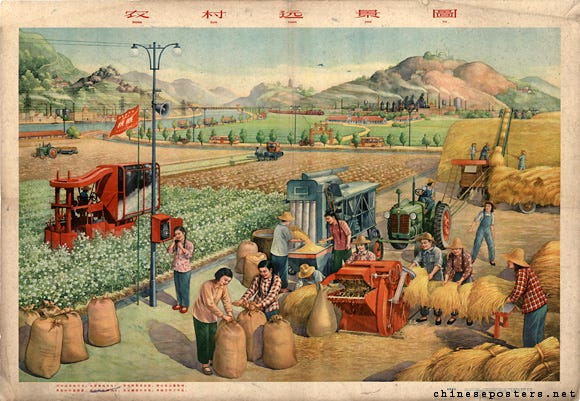
“The future prospects of the village 农村远景图,” Great Leap Forward poster, 1958. Source.
Under Deng Xiaoping, China was undoubtedly an autocracy, but it was moving away from Mao’s totalitarianism towards a more authoritarian society. For people living there, this shift made a huge difference. The incentive effect comes from that movement.
Imagine an entrepreneur in 1978. They wouldn’t be deterred by the lack of Western-style institutions. Instead, they would be encouraged by the fact that they could now start a business without fear of arrest, unlike in 1976. The incentive effect came from China becoming less autocratic, not from being autocratic.
As a policy question, the real issue is whether to move the country more towards or away from autocracy, even if the decision isn’t about fully embracing democracy.
Jordan Schneider: Can we relate this to your personal history? If you were born five or ten years earlier, do you think you would have even bothered learning English? How did this change in the political climate reflect in your youth, particularly in terms of learning and the drive to acquire knowledge?
Yasheng Huang: In my personal case, I was always interested in knowing more rather than less, regardless of the environment. After coming to the US, I spent hours in the library reading Western writings about China, particularly about the Cultural Revolution and the Great Leap Forward, because I couldn’t access that knowledge in China.
Regarding business motivations, people need to feel secure to make investments. If you know you’ll be arrested immediately after making an investment, you won’t do it. In my book, I emphasize the importance of not underestimating the incentive effect of not being arrested. Many people focus on China’s lack of secure property rights law, neglecting the fact that Deng Xiaoping significantly increased the personal security of the Chinese people. This increased security was a crucial factor in encouraging Chinese entrepreneurs to start businesses.
Ilari Mäkelä: The era after 1978 is indeed special and quite different from everything else that happened under the CCP. There wasn’t a significant rural-urban gap at the time, with rural areas growing as fast as urban areas. There was also a diversity of voices within the party, ranging from old-school economic planners to reformers like Zhao Ziyang 赵紫阳. Since you lived in China in the 1980s, could you share your personal experience of that period?
Yasheng Huang: I first came to the US in 1981, but I returned to work for the World Bank in China during the 1980s. However, my understanding of that period didn’t come from my lived experience. Like many Western observers, I didn’t have a clear view of the 1980s until I began working on my 2008 book.
After publishing a book on foreign direct investment (FDI) in 2003, I was left with the question — what was driving Chinese growth in the 1980s, before FDI became crucial? This led me to research the 1980s extensively for my 2008 book, Capitalism with Chinese Characteristics, which is also summarized in my 2023 book.
I discovered that reforms in rural China went far beyond agricultural reforms. There were contracting reforms, land reforms, village elections, and even rural financial liberalization. I was astonished by how proactive the Chinese leadership was about rural financial liberalization. Top officials from various banks were issuing support for these reforms.
Large-scale financial institutions developed extremely fast in rural areas during the 1980s. This affected 800 million people, as China was 80% rural at the time. Yet, Western scholarship largely ignores this period. The prevailing narrative is that China grew without financialization or with a state-owned financial system, disregarding the extensive documentation and statistical analysis showing otherwise.
It’s frustrating and saddening that there’s so little curiosity about this crucial period in China’s development, despite its immense impact on hundreds of millions of people.
Ilari Mäkelä: You’ve piqued my curiosity. Before we discuss what happens next and why this trend doesn’t continue, I’d like to ask a question. I mentioned earlier that one of the interesting aspects of the ATS is that it’s not always a matter of the CCP making decisions based on a grand strategy. Often, it’s because there is no grand strategy. There are internal power struggles, such as Deng Xiaoping versus Chen Yun 陈云, or Zhao Ziyang versus Li Xiannian 李先念. Based on your research into those documents, to what extent was this a unanimous decision in Beijing versus the liberal factions of Hu Yaobang 胡耀邦 and others being able to operate under the cover of confusion?
Yasheng Huang: People like Hu Yaobang and Zhao Ziyang didn’t suddenly decide to implement financial liberalization. What’s remarkable about 1980 is threefold.
There was political fragmentation at the very top, as you mentioned.
The policy ethos was focused on tangibly improving people’s lives rather than solely on GDP growth. Any policy or practice that improved people’s lives was considered the right approach by definition. For example, small-scale sellers on Beijing streets selling chickens and various goods were allowed because it improved their lives by providing income.
There was a prevalence of initiative-taking. A concrete example is the Rural Credit Foundation, an almost national-scale rural financial institution. The central bank refused to recognize it, fearing disruption of financial control. However, the Minister of Agriculture stepped in and provided legitimacy. Such local bureaucratic initiative is unimaginable in China today or even in the 1990s.
These practices weren’t initiated by Deng Xiaoping, Zhao Ziyang, or Hu Yaobang. Deng Xiaoping famously said about township and village enterprises, “The Central Committee of the Chinese Communist Party takes no credit for it. It was a total surprise to us.” Essentially, there was space for organic and spontaneous practices, which almost entirely disappeared, especially in rural China, after 1989.
Jordan Schneider: Let’s discuss 1989 then. You have this concept of axiomatic legitimacy, where after 1500 years of imperial rule over the broader Chinese landmass, people expect and defer to the legitimacy of the center, except during rare occasions like dynastic falls or major invasions. Professor, to what extent do you believe a counter-revolutionary reaction was inevitable?
Yasheng Huang: I don’t believe 1989 was inevitable. I concede that China’s post-1989 direction was more likely than before, but it wasn’t 100% determined by axiomatic legitimacy. Every culture starts with certain presumptions. In Chinese culture, due to history and autocratic rule, there’s a presumption that whatever the government does is legitimate and beneficial to individual welfare.
This view was present in both the 1980s and 1990s. The difference lies in the ability to question and debate these presumptions in the 1980s. Sometimes, you might end up with the same view you started with, which is fine. However, the opportunity for discussion and inquiry existed.
In contrast, without freedom of discussion or what Amartya Sen called “discussion democracy,” people tend to maintain their initial views without examination.
This is evident today, where many young Chinese people, even those living in the West, refuse to engage in different mental processes and cling to their axiomatic views.
Jordan Schneider: The real question is whether a discussion democracy can exist under CCP rule. Is it possible to have a system where people like young Yasheng Huang can question the legitimacy of Beijing’s rule? Can a governing body be comfortable with this level of questioning, or was the 1980s an anomaly due to the aftermath of Mao’s era, which ended when the system responded to people asking too many questions?
Yasheng Huang: I’m of two minds on this issue. It’s debatable whether 1989 was an inevitable result of a looser autocratic system or a consequence of individual decisions by leaders and students. When I study history, I’m struck by how often individual events shape its course.
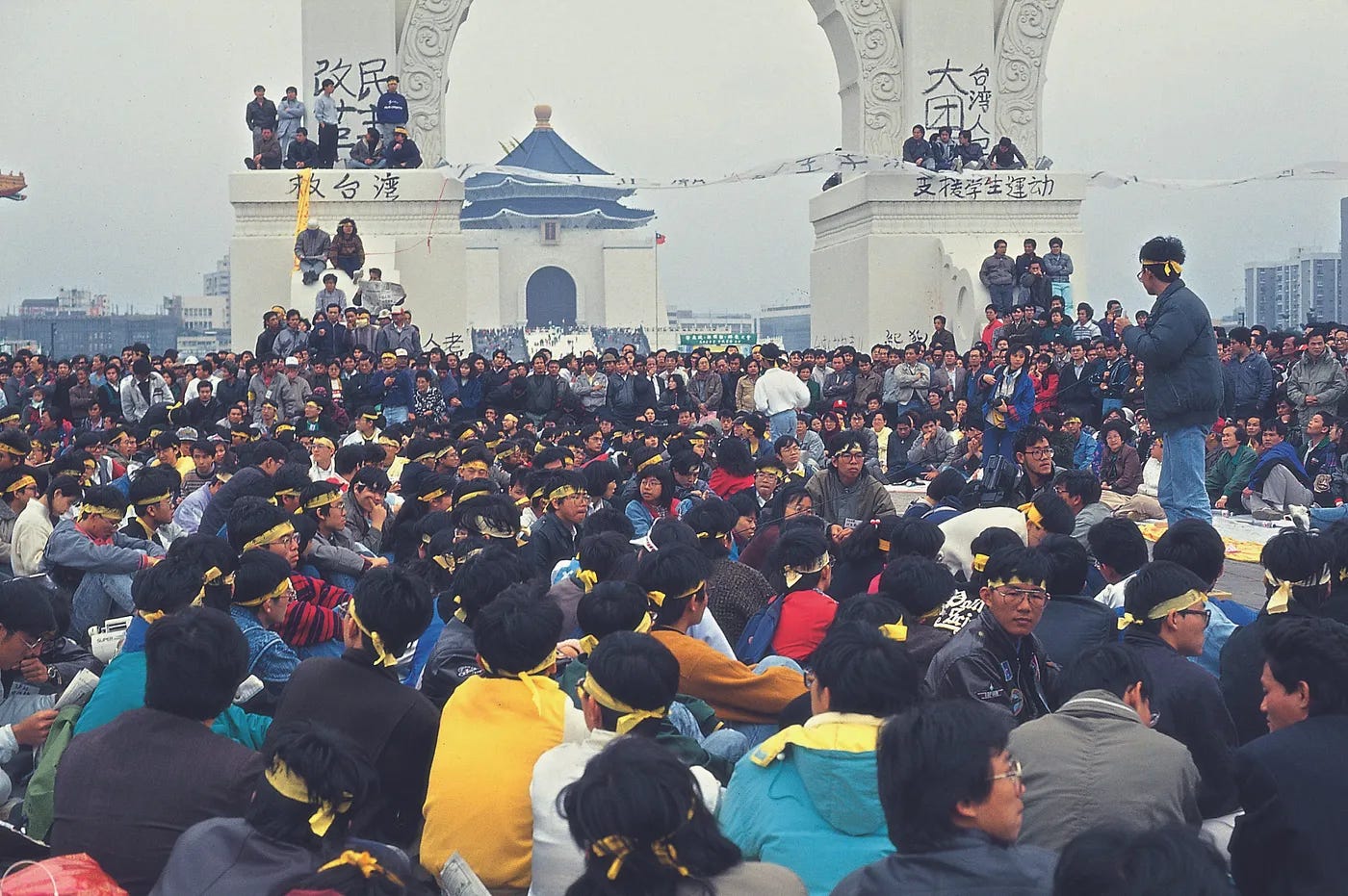
Looking at Taiwan and South Korea, both experienced massacres but didn’t reverse their economic and social progress. At some point, their leaders decided to let go and allow change.
Taiwanese students protesting for democracy at Chiang Kai-shek Memorial Hall, March 1990, during the Wild Lily movement 野百合學運. Source.
Today, Taiwan and South Korea are vibrant democracies, arguably performing better in some aspects than Western democracies.During the pandemic, for example, people in these countries trusted their governments more readily.
Regarding China in the 1990s, it wasn’t necessarily imperative for the regime to reject all political reforms proposed by Zhao Ziyang. Hu Jintao moved China further in a statist direction, and Xi Jinping continued this trend. I attribute much of the blame to the leadership that came to power in China after 1989, whom I refer to as the “Shanghainese” due to their origins and viewpoints.
This new leadership focused on globalization, privatization, and urban development while neglecting rural areas. They viewed the countryside as a burden, believing peasants couldn’t contribute significantly to GDP growth or technological development. This perspective shaped the “China model” of urban development, high-tech industries, and infrastructure that we see today. The rural reformers, including Zhao Ziyang, were sidelined or marginalized in the aftermath of Tiananmen.
Ilari Mäkelä: I’d like to challenge your earlier statement that 1989 wasn’t that important. It seems it could be the most crucial event. The conservative old guard wanted to maintain their way, while Deng Xiaoping aligned with liberal reformers like Hu Yaobang and Zhao Ziyang. The Tiananmen Square protests allowed the conservative faction to drive a wedge between the political and economic liberals and Deng Xiaoping, who appeared to be an economic liberal but a political conservative.
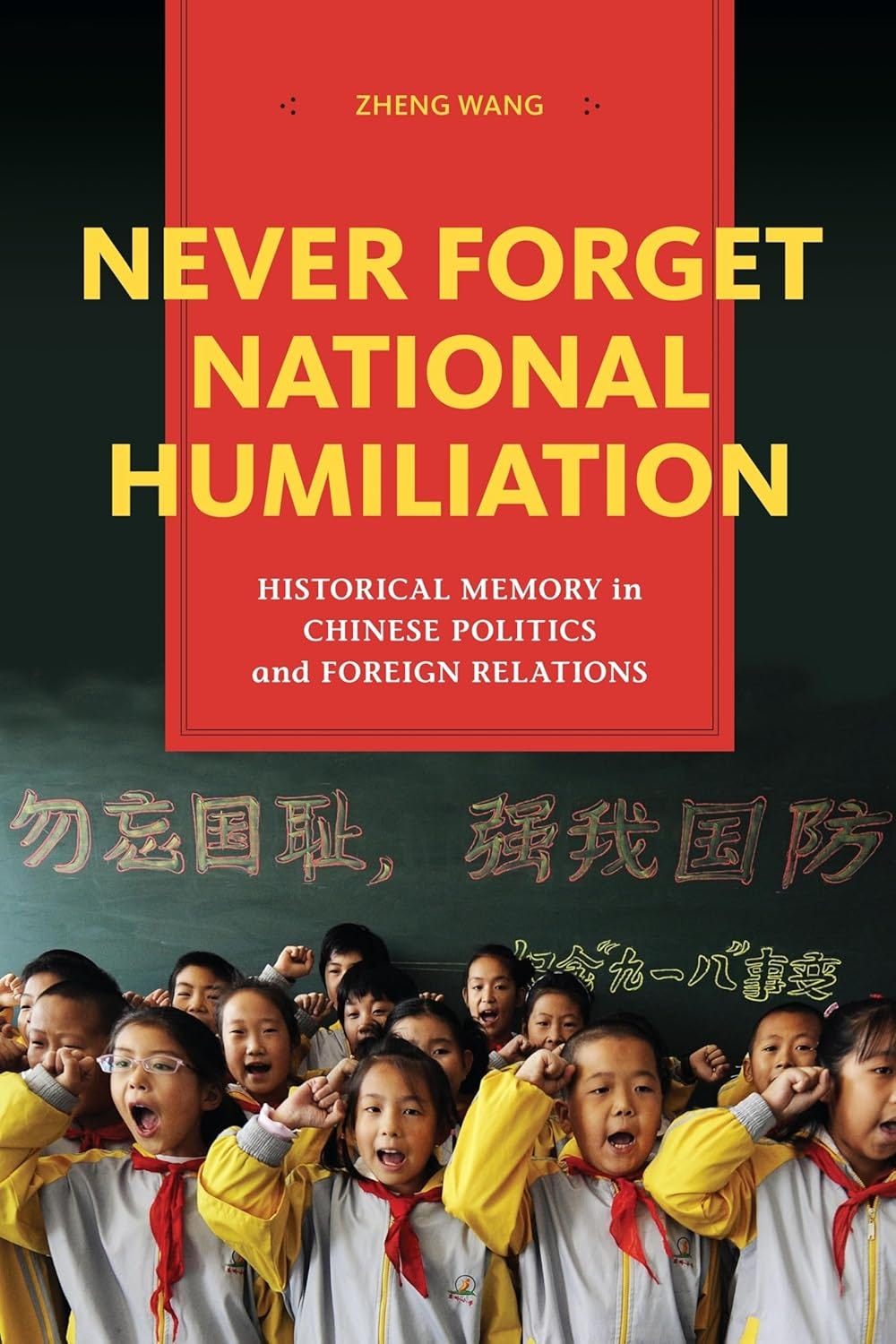
This shift resulted in everything you described, but it also led to another significant change. You mentioned the ideologically stubborn youth in China today. Some argue this is also a post-Tiananmen symptom. The government decided to emphasize ideological training over economic focus. New curricula were introduced, emphasizing national humiliation. Wang Zheng’s 汪铮 book, Never Forget National Humiliation,discusses how this phrase became a classroom mantra for Chinese children.
The words on the board say, “Never forget national humiliation, unyieldingly defend our homeland 勿忘国耻,强我国防” and, “September 18th incident 九一八事变,” which refers to the Japanese false-flag operationstaged as a pretext to invade Manchuria.
The narrative of Chinese humiliation and rejuvenation under the Communist Party became a way to prevent another Tiananmen Square incident. By teaching children about the horrible past and the great present, while instilling suspicion of foreign influence, the government shaped a new generation. The Xi Jinping era seems to be a natural progression of two trends — nationalism in textbooks and the lack of political pluralism in the CCP.
Yasheng Huang: I apologize if I wasn’t clear earlier. I absolutely believe that 1989 was extremely important. In fact, I think it was more significant than many scholars have acknowledged. They usually recognize its political impact but overlook its economic consequences. In my revised 2008 book, I presented statistics demonstrating that Tiananmen also had substantial economic effects.
The question is whether it had to turn out this way. There’s an unconfirmed rumor among Chinese intellectuals that Deng Xiaoping considered inviting Zhao Ziyang back at one point. If true, and if Zhao had returned, would China have taken such a divergent path? My observation is that while there was a 90% chance of China ending up this way, there might have been a 10% chance that leaders weren’t as constrained by 1989 and could have continued reforms.
Taiwan and South Korea, for instance, had their own massacres but managed to move on. Perhaps some distance from the event is necessary. However, China remains stuck in a Tiananmen mindset long after the event, which I believe is largely, but not entirely, determined by Tiananmen.
Jordan Schneider: The key issue, relating to your lifespan argument, is that reform in Taiwan and South Korea occurred after the death of their autocratic leaders. China’s problem was that it had more people with charismatic, revolutionary legitimacy who lived exceptionally long lives. If Deng Xiaoping and Chen Yun hadn’t been around in the late 1980s, the slightly younger generation, more open to different political perspectives, might have had more power. My counterfactual is that if Tiananmen had happened in 1994 or when these older leaders were more incapacitated or absent, the balance of power within the system might have been different. Even after Mao’s death, there were still enough people with strong beliefs in the old system and charismatic credibility to maintain their influence, preventing the new generation from asserting themselves.
Yasheng Huang: I agree with your analysis about the overlapping generations, which was absent in Taiwan and South Korea. Interestingly, the Cultural Revolution profoundly affected many revolutionary elders. While many were staunch conservatives, a few were quite liberal – more so than the technocrats who came to power in the 1990s. They were willing to think about issues systemically, which is how I define liberalism: considering solutions at a system level rather than focusing solely on leadership changes.
Take Xi Zhongxun 习仲勋, Xi Jinping’s father, for example. He was liberal not just in supporting liberalization but in making procedural arguments. At the Politburo meeting that ousted Hu Yaobang, he argued that the process violated agreed-upon rules. This was a revolutionary way of thinking in such a system, more profound than simply advocating for a market economy or democracy. His insistence on process and rules was more revolutionary than economic liberalization, although ultimately, he was defeated.
The lesson China should have learned from the Cultural Revolution was that it wasn’t just Mao’s mistakes, but the system that allowed him to make those mistakes.
Earlier Chinese Communist Party documents reflecting on that period showed this understanding. They instituted some separation of powers, with the presidency and party secretary general held by different individuals. However, this lesson was forgotten after 1989 when Jiang Zemin was brought to Beijing. Worried about his weakness, they abolished other power centers to consolidate his authority, leading to the China we see today.
Jordan Schneider: Professor, I searched for your name in Chinese and found many English language interviews about your book, but only one in Chinese. Have you considered starting your own YouTube channel or podcast series?
Yasheng Huang: I’m not very good at that, to be honest. It’s worth noting that before Xi Jinping, and even during his first term, I did many interviews with Chinese media outlets. I could go into great detail about data and evidence, much more so than with Western media. I was very impressed with the quality of Chinese financial journalism. However, the situation has changed now, not because the quality has declined, but because the political environment has shifted.
Ilari Mäkelä: Let’s examine China today then. In some ways, Xi Jinping seems to be a natural progression of these trends…
In part 3 we discuss the rise of Xi, succession dynamics, and prospects for liberalization in China’s future
We discuss…
The Steelman case for why China needed a leader like Xi Jinping,
What sets Xi apart from his predecessors,
Succession challenges in authoritarian states and likely scenarios post-Xi,
Why engagement with China failed to produce political liberalization,
How the US could have better leveraged economic relations with China,
Creative approaches to human rights advocacy in China...