Mostrando postagens com marcador Chris Miller. Mostrar todas as postagens

terça-feira, 30 de dezembro de 2025

Does Manufacturing Matter? - Chris Miller (China Talk)

 Um importante artigo sobre os mitos e verdades da desindustrialização e as novas estruturas da competividade internacional entre grandes atores (o Brasil não se qualifica nesse cenário). PRA

Does Manufacturing Matter?

Chris Miller with a guest post on goal-setting for industrial policy

While 2025 was, in USTR Jameison Greer’s phrasing, “the year of the tariff”, industrial policy served as a strong leitmotif. From the US-China rare earths saga to equity stakes, golden shares and prepurchase agreements, Trump 2.0 has wholly embraced the sort of muscular intervention into private markets that would have made the GOP of just a decade ago cry bloody murder.¹ Looking past this administration, JD Vance and Rubio, the two 2028 nominee frontrunners, both have Senate track records filled with bill proposals around industrial banks and domestic manufacturing promotion.

But for all the motion around creative applications of industrial policy in America, it’s been surprising to me how little thought has been applied to the big questions around these swings. Key questions I see unanswered include: 

  • What should the long term goals of national industrial policy be?

  • What does it mean to be an economically secure nation? Where should marginal dollars be spent to promote economic security? 

  • Just how important is manufacturing relative to services? 

  • What are the tradeoffs involved in furthering these aims?

To kick us off, Chris Miller, Chip War author and reigning belt holder for most ChinaTalk appearances, published an excellent piece on what the core policy questions are for industrial policy. We’re rerunning this from his exellent new substack below.

Exploring these themes will be a focus of our coverage in 2026. Look out for essay contests coming in the next few weeks on this theme. Leave in the comments your ideas for what our first prompts should be!


The Economist, in a recent survey of Europe’s economic woes, sparked a minor controversy by urging the continent to adjust to intense Chinese competition in manufacturing by reorienting toward services. “De-industrialization,” it argued, “need not be synonymous with decay.”

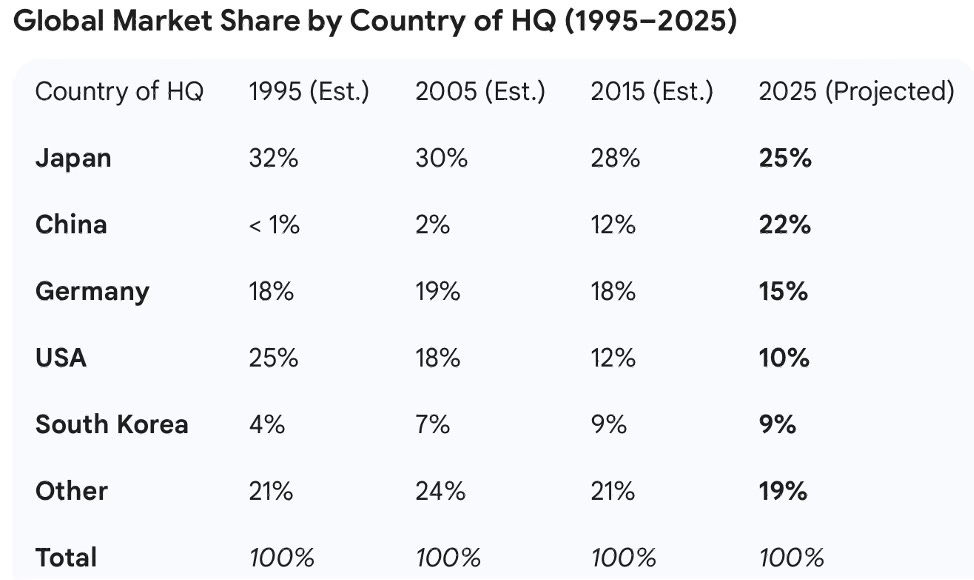
The argument goes like this: rich economies are rich because of high value-add services. America is the least industrial (measured by manufacturing as % GDP) of all big economies, but also the richest. One reason that Germany and Japan are relatively more industrial is because they never developed much of a software industry. They’re more industrial partly because their manufacturers are relatively more successful (eg, their auto firms retained more market share the US ones over the past few decades) but also partly because they’ve underperformed in high value services.

Here’s auto manufacturing, where the US has dramatically underperformed the trend (data from Gemini):
And here’s software market cap and market share, also from Gemini. Ask “would you rather have: 1) a world in which GM performed as well as Volkswagen over the past 30 years or 2) Silicon Valley?” the answer is obvious.
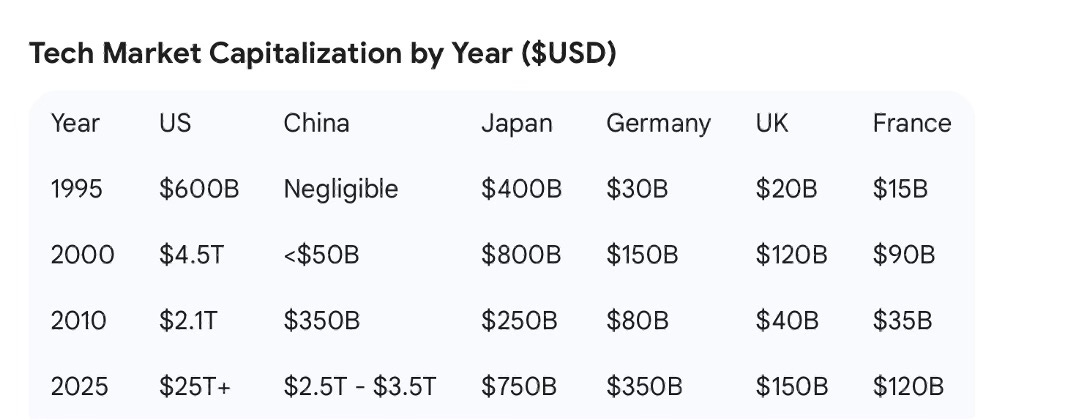
Perhaps that’s an unfair phrasing of the question, assuming that the only options were to either double down on an aged-out industrial base or to deindustrialize in favor of software.

Was there an alternative? Peter Thiel has quipped that we were promised flying cars and instead got 140 characters. Could we have redirected talent to produce less social media and more SpaceX? I’m unsure, though I’d note that Elon’s initial fortune came from enabling online shopping (PayPal) and Peter Thiel was an early Facebook investor. Palmer Luckey founded Anduril after he’d already sold a business to Facebook. It’s not easy to separate America’s titans of deep tech from the profits of the internet economy.

I’m a supporter of the “reindustrialize America” impulse. But I also haven’t seen clear thinking around the tradeoffs it implies. We need to prioritize when allocating people, dollars, and other scarce resources. So whether and when does manufacturing matter? Here are some ideas.

  1. Jobs

I find completely unconvincing the theory, commonly hawked by politicians of both parties, that manufacturing is a good source of “jobs.” Even supposing that it’s true that manufacturing jobs pay better than service sector jobs on average (I haven’t yet parsed this data carefully), manufacturing is only ~10% of employment in the U.S. and so a 20% increase in manufacturing employment will be negligible at the economy-wide level. Moreover, the only way to manufacture in the U.S. cost effectively is to aggressively automate. So as a theory of policy, “manufacturing is good for jobs” makes no sense.

  1. Driving productivity growth

I also don’t think much of the theory that you need a big manufacturing sector to drive productivity improvements in an advanced economy. If that were true, Germany would be richer and America poorer. But America has deindustrialized (manufacturing as % GDP) even as its economy has outperformed. I’m open to the idea that developing economies sometimes need manufacturing to drive productivity growth—a debate that has huge ramifications eg for India, but none for the United States.

The tech sector is a useful case. As Patrick McGee argues in Apple in China, America’s largest consumer tech firm is inextricably intertwined with China-based manufacturing. Perhaps hopelessly so. I worry a lot about the geopolitical implications of this. But I don’t worry much about the economic implications.

A decade or two after “capturing” Apple, Chinese firms still haven’t captured much economic value. Around a quarter of the bill of materials of an iPhone accrues to China-based suppliers, but generally for the lower margin components. A lot of the higher value manufacturing done in China is in factories owned by foreign firms, as Vishnu Venugopalan and I have explored.

Apple still makes ~50% margins across the iPhone business. It makes ~80% of all global profits from selling smartphones, despite selling only a fraction of the world’s phones. Chinese brands—Oppo, Vivo, Xiaomi, Honor, etc—dominate the industry by units sold. Most of the world’s phones are assembled in their neighborhood. But these companies haven’t found a way to make much money. Samsung’s done better than the Chinese firms at profitability, but far worse than Apple, despite that Samsung is much “closer” to the manufacturing process, making displays, memory chips, logic chips, and other components itself. In other words, the smartphone company furthest from the manufacturing has made the most money, now for nearly two decades. It’s actually pretty shocking.
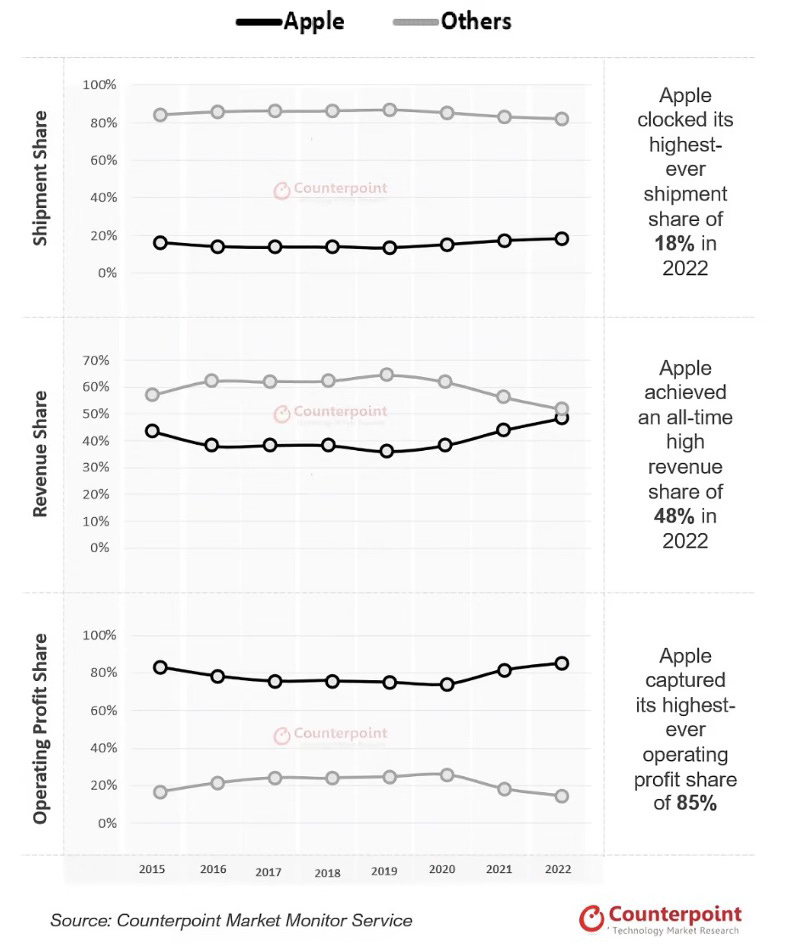
If you assume away geopolitics—which of course we can’t, more on this below— smartphones suggest that there’s no generalizable link between manufacturing, productivity improvements, and value extraction. I’m open to this dynamic existing in certain industries, but it doesn’t seem like a strong case for broad-based support for manufacturing.

  1. Defense and geopolitical leverage

The best argument against The Economist’s embrace of deindustrialization came from Sander Tordoir, who wrote in a letter to the editor: “Europe will need drones and tanks, not just consultants.” The ability to make stuff has military and geopolitical importance.

The claim that manufacturing matters for geopolitical power is obvious in the abstract. We’ve all studied the “arsenal of democracy.” We’ve lived through economic warfare around manufactured products like chips and magnets.

Yet the policy relevant question is not “is manufacturing geopolitically useful?” but rather “given resource constraints and a preexisting factor allocation, how much should we spend to boost our manufacturing capabilities? Should we target a) pure defense, b) dual use, c) chokepoints, or d) across-the-board civilian production?”

We haven’t put much collective thought into the answers. We agree that chips and magnets matter, while t-shirts don’t. What we disagree about is everything in between.

Here’s President Trump:

I’m not looking to make t-shirts, to be honest. I’m not looking to make socks. We can do that very well in other locations. We are looking to do chips and computers and lots of other things, and tanks and ships.

And CFR President Michael Froman (and former USTR) on ChinaTalk earlier this month:

Can we take T-shirts and sneakers and toys from China without compromising our national security? I would think so.

The problem is, there’s a whole lot of manufacturing that falls in between t-shirts and rare earth magnets. Of America’s ~$2 trillion in imports, only ~7% is textile products like clothes and furniture (using the excellent Atlas of Economic Complexity’s trade categorization.) Agricultural products are something similar. Toys are less than 2%. Games are 0.3%, sporting equipment 0.2%, and Christmas decorations are 0.14%. In other words: take out toys, textiles, t-shirts, and the like, and the U.S. is still importing a ton of manufactured goods.

The key remaining categories by complexity and scale are: cars, computers, phones, a wide variety of industrial and electronic machinery, chemicals and metal products. If you want to say something serious about reindustrialization, you need a view on these good. Should we be producing more of them?

Here’s a visualization: green goods are deemed by Harvard’s Atlas of Economic Complexity to be “complex” goods—roughly, high value. The yellow are simpler things produced by a larger number of trading partners, that are lower value and at lower risk of monopolization. As you’ll see, there’s a lot of green.
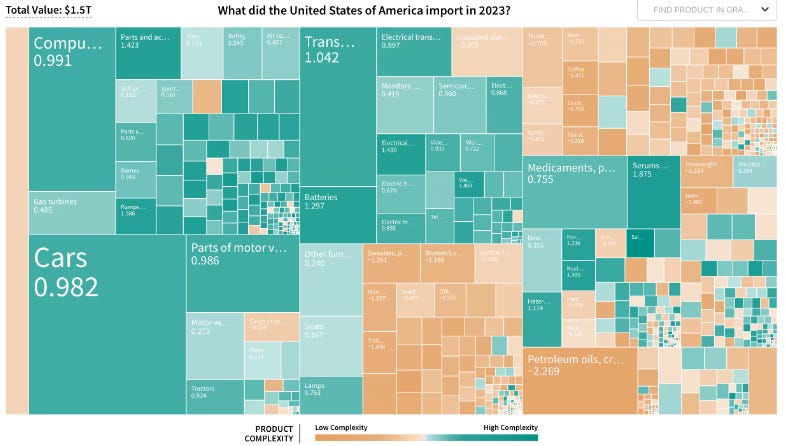
The scale of imported manufactures—including relatively complex, relatively higher-value added goods—illustrates the scale of trade offs around reindustrialization efforts. For reckoning with these trade offs as they relate to national security, I see a couple of hard-to-answer empirical questions.

  1. What’s the risk a given product can be monopolized and used for leverage, like China’s done with rare earth oxides and magnets this year?

Economists have produced rough estimates of elasticities, but you often need deep supply chain knowledge to fully understand these dynamics. If it were easy, we wouldn’t see so many supply chain disruptions in the auto industry.

  1. How shiftable is manufacturing capacity in a crisis?

One of the arguments in favor of building industrial capacity is that it can be repurposed if needed. Ford made tanks and planes during World War II. Yet how generalizable is such repurposing?

  1. How tightly linked are today’s manufacturing ecosystems and tomorrow’s?

If losing today’s manufacturing capability also prevents a country from making tomorrow’s key products—and if benefits accrued not to a specific firm, but to a broad ecosystem—it might be reasonable to subsidize it. How strong are these ecosystem effects? Some good historical examples:

  1. What’s the opportunity cost?

Even acknowledging the scale of China’s manufacturing dominance and the incapacity of our defense industrial base, we still must ask whether a marginal dollar is best spent on trying to shore up our manufacturing base versus buying defense-specific or other capabilities. Not that I wouldn’t gladly take some more manufacturing capacity, if it were free. But it isn’t. We’re constrained by labor, electricity, capital, etc, as anyone building a factory in the U.S. will immediately report.

1

See the recent riff I had refelcting on Solyndra with Rahm Emanuel. Rahm: To your point about socialism — Solyndra. We invested in this new solar firm and everyone’s like, “Oh my God, oh my God!”, and here are these guys investing in and putting public money in companies with zero operating capacity.”

A guest post by
Chris Miller
Chris Miller is author of Chip War: The Fight for the World’s Most Critical Technology, a New York Times bestseller, a professor at the Fletcher School and a nonresident senior fellow at the American Enterprise Institute.


quarta-feira, 18 de maio de 2022

Uma nova forma de sanção econômica contra a Rússia: um preço-teto para o seu petróleo - Edward Fishman and Chris Miller (Foreign Affairs)

 The Right Way to Sanction Russian Energy

How to Slash Moscow’s Revenues Without Crippling the Global Economy

Edward Fishman and Chris Miller

Foreign Affairs, Nova York - 17.5.2022


Western sanctions are beginning to hit Russia where it hurts most: its energy exports. Over the last few weeks, the European Union, the biggest buyer of Russian oil, has been working on a plan to ban imports by the end of this year, although objections by Viktor Orban of Hungary have slowed progress.

For energy sanctions to work, however, they must be carefully designed to hurt Russia more than they hurt Western states. Their primary goal should not be to cut the volume of oil and gas leaving Russia, which would further drive up world energy prices and endanger domestic support, but to reduce the dollars and euros flowing into Russia. Moving forward, the EU should therefore focus collective efforts on a more ambitious approach: partnering with the United States and other allies to impose a global regime, backed by the threat of secondary sanctions, to cap the price of Russian oil and slash the Kremlin’s revenue. 

Prior rounds of sanctions against Moscow restricted investment and technologies destined for Russia’s energy sector, targeting the country’s refineries and its construction of liquefied natural gas infrastructure. Canada, the United Kingdom, and the United States also banned Russian energy imports, but this had limited impact because all three were small consumers of Russian oil and gas. Until recently, the biggest buyer of Russian energy—the EU—not only declined to sanction energy exports but also designed its financial sanctions to explicitly allow Russian fuel to keep flowing.

But now, the Russian-European energy relationship is unraveling. On top of its discussions about phasing out Russian oil imports, the EU also announced plans to completely end Russian natural gas imports over the coming years. Europe buys slightly over half of all Russian exports of crude oil and refined products such as gasoline, diesel, and jet fuel. Taxing these exports, meanwhile, currently provides around a quarter of Moscow’s budget. The EU effort to halt Russian oil purchases therefore represents a dramatic and welcome shift in the global response to Russia’s invasion.

But Europe’s plans also pose a challenge for Washington. Thus far, the United States has declined to impose the toughest sanctions on Russian energy, including the kinds of secondary sanctions that have been used against Iran to limit oil sales to third countriesThis reluctance is explained by the Biden administration’s deference to the EU on matters affecting Europe’s energy security and concerns that reducing global oil supplies would send gasoline prices—and thus inflation—spiraling higher. But now that many Europeans are signaling that they are serious about cutting off Russian energy imports, the United States and its allies need a coordinated strategy. Together, they must figure out how to slash Russian energy revenue without unduly damaging the global economy.


CUTTING RUSSIAN REVENUE


If Washington and its allies are to make good on their intent to sanction Russian energy effectively, they will have to deal with a difficult dilemma. Russian tax revenue from oil is a function not only of the number of barrels sold, but also their price. The United States and Europe have plenty of tools to reduce Russia’s ability to sell oil, but the price is set on global markets. Because of the risk that sanctions pose to potential buyers, Russian firms must now sell their oil at a more than $30 per barrel discount on current world prices. But since the price of oil has increased substantially over the last 12 months, Russia is making roughly the same amount per barrel as it was a year ago. 

In other words, sanctions have a complex and contradictory effect on the world’s second-largest oil exporter. The more they succeed at taking Russian supply offline, the higher the world price of oil goes. This is particularly true when there are few immediate alternative sources on the global market to replace the lost Russian supply—precisely the current situation.

The EU’s embargo will exacerbate this dynamic by substantially reducing the amount of Russian oil reaching world markets. Most of Russia’s oil exports are sent abroad via ship, so they can, in theory, be sold anywhere. In practice, however, because around half of Russia’s exports of crude oil and refined products go to Europe, most shipborne exports touch European commodity traders, shippers, and insurers. EU sanctions threaten to prohibit Moscow’s use of some of this infrastructure, limiting Russia’s ability to ship oil to other potential customers.

Although there is some uncertainty about the impact, forecasts suggest that Russian exports would decrease by around 2 million barrels of oil and refined products per day if the EU halts all purchases. Russian government officials have given similar forecasts, foreseeing a 17 percent decline in Russian oil production this year. Given that Russia exported slightly less than eight million barrels of crude and refined products per day before the war, this is a substantial hit, and a meaningful reduction in world oil supply. For the Kremlin, however, such a decline is significant but far from catastrophic, as reduced production will inevitably drive oil prices higher. 

For energy sanctions to put real pressure on Russia’s government budget, they need to cut deeper. In April, according to the Russian Ministry of Finance, the government made around half a billion dollars per day taxing oil, roughly a quarter of Russian government revenue. A 17 percent decline in this figure would be painful but manageable. Moreover, because oil is priced in dollars, if the Russian government lets the ruble decrease slightly in value, it can reduce the impact of lower oil taxes on the government budget because each dollar of oil revenue will buy more rubles. In other words, although an EU embargo would be painful for Russia, it would be survivable. This is why Western countries need a new global framework—one that systematically reduces the price of Russian oil while keeping it flowing.


A REVERSE OPEC


Reducing the price of Russian oil while still allowing Moscow to sell significant volumes abroad would curtail the Russian government’s revenues without increasing global oil prices. A price reduction would hit Moscow directly, swiftly reducing the hard currency flowing into the Kremlin’s coffers. And if it were structured in the right way, the price cap would also provide incentives for everyone, including China, India, and even Russia itself, to comply.

To understand how, it is important to consider the tremendous leverage the United States, Europe, and other allies have over Russia’s oil sector. Currently, Europe accounts for roughly half of Russia’s sales of oil and refined petroleum products. Outside of Europe, other large buyers include Japan and South Korea, both of which have signed onto sanctions against Russia and should be amenable to measures that curb the Kremlin’s revenues.

The key to limiting the price of Russian oil is for these allied countries to band together and dictate terms. Think of it like a reverse OPEC: instead of wielding control over supply to set prices, the allies could leverage their control over demand to do the same. OPEC’s power is rooted in the fact that its members produce about 40 percent of the world’s oil. Europe, Japan, South Korea, and other members of the sanctions coalition account for an even greater share of Russia’s oil sales, roughly 60 or 70 percent. Members of the group, moreover, play critical supporting roles in Russia’s shipborne oil exports, from ports to shipping to maritime insurance. These links provide them with additional leverage beyond their purchasing power.

These states could form a buyers’ club that publicly announces a price cap for Russian oil. There’s room for debate about the right price, which would need to be high enough to keep Russia selling. Oil trader Pierre Andurand has proposed $50 per barrel, whereas financier and energy expert Craig Kennedy has suggested as low as $20. So long as the price is slightly above the marginal cost of production, Russia has every reason to keep shipping. In prior periods of low prices, such as 2014 and 2020, Russia continued to export roughly constant volumes of oil. Although Russia could theoretically halt exports, its storage facilities are already mostly full. The Kremlin’s only alternative to selling on the cheap is to shut down production and watch its most critical industry go into a deep freeze while its tax revenue collapses.

Would other buyers agree to a price cap? Beyond the sanctions coalition, the biggest buyer of Russian oil is China, which generally consumes around 15 percent of Russia’s exports, largely via pipeline. Historically, India has not been a major buyer of Russian oil, but it has more than doubled its purchases in recent months to take advantage of discounted prices. Russia also sells oil to many other countries, such as Lebanon and Tunisia, but they are small buyers and can acquire the oil they need from alternative sources.

To bring these other states on board, the United States, Europe, and East Asian allies could enforce compliance by using sanctions to throw sand in the gears of Russian oil shipments that violate the price cap. They could start by imposing full-blocking sanctions on vital nodes in Russia’s oil sales, including Rosneft, the state-owned oil giant; Gazprombank, the main bank serving Russia’s energy sector; and Sovcomflot, Russia’s largest shipping company. At the same time, the United States and others could provide exemptions for oil shipments that comply with the price cap. Such a regime would make it prohibitively risky for global banks and companies to deal with those entities, unless the underlying transaction abides by the price cap. The dire risk of sanctions violations would compel firms involved in such transactions to insist on clear documentation demonstrating that oil cargoes are compliant.

Additionally, allied states could wield the threat of secondary sanctions against non-Russian companies involved in prohibited oil sales. For instance, if a Chinese or an Indian firm were to buy a shipload of Russian oil for a price above the cap, Western states could threaten sanctions against the shipping company that transports the oil, the insurance company that underwrites the cargo, any port operator that provides services to the tanker, and the banks that process associated payments. The same governments could also make it illegal for U.S. and EU firms to provide any of these services, making it very difficult for such a sale to proceed. The risk involved would force Russia to sell at even greater discounts than at present, in effect enforcing the price cap.

The United States used a similar regime to curb Iran’s oil exports, slashing Tehran’s oil sales by more than 60 percent and locking tens of billions of dollars of revenue in escrow accounts. A price cap on Russian oil would be more complex because Russia is a bigger supplier of oil, with more sophisticated international trade and financial linkages. Yet, compliance would not solely rely on the threat of sanctions. Critically, there would also be a positive incentive to comply: buyers of Russian oil would benefit substantially because abiding by the price cap would lower the cost of their own imports. Challenging the cap would be rife with financial risk and carry no economic benefit—it would be charity to the Kremlin. Amid the tightest world energy markets in years, there is little reason to believe Russia’s oil customers would be in a charitable mood.

Currently, only three major importers of Russian oil stand outside the sanctions coalition: China, India, and Turkey. China can continue to import Russian oil via a pipeline that is practically immune to sanctions. This pipeline, however, represents only a small share of Russian oil exports. Because the pipeline operates at capacity, if China wanted to significantly increase its imports of Russian oil, it would need to do so via ship, which already accounts for more than half of Chinese imports of Russian oil. Moreover, as the average price of Russian oil falls, China will likely negotiate a harder bargain for piped oil, further cutting into Moscow’s bottom line. India and Turkey, on the other hand, import much of their oil from Russia via shipping routes that are exposed to Western sanctions. Both are also economically vulnerable to high oil prices and would benefit greatly from lower prices. Although it is unlikely that either would publicly welcome a price cap, both would probably abide by it.

A price cap would be a major innovation in the use of financial sanctions. Given the challenges of sanctioning Russian energy exports, a traditional embargo applied globally would be difficult to implement and, even if it were possible, would send energy prices soaring. The United States and its allies would be better served by focusing on the goal of slashing Russian revenues while keeping enough Russian oil flowing to avoid a massive price spike. Imposing a reverse OPEC price cap on Russia, backed by Western sanctions, would benefit consumers the world over while focusing pressure on the petrodollars flowing into Putin’s coffers. 


EDWARD FISHMAN is an Adjunct Senior Fellow at the Center for a New American Security, a Nonresident Senior Fellow at the Atlantic Council, and an Adjunct Professor of International and Public Affairs at Columbia University. He served as a member of the Policy Planning Staff and as Russia and Europe Sanctions Lead at the U.S. Department of State from 2014 to 2017.


CHRIS MILLER is an Assistant Professor at the Fletcher School and Jeane Kirkpatrick Visiting Fellow at the American Enterprise Institute.

Postagem em destaque

Livro Marxismo e Socialismo finalmente disponível - Paulo Roberto de Almeida

Meu mais recente livro – que não tem nada a ver com o governo atual ou com sua diplomacia esquizofrênica, já vou logo avisando – ficou final...