A China na conferência da paz de Haia 2, 1907
This Week in China’s History: Qing Diplomats Chafe over China’s Relegation to “Third-Class State” at the Hague
(September 22, 1907)
JAMES CARTER
Sinica, September 2o, 2026
The last iteration of this column found Beijing occupied by the troops of eight nations in the wake of the Boxer Uprising. Those nations had imposed on the Qing dynasty a draconian indemnity, along with other terms. The dynasty remained — somehow — in power and insisted that it continued to be one of the world’s great powers, but anyone observing would know that this was delusional. This fact was not lost on China’s representatives abroad, who on September 22, issued a memorial to the throne calling on the dynasty to immediately undertake “enlightened law reform in order to preserve sovereignty.”
The diplomats’ worry was focused specifically on discussions that had taken place in the Netherlands. There, at the Second Hague Conference on international law, concerns about China’s status in the world had been made plain in what came to be known as the “third class state incident.” Historian Ryan Martinez Mitchell in his book, Recentering the World, describes the incident as “generally forgotten in the Global North, [but] a major episode in international legal history for [China and] other then-marginalized states.”
The incident had to do with proposals to create a permanent international court, a concept that had proven difficult to implement, although numerous states endorsed the idea in concept. Details about the size, powers, and membership of such an institution remained out of reach. At the 1907 meeting, an American plan was announced for a court of sixteen or seventeen members. Membership would be assigned according to population, assuring that the world’s people would be fairly represented. A new court would be constituted every 12 years, with the eight most populous states holding the status of “great powers” and be permanent members of the court. The remainder would rotate among the rest of the world’s countries with terms of varying lengths. States would be eligible for terms of ten, four, two, and, at the low end, one year–again, based on population.
All of which would seem to suit China, as one of the world’s most populous states, quite well — even with the major if predictable caveat that the population of each state was to be assessed including its colonies. This embrace of imperialism calculated that the world’s most populous state was Britain and its empire, but even so Qing China had nearly as many people as the British empire, and was more populous than any other state by a wide margin (according to this system of counting in which, for example, India would be included in Britain’s count).
But the assembled European powers had other ideas. The “gunboat diplomacy” of the Opium Wars had been barefaced “might makes right,” but in subsequent years ...
PRA: Faltou um Rui Barbosa chinês na Haia em 1907.
segunda-feira, 21 de setembro de 2026
A China na conferência da paz de Haia 2, 1907 - James Carter (Sinica)

sábado, 12 de setembro de 2026
China’s Approach to AI in the Global South: Selling the Razor Blades, Not the Razor - ANDREW POLK (Sinica)
China’s Approach to AI in the Global South: Selling the Razor Blades, Not the Razor
ANDREW POLK
Sinica, SEP 12, 2026
Everyone keeps calling the US-China AI competition a race.
But Eric Olander, co-founder of the China Global South Project, says that framing is wrong — because a race implies a finish line, and this competition doesn’t have one.
Eric’s view is that Chinese AI companies aren’t necessarily looking to out innovate US closed-weight models.
Instead, the goal for China is to become Android to America’s Apple — 10% of the profit, but 90% of the world’s users.
On this week’s episode of the Trivium China Podcast, Eric discusses China’s approach to building AI offerings in the Global South with host Andrew Polk — but only after the two run through the flurry of travel and diplomacy Xi Jinping is undertaking throughout September.
The two discuss the implications of Xi’s travels, then turn to China’s AI strategy in the region, touching on:
How Xi turned a single stop in Egypt into a four-birds-one-stone diplomatic play, touching on the Iran war, the Israel-Palestine conflict, Africa-China relations, and the dynamics around Xinjiang all at once
Why the India-China thaw is real but fragile, and why Xi and Modi’s sideline meeting at the upcoming BRICS summit matters more than anything on the summit’s official agenda
Why China’s AI push into the Global South won’t really be about the models themselves — but about enabling those models with Huawei servers, support contracts, and services sold on top of free, open-weight code
Why the “China is less secure” pitch against Chinese AI companies doesn’t land in a Global South that trusts Washington about as little as it trusts Beijing
Why nobody in the Global South expects much from Xi’s Washington visit, and why the mood in Beijing right now is just as hardened as it is in DC
Transcript of the conversation at this link:
https://www.sinicapodcast.com/p/chinas-approach-to-ai-in-the-global?utm_source=post-email-title&publication_id=2079154&post_id=215438537&utm_campaign=email-post-title&isFreemail=true&r=8ma92&triedRedirect=true&utm_medium=email
terça-feira, 4 de agosto de 2026
Regulating Open Source - Andrew Polk, Kendra Schaefer (Sinica)
A batalha da IA Open Source já começou, e quem deve ganhar é a China:
Regulating Open Source
ANDREW POLK
Sinica, JUL 26, 2026
Xi Jinping’s speech at last week’s World AI Conference in Shanghai was an exercise in “balancing development and security.”
Xi expressed full-throated support for AI development, while indicating that regulation is moving up Beijing’s priority list.
Read together, the message was that China intends to compete hard on AI, but on its own terms, with stability ranked ahead of any near-term gains.
The bit that attracted the most attention was Xi’s reaffirmation of China’s commitment to open-source AI.
There has been growing speculation that AI safety concerns may force Chinese regulators to disallow ongoing release of open-source models.
But Xi’s message was that China isn’t going to walk away from open source.
That’s likely because the global popularity of Chinese open-source tools is a once-in-a-generation opportunity to bring the international community onto China’s AI stack – particularly in the absence of cheap, open US alternatives.
Beijing intends to press that advantage for as long as it can.
Running alongside the open-source pitch, however, was a notable elevation of regulation, ethics, and governance in Xi’s remarks.
The speech raised deep questions about practical and existential AI risk and called for new laws and risk-monitoring systems.
Beijing was already an early and fast mover on AI regulation, but Xi’s talk indicated that China will double down on AI safety, potentially placing stronger controls on both the release of new open-source models and the distribution of open model weights.
Then there was the announcement of the World Artificial Intelligence Cooperation Organization, formally launched on the eve of the conference last week.
This represents Beijing’s bid to compete with the US on global AI governance and offer the Global South an alternative to Western-led bodies.
Whether it gains traction is an open question – China’s track record on tech governance organizations is patchy at best, and the recent past is littered with abandoned Chinese-led cooperative platforms.
Zoom out from the individual announcements, though, and a bigger picture emerges: Xi believes that while AI is deeply important and transformative, it should never become so all-consuming that policymakers lose sight of what really matters.
Technology is not an end unto itself – instead, AI should serve social development and stability.
The implications of that framing are far-reaching. Beijing is prioritizing AI’s long-term development over a sprint race to build the most advanced frontier model.
Viewed through that lens, the tighter regulations, willingness to slow model releases, and the hard line on NVIDIA chip imports all begin to make a lot more sense.
The bottom line: The AI race won’t be decided this year – it is a decade-long play for who owns the AI stack that the developing world runs on, who sets the rules of global AI governance, and ultimately, whose industries make the best use of these tools for economic gain.
Kendra Schaefer, Partner and Head of Tech Policy Research, Trivium China
quarta-feira, 10 de junho de 2026
Paul Kennedy on Great Powers conflicts - Jordan Schneider (Sinica)

What a profound honor to have Paul Kennedy on the ChinaTalk podcast. Kennedy is my favorite living historian and the writer who’s most shaped my intellectual development. His analysis underpins what you hear on this show every week. The Rise and Fall of the Great Powers is an epochal work that traces global power transitions from 1500 to the present. It’s gripping, forest-and-trees scholarship at its finest. Equally impressive in different ways is his book, The Rise of Anglo-German Antagonism, 1860 to 1914. Not only is it god-tier diplomatic history, but it also gives you a feel for the era through its explorations of social, economic, domestic, political, and cultural dimensions of Anglo-German relations. There are fascinating US/China analogies that we’ll get into in this podcast. His two most recent works directly inform the military coverage on ChinaTalk. Engineers of Victory looks at how people and the systems they worked within solved engineering challenges that turned the tide for entire theaters in World War II. His latest, Victory at Sea: Naval Power and the Transformation of Global Order in World War II, is a sweeping history of a radical transformation in the balance of military power, from the mid-1930s when America was just gaining prominence, to after World War II, when it had no other significant naval competitor. The Parliament of Man: A History of the United Nations made me interested in international organizations and gave me my senior thesis topic about the creation of the UN. What Kennedy taught me more than anything is this — sweat the details, look at the individual players, and zoom out often enough to understand what truly shapes the long-term fate of nations. Over the course of this episode, we pick up themes from all across his work:
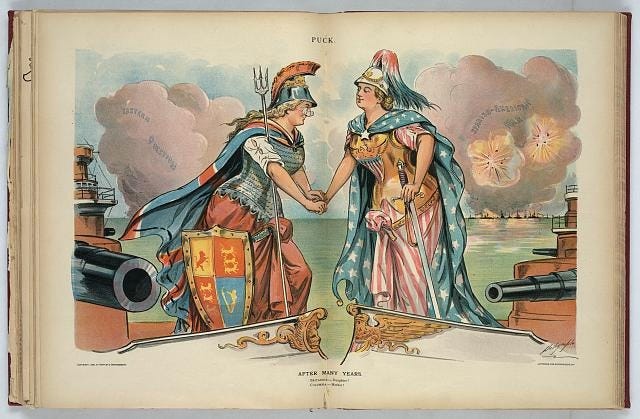
And much more, including salutary lessons from the Dutch and Swedes on boring yet prosperous futures, how Churchill’s interest in gadgets influenced the course of the Second World War, and why transformative action from the UN remains unlikely in the near future. Listen now on your favorite podcast app.How to Win Friends and Alienate NationsJordan Schneider: What is national power, and why does it matter? Paul Kennedy: Since the earliest struggles between tribes and later between larger groups of people with their symbols and more organized armies, and in particular, the emergence of the modern nation-state around the year 1500 (as historians roughly date it) — this entity has existed. The nation-state, with its capacity to raise taxes, conscript, and enroll men to fight under the direction of, say, a Dutch republic or a Spanish monarchy, has fundamentally shaped global affairs. Since that era, with the rise of the nation-state in Western Europe and its subsequent adoption worldwide, this thing we call “the country,” “the nation,” or “the state,” has operated within what political scientists term an anarchic international system. “Anarchy” here doesn’t necessarily mean everyone slaughtering everyone else, but simply the absence of a higher authority controlling global affairs. The United Nations General Assembly lists approximately 189 or 192 nation-states, large and small. We give them all a membership, a vote in the General Assembly. Almost all of them have some sort of diplomatic service as well as a domestic home service, have a government and a constitution of one form or another, and interact with the other nation-states, the other players in the system. Because the decisions they take over time impact individuals in different ways, we pay attention to this, to international history. We pay attention because this great power system, in terms of a relatively harmonious relationship between the nation-states, broke down into massive, expensive, and bloody warfare in the First and Second World Wars. It behooves us to understand this great power system and the nation-states which play such a role within the system. Jordan Schneider: I want to begin with a quote from a German politician in 1903, which comes back to your idea of tribes. Eduard Bernstein, in a debate between the left and right in the Reichstag over Anglo-German trade relations said, “The entire question is this: When do we consider the position of one land to another in the manner of jealous, acquisitive tribes, which if one robs, the other is robbed, and when do we consider it from the standpoint of a peaceful exchange of nations?” Paul Kennedy: A nice quote from Bernstein, who was one of the leaders of the left liberal and progressive parties in Imperial Germany, which were somewhat swept away with the coming of war in 1914. But he was still optimistic then. You can tell from his question in that Reichstag debate that he was presenting essentially two large, contradictory, and distinct versions of understanding international affairs. Was international affairs to be regarded as a benign relationship between these advanced states and societies in which you traded with each other? Great Britain in 1903, when Bernstein was speaking, was the number one commercial partner of Imperial Germany. Germany relied heavily upon exporting many of its manufactured goods to the UK market. The UK exported a large amount of imperial and tropical produce to the German market. This harmonious interchange of commercial goods between states, as well as the harmonious interchange of their ideas, university students, travelers, tourists — that’s the benign view of international relations. The more malign, suspicious, or competitive view is that these are rival tribes. They are in some sort of inherent, natural fighting, suspicious relationship with each other. So one is a hostile relationship and the other is benign and friendly. As the years evolved towards 1914, these two interpretations of international affairs were strongly contested because if one won and prevailed, all would be well, benign trade would rise. If the other was true, then you had to keep your weapons sharp. You had to keep your navies big and strong. You had to have intelligence systems gathering information about what the other might be up to. You had to be suspicious rather than trusting. Those are two very different views of world affairs. Jordan Schneider: The answer, of course, is both. Humanity would not have been able to reach the heights it is today if we hadn’t figured out how to cooperate with each other, but looking over the past 5,000 years, there are moments in time when that mindset shifts, particularly when it comes to great powers. You raise this fascinating counterfactual of England not being anxious about America’s rise, even though they have a past history of fighting wars. The “ties that bind” — but there were plenty of those also between Germany and the United Kingdom. Is there a theory about when the mindsets start to shift from “we can cooperate with these guys” to “we can’t really in the end”? Paul Kennedy: This is a question I pose to my students interested in international affairs and why systems break down. In the late 19th century, the number one industrial trading naval power of Great Britain was finding the world less and less comfortable because its relative share was diminishing, and the two quickly rising countries which were diminishing those shares were Imperial Germany on one side and the United States of America on the other side. Yet, as you allude to, the story is that the British turn to an ever-more-friendly, almost contractual relationship with the United States and to an ever-less-friendly, ever-more-suspicious relationship with Imperial Germany. Why should Great Britain, with these relatively sane and intelligent decision-makers in Whitehall, turn against one and turn in favor to the other? You can consider some of the major and obvious reasons and ask students to try to weigh them or evaluate their significance. One is geography — sheer distance. Even if it is a rising great power, if it is 3,000 miles away, that’s less of a problem than if this rising great power is just 15 hours steaming across the North Sea in the middle of the night. If that rising power on the other side of the Atlantic, as it threatened to be back in the 1840s and 1860s, might gobble up your dominion state of Canada, that would be different. But by 1903 or so, American-Canadian relations and disputes over borders and seal fisheries and other things had been resolved. So there was no hostile threat from this distant rising power across the Atlantic. Historians also point out the enormous advantage of a common language. You could speak to each other and feel part of a longstanding English cultural world, despite the fact the United States was a polyglot nation with all sorts of cultural inputs. Around the turn of the century, identification with Anglo culture was predominant among American elites. That helped. A good number of American politicians, from Teddy Roosevelt onward, grew up very much in this Anglo-historical tradition, and on the British side, once the elderly, suspicious Lord Salisbury had passed, there were also quite a few committed Americanophiles. Then there is the issue of ideology — an autocratic nation on one side (Imperial Germany) and a democratic parliamentary or congressional nation on the other. So you can start listing a whole number of reasons why it was relatively easy for the British to see the rise of the United States as not a threat and why they were much more cautious and suspicious about the relative rise of Imperial Germany’s power.
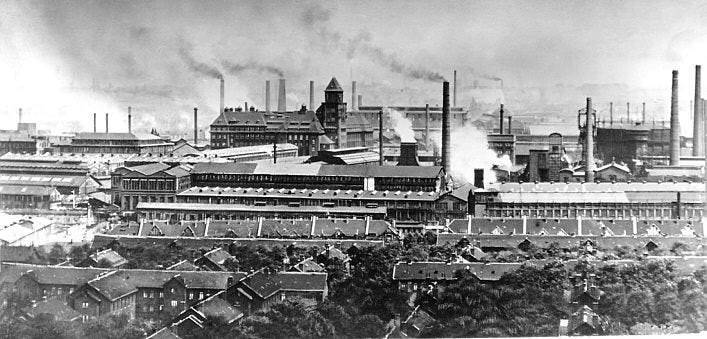
Jordan Schneider: Regardless of which direction England would have gone, it makes sense that they would pick one or the other to try to be friends with. I want to zoom out from that to the broader balancing that happens throughout history. What strikes me over the course of re-reading The Rise and Fall of Anglo-German Antagonism is all of the balancing functions that are happening at any moment in time. Can you talk a little about that in the context of moments of great power transitions? Paul Kennedy: Yes. Again, I would begin with ideology and cultural assumptions concerning whether the existence of another larger, preeminent great power was, from the German perspective, a potential threat that could hold them back or restrain them. This ties into the cultural assumption of whether the rise of another great nation and its economy constituted a challenge to one’s own status quo. I emphasize this because we know that in late Victorian and Edwardian Britain, a very strong set of liberal internationalist assumptions prevailed. While not universally held, these assumptions were strong enough to be predominant in much of Parliament. They posited that the rise and success of another nation’s economy should be applauded — that it was, in fact, a positive development. As another nation’s standard of living grew, it would create an expanding market for certain British and imperial goods, and there was nothing to be concerned about. This view stood in stark contrast to a different mentality, which held that any rise in power that shifted one’s own relative position or share of power should be regarded with distaste and concern. When inducted into the Royal Historical Society, one is allowed to present a scholarly article to the proceedings of the Royal Historical Society, and I chose a piece called “Idealists and Realists in British Foreign Policy from 1865 to 1939,” which covers the years we’re talking about here. I set them up as two almost contradictory stereotypes. The rise of German trade is a good thing, the liberal internationalists would say, because it enhances the overall prosperity and commerce of the globe. The rise of German industry is a bad thing because it’s potentially a threat to us. I cited a visit by the British newspaper magnate Lord Northcliffe where he has his driver take him on a tour of the great Ruhrgebiet and the Rhineland in Germany to see the massive iron, steel, and coal facilities around 1908. He comes back and writes to a colleague, “Every one of those great chimneys pointing up into the sky are essentially great gun barrels pointing at England.” That’s an extraordinary quotation if you think about it. He instantly turns the industrial prowess of a new factory nation into something which is potentially going to challenge the British Empire.
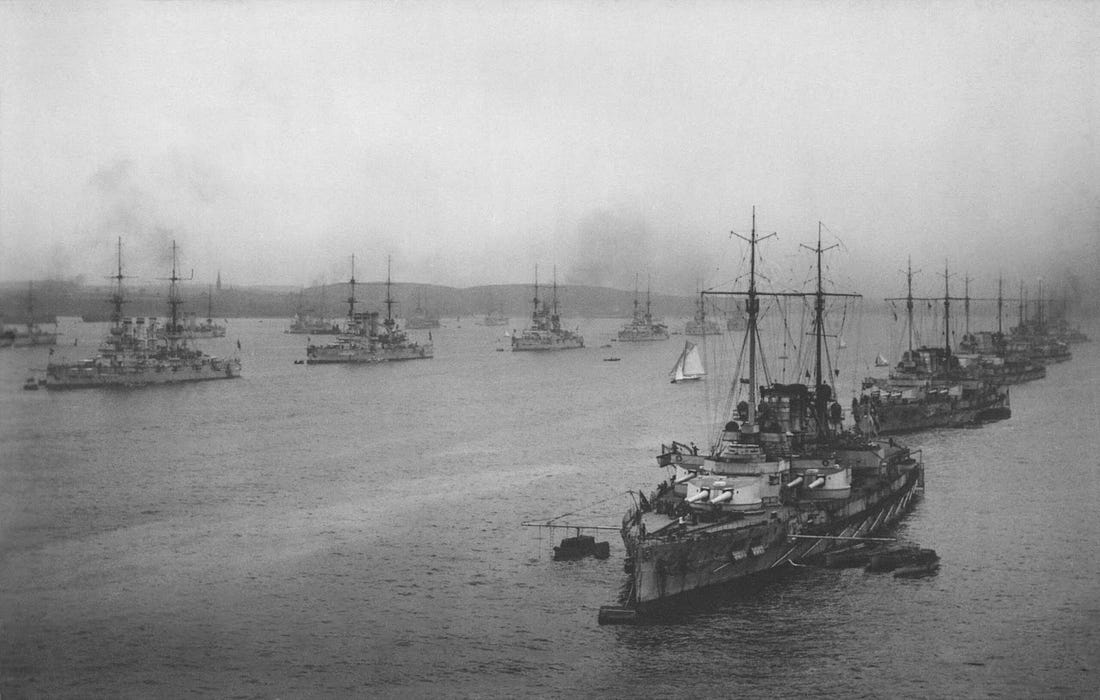
Jordan Schneider: There are two aspects of causation here. First, the growth of other nations is fine and good until they accumulate enough latent power to get in your way. On the other side, we have Germany, initially content with its land-based ambitions in Europe, but then, at a certain point, embraced Weltpolitik. For various reasons — domestic politics, foreign policy, national power, greatness, or otherwise —they concluded that both colonies and a massive navy were essential. I’m curious how you view these two sides of the picture. Is it almost inevitable for liberal internationalism to recede once another power grows sufficiently? And is it also inevitable that once powers reach number three or number two on the global stage, trending upward, they simply begin to “feel their oats” and consider national aggrandizement through territorial expansion and military power as a birthright? Obviously, we’re talking about Germany and the UK in history, but the China echoes are evident. Paul Kennedy: The China echoes are certainly around. There is the issue, though, of proximity, or geography, which I discussed earlier. Even today, with the rise of a much larger Chinese navy, the vastness of the Pacific still helps to temper or relativize the size and nature of that threat. But, a large and growing industrial power with a big navy like Germany under the erratic Kaiser Wilhelm — and here we have to consider the personal, idiosyncratic aspects of history — posed a very different situation. Even if Germany had been a truly benign democracy under a constitutional monarch like George V, rather than the Kaiser, who actively directed armies and navies, would the sight of a massive German fleet moving in and out of Wilhelmshaven, Kiel, and Hamburg still have felt just a little too close for comfort? I scratch my head about that. Is there ever a time, is there ever a place where two very large powers with two very large armies or navies or air forces have felt comfortable with another power so close? There’s another comparator here for people to think about. Around 1902, in order to get some relief from imperial pressures on their interests in the Far East, the British came into what was going to be a longstanding alliance relationship with the rising country of Japan. Japan itself was going to build a modern outward-looking navy, and Japan was going to be moving into parts of the Asian mainland — but that didn’t seem so threatening at 8,000 miles away. So I do wonder whether distance in the first place, then cultural and ideological similarity or antagonism, and then trade rivalries and other things, put together form the complex explanation as to why Britain found it so much more difficult to deal with and be reconciled to a rising Germany than to a rising United States.
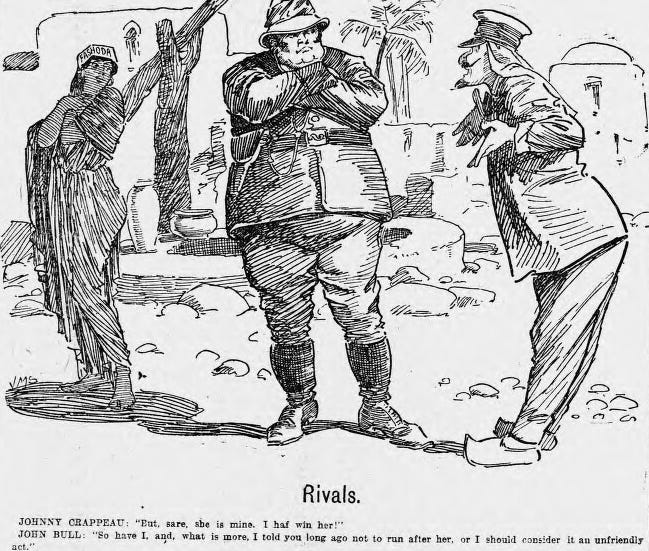
Jordan Schneider: You close this book by saying that unless the Germans surrender their desire and inherent capacity to alter the existing order in Europe and overseas, or unless the British were prepared to voluntarily accept a great change in that order, then their vital interests remained diametrically opposed. This rhymes with something that Mike Gallagher and Matt Pottinger write in their Foreign Affairs articleabout their vision of victory with China – that we have to compete with them until they give up on military modernization and decide that they want to be friends with everyone in a convincing and verifiable way. The question is — is that ever a reasonable expectation for a country that has enough productive energy to get to the number two slot in the first place? The fascinating thing about Germany in that era was that all the trend lines were pointing in their direction. They had the best technology, they were growing the fastest, and they had the largest productive forces. Had they triggered this global antibody mechanism 10 or 20 years later than 1914, we may be looking at a very different world today. Obviously, that wasn’t the case, and that’s a similar story that you can point to with China and Xi over the past 10 years as well. Paul Kennedy: It would take a big concession, an act of inordinate political wisdom for the rising successful number two to say, “I understand the neuralgia of the number one as we become more and more a success story. I am going to be superbly clever here, and I’m going to temper down the shape and the size of the imperial German navy.” It could be an overseas cruiser fleet navy. It could be a defensive home waters navy. It would not be a large, powerful, fast battle fleet navy put into German ports, which are only 20 hours steaming from the east coast of England. We get that. So we are going to invest our energies into more successful industrial production, science, technology, innovation, overseas commerce, but we’re not going to hit the neuralgic point of a navy. We’re going to take a risk. The risk would be that this dominant imperial number one, in some contests regarding the future of Samoa or Southwest Africa, would kick us around. Here, Tirpitz could say, “Once we have a big navy, we will never be kicked around again, but we’re going to go for a very bold strategy of reducing our naval overseas power.” In the larger sense of prudent advancement, Bismarck was right. Keep emphasizing that Germany is a land power without much in the way of colonial ambitions and no naval ambitions, and you’re likely to have the British on your side. Or at the very least, they’re not going to come on the side of France and Russia in any future war. That is asking an incredible amount of concession on the part of Berlin and inordinate intelligence, which only, I think, Bismarck could have or show. Jordan Schneider: Can you talk about some of the “red herring” causations from that period? You’ve argued that popular media or nationalism, for example, were actually downstream effects of changing power dynamics, rather than original causes. Paul Kennedy: There are indeed factors we observe that played a role, but the question is whether they had an original causative impact. I believe the answer is no. Even amidst the nationalistic, jingoistic newspaper writings, excitable columnists, and nasty political cartoons of the late 19th century, if you examined the spread of these opinions and caricatures around, say, the 1890s, you’d find just as much hostility, derision, and criticism directed at France or, notably, Russia, as there was towards Germany. In this age of chauvinism and jingoism, there’s a tendency to pretty much insult every other nation on the globe. Every other country and its people were caricatured. Cartoonists had caricatures for Germany, but probably a larger number of caricatures of France, of Johnny Crapaud, which goes all the way back to Napoleonic times.
Francophobia and derisory comments on France run entirely through the 19th century. If they fall away after about 1906 or so, it’s relative to the fact that you’re more apprehensive about Germany and beginning to appreciate that a good friendship with France is not a bad idea. Jordan Schneider: One of the fascinating transitions, which we also have an echo with today, is this transition from liberal economics to non-liberal economics, where all of a sudden people start thinking about self-sufficiency and supply chains and access to critical resources. That’s also another one that is downstream from the original neuralgia and anxiety. I’m curious about your reflections on that moment, both pre-World War I and pre-World War II. Paul Kennedy: It is quite striking how many observers and commentators move away from a position that international trade dependency is a good thing during the rapid transition before 1914. There’s this very strong articulation, from the 1860s onward, by Cobden and Mill and others, that the more interdependent we are in our product chains between each other, the less likelihood there is for war. Not only does that lead us to a more prosperous world since we produce and send coal to Portugal and Portugal sends port wine to us — we don’t try to grow wine in Lancashire, and they don’t look for coal in Portugal — it just makes much more sense. The closer we are tied together in our dependency economically upon each other, and therefore rid ourselves of those tariff barriers, then the better the world will be. Not only will the world be more prosperous, but it will be more harmonious because we all recognize our reliance upon each other. Once you begin to say, “I don’t like the idea of being reliant upon those German magnetos,” or “I don’t want to be dependent upon those German steel turbines, I’d rather produce them myself just in case the world turns different and hostile,” then psychologically, your attitudes change. I want to be self-reliant — and the word itself has a very strong Edwardian schoolboy tone to it. Something that’s big and strong and self-reliant. I’m sure that Teddy Roosevelt felt the same about a rising America. We will not be dependent upon anybody else. That’s a totally different, contestable viewpoint from Cobden that the more dependent you are upon others and the more dependent they are upon you, the more likely you are going to sit down and resolve any quarrels you have around a table in an amicable fashion. This is why I became very interested in the way the planners for the new United Nations system after the Second World War — planners who were already drafting around 1943-44 — were trying to create in the future, when they had won the war against the Axis States, not just a security system, but a World Bank and an IMF and a global trading system with open ground rules because they wanted to articulate the fact that economic interdependence was going to be core to future world peace. In their mental world, it made sense that interdependency was a good thing. Jordan Schneider: Cordell Hull, of course, is screaming from the rafters about this, but at the same time, you had the oil embargo and the aluminum embargo on Japan. It’s a very tricky thing to have both of these ideas in your head at the same time, which is where we are as a country today. Paul Kennedy: Yes. When Cordell Hull and others call for economic embargoes upon Japan as a warning or as a punishment, then the total free traders, the 100% open market people, are bound to be upset. You’re starting to use economic weapons as opposed to seeing economic interaction as being a totally peaceful thing. There are critics of the Cordell Hull position or indeed the John Stuart Mill position in the 1840s and 1850s, which was to say it’s all very well for you to plead for getting rid of all protective tariffs, having a completely open playing field, but aren’t you just saying that because you Americans have so much wheat in your wheat fields that when you have free markets everywhere, your wheat will be much more competitive than French wheat? Therefore, your business is a threat to the French farmers’ livelihood. French farmers, therefore, need protection and tariffs against American wheat. And you are being hypocritical when you say, “Oh, let’s pull down all of the barriers,” because your competitive advantage, we all can see, is so strong. Jordan Schneider: It’s interesting because it’s downstream of our first conversation. When you’re scared, these are the sorts of moves you start to make. What makes you scared? Is it what the other guy is doing with the leverage they have over you? Or is it just the abstract possibility of what they could do to you? Paul Kennedy: There are some interesting Edwardian cartoons of the British national type, John Bull, lying there in bed at night, fully dressed, of course, with his little pork pie hat on. He’s having alarmist bubble dreams of Germany coming across the North Sea with all sorts of imported goods and cases, with “Made in Germany” on the outside, coming to invade the British home market. Do Internationalists Ever Win?Jordan Schneider: Once that open and positive international vision of world cooperation starts to get questioned, is it a one-way ratchet? Are there any examples in history where the liberal internationalists beat back an intellectual insurgency from folks on the other side? Paul Kennedy: They found it pretty well impossible. They were swimming against the tide in the period from 1900 to 1914, even though they tried on a number of occasions, around 1912, to dampen down Anglo-German suspicions. When the internationalists, especially some of the British planners in 1918-1919, come along with their memoranda about the post-First World War global order, they’re driven to put that clock back — to say, let’s reaffirm the significance of the open world order of understanding and commercial interchange. What’s more, they have this argument about the origin of the war. They say it wasn’t just Admiral Tirpitz’s navy. It was the rising suspicions and animosities over things like trade, commerce, and tariffs. The mentality of the people who want to put tariffs up is the mentality of those who are suspicious of other nations. If we can get rid of tariffs and have free interchange, then hopefully we’ll go back to Cobden’s world of interdependent economic relationships. It’s hard to do, but this time we’re going to almost force it through with the League of Nations system and the attempt to renegotiate and reduce trade tensions in the 1920s. And it too, of course, is going to be rejected when Adolf Hitler comes in because German National Socialism, just like Italian fascism, is going to say, “No, we want to be totally in control of the resources of trade. We don’t want to be dependent upon any other nation.” Hence, they tumble towards the Second World War. Jordan Schneider: What’s scary is that the reset buttons only manifested themselves after world wars. Paul Kennedy: I can see the way you’re going. The reset buttons are there even more emphatically in 1943 to 1944. They say, we know that this reset position is the correct one. We didn’t do it sufficiently well or cleverly in 1919. We have to try again. It’s interesting to see the emphasis policymakers, especially the American ones, have on creating the Bretton Woods institutions — the World Bank and the IMF. You cannot just create a new security framework in the United Nations with the Security Council unless you have the other dimension to it, which are structures for encouraging world prosperity and open markets. That’s got to be the new instrumentalities of the World Bank and the International Monetary Fund. The British, who want to encourage American internationalism and America to step up to the plate, are really insistent. It’s not well covered in the historical literature, but they’re really insistent that the World Bank and the IMF are going to be headquartered in downtown Washington. There they are on 18th Street. They’re going to be very close to the US Congress.
The United Nations headquarters is going to be in New York because you need New York as the center of essentially internationalist propaganda. You need New York as a center of ideas and discourse and encouragement. So you put the United Nations in New York and the Bretton Woods institutions in Washington. It all fits together. You’re going to need an American Congress to support the financial rebuilding of the world, and you’re going to need a New York media center to cover how the world comes together in the General Assembly. Again, it clicks. It makes sense. Let’s not have the international financial institutions in Vienna or in Paris. That just wouldn’t work. Jordan Schneider: Let’s talk about the third reset button of the 20th century. It’s an open question to what extent it really was a potential reset button. Do you think America blew it with the fall of the Soviet Union? How are you reflecting on that 35 years down the road? Paul Kennedy: I’m shaking my head because, as you know from reading a bit of my work, a number of people who studied the international system tried to grab the chance of the fall of the Soviet Union and thought there could be another reset button in the 1990s. Whether it was our own relatively small Ford Foundation/Yale University attempt to write a report on the long-term future of the United Nations, or whether it was some other larger commissions which were set up to look at rebuilding and re-empowering the international order, or others which were more focused on whether we could do something better than a World Bank and an IMF, whether we could have other instrumentalities to help us — there was a lot of hope and optimism around 1991. When the Communist Party in Russia fell, and Gorbachev and Yeltsin had triumphed, there was the idea that we could have a chance to reset and rebuild. But it didn’t last too long. American nationalists didn’t like it because it would mean concessions from the American side, and it was difficult to think of how to bring China into this system. Now, I find very few voices suggesting that somehow, in the complicated world we have, we can use the United Nations organization in a large, creative way. When our attempt to write a new reform plan for the United Nations with additional members of the Security Council like India had fallen away in 1995, the great United Nations man Brian Urquhart, who had been there at the foundation of the UN in ’45, said that the only things we can think of now are incremental and one-on-one efforts by United Nations bodies to try to do something to help. A United Nations peacekeeping venture in Namibia or West Africa, which works and which suppresses the civil war and which later on leads to, for the first time, parliamentary elections — you can chalk that up as an individual victory for the United Nations organization and its institutions. But it’s not the same as anything large and transformative. Incidental, one-on-one, episodic improvements are just about the only thing we can hope for until there is, as Brian would say, an alteration in the minds of men. He was always a bit hopeful about that, but he didn’t think it was going to come soon. This gets back to your true but also somewhat alarming thought that you only get major institutional transformation of world relationships after a big war. And if you don’t want a big war, you have to be content with small-scale and incremental improvements. Why Number Ones Blow ItJordan Schneider: Let’s talk about big wars and preparing for them. One of the interesting questions with Trump and also looking back in history — going all the way back to Spain and its navy — is this idea of countries deciding to rest on their laurels and not taking seriously what everyone should have learned in Rise and Fall of the Great Powers: that productivity growth and overall national industrial and economic capacity is what gives you the latent ability to affect how the world operates. I’m curious for any thoughts you have on remarkable examples in history where number ones just blew it. Paul Kennedy: The best example of where a number one blows it is imperial Spain. All of the studies show that it ends up where it does because its leaders were driven by a religious determination that they had to carry out the will of God and, by either force of persuasion or of the sword, eradicate the Protestant spread. Once you have that intense ideological drive brought to bear on a country which had many resources but clearly didn’t have enough to be the arbiter of Europe, Spain is in a problematic state. Napoleon himself falls for the same hubris — “If I can conquer everywhere from the Spanish border to Moscow, then anything which is a challenge has to be eradicated, and my Napoleonic vision has to be asserted.” I was talking to somebody the other day about the many good reforms which Napoleon brought to France and Europe in his period of political domination — reform of the civil service and the tax code, and the liberation of the Jews, the ending of all sorts of restrictions upon the Jews in France. But it’s all blown by the excessive imperial ambition of marching to Moscow and then trying to fight Wellington and the Spanish guerrillas in central Spain. I also think of the countries that, at first, demonstrate imperial hubris and the drive to be number one, but then decide to just amicably step down to a non-combative but economically prosperous position. The Dutch give up their claims and decide to be more of a trading nation. Sweden, after the end of Gustavus Adolphus and his son, decides that it’s pursuing internal economic growth and development, but not overseas conquests and does not build up a large navy to fight in the Atlantic. It may be a kind of boring way of life, but it made a lot of sense to them. This position is enforced upon Japan, of course, after 1949, by a constitution which says, “You shall have no imperial army or navy.” But look at the way the Japanese turn their creative talents into manufacturing, production, organization of wealth creation, and rebuilding of their cities in a remarkably clean and civilized way. There are some benefits to the post-imperial condition, the post-number-one condition. It’ll be incredibly difficult to persuade many Americans that there are benefits to the post-number-one condition, I’m sure. Will it come in a hundred years’ time? Lord knows. Jordan Schneider: Coming back to Napoleon and Spain, this idea of maximizing long-term national power requires running hot, but not too hot. Otherwise, you encounter imperial overreach, and things turn out badly. However, if you run too cold, you might end up “stuck” like 19th century Sweden or 2000s Japan. Modulating how passionate you are about your national mission, dreams of grandeur, or religious devotion is fascinating — determining exactly where you’d want to set that dial. Paul Kennedy: Yes. There are interesting memoranda by the young Winston Churchill when he was trade secretary in Asquith’s cabinet and later as First Sea Lord. He examined Germany’s rise and said, “This is perfectly understandable. When nations experience a surge of economic productivity and creativity, they grow bigger than before.” Churchill questioned how to accommodate them instead of having an overly neuralgic reaction, allowing them a place in the international system. If we consider our contemporary and future world, this gives one food for thought — how do we want to allow rising powers like China and India a place in the international system? Innovation and the Power of Problem SolversJordan Schneider: Let’s talk about Engineers of Victory. You attribute the Allied victory to productive capacity and geography, both relatively self-explanatory, but also to what you say in this wonderful sentence: “the creation of war-making systems that contained impressive feedback loops, flexibility, a capacity to learn from mistakes, and a culture of encouragement that permitted the middlemen in this grinding conflict the freedom to experiment, offer ideas and opinions, and to cross traditional institutional boundaries.” Paul Kennedy: Did I write that? Wow. I’ve always been interested in cultures which allow for and encourage experimentation, not too top-heavy or too “revolutionary” like the Bolsheviks. The role of a creative artist or engineer — or as I later rephrased it, “problem solvers” — became my focus. I started looking for historical examples of problem solvers in world history. Problem solvers themselves don’t get anywhere unless there’s an encouraging environment around them, which allows experimentation and intellectual development. Again, I’d like to use a Churchillian example. When working on Engineers of Victory, I was interested in occasions when Churchill’s capacious, excited reign would recognize people working on ideas who needed encouragement. The story of the U-boat destroying weapon — the forward-firing “Squid” system, which was a forward-firing depth charge — wouldn’t have advanced without support. The inventors had created this device but were struggling to persuade the admiralty powers to accept this new weapon. They faced suspicion and irritation from officials who wanted to focus on existing production. These inventors got a chance when Churchill was testing new machine guns. They asked the prime minister to come around the hedge and look at their new forward-firing Squid, which could launch a depth charge into the hedge 100 yards away with the pull of a lever. Churchill was absolutely delighted when he saw this and wanted to encourage it.
Systems could allow the encouragement of new ideas and allocate resources to let experimenters and problem solvers have opportunities. Jordan Schneider: Hitler also enjoyed his gadgets. Have you spent any time thinking about how the Nazis tried to build technological innovation into their war-fighting machine? Paul Kennedy: It’s clear that Hitler had a fascination with dazzling weapon systems he hoped would win the war. His fascination with rockets near the end of the war demonstrates this. He had German scientists and creators developing weapons he believed could deliver a decisive blow against London. They allocated significant amounts of rare materials like aluminum and petroleum for their experimentation. So it’s not just democratic societies encouraging innovation compared to a completely stupid and unrelenting dictatorial view. We know that several of Stalin’s scientific advisors, trembling though they were, managed to get approval from the “big man” to create improved weapon systems. I don’t know the Japanese story very well, but I have a feeling that the major Japanese advantages in weapon systems came from developments in the 1930s, with very little evidence that wartime itself produced any innovations from the Japanese military-industrial complex. It was just more of the same, whereas in the case of the Americans and British, the scientific innovations flowing out of the system by 1943-44 were really quite amazing. Jordan Schneider: There’s this concept of wartime innovation versus peacetime innovation. In the early 1900s, some realized that machine guns were going to matter, while others in the 1930s began to comprehend the impact of carrier groups. Meanwhile, enormous bureaucracies struggled to process these innovations. This is analogous to what’s happening in Ukraine today, where high-intensity conflicts are changing due to drones and electronic warfare. Beyond just top leaders approving or disapproving innovations that cross their desk, what about larger institutions like navies and armies? What gave them the ability to implement smart adaptations rather than just being large organizations that resist new ideas? Paul Kennedy: There are several matters to unpack here. Sometimes, bureaucrats opposing investment in newer technologies are doing so because they’re fighting a war that needs to be won day by day. They cannot divert resources to interesting projects that won’t become useful for another two years. We literally have to keep producing these second-rate two-engine bombers because we need bombers for the fight across the English Channel. There’s a justification for saying, “This is all well and good, Mr. Barnes Wallis, but we can’t give you resources right now because we need those resources for bombs which drop on German factories immediately.” It’s a truism that having an array of elastic resources where you can devote just 10% or 20% of your scientists or innovative capital to new developments while using 80% to produce standard equipment is very helpful. Here’s an example — around 1942-43, someone allocating resources for aircraft development must have said, “Let’s give some resources to Frank Whittle, who says he’s invented something called a jet engine.” This happened while fighting the Battle of the Atlantic and beginning the strategic bombing offensive against Germany. Every pilot, aircraft propeller, and bit of aluminum was needed to build conventional aircraft. Then this inventor comes along requesting resources and trained test pilots to help develop a faster engine without propellers, which sounded absurd at the time. But someone around 1943 must have said, “Let’s give this guy a chance.” I admire that culture of open-mindedness, though it requires some spare resources. I wonder if there’s a big historical lesson there. Jordan Schneider: This relates to a major theme in all your books — to what extent is it really just a mathematical equation?Does success simply go to the country that is larger and richer, has more scientists, and has that extra 10% to invest in innovations that might deliver something ten times better five or ten years down the road? You end several of your books with a lyrical conclusion noting that the balance of productive forces doesn’t matter to the person on a cruiser trying to destroy a U-boat while fearing they’ll be sent to the bottom of the sea. When considering innovative capacity or flexible organizations, is it simply that the bigger, faster-growing country will have better human capital and institutions? Or can there be dramatic disconnects that can’t be derived directly from economic advancement? Paul Kennedy: That’s a big question that I grapple with in most of my books, sometimes more successfully than others. My book The Rise and Fall of the Great Powers is somewhat deterministic because it doesn’t focus on the individual, the creative spark, or the creative moment. That’s why I derived enormous enjoyment from researching, writing, and investigating The Engineers of Victory. There’s a particular section in it, perhaps in Appendix A or B, where I tell the story of two young physicists who advanced miniaturized radar through experiments along the Bristol Channel. They developed the ability to detect metal objects moving a mile away on their small television and radar screens. When I fast-forwarded to the Admiralty summaries from commanders of escort vessels protecting convoys across the Atlantic, I found a commander detailing how, at 12:30 AM, HMS Vidette, an old World War I destroyer, detected a U-boat on the surface 4,000 meters away and moved to sink it. I felt like shouting “Eureka!” There’s your moment. The miniaturized radar created by those two young scientists was installed on a small escort vessel, and in the darkness, it detected a submarine 4,000 meters away, helping turn the Battle of the Atlantic. For a historian, finding that connection is deeply satisfying. Accommodating Rising PowersJordan Schneider: Let’s talk about accommodating rising powers and whether accommodation even makes sense. We had this conversation about the ideology dial, and if it’s turned too hot, everyone else has to respond to that because it might not end where your bottom line is. Any thoughts on this? Paul Kennedy: I cannot do anything other than admit that ideology counts. Whether people are pessimistic and suspicious about the other side’s intentions and growth or more open and welcoming is really critical. We were perhaps rightly suspicious of Stalin’s Russia and what it was doing to its neighbors, the long-range rocketry it was building, and even a Red Navy coming out into the North Atlantic. We were entitled to be suspicious there. Whether we need to be so neurotic about a rising China, or whether we can try to accommodate it because its leadership is a pretty cautious and conservative leadership, is debatable. Here’s something for a later discussion between us, because it’s a huge factor in the problematic US-China relationship that I’ve only just started to consider. I come back to geography. You may say that Kennedy’s obsessed by geography, but it’s something I’ve never really thought too much about before. If you look at a map of the entire Pacific Ocean, with China on the left-hand side and the United States on the right, you have three million square miles of China and three million square miles of the United States, with seven to nine time zones between them.
What would it be like if, by some flash of a magician’s wand, the geographic space offshore of China were not occupied by an array of small American allies? All the way down the California and Oregon coast, there’s nothing offshore, which is unlike the Philippines, Taiwan, or South Korea. If there was nothing there on the other side, if from the Chinese ports you looked out all the way to Hawaii, the situation would be different. Here’s the big problem — offshore of China, we have decided that we will support and ally with several geographically close places to China. There’s Taiwan, South Korea, and the Philippines. Suppose the roles and geography were reversed. Supposing Taiwan were 6,000 miles further to the east or west. Suppose all these big entities were offshore of America, and there was a kind of naked Chinese coastline. China wouldn’t be perceived as a threat. Yet, geography is there, and you have to deal with it. In a way, both we and China are directly and indirectly prisoners of geography. Unless we can achieve some amicable American-Chinese understanding regarding the significant allies and partners offshore of China, we face a massive geopolitical conundrum. I want to think about that more. Jordan Schneider: On that note, about a year ago, the Financial Times reported that Xi Jinping told Ursula von der Leyen that Washington was trying to goad Beijing into attacking Taiwan. The scary thing with ideology is that it works both ways. My worry with your thesis is that we’re not dealing with the most rational actors. We may be dealing with particularly conspiratorial ones who’ve already convinced themselves that there’s no other way out. That’s a very scary situation to be in, and it reminds me a lot of the way you ended the Anglo-German antagonism book. You essentially said, “It could have been an archduke, it could have been this, it could have been that. But you had these trains which were running in very scary directions.” Paul Kennedy: The Germans felt trapped by geography. They wondered, “Why aren’t we allowed to expand? Some other countries are allowed to expand.” But the answer was, “You can’t expand because you are too close.” I found this wonderful quotation for the book from the Imperial German chancellor and foreign minister, Bülow. It’s under a section about the inevitability of German growth. Bülow wrote (with some exasperation) in 1903, comparing it to a father turning around and looking at his fast-growing son, saying, “Hans, you stupid boy, you are growing out of your trousers. We will have to get you larger trousers!” Bülow asks, “What happens if we can’t stop growing out of our trousers? Every year, our steel production grows up and up. Every year, our trade with the overseas world expands. Every year, the German population adds one million more people who need to be fed. We can’t help it because we’re growing.” I shake my head at that and think, “What if we tell the Chinese, you’re not allowed to expand, you’re not allowed to grow?” And the Chinese respond, “We’re growing naturally. We’re growing at so many percent a year.” Jordan Schneider: There is another underlying assumption in this conversation we’ve been having about China, which is that the relative national power weight is going to keep improving for China. I think that still needs to be put under advisement. Paul Kennedy: Agreed. Rising China doesn’t have as many internal natural resources relative to its population as does the United States. Here is further food for thought. Both countries are about three million square miles in size. Both have access to the Pacific Ocean. Both have very significant advanced technology and production. Both are modern industrial societies. China has a much lower per capita GDP, but it’s increasing all the time. When I read reports about the limited water supplies in China and their diminishing natural resources and mineral wealth, I wonder if newer technologies will compensate China for those limitations. China is less well-structured in certain ways to be a clear winner in a long-term competition with the United States. I say that even though I’ve written about China overtaking the US in many ways, like the obvious visual markers, such as automobile production. Yet in other ways — in resources per capita and environmental stress — there are limitations despite our own environmental challenges. I would flag this as an open question, which is how we should end conversations about great power politics and the rise and fall of nations. The future is not preordained. Jordan Schneider: Is there anything in particular that’s on your mind nowadays? Anything in the news? Paul Kennedy: It seems to me, Jordan, that great power relations — leaving aside Putin’s agitated and mistaken attack on Ukraine — have a kind of muted condition to them right now, but there are several nascent developments that might become clearer in the next 10-15 years. Let me list two or three. There’s the so-called swing to Asia in international power balances. There is the rise of India. Even as I work on drafting my next book on the emerging tripolar world of three large powers — China, the US, and India — with their large GDPs standing considerably above everyone else, I recognize that India’s rise is coming slowly and, at the moment, in a non-aggressive way. Modi’s visit to Putin perks up people’s attention, but it’s difficult to know what to make of that. A Russian-speaking colleague here said that when she heard the translation of Modi speaking to Putin, it was a much stronger reprimand about nations not aggressing other nations than was reported. Going to Moscow shouldn’t be seen as a significant tilt in great power balances. It was just Modi playing all directions, which he’s rather good at. We’re in a relatively quiet time in international and big-power relations. Will it change to a more decisive, turbulent, and disturbing period when Trump tries to pull the US out of NATO or do something similar? Jordan Schneider: This was such a treat. It was really fun, so thank you. You’re on the free list for ChinaTalk.
|






-
Minha entrevista desta sexta-feira 25/02/2022, sobre a dramática situação da Ucrânia no canal +BrasilNews. 1437. “ Entrevista sobre a Ucrân...
-
Carreira Diplomática: respondendo a um questionário Paulo Roberto de Almeida ( www.pralmeida.org ) Respostas a questões colocadas por gradua...
-
Uma preparação de longo curso e uma vida nômade Paulo Roberto de Almeida A carreira diplomática tem atraído número crescente de jovens, em ...
-
Uma lista com os 20 jornais mais importantes no mundo. Para fins de "importância", considere um conjunto de características do r...
-
Reação da imprensa internacional à vitória de Lula para um 4o mandato, como registrada por Madame IA (via Airton Dirceu Lemmertz): Apresente...
-
Por que estou fazendo listas de trabalhos carregados em Academia.edu? Paulo Roberto de Almeida, diplomata, professor Uma nota sobre as posta...
-
A morte do liberal brasileiro? Um fenômeno preocupante Paulo Roberto de Almeida Nota sobre o desaparecimento de uma espéc...
-
Madame IA discorre sobre uma pequena parte de meus escritos de 2017 a 2019, num tom simpático, mas também cético, pois ela talvez pretendes...
-
WHAT THE U.S. IS REALLY DOING IN VENEZUELA Suppressing democracy and extracting resources at the expense of its people By Anne Applebaum ...
-
Às vésperas das eleições de 2022, eu andava muito pessimista. Será que esse pessimismo se mantém atualmente, quatro anos depois? Pode ser....

