Temas de relações internacionais, de política externa e de diplomacia brasileira, com ênfase em políticas econômicas, viagens, livros e cultura em geral. Um quilombo de resistência intelectual em defesa da racionalidade, da inteligência e das liberdades democráticas. Ver também minha página: www.pralmeida.net (em construção).
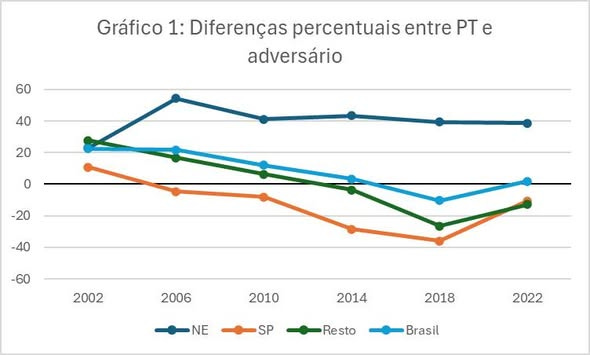
Existe uma mística nas eleições presidenciais brasileiras de que os votos do Nordeste dão a vitória ao PT. Isso é verdade, mas não é realmente o Nordeste que tem decidido as últimas eleições. A região funciona como um muro a ser transposto pelo desafiante do PT, e são as outras regiões do país que funcionam como a vara para saltar o muro. O gráfico 1 explica o conceito.
Neste gráfico, temos a diferença percentual entre o candidato do PT e o seu desafiante no Nordeste, em São Paulo, no restante do Brasil e no país inteiro. Podemos observar que, nas últimas 4 eleições, a diferença do PT para os adversários no Nordeste é de cerca de 40 pontos percentuais. O que definiu a eleição foi a diferença nas outras regiões, que variou bastante nesse período.
Blog do Marcelo Guterman é uma publicação apoiada pelos leitores. Para receber novos posts e apoiar meu trabalho, considere tornar-se uma assinatura gratuita ou uma assinatura paga.
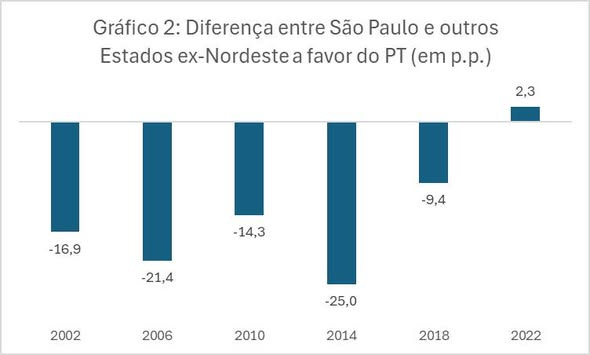
O caso de São Paulo é especial, por isso destaquei o Estado. Além de ser o maior colégio eleitoral do país (21,7% dos votos válidos em 2022), foi o que mostrou a maior variação na eleição passada. Até 2022, o eleitor de São Paulo sempre deu menos votos para o PT do que a média de todas as outras Estados ex-Nordeste. Em 2022, no entanto, essa tendência se inverteu, como podemos observar no gráfico 2.
Se São Paulo tivesse mantido a mesma diferença de 2018 em relação ao restante do país ex-Nordeste (-9,4 p.p.), tudo o mais constante, Bolsonaro teria ganho a eleição por 50,4% a 49,6% dos votos nacionais. E considere que esta diferença de -9,4 p.p. havia sido a menor da série histórica desde 2002.
Assim, a eleição nacional em São Paulo ganha uma cor diferente. O paulista vai voltar ao padrão anterior, ou este seria um “novo normal”? Podemos ter um “cheiro” analisando as eleições para governador. Em São Paulo, o PT nunca ganhou uma eleição. É difícil fazer a comparação com os números da eleição nacional porque não houve 2o turno em 2006, 2010 e 2014, e em 2018 o PT sequer foi ao 2o turno. As duas únicas eleições comparáveis são as de 2002 e 2022.
Vamos lembrar que 2002 foi o único ano da história em que o PT ganhou a eleição presidencial no estado de São Paulo. Naquele ano, o candidato a governador, José Genoíno, perdeu para Geraldo Alckmin por 5,8 pontos percentuais. Em 2022, Haddad perdeu para Tarcísio por 6,6 pontos percentuais. Foram os dois anos em que o PT chegou mais perto do Palácio dos Bandeirantes.
É neste ponto que entra a pesquisa Datafolha para o governo de São Paulo, que dá 17 pontos de vantagem de Tarcísio sobre Haddad no 2o turno (considerando apenas os votos válidos). Comparando com os 6,6 pontos de 2022, temos uma deterioração significativa do candidato do PT em SP, o que poderia indicar que a diferença na eleição presidencial também será mais larga para o candidato desafiante no Estado. Como vimos, na eleição passada, não precisava de muito para virar o jogo, tudo o mais constante.
Claro que a campanha é nacional, cada voto conta. Mas em termos regionais, São Paulo deu a vitória a Lula em 2022. E pode tirar em 2026.
Blog do Marcelo Guterman é uma publicação apoiada pelos leitores.
Oliver Ortiz de Zarate Martin foi preso em 2013 |Crédito: Severino Silva/Agência O Dia
O narcotraficante espanhol Oliver Ortiz de Zarate Martin foi um dos
investidores por trás da operação de compra do Banco Master pelo
empresário Daniel Vorcaro, revelou em entrevista exclusiva ao ICL
Notícias uma fonte que atua no mercado financeiro e acompanhou de perto
as negociatas.
A reportagem teve acesso a documentos de transações financeiras, além
de autos de processos judiciais e registros da Comissão de Valores
Imobiliários (CVM) que corroboram as afirmações.
Morador de um condomínio de luxo na Barra da Tijuca, zona oeste do
Rio de Janeiro, onde foi preso em 2013, Oliver Ortiz foi condenado por
lavagem de dinheiro e tráfico internacional de drogas. No ano passado, a
Polícia Federal (PF) notificou o criminoso de que ele seria expulso do
país, depois que cumprisse a pena definida pela Justiça brasileira.
De acordo com a fonte, o elo entre o narcotraficante e o empresário
mineiro Daniel Vorcaro é o operador do mercado financeiro Benjamim
Botelho de Almeida, apontado pela PF como sócio oculto e operador
financeiro de Vorcaro nos Estados Unidos.
Botelho mantém vínculos com a corretora Sefer Investimentos – antiga
Foco Distribuidora de Título e Valores Mobiliários (DTVM) – , que foi
alvo em janeiro da segunda fase da Operação Compliance Zero, sob
suspeita de integrar um esquema de repasse de recursos para negócios
ligados à família de Vorcaro. Uma offshore da Bahamas ligada à Sefer foi
aberta nove dias depois do Banco Central ter liquidado o Banco Master.
A Sefer era administradora de fundos vinculados ao Grupo Aquilla,
que tinha Botelho como principal executivo e da qual o Oliver Ortiz
aparece como um dos investidores. Foi por meio de um fundo pertencente
ao grupo que o narcotraficante investiu na compra do Banco Máxima em
2017, de acordo com a fonte que acompanhou a operação.
Segundo essa mesma pessoa entrevistada, Ortiz tinha centenas de
milhões investidos em fundos do Grupo Aquilla. O ICL Notícias teve
acesso a documentos que confirmam que o narcotraficante era cotista
desses fundos. Por causa do sigilo bancário, a reportagem não pôde
confirmar o valor investido citado pelo entrevistado.
“Recursos que foram utilizados na constituição dos fundos
imobiliários – os principais produtos da atual Sefer – e também na
aquisição do Banco Master – que era a instituição financeira que faltava
ao Grupo Aquilla para estender as ramificações de suas negociações e
negociatas – são oriundo de lavagem de dinheiro do traficante Oliver
Ortiz”, acrescentou a fonte.
Benjamim Botelho de Almeida é ex-funcionário do Banco Garantia,
instituição financeira que deu origem ao atual BTG Pactual. Detentor de
nacionalidade portuguesa, além da brasileira, ele mora em Lisboa. É
visto semanalmente na Faria Lima, centro financeiro de São Paulo, onde
frequenta reuniões ligadas aos seus negócios, de acordo com apuração da
reportagem.
O ICL Notícias procurou a assessoria de imprensa do Banco Master que
não respondeu aos questionamentos. Benjamim Botelho foi procurado por
email, assim como Oliver Ortiz. Nenhum dos dois enviou resposta. Caso o
façam, o texto será atualizado. A reportagem não conseguiu contato com
Yan Hirano, o espaço segue aberto para manifestação.
O esquema do Banco Master
De acordo com as investigação da PF, que hoje tramita no STF (Supremo
Tribunal Federal), o esquema fraudulento do Banco Master inclui, entre
outras fraudes, a aquisição de empresas de baixo valor para, em seguida,
inflar artificialmente os resultados financeiros dessas empresas,
fazendo crer que elas valem mais do que seu real preço.
As operações foram estruturadas para desviar recursos de fundos de
investimento e outras fontes para empresas controladas pelos envolvidos,
em detrimento dos investidores, de acordo com a investigação. Há
suspeitas de que as transações podem ter violado as leis e regulamentos
do mercado de capitais, incluindo manipulação de preços, uso de
informações privilegiadas e outras práticas fraudulentas, a exemplo de
venda de ativos podres.
Os autos da Operação Compliance Zero citam Benjamim Botelho como
participante do esquema: “Utilização de interpostas pessoas/empresas de
prateleira – as transações frequentemente envolveram empresas com
ligações diretas ou indiretas com Daniel Vorcaro, Benjamim Botelho e
outros indivíduos-chave, levantando sérias preocupações sobre conflitos
de interesses e possíveis benefícios indevidos”.
Em decisão assinada em 6 de janeiro, quando ainda era relator do
caso, o ministro Dias Toffoli decretou que Benjamim Botelho e a Sefer
fossem alvos da segunda fase da operação: “Segundo consta, em relação à
Sefer, Benjamim Botelho é proprietário e controlador da Foco DTVM
(atualmente SEFER Investimentos), devendo as medidas recaírem sobre seu
patrimônio e em todas as participações que envolvem a Sefer.”
Vorcaro e Botelho são investigados antes do escândalo do Master
Daniel Vorcaro e Benjamim Botelho estão conectados às falcatruas
investigadas pelas autoridades antes da eclosão do atual escândalo do
Banco Master.
A Compliance Zero investiga fraudes relacionadas a investimentos de
fundos de previdência de servidores de estados e municípios. De acordo
com a Polícia Federal, R$ 2 bilhões foram aplicados no Banco Master. Em
2020, Vorcaro, assim como Botelho, foram alvos de outra operação da PF, a
Fundo Fake, que já investigava justamente o mesmo tipo de operação
fraudulenta quando o banco ainda se chamava Máxima.
No celular apreendido de Daniel Vorcaro, na Operação Compliance Zero,
há trechos dos autos da Operação Fundo Fake, em que as ações criminosas
são descritas e os nomes Vorcaro, Botelho, e do narcotraficante Oliver
Ortiz são citados.
Benjamim Botelho de Almeida chegou a ser denunciado pelo Ministério
Público Federal (MPF) pelos crimes de gestão fraudulenta do Banco
Máxima, no período de 2014 a 2016. De acordo com as investigações, o
banco teria usado o fundo de investimento Aquilla Veyron FIM – que
integrava o Grupo Aquilla – para simular a valorização de investimento
da instituição. Uma manobra, segundo a denúncia, para maquiar a “grave
insuficiência de capital”.
“Ocorre que o Bacen [Banco Central] descobriu que o capital
disponibilizado pelo Aquila Veyron FIM para a compra de tais ações era,
na verdade, do próprio Banco Máxima”. “Ou seja, triangularam com
recursos do próprio Banco Maxima, culminando na apresentação de
informações e na publicação de demonstrações financeiras que não
refletiam com fidedignidade a real econômico-financeira da Instituição
Financeira e mascarou seus demonstrativos”, diz a denúncia do MPF.
De acordo com os autos, Benjamim, à época dos fatos, era o sócio
majoritário da Foco DTVM (atual Sefer), assim como responsável pela
Aquilla Asset.
“A Holding Aquilla era um conglomerado de empresas formado por uma
distribuidora de títulos e valores mobiliários autorizada a funcionar
pelo Banco Central do Brasil e pela Comissão de Valores Mobiliários.
Também faziam parte da holding uma securitizadora de títulos e uma
gestora de recursos, autorizadas apenas pela CVM”, destacou a fonte.
Em pelo menos um processo interno da CVM, Vorcaro, Botelho e o
próprio Banco Master são investigados por irregularidades na emissão e
distribuição de cotas de fundo de investimentos.
Decisão de Toffoli cita Sefer e Benjamin Botelho na operação de fraudes do Banco Master|Crédito: Marcello Casal Jr./EBC
Fonte afirma que Benjamim Botelho intermediou negociação do Master
No ano de 2016, o Banco Máxima, do paulistano Saul Sabbá, foi
inabilitado pelo Banco Central por gestão fraudulenta e rombo de caixa.
Conforme dito acima, Benjamim Botelho já aparece como vinculado às
fraudes cometidas pela instituição financeira.
Em entrevista à revista Piauí, Vorcaro afirmou que Sabbá ofereceu o banco a ele.
A fonte do mercado financeiro afirmou ao ICL Notícias, no entanto,
que a intermediação do negócio foi feita por Benjamim Botelho de Almeida
e começou no ano anterior. Ele levou Vorcaro para negociar com Sabbá.
“Daniel Vorcaro não pertencia ao mercado financeiro e de capitais,
portanto, não demonstrava conhecer todas as exigências e atributos que
se fazem necessários para que alguém se qualifique diante do Banco
Central para aquisição de uma instituição financeira”, destacou a fonte
em entrevista ao ICL Notícias.
Em 2017, Vorcaro adquiriu o Banco Máxima, que apesar de ter mudado de
nome em 2021 para Banco Master, segue roteiro semelhante. O Master foi
liquidado em novembro do ano passado pelo Banco Central, e alvo da
Operação Compliance Zero, que apura esquema bilionário de fraudes
financeiras. Nesta terça-feira (4), Vorcaro foi preso pela segunda vez
em quatro meses, sob suspeita de ameaças a jornalistas e lavagem de
dinheiro.
Documentos ligam narcotraficante ao Master
Ortiz aparece na lista de cotistas de fundos administrados pela
antiga Foco VTDM (atual Sefer Investimentos), em documento datado de 30
de outubro de 2015. Dois anos antes ele já havia sido condenado por
tráfico de drogas pela Justiça brasileira.
A relação de cotistas das empresas do Grupo Aquilla de 2015 mostram
que Ortiz – por meio de pessoa física e de empresas – era um dos
cotistas do Aquilla Fundo de Investimento Imobiliário, o qual investiu
em cotas do fundo São Domingos, utilizado na operação de aquisição do
Banco Máxima, hoje Master.
A operação revela uma triangulação por meio da qual o narcotraficante
despontava, na prática, como investidor do banco de Vorcaro.
Segundo a fonte ouvida pelo ICL Notícias, Ortiz também estava por
trás do fundo Aquilla Veyrom FIM e do Brazilian Multimarketing
Investiments LLC, uma offshore sediada nas Bahamas.
“Oliver Ortiz era um investidor que adquiria terrenos por valores
bastante reduzidos na região da Baixada Fluminense e, posteriormente, os
integralizava em troca de cotas de fundos de investimento geridos pela
Aquilla e administrados pela Foco”, explicou a fonte do mercado
financeiro.
Segundo contou ao ICL Notícias, após a integralização, esses terrenos
passavam por avaliações a valor de mercado para compor o patrimônio dos
fundos. Com isso, o valor atribuído aos imóveis acabava sendo
multiplicado diversas vezes em relação ao preço originalmente pago por
Oliver Ortiz na aquisição dos terrenos, elevando significativamente o
patrimônio do investidor como cotista dos fundos. Essa é justamente um
tipo de fraude apontada pela PF na investigação sobre o Banco Master.
A Aquilla aparece vinculada a Oliver Ortiz em um processo que tramita
no Tribunal de Justiça do Rio de Janeiro, envolvendo dois terrenos em
Queimados, na Baixada Fluminense (RJ).
Nesse caso, as empresas Agera Negócios Imobiliários Ltda. e Aquilla
Fundo de Investimento Imobiliário (FII) pedem à Justiça a retirada do
bloqueio que recai sobre os imóveis conhecidos como “Área A-2” e “Área
B”.
As empresas afirmam que adquiriram os imóveis em abril de 2012, por
meio de um contrato de promessa de compra e venda, assinado com Oliver
Ortiz e Yan Hirano (empresário que, segundo a fonte do ICL Notícias,
teria apresentado o narcotraficante a Benjamim Botelho). A reportagem
não conseguiu contato com Yan Hirano, o espaço segue aberto para sua
manifestação.
Por isso, sustentam que são as legítimas proprietárias e que o
bloqueio judicial no processo contra Oliver de narcotráfico não deveria
atingi-las.
O MPF, porém, aponta que 20% de cada terreno pertencia a Oliver e já
havia sido bloqueado judicialmente em 2013. Parte desses imóveis foi
usada em operações financeiras envolvendo fundos imobiliários. Além
disso, o MPF destaca que Oliver recebeu transferências de recursos,
adquiriu cotas de fundo imobiliário no valor de R$ 1,49 milhão e
participou de transações que envolveram a transferência de direitos
sobre imóveis e a entrada de bens ou dinheiro como capital em fundos,
incluindo o Aquilla.
Quem é o narcotraficante espanhol Oliver Ortiz
O espanhol Oliver Ortiz de Zarate Martin foi preso em junho de 2013
no Rio de Janeiro, aos 35 anos de idade. Ele foi condenado, em dezembro
do mesmo ano, à pena de 16 anos de prisão pelos crimes de lavagem de
dinheiro e tráfico internacional de drogas.
As investigações apontaram que ele atuava no crime ao menos desde
2009, “liderando estrutura hierarquizada de envio de cocaína para a
Europa, eminentemente por via marítima, elaborando rotas e empreendendo
mergulhos, uma vez que é mergulhador”, segundo os autos do processo.
A investigação contra o espanhol contou com a cooperação de autoridades de Portugal, da Austrália e dos Estados Unidos.
De acordo com a denúncia do Ministério Público Federal no Rio de
Janeiro, para lavar o dinheiro que ganhou do tráfico, Oliver Ortiz
passou a adquirir imóveis no Brasil, declarados abaixo do valor real,
usou empresas de fachada e registrou bens em nome de laranjas.
A investigação comprovou que o narcotraficante era dono de coberturas
tríplex na Barra da Tijuca, casas noturnas e restaurantes no Rio de
Janeiro.
Em 20 de março do ano passado, a PF notificou Ortiz da decisão de sua
expulsão do Brasil, de acordo com a sentença proferida pela Justiça.
A política externa nas campanhas eleitorais e nas eleições presidenciais
Paulo Roberto de Almeida, diplomata, professor. Nota sobre trabalhos anteriores sobre o o assunto
Desde que me tornei diplomata, tive naturalmente de adaptar minhas afinidades intelectuais com os temas acadêmicos da Sociologia Política, minha primeira área de especialização, para os assuntos típicos da carreira: relações internacionais, política externa e diplomacia do Brasil, relações econômicas internacionais (minha segunda área de pesquisa) e história diplomática, áreas nas quais escrevi muitos artigos, alguns livros e incontáveis participações em seminários, debates, mesas-redondas. Um dos temas da Sociologia Política que mantive foi, por justas razões, o das relações entre o Parlamento, os partidos políticos e os grandes temas de campanhas eleitorais com a política externa e a diplomacia brasileira. Escrevi muitos artigos sobre essas interações, e até mantive blogs especializados durante o período eleitoral, a exemplo desses dois, exclusivamente dedicados à área, mas com muitas outras inserções nos meus vários blogs, antes do Diplomatizzando, o que ficou nos últimos 20 anos. Cito estes três (mas tem muita coisa mais dispersas nos demais blogs):
Antes, entre eles e depois desses blogs dedicados precipuamente a essas eleições, inclusive as intermediárias (municipais), não deixei de fazer postagens, artigos, comentários e notas sobre eleições e seus grandes temas, geralmente na parte internacional, assim como sobre candidatos ou fatos específicos. Deixo de listar aqui os artigos e notas sobre eleições, programas partidários, posicionamentos de candidatos sobre assuntos de política externa ou diretamente diplomáticos pois seu número seria excessivo, ocupando várias páginas a título de registro mais ou menos completo. Mas alguns registros de trabalhos publicados, inclusive em números esparsos no Boletim da ADB (Associação dos Diplomatas Brasileiros), podem ser referenciados neste momento – aguardando uma listagem mais completa a ser preparada –, ademais das postagens que ainda podem ser encontradas nos blogs específicos referidos acima, como ilustração preliminar do que poder vir a ser um novo blog, e mais uma série mais abrangente de trabalhos sobre as eleições de 2026, que eu reputo como decisivas na presente conjuntura política, nacional e internacional do Brasil. Aqui vai um primeiro:
- 430. “A política externa nas eleições presidenciais: a plataforma de um governo PT”, Paris, 18 maio 1994, 4 p. Texto sobre as posições do PT em matéria de política externa, mencionando texto de Lula publicado no Boletim ADB. Inédito. Divulgado no blog Diplomatizzando (30/03/2022; link: https://diplomatizzando.blogspot.com/2022/03/uma-analise-do-que-seria-politica.html).
Como registrado na data inicial, ele se refere à segunda tentativa do candidato Lula da Silva, em 1994, numa campanha também histórica, pois correspondeu à preparação do Plano Real, que praticamente consolidou a vitória de Fernando Henrique Cardoso, entre julho e outubro daquele ano. O trabalho só foi divulgado muitos anos depois. Lula, depois de eleito, quase triunfalmente se ouso dizer, em 2002, voltou de complicadas acusações de corrupção para uma segunda vitória em 2006, quando eu já tinha um blog específico para essa etapa. Dela seleciono apenas três textos, nem todos publicados:
- 1588. “A política externa nas campanhas presidenciais: antecipando o debate das eleições de 2006”, Brasília, 24 abril 2006, 4 p. Artigo introdutório ao debate sobre temas de política externa na campanha presidencial de 2006. Disponível Diplomatizando (post nº 376, link: http://diplomatizando.blogspot.com/2006/04/376-poltica-externa-nas-campanhas.html#links). Elaborado novo artigo a partir deste (trabalho nº 1609).
- 1609. “A política externa nas campanhas presidenciais”, Brasília, 24 maio 2006, 3 p. Revisão substantiva do trabalho 1588. Publicado em formato resumido no boletim ADB (ano XIII, nº 53, abril-maio-junho 2006, p. 8-9). Adaptado e publicado na revista Espaço Acadêmico (ano 6, n. 62, julho 2006; ISSN: 1519-6186).
- 1644. “Questões aos candidatos”, Brasília, 25 julho 2006, 2 p. Proposta de perguntas a serem submetidas aos quatro principais candidatos no próximo escrutínio presidencial para o Boletim ADB.
Nas eleições seguintes, eu tampouco estava no Brasil, mas em Shanghai, para uma missão transitória, e escrevi muito, mas seleciono apenas um texto, que ainda carece de ser publicado devidamente:
- 2114. “A Política Externa nas Eleições Presidenciais de 2010”, para Boletim ADB (jan.-mar. 2010); Relação de Publicados 957bis.
Com a vitória do PT, eleita a sucessora de Lula, tracei algumas considerações sobre sua possível política externa, por meio de um texto, que também vou publicar novamente:
Vou recuperar os textos mais representativos, e substantivos, sobre cada uma dessas campanhas eleitorais, com análises e discussão dos programas dos candidatos e seus reflexos no exercício de cada mandato presidencial, com vistas a preparar uma base de informação e discussão sobre o próximo embate eleitoral – eleições gerais e presidenciais – em outubro de 2026. Retornarei.
Jason Jay Smart Most Western analysis still treats Russia like a consumer-state: prices rise, living standards drop, public patience breaks, and the system cracks. But the Kremlin isn’t built to run on broad public consent. It runs on extractive revenue, coercive control, and a narrow circle of beneficiaries who have every incentive to keep the machine going. That’s why sanctions, while still important, often get oversold as a straight line to internal collapse. Jonathan Fink, host of the popular YouTube channel Silicon Curtain explains to Kyiv Post's Jason Jay Smart that they raise costs and friction across the economy, but they do not automatically threaten the people who actually decide, and the regime can absorb levels of loss that would end governments in democratic systems.
This is also why Moscow’s strategy is designed as an endurance contest. Attrition on the battlefield is paired with attrition against Western attention spans, budgets, and political cycles. The stabilizer inside Russia is not public enthusiasm, it is elite incentives and the bureaucracy and security apparatus that profit from wartime redistribution and the reshuffling of assets. The real inflection point usually arrives when elite interests take a direct hit or when the cash-and-control mechanisms that fund the inner circle start failing. If you want policy that works over the long term, you have to target regime durability and elite incentives rather than betting on predictable mass backlash. Different system, different breaking point.
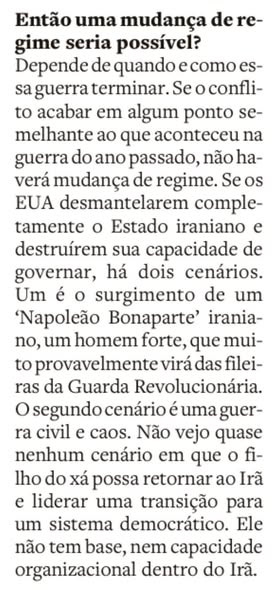
Excelente entrevista do diretor para o Irã do International Crisis Group, Ali Vaez. Destaco o trecho acima, em que Vaez traça possíveis resultados para a guerra. São quatro:
1) Continuidade do regime atual dos aiatolás
2) Fim do regime dos aiatolás e ascensão de um homem forte das fileiras da Guarda Revolucionária
3) Guerra civil e caos
4) Transição democrática com sob a liderança do filho do xá Reza Pahlevi.
Desses quatro cenários, o menos provável é o quarto, porque o filho do xá “não tem base nem capacidade organizacional dentro do Irã”. Você já leu isso aqui.
Restam os três primeiros cenários, nenhum deles alvissareiro para os amantes da democracia. Para os iranianos, a escolha é entre o caos ou um velho ou novo regime autoritário.
Blog do Marcelo Guterman é uma publicação apoiada pelos leitores.
A Strategic Learning Deficit: Western Military Institutions Ignored Ukraine War Lessons.
The Big Five, Futura Doctrina, 8 March edition
My weekly update on war and strategic competition. This week, ignoring Ukraine war lessons hurts, battlefield and long-range strike, PLA operations in the Pacific and my Big 5 reading recommendations.
Ukrainians have been fighting against “shahed” drones for years now, and everyone recognizes that no other country in the world has this kind of experience. We are ready to help, and we expect that our people will also receive the support they need. Protecting life must be a shared priority, and it is very important to coordinate for security both in Europe and in the Middle East.President Zelenskyy, 8 March 2026.
The week of 2–8 March 2026 continued to show that the war in Ukraine has a level of dynamism that is not reflective of the ‘frozen conflict’ narratives popular in some areas. On the frontline, Ukrainian ground forces demonstrated a quiet resurgence while continuing to hold the line against the Russian offensive machine. Long range strike forces executed one of the most operationally significant maritime strikes of the war.
Diplomacy collapsed under the weight of a new Middle East war. 300 Ukrainian prisoners of war returned home, and, President Zelenskyy visited his frontline soldiers again - something Putin has shown no inclination to do, and no courage to do, in the past four years.
In the Pacific, Taiwan is focussed on integrating its defences within a larger First Island Chain defensive strategy, and China halted its aerial incursions into Taiwan’s airspace for a week.
Welcome to this week’s update and Big Five!
Ukraine
Image: Wild Hornets
Interceptor Drones and the Systemic Learning Deficit in Western Military Institutions. This week revealed fully just how poor western and Middle East military institutions have been at learning from the war in Ukraine. I have written several times about how western military organisations have shown a lack of humility in learning from Ukraine, but the past week has provided the best evidence yet of that phenomenon.
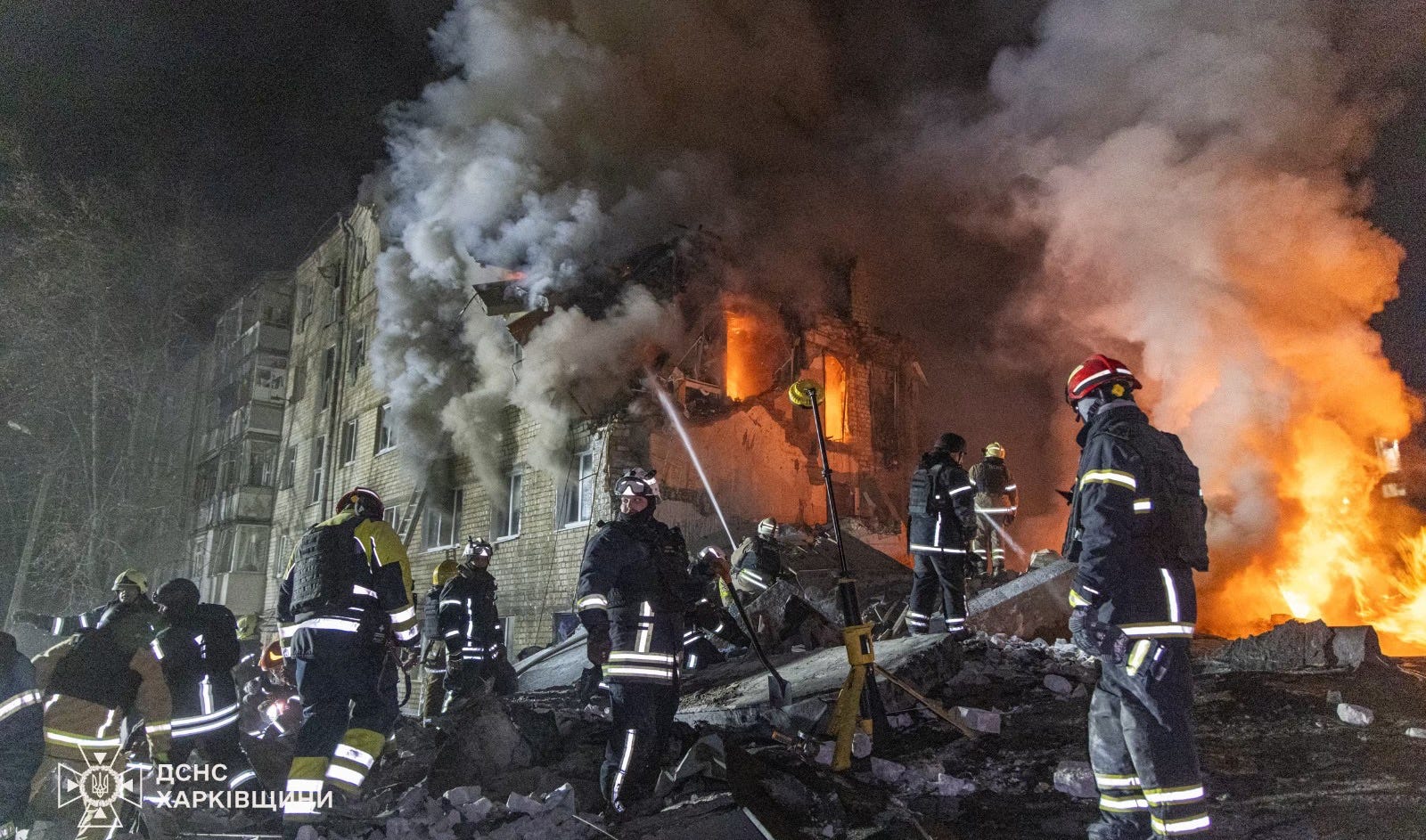
Therefore, it was an extraordinary development this week when the United States formally asked Ukraine for help defeating Iranian drones. When the U.S. and Israel launched their attack on Iran on 28 February, Iran responded with a barrage that included over 500 ballistic missiles and approximately 2,000 unmanned aerial systems in the first five days, according to US Central Command. American air defences — designed for the threat environments of the late 20th century — struggled with the volume of cheap, slow-moving Shahed-type drones. A strike in Kuwait killed six American servicemembers. Drone strikes damaged the US Fifth Fleet headquarters in Bahrain. The Washington Post reported on 5 March that both the United States and its Middle Eastern allies had approached Ukraine seeking expertise and practical support in countering Iranian drones.
Zelenskyy responded shrewdly. He confirmed that Ukraine would provide assistance, directed officials to present options, and announced that Ukrainian specialists and technology would be deployed to the region. He then offered a proposition that was equal parts pragmatic and diplomatically elegant: Kyiv offered to send its best drone interceptors to the Gulf — in exchange for Patriot air defence missiles. ‘It is an equal exchange,’ Zelenskyy said.
Image: @DefenceU
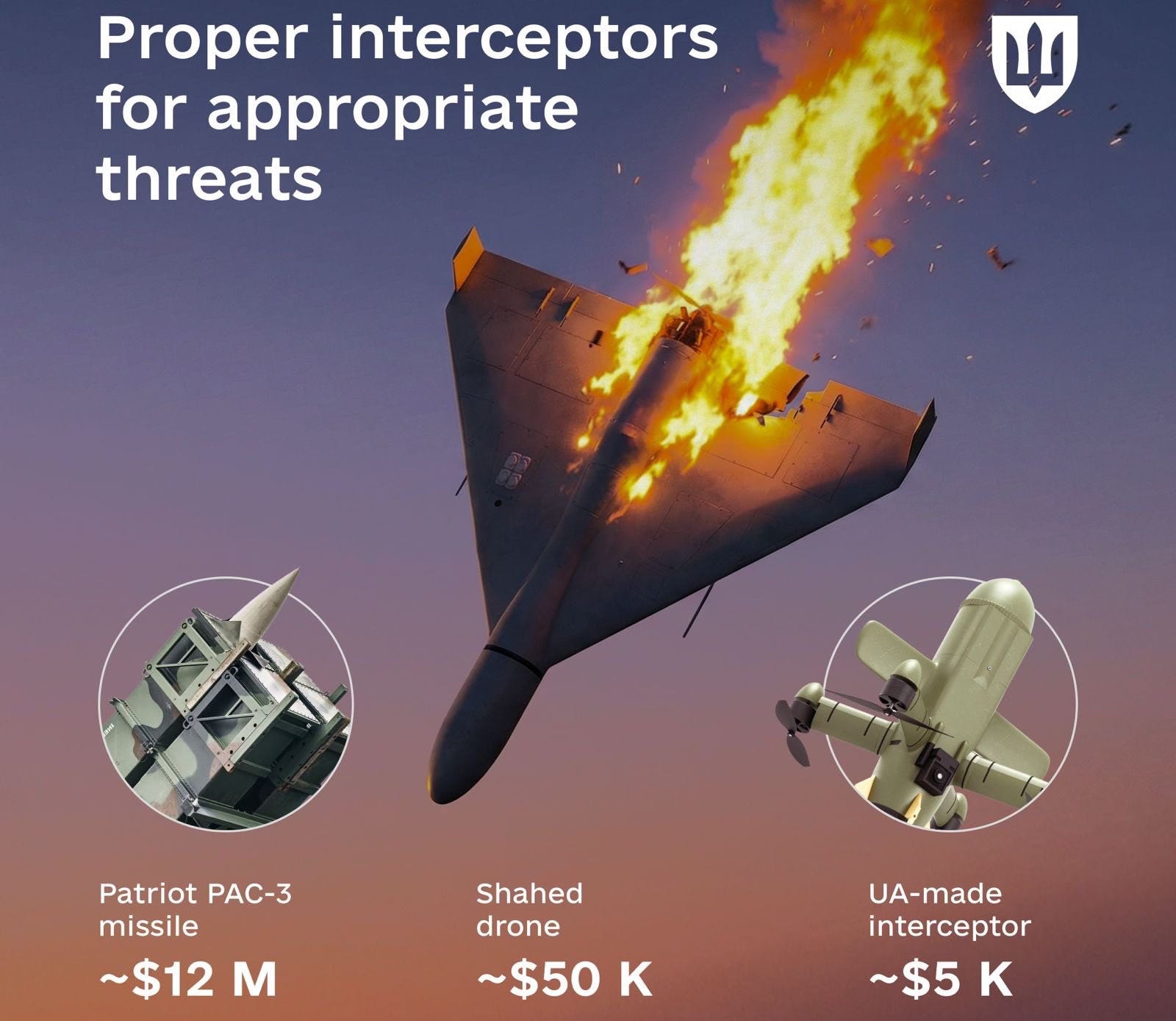
The irony is huge. Ukraine has been defending itself against Shahed drones since 2022. Russia initially imported them from Iran; Iran has since supplied an estimated 5,000 to 10,000 of the weapons to Moscow, with Russia also producing modified variants (the Geran) domestically. Ukraine has built a layered, cost-effective counter-drone architecture over four years of trial and error. For at least a year, Ukraine has employed low-cost drone interceptors, which are an order of magnitude cheaper than Shaheds, as part of this air defence system. It is exactly what the United States and some of its partners lack in the Gulf. CNN reported on 7 March that the US had also decided to deploy its Merops anti-drone system — proven in combat against Russian drones in Poland and Romania — to the Middle East, citing lessons learned from the Ukrainian theatre.
This was a highly predictable threat from Iran which was not paid sufficient respect by the Americans and others, and as a result, they were unprepared. But at least the U.S. military demonstrated some capacity for learning by using Shahed copies (the LUCAS drones) against Iran. The situation is much worse in other countries (particularly Australia), where these has been a systemic effort to downplay or ignore learning from Ukraine. It is an example of a systemic learning deficit in western military organisations which has bitten America and countries in the Middle East.
Just in case we are led to believe that the drone interceptors are the only example of a lack of learning, there was another good example of this systemic learning deficit during the week. A British politician visiting Ukraine tweeted from a previously undeclared maintenance site for British military equipment. For four years, both Ukraine and Russia have employed simple and widely available geolocation from social media posts (and images / videos in those posts) to prime their targeting process. How had they not learned this? As a result, it is highly likely the Russians will target this location, and more lives might be put at threat. At the minimum, the site will have be relocated.
In conclusion, ignoring lessons of modern wars - in an era when war has never been more visible - will hurt you at some point. America and Middle East nations found this out the hard way during the week. What other nations out there have also engaged in willing ignorance of what Ukraine can teach us?
Image: @DefenceU
Ukraine Armed Forces Strategic Research Priorities 2026. This week, the Ukrainian Armed Forces released its research priorities for the coming year. The briefing provided a look back at 2025, noting that:
The main change in 2025 is the transition from chaotic developments to a holistic state system…Last year, the Armed Forces of Ukraine completed the formation of a holistic system that allows them to respond instantly to the challenges of war. The key principle is feedback.
The key priorities for research funding (and percentage of research funding received) in 2025 were:
UAV – 28%.
Robotic systems (RCS) – 15%.
Communication and information protection – 11%.
Electronic warfare and countermeasure systems – 8%.
This year, the Ukrainian Armed Forces will focus on four strategic areas:
Improvement of the innovation management system.
Scaling of research activities.
Deep implementation of Artificial Intelligence technologies.
Further development and integration of unmanned systems in all branches of troops.
Reckoning in the South: The Ground War. This week Ukraine’s Commander-in-Chief, General Syrskyi reported that Ukrainian forces captured more territory in February 2026 than Russian forces were able to seize during the same period. This represents the best relative territorial performance for Ukraine’s ground force since the Kursk operation in August 2024. He described it as having survived a ‘difficult battle of the winter.’
This matters because the pattern of Russian winter advances has been consistent (and often demoralising) in the past couple of years. The Ukrainian gains have broken that pattern, at least for 2026. According to Russia Matters, which cross-references ISW data, Russian forces gained just 46 square miles of Ukrainian territory in the period from 3 February to 3 March 2026 compared with 123 square miles in the previous four-week period. Russian monthly gains of Ukrainian territory have nearly collapsed from their late-2025 peak.
The most consequential Ukrainian gains occurred in the south — in the Zaporizhzhia and Dnipropetrovsk oblasts. ISW’s assessment of 6 March assessed that Ukrainian forces have liberated 244 square kilometres in the Hulyaipole and Oleksandrivka directions since 1 January 2026, while Russian forces seized 115 square kilometres in the same region and time period. This is a net Ukrainian gain of nearly 130 square kilometres on this axis of advance. Ukrainian forces cleared Russian positions west of the Haichur River and likely liberated the settlements of Ternuvate and Kosivtseve.
Along the northern and eastern regions of the frontline, the picture was mixed. ISW’s daily assessments throughout the week tracked Ukrainian advances in the Kostyantynivka-Druzhkivka tactical area and near Kupiansk, while Russian forces continued to press their advance on the Pokrovsk and in the Slovyansk axes of advance. The grinding combat on the ground in Donetsk continues.
Long Range Strike. Russia has probably failed to achieve the objectives it set for its Winter 2025–2026 long-range missile and drone campaign against Ukrainian energy infrastructure. This assessment is supported by an ISW report from the week, which also noted that the Russian military command ‘continues to operate in an alternate reality, setting wildly unrealistic deadlines that do not match Russia’s actual battlefield capabilities.’
President Zelenskyy also warned this week that Russia intends to shift its strike campaign toward Ukrainian logistics and water infrastructure as spring arrives — a potentially significant escalation that could threaten civilian supply chains and Ukraine’s ability to sustain frontline forces. He issued that warning in ISW’s 2 March assessment, and Ukrainian authorities have since been taking steps to harden railway junctions and water facilities against attack.
The most significant long range strike event of the week occurred on 2 March, when Ukrainian forces executed a large-scale drone strike against the Russian Black Sea Fleet’s primary operating base at Novorossiysk. It was a complex, large-scale attack of a type we must all learn from.
According to Ukrainska Pravda, citing sources within the Security Service of Ukraine (SSU), the operation involved approximately 200 aerial and maritime drones, coordinated across multiple Ukrainian agencies including Special Operations Forces, the State Border Guard Service, Defence Intelligence, and the Unmanned Systems Forces. The Ukrainians claim to have hit Russian naval vessels, air defence systems, as well as energy infrastructure at the Sheskharis oil terminal.
The key strike was against the frigate Admiral Essen, which is a Burevestnik-class warship carrying eight Kalibr cruise missiles. UNITED24 Media reported that the frigate’s midsection superstructure was hit, triggering an 18-hour fire. The SSU stated that: ‘The ship sustained critical damage that significantly limits its ability to use Kalibr cruise missiles. At present, the frigate cannot carry out strikes on the territory of Ukraine.’
This is a good outcome. The Admiral Essen has been a persistent source of Kalibr strikes against Ukrainian cities since 2022. Its effective removal from the Russian strike fleet — even temporarily — has operational consequences. The same strike also damaged the minesweeper Valentin Pikul, the anti-submarine corvettes Yeysk and Kasimov, hit a guidance radar from an S-300PMU-2 air defence system, and set fire to six of seven oil loading arms at the Sheskharis terminal.
Later in the week, the Ukrainians hit a key Russian Shahed drone hub near Donetsk Airport. The site was used to store, prepare, and launch strike UAVs against Ukraine.
The broader strategic significance of these strikes is that another Russian Black Sea Fleet refuge is no longer a safe harbour for the Russian Navy. Ukraine’s ability to strike deep into Russian rear areas with significant air, missile and drone defences by using complex multi-domain drone swarms represents one of the most important military developments of this war. The Ukrainian long range strike capability, something I have written about for three and a half years, continues to mature.
And it offers many insights for other military institutions – if they are willing and humble enough to learn.
Diplomacy Interrupted. The diplomatic track of the Ukraine War, which had been dragging on with little progress across the Coalition of the Willing summit in Paris in January and three rounds of US-brokered talks, came to an abrupt halt this week as the war against Iran commenced.
A fourth round of trilateral talks between Ukrainian, Russian, and American representatives had been scheduled for 5–6 March in Abu Dhabi. Bloomberg reported on 5 March that Zelenskyy formally confirmed the talks were postponed indefinitely. “For now, because of the situation with Iran, the necessary signals for a trilateral meeting haven’t come yet. As soon as the security situation and the broader political context allow us to resume the trilateral diplomatic work, it will be done.”
The venue for the talks was part of the problem. The UAE, which had hosted two prior rounds of talks, had largely closed its airspace as Iranian ballistic missiles and drones targeted Gulf states. Indeed, as I write this, another strike against the Dubai airport occurred. Modern Diplomacy reported this week that Ukrainian officials were exploring alternative venues for the talks, including Turkey and Switzerland, both of which have previously hosted negotiations related to the conflict. But the deeper problem with the talks now is not geography — it is political bandwidth.
The Trump administration, which had been the primary diplomatic driver of the Ukraine peace process, is now absorbed by its war against Iran. American attention, American assets, and American political capital have been redirected. Zelenskyy was direct about the risk: speaking to Novaya Gazeta Europe, he warned that a prolonged U.S.-Iran war could deprive Ukraine of key air defence systems it needs to intercept Russian missiles, as Washington would prioritise supplying the Middle East with Patriots and other interceptors.
The Kremlin quickly exploited the disruption. ISW’s 5 March assessment noted that Kremlin officials are ‘using the escalation in the Middle East to set conditions to blame the United States for any future failures in negotiations for a peace in Ukraine.’ Russian officials are working to rhetorically place Russia and the United States in opposition, attempting to discredit U.S.-led mediation efforts by painting Washington as an aggressive power unfit to serve as a neutral broker.
Peace in 2026 is looking even more unlikely – and I began the year with low hopes for this.
Despite the war in Iran, the war in Ukraine continues. Image: @ZelenskyyUa
Strategic Assessment. Ukraine is performing better on the battlefield than the narrative of inevitable victory from Russia describes. As I noted in a piece this week, strategic narratives are not strategy. Russia, likely to launch its spring offensives soon, will be doing so having failed to achieve its strategic objectives for winter. Diplomacy, interrupted by the war in Iran and a global security environment that is changing rapidly, is unlikely make significant progress in the short term.
Three conclusions are worth noting.
First, Ukrainian military performance is holding up and in some areas improving. The Novorossiysk strike, and the counter attacks in the south (now largely halted because of clearer weather) all point to a force that is learning, adapting, and finding ways to strike the Russians in new ways. This is an army that continues to take punches but remains standing and continues hitting back. We can learn from that.
Second, the diplomatic window is narrowing. The Iran War has not killed the Ukraine peace process, but it has disrupted it at a critical point. Russia still shows no signs of genuine compromise on the territorial question that is the heart of any potential settlement, however. The United States remains a crucial broker but is currently otherwise occupied.
Finally, the new Iran War shows that Ukraine’s hard-won expertise has global strategic value. Kyiv is leveraging it intelligently to extract air defence resources from Middle East nations, and to maintain its relevance in a Washington increasingly consumed by a different war. Whether this translates into meaningful gains — Patriot systems, continued military support, sustained American diplomatic engagement — remains to be seen.
The Middle East
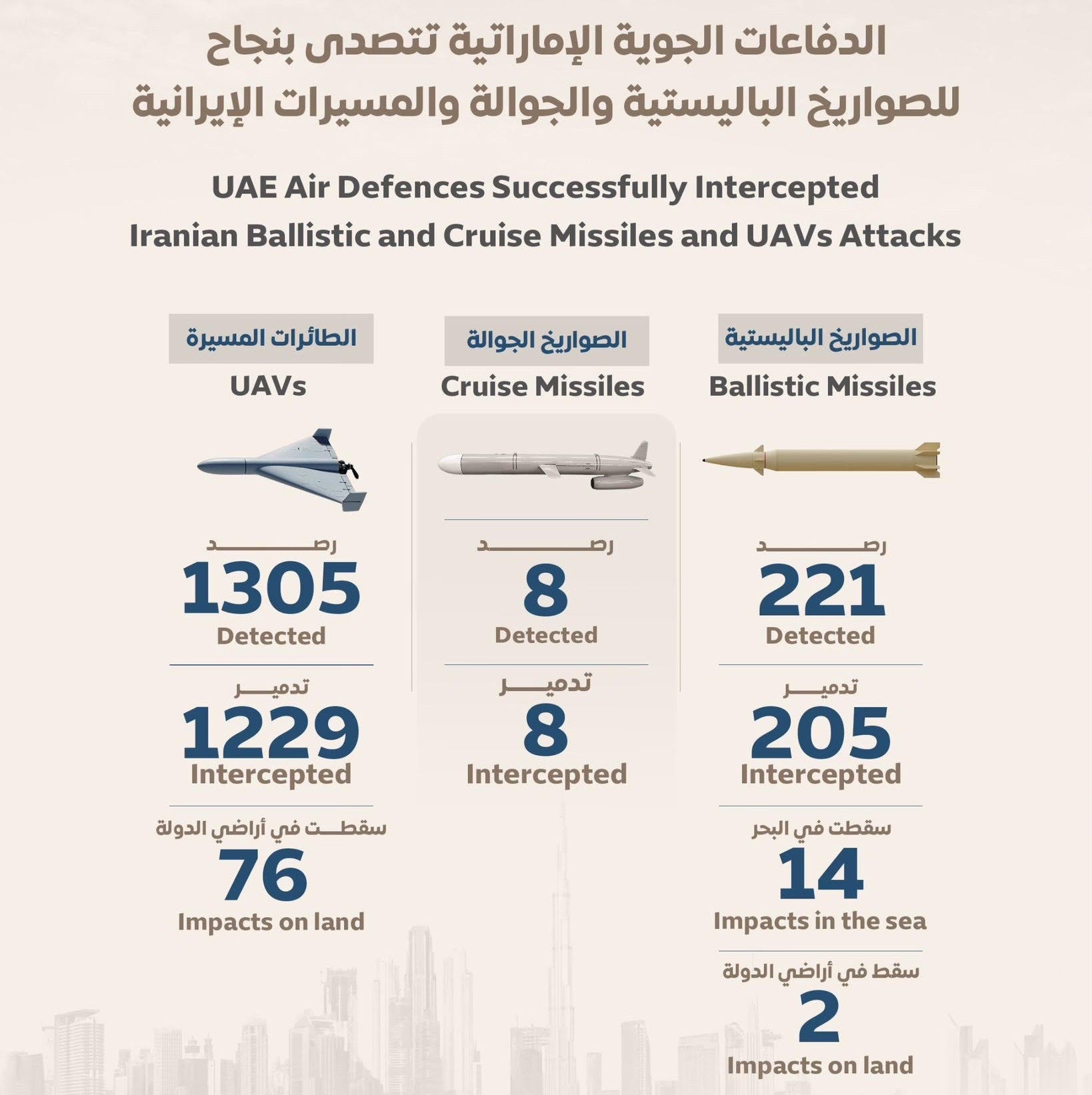
Because I have published a few articles on this topic throughout the week, I will focus on the statistics of the war for this section of the update. The first is an update from the UAE Ministry of Defence (as at 7 March) that covers the drone and missiles strikes against the country since the start of the new Iran War.
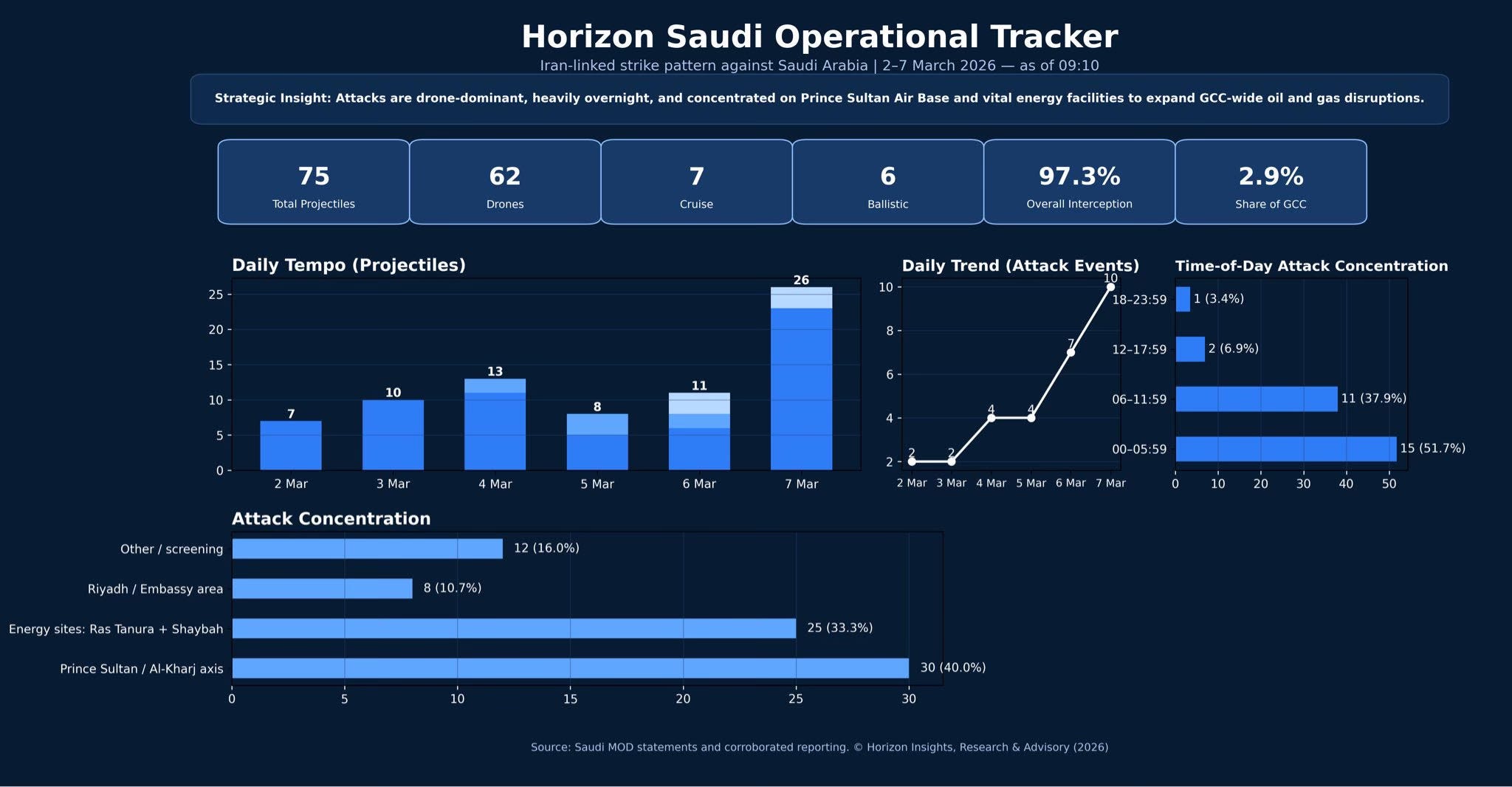
Next, is the update from Saudi Arabia that contains similar data. Attacks on Saudi Arabia are an order of magnitude lower than those in UAE. However, just a few well placed drones and missiles hitting oil production facilities can reverberate around the world.
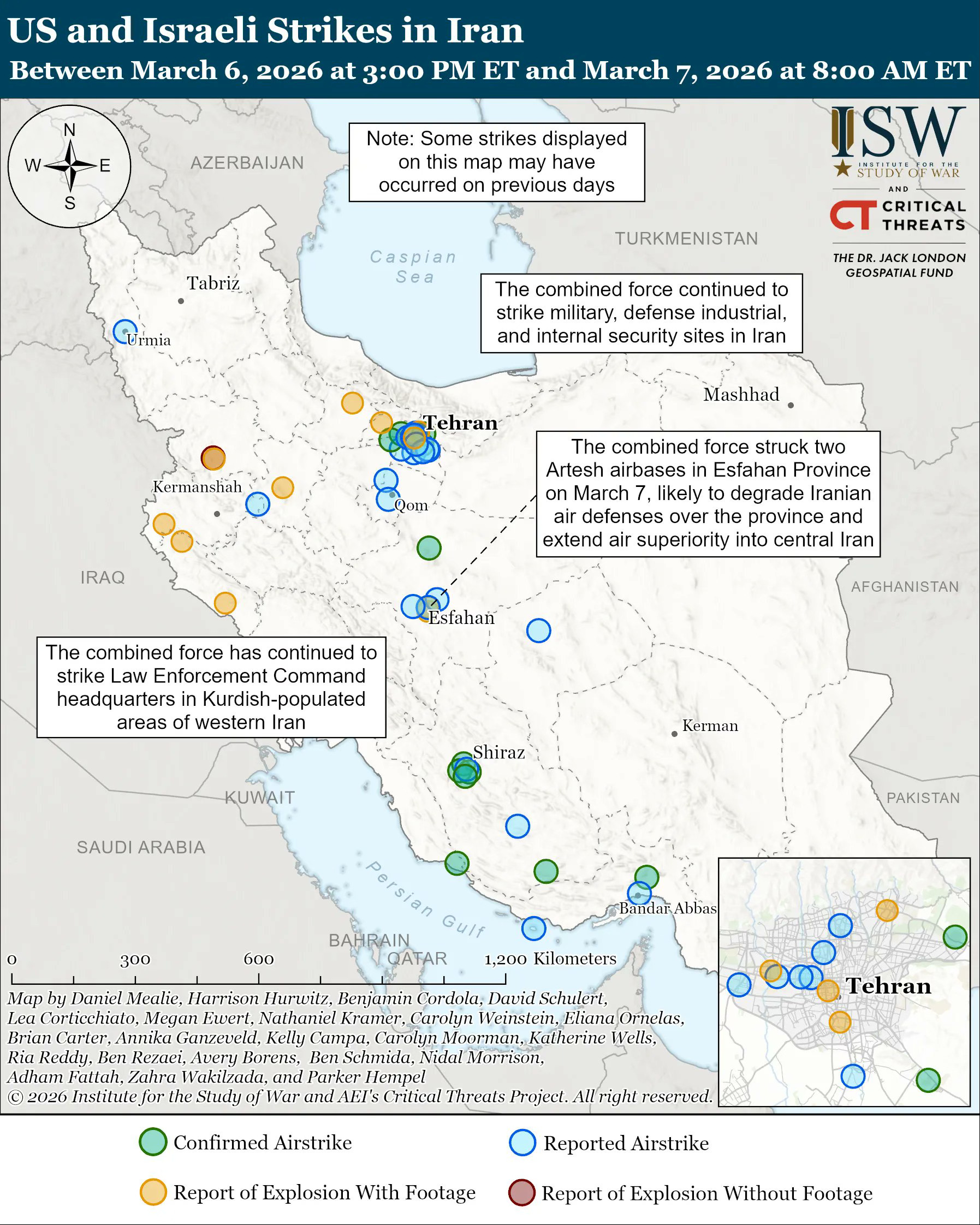
Finally, the latest info-graphic from The Institute for the Study of War covering where U.S. and Israeli forces have conducted strikes against Iran in the past 24 hours.
First Island Chain Integration Strategy. Taiwan Foreign Minister Lin Chia-lung’s interview with The Japan Times articulated a diplomatic strategy acknowledging changed strategic circumstances. Lin argued that effectively deterring China’s expansion into the Pacific requires embedding Taiwan more fully into Indo-Pacific security frameworks, particularly with First Island Chain partners. This represents not just political announcements but recognition that Taipei cannot rely solely on bilateral U.S. security commitments given contemporary American strategic ambiguity.
Foreign Minister Lin called for enhanced cooperation in intelligence-sharing, joint exercises, defense-industry tie-ups, data links, and dealing with hybrid threats such as China’s grey-zone activities. The emphasis on mini-lateral frameworks reflects Taiwan’s assessment that distributed deterrence through multiple partnership nodes offers greater resilience than dependence on a single alliance relationship.
Yet this strategy confronts structural constraints: Taiwan lacks formal diplomatic recognition from most First Island Chain states, limiting the depth and transparency of security cooperation.
China’s Low Tempo Air Operations Around Taiwan. This week, PLA aircraft activity near Taiwan showed a fascinating pattern. After an eight-day absence of detected flights—the longest such stretch since systematic tracking began—Chinese military aircraft resumed operations on 7 March. The pause has generated speculation about causes ranging from mechanical maintenance cycles to deliberate strategic signalling. Taiwan’s Defense Minister Wellington Koo cautioned legislators that absence of air incursions should not imply absence of PLA activity, noting that sea-based operations continued without pause.
This pause naturally sparked speculation, however many popular theories are as of yet unsupported by observable patterns and regional events. Observers have forwarded several possible explanations, to include the ongoing operations in Iran, the upcoming summit between President Trump and Xi, an inability to operate routinely following a series of major officer purges, and domestic politics in Taiwan.
You can read their full analysis on this pause (which is now over) at this link.
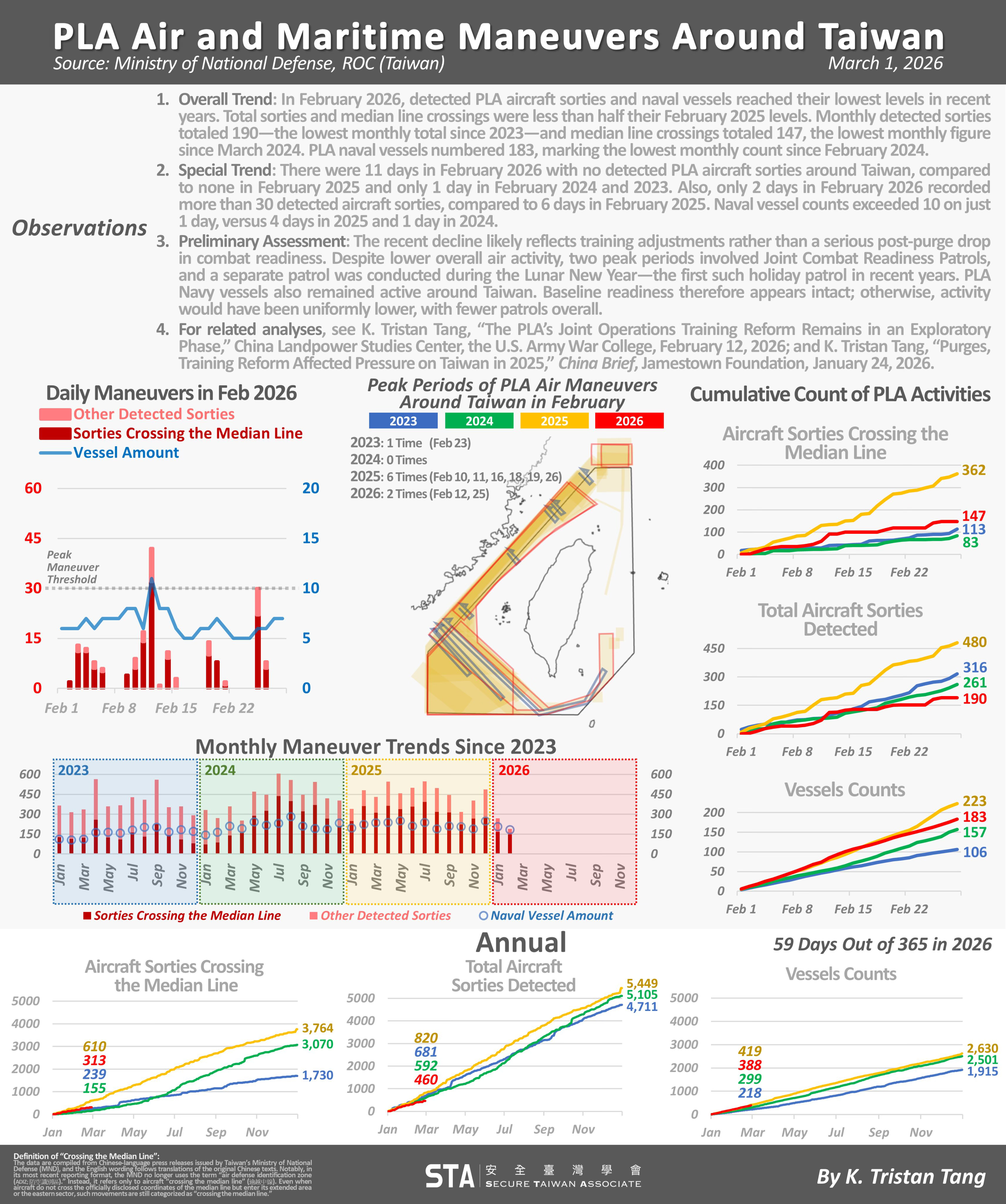
Monthly Update on PLA Air and Maritime Maneuvers Around Taiwan. During the week,@KTristanTang released his latest monthly update on Chinese activity around Taiwan. His conclusion: “PLA air and maritime activity around Taiwan has declined, but this does not necessarily imply that combat readiness has been seriously weakened by the recent purges. Rather, it appears to reflect a shift in training planning toward exploring joint operational modes.”
Middle Power Security and Carney’s Asia-Pacific Visit. This week the Canadian Prime Minister visited the Pacific region, including stops in Australia, India and Japan. Pitching a middle power approach to regional security, he seeks to address the fundamental question confronting Pacific security affairs. Is a network of distributed, minilateral security agreements a viable substitute for weakened bilateral alliance credibility. Manila, Tokyo, Canberra, and Taipei are building networked relationships precisely because long-standing hub-and-spoke arrangements in the region, of which America is a critical component, appear insufficient.
Yet networked resilience of the type discussed this week depends on each nations’ individual capability and collective coordination. The transition from American-guaranteed stability to a more distributed form of deterrence against Chinese aggression will either produce more robust security or dangerous gaps. This week suggests allies and partners understand the challenge, but have not yet invested in solving it.
Japan’s defence spending has doubled from 1% to 2% of GDP, and the current Japanese PM is looking at further enhancements to the budget as well as constitutional change. Unfortunately, few other countries in the region, including Canada or Australia, have shown an inclination to drastically increase defence spending or a willingness to take more strategic risk in seeking to deter China.
First, I published an article on 2 March which examined initial insights and questions from the initial phase of the new U.S.-Israeli military campaign against Iran. You can read that article here.
Next, I published a piece yesterday that explored what Putin and Xi might be learning from the war in Iran. Called Selective Belligerence and Unconditional Surrender, you can read this article at the following link.
*******
It’s time to explore this week’s recommended readings.
In this week’s Big Five, I have included an excellent new report from RAND that examines Chinese perspectives on the military applications of AI. There are also articles on how the Chinese leader might approach his upcoming summit with President Trump, insights into how AI will impact on army officers and a good piece of FICINT from Peter Singer and August Cole.
As always, if you only have the time available to read one of my recommendations, the first is my pick of the week.
Happy reading!
1. PLA Perspectives on AI
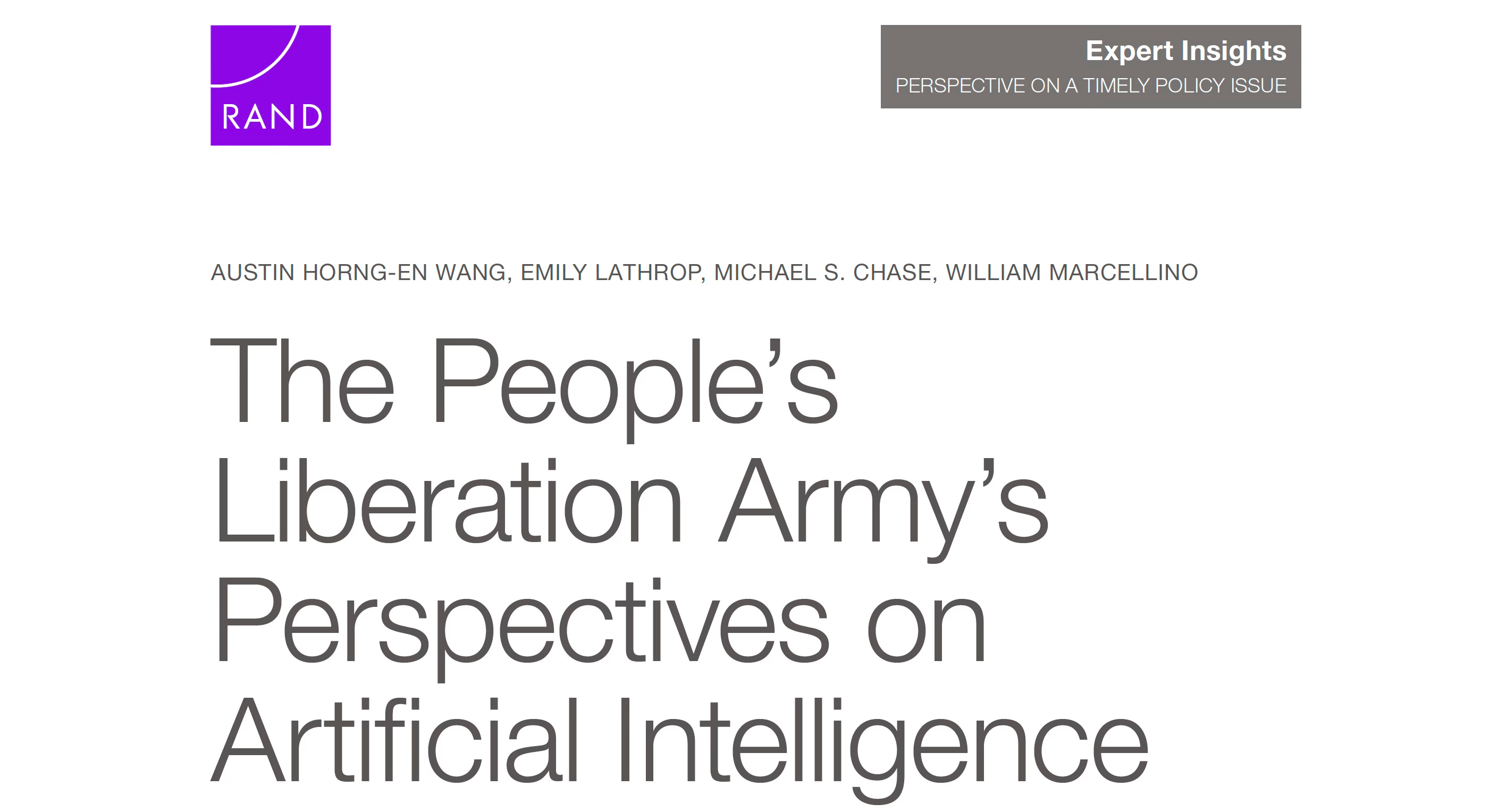
In this new report from RAND, the authors explore integration into the PLA from the perspective of Chinese military leaders. The review indicates that the PLA will use AI to enhance its kill chains by strengthening joint AI integration, multi-agent collaboration, and improved, secure data transmission. There is also examination of the use of AI in military logistics. Finally, the authors propose several targetable vulnerabilities in the PLA approach to AI implementation. You can read the full report at this link.
2. Will China Overplay Its Hand?
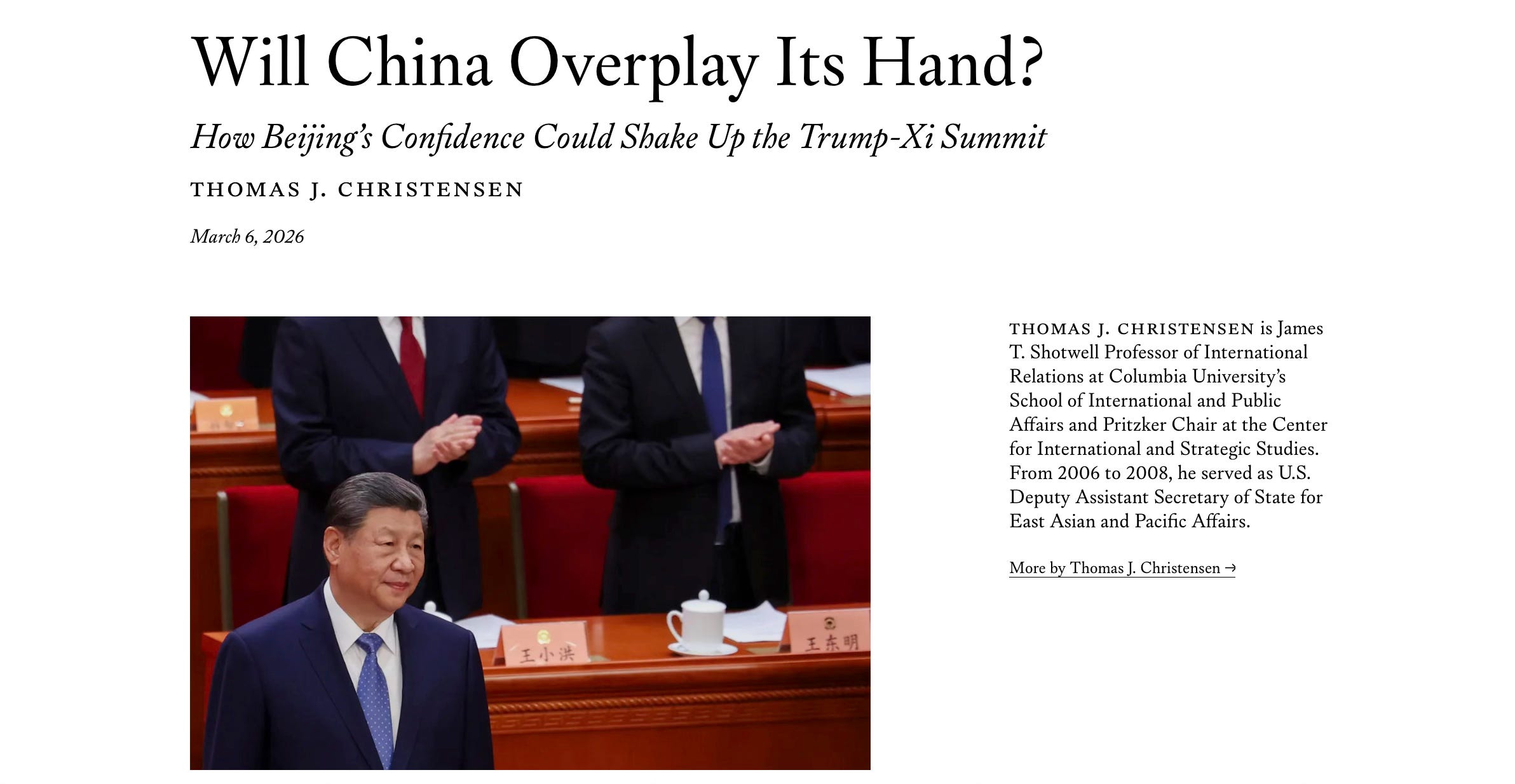
In this article published by Foreign Affairs, the author examines how the Chinese leader might approach the forthcoming summit with President Trump. The author notes that “the most significant factor that will shape the upcoming Trump-Xi meetings will be Beijing’s perception of its own apparent success in 2025 in responding to U.S. threats with resolute counterthreats…Many Chinese experts believe that Beijing, unlike other capitals subjected to Trump’s threats, managed to back Washington into a corner and that this outcome signaled China’s arrival as a global power on par with the United States.” How this will influence the coming summit remains to be seen. You can read the full article here.
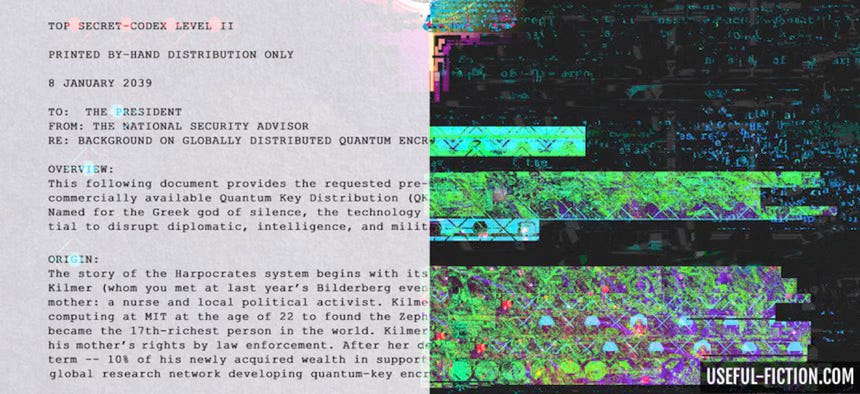
3. Effects of Private Quantum Encryption
Peter Singer and August Cole have been working with Defense One this year to produce a series of short stories that examine key national security and military issues. This FICINT (fictional intelligence) is designed to be an accessible yet thought-provoking means to drive conversions in government and beyond about the impacts of new technologies on national security and societies more broadly. The latest story, The Quantum Curtain, has just been published and can be read at this link.
4. The Impact of AI on Army Officers
A new report was released by the Special Competitive Studies Project (SCSP) that explores the impact of AI on Army officers and the army profession more generally. As the author of the report notes, “these changes will affect not only which jobs warfighters perform, but how they perform them, requiring the U.S. military to rethink how it organizes, trains, and equips its future workforce, as well as how it designs its forces.” You can read the full report at this link.
5. Responsible Procurement of AI in Military Institutions
This report from the Stockholm International Peace Research Institute (SIPRI) explores the intersection of military procurement and responsible use of military AI. The authors propose that procurement process can be a mechanism for states to implement political commitments and legal obligations, and therefore, also a mechanism for implementing responsible use of AI in military institutions. You can read their full report here.



 Inscrito