domingo, 2 de julho de 2023

As companhias militares privadas e a tirania russa de Putin - Adam Tooze

The Wagner uprising and the centrigugal force of war

Adam Tooze

Chartbook, July 1, 2023


What happened this time last week in Russia? 

As Robert Armstrong observed it went by so fast that markets hardly had time to react. One could infer that Russia doesn’t matter that much. As Armstrong argued that would be a mistake. In fact it may very well be of decisive importance to a number of key facets of the world economy, notably energy markets. The problem is that like other crucial factors in the global scene right now - most notably the logic driving Chinese policy - it is devilishly hard to get good information about what is going on and to decide its significance. What it does clearly illustrate, however, is the centrifugal dynamic of war. 

On Ones and Tooze this week, Cameron Abadi and I discussed some of the questions that arise from the incident. 

  • What kind of organization was Wagner? 

  • Is Putin weaker now than he was prior to the mutiny? 

  • How far are economic factors decisive in political history, or is it ultimately men with guns who call the shots? 

  • And has Putin overcommitted his military to Ukraine? How many soldiers is it normal for states to have? 

You can listen and read more here.

One piece that really set me off was a an op ed by Tony Barber in the FT. He evoked what is supposedly a 

long tradition of unofficial, semi-official or secretly state-backed warriors who fight for Russia — a tradition that extends from the tsarist empire’s 19th-century volunteers to the Wagner group of Vladimir Putin’s presidency.

To make the point Barber invokes the character of Count Alexei Vronsky from Tolstoy’s Anna Karenina who set off to join thousands of Russian volunteers fighting in the Balkans for the liberation of fellow Slavs from Ottoman rule.

To me that seems about as illuminating as saying that the British mercenaries operating in the Gulf, or the Congo or West Africa in recent decades are descendants of a tradition that goes back to the Greek wars of liberation in the 1820s.

In fact, Russia’s laws are comparatively strict when it comes to truly free lance, private mercenary activity. That didn’t stop military entrepreneurialism of many kinds after the collapse of the Soviet Union. According to one report: “by 1998 an official Russian government estimate placed the total number of private security companies operating in Russia at around 5,000.” High-profile private operations overseas, however, were by no means encouraged. The survivors of one precursor organization to Wagner were arrested on their arrival back in Russia after their first and highly unsuccessful sally into Syria. 

It took a rethink on Putin’s part, between 2009 and 2012 to lead to the state backing of Wagner. As András Rácz pointed out in a CSIS blog:

As pointed out by Anna Borshchevskaya, in 2009 several special operations units of the Main Intelligence Directorate (GRU) were subordinated directly to Chief of Staff Nikolay Makarov. Though there is no direct evidence, these units were probably intended to become the personnel source for private military companies to be set up in the future. A year later, Makarov publicly spoke about the need to use private military companies “for delicate missions abroad.” The logic prevailed: in April 2012, when then-Prime Minister Vladimir Putin was asked in the Russian Duma about whether he supported the idea of creating a network of Russian private military companies, he replied positively and emphasized that PMCs could be tools of influence abroad, allowing the realization of national interests without the direct involvement of the state. As examples, he noted that such companies could provide protection of important facilities, as well as training for foreign military personnel abroad. Plausible deniability played a key role in Russia’s considerations about setting up private military companies, based also on the rich historical experiences Moscow has.

Wagner was never a PMC like Blackwater. It was always a proxy force, a deniable military arm of the Russian state. The obvious historical analogue, therefore, is less romantic military adventurers in the 19th century, than the kind of front companies used by the CIA in various settings. The main difference seems to be that whereas the CIA used front companies above all for air transport, Wagner developed into something like a miniature combined arms force. Its main base in Russia, its long-range logistics and tricky matters like passports were all provided by the GRU. 

As to the question of the state and the monopoly over the legitimate use of violence, Wagner was obviously in a grey zone. On the one hand it was deniable. On the other hand it was an open-secret that it was endorsed and backed by Putin himself, which gave it a status in a sense higher than the regular military. It was an exception defined by the sovereign and defining his sovereignty. 

The serious problem this kind of organization creates is less the question of legitimacy than the rivalry between different militaries, especially when the going gets rough and it is not victory, but the responsibility for defeat that has to be apportioned. 
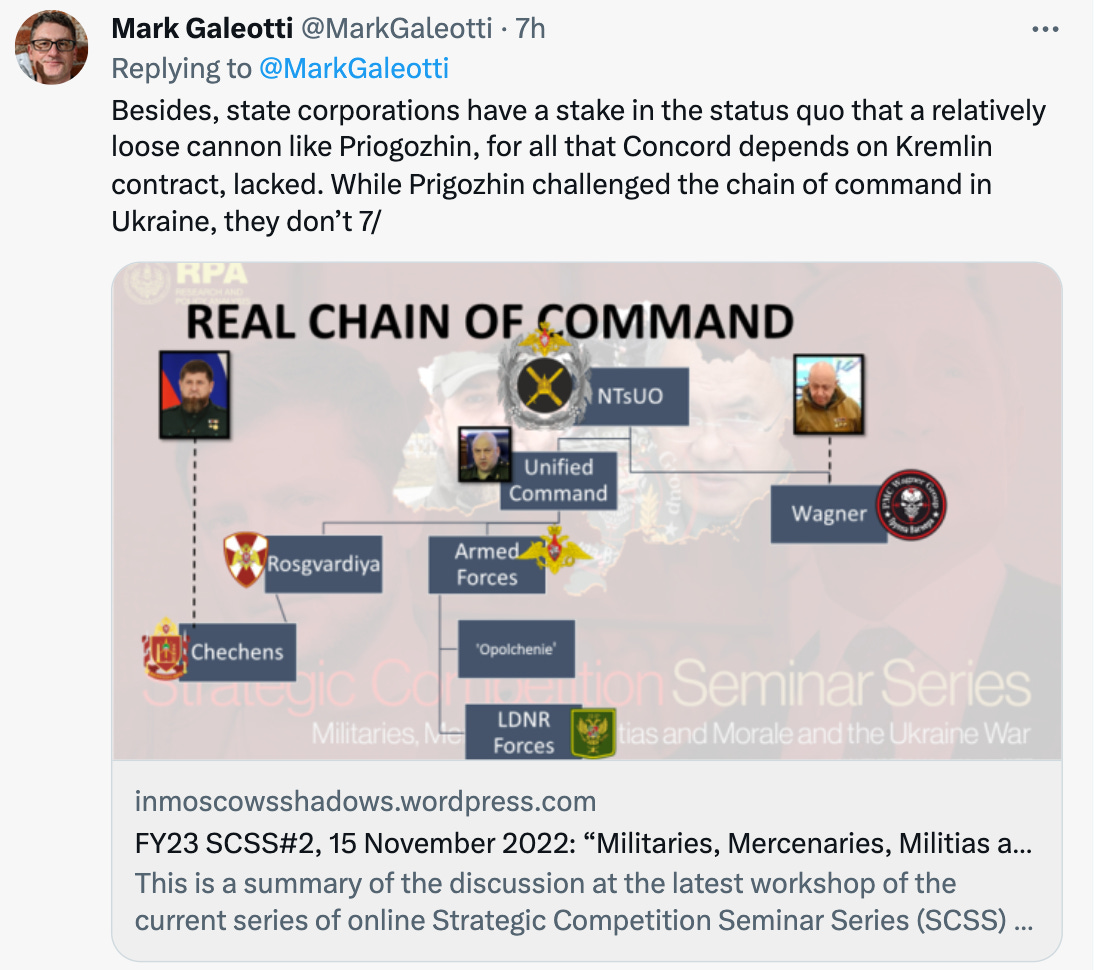
This is not unusual in war. All armed forces are complex. This gives rise to rivalry and political arguments - with both a small and a capital “p”. In the American Civil War, for instance, different units of the Union army had more or less radical positions on abolition. In World War 2, Army Group Center on the Eastern Front harbored many of those involved in the bomb plot of 20 July 1944. The tensions are likely to be particularly acute when military forces are made up of units recruited through different politicized channels, as on the Republican side during the Spanish civil war. 

Tensions between Wagner and the regular Russian military flared already in Syria. In the disastrous war in Ukraine it was hardly surprising that they would reach a new pitch. The bushfire of indignant nationalist military bloggers on Telegram are a welcome extension of Kremlin propaganda, but a risk for the regular military leadership. This Al-Jazeera segment on the military bloggers was excellent. 

When Prigozhin’s attacks on the top brass became too outrageous and Wagner was ordered to be incorporated into the Russian military command chain, it was hardly surprising that this triggered opposition. It is surprising only that it was allowed to flare into an armed rebellion. It was not a rebellion against the war, or even truly against Putin, but an internal military on military struggle, which has been resolved in favor of the regular military command chain.

Bruno Macaes concludes with characteristic insight but also overstatement that what the Putsch shows us is that the Russian state is hollow. It certainly demonstrates that Putin is losing his grip in balancing the different factions and showed little actual ruthlessness in dealing with the rebellion. We surely expected to see Prigozhin subjected to savage reprisals. If he eventually falls victim to an assassin it will hardly be surprising, but nor will it do much to restore Putin’s authority. 

Rather than cause for celebration, as Alexander Clarkson remarks, if this is a sign of things to come, it should surely be reason for concern. 

In a system that has become reliant on an individual leader to act as arbiter between rival factions, the ability of a force made up of a few thousand troops to threaten the capital demonstrates the chaos that could unfold once Putin is gone. Putin’s unwillingness to select a potential successor who could become an alternative center of authority means that the risk of disputes over the succession process once he does eventually—and inevitably—leave office are inherent to the power structure he had put in place. With the severe pressure that a disastrous war against Ukraine has put on Russian society and the proliferation of parastatal armed units—of which Wagner and Chechen leader Ramzan Kadyrov’s Akhmat units are only the most prominent examples—the likelihood has risen sharply that such a succession dispute could escalate into a neo-feudal civil war that fractures the state.

We must also ask, surely, what the implications of this shock are for our wider thinking about the war and its future course. 

Of course, Putin’s Russia has a distinctive political structure. But Ukraine’s military effort too has its roots back in 2013 and 2014 in formations recruited under different flags and with very different politics. They have been welded together highly effectively by Kyiv. Success and the patriotic rally has done the rest. But will that unity hold if the Ukrainian offensive continues without major success, if supplies of equipment run critically short, or when it comes to negotiating peace? 

Tony Barber in his piece about the Wagner rebellion refers to the ominous example of the Freikorps in Weimar Germany. He cites them as an example of the breakdown of state power. But they were also a political force. They were the spawning ground of Nazism and they were organized above all around opposition to the decision by the democratic forces in Germany to negotiate a peace and to try and fulfill the terms of the Versailles peace treaty. They killed not only the revolutionary communist leaders Rosa Luxemburg and Karl Liebknecht, but also thousands of other leftists and two of the most prominent civilian politicians involved in negotiating the peace, Walther Rathenau and Matthias Erzberger. 

Nor was this logic of disintegration in the face of peace confined to Germany. Think of the civil war in Ireland that followed the Anglo-Irish Treaty of 1921. The IRA was able to resist the compromise peace with armed force, because it had grown out of an armed underground resistance with an independent system of financing and arming itself. In the moment that he put his signature on the Anglo-Irish Treaty, Michael Collins knew that he was a man marked for death.

Modern wars generate massive and violent centrifugal forces. We should not be surprised if this is just the beginning.


A 3a GM comecará na Belarus, ou seja, na Polônia outra vez? - Osborn Baya (Medium)


Poland Is Going To War Against Russia

Osborn Baya

4 min read·3 days ago

Has Poland Triggered The World War III Bomb?

Photo by Daniel on Unsplash

Has Poland started what the world has not wished for a lifetime? Has it started WWIII?

The past few days have been busy for the International Community with the attempted coup on Russian President Vladimir Putin by the war mafia and Leader of the Private Military Group, Wagner PMC, Yevgeny Prigozhin. The leader was allegedly in conflict with the Defence Minister of the Russian Federation, Sergei Shoigu, over the misappropriation of funds and strategic failures. Putin referred to this attempted coup as a “betrayal of their own country”. He termed them as insurgents. His speech sealed their fight, and I analysed it here: Putin’s Stance on the Fate of Wagner PMC

These events led to a deal being struck between Putin and Prighozin, with Belarusian President Aleksandr Lukashenko acting as the mediator. The deal meant that Prighozhin was to cease his advancements towards the Kremlin, which he was a mile away from. It was also deemed necessary for the war mafia to relocate to Belarus to ascertain his security as all criminal charges were dropped against him. I also wonder why, if you ask me. Criminal charges for an act of this scope translate to treason in the Russian Republic.

The relocation of Prighozin, popularly known as “Putin’s personal chef”, meant that the bases of his Wagner PMC mercenaries were going to be in Belarus. They still have the blessing of the Kremlin to continue their military activities and expeditions in Africa and the Middle East. I will soon write a story on this issue. Does this move scare anyone around? Yes, it does. This move has had three countries scrambling to advance their strategic military positions in fear of these mercenaries.

These countries are Poland, Latvia, and Lithuania. Poland's President Andrzej Duda was quoted as saying:

We see what is happening, the relocation of Russian forces in the form of the Wagner Group to Belarus, and the head of the Wagner Group going there, those are all very negative signals for us which we want to raise strongly with our allies

With the military and political instability happening in the region, the three countries seemed to have urged getting ready for any advancements from the most dangerous Private Military Group Wagner, which seems to be a few miles away from their borders. Latvian Foreign Minister Edgars Rinkevics was quoted saying this in Paris. He specifically said this:

This move needs to be assessed from a different security point of view. We have seen the capabilities of those mercenaries

Their Lithuanian counterparts, through Foreign Minister Gabrielius Landsbergis, said that the mercenaries are just one day away from their capital city. This is what he had to say:

Our countries’ borders are just hundreds of kilometres from that activity so it could take them 8–10 hours to suddenly appear somewhere in Belarus close to Lithuania

It is creating a more volatile, unpredictable environment for our region.

We need to take the defense of the Baltic region very seriously

With this confusion, the World War III that people have seemingly thought was far from happening is now near enough.

Map of Belarus and its territorial neighbours.

These Baltic countries are members of the North Atlantic Treaty Organisation, commonly known as NATO. This therefore means that any military advancements in the region would trigger a response from the Alliance, which has membership in the USA, UK, and France, among other European Union countries. They would also trigger a response from the Russian side, which has a close relationship with Belarus. This would also push the involvement of China, which has been taking a military strategic position in African countries, and other countries aligned with the Communist Republic.

These events therefore spark a sense of a war that would crumble the world and bring about disorder. A war against NATO countries and former Warsaw Pact members could see the use of nuclear weapons, which would destabilise the world. I really wish the events in that region don’t escalate in that direction. If you can clearly remember, the Second World War began there, which saw Adolf Hitler invade Poland. I sincerely hope that the Baltic countries remain calm and quell the situation quickly.

What do you think about these events? Do you think that we could witness a Third World War soon enough?

If you have any comments about my views, please comment them down below or email me directly at bayaosborn78@gmail.com. If you have any suggestions, a story you would like me to analyse, or things I need to improve on, please do the same.

To stay informed on international politics, follow me on Twitter and Medium for insightful perspectives and expert commentary. I offer valuable insights into the complex dynamics of the international stage. You can find me at @bayaosborn, where I share a wealth of information and engage in informed discussions on the ever-evolving world of politics.

Crônica de uma Catástrofe Anunciada: russos preparam a implosão da central nuclear de Zaporozhye - Nadin Brzezinski (Medium)

 Will the Russians Blow up the Zaporizhia NPP?

Nadin Brzezinski
5 min read·21 hours ago

Russia has a pattern. It’s an old pattern. It’s one involving the destruction that they can’t have. They have taken pavement from roads on their way out, for example. They have destroyed cities to capture them. The jokes around washers and toilets are long in the tooth at this point. Now they control the sixth largest nuclear plant in Europe, and there is noise they are leaving.

There is also noise. They intend to do great damage on the way out. One of those signals is, as always, accusing the other of what they intend to do. The screen cap below is from TASS, hardly alone. They have also distributed a letter in the United Nations a priori denying responsibility.

The old tool of propaganda is accusing others. Germans perfected this during the Second World War, but Russians were also experts. This is strategic disinformation.

But there is more:

Against the background of the information transmitted the other day by GUR, which showed that the Russians would intend to cause an accident at the Zaporozhye power plant, the same Ukrainian intelligence service today publishes an information on the Telegram channel, according to which 
“ According to the latest data, the occupation contingent is leaving gradually the territory of the Zaporozhye nuclear power plant”.

The intelligence agency said among the first to leave the station were three Rosatom employees, who managed the Russians’ actions. Ukrainian employees who signed a contract with Rosatom were also advised to evacuate.

According to the instructions received, they should leave by July 5th.

Also, the number of military patrols is gradually decreasing on the actual territory of the Zaporozhye nuclear power plant and in the plant’s satellite city — Energodar. 
Staff remaining at the station were instructed to “blame Ukraine in case of any emergencies”.

On June 25, the head of the Main Intelligence Directorate, Kirilo Budanov — “The Man Who Never Smiles” — , said that the Russians had completed preparations for a possible terrorist attack on the Zaporozhye nuclear power plant.

Explosive devices were placed near four of the Plant’s six units. IAEA Director General Raphael Grossi had previously stated that the undermining of the Kahovka Dam threatens the operation of the Zaporozhye nuclear power plant. According to him, there is a risk of running out of the necessary level of water to cool the reactors in a few weeks. On June 15, he said the situation in Zaporozhye was “serious” but he was trying to “stabilize” it.

Energoatom reported that despite the Russians blowing up the Kahovka Dam, the situation at the Zaporozhye nuclear power plant remains under control and there is enough water in the cooling pool to meet the plant’s needs.

From my point of view, any act of sabotage — blowing up, simulating overvoltage, or any other similar act, is still unlikely to ‘0’ considering the catastrophic consequences, both for Europe and, to the same extent, for Russia. Also, a significant part of N-E Turkey would be affected.

The main danger, but which is currently under control, is the provision of the water needed to cool the 6 nuclear reactors.

Now these are not pile reactors. They do run hotter than Western reactors. So perhaps we will have less of an issue than Chornobyl. There is some technical data as to why it will not be that bad. Also, the types of man-made accidents we might expect. I found this Twitter thread useful. However, western reactors did suffer explosions a decade ago.

Now Ukrainians have been screaming to the four winds, to anybody who will listen, that Russia will do this. As of this morning, they shared this as well:

Russia has a plan to remotely detonate the ZNPP when the aggressor’s troops hand over control of the nuclear plant to the IAEA and Ukraine, — Zelensky

To me, the signal that they intend to do it is not the withdrawal of military personnel. Sure, that would be good. The withdrawal of technical personnel needed to deal with an accident is. For somebody screaming the other side is going to do it, why take away the technicians needed to control such a provocation? At least now we know Russians value some lives, maybe.

Yes, at this point, I am way cynical.

Now there are going to be consequences. Perhaps Russia is indeed looking forwards to, for real, losing the war to NATO because losing to Ukraine is short-circuiting their imperial brain. Crests (using the less objectionable insult) are not supposed to be able to fight Russia and defeat Russia. Now, losing to NATO is far more acceptable.

This is why they captured a U.S. General; they did not. Why did they claim there were two NATO generals and troops at Kramatorsk. No, there were not why they hit a command post in Lviv where ten allied generals died; no, that never happened.

But to the Russian people, this is great propaganda. See, we are fighting the collective West! We even have audio on Telegram of the International Legion, who, of course, speak a panoply of languages, including, shockingly, I know, English and Polish, two favorites for the propagandist. They even showed off a few British citizens captured at Mariupol who served with the regular Ukrainian Marines. They were not even in the Legion. Russians intended to try them and execute them as a show trial. In the end, they were exchanged.

We have been at the most dangerous point of this war for at least two weeks. The drama inside Russia is also raising the stakes. This is why. This is one of a few reports from Ukrainian successes at the front:

Counterattack | The 47th OMBr “Magura” breaks through the defense of the Russians in the south

47 OMBr “Magura” breaks through the defense of the Russians in the south. This video concentrates the events of two days of assault. Two companies of Russians fled from their positions.

https://youtu.be/bk5OG6JYmfI

https://t.me/censor_net/32470

Ukrainians are starting to push through defense lines. The video is not that gory, but one section shows the dense minefields, removed by sappers, to the side. They are going slowly, purposefully, and methodically. This saves lives in the end.

So returning to the plant. I concluded a while ago that they would damage that plant on the way out. How serious is a damn good question? My mind firmed this when they blew the Kharkhova dam. This is based on how the Russian mind works. Yes, I will say it right now. I prefer to eat a large crow pie with them fixings on the side. If I am wrong, please tell me this.

We will likely add to the rapidly growing collection of war crimes. This will be in the category of crime against humanity worst case. Let’s hope it’s the best case—either a small incident or none at all.

I indeed look forward to a full pie, not just a slice. Let’s hope I get that.


Postagem em destaque

Livro Marxismo e Socialismo finalmente disponível - Paulo Roberto de Almeida

Meu mais recente livro – que não tem nada a ver com o governo atual ou com sua diplomacia esquizofrênica, já vou logo avisando – ficou final...