O que é este blog?

Este blog trata basicamente de ideias, se possível inteligentes, para pessoas inteligentes. Ele também se ocupa de ideias aplicadas à política, em especial à política econômica. Ele constitui uma tentativa de manter um pensamento crítico e independente sobre livros, sobre questões culturais em geral, focando numa discussão bem informada sobre temas de relações internacionais e de política externa do Brasil. Meus livros podem ser vistos nas páginas da Amazon. Outras opiniões rápidas podem ser encontradas no Facebook ou no Threads. Grande parte de meus ensaios e artigos, inclusive livros inteiros, estão disponíveis em Academia.edu: https://unb.academia.edu/PauloRobertodeAlmeida

Site pessoal: www.pralmeida.net.

domingo, 31 de agosto de 2025

História do Futuro - António Vieira, uma espécie de bolchevique dos jesuitas do século XVII

História do Futuro é um livro escrito pelo padre português António Vieira (1608-1697) no século XVII.

Segundo o escritor Roberto de Sousa Causo, trata-se da primeira narrativa utópica escrita em português, onde o autor buscou reavivar o mito milenarista do Quinto Império, um império cristão e português a dominar o mundo, sucedendo os 4 célebres impérios da Antiguidadeassíriopersagrego e romano.[1] Para ele, havia uma nítida repetição dos ciclos da História, e agora caberia a Portugal a liderança do mundo civilizado. Sua escrita iniciou-se em 1649, segundo Sorel, ou em torno de 1665, segundo Bosi, mas só foi publicado postumamente em Lisboa em 1718, e mesmo sendo apenas um fragmento inacabado, despertou grande interesse - e também a suspeita de heresia.[2][3][4] Vítor Amaral de Oliveira a considera, junto com as Trovas, de Bandarra, um dos dois mais importantes textos do sebastianismo.[5]

Referências

  1.  Causo, Roberto de Sousa. Ficção científica, fantasia e horror no Brasil, 1875 a 1950. Editora UFMG, 2003, p. 59
  2.  Priore, Mary Del e Venâncio, Renato Pinto. O livro de ouro da História do Brasil. Ediouro Publicações, 2001, p. 128
  3.  Bosi, Alfredo. História Concisa da Literatura Brasileira. Cultrix, 1997, p. 44
  4.  Sorel, Andrés. José Saramago: Una mirada triste y lúcida. EDAF, 2007, p. 93
  5.  Oliveira, Vítor Amaral de. Sebástica: bibliografia geral sobre D. Sebastião. Biblioteca Geral da Universidade de Coimbra, 2002, p. xxx.


sábado, 30 de agosto de 2025

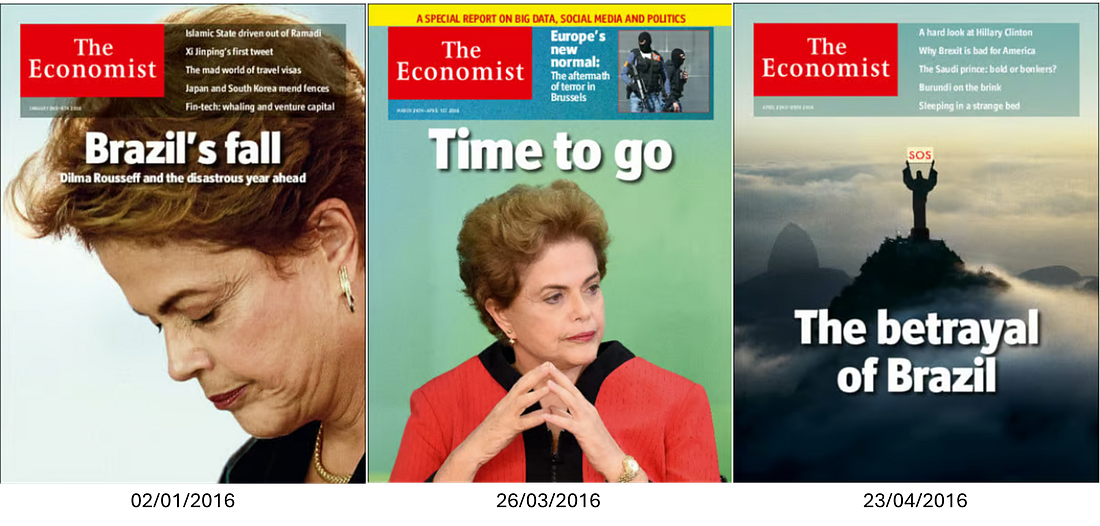
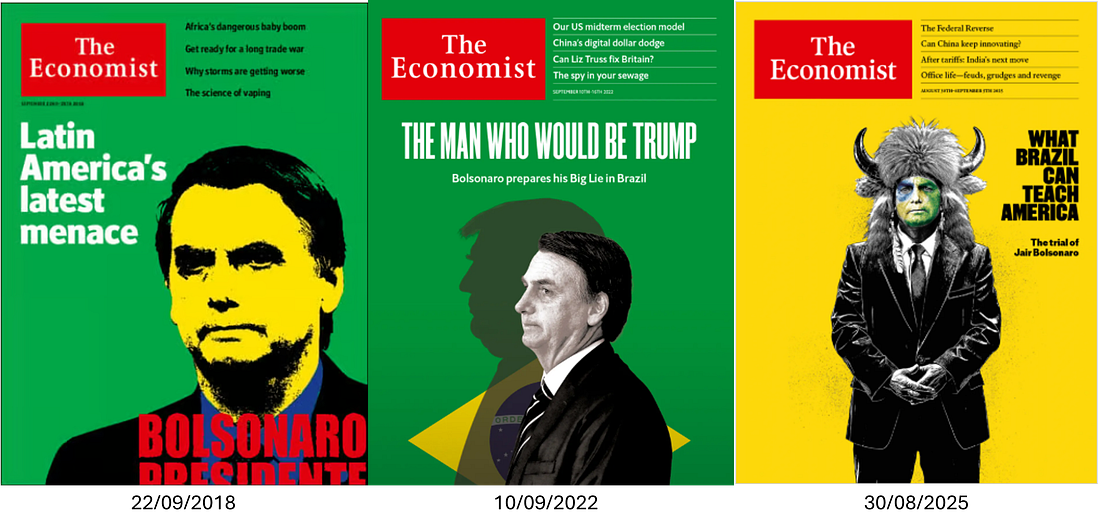
O Brasil nas capas da The Economist - Marcelo Guterman

O Brasil nas capas da The Economist

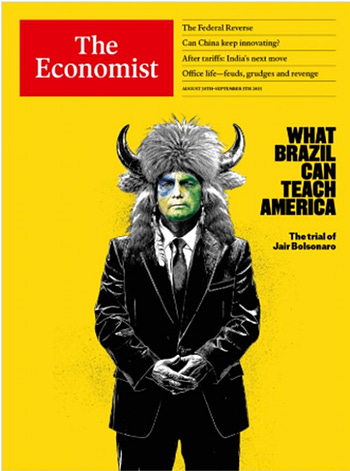
Mais uma capa da The Economist sobre o Brasil causou furor. É sempre assim: as capas da revista mais prestigiada do mundo nunca são neutras, sempre procuram provocar discussão. Com essa não foi diferente, ao propor que a democracia brasileira poderia ser um exemplo para a americana. Como disse meu amigo Victor H M Loyola, parece mais uma capa provocando Trump do que propriamente sobre Bolsonaro.

Fiquei curioso em saber quantas vezes o Brasil foi capa da The Economist nos últimos anos. Os arquivos da revista retroagem somente até 1997 (pelo menos contendo as edições completas semanais). Desde 1997, foram 13 capas dedicadas ao Brasil, ou 0,9% do total. Essa é a medida da relevância brasileira.

Blog do Marcelo Guterman é uma publicação apoiada pelos leitores. Para receber novos posts e apoiar meu trabalho, considere tornar-se uma assinatura gratuita ou uma assinatura paga.

A primeira foi em 16/01/1999, sobre a desvalorização cambial, que fazia parte de uma série de capas sobre a grave crise financeira que vinha se abatendo sobre os mercados emergentes.

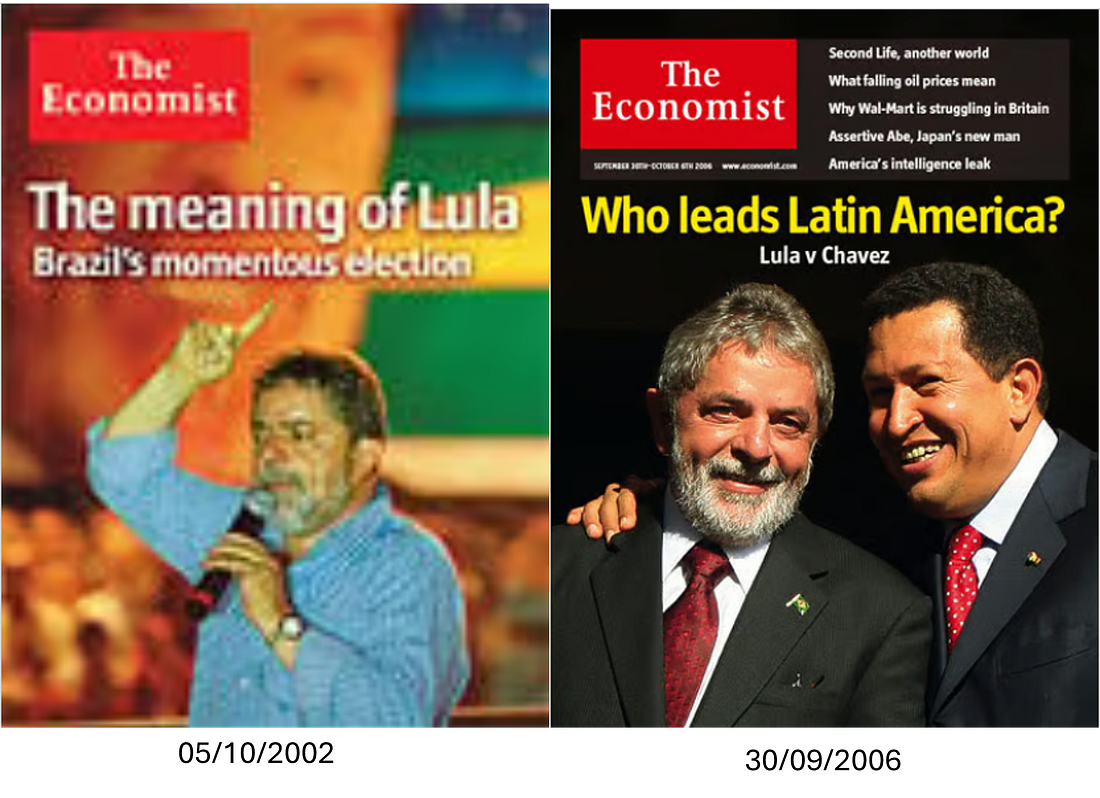
As duas próximas, em 05/10/2002 e 30/09/2006, focariam em Lula. A primeira comenta a primeira eleição de Lula, enquanto a segunda, vejam só, coloca Hugo Chavez como uma possível ameaça à liderança de Lula na América Latina, dado que o presidente brasileiro vinha sofrendo com o Mensalão e uma economia que andava de lado.

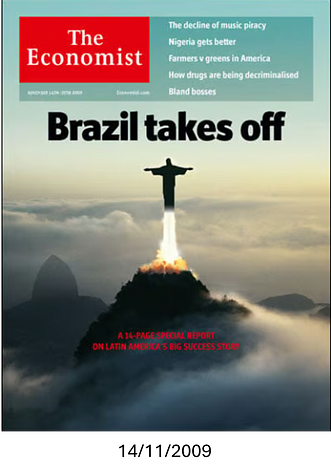
Três anos depois, temos talvez a capa mais icônica sobre o Brasil, com o famoso Cristo Redentor decolando, em 14/11/2009. Era a época do milagre econômico brasileiro.

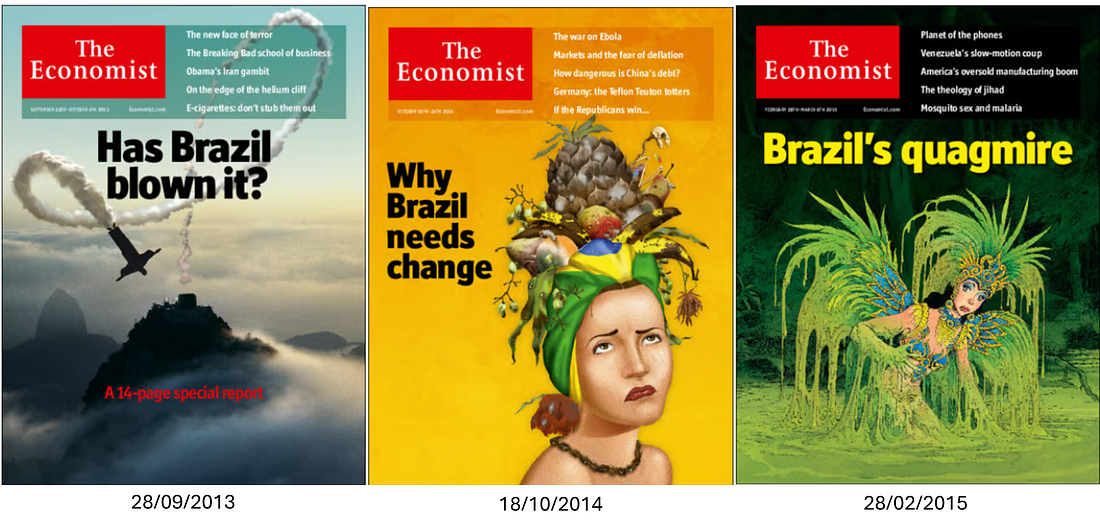
Mas o otimismo deu lugar a três capas em que a The Economist descreve a espetacular queda do Brasil no governo Dilma. A primeira, de 28/09/2013, é um contraponto ao Cristo decolando, a segunda, às vésperas da eleição de 2014, pede a mudança do governo, e a terceira, em 28/02/2015, descreve o pântano econômico em que o País estava metido.

Em 2016, algo inusitado: 3 capas em 4 meses, sobre a queda de Dilma. A primeira (02/01/2016) prevê um ano horrível para Dilma, a segunda (26/03/2016) pede a saída de Dilma e a terceira, logo após a votação do impeachment (23/04/2016), comenta todo esse processo.

Finalmente, as três últimas capas trazem Bolsonaro. A primeira, em 22/09/2018, coloca Bolsonaro como uma nova ameaça populista na América Latina às vésperas das eleições, a segunda (22/09/2022), também às vésperas das eleições, chama a atenção para a alegação de fraude nas urnas (a mesma que Trump havia usado dois anos antes) e, finalmente, a desta semana, às vésperas do julgamento de Bolsonaro. Com essa última capa, Bolsonaro passa a ser o político brasileiro com mais aparições na capa da The Economist, pelo menos desde 1997.

Como podemos observar, a revista não alivia para ninguém. Sempre haverá quem comemore e quem torça o nariz, a depender das simpatias políticas. Enquanto isso, a The Economist continua sendo uma referência no debate público global.

Blog do Marcelo Guterman é uma publicação apoiada pelos leitores. Para receber novos posts e apoiar meu trabalho, considere tornar-se uma assinatura gratuita ou uma assinatura paga.

Um momento expletivo: usando o bravo capitão Haddock contra um capitão criminoso, golpista e negacionista


Hora de atualizar os impropérios mais adequados para aplicar ao objeto mais asqueroso de um processo que pode até não estar errado, o da tentativa de golpe, mas que vem tarde, com respeito ao processo que deveria ter sido iniciado desde o momento em que o capitão genocida e o seu general criminoso foram responsáveis por milhares de mortes de brasileiros durante a pandemia.

Atualizando o CV-ENG, Paulo Roberto de Almeida

Atualizando o CV-Eng, 2025

PAULO ROBERTO DE ALMEIDA
Paulo Roberto de Almeida (born in São Paulo, 1949) is Ph.D. in Social Sciences (Free University of Brussels, 1984), Master in Economic Planning (College for Developing Countries, State University of Antwerp, 1977), has graduated in Social Sciences (Brussels, 1975), and a Brazilian career diplomat between 1977 and 2021. From August 2016 to March 2019 served as Director of the International Relations Research Institute, of the Brazilian Ministry of External Relations (Funag). Acted as professor of International Political Economy at the Master and Doctoral Law programs at the University Center of Brasília (Uniceub), from 2004 to 2021; former professor at the Brazilian Diplomatic Academy (Instituto Rio Branco) and at graduate studies in Sociology at the University of Brasília.
Served as Minister-Counselor at the Brazilian Embassy in Washington (1999-2003) and Special Advisor to the head of the Strategic Affairs Unit of the Brazilian Presidency, in Brasilia (2003-2007). Previous assignments include Brazilian embassies in Paris, Bern and Beograd, and delegations to international organizations in Geneva (GATT and other UNO organizations) and Latin American Integration Association, in Montevideo, finally deputy consul at the Brazilian General Consulate in Hartford (2013-2015). At the Ministry of Foreign Affairs, was head of the Financial Policy and Development Division (1996-1999).
Has been invited regularly to give courses in universities (Brazilian and foreign). Has researched in many fields, such as international relations, economic history, political sociology, and comparative development, and has experience in negotiations in trade and integration, intellectual property, financial affairs and technological development.


Published books:

Vidas Paralelas: Rubens Ricupero e Celso Lafer nas relações internacionais do Brasil (2025); Intelectuais na Diplomacia Brasileira: a cultura a serviço da nação (org., 2025); Treze ideias fora do lugar nas relações internacionais do Brasil: argumentos contrarianistas sobre a política externa e a diplomacia (2024); O Brasil no contexto regional e mundial: artigos sobre nossa dimensão internacional (2023); Marxismo e socialismo: trajetória de duas parábolas na era contemporânea (2023); A grande ilusão do Brics e o universo paralelo da diplomacia brasileira (2022); Construtores da Nação: projetos para o Brasil, de Cairu a Merquior (2022); Apogeu e demolição da política externa: itinerários da diplomacia brasileira (2021); O Itamaraty Sequestrado: a destruição da diplomacia pelo bolsolavismo, 2018-2021 (2021); Uma certa ideia do Itamaraty: a reconstrução da política externa e a restauração da diplomacia brasileira (2020); A ordem econômica mundial e a América Latina: ensaios sobre dois séculos de história econômica (2020); O Mercosul e o regionalismo latino-americano: ensaios selecionados, 1989-2020 (2020); O Itamaraty num labirinto de sombras: ensaios de política externa e de diplomacia brasileira (2020); Miséria da diplomacia: a destruição da inteligência no Itamaraty (2019); Contra a Corrente: ensaios contrarianistas sobre as relações internacionais do
Brasil (2019); A Constituição Contra o Brasil: ensaios de Roberto Campos sobre a Constituinte e a Constituição de 1988 (2018); O Homem que Pensou o Brasil: trajetória intelectual de Roberto Campos (2017); Formação da diplomacia econômica no Brasil: as relações econômicas internacionais no Império (2017; 2005; 2001); Nunca Antes na Diplomacia: a política externa brasileira em tempos não convencionais (2016; 2014); Révolutions bourgeoises et modernisation capitaliste: démocratie et autoritarisme au Brésil (2015); Integração Regional: uma introdução (2013); Relações Internacionais e Política Externa do Brasil: a diplomacia brasileira no contexto da globalização (2012); Globalizando: ensaios sobre a globalização e a antiglobalização (2011); Guia dos Arquivos Americanos sobre o Brasil (2010); O Moderno Príncipe: Maquiavel revisitado (2009); O estudo das relações internacionais do Brasil (2006); Relações Brasil-Estados Unidos: assimetrias e convergências (2005); Envisioning Brazil: a Guide to Brazilian Studies in the United States (2005); Relações internacionais e política externa do Brasil (1998; 2004); Une Histoire du Brésil: pour comprendre le Brésil contemporain (2002); Os primeiros anos do século XXI: o Brasil e as relações internacionais contemporâneas (2002); Le Mercosud: un marché commun pour l’Amérique du Sud (2000); O Brasil e o multilateralismo econômico (1999); O Mercosul no contexto regional e internacional (1993).
Has organized some books and has many chapters in edited books. Contributes regularly to journals and to other scholarly undertakings; former editor of Revista do Instituto Histórico e Geográfico do DF (2021); former deputy editor of Revista Brasileira de Política International (the oldest IR journal in Brazil, founded in Rio de Janeiro 1958, in Brasília since 1993).

Complete CV: http://lattes.cnpq.br/9470963765065128
Website: http://www.pralmeida.net/ – E-mail: pralmeida@me.com Blog: http://diplomatizzando.blogspot.com Other sources for works: Academia.edu: https://itamaraty.academia.edu/PauloRobertodeAlmeida Research Gate: https://www.researchgate.net/profile/Paulo_Almeida2

Embaixador conta, em livro, a experiência de resgatar brasileiros da Faixa de Gaza - Publico (PT) - livro de Alessandro Candeias

Meu amigo e colega Alessandro Warley Candeas objeto desta matéria do Público (PT) sobre seu próximo livro:

Embaixador conta, em livro, a experiência de resgatar brasileiros da Faixa de Gaza
Em Peregrinação & Guerra — Anotações de um Diplomata na Terra Santa, Alessandro Candeas relata os dias após o ataque do Hamas a Israel, em 2023. Mas ele avisa: “Não quero jogar gasolina na fogueira”.

https://www.publico.pt/2025/08/30/publico-brasil/entrevista/embaixador-conta-livro-experiencia-resgatar-brasileiros-faixa-gaza-2145501

Embaixador conta, em livro, a experiência de resgatar brasileiros da Faixa de Gaza
Atual cônsul-geral do Brasil em Lisboa, ele conta como foi escrever o livro Peregrinação & Guerra — Anotações de um Diplomata na Terra Santa (editora Contracorrente, 364 páginas), que será lançado no Brasil e em Portugal em datas a serem definidas.


José Murilo de Carvalho mostra como país falhou nos valores cívicos - CHRISTIAN LYNCH (FSP)

José Murilo de Carvalho mostra como país falhou nos valores cívicos

CHRISTIAN LYNCH

FSP 26.08.2023


[RESUMO] José Murilo de Carvalho deixou obra incontornável sobre a construção do Império brasileiro e a formação da sociedade no começo da República, destacando como o país falhou, nesses momentos históricos cruciais, em criar uma cultura cívica que superasse o elitismo, o patrimonialismo e o militarismo. Morto aos 83, o historiador deixa às novas gerações a tarefa de enfim aprofundar a cidadania no Brasil.

*

José Murilo de Carvalho foi um dos mais influentes acadêmicos de sua geração. No campo da ciência política, atuou nos programas da Universidade Federal de Minas Gerais (UFMG) e da Universidade do Estado do Rio de Janeiro (Uerj). No da história, foi pesquisador da Fundação Casa de Rui Barbosa e do programa da Universidade Federal do Rio de Janeiro (UFRJ).


Tendo se doutorado na Universidade Stanford (EUA), foi professor visitante em um sem número de outras, como Oxford (Reino Unido) e Princeton (também nos EUA). Recebeu o título de doutor honoris causa da Universidade de Coimbra. A consagração definitiva chegaria com sua eleição para as mais antigas e prestigiosas instituições culturais do país: o Instituto Histórico e Geográfico Brasileiro (IHGB) e a Academia Brasileira de Letras (ABL).


Para quem o conhecia, chamava a atenção o contraste entre a monumentalidade de sua obra e a sua personalidade, referida por Ruy Castro como tímida e modesta. Eu acrescentaria esquiva, especialmente em ambiente mundano. Essa discrição indicava, claro, sua origem de mineiro do interior, de que se orgulhava, mas havia mais que o estereótipo regional.


Nascido em 1939, José Murilo estudou em colégio de padres e militou na Ação Popular, grupo cristão de esquerda, ajudando na organização de sindicatos rurais. Para além da "mineirice", havia também certo espírito de missionário franciscano, que como cientista social cedo elegeu o Brasil como a comunidade ou "República" a cujo serviço se devotaria.


Ele acreditava que os males do Brasil decorriam da insuficiência do equivalente cívico das virtudes cristãs, que eram as virtudes republicanas. Nada surpreendente, já que desde Tiradentes e Teófilo Otoni a república sempre foi o tema por excelência da intelectualidade mineira.


Para bem servir à república como intelectual público (o equivalente secular do missionário), cumpria conhecê-la em sua formação. As inquietações de José Murilo decorriam do trauma comum a toda a primeira geração de cientistas políticos profissionais, o golpe de 1964.


Eles todos haviam na mocidade embarcado no sonho nacionalista e desenvolvimentista de Getúlio e JK. Acreditavam, pela leitura dos intelectuais do Iseb (Instituto Superior de Estudos Brasileiros), como Hélio Jaguaribe e Guerreiro Ramos, que a modernidade brasileira começou com a urbanização e a industrialização a partir da Revolução de 1930; e que as reformas de base eram o corolário lógico de uma nação que não mais cabia na moldura oligárquica do tempo anterior.


A marcha ascensional para patamares superiores de autonomia e igualdade era inevitável. Daí o choque de 1964, que levaria José Murilo a empregar o melhor de suas energias na revisitação do processo de formação do Estado e da sociedade brasileira anterior a 1930, em busca das causas dos males presentes.


Quem admira José Murilo como historiador deve sempre lembrar que a força de suas análises vinha de sua formação em sociologia e política. A UFMG já possuía um núcleo importante de ciência e sociologia política dentro do curso de direito, em torno de Orlando Carvalho e sua revista. Não foi difícil depois dar-lhe autonomia e profissionalizá-lo.


O tema por excelência da ciência social mineira na época era o coronelismo, que explicava a articulação das modernas instituições políticas brasileiras sobre sua arcaica estrutura socioeconômica fundiária. Sob a influência da obra clássica de Victor Nunes Leal, José Murilo escreveu suas duas primeiras obras: a primeira, sobre a política municipal de Barbacena; a segunda, sobre a criação da Escola de Minas de Ouro Preto.


Já então ele questionava a eficácia do marxismo na compreensão dos fenômenos, preferindo o weberianismo dos primeiros membros do Iseb. Quando José Murilo partiu com uma bolsa da Fundação Ford para fazer seu mestrado e doutorado em ciência política em Stanford, lá conheceu o cientista político Wanderley Guilherme dos Santos. Foi um encontro providencial. Wanderley o convenceu a trocar sua projetada tese sobre municipalismo por outra, a respeito da construção do Estado brasileiro no século 19. Deu certo.


Na primeira parte da tese, "A Construção da Ordem", José Murilo argumentava que, diversamente das elites da América hispânica, as do Brasil conseguiram conservar sua unidade política devido a seu maior grau de homogeneidade, uma vez que, enviadas a Coimbra, recebiam a mesma formação ideológica e uma socialização burocrática quase consensual em torno de um projeto de Estado reformista e autoritário.


Na segunda parte, "Teatro de Sombras", ele revelava a dinâmica tensa entre este Estado modernizador e a sociedade escravista agrária que a ele resistia. Quanto mais o Estado fazia uso de seus instrumentos autoritários para liberalizar a sociedade pelo alto, mais solapava os fundamentos de sua própria legitimidade.


Aqui José Murilo já revelava duas características. A primeira, de caráter formal, passava pelo exame do processo político empírico em perspectiva interdisciplinar, pela articulação entre ciência política, história e pensamento brasileiro. A segunda, de caráter substantivo, assinalava a preocupação com a formação da cultura cívica e das instituições "republicanas".


Sua tese de relativa autonomia do Estado imperial afrontava a literatura marxista então hegemônica, para a qual a monarquia não passava de braço do latifúndio escravista. Por isso, a recepção inicial da primeira parte dessa análise, "A Construção da Ordem: a Elite Política Imperial" (1980), foi fria.


Em 1978, José Murilo foi convidado por Wanderley para integrar o corpo docente do antigo Iuperj (atual Instituto de Estudos Sociais e Políticos da Uerj). Em 1986, ele passou a integrar também os quadros da Fundação Casa de Rui Barbosa.


Nesse tempo, por ele considerado o mais feliz de sua carreira, Murilo desenvolveu as pesquisas sobre a formação da cultura cívica brasileira que o consagraram e que resultariam em "Os Bestializados" (1987), "A Formação das Almas" (1990) e "Forças Armadas e Política no Brasil" (2005).


Trata-se de um tríptico que, depois do díptico anterior sobre a construção do Estado imperial, investigava a formação da sociedade no começo da República, concluindo pelo fracasso das elites na constituição de uma cultura cívica republicana, atravessada pelo elitismo, pelo patrimonialismo e pelo militarismo.


Em "Os Bestializados", José Murilo destacava o descolamento entre povo e elites nas primeiras décadas do regime republicano, desenvolvendo o conceito de "estadania" para designar a concepção deformada de cidadania que só reconhecia direitos ao povo desde que subordinado e encaixado na métrica de "civilizado".


Em "A Formação das Almas", ele apontava o relativo fracasso das elites —positivistas, jacobinas, liberais— em criar um imaginário de pertencimento que servisse de cimento cívico à nação. Se o Império havia sido bem-sucedidos em construir um Estado, a República falhava em construir a nação.


Já "Forças Armadas e Política no Brasil" se dedicava a compreender a origem e a persistência do militarismo por aqui. Formados em regime de completo insulamento do resto da sociedade, os militares acreditariam ser a única elite capaz de bem cuidar dos interesses nacionais, porque organizada, nacionalista e desinteressada.


Tais reflexões caíam como uma luva à época do centenário da República (1989), quando a efeméride incentivava o público a pensar a história como insumo para dotar o regime democrático de substância para além da forma puramente eleitoral.


José Murilo fez assim da denúncia do nosso déficit republicano seu grande tema como intelectual público. Distinguindo a república como modo de convivência cívica da república como mero regime formal, lhe parecia que as últimas décadas do Império teriam sido marcadas por uma efervescência democrática abortada pelo golpe militar republicano. Este seria o tema de suas pesquisas sobre a campanha abolicionista e de livros mais recentes, como "Clamar e Agitar Sempre: Os Radicais na Década de 1860" (2018).


Para José Murilo, o governante mais republicano do Brasil teria sido dom Pedro 2º, a quem dedicou uma biografia: "Ser ou Não Ser" (2007). Depois do impeachment de Collor, ele participou das discussões em torno do plebiscito de 1993 de forma provocativa, defendendo a opção da Monarquia para chamar a atenção para a insuficiência da República.


Em debate realizado à época no salão nobre do Palácio do Catete, José Murilo iniciou sua fala se dizendo constrangido em meio a toda aquela "pompa republicana". A polêmica da época levaria este republicano empedernido a carregar por décadas a pecha de… monarquista.


"Cidadania no Brasil: O Longo Caminho" (2001) se tornaria a obra síntese de José Murilo em relação ao diagnóstico da má formação cívica brasileira e a necessidade de saná-la. Partindo da tese do sociólogo T. H. Marshall de que a sequência clássica da cidadania moderna começaria pelos direitos civis, seguido pelos políticos e depois pelos sociais, Murilo defendia que no Brasil a pirâmide havia sido invertida —e que o principal déficit da República residiria na falta de acesso à Justiça pela inefetividade dos direitos civis.


A exposição objetiva e clara dessa hipótese, entremeada pela narrativa da história do Brasil desde a Independência até o presente, fez desse livro o seu grande best-seller, adotado em todas as graduações de ciências humanas.


Paralelamente, como complemento de seus livros, José Murilo escreveu dezenas de artigos dedicados a fenômenos políticos e sociais, como o mandonismo, e a personagens da vida intelectual brasileira, como Vasconcelos, Uruguai, João Francisco Lisboa, Alencar, Nabuco, Rui Barbosa, José do Patrocínio, José Veríssimo, Eduardo Prado e Juarez Távora.


Os mais importantes, talvez, tenham sido os dois textos dedicados a Oliveira Vianna, autor que considerava crucial para compreender os problemas das elites republicanas e cuja obra cumpria, portanto, "resgatar do inferno".


José Murilo concluiu sua conversão pública para "historiador" ao se tornar titular do programa de história da UFRJ, em 1997, mas o essencial de suas pesquisas giraria dali por diante no aprofundamento das teses já expostas nos livros anteriores.


Por meio do projeto Caminhos da Política no Império do Brasil, financiado pela CNPq, ele se cercou de uma rede interinstitucional de excelentes historiadores, cujos trabalhos comuns resultaram em várias coletâneas, como "Linguagens e Fronteiras do Poder" (2011).


Uma mudança importante no período foi a maneira de José Murilo pensar a participação popular. As pesquisas com Lúcia Bastos e Marcelo Basile sobre os panfletos da Independência, que resultaram no livro "Guerra Literária" (2014), o convenceram de que, ao contrário do que se dizia, a revolução de emancipação do Brasil teve considerável participação popular, não sendo restrita às elites.


Nos últimos tempos, porém, a fé republicana de José Murilo sofreu múltiplos revezes. A esperança nos governos do PT tropeçou nos escândalos de corrupção que levaram ao impeachment de Dilma Rousseff. As eventuais expectativas de melhora do padrão de vida cívica se esvaíram quando a bandeira anticorrupção passou às mãos da extrema direita aliada ao militarismo.


A história de sua mocidade parecia se repetir na velhice, reavivando seus traumas e decepções cívicas. Se a campanha udenista que denunciara o "mar de lama" resultara no suicídio de Getúlio Vargas e no golpe militar de 1964, o moralismo lavajatista desaguara na prisão de Lula e na eleição de Bolsonaro.


Nos últimos anos, José Murilo parecia mais interessado em tirar a limpo o próprio passado, reatando amizades e concedendo depoimentos sobre sua carreira e instituições de que fizera parte. Evitava entrevistas, porque no final de seu longo apostolado lhe parecia que tudo tinha sido inútil.


Em "O Pecado Original da República" (2017), ele chegava a afirmar que a condição republicana parecia incompatível com a identidade brasileira. Poderia ter desabafado como um de seus mestres, o sociólogo Guerreiro Ramos, em entrevista de 1981: "Este é o país da picaretagem. Não tem ninguém com grandeza, a grandeza de Alberto Torres, do Visconde de Uruguai, do Barão do Rio Branco, de José Bonifácio, Getúlio Vargas. Acabou, o país destruiu a nós todos".


A missão do homem José Murilo de Carvalho, mineiro tímido e modesto, terminou. Ela segue agora por meio de sua obra monumental e de seus admiradores das gerações mais novas, de cujos visionários o Brasil continua precisando para se republicanizar.


JOSÉ MURILO DE CARVALHO


Vida


Nasceu em 1939. Formado em sociologia e política pela UFMG (Universidade Federal de Minas Gerais), fez mestrado e doutorado em ciência política na Universidade de Stanford, nos EUA. Foi professor nas duas instituições, assim como, no Brasil, na UFRJ e, no exterior, em Oxford (Reino Unido) e Princeton (também nos EUA). Fazia parte do Instituto Histórico e Geográfico Brasileiro (IHGB) e da Academia Brasileira de Letras (ABL). Morreu em 13 de agosto, aos 83 anos

Principais livros

"A Construção da Ordem: a Elite Política Imperial" (1980), "Os Bestializados. O Rio de Janeiro e a República Que não Foi" (1987), "Teatro de Sombras: a Política Imperial" (1988), "A Formação das Almas. O Imaginário da República no Brasil" (1990), "A Cidadania no Brasil: o Longo Caminho" (2001), "Forças Armadas e Política no Brasil" (2005), "D. Pedro 2º: Ser ou Não Ser" (2007)

Foto: O historiador José Murilo de Carvalho na biblioteca de sua casa, no Rio - Raquel Cunha-25.mai.19/Folhapress


sexta-feira, 29 de agosto de 2025

O imperialismo chinês, ou o capitalismo chinês, não têm nada a ver com equivalentes atuais ou passados: uma pesquisa publicada na revista International Security

Reproduzindo trecho de uma postagem que se encontra neste mesmo blog um pouco abaixo: 

Temos um imperialismo cruel em plena ação, por um líder assassino racional: Putin. Temos um outro em ação desencontrada por um líder demencial: Trump. Ambos condenados desde já no plano da ética, e mais adiante na prática. Temos um outro imperialismo, mas de uma outra natureza e isto pode ser constatado num artigo da International Security, que li e transcrevi recentemente. Um excerto:

https://diplomatizzando.blogspot.com/2025/08/china-its-true-objectives-in-foreign.html

"Our findings indicate that China is a status quo power concerned with regime stability and is more inwardly focused than externally oriented. China's aims are unambiguous, enduring, and limited: It cares about its borders, sovereignty, and foreign economic relations. China's main concerns are almost all regional and related to parts of China that the rest of the region has agreed are Chinese—Hong Kong, Taiwan, Tibet, and Xinjiang. Our argument has three main implications. First, China does not pose the type of military threat that the conventional wisdom claims it does. Thus, a hostile U.S. military posture in the Pacific is unwise and may unnecessarily create tensions. Second, the two countries could cooperate on several overlooked issue areas. Third, the conventional view of China plays down the economic and diplomatic arenas that a war-fighting approach is unsuited to address."


This leads to a key question: What does China want? To answer this question, this article examines contemporary China's goals and fears in words and deeds. In contrast to the conventional view, the evidence provided in this article leads to one overarching conclusion and three specific observations. Overall, China is a status quo power concerned with regime stability, and it remains more inwardly focused than externally oriented. More specifically: China's aims are unambiguous; China's aims are enduring; and China's aims are limited.

First, China's aims are unambiguous: China cares about its borders, its sovereignty, and its foreign economic relations. China cares about its unresolved borders in the East and South China Seas and with India, respectively. Almost all of its concerns are regional. Second, China deeply cares about its sovereign rights over various parts of China that the rest of the region has agreed are Chinese—Hong Kong, Taiwan, Tibet, and Xinjiang. Third, China has an increasingly clear economic strategy for its relations with both East Asia and the rest of the world that aims to expand trade and economic relations, not reduce them.

It is also clear what China does not want: There is little mention in Chinese discourse of expansive goals or ambitions for global leadership and hegemony. Furthermore, China is not exporting ideology. Significantly, the CCP's emphasis on “socialism with Chinese characteristics” is not a generalized model for the world.15 In contrast, the United States claims to represent global values and norms. What China also does not want is to invade and conquer other countries; there is no evidence that China poses an existential threat to the countries on its borders or in its region that it does not already claim sovereignty over.


O conceito estratégico da OTAN, de 2010: vale a pena ler de novo: OTAN: novo conceito estrategico aprovado

 Postei este longo documento 15 anos atrás, e como a OTAN está em causa, por Putin e por Trump, cabe ler novamente este documento referencial: 

domingo, 21 de novembro de 2010

OTAN: novo conceito estrategico aprovado

A OTAN, num dos mais importantes encontros de cúpula realizados desde o final da Guerra Fria, acaba de aprovar um novo conceito estratégico, cuja íntegra segue abaixo, retirada do site oficial da organização, criada em 1949.

NATO website, 19 Nov. 2010

Active Engagement, Modern Defence

Strategic Concept for the Defence and Security of The Members of the North Atlantic Treaty Organisation adopted by Heads of State and Government in Lisbon

Preface

We, the Heads of State and Government of the NATO nations, are determined that NATO will continue to play its unique and essential role in ensuring our common defence and security. This Strategic Concept will guide the next phase in NATO’s evolution, so that it continues to be effective in a changing world, against new threats, with new capabilities and new partners:
  • It reconfirms the bond between our nations to defend one another against attack, including against new threats to the safety of our citizens.
  • It commits the Alliance to prevent crises, manage conflicts and stabilize post-conflict situations, including by working more closely with our international partners, most importantly the United Nations and the European Union.
  • It offers our partners around the globe more political engagement with the Alliance, and a substantial role in shaping the NATO-led operations to which they contribute.
  • It commits NATO to the goal of creating the conditions for a world without nuclear weapons – but reconfirms that, as long as there are nuclear weapons in the world, NATO will remain a nuclear Alliance.
  • It restates our firm commitment to keep the door to NATO open to all European democracies that meet the standards of membership, because enlargement contributes to our goal of a Europe whole, free and at peace.
  • It commits NATO to continuous reform towards a more effective, efficient and flexible Alliance, so that our taxpayers get the most security for the money they invest in defence.
The citizens of our countries rely on NATO to defend Allied nations, to deploy robust military forces where and when required for our security, and to help promote common security with our partners around the globe. While the world is changing, NATO’s essential mission will remain the same: to ensure that the Alliance remains an unparalleled community of freedom, peace, security and shared values.

Core Tasks and Principles

  1. NATO’s fundamental and enduring purpose is to safeguard the freedom and security of all its members by political and military means. Today, the Alliance remains an essential source of stability in an unpredictable world.
  2. NATO member states form a unique community of values, committed to the principles of individual liberty, democracy, human rights and the rule of law. The Alliance is firmly committed to the purposes and principles of the Charter of the United Nations, and to the Washington Treaty, which affirms the primary responsibility of the Security Council for the maintenance of international peace and security.
  3. The political and military bonds between Europe and North America have been forged in NATO since the Alliance was founded in 1949; the transatlantic link remains as strong, and as important to the preservation of Euro-Atlantic peace and security, as ever. The security of NATO members on both sides of the Atlantic is indivisible. We will continue to defend it together, on the basis of solidarity, shared purpose and fair burden-sharing.
  4. The modern security environment contains a broad and evolving set of challenges to the security of NATO’s territory and populations. In order to assure their security, the Alliance must and will continue fulfilling effectively three essential core tasks, all of which contribute to safeguarding Alliance members, and always in accordance with international law:
    1. Collective defence. NATO members will always assist each other against attack, in accordance with Article 5 of the Washington Treaty. That commitment remains firm and binding. NATO will deter and defend against any threat of aggression, and against emerging security challenges where they threaten the fundamental security of individual Allies or the Alliance as a whole.
    2. Crisis management. NATO has a unique and robust set of political and military capabilities to address the full spectrum of crises – before, during and after conflicts. NATO will actively employ an appropriate mix of those political and military tools to help manage developing crises that have the potential to affect Alliance security, before they escalate into conflicts; to stop ongoing conflicts where they affect Alliance security; and to help consolidate stability in post-conflict situations where that contributes to Euro-Atlantic security.
    3. Cooperative security. The Alliance is affected by, and can affect, political and security developments beyond its borders. The Alliance will engage actively to enhance international security, through partnership with relevant countries and other international organisations; by contributing actively to arms control, non-proliferation and disarmament; and by keeping the door to membership in the Alliance open to all European democracies that meet NATO’s standards.
  5. NATO remains the unique and essential transatlantic forum for consultations on all matters that affect the territorial integrity, political independence and security of its members, as set out in Article 4 of the Washington Treaty. Any security issue of interest to any Ally can be brought to the NATO table, to share information, exchange views and, where appropriate, forge common approaches.
  6. In order to carry out the full range of NATO missions as effectively and efficiently as possible, Allies will engage in a continuous process of reform, modernisation and transformation.

The Security Environment

  1. Today, the Euro-Atlantic area is at peace and the threat of a conventional attack against NATO territory is low. That is an historic success for the policies of robust defence, Euro-Atlantic integration and active partnership that have guided NATO for more than half a century.
  2. However, the conventional threat cannot be ignored. Many regions and countries around the world are witnessing the acquisition of substantial, modern military capabilities with consequences for international stability and Euro-Atlantic security that are difficult to predict. This includes the proliferation of ballistic missiles, which poses a real and growing threat to the Euro-Atlantic area.
  3. The proliferation of nuclear weapons and other weapons of mass destruction, and their means of delivery, threatens incalculable consequences for global stability and prosperity. During the next decade, proliferation will be most acute in some of the world’s most volatile regions.
  4. Terrorism poses a direct threat to the security of the citizens of NATO countries, and to international stability and prosperity more broadly. Extremist groups continue to spread to, and in, areas of strategic importance to the Alliance, and modern technology increases the threat and potential impact of terrorist attacks, in particular if terrorists were to acquire nuclear, chemical, biological or radiological capabilities.
  5. Instability or conflict beyond NATO borders can directly threaten Alliance security, including by fostering extremism, terrorism, and trans-national illegal activities such as trafficking in arms, narcotics and people.
  6. Cyber attacks are becoming more frequent, more organised and more costly in the damage that they inflict on government administrations, businesses, economies and potentially also transportation and supply networks and other critical infrastructure; they can reach a threshold that threatens national and Euro-Atlantic prosperity, security and stability. Foreign militaries and intelligence services, organised criminals, terrorist and/or extremist groups can each be the source of such attacks.
  7. All countries are increasingly reliant on the vital communication, transport and transit routes on which international trade, energy security and prosperity depend. They require greater international efforts to ensure their resilience against attack or disruption. Some NATO countries will become more dependent on foreign energy suppliers and in some cases, on foreign energy supply and distribution networks for their energy needs. As a larger share of world consumption is transported across the globe, energy supplies are increasingly exposed to disruption.
  8. A number of significant technology-related trends – including the development of laser weapons, electronic warfare and technologies that impede access to space – appear poised to have major global effects that will impact on NATO military planning and operations.
  9. Key environmental and resource constraints, including health risks, climate change, water scarcity and increasing energy needs will further shape the future security environment in areas of concern to NATO and have the potential to significantly affect NATO planning and operations.

Defence and Deterrence

  1. The greatest responsibility of the Alliance is to protect and defend our territory and our populations against attack, as set out in Article 5 of the Washington Treaty. The Alliance does not consider any country to be its adversary. However, no one should doubt NATO’s resolve if the security of any of its members were to be threatened.
  2. Deterrence, based on an appropriate mix of nuclear and conventional capabilities, remains a core element of our overall strategy. The circumstances in which any use of nuclear weapons might have to be contemplated are extremely remote. As long as nuclear weapons exist, NATO will remain a nuclear alliance.
  3. The supreme guarantee of the security of the Allies is provided by the strategic nuclear forces of the Alliance, particularly those of the United States; the independent strategic nuclear forces of the United Kingdom and France, which have a deterrent role of their own, contribute to the overall deterrence and security of the Allies.
  4. We will ensure that NATO has the full range of capabilities necessary to deter and defend against any threat to the safety and security of our populations. Therefore, we will:
    • maintain an appropriate mix of nuclear and conventional forces;
    • maintain the ability to sustain concurrent major joint operations and several smaller operations for collective defence and crisis response, including at strategic distance;
    • develop and maintain robust, mobile and deployable conventional forces to carry out both our Article 5 responsibilities and the Alliance’s expeditionary operations, including with the NATO Response Force;
    • carry out the necessary training, exercises, contingency planning and information exchange for assuring our defence against the full range of conventional and emerging security challenges, and provide appropriate visible assurance and reinforcement for all Allies;
    • ensure the broadest possible participation of Allies in collective defence planning on nuclear roles, in peacetime basing of nuclear forces, and in command, control and consultation arrangements;
    • develop the capability to defend our populations and territories against ballistic missile attack as a core element of our collective defence, which contributes to the indivisible security of the Alliance. We will actively seek cooperation on missile defence with Russia and other Euro-Atlantic partners;
    • further develop NATO’s capacity to defend against the threat of chemical, biological, radiological and nuclear weapons of mass destruction;
    • develop further our ability to prevent, detect, defend against and recover from cyber-attacks, including by using the NATO planning process to enhance and coordinate national cyber-defence capabilities, bringing all NATO bodies under centralized cyber protection, and better integrating NATO cyber awareness, warning and response with member nations;
    • enhance the capacity to detect and defend against international terrorism, including through enhanced analysis of the threat, more consultations with our partners, and the development of appropriate military capabilities, including to help train local forces to fight terrorism themselves;
    • develop the capacity to contribute to energy security, including protection of critical energy infrastructure and transit areas and lines, cooperation with partners, and consultations among Allies on the basis of strategic assessments and contingency planning;
    • ensure that the Alliance is at the front edge in assessing the security impact of emerging technologies, and that military planning takes the potential threats into account;
    • sustain the necessary levels of defence spending, so that our armed forces are sufficiently resourced;
    • continue to review NATO’s overall posture in deterring and defending against the full range of threats to the Alliance, taking into account changes to the evolving international security environment.

Security through Crisis Management

  1. Crises and conflicts beyond NATO’s borders can pose a direct threat to the security of Alliance territory and populations. NATO will therefore engage, where possible and when necessary, to prevent crises, manage crises, stabilize post-conflict situations and support reconstruction.
  2. The lessons learned from NATO operations, in particular in Afghanistan and the Western Balkans, make it clear that a comprehensive political, civilian and military approach is necessary for effective crisis management. The Alliance will engage actively with other international actors before, during and after crises to encourage collaborative analysis, planning and conduct of activities on the ground, in order to maximise coherence and effectiveness of the overall international effort.
  3. The best way to manage conflicts is to prevent them from happening. NATO will continually monitor and analyse the international environment to anticipate crises and, where appropriate, take active steps to prevent them from becoming larger conflicts.
  4. Where conflict prevention proves unsuccessful, NATO will be prepared and capable to manage ongoing hostilities. NATO has unique conflict management capacities, including the unparalleled capability to deploy and sustain robust military forces in the field. NATO-led operations have demonstrated the indispensable contribution the Alliance can make to international conflict management efforts.
  5. Even when conflict comes to an end, the international community must often provide continued support, to create the conditions for lasting stability. NATO will be prepared and capable to contribute to stabilisation and reconstruction, in close cooperation and consultation wherever possible with other relevant international actors.
  6. To be effective across the crisis management spectrum, we will:
    • enhance intelligence sharing within NATO, to better predict when crises might occur, and how they can best be prevented;
    • further develop doctrine and military capabilities for expeditionary operations, including counterinsurgency, stabilization and reconstruction operations;
    • form an appropriate but modest civilian crisis management capability to interface more effectively with civilian partners, building on the lessons learned from NATO-led operations. This capability may also be used to plan, employ and coordinate civilian activities until conditions allow for the transfer of those responsibilities and tasks to other actors;
    • enhance integrated civilian-military planning throughout the crisis spectrum,
    • develop the capability to train and develop local forces in crisis zones, so that local authorities are able, as quickly as possible, to maintain security without international assistance;
    • identify and train civilian specialists from member states, made available for rapid deployment by Allies for selected missions, able to work alongside our military personnel and civilian specialists from partner countries and institutions;
    • broaden and intensify the political consultations among Allies, and with partners, both on a regular basis and in dealing with all stages of a crisis – before, during and after.

Promoting International Security through Cooperation

Arms Control, Disarmament, and Non-Proliferation
  1. NATO seeks its security at the lowest possible level of forces. Arms control, disarmament and non-proliferation contribute to peace, security and stability, and should ensure undiminished security for all Alliance members. We will continue to play our part in reinforcing arms control and in promoting disarmament of both conventional weapons and weapons of mass destruction, as well as non-proliferation efforts:
    • We are resolved to seek a safer world for all and to create the conditions for a world without nuclear weapons in accordance with the goals of the Nuclear Non-Proliferation Treaty, in a way that promotes international stability, and is based on the principle of undiminished security for all.
    • With the changes in the security environment since the end of the Cold War, we have dramatically reduced the number of nuclear weapons stationed in Europe and our reliance on nuclear weapons in NATO strategy. We will seek to create the conditions for further reductions in the future.
    • In any future reductions, our aim should be to seek Russian agreement to increase transparency on its nuclear weapons in Europe and relocate these weapons away from the territory of NATO members. Any further steps must take into account the disparity with the greater Russian stockpiles of short-range nuclear weapons.
    • We are committed to conventional arms control, which provides predictability, transparency and a means to keep armaments at the lowest possible level for stability. We will work to strengthen the conventional arms control regime in Europe on the basis of reciprocity, transparency and host-nation consent.
    • We will explore ways for our political means and military capabilities to contribute to international efforts to fight proliferation.
    • National decisions regarding arms control and disarmament may have an impact on the security of all Alliance members. We are committed to maintain, and develop as necessary, appropriate consultations among Allies on these issues.
Open Door
  1. NATO’s enlargement has contributed substantially to the security of Allies; the prospect of further enlargement and the spirit of cooperative security have advanced stability in Europe more broadly. Our goal of a Europe whole and free, and sharing common values, would be best served by the eventual integration of all European countries that so desire into Euro-Atlantic structures.
    • The door to NATO membership remains fully open to all European democracies which share the values of our Alliance, which are willing and able to assume the responsibilities and obligations of membership, and whose inclusion can contribute to common security and stability.
Partnerships
  1. The promotion of Euro-Atlantic security is best assured through a wide network of partner relationships with countries and organisations around the globe. These partnerships make a concrete and valued contribution to the success of NATO’s fundamental tasks.
  2. Dialogue and cooperation with partners can make a concrete contribution to enhancing international security, to defending the values on which our Alliance is based, to NATO’s operations, and to preparing interested nations for membership of NATO. These relationships will be based on reciprocity, mutual benefit and mutual respect.
  3. We will enhance our partnerships through flexible formats that bring NATO and partners together – across and beyond existing frameworks:
    • We are prepared to develop political dialogue and practical cooperation with any nations and relevant organisations across the globe that share our interest in peaceful international relations.
    • We will be open to consultation with any partner country on security issues of common concern.
    • We will give our operational partners a structural role in shaping strategy and decisions on NATO-led missions to which they contribute.
    • We will further develop our existing partnerships while preserving their specificity.
  4. Cooperation between NATO and the United Nations continues to make a substantial contribution to security in operations around the world. The Alliance aims to deepen political dialogue and practical cooperation with the UN, as set out in the UN-NATO Declaration signed in 2008, including through:
    • enhanced liaison between the two Headquarters;
    • more regular political consultation; and
    • enhanced practical cooperation in managing crises where both organisations are engaged.
  5. An active and effective European Union contributes to the overall security of the Euro-Atlantic area. Therefore the EU is a unique and essential partner for NATO. The two organisations share a majority of members, and all members of both organisations share common values. NATO recognizes the importance of a stronger and more capable European defence. We welcome the entry into force of the Lisbon Treaty, which provides a framework for strengthening the EU’s capacities to address common security challenges. Non-EU Allies make a significant contribution to these efforts. For the strategic partnership between NATO and the EU, their fullest involvement in these efforts is essential. NATO and the EU can and should play complementary and mutually reinforcing roles in supporting international peace and security. We are determined to make our contribution to create more favourable circumstances through which we will:
    • fully strengthen the strategic partnership with the EU, in the spirit of full mutual openness, transparency, complementarity and respect for the autonomy and institutional integrity of both organisations;
    • enhance our practical cooperation in operations throughout the crisis spectrum, from coordinated planning to mutual support in the field;
    • broaden our political consultations to include all issues of common concern, in order to share assessments and perspectives;
    • cooperate more fully in capability development, to minimise duplication and maximise cost-effectiveness.
  6. NATO-Russia cooperation is of strategic importance as it contributes to creating a common space of peace, stability and security. NATO poses no threat to Russia. On the contrary: we want to see a true strategic partnership between NATO and Russia, and we will act accordingly, with the expectation of reciprocity from Russia.
  7. The NATO-Russia relationship is based upon the goals, principles and commitments of the NATO-Russia Founding Act and the Rome Declaration, especially regarding the respect of democratic principles and the sovereignty, independence and territorial integrity of all states in the Euro-Atlantic area. Notwithstanding differences on particular issues, we remain convinced that the security of NATO and Russia is intertwined and that a strong and constructive partnership based on mutual confidence, transparency and predictability can best serve our security. We are determined to:
    • enhance the political consultations and practical cooperation with Russia in areas of shared interests, including missile defence, counter-terrorism, counter-narcotics, counter-piracy and the promotion of wider international security;
    • use the full potential of the NATO-Russia Council for dialogue and joint action with Russia.
  8. The Euro-Atlantic Partnership Council and Partnership for Peace are central to our vision of Europe whole, free and in peace. We are firmly committed to the development of friendly and cooperative relations with all countries of the Mediterranean, and we intend to further develop the Mediterranean Dialogue in the coming years. We attach great importance to peace and stability in the Gulf region, and we intend to strengthen our cooperation in the Istanbul Cooperation Initiative. We will aim to:
    • enhance consultations and practical military cooperation with our partners in the Euro-Atlantic Partnership Council;
    • continue and develop the partnerships with Ukraine and Georgia within the NATO-Ukraine and NATO-Georgia Commissions, based on the NATO decision at the Bucharest summit 2008, and taking into account the Euro-Atlantic orientation or aspiration of each of the countries;
    • facilitate the Euro-Atlantic integration of the Western Balkans, with the aim to ensure lasting peace and stability based on democratic values, regional cooperation and good neighbourly relations;
    • deepen the cooperation with current members of the Mediterranean Dialogue and be open to the inclusion in the Mediterranean Dialogue of other countries of the region;
    • develop a deeper security partnership with our Gulf partners and remain ready to welcome new partners in the Istanbul Cooperation Initiative.
Reform and Transformation
  1. Unique in history, NATO is a security Alliance that fields military forces able to operate together in any environment; that can control operations anywhere through its integrated military command structure; and that has at its disposal core capabilities that few Allies could afford individually.
  2. NATO must have sufficient resources – financial, military and human – to carry out its missions, which are essential to the security of Alliance populations and territory. Those resources must, however, be used in the most efficient and effective way possible. We will:
    • maximise the deployability of our forces, and their capacity to sustain operations in the field, including by undertaking focused efforts to meet NATO’s usability targets;
    • ensure the maximum coherence in defence planning, to reduce unnecessary duplication, and to focus our capability development on modern requirements;
    • develop and operate capabilities jointly, for reasons of cost-effectiveness and as a manifestation of solidarity;
    • preserve and strengthen the common capabilities, standards, structures and funding that bind us together;
    • engage in a process of continual reform, to streamline structures, improve working methods and maximise efficiency.
An Alliance for the 21st Century
  1. We, the political leaders of NATO, are determined to continue renewal of our Alliance so that it is fit for purpose in addressing the 21st Century security challenges. We are firmly committed to preserve its effectiveness as the globe’s most successful political-military Alliance. Our Alliance thrives as a source of hope because it is based on common values of individual liberty, democracy, human rights and the rule of law, and because our common essential and enduring purpose is to safeguard the freedom and security of its members. These values and objectives are universal and perpetual, and we are determined to defend them through unity, solidarity, strength and resolve.
Last updated: 19-Nov-2010 20:51