Temas de relações internacionais, de política externa e de diplomacia brasileira, com ênfase em políticas econômicas, viagens, livros e cultura em geral. Um quilombo de resistência intelectual em defesa da racionalidade, da inteligência e das liberdades democráticas. Ver também minha página: www.pralmeida.net (em construção).
IN
THE summer of 1974, a 26-year-old Mayan villager lay drunk in a town
square in the Guatemalan highlands. Suddenly he heard a voice that was
to change the course of his life and that of his home town, Almolonga.
“I was lying there and I saw Jesus saying, ‘I love you and I want you to
serve me’,” says the man, Mariano Riscajche. He dusted himself down,
sobered up and soon started preaching, establishing a small Protestant
congregation in a room not far from the town’s ancient Catholic church.
Half
a millennium earlier, a 33-year-old German monk experienced something
similar. At some point between 1513 and 1517, Martin Luther had a direct
encounter with God and felt himself “to be reborn and to have gone
through open doors into paradise”. His moment of being born again was
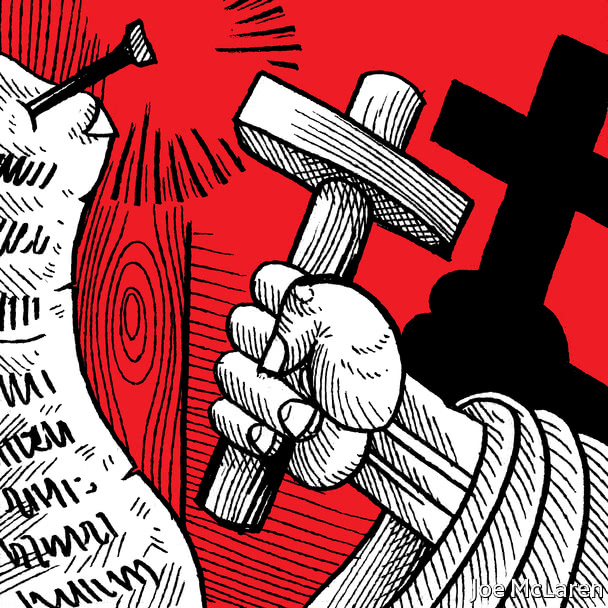
private. The day on which he is said to have nailed a list of 95
complaints about ecclesiastical corruption to the church door in
Wittenberg, Saxony—widely thought to have been October 31st 1517—made
the private public and, soon, political. A mixture of princely
patronage, personal stubbornness and chance led what could have ended up
as just another minor protest in a remote corner of Europe to become a
global movement.
At the heart of this Protestant faith were, and are, three beliefs resting on the Latin word for “alone”: sola fide (that people are saved by faith in Jesus alone, not by anything they do); sola gratia (that this faith is given by grace alone, and cannot be earned); and sola scriptura
(that it is based on the authority of the Bible alone, and not on
tradition or the church). In a way that complemented the broader themes
of the Renaissance, Luther wanted Christianity to go back to the
“pristine Gospel”: the teachings of Jesus and the apostles. This return
offered a new sort of freedom, one centred on the individual, which
helped pave the way for modernity. “The separation of powers,
toleration, freedom of conscience, they are all Protestant ideas,” says
Jacques Berlinerblau, a sociologist at Georgetown University.
A safe stronghold
Protestantism
continues to change lives today; indeed, over the recent decades the
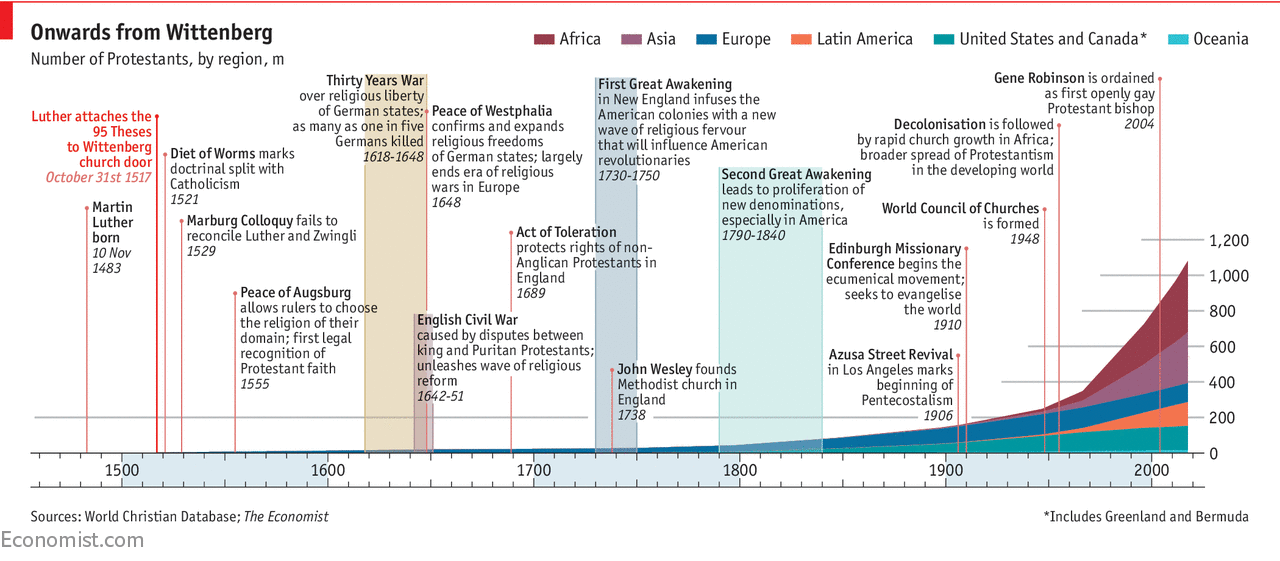
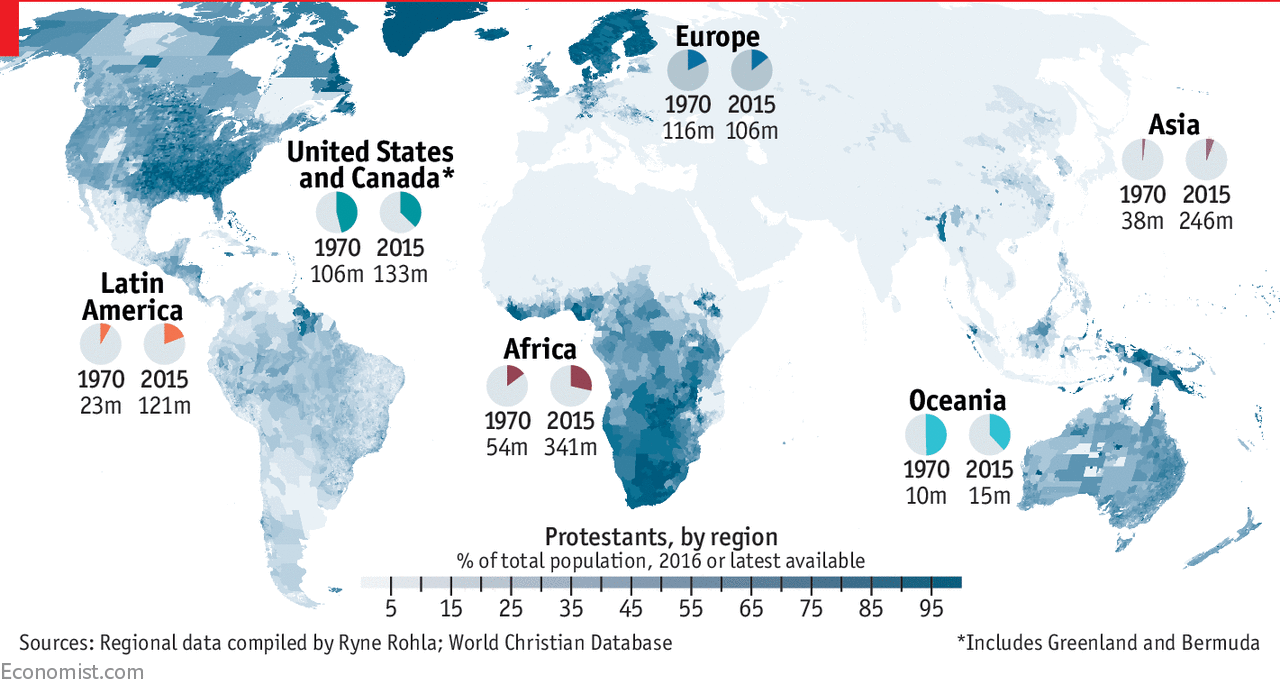
number of its adherents has grown substantially. Since the 1970s, about
three-quarters of Almolonga’s 14,000 residents have converted; more than
40% of Guatemala’s population is now Protestant. Its story is a
microcosm of a broader “Protestant awakening” across Latin America and
the developing world. According to the Pew Research Centre Protestants
currently make up slightly less than 40% of the world’s 2.3bn
Christians; almost all the rest are Roman Catholics. The United States
is home to some 150m Protestants, the largest number in any country.
In
Luther’s native Germany roughly half the Christians follow his
denomination. But today Europe accounts for only 13% of the world’s
Protestants. The faith’s home is the developing world. Nigeria has more
than twice as many Protestants as Germany. More than 80m Chinese have
embraced the faith in the past 40 years.
There are many ways to be
a Protestant, from the quietist to the ecstatic. The fastest-growing
varieties tend to be the evangelical ones, which emphasise the need for
spiritual rebirth and Biblical authority. Among developing-world
evangelicals, Pentecostals are dominant; their version of the faith is
charismatic, in that it emphasises the “gifts” of the Holy Spirit, held
to be a universally accessible and sustaining aspect of God. These gifts
include healing, prophecy and glossolalia. According to the World
Christian Database at Gordon-Conwell Theological Seminary in
Massachusetts, Pentecostals and other evangelicals and charismatics
account for 35% of Europe’s Protestants, 74% of America’s and 88% of
those in developing countries. They make up more than half of the
developing world’s Christians, and 10% of all people on Earth.
Changed
lives change places. Almolonga’s Pentecostal believers have brought new
energy to their town. Where once the prison was full and drunks slumped
in the streets, there is now a buzz of activity. A secondary school
opened in 2003; it sends some of its graduates, all members of the
indigenous K’iché people, to national universities. “We want one of our
students to work at NASA,” says Mr Riscajche’s son, Oscar, who chairs
the school board.
Scholars have been surprised by the developing
world’s Protestant boom. K.M. Panikkar, an Indian journalist, spoke for
many when he predicted in the 1950s that Christianity would struggle in a
post-colonial world. What might survive, he suggested, in both
Protestant and Catholic forms, would be a more modern, liberal form of
the faith. The Pentecostal expansion proved him quite wrong. Peter
Berger of Boston University, a leading sociologist of religion (who died
this summer), saw it as a key part of a wider “desecularisation” of the
world.
To some extent, this growth of Pentecostalism among the
global poor marks a loss of faith in political and secular creeds. As
Mike Davies, an American writer and activist, put it in 2004, “Marx has
yielded the historical stage to Mohammed and the Holy Ghost.” But it is
worth noting that between 2000 and 2017 the 1.9% annual growth in the
number of Muslims was mostly due to an expanding population, whereas a
significant part of Pentecostalism’s expansion of 2.2% a year was due to
conversion. Half of Latin America’s Protestants did not grow up in the
faith.
Their emphasis on personal experience makes Pentecostalism
and similar beliefs culturally malleable; their simplicity and ability
to dispense with clergy gives them a nimbleness that suits people on the
move. They tend to erode distinctions of faith based on ethnicity or
birthplace. To Berger, that made this sort of Protestantism a
modernising force. It is, he argued, “the only major religion which, at
the core of its piety, insists on an act of personal decision.” Its
mixture of distinctive individualism and strong, supportive communities,
he wrote, makes it “a very powerful package indeed”.
It
is a bootstrapping faith. Anyone pulling himself up in the world can
join. Many of those who do are from the margins of society. Churches
provide migrants in their congregations with employment, support and the
possibility of advancement. Where the faith is not part of the
establishment, as in Latin America or China, it carries the potential
for disruption.
For some sociologists, such ideas evoke the ghost
of Max Weber, whose book, “The Protestant Ethic and the Spirit of
Capitalism”, published in 1905, posited that modern capitalism was the
unintended consequence of an “inner-worldly asceticism” in early modern
Protestantism. Such people made money but did not spend it, creating a
thrifty, hard-working, literate, self-denying citizenry who drove
forward the economies of their countries.
Few economists these
days put much stock in Weber’s views. They point out that there was
plenty of proto-capitalism—in 13th-century Italian city-states, for
instance—before the Reformation, and the development of its modern form
was influenced by many other factors. Today the idea seems out of date:
the borders that once ensured an overlap between national markets and
economic moralities have given way to capital flows and a consumer
culture in which unrestricted gratification seems to be the norm.
Yet
some hear echoes of Weber’s ideas in Pentecostalism’s growing social
influence. “In Guatemala the Pentecostal church is just about the only
functioning organisation of civil society,” says Kevin O’Neill of the
University of Toronto. Almost all the drug-rehabilitation centres in
Guatemala City, of which there are more than 200, are run by Pentecostal
volunteers. Throughout Latin America, there are hints of the faith’s
socioeconomic impact. A recent study of Brazilian men by Joseph Potter
of the University of Texas and others found that Protestant faith was
associated with an increase in the earnings of male workers over a
30-year period, especially among less educated people of colour.
In
Almolonga itself, in the first decade of this century, farmers on
average earned twice as much as those in the next village, where
Protestantism had not taken off. Sceptics attribute this to the more
fertile soil or new methods of farming. But according to Berger, “Max
Weber is alive and well and living in Guatemala.”
How a turbulent monk turned the world upside down
LUTHER
was an accidental revolutionary. He was not trying to modernise his
world but to save it. Had he become a lawyer, as his father wanted,
Christendom—the European order organised by its rulers along lines
largely set by the church—might have evolved very differently. The
church might have reformed more from within; it might have fractured
even more deeply than it did.
It
was change from within that Luther wanted. Having entered an
Augustinian monastery, he went on to teach at the University of
Wittenberg. He still believed in Christendom, but his experience of God
persuaded him that the church was getting it wrong.
In 1521, at
the Diet of Worms—an assembly called to discuss Luther’s teachings
presided over by the Holy Roman Emperor, Charles V—Luther was asked to
recant his heretical view that men and women are saved by the grace of
God alone. He replied that he could do so only if the Bible could be
shown to prove him wrong. “My conscience is captive to the word of God. I
cannot and I will not recant anything, for to go against conscience is
neither right nor safe.” He may or may not have then said the words
“Here I stand. I can do no other.” But that is the phrase that went on
to define him and his faith.
Some who of those who took Luther’s
Reformation further were better at systematising the faith. By the 1550s
John Calvin had turned Geneva into a model Protestant city. Others were
holier and shrewder. But few were such prolific agitators. Luther was
responsible for more than a fifth of the entire output of pamphlets from
the empire’s newfangled printing presses during the 1520s. “Every day
it rains Luther books,” sighed one churchman. “Nothing else sells.”
Cantankerous
and fiercely anti-Semitic, Luther was far from otherworldly. He
abandoned his vows of chastity and entered an affectionate marriage,
swore freely, drank eagerly and referred frequently to the state of his
bowels. He was by no means a democrat, but his ideas had a huge
political impact. In 1596 Andrew Melville, a Scottish Presbyterian,
explained Luther’s doctrine of the “two kingdoms” to his king, James VI.
In one kingdom James was a king, ruling in earthly pomp. But in the
other, the kingdom of Christ, James was “not a king, nor a lord, nor a
head, but a member”—the same as anyone else.
To begin with, Luther
and other Protestants were keen that church and state should continue
to be bound together—just with much clearer lines between their realms
of authority. Keeping the state out of the church’s business meant
clerics lost the power to suppress heretics by force. But Luther was
content with that. He insisted that heresy should be fought from pulpits
and in pamphlets, not by coercion. “Let the spirits collide,” he wrote.
“If meanwhile some are led astray, all right, such is war.”
The
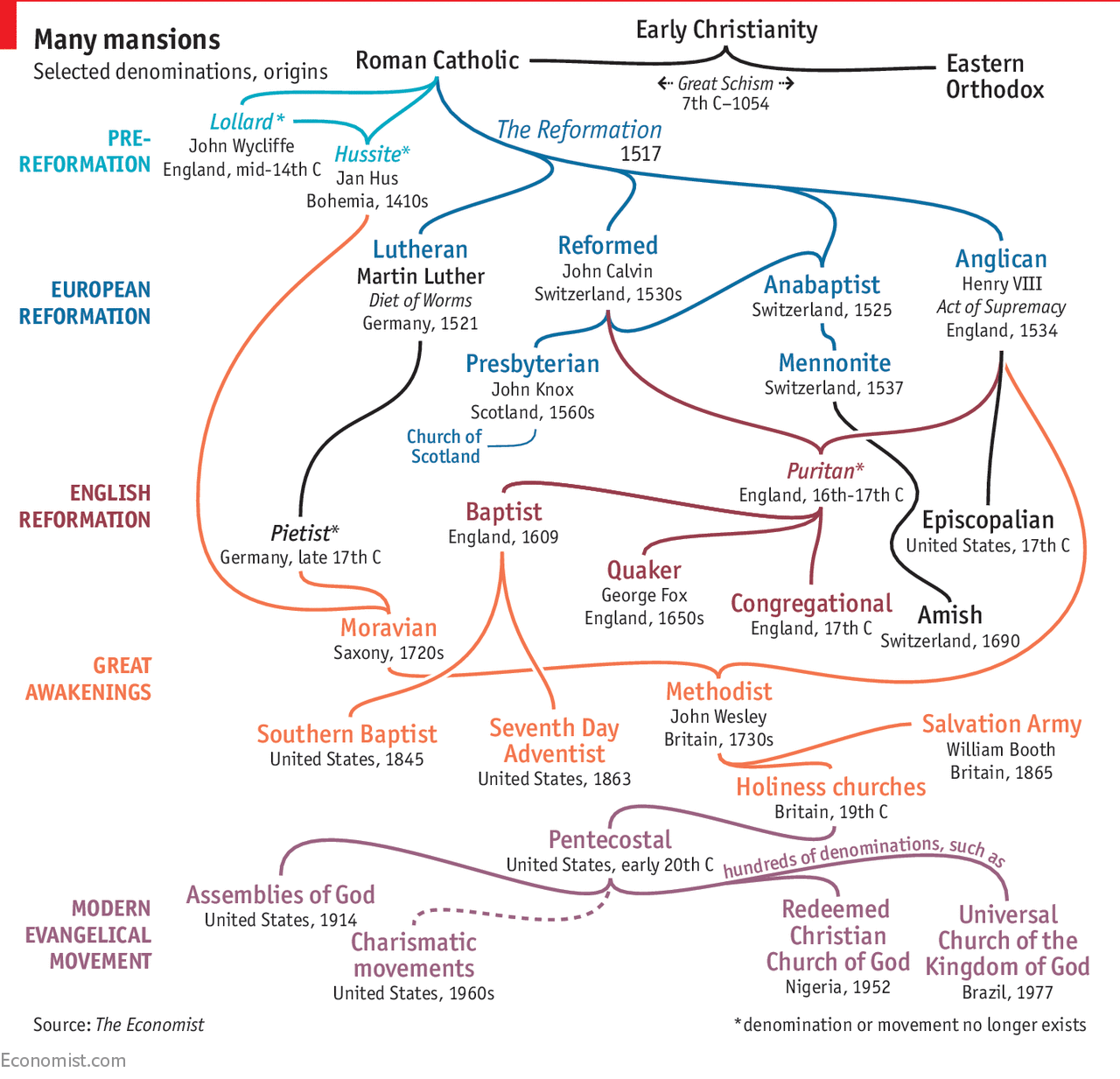
result was a fissile movement. Protestantism’s first split was between
the “magisterial” reformers, such as Luther and Calvin, who believed in
national churches backed by state power, and the “radical” reformers,
such as Anabaptists—men and women who wanted to form their own separate,
perfect communities without waiting for the world to catch up with
them. Those in the second group were often millenarians who believed in
the imminent return of Jesus, John Milton’s “shortly expected King”. It
is partly from this wing of the faith that the Pentecostal, evangelical
and charismatic strands of modern Protestantism have grown.
The
division in Protestantism had political repercussions. The German
Peasants’ Revolt in 1524-25 was led by men who denounced serfdom as
incompatible with Christian liberty and said they would desist only if
they could be proved wrong on Biblical grounds. Luther was shocked at
what he had unleashed, penning a pamphlet entitled “Against the Robbing
and Murdering Hordes of Peasants”. But it was too late. The sects would
not do as they were told. If God had spoken to them directly through his
word, what was there to fear from kings and bishops?
Though the
magisterial reformation triumphed in the transformation of northern
European establishments from Catholic to Protestant, it was the
longer-term triumph of the radical reformation that arguably had the
deepest effects, in northern Europe and elsewhere. The new Protestant
sects’ insistence that they be free to practise their faith did not
extend to others—notably Catholics—seeking to practise theirs. But it
did open up some space for the toleration and freedom of conscience that
eventually helped create the principle of limited government. Milton’s
“Areopagitica” of 1644 urged freedom of thought and freedom to publish.
Uncensored printing offered the possibility of choice, ending the state
church’s monopoly on opinion-forming.
Protestant toleration was
good for business, too. The Calvinist Netherlands of the late 16th
century became the world’s richest society as Huguenots, Jews and other
hard-working refugees from Catholic lands flooded in. “The really
radical twist that Protestantism added was the idea of human spiritual
equality having a political consequence,” says Alec Ryrie of Durham
University, author of “Protestants”, the best recent history of the
faith.
This played out in the aftermath of the English civil war
when religious groups such as the Diggers and the Levellers demanded
universal male suffrage and common ownership of the land. In 1647 one of
them, Thomas Rainsborough, said in the Putney debates with Oliver
Cromwell, the Puritan who had led parliament, that “The poorest man in
England is not at all bound in a strict sense to that government that he
hath not had a voice to put himself under.” The Diggers were dispersed,
but the idea that equality before God implied full democracy took root.
The dispossessed, reclaiming what was theirs
The
resistance of dissenters impressed John Locke, an English philosopher
with strong Protestant roots. Their stand influenced his writings on
freedom of conscience, which were to form the foundation for English
liberalism, and the Toleration Act of 1689, which formalised the legal
acceptance of nonconformist sects. The participatory ways in which
nonconformist churches often chose their leaders eventually filtered
through to society in general. “Churches were schools of democracy,”
says David Martin, a British sociologist of religion.
If people
were to find Bible-based salvation independent of the clergy, literacy
was indispensable. By 1760 about 60% of England’s men, and 40% of its
women, were able to read. Protestant education provided opportunities
for social mobility, improved the status of women and fostered economic
growth. Elie Halévy, an influential early 20th-century French historian,
believed that Methodism helped 18th-century England avoid a revolution
of the sort that later befell France by educating the lower classes and
bringing about social reform. This admiration was not universal:
Britain’s pioneering Marxist historian of the working class, E.P.
Thompson, considered Methodism to be a “ritual form of psychic
masturbation”.
Before
the Toleration Act and other developments made Britain and northern
Europe more amenable to radical Protestantism, many seeking religious
freedom had crossed the Atlantic to secure it. A strong tradition of
radical Protestantism became a feature of the American colonies and the
subsequent history of the United States, refreshed from time to time by
revivalist “great awakenings”. That America became the fullest example
of limited government enshrined in law is in large part a consequence of
its Protestant settlement. The truths the Founding Fathers held to be
self-evident had not seemed so to anyone before the Reformation.
Like
Roman Catholics, Protestants sought to bring their faith to other
peoples, too. The motives for this were mixed, the respect for
indigenous cultures often scant and frequently nonexistent and some of
the results disastrous. That said, Robert Woodberry of Baylor University
in Texas has mounted statistical arguments that former colonies where
evangelical (what he calls “conversionary”) Protestant missionaries were
active have become more democratic. He attributes this to mass
education, religious liberty and a legacy of voluntarism.
In the
colonies and Europe alike, Protestant Christianity brought bloodshed and
persecution aplenty. Protestants and Catholics burned each other at the
stake. During the Thirty Years War, fought mainly between Protestant
and Catholic states, 8m people died. Britain, with its established
Protestant church, did more than any other country to build up the trade
that shipped some 12m people across the Atlantic in chains; Protestant
America whipped the slaves thus delivered to work. In the 20th century
the apolitical attitude inherent in Luther’s “two kingdoms” approach led
German Protestants to believe they should not interfere with the state
even when power fell into Nazi hands. Many were “either complicit or
indifferent as unimaginable crimes were committed around them”, says Mr
Ryrie.
Throughout, Protestants had an almost comical capacity for
hypocrisy of all kinds. It could be seen not just in their vices, but
also their virtues—particularly a rather selective toleration. The
respect for their religious rights that 16th-century Mennonites demanded
from the Dutch Republic was not extended to dissenters within their own
ranks. By 1600 there were at least six Mennonite groups in the country.
They hated each other with a passion.
How far from the tree can the fruits of the spirit fall?
PROTESTANTISM’S
fissiparous tendencies persist. When searching for Mr Riscajche’s
church in Almolonga, the Evangelical Church of Calvary, your confused
correspondent thought he had arrived when he discovered the Mount
Calvary Church. Not at all the same thing, it turned out. Almolonga,
small though it is, has at least a dozen Pentecostal churches. But if
the individual congregations for each are small, their cumulative effect
is not.
Until the 1970s Guatemala was a staunchly Catholic
country. When Protestant aid agencies rushed in after a massive
earthquake in 1976, the faith gained a substantial foothold. After the
country’s bloody civil war ended in 1996 it spread as if unshackled.
Guatemalans took to the faith for many reasons, says Virginia Garrard of
the University of Texas, but upheaval had a lot to do with it. The
civil war represented a definitive break with the past: when so much had
been destroyed anyway, losing your Catholic heritage meant less. At a
time of painful economic dislocation, people who felt that Catholicism
and liberation theology had failed them turned to an aspirational faith
that promised a new upward mobility. With a low bar to entry and almost
no hierarchy, new Pentecostal churches matched the entrepreneurial
spirit of the times.
The message has resonated elsewhere. In South
Korea, the Protestantism that accompanied the country’s dizzying
economic rise was an expression of Korean nationalism. In China, a
modernising population is looking for a moral framework to go with its
new mobility. Yang Fenggang of Purdue University predicts that there
could be at least 160m Protestants in China by 2025. He expects the
country will soon be home to more Protestants than America.
As in
early modern Europe, women in developing countries have often been
especially affected by Protestantism. Having studied churches in
Colombia, Elizabeth Brusco, author of “The Reformation of Machismo”, was
surprised to find that evangelicalism was a women’s movement “like
Western feminism”, explaining that “it serves to reform gender roles in a
way that enhances female status.” Male Colombian converts had
previously spent up to 40% of their pay in bars and brothels; that money
was redirected to the family, raising the living standards of women and
children. Temperance helped employment, too. Scholars also argue that
the voice this has given women helps consolidate democracy; Mr Martin
sees parallels with England’s 19th-century Methodists.
That
does not mean the faith is egalitarian. Pentecostalism reforms
traditional gender roles rather than abolishing them; it tends to be
robustly patriarchal, and profoundly intolerant of homosexuality. But a
sober patriarch committed to a moral code that, crucially, treats
domestic violence as sinful can provide stability. An acceptance of
birth control also eases women’s lot.
More stable, economically
active households and well-knit communities have undoubtedly made places
like Almolonga more agreeable for most who live there. But what effect
do they have on a grander scale? Can they remake not just villages but
whole countries and their economies?
Pentecostals have
traditionally been suspicious of politics as too “worldly” and of
development work as too long-term. But in Guatemala and elsewhere some
are now mobilising for social change. Witness a rap battle in a
community hall in one of the areas of Guatemala City known as “red
zones”. Teenagers take it in turns to get up on stage and rap against
each other, with judges deciding who goes through to the next round. The
event has been organised by Angel, a local man who joined one of the
city’s notorious gangs when he was 14. By the age of 22, he had shot “a
lot of people”, he says. When he found himself about to be executed by a
rival gang, he called out to God for help; he escaped death and was
born again. For the past ten years, in a typically Pentecostal bottom-up
initiative, he has been saving kids from gangs.
As yet, it is
hard to see a broader impact from these individual transformations.
Guatemala remains poor and desperate. Many people do not vote or pay
tax; only a tiny fraction of murder investigations lead to convictions.
The country lags behind the rest of Latin America on many development
indicators. “Guatemala tests the limits of religion as an agent of
change,” says Kevin O’Neill of Toronto University. “It’s not that the
religion is ineffectual. It has changed a lot in society. It’s just that
it has not changed things measurable by the metrics we use, such as
security, democracy and economy.”
Perhaps the sort of change that
can be measured will arrive in due course. Guatemala’s history has left
it poor and oligarchic. “Five percent of the population controls 85% of
the wealth,” says Mr O’Neill. More than three-quarters of the cocaine
from South America heading for the United States now passes through it;
many gang members have been deported from Los Angeles. Any society,
never mind one recovering from a 36-year civil war, would struggle.
“Guatemala is like a 400lb man who has lost 100lb in weight. He is
getting better, but he is still in a bad state,” says Ms Garrard, who
first visited in 1979. She ascribes much of the progress to the
churches.
But it may also be that there are limits to 21st-century
Protestantism’s capacity for large-scale reform. For one thing, it is
largely a faith at the margins of society. In the places where
Protestantism made its clearest mark in early modern Europe it took root
in the bourgeoisie, among people of influence. A classic example is
William Wilberforce, a British politician whose legislation banning the
slave trade stemmed from his evangelical beliefs. Moreover, northern
Europe’s Protestants lived in countries that already had clear property
rights and the rule of law. By contrast, Protestants in the developing
world are often among the poorest members of society, living in places
with endemic corruption.
The otherworldly nature of Pentecostalism
does not help. Believing in imminent apocalypse militates against
strong social engagement. The ship is sinking; rather than try to fix
it, Pentecostals want to get as many people as possible into the
lifeboats. “What Guatemala needs is tax reform, voter registration,
microloans, community organising,” says Mr O’Neill. But “people are just
sitting there praying.”
That is not entirely true. “We know we
need to change the system,” says Cash Luna, pastor of Casa de Dios, one
of Guatemala’s half-dozen megachurches. “We pay our taxes and we
encourage our congregation to do the right thing,” he says. The church
also tries to mediate in the city’s gang warfare (Angel is a member) and
holds classes for policemen on how to engage better with the public.
Pentecostals took part in the anti-corruption movement that brought down
the country’s president in 2015. But Protestant involvement in
Guatemalan politics has been messy, and plentiful compromises have
dragged the faith into disrepute.
Protean politics
Unlike
Catholics, Pentecostals have no unified theology of the state, nor any
well-formulated programme for sociopolitical reform. To the extent that
they are political at all, they merely think that their co-religionists
should be elected and that their countries should be Christian.
In
many places they lean to the right. Efraín Ríos Montt, who took control
of Guatemala in a coup in 1982—and thus became the country’s first
Protestant leader—waged the civil war as a fierce anti-Communist. He was
responsible for the deaths of tens of thousands of people, 80% of them
indigenous Mayans; for some, Protestantism became a survival strategy.
At the same time many Nicaraguan evangelicals supported the left-wing
Sandinista government. In Brazil many of the country’s new evangelicals
supported Lula, a left-wing president, in the 2000s. The movement’s
political engagement there has not gone well. One pastor talks of the
problem being “a church without a tradition…and an incapacity to think
Christianly about society.”
It might be argued that the faith has
been politically more successful in opposition than in power. Protestant
churches, in particular the historic denominations established by
missionaries, were instrumental in apartheid’s downfall in South Africa.
Similar stories abound. “In Kenya during the 1980s, when all opposition
activity was banned, the leaders of the opposition were, in effect,
churchmen,” says Paul Gifford, emeritus professor of religion at the
School of Oriental and African Studies in London.
But there were
Protestants on the other side, too: apartheid was underpinned by the
Dutch Reformed Church. Besides, the time for such opposition has largely
passed, and the churches that offered it have not themselves become
more democratic. Their leaders, including Desmond Tutu, a South African
clergyman and theologian, have admitted that they have not adapted as
well as the less hierarchical Pentecostal churches to the post-apartheid
order. “We knew what we were against,” says Mr Tutu. “It is not nearly
so easy to say what we are for.”
Early Protestantism tended to
play down possessions. Luther himself called worldly success a sign of
God’s displeasure. The wealth observed by Weber was treated to some
extent as an unintended consequence of its possessors’ Calvinist faith.
But in the “prosperity Gospel”, a recent export from the United States,
wealth is very much the intention. Many of the new generation of pastors
tell their flocks that God does not want them to be poor.
In
Africa, many Pentecostal churches are concerned with “this-worldly”
victory, says Mr Gifford. In Nigeria congregations with names like the
“Victory Bible Church” hang banners saying things like “Success is my
Birthright”. One of Nigeria’s best known pastors, David Oyedepo, whose
church has been attended by the country’s presidents, says that
Christians must be rich. Such preachers suggest that “planting seeds”
(giving money to the church) will bring a harvest of its own, and that
wealth is proof of God’s love. God must love Mr Oyedepo a lot; the
Nigerian press reports that he is worth more than $150m and owns four
private jets.
What Protestants do best is protest
IN
1882 Friedrich Nietzsche, a philosopher raised in Saxony as the son of a
Lutheran minister, declared that God was dead. The vibrant spiritual
lives of billions would seem to give this the lie. But in 20th-century
Europe, at least, there seemed to be some truth to it; and a fair bit of
the blame, or credit, fell to the Reformation. In helping to shape the
West, Protestantism sowed the seeds of its own destruction. In giving
people space to believe what they wanted and choose what sort of life to
lead, it allowed them to stop believing at all and choose something
else. And it has not fought as hard to resist this trend as some faiths
might. After all, the whole point of Protestantism is that, in Mr
Ryrie’s words, “it values the personal and the private over the
political and the public.”
One effect of European (and, to some
extent, American) secularisation is that old religious divisions are
healing. There is still sectarian prejudice in parts of Europe, but much
less than there was. And Protestantism is also less distinct than it
was. According to the Pew Research Centre, 46% of American Protestants
say faith alone is needed to attain salvation—the basis of Luther’s
stand—but more than half now believe that good deeds are needed, too.
As
interdenominational divisions have healed, some individual churches
have started to fall apart. In the Anglican communion, which contains
the Church of England and many of its offshoots, homosexuality is
driving a wedge between believers in the northern hemisphere, many of
whom increasingly support gay rights, and those in developing countries,
who mostly do not.
Even in America, the proportion of Protestants
is declining. Mainline, often more liberal, denominations fell from
18.1% to 14.7% between 2007 and 2014, according to the Pew Research
Centre. The proportion of evangelicals dropped less drastically, from
26.3% to 25.4%. Meanwhile, the religiously unaffiliated rose from 16.1%
to 22.8%. In future, churches “that disdain the corruption of public
life and offer spiritual rather than political power may find that their
message resonates most,” predicts Mr Ryrie. But the faith will no doubt
continue to be used as a weapon in the culture wars.
As for the
developing world, the growth of Protestantism in Africa and Latin
America does not seem to be just a way-station on the road to
secularisation. But nor does it yet look like something that will
transform the economy or politics on a large scale. Its effects may be
strong, but they may also be largely indirect.
In some places
Protestantism may settle down, with Pentecostals perhaps shifting to
more staid denominations—or, indeed, fading into secularism. Some
Protestants have understood that when they become the dominant religion,
their faith’s power—its here-I-stand refusal to accept orders from any
source but God or conscience—tends to seep away.
The places where
Protestantism is most alive and seems politically most salient—where its
churches continue to argue about who is right and what the Bible means,
issuing statements and counterstatements just as Luther did—are often
those where it has retained its outsider status. The growth of
evangelical faith in China, for example, is taking place in a context of
disapproval from which it seems to draw strength. In 2015 Wang Yi, a
leading pastor, issued his own 95 theses on “Reaffirming our Stance on
the House Churches”—the congregations outside the control of the
government. It reiterated the need for freedom of conscience and for
house churches to be allowed their independence, while protesting
against the distortion of scripture and attacking state-approved
churches for collusion with the Communist Party authorities. Wherever
overweening rulers clash with people demanding their right to religious
freedom, Luther’s divisive, dynamic spirit will remain an inspiration
for a long time to come.
Diz a lenda que, em 31 de outubro de 1517, o monge agostiniano Martinho Lutero (1483-1546), escandalizado com o vergonhoso espetáculo que a Igreja Católica
oferecia e indignado com a venda de indulgências, pregou nas portas da
igreja de Wittenberg as 95 teses que desafiavam o poder de Roma. O
aniversário de 500 anos desse gesto está sendo celebrado com pompa na
Alemanha. Merkel e Obama
prestaram homenagem a Lutero em 25 de maio no Portão de Brandemburgo e,
por volta da mesma data, foi inaugurada uma espetacular exposição em
Wittenberg. Esses são só alguns dos eventos mais destacados. Desde o fim
da Segunda Guerra Mundial,
os aniversários luteranos (nascimento, morte, 95 teses, iluminação
divina durante a tempestade de 1505…) quase não tinham relevância. Mas
agora isso mudou. Por quê?
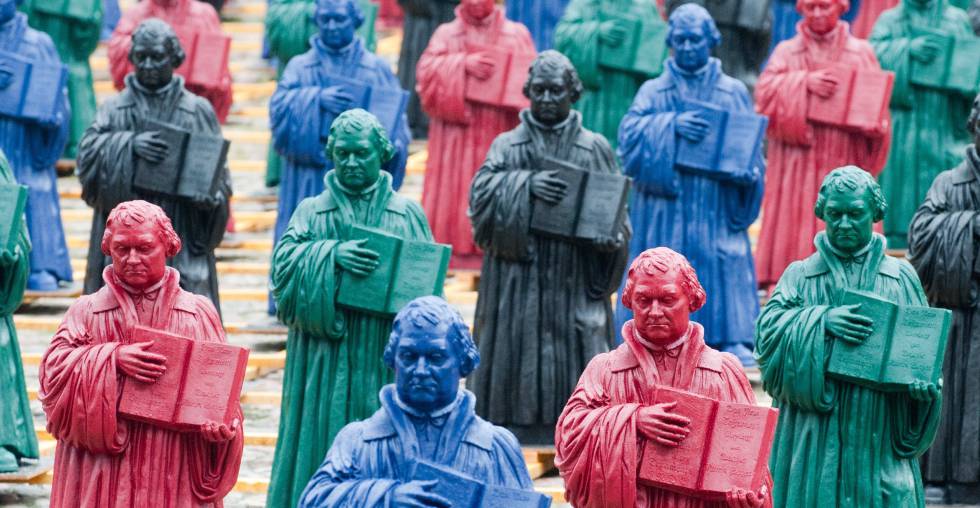
Instalação
do artista alemão Ottmar Hörl feita com 800 imagens de Martinho Lutero e
exposta na cidade alemã de Wittenberg em agosto de 2010.PETER ENDIGAFP / Getty Images
O gesto descrito às portas da igreja de Wittenberg é a
representação mítica e ritual do significado de Martinho Lutero para o
chamado Sacro Império Romano-Germânico.
Há muito se duvida que ele tenha mesmo pregado suas teses; as menções
ao ato desafiador aparecem muito depois, conforme se vai adornando e
mitificando a personagem Lutero e o cisma que ele trouxe consigo. Mas, se non è vero, è ben trovato (ainda que não seja verdade, é bem possível).
Seria muito menos heroico mandar o texto de protesto pelo correio – que
é o que provavelmente aconteceu – ao bispo de Mogúncia (Mainz). O gesto
simbólico conserva hoje toda sua aura teatral, mas era muito mais épico
naquele tempo, porque o homem do século XVI sabia que essa era a
maneira de divulgar os chamados cartazes de desafio, em que um
cavalheiro insultava publicamente outro e o desafiava a um duelo. E era
preciso responder, quem não o fazia ficava desonrado para sempre. Há, na
figura de Lutero, um componente de heroísmo a posteriori muito interessante para compreender seu significado na história da Alemanha e também, não se surpreenda o leitor, na da Espanha.
O
cisma luterano é a manifestação de um problema político, mas o contexto
religioso em que foi mantido turva completamente sua compreensão.
Através dele se expressa o nacionalismo germânico primordial e, por
isso, Martinho Lutero é celebrado e exaltado na Alemanha cada vez que
esse nacionalismo ganha força. Desde a Segunda Guerra Mundial não se
comemorava de maneira significativa nenhuma efeméride luterana. Em 1983
passou em branco na Alemanha Ocidental o quinto centenário do nascimento
de Martinho Lutero, tão festejado nos tempos de Bismarck. Em 10 de novembro de 1883, por exemplo, o imperador Guilherme I liderou o desfile do quarto centenário de nascimento de Lutero em Eisleben.
Em Historia del año 1883 o intelectual e político
espanhol Emilio Castelar escreve: “Os povos protestantes celebraram o
quarto centenário de Lutero com júbilo universal” e ainda, embora “os
católicos e os protestantes
da Alemanha não tenham concordado em homenagear o religioso,
concordaram em homenagear o patriota”. Mas o mais interessante é o
expediente: “Nós, que não pertencemos à religião luterana
nem à raça germânica, espanhóis e católicos de nascimento, podemos
celebrar sem receio aquele que, iniciando as liberdades de pensamento e
de exame, iniciou as revoluções modernas, por cuja virtude rompemos
nossos grilhões de servos e proclamamos a universalidade da justiça e do
direito”. Não precisamos, portanto, ir a Wittenberg para ler os textos
que comentam a espetacular exposição. O que ali se conta é exatamente o
mesmo que Castelar nos diz: Lutero, o pai da liberdade religiosa na Europa; Lutero, o herói por cujo esforço ímpar este continente se livrou das trevas e da escravidão.
Castelar diz que “rompemos nossos grilhões”. A Lutero devemos nada
menos que “a justiça e o direito”, porque é evidente que os espanhóis
não tínhamos isso.
Lutero foi o grande protetor das
oligarquias, o fiador religioso de um feudalismo tardio que manteve a
Alemanha no atraso e na pobreza
E, claro, se Lutero rompe os grilhões
é porque havia grilhões a romper e alguém os tinha colocado. Se traz a
liberdade de pensamento é porque isso não existia, e quem impedia? Nem é
preciso dizer com todas as letras, mas está aí, constantemente
presente: o sombrio e sinistro Império espanhol e católico. Para que o
herói Lutero exista é preciso haver um monstro que o antagonize. Sem
monstro, não há herói. Quem visita Wittenberg ou qualquer das muitas
exposições e celebrações na Alemanha hoje, mesmo sendo espanhol e
católico – e especialmente se for espanhol e católico – não vê o cenário
que torna possível o brilho germânico. Quando digo católico não quero
dizer religioso. A fé é irrelevante neste contexto. Refiro-me a quem
nasceu em um país de cultura católica. Porque esse fulgor germânico precisou, século após século, como condição sine qua non
para sua exaltação, que o sul mediterrâneo fosse obscuro e atrasado,
imoral e decadente, indolente e pouco confiável. Foi em tempos de Lutero
que o adjetivo welsch – uma denominação geográfica pouco
precisa para referir-se ao sul – passou a significar latino ou românico,
e malvado e imoral ao mesmo tempo.
A “liberdade luterana” não resiste a um olhar próximo e
livre de preconceitos. Começou provocando uma guerra espantosa que se
chamou Guerra dos Camponeses
e deixou mais de 100.000 mortos nos campos do Sacro Império. Porque os
camponeses acreditaram de verdade naquelas exaltadas pregações da boca
de Lutero e de outros que clamavam contra as riquezas acumuladas pelos
poderosos da terra com Roma como fiadora de tais injustiças. Isso provocou uma convulsão social como nenhuma outra na Europa até a Revolução Francesa.
Os príncipes alemães, cujo propósito era basicamente opor-se ao
imperador, não pensaram que incentivar aquela efervescência antissistema
(Carlos V e o catolicismo) poderia se voltar contra eles, mas tiveram
que enfrentar uma revolta de proporções gigantescas. Alguns clérigos
revolucionários como Müntzer,
conhecido como o teólogo da revolução, mantiveram-se fiéis a seus
princípios até o final e foram executados, mas Lutero decidiu
sobreviver. Desde o início de 1525, depois da morte de Hutten
e Sickingen, os dois líderes revolucionários que o tinham protegido,
Lutero fica serviço dos príncipes alemães e incentiva a violência brutal
com que os grandes senhores germânicos sufocaram as rebeliões
campesinas: “Contra as hordas assassinas e saqueadoras molho minha pena
em sangue, seus integrantes devem ser estrangulados, aniquilados,
apunhalados, em segredo ou publicamente, como se matam os cães
raivosos”.
A partir de então Lutero passa a ser o grande defensor das oligarquias senhoriais, o arrimo teológico de um feudalismo tardio
que manteve a Alemanha em um estado de pobreza e atraso já superado na
Espanha e na maior parte do sul. A estagnação dessas oligarquias pela
via religiosa impediu a unificação da Alemanha e possibilitou uma
sobrevivência anômala do sistema feudal nessa parte da Europa. Quase
todo mundo sabe que a servidão na Rússia
durou até o século XIX, mas se ignora que na Alemanha também, sobretudo
nas regiões protestantes. Um dos primeiros estados a abolir as leis de
servidão foi a católica Bavária em 1808, mas, na região oriental, o
processo só foi concluído em meados do século. Bem. Isso no que diz
respeito a Lutero como libertador social. Vejamos agora Lutero como
libertador do pensamento. Liberdade religiosa
e livre exame são dois ícones linguísticos cunhados por Lutero que
nunca tiveram um reflexo na realidade, como demonstram primeiro a lógica
e depois a história.
Quase uma quarta parte das propriedades do Sacro Império mudaram de mãos. Não houve um latrocínio igual até a Revolução Russa
Supostamente o livre exame significa que o cristão deve se
entender diretamente com Deus através dos textos sagrados, sem
intermediários onerosos e imorais como “os romanos” (assim Lutero
chamava o clero católico, embora fossem tão alemães como ele). Se for
assim, há uma consequência imediata: o desaparecimento do clero, por
desnecessário. Os fatos demonstram que isto jamais aconteceu, porque
Lutero não operou a destruição das igrejas, apenas criou outra. Nem
Lutero deixou de ser clérigo, nem o número deles no Sacro Império
diminuiu. Simplesmente se formou um novo corpo sacerdotal que também
guiou o rebanho aonde deveria ir. Só que agora esse corpo de pastores
serve unicamente ao senhor do território (e não a um Papa estrangeiro e a
um imperador aliado com o mundo welsch), que é quem lhe dá de
comer. Se lhe servir bem, como fez Lutero, viverá bem. Viverá inclusive
melhor que com os “romanos”, e assim Lutero recebeu do príncipe da
Saxônia, como primeira prova de gratidão, aquele que havia sido o seu
antigo convento em Wittenberg. É um belíssimo palácio, onde se instalou
com sua nova esposa, seus parentes e seus criados. Tinha nascido no seio
de uma família muito humilde e, como monge agostiniano, jamais teria
podido se permitir esses luxos. E aqui não tocaremos mais no assunto das
críticas ferozes aos luxos do clero “romano”.
A liberdade religiosa é provavelmente o totem linguístico
mais afortunado de Martinho Lutero. Foi e é ininterruptamente debatido
diante das trevas do catolicismo e da sua nação defensora por princípio,
a Espanha. Nem é preciso pensar muito para ver aonde vai parar a
liberdade luterana. Se ela tivesse existido alguma vez, mesmo que
teoricamente, também os católicos e outras facções protestantes teriam
tido direito a ela. Se o cristão é livre para interpretar os textos
sagrados, então também a interpretação católica é possível e deve ser
aceita. E deveria ter sido respeitada em consonância com a “liberdade religiosa”
que Lutero e seus diáconos pregavam. Se a lógica humana não é um engodo
desde a sua própria raiz, é porque é assim mesmo. Mas o fato é que o
novo clero criou uma versão do cristianismo que foi a única aceitável, e
todas as demais foram proscritas e perseguidas; a católica, obviamente,
mas também os anabatistas, calvinistas, menonitas etcétera.
Ele é apresentado como o paladino da liberdade religiosa, mas o clero luterano perseguiu as demais versões do cristianismo
Entretanto, século após século, Lutero passeou pela história
da Europa imune à verdade, aos fatos e à lógica. Basta o leitor digitar
a sequência “Lutero liberdade religiosa”
em algum buscador da Internet e verá. Se escrever em inglês e alemão,
ficará pasmado. Poderíamos levar um pouco adiante este perverso jogo com
as palavras e exasperar os argumentos históricos habitualmente aceitos.
Porque aplicar a “liberdade religiosa” em sentido luterano é o que
fizeram os Reis Católicos na Espanha, ou seja, que todos os súditos devem ter a mesma religião que seu senhor terreno. Este é o princípio conhecido como cuius regio, eius religio,
e deu cobertura legal aos príncipes alemães para obrigarem as
populações de seus territórios a se tornarem protestantes, quisessem ou
não, e nem sempre graças a sermões persuasivos e pacíficos. Mas é
evidente que os Reis Católicos não podem ser os pais da liberdade
religiosa, embora tenham feito exatamente o mesmo, porque, como diz
Castelar, nós não somos luteranos nem pertencemos à raça germânica.
A esta altura você já estará se perguntando: mas por que os príncipes alemães
tinham tanto empenho em se tornarem protestantes? Não é difícil de
explicar, mas para isso, como apontamos acima, é preciso sair do terreno
religioso, da superioridade moral e das palavras totêmicas, onde todo o
protestantismo diligentemente insistiu em situar aquele sangrento
conflito. Quase uma quarta parte dos bens imóveis do Sacro Império
mudaram de mãos, entre confiscos de propriedades eclesiásticas e de
pessoas que abandonaram os territórios protestantes por se negarem a
acatar a conversão forçosa. Até a Revolução Russa,
não houve latrocínio comparável no Ocidente. Mas, claro, não chamamos
assim, porque um tinha uma cobertura teológica, e o outro, uma cobertura
ideológica. Definitivamente: uma justificativa moral. Isto naturalmente
não será contado ao visitante na magna exposição de Wittenberg.
Foi furiosamente antissemita e prefigura o programa nazista. A Noite dos Cristais foi feita em homenagem aos seus 450 anos
Lutero foi não somente antilatino, mas também furiosamente antissemita. O filósofo alemão Karl Jaspers escreveu que o programa nazista está prefigurado em Martinho Lutero, que dedicou parágrafos horripilantes aos judeus:
“Devemos primeiro atear fogo às suas sinagogas e escolas, sepultar e
cobrir com lixo o que não incendiarmos, para que nenhum homem volte a
ver deles pedra ou cinza”. O primeiro grande pogrom de 1938, a Noite dos Cristais, foi justificado como uma operação piedosa em homenagem a Martinho Lutero por seus 450 anos. Hitler
disputou as eleições de 1933 com um soberbo cartaz no qual a imagem de
Lutero e a cruz gamada aparecem juntas. As celebrações luteranas dos
nazistas eram espetaculares. Com idêntica ferocidade Lutero estimulou e
justificou a queima de bruxas, que deixou nada menos do que 25.000
vítimas na Alemanha, segundo Henningsen. Acumulamos tantos milhares,
milhões de mortos com este assunto que é melhor nem fazer contas.
Mas não há do que se envergonhar. A Alemanha celebra
ostensivamente Martinho Lutero porque se sente bem, porque Lutero é o
pai do nacionalismo alemão e de sua Igreja, e tem, portanto… indulgência
teológica. Desde a reunificação, e depois com a chegada do euro como
elixir mágico, a Alemanha está em um tempo novo e encara às claras uma
hegemonia europeia inconteste. A Grã-Bretanha desertou do barco da União, e a França não está em condições de confrontar a indiscutível supremacia germânica. Nem a Espanha nem a Itália
parecem perceber muito bem como são necessárias para compensar esta
hegemonia e como andam perdidas, sem conseguir superar o complexo de
inferioridade que assumiram há séculos. Porque, com tudo isto, chegamos
ao grande assunto do qual se trata aqui: o da superioridade moral frente
ao suíno mundo não protestante no qual vivemos, a qual foi tão
absolutamente assumida que muitos de nossos jornais, como nos tempos de
Castelar, se somaram contentes à celebração luterana, tão cegos e tão
perdidos hoje no labirinto da sua própria inferioridade como estavam há
100 anos.
*María Elvira Rocha Bareaé filóloga e autora de ‘Imperiofobia e Lenda Negra’ (Siruela).