
sábado, 15 de abril de 2023

Artigos sobre a guerra de agressão da Rússia contra a Ucrânia no Project Syndicate

Putin’s War on Ukraine

https://www.project-syndicate.org/topic/the-russia-ukraine-crisis


How to Prosecute Putin

Apr 10, 2023


Putting the Russian president on trial for the international crime of aggression would be more straightforward than trying him for war crimes and crimes against humanity. Since the International Criminal Court has no mandate to prosecute such crimes, a special international tribunal must be formed – with US support.

EDINBURGH – A few weeks ago, the International Criminal Court issued an arrest warrant for Russian President Vladimir Putin for the war crime of unlawful deportation and transfer of children from occupied areas of Ukraine to Russia. It is a significant – indeed, historic – step toward holding Putin and his henchmen accountable for their crimes in Ukraine. But more must be done.

Evidence of Russian atrocities in Ukraine – including murder, rape, torture, and attacks on civilians, civilian infrastructure, and other non-military targets – continues to accumulate. Just last month, a United Nations-backed inquiry published a report accusing Russia of war crimes and possible crimes against humanity. While the ICC indictment is unlikely to be the only legal action brought against Putin and his cronies, it is the first. The ICC prosecutor has ensured that Putin will go down in history as the first leader of a permanent member of the UN Security Council to be indicted for an international crime.

The move is not merely symbolic. Those who think imprisoning Putin is an impossibility should recall that Liberian war criminal Charles Taylor is currently serving a 50-year sentence in a British prison, and former Serbian leader Slobodan Milošević died in prison in The Hague while on trial for war crimes. And those who think that the arrest warrant will have no impact on the accused should take note of reports of growing dissent within Putin’s leadership cabal, with insiders no doubt fearing that they will soon face indictments as well.

Admittedly, while the ICC president has moved unusually quickly and issued a statement of intent to arraign Putin in The Hague, Putin is unlikely to leave himself open to arrest by entering any of the 123 states that are signed up to the ICC. Sadly, Russia does not recognize the ICC (nor does the United States). So, given that US President Joe Biden has welcomed action, despite opposing the ICC, how can the world add to the pressure on Putin and his cronies?

The crime of aggression – beginning with the invasion of Crimea in 2014 – is Putin’s “original sin,” the font of all the recent atrocities. As University College London law professor Philippe Sands has argued, aggression would be more straightforward to prosecute than war crimes and crimes against humanity, because it can be linked directly to the Kremlin.

The ICC’s mandate does not extend to prosecuting the crime of aggression, but a special international tribunal can be created with an explicit focus on this “leadership crime.” The tribunal’s work would complement and give weight to that of the ICC.

The encouraging news is that all major European countries, as well as the European Union and the Council of Europe, have endorsed Ukrainian President Volodymyr Zelensky’s request that Putin and his circle be prosecuted for the crime of aggression. A tribunal could be constituted in the coming months.

But American support will be vital to the success of such a tribunal. Biden need not fear that supporting an investigation into Putin would tilt the scales – which he has so carefully calibrated – from support for Ukraine’s defense to active aggression against Russia. After all, the US has regularly supported special tribunals – notably for Cambodia, Lebanon, Rwanda, Sierra Leone, and the former Yugoslavia – to prosecute international crimes. And US prosecutors were at the forefront of the Nuremberg trials, carried out by the International Military Tribunal to prosecute and punish leading Nazis after World War II. The same went for the International Military Tribunal for the Far East, which carried out the “Tokyo trials” of Japanese war criminals.

Both tribunals were founded upon the 1941 Declaration of St. James’s Palace, or London Declaration, in which the Allied powers agreed that there would be no safe haven for those guilty of aggression. This would likewise form the basis of the special tribunal tasked with investigating and prosecuting Putin.

Concerns that such a tribunal would open the door for prosecutions relating to conflicts like the Iraq War are also unfounded. The special tribunal on crimes of aggression in Ukraine would be a response to Zelensky’s explicit request, made on behalf of Ukraine’s government and people. The tribunal’s authority would be derived from Ukrainian law, together with the prohibition on crimes of aggression inherent in international law. And the body would focus exclusively on the situation in Ukraine, where the evidence of wrongdoing arguably – and unlike in many other conflicts – meets the very high standard of proof required.

Nor will the prospect of a trial make Putin less willing to contemplate peace talks. I dealt directly with him, as both finance minister and prime minister of the United Kingdom, not least over the assassination in 2006 of the UK-nationalized Russian defector Alexander Litvinenko. Those experiences taught me that the only language Putin understands is that of power. He will not view pulled punches as an olive branch worth taking, but as yet more appeasement born of weakness.

In the face of Russian brutality, Ukrainians have stood united and fought valiantly. The rest of the world – led by the US – must show the same courage and resolve to ensure that justice is served, beginning with Russia’s top leaders.

America has willed the end – accountability for Putin and his cronies. Now it must join Europe in supporting the means.


GORDON BROWN

Writing for PS since 2010

Gordon Brown, a former prime minister and chancellor of the exchequer of the United Kingdom, is Chair of Education Cannot Wait’s High-Level Steering Group.

================

The Great Revision

Mar 31, 2023

Amid so much instability, one thing is clear 13 months after Russia’s full-scale invasion of Ukraine: the world order will not survive in its previous form, and Europe will have to adapt quickly. Even if cooperation eventually prevails, the European Union’s basic character will have changed.

BERLIN – Did Russian President Vladimir Putin know what he was doing when he ordered a full-scale invasion of Ukraine last February 24? That decision was a turning point for Europe. For the first time in eight decades, a great land war had erupted on the continent, shattering Europeans’ cherished illusions of peace with a force paralleling that of the Russian bombs that have been exploding in Ukrainian towns and villages ever since.

Putin apparently cannot conceive of Russia as anything other than a weaponized, feared, authoritarian world power. But achieving that status requires Russian hegemony in Eastern Europe – a revival of the imperial legacy of czarist Russia and the Soviet Union – for which Putin needed Ukraine. But he badly underestimated the Ukrainian willingness to fight and die for their freedom and independence. This, together with the support provided by NATO and the European Union, has prevented him from achieving his goal.

Three days after the invasion, German Chancellor Olaf Scholz captured the moment well in a speech to the German parliament. “We are living through a watershed era,” he declared. “And that means that the world afterwards will no longer be the same as the world before.” In fact, the war in Ukraine is about much more than most people – including Scholz – realized 13 months ago.

Obviously, the fighting is first and foremost about the Ukrainian people’s survival and the future of their homeland. But it is also about the future of the international order. Will violence triumph over law, or can we return to a lasting peace based on law and treaties? And what are the broader geopolitical implications? Russia’s invasion represented the global order’s first major revision in the twenty-first century, and now China and Russia have entered a deeper (albeit unformalized) alliance to challenge the United States and the West’s dominance.

This struggle – a revival of Cold War power politics – is embedded in two major global transformations: the encroaching digitalization of all spheres of modern life, and the final crisis of fossil-fueled industrial society.

Moreover, Russia’s war has revealed an increasingly complex international picture. Important emerging economies – such as Brazil, India, and South Africa – have refused to take a clear stand. So, too, have most of the Gulf states. All are behaving strictly according to their national interests. When they assess the new great-power conflict, they see not only economic advantages (discounted oil and gas shipments from sanctioned Russia), but also opportunities to enhance their own geopolitical and diplomatic standing.

There is no doubt that the so-called Global South will play a major role in the emerging struggle for dominance in the twenty-first century; that much is already obvious after 13 months of war in Ukraine. Unfortunately, many of these countries and regions will remember the treatment they received from the West – and particularly its leading power, the United States – in the recent past. Their participation in confronting powers like China cannot be assumed. It will have to be won.

In any case, beyond those directly affected by the fighting, Europe will be the region most changed by Russia’s aggression. The war is being waged in its own immediate neighborhood, and it was started by an authoritarian regime that embodies values completely antithetical to its own. With the illusion of peace shattered, Europe’s task now is to overcome its internal divisions and its defenselessness as soon as possible. It must become a geopolitical power capable of self-defense and deterrence, including nuclear capability.

This will not be easy, and the path ahead is strewn with hazards. Consider some of the worst-case scenarios. What will Europe do if another “America first” isolationist is elected to the White House next year, followed by the ascent of French right-wing nationalist leader Marine Le Pen to the Elysée? This outcome is a distinct possibility.

With Russia unable to defeat Ukraine on the battlefield, the war will eventually have to be ended through difficult negotiations. Whatever the outcome, Europe will be living in a different world, just as Scholz foresaw. It will have to adjust to the existence of a perpetual threat from the East, regardless of whether it is Putin or his successor.

Although the EU will have gained more internal stability, its basic character will have changed. Security will be a central concern for the foreseeable future. The EU will have to start thinking of itself as a geopolitical power and as a defense community working closely with NATO. Its identity will no longer be defined mainly by its economic community, its common market, or its customs union. The bloc has already accepted Ukraine as a candidate for future membership, and that decision was driven almost entirely by geopolitical considerations (as was also the case, previously, with Turkey and the West Balkan states).

A great revision of the world order is underway. If this struggle plays out according to traditional power politics, everyone will be worse off. Cooperation must prevail if we are to create an order adequate to the great economic, security, and climate challenges of the twenty-first century.


JOSCHKA FISCHER

Writing for PS since 2006

Joschka Fischer, Germany’s foreign minister and vice chancellor from 1998 to 2005, was a leader of the German Green Party for almost 20 years.


==============

How Vladimir Putin Saved NATO
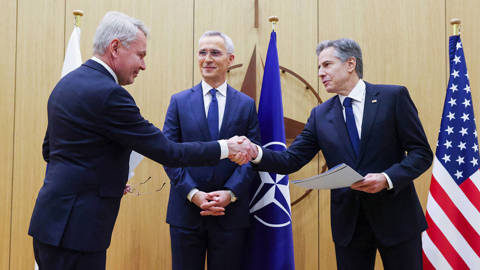
JOSEF JOFFE argues that the Alliance was never as sclerotic as even many Western leaders presumed in recent years.

jjoffe10_JOHANNA GERONAFP via Getty Images_nato finland


A Reality Check for the Renminbi - Shang-Jin Wei (Project Syndicate)

Rumores sobre o declínio do dólar e a ascensão do renmimbi são muito exagerados, como diria Mark Twain... 


A Reality Check for the Renminbi

Project Syndicate, Apr 6, 2023

https://www.project-syndicate.org/commentary/renminbi-still-no-match-for-us-dollar-by-shang-jin-wei-2023-04?fbclid=IwAR3B_tLuC363IoeomhGhpMocGsCweqkna8IV38Pl2OM0e3S6Err_rLwQDnw


While China has made great strides in internationalizing its currency, the goal of dethroning the US dollar is still far off. To undermine the dollar’s dominance in cross-border trade, China must loosen capital controls and make the renminbi more attractive to international investors.


NEW YORK – After years of speculation and false starts, it seems that the internationalization of the renminbi is well underway. On March 29, China and Brazil announced plans to trade using their own currencies, rather than the US dollar. The day before, the China National Offshore Oil Corporation and France’s TotalEnergies completed their first-ever renminbi-denominated liquefied natural gas trade. Russian President Vladimir Putin recently said that he wants to use the Chinese currency not just for trading with China but also as a form of payment in trade with other countries in Asia, Africa, and Latin America. And Saudi Arabia has been in talks with China since last year about accepting payments for some oil exports in renminbi.

It is no secret that China would like to convert the renminbi into an international currency and move away from the global dominance of the US dollar. While this is often interpreted as a geopolitical move, a way to insulate China from possible US-led economic sanctions in the future, transforming the renminbi into one of the world’s leading settlement currencies would also greatly benefit the Chinese economy. Moreover, it would help protect the country from an exchange-rate crisis, which is why other countries, including India and ASEAN countries, are trying to internationalize their currencies, too. 

The figure below, based on ongoing research by my co-authors and me, illustrates the progress that China has made in its efforts to internationalize the renminbi. The red line traces South Korean firms’ renminbi-denominated exports as a share of its total exports to China between 2006 and 2020, showing the Chinese currency’s share rising from 0% before 2008 to nearly 6% by 2020. In October 2016, the renminbi became part of the basket of currencies underpinning the International Monetary Fund’s reserve asset, special drawing rights, joining an exclusive club alongside the dollar, the euro, the yen, and the British pound. 

While these are impressive milestones, one should not exaggerate the degree to which the renminbi is encroaching on the greenback’s position. As the figure shows, the US dollar’s share of South Korean exports to China declined from nearly 98% in 2006 to roughly 87% in 2020. In other words, the dollar has gone from overwhelmingly dominant to slightly less dominant. Even in China-South Korea bilateral trade, the renminbi is not even close to displacing the dollar.

(Share of currencies in Korean exports to China)

Moreover, roughly 99% of South Korean exports to the United States during the same period were denominated in dollars; none were denominated in renminbi. By contrast, the dollar’s share of South Korean exports to Japan was 45%, about equal to that of the yen, with the won and the euro accounting for the rest. In other words, the US dollar continues to dominate global trade, including bilateral trade not involving the US, while the renminbi is essentially used only in transactions involving China. 

Part of the reason for the greenback’s continued preeminence is that, in addition to its status as a trading power, the US has very large and liquid capital markets where foreign investors can park their dollar-denominated assets. Because of its capital controls, China’s domestic financial market is far less liquid, making the renminbi unattractive to international investors.

Theoretically, China could raise the renminbi’s global profile by loosening capital controls. But doing so could come at significant cost, exposing the Chinese economy to the (often negative) consequences of US interest-rate movements and global financial cycles. Moreover, premature capital-account liberalization could exacerbate existing distortions within China’s financial system, where domestic savings are not always channeled to the most productive firms. The Chinese authorities are keenly aware of these risks, which is why they have been prioritizing financial stability over renminbi internationalization. 

There are, however, other ways to promote the renminbi. A series of currency swap agreements between the People’s Bank of China and its counterparts in other countries, for example, could help make the renminbi less risky for international firms and investors. 

In addition, a digital renminbi could facilitate partial capital-account liberalization without formally removing capital controls. By removing the anonymity of foreign investors, a digital renminbi would allow the PBOC to limit cross-border financial transactions to less volatile types and more conveniently activate a circuit-breaker when needed. Being able to separate inflows of “hot money” from more stable types of foreign investment could convince the central bank to relax some capital controls and allow financial capital to flow more freely. 

In sum, while China has achieved notable progress toward making the renminbi a global reserve currency, it is still far from reaching its goal. While it could use a digital currency to deliver de facto partial capital-account liberalization, it will not undermine the dollar’s hegemony without going much further in loosening capital controls.


SHANG-JIN WEI

Writing for PS since 2015 

Shang-Jin Wei, a former chief economist at the Asian Development Bank, is Professor of Finance and Economics at Columbia Business School and Columbia University’s School of International and Public Affairs. 


Formação da Ucrânia moderna: um curso de Timothy Snyder

Making of Modern Ukraine 11

The Triangle: Ottomans, Poles, Russians


For me personally, this is one of the most important lectures. In space, modern Ukraine includes lands that were well beyond the reach of ancient Rus, but well within the ambit of ancient Greek, Byzantine, Ottoman, and perhaps most importantly Crimean Tatar power. The Crimean state lasted for centuries, and is wrongly neglected. In time, we are dealing here with an important moment, the eighteenth century, in which all four alternatives to Russian power in Ukraine — Crimean Tatars, Ottomans, Poland-Lithuania, and various Ukrainian Cossack entities —fade from the picture. This had as much to do with their internal institutional failures and their dealings with one another as it did with the rise of the new Russian Empire. Petersburg would soon create a story in which those prior states did not matter, one which distorts our view of the actual history of the territory to this day. But the doings of the Ottomans, the Crimeans, the Cossacks, and the Poles/Lithuanians are very much worthy of attention on their own, and indispensable for even the most basic understanding of Ukraine.

(…)

The video is here and the podcast version is here or here.


Making of Modern Ukraine 12

The Habsburg monarchy (Austria) comes late to Ukrainian history, but with a fascinating legacy, and an important contribution. The Habsburgs ruled the original empire on which the sun never set, and were arguably the most important family in modern European history. This lecture summarizes their history before the partitions of Poland in the late eighteenth century that brought Galicia under Habsburg power. The name “Galicia” like so many other things was actually a Habsburg invention; it just designated with slightly spurious Latinate grace the lands Vienna took from Poland. (The Ukrainian name is “Halychyna,” which has an ancient source.) The eastern part of these territories was inhabited by speakers of Ukrainian (and Polish and Yiddish and other languages); over the course of the nineteenth century, and especially at its end, it became very important that they were ruled from Vienna rather than from Petersburg. The modern Ukrainian movement, which began in the Russian Empire, continued, after Russian imperial oppression, in Habsburg lands. The liberal and increasingly democratic character of Habsburg rule created a special incubator for Ukrainian politics and culture.

Reading:

Rudnyts'kyi, "Intellectual Origins of Modern Ukraine"

Plokhy, Gates of Europe, chapters 13, 14, 16, 17.

Terms:

Muscovy/Russia, Poland, Crimeans, Cossacks

Sweden, Habsburgs

Sloboda Ukraina, Left bank, right bank, Zaporizhia, Black Sea, Azov Sea

Crimea: Byzantium until 1204

Fourth Crusade, sack of Constantinople 1204

Empire of Trebizond to 1461

Genoa, colonies, 1266 to 1475

Crimean Khanate, 1441 to 1783

Taking tribute from Moscow, occasionally attacking, 1571

Kalga, deputy or serves during interregnum

Noble assembly, or kiriltai

Muslim Tatars in Lithuania

Jagiełło, Grünwald, 1410

Kitab

Ottomans

Asia Minor (Turkey)

Osman Gazi (hence "Ottoman") 1290-1326.

Mehmet II (r. 1444-1446, 1451-1481) takes Constantinople 1453

Selim I the Grim r. 1512-1520,

Battle of Mohács 1526. 

Transylvania, Moldavia, Wallachia

1683, Jan Sobieski, siege of Vienna

Treaty of Karlowitz 1699

1667 Treaty of Andrusovo

1667-1668 Hetman Petro Doroshenko

1681  Peace at Bahçeseray Russia and Ottomans

Podolia, Chasidism, Israel ben Eliezer, Międzybóż

Ivan Mazepa

1689 Peter becomes tsar

Great Northern War, begins 1700

1709 Battle of Poltava, Russia reaches the Baltic

Cossacks grain export ban 1719

1722 Little Russian Collegium

1735-1739 Russo-Turkish war

1768 last Tatar slave raid into Russian territory

1768-1774 Russo-Turkish War

1785  Charter of Nobility

1789 concription of Cossacks

Kharkov University 1805

Taras Shevchenko, 1814-1861

1830-1831 Polish uprising

1840 abolition of Lithuanian statute as Polish (actually has origins in Rus)

Crimean War 1853-1856

Valuyev's Circular, 1863

Ems decree, 1876

© 2023 Timothy Snyder
548 Market Street PMB 72296, San Francisco, CA 94104


Se o Brasil, a China ou os Brics querem substituir o dólar, boa sorte com isso', diz ex-embaixador dos EUA, Thomas Shannon - Janaina Figueiredo (O Globo)

 'Se o Brasil, a China ou os Brics querem substituir o dólar, boa sorte com isso', diz ex-embaixador dos EUA

O ex-subsecretário do Hemisfério Ocidental do Departamento de Estado Thomas Shannon também afirma que Lula deve ter cuidado com o que diz sobre a guerra entre Rússia e Ucrânia

Por Janaína Figueiredo — Buenos Aires

O Globo, 14/04/2023 04h30

Em sua visita à Pequim e Xangai, o presidente Luiz Inácio Lula da Silva está “repetindo a narrativa da China”, e isso não trará benefícios ao Brasil. Essa é a avaliação do embaixador americano Thomas Shannon, que chefiou a embaixada dos Estados Unidos em Brasília durante os anteriores governos do PT e é ex-subsecretário do Hemisfério Ocidental do Departamento de Estado.

Em entrevista ao GLOBO, Shannon comentou a visita de Lula à empresa Huawei, considerada um risco para a segurança nacional americana, e as declarações do presidente brasileiro sobre a dependência global do dólar americano. “São escolhas do Brasil, e serão problemas para o Brasil. Boa sorte com isso”, afirma Shannon, que defende a necessidade de os governos de Lula e Joe Biden basearem sua relação na defesa da democracia em ambos os países.

A visita de Lula à China tem uma dimensão superior à viagem a Washington, em fevereiro…

Acho que é um erro comparar as duas visitas, porque elas são motivadas por razões diferentes. Mas Lula veio primeiro aos EUA, e isso, em si mesmo, é um recado. Lula é conhecido nos EUA, e é conhecido pelo presidente Biden. A visita não foi, como na China de Xi Jinping, uma introdução. Na China, o Brasil está buscando reativar suas relações econômicas bilaterais. Com os EUA, temos mais de 100 anos de história comercial, de investimentos mútuos, integração de cadeias produtivas, não se pode dizer isso sobre a China. O Brasil está buscando uma relação mais profunda com a China, não vejo uma questão nisso.

Lula visitou a fábrica da Huawei, uma empresa considerada uma ameaça à segurança nacional dos EUA…

Os EUA deixaram claro que a Huawei representa um desafio para os países que querem construir suas redes e sua infraestrutura digital. A Huawei pode usar essas estruturas para ter acesso a informações, que podem ser repassadas para o governo da China. É uma decisão que cada governo deve fazer. Nós deixamos claras nossas preocupações sobre segurança, confidencialidade.

É um risco que o Brasil corre, então?

É a escolha do Brasil, e será um problema do Brasil. Boa sorte com isso.

O senhor conhece bem o Brasil, está surpreso pelas posições e falas de Lula?

Não muito, mas eventualmente o presidente Lula e sua equipe vão retornar ao Brasil e a realidade vai se impor. Terão de avaliar o que conseguiram. O Brasil, como [o presidente da França, Emmanuel] Macron, está apoiando a China em algumas questões, e, me pergunto, o que isso vai dar ao Brasil? Não acho que muita coisa.

O senhor considera que o Brasil está cometendo erros?

Diria que sim, mas entendo que a China é um parceiro importante para o Brasil na economia global. Entendo que o Brasil quer ter uma relação positiva com a China. Mas, dito isto, o Brasil deve se apresentar como um país que define seus interesses, que articula esses interesses, e não parecer subserviente com ninguém. Hoje vejo o Brasil repetindo a narrativa da China, sem necessariamente obter algo importante para os interesses do Brasil.

As críticas de Lula ao dólar americano podem causar mal-estar em Washington?

Muitas pessoas no mundo gostariam de não depender do dólar, mas o dólar não é uma moeda global porque os EUA o impuseram, é uma moeda global pelo poder da economia americana, e pelo papel da economia americana no sistema financeiro e na ordem econômica global. Se o Brasil, a China ou os Brics querem substituir o dólar, OK, vão em frente. Que moeda vão usar? A moeda chinesa, a brasileira? Ok, boa sorte com isso.

O governo Biden deve ficar incomodado?

Não sei, realmente. Mas acho que, primeiro, os presidentes Lula e Biden têm um bom relacionamento, e isso tem enorme valor. Os EUA reconhecem que o Brasil é um parceiro importante, especialmente nos atuais momentos, com a guerra entre Rússia e Ucrânia. Questões como energia, alimentos, e muitas outras, são importantes. O governo Biden vai focar nisso, e não na retórica, especialmente na retórica de uma visita de Estado. Os EUA e o Brasil têm uma relação profunda, forte, que é maior do que seus governos. Isso não me preocupa.

O que o preocupa, então?

Os dois governos precisam ter uma conversa mais ampla, não sobre Huawei, ou sobre moedas globais, precisam falar sobre como fazer a democracia funcionar. Sobre como podemos cooperar e colaborar para fazer com que as democracias em nossos dois países funcionem. Se nossas conversas estiverem apenas baseadas na geopolítica, não chegaremos muito longe. Temos, ambos, problemas de governabilidade, sociedades polarizadas, divididas, e nossas democracias, as maiores da região, precisam trabalhar juntas para entregar bons resultados. Lula está no governo há 100 dias. Sua popularidade está em 36%, e Biden está em torno dos 40%. O Brasil não fortalecerá sua democracia na relação com a China, e sim o fará na sua relação com os EUA.

Sobre a guerra, como avalia as declarações de Lula sobre a Crimeia?

Bom, poderia dizer que [o presidente da Ucrânia, [Volodymyr] Zelensky poderia sugerir que Lula desse o Rio Grande do Sul para a Argentina. Mas, falando sério sobre um assunto muito grave e que preocupa a todos, se o Brasil espera ter um papel no processo que ajude a terminar com esta guerra, deve ter cuidado com o que diz, deve se apresentar como neutro.

https://oglobo.globo.com/mundo/noticia/2023/04/o-brasil-esta-repetindo-a-narrativa-da-china-diz-ex-embaixador-dos-eua.ghtml

Postagem em destaque

Livro Marxismo e Socialismo finalmente disponível - Paulo Roberto de Almeida

Meu mais recente livro – que não tem nada a ver com o governo atual ou com sua diplomacia esquizofrênica, já vou logo avisando – ficou final...