quinta-feira, 10 de setembro de 2015

Parcerias estrategicas na diplomacia brasileira: um relatorio de minoria - Paulo Roberto de Almeida

Meu artigo mais recente, recém publicado:


Contra as parcerias estratégicas: um relatório de minoria
Revista Monções: Revista do Curso de Relações Internacionais da UFGD (vol. 4, n. 7, jan.-jun. 2015, pp. 113-129; ISSN: 2316-8323; dossiê sobre “As parcerias estratégicas na política externa brasileira contemporânea: um balanço necessário”; 
Relação de Originais n. 2832; Relação de Publicados n. 1192.

Sumário:
1. O que é estratégico numa parceria?
2. Quando o estratégico vira simplesmente tático
3. Parcerias são sempre assimétricas, estrategicamente desiguais
4. A experiência brasileira: parcerias ex-ante, frustração garantida
5. A proliferação e o abuso de uma relação não assumida
 

Resumo:  Ensaio analítico e opinativo deliberadamente contrário ao princípio e à aplicação das chamadas parcerias estratégicas, com exame da experiência brasileira nessa área nos últimos 15 anos. Depois de dissecar o fenômeno, bastante disseminado no período recente, de estabelecimento de parcerias estratégicas, o ensaio argumenta que elas possuem muito pouco de verdadeiramente estratégico, constituindo bem mais expedientes táticos empregados por Estados para reforçarem a defesa e a promoção de seus interesses nacionais exclusivos na cena internacional. Geralmente de cunho bilateral, uma parceria estratégica não corrige nenhuma das diferenças ou assimetrias estruturais que necessariamente existem entre os parceiros. São repertoriados os casos mais comuns da interface brasileira nessa área, constatando-se o mero caráter ideológico do empreendimento.


Introdução: o que é um relatório de minoria?
Dá-se o nome de “relatório de minoria” nos casos em que um ou mais membros de uma comissão governamental qualquer, convocada oficialmente para apresentar um diagnóstico sobre uma questão de interesse público, divergem das conclusões gerais ou das recomendações formuladas pela maioria dos membros dessa comissão. Havendo previsão para tal nas regras de procedimento, o dissidente, mas também, eventualmente, alguns outros membros que os acompanham apenas parcialmente, podem, se assim for acordado, assinar um relatório de minoria, dando conta de suas próprias conclusões, as razões que os fizeram opor-se ao relatório da maioria, e propor, se for o caso, suas próprias recomendações a respeito da questão que motivou a formação da comissão em causa. O relatório de minoria também é levado ao conhecimento da autoridade que encomendou o trabalho à comissão – geralmente independente, ou integrando membros sem qualquer vínculo com o governo em questão – que poderá, ou  não, levar em consideração tais opiniões dissidentes.
Tais situações são muito comuns nos governos parlamentares, ou de forte atuação congressual, quando os partidos hegemônicos ou as coalizões formadas no âmbito do Legislativo assentem em abrir a discussão da questão a um amplo leque de opiniões. Elas são menos frequentes nos regimes estreitamente presidencialistas, e provavelmente nas instituições privadas, que preferem atribuir um mandato executivo a um grupo determinado que possui latitude analítica e de formulação de sugestões, mas são mais rígidos quanto às regras de procedimento. No caso de instituições fortemente hierarquizadas – a exemplo das militares, do Vaticano, ou, para ficar num caso mais próximo, o do Itamaraty, no Brasil – essa possibilidade praticamente inexiste, em função de alguns pressupostos dogmáticos, para não dizer que a própria formação de comissões independentes para analisar uma questão qualquer e oferecer sugestões de medidas pertinentes é um evento raro no plano da organização e do seu processo decisório. Empresas privadas, por sua vez, são eminentemente práticas e objetivas, não tendo de prestar contas senão a seus dirigentes e acionistas majoritários, o que limita bastante, senão inviabiliza, não só comissões desse tipo, mas também relatórios de minoria: o que se pretende é oferecer soluções rápidas a problemas práticos, não fazer algum exame de consciência sobre escolhas políticas transcendentes.
Em relação ao tema das parcerias estratégicas na política externa brasileira, mesmo não considerando nenhuma avaliação de tipo executivo ou governamental, é de se presumir que o tema recolha não só a adesão da maior parte dos funcionários de Estado encarregados da área – ou seja, os diplomatas e seus chefes políticos – mas também a concordância da parte dos analistas acadêmicos quando à sua importância, e até mesmo a sua necessidade. É de se presumir, portanto, que qualquer balanço que se faça sobre as parcerias estratégicas estabelecidas pelo governo brasileiro nos últimos dez ou quinze anos, tenderá a considerar essa possibilidade de atuação no plano externo não apenas como uma necessidade objetiva da atuação diplomática do Brasil, como também um recurso de configuração eminentemente positiva nesse tipo de cenário de atuação estatal na frente externa.
O que se pretende apresentar aqui, no entanto, é um “relatório de minoria” a respeito da questão, tanto no plano puramente conceitual, quanto no de sua aplicação prática na política externa brasileira desse período. O autor tem nitidamente consciência de que suas posições são perfeitamente minoritárias, para não dizer claramente dissidentes, do mainstream prevalecente tanto no ambiente funcional da diplomacia brasileira, quanto nos meios acadêmicos. O ensaio assume assim um caráter mais opinativo do que propriamente expositivo ou analítico, uma vez que pretende focar sobre os fundamentos das escolhas feitas bem como suas modalidades operacionais, ao mesmo tempo em que considera exemplos retirados a experiência brasileira recente. Como indica o seu  título, a postura é claramente contrária não apenas ao princípio subjacente à tal tipo de atuação diplomática, em geral, como especificamente às escolhas feitas pela diplomacia brasileira desde 2003.

1. O que é estratégico numa parceria?
(...)

Leiam a íntegra neste link: 
http://www.periodicos.ufgd.edu.br/index.php/moncoes/article/view/4134/2265
ou  na plataforma Academia.edu (link: https://www.academia.edu/15582734/2832_Contra_as_parcerias_estrategicas_um_relatorio_de_minoria_2015_)

quarta-feira, 9 de setembro de 2015

Nathan Rosenberg: mais sobre o grande historiador econômico - Eric Schliesser

Mais um necrológio, e ao final eu informo sobre o "custo do sucesso".
Paulo Roberto de Almeida

A few weeks ago I wrote a short memorial piece in which I focus on his writings in the history of economics:
http://digressionsnimpressions.typepad.com/digressionsimpressions/2015/08/rip-nathan-rosenberg-1927-1915.html
Perhaps it is of interest.
Sincerely,
Eric Schliesser

Fui buscar seu livro mais citado e famoso, e o mercado sabe precificar exatamente o valor das coisas:

Rosenberg, Nathan
Published by Edward Elgar Publishing 1994-11 (1994)
ISBN 10: 185898047X ISBN 13: 9781858980478
Used Hardcover
Quantity Available: 1
From: Harvest Book Company LLC (Fort Washington, PA, U.S.A.)
Add Book to Shopping Basket
Price: US$ 44.00
Convert Currency
Shipping: US$ 3.79
Within U.S.A.
Item Description: Edward Elgar Publishing 1994-11, 1994. Hardback. Book, 188 pp As new condition. As new dust jacket. ISBN: 185898047X. Bookseller Inventory # E950020

Rosenberg, Nathan
Published by Edward Elgar Pub (1994)
ISBN 10: 185898047X ISBN 13: 9781858980478
New Hardcover
Quantity Available: 1
From: Revaluation Books (Exeter, United Kingdom)
Add Book to Shopping Basket
Price: US$ 164.33
Convert Currency
Shipping: US$ 9.24
From United Kingdom to U.S.A.

Yesterday, I learned from his former colleague, June Flanders, that the Stanford economist, Nathan Rosenberg, has died. At his passing he was the Fairleigh S. Dickinson, Jr. Professor Emeritus of Public Policy in the Department of Economics. He was an expert in the economics of technology, especially technological change and his work influenced theories about the role of institutions and technological change in economic history  and innovation studies (see, e.g., North's Nobel lecture). Some other time I hope to return to his significance in these areas for philosophy of science and science policy.
Not unlike other economists of his generation, Rosenberg was educated in the history of economics and not above making genuine contributions to scholarship in the area and to integrate such scholarship in his contributions to economics. His papers in the area (the most important of which published during the 1960s in leading journals) were collected in The Emergence of Economic Ideas: Essays in the History of Economics (1994).
I never met Professor Rosenberg in person, but I had a significant interaction with him. I read his seminal paper (1960) "Some institutional aspects of the Wealth of Nations" (The Journal of Political Economy) while researching my dissertation (recall also this post). Rosenberg's paper was not unknown, but the only full-length study of Smith that had been clearly influenced by it was Jerry Muller's very fine study, Adam Smith in His Time and Ours: Designing the Decent Society (1993); I thought this had not exhuasted Rosenberg's insights. So, the central chapter of my dissertation, an original interpretation of Smith's methodology of the Wealth of Nations (a revised version was published here), was an elaboration of Rosenberg's insights in light of my own reconstruction of Smith's epistemology and philosophy/sociology of science.
Because even widely read professional philosophers (like the supervisors of my dissertation) were not expected to be fully conversant in scholarship in the history of economics, I approached a bunch of economists to read this chapter (assuming incorrectly at the time, that professional economists would be relevant experts). Rosenberg sent me generous and detailed comments on my chapter (which were gratefully acknowledged) as well as a copy of his own The Emergence of Economic ideas. In particular, his comments helped me formulate my central claim about the nature of natural prices in Wealth of Nations in terms that would be familiar to modern readers. Now that I have a become a busy, over-extended scholar (that routinely fails to meet accepted and self-imposed deadlines), I recognize the true generosity of Rosenberg to draw on his most valuable scholarly resource (his time) in order to read and comment on work by an unknown, junior scholar from a different discipline. Because I was abroad at the time, he also offered to fax me his comments.
Emergence also reprints Rosenberg's elegant paper on Mandeville. This paper was published before Hayek's (more) famous lecture on Mandeville and it clearly anticipates several of Hayek's most important claims (as Hayek acknowledges). When I first read it (after Rosenberg had sent me Emergence), it was a total eye-opener on the significance of Mandeville (on Hume and Smith).
I close with a scholarly observation. In going through my correspondence with him, I noticed that I wrote a letter with my responses to each of the paper's of Emergence. (I hope this amused him!) I quote one of these comments (from December 10, 2001) to give a flavor of his significance to Smith scholarship: "Reading your paper on "Adam Smith, Consumer Tastes, and Economic Growth," finally made me see why Smith devotes so little systematic attention to the service-sector in commercial societies. (Something that has vexed me, as I found the obvious answer, services are not that important in his day, unsatisfying.) He had identified services with the backward (and retrogressive stage of) Feudalism in which there were few opportunities for economic growth (p. 368 & 372)."
- See more at: http://digressionsnimpressions.typepad.com/digressionsimpressions/2015/08/rip-nathan-rosenberg-1927-1915.html#sthash.j16Z0V7J.dpuf

RIP: Nathan Rosenberg 1927-2015

Yesterday, I learned from his former colleague, June Flanders, that the Stanford economist, Nathan Rosenberg, has died. At his passing he was the Fairleigh S. Dickinson, Jr. Professor Emeritus of Public Policy in the Department of Economics. He was an expert in the economics of technology, especially technological change and his work influenced theories about the role of institutions and technological change in economic history  and innovation studies (see, e.g., North's Nobel lecture). Some other time I hope to return to his significance in these areas for philosophy of science and science policy.
Not unlike other economists of his generation, Rosenberg was educated in the history of economics and not above making genuine contributions to scholarship in the area and to integrate such scholarship in his contributions to economics. His papers in the area (the most important of which published during the 1960s in leading journals) were collected in The Emergence of Economic Ideas: Essays in the History of Economics (1994).
I never met Professor Rosenberg in person, but I had a significant interaction with him. I read his seminal paper (1960) "Some institutional aspects of the Wealth of Nations" (The Journal of Political Economy) while researching my dissertation (recall also this post). Rosenberg's paper was not unknown, but the only full-length study of Smith that had been clearly influenced by it was Jerry Muller's very fine study, Adam Smith in His Time and Ours: Designing the Decent Society (1993); I thought this had not exhuasted Rosenberg's insights. So, the central chapter of my dissertation, an original interpretation of Smith's methodology of the Wealth of Nations (a revised version was published here), was an elaboration of Rosenberg's insights in light of my own reconstruction of Smith's epistemology and philosophy/sociology of science.
Because even widely read professional philosophers (like the supervisors of my dissertation) were not expected to be fully conversant in scholarship in the history of economics, I approached a bunch of economists to read this chapter (assuming incorrectly at the time, that professional economists would be relevant experts). Rosenberg sent me generous and detailed comments on my chapter (which were gratefully acknowledged) as well as a copy of his own The Emergence of Economic ideas. In particular, his comments helped me formulate my central claim about the nature of natural prices in Wealth of Nations in terms that would be familiar to modern readers. Now that I have a become a busy, over-extended scholar (that routinely fails to meet accepted and self-imposed deadlines), I recognize the true generosity of Rosenberg to draw on his most valuable scholarly resource (his time) in order to read and comment on work by an unknown, junior scholar from a different discipline. Because I was abroad at the time, he also offered to fax me his comments.
Emergence also reprints Rosenberg's elegant paper on Mandeville. This paper was published before Hayek's (more) famous lecture on Mandeville and it clearly anticipates several of Hayek's most important claims (as Hayek acknowledges). When I first read it (after Rosenberg had sent me Emergence), it was a total eye-opener on the significance of Mandeville (on Hume and Smith).
I close with a scholarly observation. In going through my correspondence with him, I noticed that I wrote a letter with my responses to each of the paper's of Emergence. (I hope this amused him!) I quote one of these comments (from December 10, 2001) to give a flavor of his significance to Smith scholarship: "Reading your paper on "Adam Smith, Consumer Tastes, and Economic Growth," finally made me see why Smith devotes so little systematic attention to the service-sector in commercial societies. (Something that has vexed me, as I found the obvious answer, services are not that important in his day, unsatisfying.) He had identified services with the backward (and retrogressive stage of) Feudalism in which there were few opportunities for economic growth (p. 368 & 372)."
- See more at: http://digressionsnimpressions.typepad.com/digressionsimpressions/2015/08/rip-nathan-rosenberg-1927-1915.html#sthash.j16Z0V7J.dpuf

Um brasileiro de Hartford disse tudo sobre o Brasil

Um simples cartaz, mas é a síntese do que pensam mais de dois terços dos brasileiros. 
Paulo Roberto de Almeida 

Nova foto Brazilia Day

O texto anterior tinha um trecho meio atrapalhado. Já corrigi, mas destaco aqui. Do ponto de vista da cor da pele, o maior grupo no Brasil, segundo dados do IBGE de 2010, é o de brancos: 47,7%, seguido de perto pelos pardos (mestiços, no mais das vezes, de brancos com negros), com 43,1%. Os negros propriamente são 7,6%. O IBGE segue o critério da autodeclaração.

A realidade brasileira, observei no post anterior, é diferente da americana, onde há apenas 13% de “negros”, já considerados aí os mestiços. Como certa elite branca brasileira — os socialistas da Zona Sul do Rio — pensa pertencer à riqueza cool dos democratas nova-iorquinos, acaba misturando as estações. Antes que Gilberto Braga descobrisse os negros, como quer Fernanda Montenegro, os brasileiros já se haviam descoberto uns aos outros e decidido se misturar.

A guerra final de classes — ou de categorias raciais — no Brasil não será aquela travada no Projac. Nem vai terminar num quadro patético do “Fantástico” chamado “Vai Fazer o quê?”, que confunde exercício de cidadania com bate-boca entre caricaturas em praça de alimentação de shopping.

Quem não perceber que este país está em transe e em trânsito vai dançar. Aliás, tomara mesmo que alguns não percebam. Já atrapalharam demais o debate com a sua boa má consciência.

Volto à foto do Brazilian Day, em que uma frase minha aparece no cartaz. O rapaz que o exibe se identificou: trata-se do brasileiro Wellington Batista Santos, que mora em Hartford, capital do estado de Connecticut.

terça-feira, 8 de setembro de 2015

Ditadura militar brasileira: Itamaraty colaborou na espionagem de exilados (OESP)

A matéria traz mais algum complemento de informação e pode servir para ampliar este meu estudo sobre o Itamaraty sob o AI-5, feito alguns anos atrás:
Paulo Roberto de Almeida
“Do alinhamento recalcitrante à colaboração relutante: o Itamaraty em tempos de AI-5” 
In: Oswaldo Munteal Filho, Adriano de Freixo e Jacqueline Ventapane Freitas (orgs.),  
“Tempo Negro, temperatura sufocante": Estado e Sociedade no Brasil do AI-5 
(Rio de Janeiro: Ed. PUC-Rio, Contraponto, 2008; 396 p. ISBN 978-85-7866-002-4; p. 65-89). 
Link no site pessoal: http://www.pralmeida.org/01Livros/2FramesBooks/103BrasilAI5.html. 
Disponível em Academia.edu: https://www.academia.edu/5794095/066_Do_alinhamento_recalcitrante_%C3%A0_colabora%C3%A7%C3%A3o_relutante_o_Itamaraty_em_tempos_de_AI-5_2008_.
 Relação de Trabalhos nº 1847.

Itamaraty vigiava exilados antes da queda de Allende
Wilson Tosta
O Estado de S. Paulo, 8/09/2015

Passos dos brasileiros eram monitorados por agentes da ditadura, revelam documentos do extinto Centro de Informações do Exterior
Depois de 42 anos da deposição do governo de Salvador Allende (1908-1973) no Chile, documentos secretos do extinto Centro de Informações do Exterior (CIEx) detalham como agentes da ditadura militar do Brasil vigiavam exilados brasileiros antes do golpe.
Na papelada do Arquivo Nacional, há dados sobre viagens e reuniões dos ativistas. Misturam-se a análises da política local, bastidores da crise e listas de presos – essas, já depois que a ditadura chilena se instalara.
Um dos focos da vigilância do CIEx era a Associação Chileno-Brasileira de Solidariedade (ACBS). Entre os exilados espionados estavam o ex-ministro do Trabalho Almino Affonso, o ex-presidente da União Nacional dos Estudantes (UNE) e hoje senador José Serra (PSDB-SP) e o poeta Thiago de Mello.
Há ainda detalhes de reuniões sociais, políticas ou de caráter cultural, da comunidade de exilados brasileiros e dados sobre o suposto sustento financeiro das organizações formadas por brasileiros no exílio chileno à época.
O CIEx era um braço da comunidade de informações. Funcionava no Ministério das Relações Exteriores do Brasil. Foi criado em 1966 e operou até os anos 80. Oficialmente, não existia. O CIEx escondeu-se sob outros nomes, insuspeitos. Chamou-se Assessoria de Documentação de Política Exterior (Adoc) e Secretaria de Documentação de Política Exterior (Sedoc). Manteve ligações com o Serviço Nacional de Informações (SNI).
“Em 26 de julho de 1973, às 19h30, no Teatro La Reforma de Santiago do Chile, o refugiado brasileiro Alexandre Manuel Thiago de Mello (“Manduka”) deu um recital de música brasileira de protesto em homenagem à festividade cubana da ‘tomada do Quartel Moncada’, sob o patrocínio de estudantes universitários esquerdistas da Universidade do Chile e da Associação Chileno-Brasileira de Solidariedade (ACBS)”, afirma o Informe 420/73, de 11 de setembro de 1973.
“O recital contou com cerca de 500 assistentes, entre os quais se encontravam o pai do marginado, Amadeu Thiago de Mello, e os asilados brasileiros Almino Affonso, Armando Ziller, José Ferreira cardoso, José Chirico Serra, Theotonio dos Santos, Gerson Gomes, Francisco Whitaker Ferreira, Estevam Strauss, Alaor da Silva Passos, José Maria Rabelo, Arutana Terena Coberio e outros não identificados”, diz.
Outro Informe do CIEx da mesma data, o número 427/73, mostra mais indícios da ação de espiões contra a entidade. “O refugiado brasileiro Antonio Bezerra Baltar, funcionário da Cepal/ONU, deverá regressar a Santiago do Chile, proveniente dos Estados Unidos, através da América Central, trazendo a soma de US$ 25 mil, em dinheiro, para a Associação Chileno-Brasileiro de Solidariedade (ACBS)’ e para o ‘Instituto de Estudos Sociais e Econômicos (IESE)’”, afirma.
Ainda no 11 de setembro, o Informe CIEx número 250/73 focava a ACBS. “Em anexo, fotocópia de documento enviado pelo asilado brasileiro José Ferreira Cardoso, presidente da ACBS, aos representantes do Partido Comunista Brasileiro, Partido Comunista Brasileiro Revolucionário, Ação Libertadora Nacional, Partido Operário Comunista, ‘PP-1’ e mais dez grupos de asilados e refugiados brasileiros no Chile, no qual propõe uma reunião do ‘conselho’ da ACBS com as respectivas organizações subversivas, com a finalidade de aclarar alguns problemas pendentes entre a ACBS e os referidos grupos”, afirma o texto.
“Esta iniciativa (...) prende-se a pressões oriundas do Comitê de Denúncia à Repressão no Brasil (CDR) através de seu coordenador-geral, Francisco Whitaker Ferreira, no sentido de que dinheiro doado por organizações internacionais à ACBS passe a ser utilizado, exclusivamente, pelo CDR e pela Frente Brasileira de Informações.”
Outro exilado brasileiro cujos passos foram seguidos pelo CIEx foi Gerson Gomes. Identificado como funcionário da ONU, ele teve cópia de seu cartão de identidade distribuído à comunidade de informações em informe, segundo o qual, ele teria viajado à Europa e trazido “uma indeterminada quantia em dólares para atender às atividades subversivas”.

Tibet: a China "celebra" a anexacao 'a sua maneira - Shanghai Daily

Tibet to celebrate 50 years

A ceremony marking the 50th year since the founding of the Tibet Autonomous Region will be held at the Potala Palace (above) square in Lhasa today. Meanwhile, a man the Dalai Lama named as one of the most senior figures in Tibetan Buddhism is living a normal life and does not want to be disturbed. Gedhun Choekyi Nyima “is receiving education, living normally and growing healthily. He does not want to be disturbed by anyone,” said Norbu Dondup, an official with Tibet’s United Front Work Department. — Xinhua

Nathan Rosenberg, um grande historiador economico - obituario por Joel Mokyr

Eu tinha justo acabado de comprar o livro de Joel Mokyr, The Lever of Riches: Technological Creativity and Economic Progress (num sebo de Amherst, MA), e estava admirando seu trabalho de pesquisa extremamente erudito, que me lembrava justamente o de Birdzell e Rosenberg, How the West Grew Rich, que havia lido primeiro na tradução brasileira, antes de retirá-lo novamente na biblioteca de West Hartford, para citar em um livro que estou preparando.
Os dois, Rosenberg e Mokyr, são os melhores historiadores do progresso tecnológico que conheço, junto com David Landes, mas eu não sabia que Mokyr era sobrinho de Rosenberg, e ele assina aqui um denso e simpático obituário que transcrevo da lista de história econômica.
Paulo Roberto de Almeida

Nathan Rosenberg, 1927-2015
Joel Mokyr
Society for the History of Economics, September 2015

The economic history profession has lost one of its most original, creative, and wide-ranging minds in the passing of Nathan Rosenberg on Aug. 24, 2015. Rosenberg was one of the founding fathers of Cliometrics, a member of the first group of Cliometricians that with coining the term “congregated at Purdue University in the late 1960s, and which included other luminaries among them Lance Davis, Jonathan Hughes, and Stanley Reiter (who is widely credited Cliometrics”). By 1970, this group had moved away from West Lafayette and dispersed to institutions such as Northwestern and CalTech. Rosenberg was hired by the University of Wisconsin, and was a member of a different group of influential and distinguished economic historians in Madison, including at one time or another Jeffrey Williamson, Peter Lindert, Morton Rothstein, Rondo Cameron, and Claudia Goldin. While at Wisconsin, Rosenberg was the editor of the Journal of Economic History and instrumental in its growing focus on the new economic history that was theoretically informed by economics and quantitatively more sophisticated — the very essence of the Cliometric Revolution.
In 1974, Rosenberg moved to Stanford, where he taught for more than a quarter century until his retirement in 2002. As department chair at Stanford between 1983and 1986 he helped build the department and maintain its position as one of the top economics departments in the country. Moreover, his leadership guaranteed that economic history remained an integral part of the undergraduate and Ph.D. programs and includes some of its most distinguished practitioners such as Gavin Wright and Avner Greif, as well as younger and promising scholars. Today, thanks to Rosenberg’s initiative and entrepreneurship, the Stanford department is housed in a gorgeous building named after Ralph Landau, whose support for research and teaching in economics was first stimulated by a fortuitous meeting with Rosenberg. The partnership with Landau, a chemical engineer and entrepreneur fascinated by economics, led to a fruitful scholarly collaboration between him and Rosenberg, especially in two well-regarded collections they edited together. Thanks in large part to Rosenberg’s resourcefulness, the graduate program at Stanford has thrived and produced many distinguished members of the economic history profession and applied economists working on innovation. While not all of them worked with him directly, his influence on the flourishing of economic history at Stanford was undeniable. Many of the former graduate students he trained and inspired co-authored and co-edited papers and books with him, such as David Mowery with whom he wrote Technology and the Pursuit of Economic Growth (Cambridge University Press, 1989). Without exception these young economists admired and adored him; two of them, Scott Stern and Shane Greenstein, were my former colleagues, and the three of us were instrumental in Northwestern awarding him an honorary doctorate in 2006, in the same class of honorary degrees as the then little-known junior senator from Illinois. If ever there was an academic conspiracy that can be called a true labor of love, this was it.

As a scholar, much of Rosenberg’s most important and influential work is captured by the title of his Inside the Black Box, a collection of essays on the nature of technology (Cambridge University Press, 1982). In it, he stated from the onset that “economists have long treated technological phenomena as events transpiring inside a black box...the economics profession has adhered rather strictly to a self-imposed ordinance not to inquire too seriously into what transpires inside that box. The purpose of this book is to break open and to examine the contents of the black box” (p. vii). That metaphor captures the central theme of Rosenberg’s career.

What, then did Rosenberg find inside that black box? In his typical self-deprecating way, he once remarked to me that once you open the big black box of technology, you find inside a smaller black box, and so on, much like Russian matryoshkadolls. Maybe, he reflected, in the end this is what scientific progress really consists of? But of course, opening the black box led Rosenberg to considerably more important insights on the nature of technological change. I will list only a few that I find the most insightful — others can have other preferences. One is his emphasis on the subtle and complex interplay between science and technology stressed in his magnificent essay “How Exogenous is Science?”. In it he points out the many feedback effects that run from technology to science, and debunked the “linear model” that draws the main arrow of causality from Science to Applied Science to Technology. Since Rosenberg’s work, historians of technology have heaped scorn on the linear model. Technology in his view is not the mechanical “application of science” to production; it is a field of knowledge by itself, quite different in its incentives, its modes of transmission, and its culture. It is affected by science, but in turn provides “pure research” with its instruments and much of its agenda. In many cases, he noted, scientists were confronted by the fact that things they had previously declared to be impossible were actually carried out by engineers and mechanics and had to admit somewhat sheepishly that were possible after all. More than a decade later, in his later book Exploring the Black Box, he returned to the important but often-neglected link between technology and scientific progress, provided by scientific instrumentation.

A second item Rosenberg found inside his black box early on was the importance of the machine industry in the generation of technological change and economic growth, a topic he explored early in his career in his influential 1963 Journal of Economic History paper, “Technological Change in the Machine Tool Industry” reprinted in his Perspectives on Technology (Cambridge University Press, 1976). The paper stressed the crucial importance of machine tools in creating the mechanization that was at the heart of the Industrial Revolution in the United States and Britain, and showed that without the improvements in lathes, planers, milling machines and precision grinders, much of the growth of modern manufacturing could not have happened. In his later book Technology and American Economic growth (Harper & Row, 1972) he explained how the ever-growing specialization, and not just the quality improvement and lower prices of these precision metal-cutting and shaping devices, stimulated and supported the rise of modern industry. In his citation for the Leonardo Da Vinci medal that the Society for the History of Technology awarded Rosenberg in 1995, David Hounshell wrote that “His 1963 article remains to this day perhaps the single most influential essay ever written in our discipline. In it, Rosenberg grasped the essential nature of the technical knowledge embedded in the machine tool industry and recognized how that knowledge would not fit easily into existing economic models.”

A third item that many historians of technology, whether economists or not, have found extremely insightful in Rosenberg’s black box is his concept of “focusing devices,” first enunciated in his 1969 Economic Development and Cultural Changepaper “The Direction of Technological Change,” (reprinted in Perspectives on Technology). It is an intuitively powerful concept that essentially proposes that much of technological progress occurs because a firm, a group, or the government realizes that there is an urgent need for a clear solution to a pressing and well-defined social issue or bottleneck in production. The solution is not always forthcoming of course — Rosenberg cited with great glee Hotspur’s decisive riposte to Glendower’s claim that he could call the spirits from the vastly deep: “why, so can I, so can any man; but will they come when you call for them?” (see his Technology and American Growth, p.51). But when the solution is arrived at, it often solves far more than it was intended for and overshoots its target, and thus it creates a new bottleneck. This leapfrogging or “compulsive sequences” phenomenon was used to describe the eighteenth century cotton manufacturing, but in fact it applies to much of the rest of the technological revolutions of the eighteenth century. At the start of the century, British society knew well that it faced a number of hard but well-defined problems: finding longitude at sea, pumping water out of deep-shaft coal mines, ridding society of smallpox, and turning pig iron into wrought iron cheaply and rapidly. By 1800 these problems had all been solved. Rosenberg’s essay deals with firms and their recognition of an opportunity for profit, but one can easily add other motives, from the altruism of Jonas Salk, the driving ambition of James Watson to the political ideology of the men and women working on Project Manhattan.

Academic work was the center of Rosenberg’s life. After his retirement, he continued to write and publish. Together with Bronwyn Hall, he edited the massive two-volume Handbook of the Economics of Innovation (Elsevier, 2010), which contains wonderful survey essays by every serious scholar working in the area. He also published a sparklingly original and creative paper (jointly with Manuel Trajtenberg) in the Journal of Economic History (2004) on the economic significance of the Corliss steam engine and its effect on American industrialization. The brand new Handbook of Cliometrics (2015) contains an essay by Rosenberg jointly with Stanley Engerman on “Innovation in Historical Perspective.”

There was much more to Rosenberg’s intellectual persona than his interest in innovation and technical knowledge. He was fascinated by the “greats” of economics — especially Smith and Marx, on whom he wrote perceptive essays, as well as lesser but equally fascinating figures such as Charles Babbage. He published a collection of his essays on the History of Economics as he saw it (often from the point of view of technology), entitled The Emergence of Economic Ideas: Essays in the History of Economics — idiosyncratic, perhaps, but never dull. In the editors’ introduction to the first volume of the Economics of Innovationcompilation, Rosenberg and Hall cite a long passage from Schumpeter’s preface to the Japanese edition of his 1937 book The Theory of Economic Development.Schumpeter recounted a debate he had with Walras on whether economics should concern itself only with statics or should also be concerned with the rapid changes in the economy. These kinds of historical issues held endless fascination for Rosenberg. The first essay in his published Graz Lectures, Schumpeter and the Endogeneity of Technology: Some American Perspectives (Routledge, 2000), was entitled “Joseph Schumpeter and the Economic Interpretation of History.” He cited at length and with almost palpable delight Schumpeter’s statement that economic history was absolutely required for the scientific study of economics. Rosenberg was also interested in modern medical research and its place in the modern American research university. He surely was the only economic historian to have published a paper both in The New England Journal of Medicine and The Energy Journal (and probably the only one to have published in either).

Rosenberg was one of the broadest and most intellectually curious minds I ever met. He was, as Ken Arrow remarked in his eulogy, an enormous lover of books and owned many thousands of them — yet ironically his own preferred format was the short pointed essay or at most a short and summary book such as his briefTechnology and American Economic Growth. Having read papers on science and technology his entire life, he may have adopted the scientist’s preferred mode of communication over the long and heavily-detailed books written by the typical economic historian. He never wrote a single-authored magnum opus on economic history. The closest he ever came to a big-think ambitious “explanation of everything” was the set of Rosenberg’s lecture notes that L.E. Birdzell collected and then together published as a book How the West Grew Rich. It is a lovely and often insightful book, but it lacks the grandeur and sweep of a David Landes, Douglass North, or Eric Jones, who have written books with similar themes. Rosenberg’s comparative advantage was the brief essay, and the books he published were mostly collections of these essays. These essays were, without exception, beautifully written: he had the gift of expressing a complex and nuanced economic relation in a short and elegant phrase. They are still read by students and scholars all over the world.

As a person, Rosenberg was deeply loved and admired by those who knew him well. He was urbane and erudite even by the high standards of the great economic historians of his generation. He was witty to the point of being hilarious, and could be sarcastic and cutting when he wanted. He was also a deeply caring husband, father and grandfather, the emblematic Jewish father who knew that investment in human capital and family cohesion were the essence of Jewish culture. He was a great colleague and a warm and wonderful friend. Of all the many senior economic historians of that generation whom I knew and admired over the years, he was the only one whom I regarded as much as a relative as a colleague. I will never forget you, Uncle Nate.

segunda-feira, 7 de setembro de 2015

Gastos publicos: comecem os cortes pela propaganda oficial

Uma maneira simples de economizar alguns bilhões: eliminar, zerar, acabar completamente com quaisquer gastos com publicidade oficial: além de não haver dinheiro, a maior parte é mentira...
Paulo Roberto de Almeida 

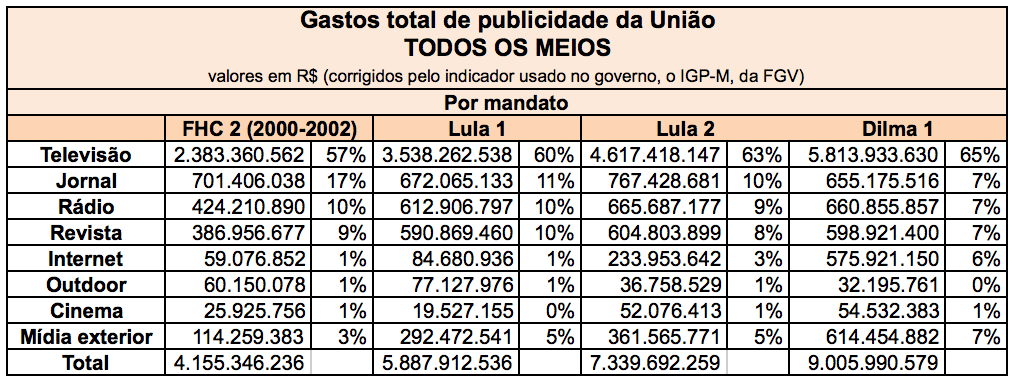
Em 4 anos, Dilma gastou R$ 9 bilhões em publicidade, 23% a mais que Lula

Fernando Rodrigues

No seu primeiro mandato (2003-2014), a presidente Dilma Rousseff gastou 23% a mais com propaganda do que seu antecessor, o petista Luiz Inácio Lula da Silva.

De acordo com dados obtidos pelo UOL, a administração dilmista destinou nos 4 anos de seu primeiro governo R$ 9 bilhões para publicidade em emissoras de rádio e televisão, jornais, revistas, sites de internet, outdoors, cinemas e em outros tipos de mídia.

Lula consumiu R$ 7,3 bilhões nos seu segundo mandato (2007-2010) com publicidade estatal.

Para a Secom (Secretaria de Comunicação Social da Presidência da República), o ideal é fazer a comparação apenas com os dois últimos anos (2009 e 2010) do segundo mandato de Lula. A Secom prefere comparar gastos de Dilma apenas com final do mandato de Lula.

Nos seus primeiros 4 anos no Palácio do Planalto (2003-2006), Lula gastou R$ 5,9 bilhões com esse tipo de despesa. Essas cifras são todas atualizadas monetariamente pelo IGP-M, o índice usado no mercado publicitário e também pelo governo quando se trata de informações dessa área.

Já o tucano Fernando Henrique Cardoso gastou R$ 4,1 bilhões com publicidade em seus últimos três anos de mandato (2000 a 2002). Não há dados disponíveis anteriores ao ano 2000.

Eis os dados compilados comparando os gastos publicitários de FHC, Lula e Dilma (clique na imagem para ampliar):

por mandato2


DIVISÃO POR MEIOS
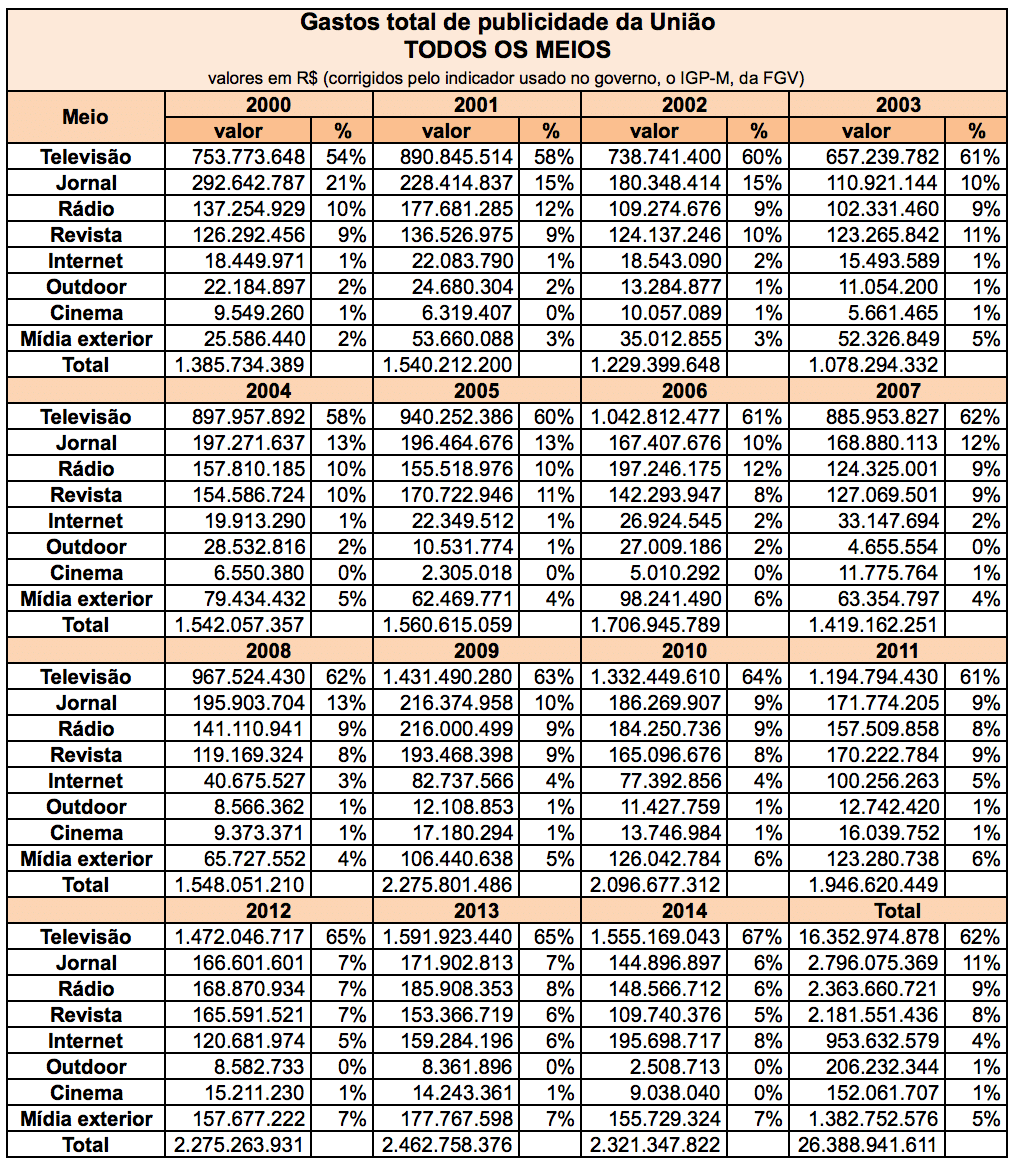
Nas três administrações, segundo dados oficiais, o governo federal (administrações direta e indireta), gastou R$ 26,4 bilhões em propaganda.

As TVs são as campeãs no recebimento dessas verbas. Em 2014, tiveram 67% do total. Não há novidade a respeito desse fato, que persiste desde quando esta série história de dados vem sendo coletada.

As diferenças são vistas na participação dos veículos de outras plataformas no bolo de publicidade estatal federal.

Por exemplo, os jornais impressos ficavam com 21% das verbas de propaganda da União no ano 2000. Agora, têm apenas 6%. Essa foi a queda mais abrupta.

Revistas tiveram apenas 5% em 2014. Perderam para as rádios, com 6%.

O meio que mais tem avançado nos últimos anos é internet. Portais, sites, blogs, redes sociais receberam 8% do total das verbas estatais federais de publicidade em 2014. Ficaram em segundo lugar, perdendo apenas para as TVs.

Eis os dados detalhados, ano a ano, da divisão de receitas publicitárias da União por meios, de 2000 a 2014 (clique na imagem para ampliar):

todososmeiosMetodologia2-vale

(Colaborou nesta reportagem Bruno Lupion, do UOL, em Brasília).

Leia mais sobre publicidade estatal:


Esse terrivel impulso de sempre buscar a liberdade

A Train's Journey From Communism to Freedom
Rukmini Callimachi
The New York Times, September 6, 2015

More than three decades ago, my mother, grandmother and I boarded a train in communist Romania, armed with the papers my mother had painstakingly gathered in an effort to give me a better life. I was 5 years old, and I had been told we were going on a holiday to Paris. I realized something was wrong when my surrogate grandfather Tata Geo (Father Geo) broke into sobs as we left the house.
It was March 7, 1979, and you needed special permission to leave the totalitarian country; passports were issued only to those who could prove they were returning. That meant that anyone who tried to leave for good was forced to break the law, and the consequences for getting caught made the decision to leave as final and harrowing then as it is today for the thousands of migrants arriving on Europe’s shores.
For weeks leading up to our departure, my mother talked loudly about the plans she had for expanding the balcony of our Bucharest apartment. She also cashed in her savings to buy a color TV, the first our family had owned, in the hopes that the Securitate agents assigned to track our family would be fooled into thinking we planned to return. My father agreed to stay back, sacrificing himself in an effort to make it appear as if the family were still rooted in Romania.
The night of our departure, I lined up my stuffed animals and “interviewed” them to find out which ones wanted to come with me to Paris. I decided they all wanted to come, and so I shoved them into a suitcase and struggled to zip it shut, only to be scolded by my mother, who said I could take two at most. I chose a doll and my stuffed rabbit, and then when she wasn’t looking, I slipped in a miniature elephant and several coloring pencils.
Our destination initially was Germany, which then — as now — was the first safe haven for political refugees.
The train left Bucharest, and hours later we crossed into Hungary. My grandmother opened her prayer book to the picture of the Virgin Mary. The page was stained the color of her lipstick from all the times she had kissed the image.
The train stopped, and I remember the conductor inspecting our papers, my mother sitting like stone.
He left, and just as the train was about to depart, a woman came running up to our compartment, banging violently on the window, screaming in Hungarian. I will never forget the look of terror in my mother’s face. The woman on the platform knew we weren’t supposed to be there, and she gestured and yelled and poked her finger accusingly in our direction, but the train was already moving. It was gaining speed, and the woman ran alongside us, until she fell back as we pulled out of the station.
Then, as now, Hungary was a place of treachery for migrants. It was a place where my family’s journey — like those of thousands of Syrians today, facing much greater risks after four years of civil war — almost came to an end. Had we been turned back, it would have meant certain imprisonment for my mother, and possibly for my elderly grandmother.
We reached Germany, where the authorities provided us temporary housing. A week later, we took the train to Switzerland, where we were awarded political refugee status.
Back in Bucharest, my father, considered one of Romania’s top pediatric surgeons, was told he was being relocated to a clinic in the remote countryside. And roughly a year after our departure, the man who would one day become my stepfather, after my parents’ divorce, was placed under house arrest for criticizing the catastrophic economic policies of Romania’s dictator, Nicolae Ceausescu.
It took years for me to understand that we were not on a holiday. As a child, I clung to the hope that we would return to Apartment No. 49, on Vasile Conta Street in Bucharest, to the two-bedroom home where I had left all my dolls and where Tata Geo now lived alone.
I am deeply grateful to the officials in Germany and Switzerland who gave us safe passage. I am even more grateful to the man at the immigration counter in the United States who years later looked over my high school transcript and nodded, then stamped the form awarding me American citizenship.
Yet that day 36 years ago also marked a fissure in my life: There was a “Before,” a time when I felt secure and deeply loved, and where I knew my place in the world; and there was an “After,” when nothing could ever be taken for granted again. Despite the fact that I speak fluent English, own a home in America and attended elementary school, high school and college here, the nice lady at Chase whom I called yesterday to ask about a charge on my account still begins the conversation with: “What an unusual name; where are you from, honey?”
The only objects I have from Romania are the stuffed rabbit and the stuffed elephant which I was allowed to take. Both are now missing their heads.
When my grandmother died, she left me her prayer book.
The picture of the Mother of God still bears the color of her lipstick. She kissed it that day in Hungary in thanks for the fact that the train kept going, and then for every miracle along our journey since.

Os brasileiros ficaram mais pobres com o PT - Luiz Fernando Rudge

Reproduzindo, sem necessidade de agregar mais nada...
Ou talvez sim: em dois anos o Brasil volta ao FMI, ou vai ser o primeiro membro do BRICS a usar do seu próprio Acordo Contingente de Reservas.
Não é um sucesso companheiro?
Paulo Roberto de Almeida

Luiz Fernando Rudge
Domingo, 6 de setembro de 2015
O brasileiro se sente mais pobre do que quando o PT assumiu. Por quê?
Faltam três semanas cheias para o fim do terceiro trimestre de recessão econômica no Brasil, que ocorre no terceiro mandato do PT à frente da administração, e os principais analistas já reconhecem que este será o pior trimestre desta retração, porque a administração da Economia está sem rumo e “não há forças capazes de levar a uma retomada do crescimento”, segundo um rigoroso analista da situação nacional.
Os empresários que se preocupam com a gestão de seus empreendimentos devem, neste mês, iniciar o planejamento para enfrentar 2016 – e, inevitavelmente, projetar esse planejamento até 2018, por causa da questão política. Segundo os jornais, “lamentam o desalento dos consumidores, que temem demissões que eles mesmos tiveram ou terão de fazer”. E afligem-se com a indefinição dos rumos do país, exatamente na hora em que devem planejar o futuro.
Irão planejar o quê? As agências de classificação de riscos estão atrasadas, porque o mercado já antecipou que perdemos o grau de investimento, com o salto para cima nas taxas do CDS - principal medidor do risco real - superando por larga margem o CDS da Turquia – que não tem grau de investimento.
O Brasil aproxima-se do efetivo descontrole cambial, com o dólar precificado em função do risco, reforçado pelo bom desempenho da economia e pela valorização da moeda americana e pela queda nos preços de commodities.
O mau comportamento do real frente ao dólar ocasiona preocupantes pressões inflacionárias, reforçadas pelo insucesso do ministro da Fazenda em corrigir os desajustes fiscais a que se propôs, no que foi impedido pela presidente que o nomeou, e que sofre de recaída das iniciativas do seu mandato anterior. Com isso, o prêmio de risco da inflação cresceu sem controle, levando as taxas de juros bancários de prazo longo a aumentar, carimbando a inflação como um evento de alto risco.
O planejamento de gestão empresarial sofre ainda com os dados que a Economia apresentou nestes três trimestres de retração:
·        Incerteza no mundo empresarial;
·        Consumo em queda, com inadimplência em alta;
·        Aumento do nível de desemprego;
·        Aumento no estoque de imóveis à venda;
·        Retração do crédito;
·        Baixa taxa de investimento.
Esta última característica tem, na Petrobrás, um efeito adicional, já que a companhia normalmente responde por 10% da FBCF (formação bruta de capital fixo) na Economia brasileira, e agora vê-se a braços com dívidas em dólar acima de sua capacidade de pagamento, e plano de negócios que exige desinvestimento difíceis de realizar, porque a indústria do petróleo vive um momento de baixa.
Resta-nos apenas a última fala da presidente, de que já cortou todos os gastos de governo que podia cortar.
Ninguém acredita nisso.

A opcao nuclear como expediente tatico-militar na Guerra Fria - resenha de livro

Até onde se sabia, foi Truman quem recusou qualquer novo uso de bombas atômicas como expediente de guerra, seja no plano puramente de concepção estratégica, em meados da segunda metade da década de 1940, seja em 1950, quando o general McArthur cogitou dessa possibilidade, por ocasião da guerra da Coreia, quando as forças chinesas ameaçavam jogar as tropas americanas no mar...
Mas, parece que o presidente sucessivo, Dwight Eisenhouwer, não só cogitou como chegou a pensar em usar bombas nucleares táticas na Indochina, o que os próprios franceses (e ingleses) recusaram.
Essa é uma revelação importante, que se soma a coleção de malucos nucelares estilo Dr. Strangelove (que só apareceria alguns anos depois).
Em todo caso, este livro parece muito interessante.
Paulo Roberto de Almeida

H-Net
Greetings Paulo Almeida,
New items have been posted in H-Diplo.

Oliva on Watry, 'Diplomacy at the Brink: Eisenhower, Churchill, and Eden in the Cold War' [review]

David M. Watry. Diplomacy at the Brink: Eisenhower, Churchill, and Eden in the Cold War. Baton Rouge: Lousiana State University Press, 2014. 240 pp. $29.95 (cloth), ISBN 978-0-8071-5718-3.

Reviewed by Mara Oliva (University of Reading)
Published on H-Diplo (September, 2015)
Commissioned by Seth Offenbach

The Special Relationship Revisited

In Diplomacy at the Brink: Eisenhower, Churchill, and Eden in the Cold War, author David M. Watry argues that the special relationship between the United States and Great Britain steadily deteriorated throughout Dwight D. Eisenhower’s presidency. Because of the American leader’s staunch anti-Communism, dangerous nuclear policy, and Far-Right unilateralism, the close World War II alliance turned into a bitter and vengeful partnership, which ultimately led to Anthony Eden’s, the prime minister’s, removal and a US declaration of economic war against Britain.

This thought-provoking and well-researched monograph draws on a vast range of primary sources from both sides of the Atlantic and challenges many of the contentions made by the numerous schools of thought in the Eisenhower historiography. Among the most controversial ones, Watry argues that GOP Old Guard Ohio Senator Robert Taft’s isolationist and unilateralist ideas on national security became the basis of Eisenhower’s New Look; that Eisenhower did not consider the alliance with the United Kingdom a special relationship at all, but was actually quite keen on distancing the United States from British imperialism and colonialism; and that historians for far too long have wrongly praised the president’s strategy of ambiguity when dealing with nuclear weapons.

While it is true that on many occasions the president believed that a unilateral foreign policy and the use of tactical nuclear weapons were necessary to protect American national security, it would be wrong to argue (as Watry does) that these characterized his entire strategy. Eisenhower, like the East Coast establishment that embraced him in 1952, was an internationalist Republican. He believed that the United States could not afford to go back to isolationism and lose Europe. A fully communized Europe would deprive America of essential markets and investment opportunities and would shift the global military balance in favor of the Soviet Union, endangering American economic institutions. He was particularly disturbed by Taft and his fellow isolationists’ rejection of North Atlantic Treaty Organization (NATO), which he considered of vital importance for the security of Europe.[1]

The importance of maintaining good relations with the European allies was especially evident during the Indochina crisis of 1953, which Watry discusses in detail in chapters 3 and 4. Eisenhower did consider the use of small tactical nuclear weapons to prevent the fall of Dienbienphu to Communism, but he withdrew the plan when Britain and France refused to collaborate. Lacking support from Europe, he successfully turned his attention to collective defense by creating and promoting the Southeast Asia Treaty Organization (SEATO), which the United States, Britain, France, Australia, New Zealand, Pakistan, the Philippines, and Thailand signed on September 8, 1954.

Watry makes the valid point that historians have thus far failed to fully understand and acknowledge Eisenhower’s willingness to treat tactical nuclear weapons as conventional munitions. He clearly demonstrates this in his analysis of the First Taiwan Crisis in chapters 3 and 4. The president was certainly not bluffing when it came to protect US national security. Losing the offshore islands of Matsu and Quemoy to Communist China would have endangered the position of Taiwan, a vital link in the American security chain in the Pacific. Eisenhower carefully planned and authorized the use of tactical nuclear weapons in order to save the islands. Watry’s convincing argument, partially already explored by historian Matthew Jones, is amply backed up by a vast range of archival material, in particular, Eisenhower’s correspondence with Winston Churchill, the British prime minister.[2]

It is through the analysis of this collection that the book makes its most important contribution: US–British disagreement over Far Eastern policy. The vast majority of scholars have identified the Suez Canal crisis of 1956 as the breaking point in the relationship. A furious Eisenhower forced Eden to abandon any military plans to regain the Suez Canal, and then, through skillful back-channel manipulations, had Eden replaced by Harold MacMillan. Watry actually argues that strong disagreements were already present well before the 1956 crisis. His discussion of the Korea, Indochina, and Taiwan crises clearly shows that British foreign policy was entirely Eurocentric and it did not believe in the “domino theory.” Britain was also one of the first countries to recognize the People’s Republic of China (PRC) in 1950, a move that deeply upset the United States. Churchill and Eden constantly urged military restraint against Beijing. Their reason was to protect Hong Kong, a territory the United States did not deem important in fighting the Cold War and only used as an intelligence base. British-Chinese trade relations further exacerbated the Anglo-American relationship by weakening US policy of total hostility against the PRC.

The book also does an excellent job in explaining how the different relationships between Eisenhower and Churchill and Eisenhower and Eden affected the alliance. Churchill, unlike Eden, wisely realized the importance of keeping on the good side of the United States. After the Indochina crisis, he understood how transatlantic relations had become gravely strained and began to rebuild his relationship with both the president and Secretary of State John Foster Dulles. Eden instead deliberately antagonized the Americans, especially Dulles for whom he had neither respect nor admiration. Their serious political differences had much to do with their opposing view of how to deal with the Soviet Union. The president and the secretary of state believed there was no room for negotiations with the Communists and only a hard-line policy would end the Cold War. Eden, on the other hand, continued his pragmatic balance-of-power approach toward Moscow, which ultimately, Watry argues, led to the complete unraveling of the British Empire.

Overall, the book reads slightly uneven as its focus is predominantly on the Eisenhower administration. This criticism notwithstanding, this is an important and outstanding contribution to the Eisenhower and Cold War historiographies.

Notes
[1]. Dwight D. Eisenhower, The White House Years: Mandate for a Change: 1953-1956 (Garden City, NY: Heinemann, 1963), 17-18; Fred Greenstein, The Hidden Hand Presidency: Eisenhower as Leader (New York: Basic Books, 1982); and John Lewis Gaddis, Strategies of Containment: A Critical Appraisal of American National Security Policy during the Cold War (Oxford: Oxford University Press, 2005).

[2]. Matthew Jones, “Targeting China: US Nuclear Planning and ‘Massive Retaliation’ in East Asia 1953-1955,” Journal of Cold War Studies 10 (2008): 37-65.

Printable Version: http://www.h-net.org/reviews/showpdf.php?id=43068

Citation: Mara Oliva. Review of Watry, David M., Diplomacy at the Brink: Eisenhower, Churchill, and Eden in the Cold War. H-Diplo, H-Net Reviews. September, 2015.
URL: http://www.h-net.org/reviews/showrev.php?id=43068


This work is licensed under a Creative Commons Attribution-Noncommercial-No Derivative Works 3.0 United States License.
Read more or reply
You can manage your notification settings at https://networks.h-net.org/user/126802/notifications

Postagem em destaque

Quando comecei a seguir metodicamente as eleições presidenciais? Em 2006, mas já o fazia antes... - Paulo Roberto de Almeida

 Por acaso, apareceu das "catacumbas" um texto escrito em 2006 sobre as campanhas eleitorais no Brasil e as eleições presidenciais...