domingo, 21 de maio de 2023

Timothy Snyder: Oligarchies in Russia and Ukraine post 1991

 Oligarchies in Ukraine and Russia

Ukraine lectures 19

May 21, 2023


https://substack.com/app-link/post?publication_id=310897&post_id=122067026&utm_source=post-email-title&isFreemail=true&token=eyJ1c2VyX2lkIjoxNDQ3NjY0NiwicG9zdF9pZCI6MTIyMDY3MDI2LCJpYXQiOjE2ODQ1ODY2OTIsImV4cCI6MTY4NzE3ODY5MiwiaXNzIjoicHViLTMxMDg5NyIsInN1YiI6InBvc3QtcmVhY3Rpb24ifQ.ykXFkUePRdX9_o3dZHhTH5G323azXQguDjwfYg2QrkQ


Apologies: I took a weekend off from posting my Making of Modern Ukraine lectures because I had a couple of other important pieces published: the one on “War and Politics” here as well as the one on nuclear propaganda in the New York Times.

The purpose of this lecture is to evaluate the Ukrainian and Russian states as they emerged after the end of the Soviet Union in 1991. I begin though with an excursus into postwar Polish history. It is very important to establish how the Polish factor changed, such that Russia became the most important “other” in Ukrainian history. The efforts of Polish thinkers and then Polish diplomats to create a new paradigm in Polish-Ukrainian relations bore fruit in the 1990s; this success was one reason why Poland was able to join NATO and the EU. Ironically, the very absence of of Polish-Ukrainian conflict made it difficult to remember just how important the Polish factor had always been. 

Russia and Ukraine both emerge from the Soviet Union, but diverge in their domestic politics. Both suffered from the problem of oligarchy: concentration of wealth and associated political power. In Ukraine this led to a certain pluralism; in Russia, one person eventually became the boss of bosses. By the 2010s, the state and societies were more different than (I think) the people in question sometimes realized; this became apparent during Ukrainian protests for democracy and for European integration, which are subjects of lectures to come.

The video is here and the podcast version is hereor here. Sorry I forgot to post the links last time! They are always the same, so if you are following these lectures, you could just bookmark them. 

man holding a book statue
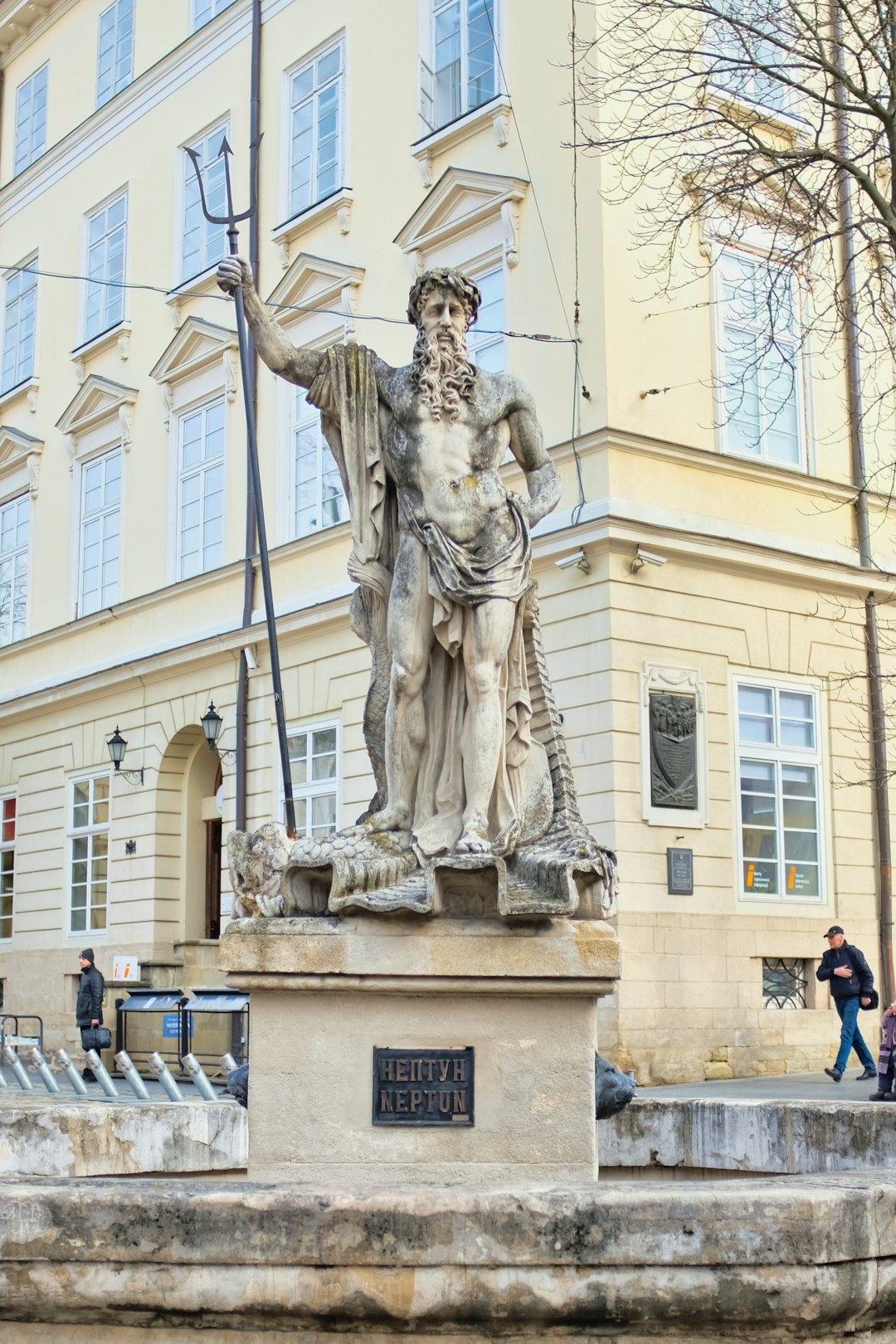
Lviv, Market Square. These statues are currently stored to preserve them from Russian bomb and missile attacks, and the square is full of sandbags.

Readings:

Plokhy, Gates of Europe, chapter 26.

Serhy Yekelchyk, The Conflict in Ukraine, Oxford: Oxford University Press, 2015, chapter 4.

Peter Pomerantsev, Nothing is True and Everything is Possible, New York: Public Affairs, 2014, Act 1: Reality Show Russia, 1-77.


Diplomacia brasileira: onde estávamos 4 anos atrás - Paulo Roberto de Almeida

 Não custa recordar o estado miserável de nossa diplomacia 4 anos atrás. Vejam o que escrevi, no Facebook, em 24 de abril de 2020: 

24 de abril de 2020 
Compartilhado com Público
Público

Uma declaração apenas pessoal, mas acredito que represento e expresso os mesmos sentimentos da quase totalidade da diplomacia profissional
Profunda vergonha de nossa atual diplomacia
Paulo Roberto de Almeida
sexta-feira, 24 de abril de 2020
Como diplomata, ou melhor, como simples cidadão brasileiro, estudioso de nossa história diplomática, lamento profundamente que a atual diplomacia bolsonarista tenha descido tão baixo na escala dos princípios e valores que sempre foram os nossos no trabalho normal da política externa, de um país outrora integrado e ativo nas frentes abertas à nossa inserção internacional pela via da cooperação em prol da humanidade.
O Brasil hoje virou um pária no cenário mundial, desprezado pelas mais vibrantes democracias, ignorado pelos chefes de Estado que possuem visão de ação conjunta em prol da Humanidade.
Como cidadão, mas também como servidor do Estado, declaro-me em total oposição a tudo o que o presente (des)governo representa supostamente em nome do povo brasileiro.
Solitariamente, apenas em função de minha própria consciência, mas também confiante numa função voluntariamente assumida de representação da quase totalidade do corpo diplomático do Brasil, declaro que essa diplomacia e esse governo não representam o povo brasileiro e, ao contrário, envergonham profundamente a nação.
Paulo Roberto de Almeida
Brasília, 24 de abril de 2020
Todas as reações:
Gustavo Bezerra, Egidio Lessinger e outras 15 pessoas
Curtir
Comentar
Compartilhar

A tale of two countries: Belarus and Lithuania - Thorvaldur Gylfason, Eduard Hochreiter (Social Europe)

A tale of two countries: Belarus and Lithuania

Social Europe, 16th May 2023

https://www.socialeurope.eu/a-tale-of-two-countries-belarus-and-lithuania

In 1991, Belarus did not join the Baltic states in striking out independently from the Soviet Union. Now the jury is in.

Independence from the collapsing Soviet Union in 1991 offered its successor states the chance for fundamental reforms. They used these opportunities in strikingly different ways.

Lithuania, as with the other Baltic states, broke away from the old system as quickly as possible—indeed it was the first former Soviet republic to do so, declaring independence in March 1990. Belarus, remaining under autocratic rule, remained closely tied to Russia.

At first, the Belarusian model of ‘state capitalism’ seemed to work but around 2012 things began to deteriorate. Having spurned the ‘European perspective’ adopted by Lithuania, the associated absence in Belarus of democracy, institutional reforms, good governance and, of course, integration into the European Union now do not bode well for its economic and political future.

Radically different paths

Following the example of Estonia, Lithuania was an early and radical reformer. It rushed toward integration into the EU and the North Atlantic Treaty Organization in 2004, adopted the euro in 2015 and has become one of the best-performing countries in central and eastern Europe (CEE).

In contrast, Belarus, after timidly implementing some reforms in the first few years of independence, has remained stuck since 1994, when Alyaksandr Lukashenka was elected president. Its state-capitalist model has been based on an implicit social contract: the authorities guaranteed law and order, employment opportunities and a low dispersion of income, while the public sacrificed political freedom. Evidently, this contract broke down in the last few years—decisively so after the rigged elections of August 2020, followed by mounting suppression after the second Russian invasion of Ukraine in February 2022.

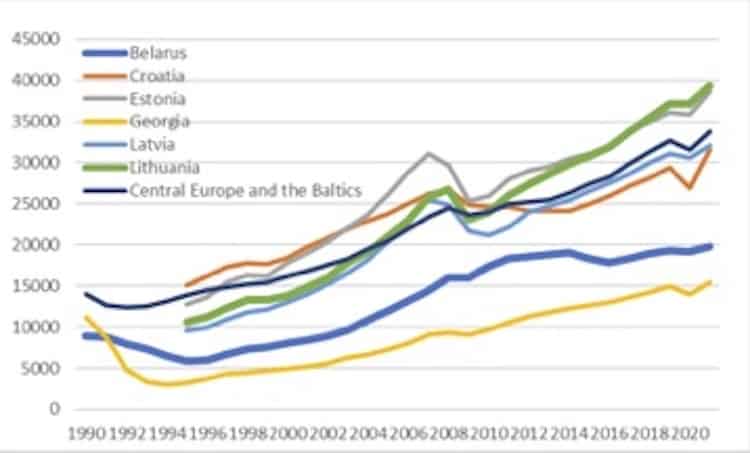
The economic corollaries of this are shown in Figure 1. Having reversed the initial decline in output at the start of the transition from plan to market, the economies of Lithuania and Belarus grew broadly in tandem from 1995 in terms of gross domestic product per head. The data do have to be taken with a pinch of salt, however: Belarus benefited from implicit energy subsidies from Russia which averaged a whopping 18 per cent of GDP during 2001-08 and many prices remain controlled. Lithuania lost about a quarter of her population to emigration in the past 25 years but did perform better, on a per capita basis, especially after 2012.

Figure 1: per capita GDP, 1990-2021 (constant international 2017 dollars at purchasing-power parities)

Belarus,Lithuania
Source: World Bank, World Development Indicators 2023

The story is similar when it comes to the fundamental social indicator of life expectancy (Figure 2). Lithuanians have lived longer than Belarussians since 1995. After 1990, life expectancy in Belarus fell by three years compared with a little more than two in Lithuania, where the reversal began in 1994 but in Belarus was delayed until 2002. True, in 2020, the life-expectancy deficit which had opened up between Belarus and other CEE states, bar Georgia, was reduced because the country attracts few tourists, so limiting contagion from the coronavirus (for which Lukashenka advocated driving tractors and drinking vodka as remedies).

Figure 2: life expectancy 1990-2020 (years)

Belarus,Lithuania
Source: World Bank, World Development Indicators 2023

Investment quality

Why is GDP per person so much higher in Lithuania than in Belarus and why has the income differential continued to grow in Lithuania’s favour? To answer that question, we have compared the evolution of standard determinants of growth in the two countries since independence.

Investment is a key determinant. Both countries saw a surge of gross investment in machinery and equipment from around 2000, later reversed, leaving the investment ratio essentially unchanged from the mid-to-late 1990s until 2021. Belarus did though invest about 30 per cent of its GDP on average during 1990-2021, compared with 21 per cent in Lithuania.

Official investment data do not however distinguish quantity from quality. One may doubt its quality in Belarus where investment decisions, in Soviet fashion, have been motivated more by politics than return and the state owns two-thirds of the banking system. Thus, preferential credits have been extended to state-owned enterprises and agriculture.

The booming information-technology industry has been fully competitive in world markets, as have refined oil products and fertilisers, though Belarus has long received ‘loyalty’ rents from Russia. Recently, many foreign IT firms have left the country and the ‘loyalty’ rents have declined, while sanctions have been placed on Belarus’ exports.

Net foreign direct investment in Lithuania amounted to nearly 4 per cent of GDP on average in 1990-2021, compared with 2 per cent in Belarus. Again, quality matters and the benefits of EU and NATO membership clearly show. FDI in Belarus is heavily tilted toward Russia, which accounts for around 80 per cent of its total (2016 figure), while most FDI in Lithuania stems from the EU.

Market integration

The second key determinant of growth is trade. Exports of goods and services from Lithuania amounted to 58 per cent of GDP on average in 1990-2021—a bit less than the 61 per cent in Belarus. But, while the Belarusian export ratio has held steady since the mid-1990s and maintained its eastward orientation, the Lithuanian ratio shot up from 40 per cent to 80 per cent, reflecting its integration into western markets and participation in the EU single market; Belarus, like Russia, retains a rather restrictive import regime.

Turning to education, our third determinant, Belarus has maintained the good sides of Soviet education, especially in mathematics and science, but remains poor in languages. In both countries, nearly all youngsters attend secondary school, but Belarus has lagged behind Lithuania in recent years. Reflecting the success of the IT industry, Belarus has though recently caught up with Lithuania in individual use of the internet.

It is in the area of democratic rule and good governance that we find the starkest differences—and in Belarus the political and institutional situation is turning from bad to worse. Lithuania has been an unfettered democracy since the early 1990s, consistently scoring top grades in international comparisons: Freedom House awards Lithuania a democracy score of 90 out of 100, while Belarus was demoted from 15 in 2015 to just 11 in 2021.

The distribution of income is less equal in Lithuania than in most advanced economies. As social cohesion is good for growth, Belarus’ low Gini coefficient of inequality may have contributed to growth in the past. More recently though, especially since 2020, social cohesion has all but disappeared.

Accounting for growth

Is growth more driven by crude capital accumulation or more efficient use of existing capital and other resources? The latter include ‘human’ and ‘social’ capital accumulated through education, good governance, efficient organisation, strong institutions and so on. In earlier comparative studies of Estonia and Georgia and Croatia and Latvia, we quantified the relative contributions of different growth determinants to income gaps using a simple growth-accounting model.

When it comes to Lithuania and Belarus, overall efficiency and education again outweigh investment as explanations for the income differential in 2019. Intensive growth is what counts.

Belarus and Lithuania adopted different transition models and reaped different political and economic outcomes. Lithuania was a frontrunner in transition while Belarus started late and its unique, state-capitalist model quickly stalled.

From 1995 to 2021 the income gap between the two countries rose from 83 per cent to twofold in Lithuania’s favour with adjustment for purchasing-power parities and from 58 per cent to more than threefold without it. The latter may be a more appropriate yardstick, in view of the extensive price controls and distortions in Belarus.

Lithuania has outperformed Belarus in most respects, even though Belarus has since 1991 invested 50 per cent more than Lithuania in machinery and equipment relative to GDP and had a more equal income distribution. Lithuania has invested more in human capital and has had more external trade—and, importantly, more democracy, less corruption and better governance.

‘Soft’ factors, such as institutions, governance and education, have prevailed in shaping relative economic performance. Belarus missed an opportunity to boost economic efficiency (‘total factor productivity’) and thus provide a basis for rapid long-run growth. In light of increasing oppression, sanctions and the flight of human capital, its future appears bleak.

Thorvaldur Gylfason

Thorvaldur Gylfason is professor emeritus of economics at the University of Iceland and a former member of Iceland´s Constitutional Council.

Eduard Hochreiter is senior research associate at the Vienna Institute for International Economic Studies (wiiw). Previously he worked for the Austrian central bank and the International Monetary Fund and was associate professor of international monetary economics at the University of Innsbruck and the Vienna University of Economics and Business.

sábado, 20 de maio de 2023

O novo Celeste Império retoma o que lhe foi roubado pelo imperialismo czarista no passado: Vladivostok (Lianhe Zaobao)

 O porto e a cidade de Vladivostok pertenciam à China, até a dinastia Qing cedê-los ao Império czarista, em sua expansão em direção aó Pacífico. Harbin, a capital da província chinesa da Manchuria foi fundada por engenheiros russos, no mesmo movimento. Agora que a Rússia, destruída pela irresponsabilidade de Putin, se torna vassala da China, tudo vai retornar ao dominio do novo Celeste império sendo reconstruído por seu novo imperador.

Paulo Roberto de Almeida 

Fascinating development: With its military decimated and its economy in tatters, Russia quietly opens the port of Vladivostok to China - 163 years after the Qing ceded it to the Russian Empire. (Chris Horton, 何桂森)

https://t.co/nxgGwv31oI 

Amid the Russia-Ukraine war, Russia has opened the key port of Vladivostok to China, which will enhance the transportation of domestic goods in China’s northeast region. Many see this as an act of goodwill, while some believe that Russia could be turning into a vassal of China. Lianhe Zaobao correspondent Wong Siew Fong takes us through what the port opening means for China.

China-Russia relations have grown closer since the Russia-Ukraine war. According to China’s General Administration of Customs (GAC), Russia’s port of Vladivostok will be added to its list of transit ports for the domestic transportation of goods. This means that after 163 years, Russia is reopening this key port to China after it was ceded by the Great Qing to the Russian Empire in 1860. Not only that, the northeastern interior of China will gain access to the sea. 

An interviewed academic said this further proved that the scales have tipped in favour of China being the dominant partner in China-Russia relations amid Russia’s isolation due to the Russia-Ukraine war.

Cutting cost of domestic trade logistics

The GAC released a notice on further expanding the operation of its cross-border transportation of domestic goods in Jilin province on 4 May, but the news only garnered attention from the Chinese press on 15 May. According to the notice, with effect from 1 June, Russia’s Vladivostok will be operational as a Chinese transit port.

Located in northeast Eurasia, Vladivostok is the largest Russian port on the Pacific Ocean with an annual container throughput of nearly 1 million twenty-foot equivalent units (TEUs). The city is also the home port of the Russian Pacific Fleet.  

Once the new measures take effect, Jilin and Heilongjiang’s land transport distance to the sea will be significantly reduced, which will greatly enhance their manufacturing competitiveness. 

Under the name Haishenwai (海参崴), Vladivostok was previously part of China during the Qing dynasty. However, in November 1860, the territory east of the Ussuri River, including Vladivostok, was ceded to the Russian Empire under the Treaty of Peking. In the past 163 years, the neighbouring Chinese provinces of Heilongjiang and Jilin did not have access to the sea, and could only reach Dalian, Yingkou and other ports in Liaoning province through overland transportation.

Once the new measures take effect, Jilin and Heilongjiang’s land transport distance to the sea will be significantly reduced, which will greatly enhance their manufacturing competitiveness. 

Quoting a veteran Shanghai-based freight forwarder, Caixin reported that in the past, goods shipped from northeast China to domestic destinations had to be first loaded onto ships in Yingkou or Dalian before they could be transported to Xiamen, Guangzhou or other regions. However, the distance from Jilin and Heilongjiang to the ports in Liaoning is over 1,000 kilometres, which racks up huge transportation costs.

In comparison, as Heilongjiang’s Suifenhe and Jilin’s Hunchun are only about 200 kilometres away from Vladivostok, land transportation costs will be greatly reduced. Shipping goods from northern to southern China via the foreign port of Vladivostok will not only cut costs but also help China strengthen its industrial and supply chains with its neighbours. 

Russian Prime Minister Mikhail Mishustin signed a government order approving an intergovernmental agreement to supply natural gas to China via the Far East gas pipeline route, which ends in Vladivostok.

Low-key release of news

Some analyses point out that Vladivostok is located in Northeast Asia where China, North Korea, Japan and Russia meet, and is the transport node between the whole of Europe and Asia. The opening up of Russia’s far eastern region will strongly boost the economic development of China’s northeastern region.

Notably, Russia’s TASS news agency also reported last week that Russian Prime Minister Mikhail Mishustin signed a government order approving an intergovernmental agreement to supply natural gas to China via the Far East gas pipeline route, which ends in Vladivostok.

As Western countries entered the G7 and Quad summits season in May, the Chinese government’s special envoy for Eurasian affairs Li Hui kicked off his visit to Ukraine, Russia and other European countries this week. Amid Western wariness of China-Russia relations, both China and Russia have kept a low profile over the news of opening up the Vladivostok port to China.

Caixin reported on the news of Vladivostok’s opening to China over a week after the release of the document — there were no reports on this significant joint effort in other state Chinese media such as the People’s Daily and the Global Times in the past week.

After Caixin’s report came out, the GAC issued a statement in the form of a Q&A on its official WeChat account on the evening of 15 May, stating that the inclusion of Vladivostok as an overseas transit port for Jilin is a mutually beneficial cooperation model between the two countries, and the GAC will actively provide support for operations based on its follow-up evaluation.

China benefiting from war in Ukraine

Following the war in Ukraine, many analysts believe that Russia, which has been isolated by the international community, will increasingly depend on China and may even gradually become its vassal state. Public opinion in China also calls the opening of Vladivostok port to China a “bonus” of the Ukraine war.

…while China will become the stronger side in China-Russia relations, it is an oversimplification to interpret it as Russia becoming a vassal of China — China is also in need of Russia’s support. — James Dorsey, senior research fellow, Rajaratnam School of International Studies, Nanyang Technological University.

James Dorsey, senior research fellow at the Rajaratnam School of International Studies at Nanyang Technological University in Singapore, said that Russia’s opening of a key port like Vladivostok to China is clearly a gesture of goodwill. Following the war in Ukraine, the balance of China-Russia relations has shifted towards China, and Russia needs China more, and it is actively promoting economic cooperation between both countries.

However, Dorsey also said that while China will become the stronger side in China-Russia relations, it is an oversimplification to interpret it as Russia becoming a vassal of China — China is also in need of Russia’s support.

This article was first published in Lianhe Zaobao as “时隔163年 俄罗斯对中国开放符拉迪沃斯托克港”.

sexta-feira, 19 de maio de 2023

"On May 27th Mr Kissinger will turn 100" - Meu "obituário" feito muitos anos atrás, mas ele não morreu ainda - Paulo Roberto de Almeida

Henry Kissinger – CartaCapital

 Ja tinha feito um "requiem" ao metternichiano cínico, muitos anos anos atrás, mas ele ainda não morreu. Minhas saudações ao realista genial.

1894. “O legado de Henry Kissinger”, Brasília, 1 junho 2008, 5 p. Comentários sobre a obra prática e intelectual do estadista americano. Publicado em Mundorama (Brasília, 31/05/2008); em Meridiano 47 (n. 94, maio de 2008, p. 29-31); divulgado no blog Diplomatizzando (11/05/2020; link: https://diplomatizzando.blogspot.com/2020/05/o-legado-de-henry-kissinger-paulo.html). Reproduzido em Via Política (08.06.2008). Ensaio incorporado ao livro: Paralelos com o Meridiano 47: Ensaios Longitudinais e de Ampla Latitude (Hartford, 2015). Relação de Publicados n. 838.

O legado de Henry Kissinger


Paulo Roberto de Almeida


Não, o velho adepto da realpolitik ainda não morreu. Mas tendo completado 85 anos em maio de 2008, o ex-secretário de Estado e ex-conselheiro de Segurança Nacional dos EUA Henry Kissinger aproxima-se das etapas finais de sua vida. Seus obituários – não pretendendo aqui ser uma ave de mau agouro – devem estar prontos nas principais redações de jornais e revistas do mundo inteiro, e os comentaristas de suas obras preparam, certamente, revisões de análises anteriores para reedições mais ou menos imediatas, tão pronto este “Metternich” americano passe deste mundo terreno para qualquer outro que se possa imaginar (na minha concepção, deverá ser o mundo das ideias aplicadas às relações de poder). 

 Talvez seja esta a oportunidade para um pequeno balanço de seu legado, que alguns – por exemplo Cristopher Hitchens, em The Trial of Henry Kissinger  querem ver por um lado unicamente negativo, ou até criminoso, como se ele tivesse sido apenas o inimigo dos regimes “progressistas” e um transgressor consciente dos direitos humanos e da autodeterminação dos povos. Ele certamente tem suas mãos manchadas de sangue, mas também foi o arquiteto dos acordos de redução de armas estratégicas e da própria tensão nuclear com a extinta União Soviética, além de um mediador relativamente realista nos diversos conflitos entre Israel e os países árabes, no Oriente Médio. Sua obra “vietnamita” é discutível, assim como foi altamente discutível – ou francamente condenável – o prêmio Nobel da Paz concedido por um simplesmente desengajamento americano, que visava bem mais a resolver questões domésticas do que realmente pacificar a região da ex-Indochina francesa. 

Pode-se, no entanto, fazer uma espécie de avaliação crítica de sua obra prática e intelectual, como reflexão puramente pessoal sobre o que, finalmente, reter de uma vida rica em peripécias intelectuais e aventuras políticas. Sua principal obra de “vulgarização” diplomática, intitulada de maneira pouco imaginativa Diplomacia simplesmente, deve constituir leitura obrigatória em muitas academias diplomáticas de par le monde. Seu trabalho mais importante, uma análise do Congresso de Viena (1815), é mais conhecido pelos especialistas do que pelo grande público, mas ainda assim merece ser percorrido pelos que desejam conhecer o “sentido da História”.

 O legado de Henry Kissinger é multifacético e não pode ser julgado apenas pelos seus atos como Conselheiro de Segurança Nacional de Richard Nixon, ou como Secretário de Estado desse presidente e do seguinte, Gerald Ford, quando ele esteve profundamente envolvido em todas as ações do governo americano no quadro da luta anticomunista que constituía um dos princípios fundamentais da política externa e da política de segurança nacional dos EUA. Esse legado alcança, necessariamente, suas atividades como professor de política internacional, como pensador do equilíbrio nuclear na era do terror – doutrina MAD, ou Mutually Assured Destruction –, como consultor do Pentágono em matéria de segurança estratégica, e também, posteriormente a seu trabalho no governo, como articulista, memorialista e teórico das relações internacionais.

A rigor, ele começou sua vida pública justamente como teórico das relações internacionais, ou, mais exatamente, como historiador do equilíbrio europeu numa época revolucionária, isto é, de reconfiguração do sistema de poder no seguimento da derrocada de Napoleão e de restauração do panorama diplomático na Europa central e ocidental a partir do Congresso de Viena (1815). Sua tese sobre Castlereagh e Metternich naquele congresso (A World Restored, 1954) é um marco acadêmico na história diplomática e de análise das realidades do poder num contexto de mudanças nos velhos equilíbrios militares anteriormente prevalecentes. Depois ele foi um fino analista dessas mesmas realidades no contexto bipolar e do equilíbrio de terror trazido pelas novas realidades da arma atômica. Ele se deu rapidamente conta de que não era possível aos EUA manter sua supremacia militar exclusiva, baseada na hegemonia econômica e militar e no seu poderio atômico, sem chegar a algum tipo de entendimento com o outro poder nuclear então existente, a União Soviética, uma vez que, a partir de certo ponto, a destruição assegurada pela multiplicação de ogivas nucleares torna ilusória qualquer tentativa de first strike ou mesmo de sobrevivência física, após os primeiros lançamentos.

Daí sua preocupação em reconfigurar a equação dos poderes – aproximando-se da China, por exemplo – e em chegar a um entendimento mínimo com a URSS, através dos vários acordos de limitações de armas estratégicas. O controle da proliferação nuclear também era essencial, assim como evitar que mais países se passassem para o lado do inimigo principal, a URSS (o que justifica seu apoio a movimentos e golpes que afastassem do poder os mais comprometidos com o lado soviético do equilíbrio de poder). Numa época de relativa ascensão da URSS, com governos declarando-se socialistas na África, Ásia e América Latina, a resposta americana só poderia ser brutal, em sua opinião, o que justificava seu apoio a políticos corruptos e a generais comprometidos com a causa anticomunista. Não havia muita restrição moral, aqui, e todos os golpes eram permitidos, pois a segurança dos EUA poderia estar em jogo, aos seus olhos. 

Ou seja, todas as acusações de Christopher Hitchens estão corretas – embora este exagere um pouco no maquiavelismo kissingeriano – mas a única justificativa de Henry Kissinger é a de que ele fez tudo aquilo baseado em decisões do Conselho de Segurança Nacional e sob instruções dos presidentes aos quais serviu. Não sei se ele deveria estar preso, uma vez que sua responsabilidade é compartilhada com quem estava acima dele, mas certamente algum julgamento da história ele terá, se não o dos homens, em tribunais sobre crimes contra a humanidade. Acredito, pessoalmente, que ele considerava as “vítimas” de seus muitos golpes contra a democracia e os direitos humanos como simples “desgastes colaterais” na luta mais importante contra o poder comunista da URSS, que para ele seria o mal absoluto.

O julgamento de alguém situado num plano puramente teórico, ou “humanista” – como, por exemplo, intelectuais de academia ou mesmo jornalistas, para nada dizer de juízes empenhados na causa dos direitos humanos ou de “filósofos morais” devotados à “causa democrática” no mundo –, tem de ser necessariamente diferente do julgamento daqueles que se sentaram na cadeira onde são tomadas as decisões e tem, portanto, de julgar com base no complexo jogo de xadrez que é o equilíbrio nuclear numa era de terror, ou mesmo no contexto mais pueril dos pequenos golpes baixos que grandes potências sempre estão aplicando nas outras concorrentes, por motivos puramente táticos, antes que respondendo a alguma “grande estratégia” de “dominação mundial”. Desse ponto de vista, Kissinger jogou o jogo de forma tão competente quanto todos os demais atores da grande política internacional, Stalin, Mao, Kruschev, Brejnev, Chu Enlai, Ho Chi-min e todos os outros, ou seja, não há verdadeiramente apenas heróis de um lado e patifes do outro. Todos estão inevitavelmente comprometidos como pequenos e grandes atentados aos direitos humanos e aos valores democráticos.

Não creio, assim, que ele tenha sido mais patife, ou criminoso, do que Pinochet – que ele ajudou a colocar no poder – ou de que os dirigentes norte-vietnamitas – que ele tentou evitar que se apossassem do Vietnã do Sul (e, depois, jogou a toalha, ao ver que isso seria impossível cumprir pela via militar, ainda que, na verdade, os EUA tenham sido “derrotados” mais na frente interna, mais na batalha da opinião pública doméstica, do que propriamente no terreno vietnamita). Ou seja, Kissinger não “acabou” com a guerra do Vietnã: ele simplesmente declarou que os EUA tinham cumprido o seu papel – qualquer que fosse ele – e se retiraram da frente militar.

Seu legado também pode ser julgado como “comentarista” da cena diplomática mundial, como memorialista – aqui com imensas lacunas e mentiras, o que revela graves falhas de caráter – e como consultor agora informal de diversos presidentes, em geral republicanos (mas não só). Ele é um excelente conhecedor da História – no sentido dele, com H maiúsculo, certamente – e um grande conhecedor da psicologia dos homens, sobretudo em situações de poder. Trata-se, portanto, de um experiente homem de Estado, que certamente serviu ardorosamente seus próprios princípios de atuação – qualquer que seja o julgamento moral que se faça deles – e que trabalhou de modo incansável para promover os interesses dos EUA num mundo em transformação, tanto quanto ele tinha analisado no Congresso de Viena.

Desse ponto de vista, pode-se considerar que ele foi um grande representante da escola realista de poder e um excelente intérprete do interesse nacional americano, tanto no plano prático, quanto no plano conceitual, teórico ou histórico. Grandes estadistas, em qualquer país, também são considerados maquiavélicos, inescrupulosos e mentirosos, pelos seus adversários e até por aliados invejosos. Esta é a sina daqueles que se distinguem por certas grandes qualidades, boas e más. Kissinger certamente teve sua cota de ambas, até o exagero. Não se pode eludir o fato de que ele deixará uma marca importante na política externa e nas relações internacionais – dos EUA e do mundo – independentemente do julgamento moral que se possa fazer sobre o sentido de suas ações e pensamento.

Por uma dessas ironias de que a História é capaz, coube a um dos presidentes mais ignorantes em história mundial (Ronald Reagan) enterrar, praticamente, o poder soviético com o qual Kissinger negociou quase de igual para igual durante tantos anos. Ele, que considerava o resultado de Viena um modelo de negociação – por ter sido uma paz negociada, justamente, não imposta, como em Versalhes – deve ter sentido uma ponta de inveja do cowboy de Hollywood, capaz de desmantelar o formidável império que tinha estado no centro de suas preocupações estratégicas – e que ele tinha poupado de maiores “desequilíbrios” ao longo dos anos. Seu cuidado em assegurar o “equilíbrio das grandes potências” saltou pelos ares com o keynesianismo militar praticado por Reagan, um desses atos de voluntarismo político que apenas um indivíduo totalmente alheio às grandes tragédias da História seria capaz. Talvez Kissinger tivesse querido ser o arquiteto do grande triunfo da potência americana, mas ele teve de se contentar em ser apenas o seu intérprete tardio. Nada mau, afinal de contas, para alguém que foi, acima de tudo, um intelectual...


Paulo Roberto de Almeida

Brasília, 2 de junho de 2008

Divulgado no blog Diplomatizzando (11/05/2020; link: https://diplomatizzando.blogspot.com/2020/05/o-legado-de-henry-kissinger-paulo.html).


Postagem em destaque

Livro Marxismo e Socialismo finalmente disponível - Paulo Roberto de Almeida

Meu mais recente livro – que não tem nada a ver com o governo atual ou com sua diplomacia esquizofrênica, já vou logo avisando – ficou final...