Mostrando postagens com marcador Garry Kasparov. Mostrar todas as postagens

sábado, 11 de julho de 2026

Anatomia do Estado mafioso putinesco - Garry Kasparov (comentário inicial PRA) + Madame IA

 Anatomia da autocracia putinesca, uma ditadura ainda mais absolutista do que o regime dos czares e uma tirania ainda mais explcita do que o totalitarismo lenino-stalinista, segundo Garry Kasparov, ou um Estado mafioso com bandeira, como ele a caracteriza. Ainda não sabemos se ele aguarda o seu 1905, um dos dois 1917 ou algum atentado ao estilo narodnik. Quando algo do gênero acontecer, vamos precisar de um novo John Reed, para relatar os novos dias que abalaram o mundo, qualquer que seja o resultado. A partir daí seria preciso recomeçar tudo de novo, ou, como dizem os hermanos, “borrón y cuenta nueva!”

Paulo Roberto de Almeida 

================

“HOW PUTIN DESTROYED DEMOCRACY IN RUSSIA TO SUIT HIS OWN CORRUPT AGENDA, RUSSIA IS NOW A MAFIA STATE

President Vladimir Putin dismantled Russia's fragile 1990s democracy by systematically neutralizing independent media, eliminating political competition, centralizing regional power, and engineering constitutional changes to secure indefinite rule. Rather than launching a sudden military coup, Putin executed a gradual "slide into authoritarianism" by converting the state's legal and security apparatus into a tool for absolute political control. The erosion of Russian democracy occurred through several calculated strategies:

1. Stripping Media Independence

One of Putin's earliest objectives after taking power in 2000 was to bring major information channels under direct Kremlin control. 

• Exiling media tycoons: The state targeted prominent oligarchs who owned independent networks, forcing critical figures into exile on targeted charges. 

• State takeovers: Broadcasters like NTV, which frequently criticized government actions, were forced into state-directed buyouts and transformed into government mouthpieces. 

• Censorship laws: Over two decades, laws were introduced that systematically restricted political analysis during elections, criminalized criticism of the government, and eventually mandated prison sentences for "discrediting the military"2. Eliminating Political Competition and Oligarch Power

Putin leveraged public resentment against the post-Soviet oligarch class to eliminate any genuine political opposition. 

• Selective prosecution: High-profile figures who funded independent political factions faced aggressive legal crackdowns. A defining moment occurred in 2003 with the arrest and imprisonment of oil tycoon Mikhail Khodorkovsky, which sent a message that political defiance would result in total ruin. 

• Targeting opposition figures: True opposition politicians were barred from appearing on ballots, forced into exile, imprisoned on fabricated charges, or physically neutralized 

• Manipulating election rules: The threshold for political parties to register was drastically tightened, and single-seat legislative races were abolished in favor of rigid party lists controlled by the state. .

3. Centralizing Regional Power

When Putin took office, Russia functioned as a highly decentralized federation where regional governors possessed significant autonomous power. 

• Abolishing gubernatorial elections: In September 2004, Putin eliminated direct popular elections for regional governors.

• Imposing federal oversight: Regional leaders were replaced by presidential appointees who required approval from regional legislatures. If a legislature rejected a nominee multiple times, Putin retained the constitutional power to dissolve that body, effectively ending Russian federalism. 

4. Rewriting the Constitution

To bypass legal limits on presidential power, Putin systematically modified the Russian legal system. 

• Extending terms: Presidential terms were extended from four to six years.

• The "Reset" amendment: Constitutional revisions passed in 2020 officially reset Putin's previous term counts to zero. This change legally allowed him to seek additional terms, effectively paving the way for him to retain power until 2036. 5. Weaponizing the Security Services

Putin built his regime around the siloviki—individuals with backgrounds in the post-Soviet security and intelligence agencies. 

• Expanding surveillance: Agencies like the FSB received expanded funding and jurisdiction to monitor civil society.

• The "Foreign Agent" law: Enacted in 2012 and continuously expanded, this law labeled civil rights organizations, independent journalists, and watchdog groups receiving international funding as foreign subversives, freezing their operations and starving civil society of independent resources. Through this gradual fusion of state resources, security enforcement, and legally mandated suppression, the competitive elections of the 1990s were replaced by a rigid bureaucratic-authoritarian state where election outcomes are entirely predetermined. Detailed retrospectives on this transition are available through academic resources like the Oxford Academic Analysis of Russia's Breakdown and historical records kept by the Council on Foreign Relations.

============ 


Reescreva o conteúdo/texto do link mencionado neste comando. O texto reescrito deverá manter a linha de pensamento e as ideias e opiniões, mas de modo resumido e com linguagem coloquial. O link é: https://diplomatizzando.blogspot.com/2026/07/anatomia-do-estado-mafioso-putinesco.html (título, entre aspas: "Anatomia do Estado mafioso putinesco - Garry Kasparov (comentário inicial PRA)"). 

"Anatomia do Estado mafioso putinesco" — Garry Kasparov (comentário de Paulo Roberto de Almeida)
O texto discute a real face da autocracia de Vladimir Putin na Rússia, que, segundo a análise de Garry Kasparov, virou uma verdadeira ditadura absolutista. É um regime mais escancarado que o totalitarismo do passado e funciona basicamente como um Estado mafioso com bandeira nacional. [1, 2]
Ainda não dá para saber quando ou como esse governo vai balançar (seja por revoltas ou atentados). Mas, quando o castelo de cartas cair, o mundo vai precisar de novos relatos para entender o tamanho do impacto. A partir daí, será o caso de passar a régua, esquecer o passado e recomeçar o país do zero. [1, 2, 3]
Como Putin acabou com a democracia russa por interesse próprio:
Putin não precisou dar um golpe militar clássico de uma hora para a outra. Ele foi sufocando a frágil democracia dos anos 90 aos poucos, usando as próprias leis e as forças de segurança para garantir controle absoluto. Ele fez isso por meio de cinco estratégias principais: [1, 2, 3]
  • Fim da imprensa livre: Tomou canais de TV críticos à força e expulsou do país os donos de mídias que o incomodavam, transformando o jornalismo em assessoria de imprensa do governo. Criou também leis de censura que botam na cadeia quem fala mal do governo ou do exército. [1]
  • Asfixia da oposição: Aproveitou o ranço do povo contra os super-ricos (oligarcas) para esmagar rivais políticos. Quem tentava financiar a oposição ia preso (como Mikhail Khodorkovsky em 2003) para servir de exemplo. Políticos de verdade foram barrados de eleições, exilados ou eliminados. [1]
  • Centralização do poder regional: Acabou com a eleição direta para governadores. Agora, o presidente indica quem ele quer. Se as assembleias locais não aceitarem o nome, Putin simplesmente fecha a assembleia, matando a autonomia das regiões. [1]
  • Mudança nas regras do jogo (Constituição): Mudou o mandato presidencial de 4 para 6 anos. Em 2020, fez uma reforma que "zerou" o contador de seus mandatos anteriores, o que dá o direito legal para ele ficar no poder até 2036.[1]
  • Uso da polícia secreta e espionagem: Encheu o governo de aliados vindos da inteligência (os siloviki) e aumentou a espionagem sobre o povo. Criou a lei do "Agente Estrangeiro" para carimbar ONGs, defensores de direitos humanos e jornalistas independentes como traidores da pátria, congelando suas contas e sufocando a sociedade civil. [1]
O resultado de tudo isso é que as eleições reais do passado viraram um teatro burocrático onde o vencedor já é escolhido antes mesmo da votação começar. [1]


sexta-feira, 28 de novembro de 2025

Garry Kasparov e a felicidade de viver num país livre


Garry Kasparov: What Thanksgiving Means to Me

It's America's most important holiday.

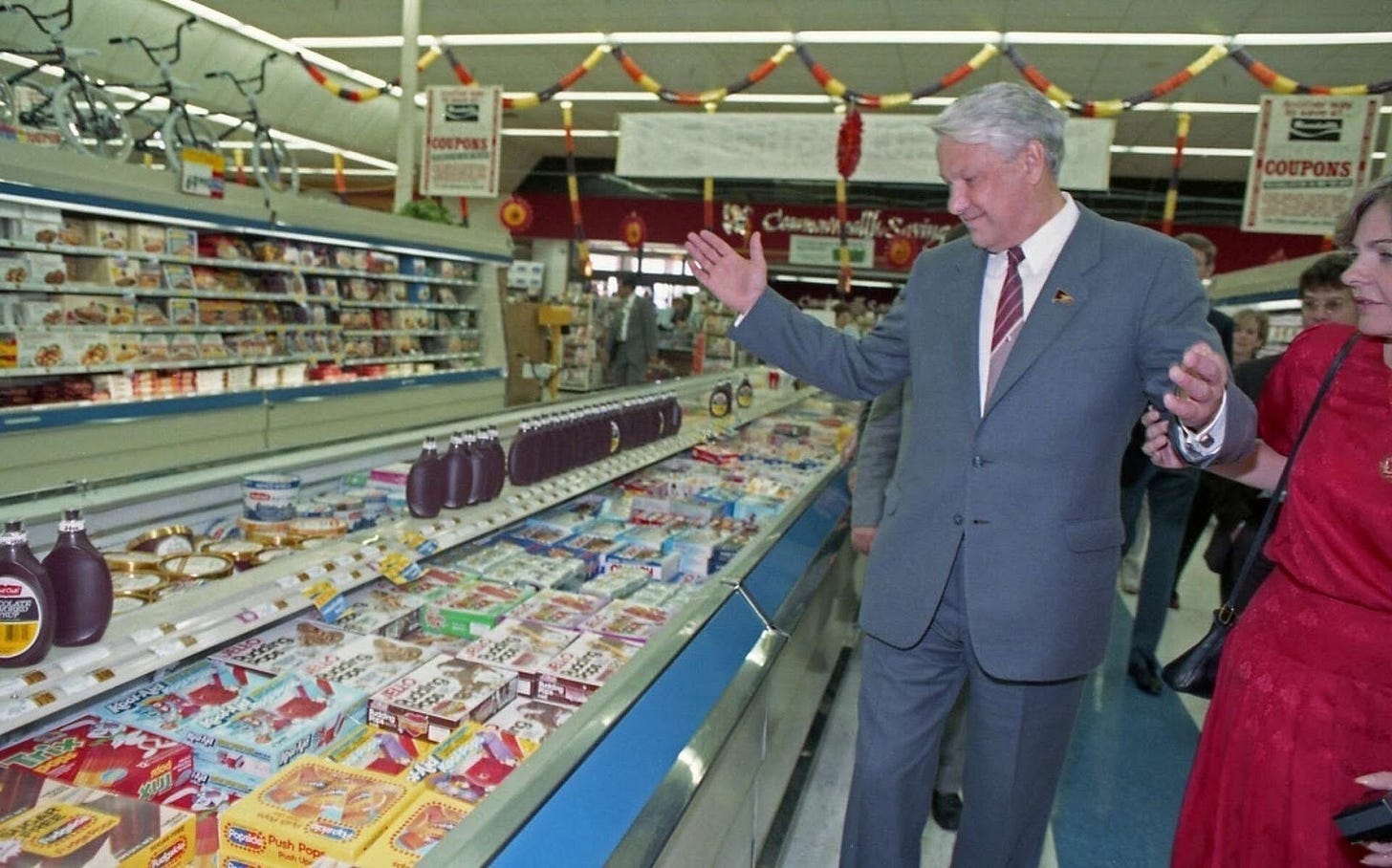
Boris Yeltsin visiting a Texas supermarket, 1989. (Larry Reese/Houston Chronicle.)

There is a lot that I love about America. Thanksgiving is one of the things I love the most.

More than any other date on the calendar, Thanksgiving reminds us what we supporters of liberty are really fighting for.

More than the Fourth of July?” you might ask. “More than the date on which we commemorate American democracy, freedom, and independence?”

Yes, more than the Fourth of July.

Democracy, freedom—politics, too. These are not ends in and of themselves. They are a vehicle for delivering human happiness and flourishing. Thatgoal is what we’re fighting for.

The notion of a free society is abstract. Thanksgiving celebrates abundance, and abundance is tangible. You can taste it. Smell it. Hear it. The turkey and mashed potatoes on your plate, the chatter with loved ones, whom you’re free to visit—these are the fruits of a free society.

President Abraham Lincoln formally consecrated Thanksgiving as a national holiday in the middle of the Civil War. His proclamation is full of vivid imagery of America’s bounty. Lincoln opens by recalling:

The year that is drawing towards its close, has been filled with the blessings of fruitful fields and healthful skies.

He continues:

Needful diversions of wealth and of strength from the fields of peaceful industry to the national defence, have not arrested the plough, the shuttle or the ship; the axe has enlarged the borders of our settlements, and the mines, as well of iron and coal as of the precious metals, have yielded even more abundantly than heretofore.

Speaking of abundance, you may have heard the story of Boris Yeltsin’s visit to an American supermarket.

It was September 1989. Yeltsin had been installed as a member of the Supreme Soviet of the USSR just a few months earlier. He took a tour of Johnson Space Center. I’m sure he was impressed, but the Soviet Union had rockets and even an imitation space shuttle too.

But the Soviet Union did not have abundance like America did.

On the way back from the space center, Yeltsin asked to visit a supermarket. The store was given only minutes’ notice that a senior Soviet dignitary would be dropping in.

Yeltsin wandered the aisles, amazed at the variety and volume of products, colorful popsicles and frozen treats; plentiful produce, all painting a stark contrast to dreary communist scarcity. Yeltsin’s associates and biographers describe the transformative impact of the grocery pit stop. It further convinced the future Russian president of the brokenness of the Soviet system.

The store Yeltsin visited was a medium-sized outpost of Randalls—a Texas grocery chain. In America, there are and were far more palatial supermarkets. One wonders how Yeltsin might have reacted to the vastness of a Costco or the opulence of an Erewhon.

But in September 1989, an unremarkable local supermarket was sufficient to capture Yeltsin’s imagination. Eight weeks after his visit, that Randalls location was undoubtedly crowded with Americans stocking their kitchens for Thanksgiving.


Persuasion is a registered nonprofit that relies on reader support to pay our staff and keep our content free for everyone. If you value our work and want to fight for liberal democratic values wherever they are threatened, please consider becoming a paying subscriber today!


Years before Yeltsin’s trip to Texas, I had my own “American supermarket moment”—actually several—when I experienced, viscerally, the difference between free and unfree.

As a top chess player, I enjoyed privileges my neighbors in the Soviet Union could not even dream of.

I got to travel to Western democracies to compete. Assuming they even had the means to travel, a Soviet citizen could count themselves as extremely fortunate if they got approval for a holiday in Bulgaria. I was playing chess in places like New York, London, Paris, and Amsterdam.

Of course, that freedom was conditional: Before I turned 20, the KGB would not allow my mother to travel abroad with me to competitions, essentially holding her in the USSR as human collateral to discourage defection. (Remember what I said about the ability to freely visit loved ones?)

The only chess title I never won was the under-16 championship. I tried, first in 1976, and then again the following year. The competition took place in northern France. My mother, always an essential, supportive presence at my matches back home, was replaced by a state-appointed coach. I was a 13-year-old kid from Baku—from the fringes of the Soviet empire—with only a stranger as my company in a strange land. It was a deeply uncomfortable experience, and I just couldn’t manage the win.

Still, the Soviet authorities could not hold a blindfold over my eyes. I, too, was exposed to the fruits of a free society, and from a much younger age than Boris Yeltsin.

In France, I met a family who would cross the border into Belgium each morning to buy milk. They were confident there would be milk readily available to buy. That shattered my sense of travel as a deeply proscribed activity. No commissar had to sign off on that family’s daily excursion. Free societies enable freedom of movement.

Four years later, in 1980, I was in Italy, on my way back from my first chess olympiad in Malta. During a long layover, I caught The Empire Strikes Back. It was my first experience with American cinema that hadn’t been filtered by a censor and a dub. What a drag to leave the theater knowing I was returning to a country where the Darth Vaders ran the show. Free societies foster creative expression; unfree ones force it underground or wipe it away altogether.

In 1991, in the final days of the Soviet Union, I spoke at a rally—as it happens, in support of Boris Yeltsin’s presidential campaign (we had higher hopes for him back then). I stood on Manezh Square, just beyond the Kremlin walls. I was confident; I’d been in the public eye for some time. But, standing in front of hundreds of thousands of people, I briefly found myself at a loss for words.

When I collected myself, I recounted how I’d recently been to America. There, I saw long lines in only one place: Disneyland. I told the crowd that we ought to have a country where people queued for amusement park rides and not for food.

Free societies deliver abundance.


These days, there is a lot of doom and gloom about the United States across the political spectrum. I am not talking about America’s current democratic and institutional crisis, which is indeed deathly serious. I am referring to the short-sighted ideological decay that is increasingly popular with radicals of all stripes: on the right, the perception of America as sinful, deviant, and overly tolerant; on the left, the view that America is criminal, colonial, illegitimate.

The exhortation to make America great againimplies that America is no longer great. Far-left self-flagellation tells us it never was.

Americans would do well to discard these self-destructive narratives. It may be hard to describe what lofty concepts like democracy and freedom really mean, but you can see the rewards of those concepts all around you if you’re willing to open your eyes.

If Abraham Lincoln could find time for gratitude in the middle of a deadly Civil War, Americans today can too. If Yeltsin could be so impressed by a grocery store many Americans might consider average, then you have something to be thankful for. I’ll dispense with the caveat that America isn’t perfect (what country is?). If you are thankful for something, then you have something you can fight for.

Happy Thanksgiving.

Garry Kasparov, the 13th World Chess Champion, is an author, speaker, and chairman of the Renew Democracy Initiative and the Human Rights Foundation.

A version of this essay originally appeared in The Next Move.


Follow Persuasion on XInstagramLinkedIn, and YouTube to keep up with our latest articles, podcasts, and events, as well as updates from excellent writers across our network.

And, to receive pieces like this in your inbox and support our work, subscribe below:


Postagem em destaque

Na morte de José Van Den Besselaar - Francisco José dos Santos Braga

Transcrevo, do blog do eminente estudioso de São João del-Rei, Francisco José dos Santos Braga, uma postagem do maior interesse para os estu...