US election 2020: How Trump has changed the world
By Rebecca Seales
BBC News, October 24, 2020
The president of the United States is not just the leader of his country, he is probably the most powerful person on Earth. What he does changes life for all of us. Donald Trump is no exception. So how exactly has Mr Trump changed the world?

How the world sees America
President Trump has repeatedly declared the US "the greatest country in the world". But according to a recent 13-nation poll by the Pew Research Center, he hasn't done much for its image overseas.
In many European countries, the percentage of the public with a positive view of America is at its lowest for almost 20 years. In the UK, 41% had a favourable opinion, while in France it was 31%, the lowest since 2003, and in Germany just 26%.
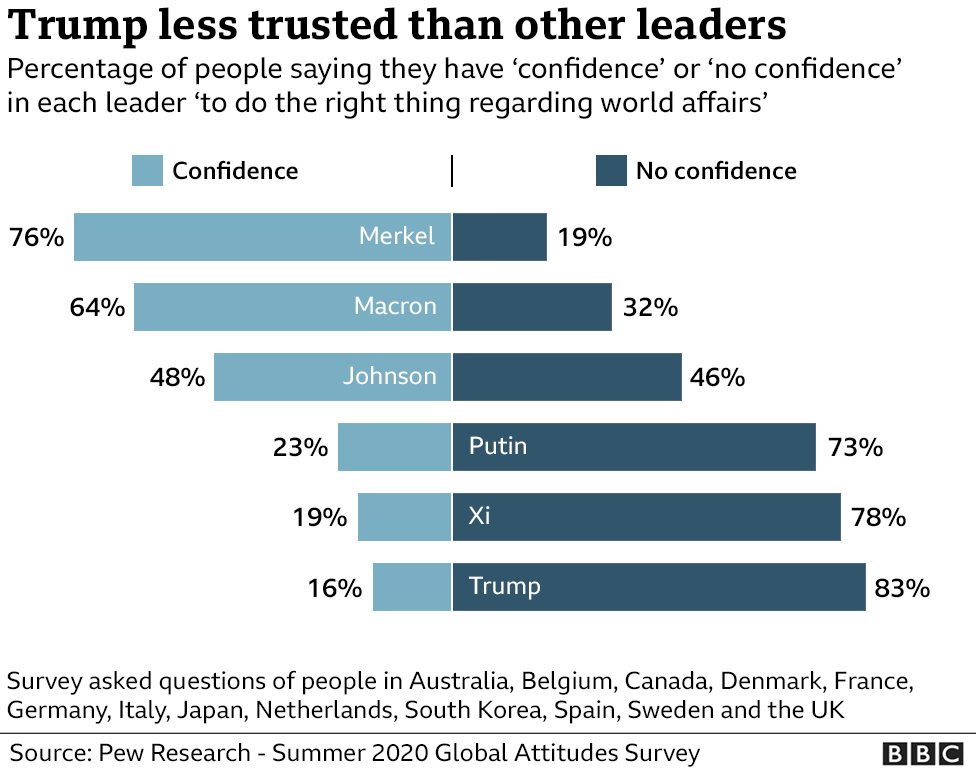

America's response to the coronavirus pandemic was a major factor - only 15% of respondents felt the US had handled the virus well, according to figures from July and August.
Stepping back on climate change
It's hard to pin down what President Trump believes about climate change, as he's called it everything from "an expensive hoax", to a "serious subject" that is "very important to me". What is clear is that six months into the job, he dismayed scientists by announcing America's withdrawal from the Paris climate accord, which committed nearly 200 countries to keeping global temperature rises well under 2C.
The US is the second-biggest emitter of greenhouse gases behind China, and researchers have warned that if Mr Trump is re-elected, it may become impossible to keep global warming in check.
Rejecting the Paris agreement, the president claimed it "would have been shutting down American producers with excessive regulatory restrictions". This has been a theme for Mr Trump, who has removed a raft of pollution regulations to cut the cost of producing coal, oil and gas.


Several US coal mines have still closed, however, driven by competition from cheaper natural gas and state efforts to support renewable energy. Government figures show renewable sources generated more energy than coal in the US in 2019, for the first time in more than 130 years.
America's exit from the Paris climate deal formally takes effect on 4 November, the day after the presidential election. Joe Biden has pledged to rejoin the pact if he wins.
Fears that the US pull-out would prompt a domino effect have not been realised, although some observers believe it smoothed the path for Brazil and Saudi Arabia to block progress on cutting carbon emissions.
Closed borders, for some
President Trump set out his stall on immigration just a week after his inauguration, closing US borders to travellers from seven Muslim-majority countries. Currently 13 nations are subject to tight travel restrictions.
The number of foreign-born people living in the US was about 3% higher in 2019 than in 2016, President Obama's last year in office. But who those immigrants are has changed.
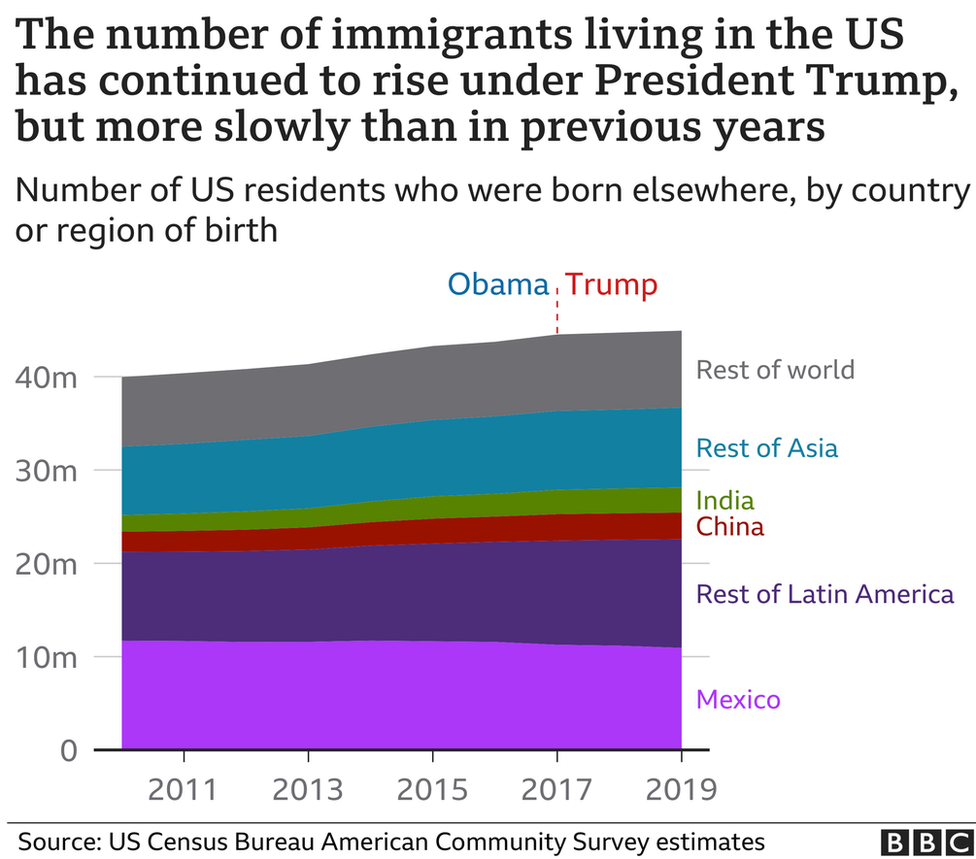
The percentage of US residents born in Mexico has fallen steadily during Mr Trump's term, while the number who moved from elsewhere in Latin America and the Caribbean has increased. There has also been a general tightening of the number of visas enabling people to settle permanently in the US - particularly for relatives of those already living there.
If there's an emblem of President Trump's immigration policy, it's surely the "big, beautiful wall" he swore to build on the border with Mexico. As of 19 October, US Customs and Border Protection says 371 miles of wall have been constructed - almost all of it replacement fencing where barriers already existed.
The work did not deter those desperate to reach America.
The number of migrants detained at the US-Mexico border hit its highest level for 12 years in 2019, spurred by a peak in arrivals during the spring. More than half were families, mostly from Guatemala, Honduras, and El Salvador, where violence and poverty are driving people to seek asylum and a new life elsewhere.
Turning to refugees, Donald Trump has made swingeing cuts to the number who can resettle in America. The US took in almost 85,000 refugees in the fiscal year 2016, which fell to under 54,000 people the following year.
In 2021, the maximum will be 15,000 people - the fewest since the refugee programme launched in 1980.
The rise of 'fake news'
"I think one of the greatest of all terms I've come up with is 'fake'," Donald Trump said in an October 2017 interview. Although the president definitely didn't invent the term "fake news", it's fair to say he popularised it. According to social media posts and audio transcripts monitored by Factba.se, he has used the phrase about 2,000 times since first tweeting it in December 2016.
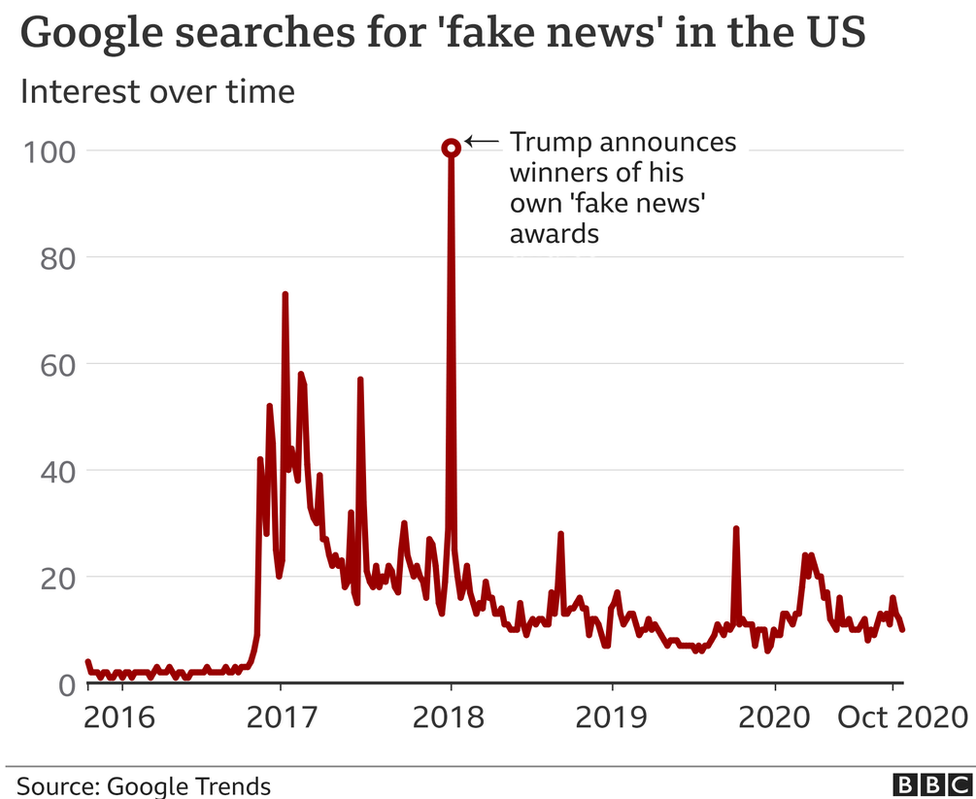
Search Google for "fake news" today and you'll get more than 1.1 billion results from all over the world. Charted over time, you can see how US interest rose in the winter of 2016-17, and spiked the week the president unveiled what he called the "Fake News Awards", a list of news stories he viewed as false.
During the 2016 White House race, "fake news" meant untrue reports like one about Pope Francis endorsing Mr Trump for the presidency. But as it seeped into popular usage, that meaning shifted away from being just about misinformation.
The president has frequently used "fake news" to attack news stories he disagrees with. In February 2017, he took it further, branding several news outlets "the enemy of the American people".
It's a term that's been picked up by leaders in Thailand, the Philippines, Saudi Arabia and Bahrain, among others, and some have used allegations of spreading "fake news" to justify repression and prosecutions against opposition activists and journalists.
Civil society groups say that by using the term against credible reporting, politicians fundamentally undermine democracy, which relies on people agreeing what the basic facts are.
America's 'endless wars', and a Middle East deal
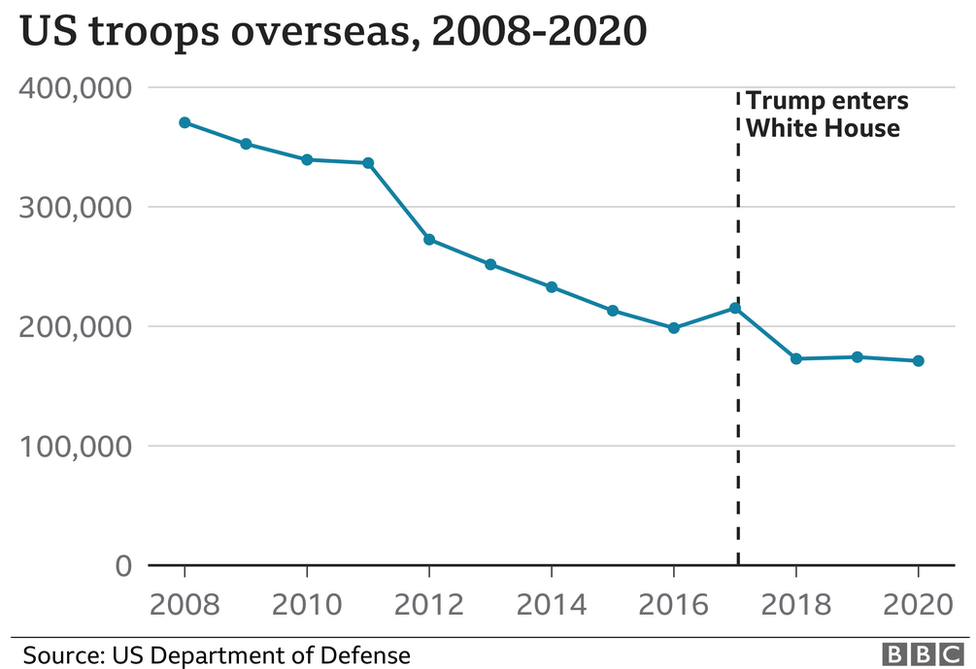
In his February 2019 State of the Union address, President Trump pledged to withdraw US troops from Syria, declaring: "Great nations do not fight endless wars."
The numbers paint a more nuanced story. Not least because months down the line, Mr Trump decided to keep about 500 troops in Syria after all to protect oil wells. The president has scaled back the presence he inherited in Afghanistan, and to an extent in Iraq and Syria. But American forces are still everywhere they were the day he took office.
There are ways to impact on the Middle East without troops, of course. President Trump overturned the objections of previous presidents by moving the US embassy from Tel Aviv to Jerusalem in 2018, and recognising the city, including its occupied East, as Israel's capital. Last month he hailed the "dawn of a new Middle East" when the United Arab Emirates and Bahrain signed agreements normalising relations with Israel - a move the US helped broker.
Rhetoric aside, this was perhaps the most significant diplomatic achievement of the Trump administration. The two Gulf states are just the third and fourth Arab nations in the Middle East to recognise Israel since it declared independence in 1948.
The art of the (trade) deal
President Trump seems to scorn deals he didn't broker. On his first day in office, he dumped the Trans-Pacific Partnership, a 12-nation trade deal approved by President Obama, after branding it "horrible". The withdrawal mostly benefited China, which viewed the deal as an attempt to curb its influence in the Asia-Pacific region. But in the US, critics who felt the agreement would compromise American jobs cheered its demise.
Mr Trump also renegotiated the North American Free Trade Agreement with Canada and Mexico, which he called "perhaps the worst trade deal ever made". Its replacement left much unchanged, but toughened up labour provisions and rules on the sourcing of car parts.
The president's real fixation has been how America benefits from trade with the world. The outcome was a bitter trade war with China, in which the world's two largest economies imposed hundreds of billions of dollars of taxes on each other's goods. It's been a headache for US soybean farmers and the tech and auto industries. China was affected too, as businesses moved their manufacturing to countries like Vietnam and Cambodia to lower their costs.
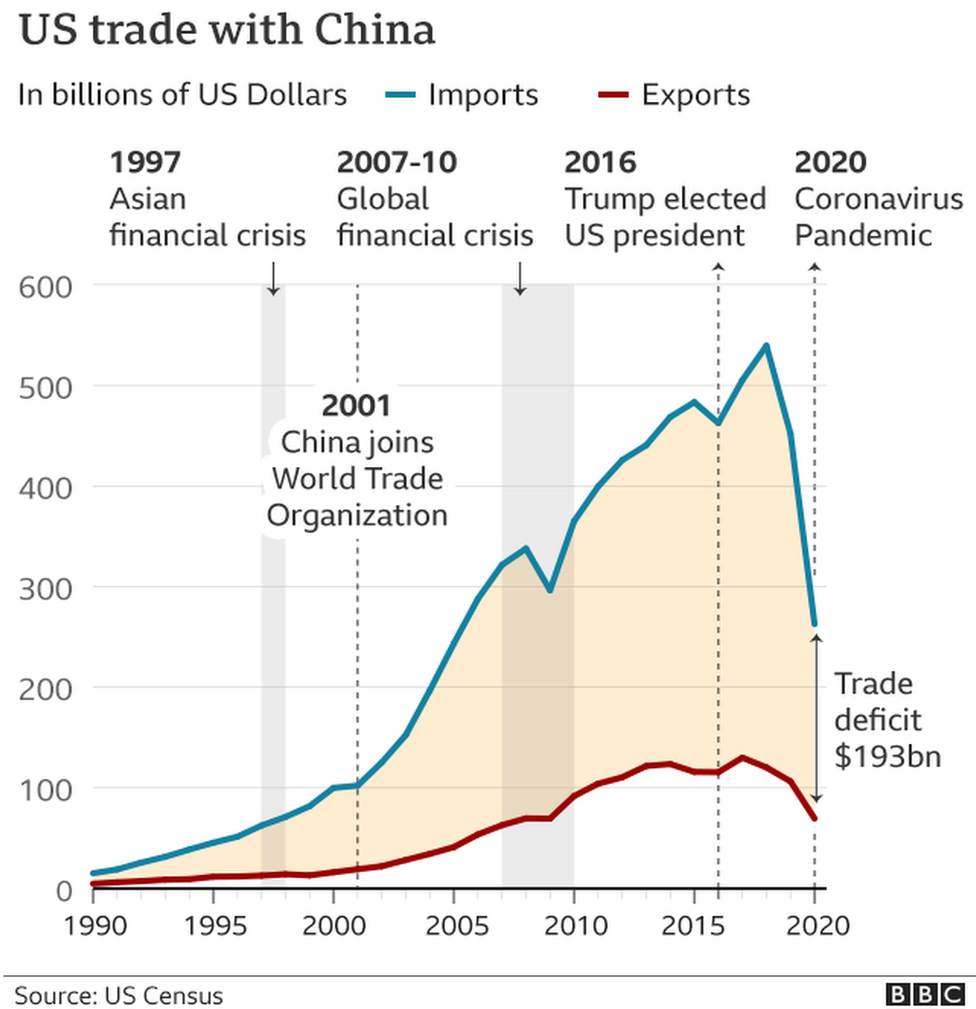
For 2019, the US trade deficit in goods with China was slightly under its 2016 level. American companies imported less as they sought to avoid Mr Trump's tariffs.
However, despite the coronavirus pandemic heavily influencing trends for 2020. America still imports more goods than it exports.
Tussles with China
This Trump tweet refers to a policy rollback so stunning that the phone call in question has its own Wikipedia page.
On 2 December 2016, Mr Trump (then president-elect) took the highly unusual step of speaking directly to the president of Taiwan - breaking with a precedent set in 1979, when formal relations were cut. Carrie Gracie, then the BBC's China editor, predicted the move would prompt "alarm and anger" in Beijing, which sees Taiwan as a province of China not an independent state.
The bold opener from Mr Trump was the first in a multi-pronged poking contest between the great geopolitical rivals, which has sunk relations to their lowest point in years.
The US has irked China by declaring its territorial claims in the South China Sea illegal, heaping tariffs on its goods, banning downloads of the popular apps TikTok and WeChat, and blacklisting Chinese telecoms giant Huawei - which it claims is a threat to national security.
But the tensions did not begin under Mr Trump, and are driven in part by China's own actions. President Xi Jinping, in power since 2013, has presided over a highly controversial national security law in Hong Kong, and the mass imprisonment of China's Muslim minority Uighurs.
President Trump has renamed Covid-19 "the China virus", and while he may be keen to deflect scrutiny from his own handling of the pandemic, a change of US leadership wouldn't necessarily mean a more conciliatory tone. Democratic nominee Joe Biden has called President Xi a thug, and claimed the Chinese leader "doesn't have a [democratic] bone in his body".
An almost-war with Iran
"Iran will be held fully responsible for lives lost, or damage incurred, at any of our facilities. They will pay a very BIG PRICE! This is not a Warning, it is a Threat," Mr Trump tweeted on New Year's Eve, 2019. "Happy New Year!"
Days later, to global shock, the US assassinated Qasem Suleimani, Iran's most powerful general, and the man who spearheaded its military operations in the Middle East. Iran retaliated, firing more than a dozen ballistic missiles at two American bases in Iraq. More than 100 US troops were injured, and analysts deemed the nations on the brink of war.
There was no war, but innocent civilians still died: just hours after Iran's missile strikes, its military mistakenly shot down a Ukrainian passenger jet, killing all 176 people on board.
How did it come to this? A series of mutual miscalculations made against a backdrop of mistrust.
The US and Iran have been at loggerheads since 1979, when Iran's US-backed shah (its monarch) was overthrown, and 52 Americans were taken hostage inside the US embassy. In May 2018, Mr Trump ratcheted up tensions by abandoning a 2015 nuclear deal, under which Iran agreed to limit its nuclear programme in return for the lifting of economic sanctions. He then put in place what the White House called "the toughest sanctions regime ever imposed" - designed to compel Iran's leaders into a deal more to his liking.
Tehran refused to bend. The sanctions drove Iran's economy into severe recession, and by October 2019 the cost of food was up by 61% year-on-year and the price of tobacco by 80%. Suffering Iranians held widespread protests a month later.
While the coronavirus crisis has absorbed political attention in both hard-hit countries, their diplomatic channels remain few and their flashpoints numerous.


