domingo, 23 de novembro de 2025

Putin está perdendo a guerra de agressão contra a Ucrânia- a IA tente poderar os argumentos de minha postagem

Como já feito em ocasiões precedentes, Airton Dirceu Lemmertz submeteu minha postagem imediatamente anterior a esta ao crivo da IA,e essa Senhora bem-informada e tentativamente equilibrada, tenta ponderar os argumentos nela contidos. Acho o exercicio muito util, e recebo com prazer esses exercicios de computação desenfreada, com meus agradecimentos ao Airton pelo trabalho efetuada.

Doravante, vou passar a chamar a IA de Senhora Bem-Informada, ainda que excessivamente prudente, ou seja, muddle term.

Paulo Roberto de Almeida 

Brasília, 23/11/2025


 " A guerra de Putin na Ucrânia forneceu-lhe uma justificativa para sufocar a dissidência na Rússia, redirecionando vastos recursos para transformar a economia russa em produção militar, patrocinando esforços para derrubar governos que apoiam a Ucrânia e preparando-se para novas invasões que restabelecerão o império russo e consolidarão seu legado como um Stalin moderno. Apesar de tudo isso, Putin ainda está perdendo a guerra na Ucrânia. Esse conflito está consumindo homens e equipamentos a um ritmo insustentável. Além disso, tem sido um desastre estratégico. A guerra fortaleceu o nacionalismo ucraniano. Energizou os membros europeus da OTAN e levou a Finlândia e a Suécia a aderirem à OTAN, o que dobrou a extensão da fronteira da OTAN com a Rússia. Destruiu o mito da superioridade militar russa. Acabou com as exportações de gás natural russo para a União Europeia, que haviam sido cuidadosamente cultivadas por décadas. Levou à emigração de mais de meio milhão dos melhores e mais brilhantes russos. A maioria dos países da OTAN está agora rearmando e expandindo seus exércitos. O Produto Interno Bruto (PIB) combinado dos países da UE, de US$ 19,4 trilhões em 2024, somado ao PIB do Reino Unido, de US$ 3,6 trilhões, totalizou mais de US$ 23 trilhões, enquanto o PIB da Federação Russa, em 2024, foi de US$ 2,1 trilhões. A longo prazo, a Rússia não pode competir com a Europa Ocidental. A Europa pode arcar com o apoio da economia e do esforço de guerra da Ucrânia, enquanto os países europeus intensificam suas indústrias de defesa e infraestrutura militar. Putin acabará perdendo não apenas a guerra na Ucrânia, mas também seu sonho de um novo império russo. ". ANALISE DE MODO CRÍTICO E DETALHADO O CONJUNTO DE INFORMAÇÕES DO TEXTO ACIMA, ENTRE ASPAS.


O texto em análise apresenta uma perspectiva crítica e unilateral sobre a guerra na Ucrânia, argumentando que, apesar de Putin ter usado o conflito para consolidar poder interno e redirecionar recursos, ele está perdendo a guerra devido a reveses estratégicos e à superioridade econômica de longo prazo do Ocidente. A análise detalhada a seguir examina os principais argumentos, pesando suas validades e nuances com base em informações factuais. 
* Análise Crítica Detalhada dos Argumentos 
1. Consolidação Interna e Economia de Guerra: 
- Argumento do texto: Putin usou a guerra como justificativa para sufocar a dissidência e transformar a economia russa em produção militar, agindo como um "Stalin moderno".
- Análise: Este argumento é em grande parte corroborado por fatos observáveis. Houve um aumento significativo na repressão à oposição e à mídia independente na Rússia desde o início da invasão, com novas leis que criminalizam a "desinformação" sobre a guerra. Economicamente, a Rússia mudou seu foco para uma economia de guerra, com gastos militares representando uma fatia recorde do PIB em 2024 (cerca de 8,7%). Isso impulsionou um crescimento do PIB russo notavelmente forte em 2024, superando muitas economias ocidentais, embora esse crescimento seja impulsionado pelo complexo militar-industrial e não por uma economia civil saudável e diversificada. 
2. "Putin ainda está perdendo a guerra" / Ritmo Insustentável: 
- Argumento do texto: O conflito está consumindo homens e equipamentos a um ritmo insustentável.
- Análise: A avaliação de "perder a guerra" é complexa e subjetiva, dependendo dos objetivos definidos. A Rússia sofreu perdas significativas de pessoal e equipamento. No entanto, a Ucrânia também sofreu perdas pesadas e tem enfrentado desafios no recrutamento e na dependência contínua de apoio externo. A Rússia demonstrou uma capacidade surpreendente de absorver sanções e continuar sua produção militar, ajustando-se para um conflito de longo prazo. O "ritmo insustentável" é uma avaliação que se aplica a ambos os lados em uma guerra de atrito. 
3. Desastre Estratégico e Fortalecimento da OTAN: 
- Argumento do texto: A guerra fortaleceu o nacionalismo ucraniano, energizou a OTAN e levou Finlândia e Suécia a aderirem à aliança, dobrando a fronteira da OTAN com a Rússia.
- Análise: Esta é uma das consequências estratégicas mais evidentes e um revés claro para os objetivos declarados de Putin de impedir a expansão da OTAN. A adesão da Finlândia e da Suécia, que abandonaram décadas de neutralidade, é uma derrota política e militar significativa para Moscou, transformando o Mar Báltico em grande parte em um "lago da OTAN". O nacionalismo ucraniano foi inegavelmente fortalecido pela agressão externa. 
4. Destruição do Mito da Superioridade Militar Russa: 
- Argumento do texto: A guerra destruiu o mito da superioridade militar russa.
- Análise: Inicialmente, a falha russa em capturar Kiev rapidamente e os problemas logísticos expuseram fraquezas. No entanto, as forças russas se adaptaram e demonstraram resiliência e capacidades em guerra de atrito e uso de artilharia em massa. Embora a campanha não tenha sido a operação rápida que muitos esperavam, a Rússia ainda ocupa cerca de 20% do território ucraniano e continua avançando em algumas áreas. A percepção de "superioridade" pode ter mudado, mas a Rússia permanece uma força militar formidável. 
5. Consequências Econômicas e Comparação do PIB: 
- Argumento do texto: O fim das exportações de gás para a UE, a emigração de cérebros russos e a disparidade do PIB Ocidental (US$ 23 trilhões combinados da UE + UK versus US$ 2,1 trilhões da Rússia em 2024) significam que a Rússia não pode competir a longo prazo.
- Análise: Os dados do PIB são amplamente consistentes com as estimativas (PIB da UE em torno de US$ 19,4 trilhões, Reino Unido cerca de US$ 3,6 trilhões, Rússia cerca de US$ 2,1 trilhões). A disparidade econômica é de facto vasta. A Rússia perdeu mercados de gás importantes, mas redirecionou exportações para a China e a Índia e beneficiou-se do aumento dos preços globais de energia após a invasão. A emigração de profissionais qualificados é um problema de longo prazo para a Rússia. A conclusão de que a Rússia "não pode competir a longo prazo" é uma projeção plausível com base em fundamentos econômicos, mas a capacidade da Rússia de sustentar a guerra no médio prazo, alavancando a sua economia de guerra, tem sido maior do que muitos analistas previram inicialmente. 
* Conclusão 
O texto oferece uma análise forte e coerente dos reveses estratégicos e das vulnerabilidades econômicas da Rússia a longo prazo. Os argumentos sobre o fortalecimento da OTAN e a vasta diferença de recursos econômicos são bem fundamentados. No entanto, a conclusão de que Putin "está perdendo" a guerra é uma simplificação. A Rússia adaptou-se, mobilizou sua economia para o conflito e continua a lutar, enquanto as potências ocidentais enfrentam desafios políticos internos para manter um apoio consistente à Ucrânia. A vitória ou derrota dependerá da resiliência contínua de ambos os lados e da evolução do apoio internacional.

Fonte (Gemini, a IA do Google):
https://www.google.com/search?q=%22+A+guerra+de+Putin+na+Ucr%C3%A2nia+forneceu-lhe+uma+justificativa+para+sufocar+a+dissid%C3%AAncia+na+R%C3%BAssia%2C+redirecionando+vastos+recursos+para+transformar+a+economia+russa+em+produ%C3%A7%C3%A3o+militar%2C+patrocinando+esfor%C3%A7os+para+derrubar+governos+que+apoiam+a+Ucr%C3%A2nia+e+preparando-se+para+novas+invas%C3%B5es+que+restabelecer%C3%A3o+o+imp%C3%A9rio+russo+e+consolidar%C3%A3o+seu+legado+como+um+Stalin+moderno.+Apesar+de+tudo+isso%2C+Putin+ainda+est%C3%A1+perdendo+a+guerra+na+Ucr%C3%A2nia.+Esse+conflito+est%C3%A1+consumindo+homens+e+equipamentos+a+um+ritmo+insustent%C3%A1vel.+Al%C3%A9m+disso%2C+tem+sido+um+desastre+estrat%C3%A9gico.+A+guerra+fortaleceu+o+nacionalismo+ucraniano.+Energizou+os+membros+europeus+da+OTAN+e+levou+a+Finl%C3%A2ndia+e+a+Su%C3%A9cia+a+aderirem+%C3%A0+OTAN%2C+o+que+dobrou+a+extens%C3%A3o+da+fronteira+da+OTAN+com+a+R%C3%BAssia.+Destruiu+o+mito+da+superioridade+militar+russa.+Acabou+com+as+exporta%C3%A7%C3%B5es+de+g%C3%A1s+natural+russo+para+a+Uni%C3%A3o+Europeia%2C+que+haviam+sido+cuidadosamente+cultivadas+por+d%C3%A9cadas.+Levou+%C3%A0+emigra%C3%A7%C3%A3o+de+mais+de+meio+milh%C3%A3o+dos+melhores+e+mais+brilhantes+russos.+A+maioria+dos+pa%C3%ADses+da+OTAN+est%C3%A1+agora+rearmando+e+expandindo+seus+ex%C3%A9rcitos.+O+Produto+Interno+Bruto+%28PIB%29+combinado+dos+pa%C3%ADses+da+UE%2C+de+US%24+19%2C4+trilh%C3%B5es+em+2024%2C+somado+ao+PIB+do+Reino+Unido%2C+de+US%24+3%2C6+trilh%C3%B5es%2C+totalizou+mais+de+US%24+23+trilh%C3%B5es%2C+enquanto+o+PIB+da+Federa%C3%A7%C3%A3o+Russa%2C+em+2024%2C+foi+de+US%24+2%2C1+trilh%C3%B5es.+A+longo+prazo%2C+a+R%C3%BAssia+n%C3%A3o+pode+competir+com+a+Europa+Ocidental.+A+Europa+pode+arcar+com+o+apoio+da+economia+e+do+esfor%C3%A7o+de+guerra+da+Ucr%C3%A2nia%2C+enquanto+os+pa%C3%ADses+europeus+intensificam+suas+ind%C3%BAstrias+de+defesa+e+infraestrutura+militar.+Putin+acabar%C3%A1+perdendo+n%C3%A3o+apenas+a+guerra+na+Ucr%C3%A2nia%2C+mas+tamb%C3%A9m+seu+sonho+de+um+novo+imp%C3%A9rio+russo.+%22.+ANALISE+DE+MODO+CR%C3%8DTICO+E+DETALHADO+O+CONJUNTO+DE+INFORMA%C3%87%C3%95ES+DO+TEXTO+ACIMA%2C+ENTRE+ASPAS.&rlz=1C2GCEA_enBR1094BR1098&sca_esv=e816a71fa66a67a5&sxsrf=AE3TifPuLxEm50I-c7wUuP7XCpdtIsovgw%3A1763865726021&source=hp&ei=fXQiaa_SPPG_5OUPvsC7kQ4&iflsig=AOw8s4IAAAAAaSKCjpJSD20vLBzk_QtBrNwL1xVVq4rV&aep=22&udm=50&ved=0ahUKEwjvhJ7wn4eRAxXxH7kGHT7gLuIQteYPCBE&oq=&gs_lp=Egdnd3Mtd2l6IgBIAFAAWABwAHgAkAEAmAEAoAEAqgEAuAEByAEAmAIAoAIAmAMAkgcAoAcAsgcAuAcAwgcAyAcA&sclient=gws-wiz&mstk=AUtExfBIoF5-ZCEmUEDjax0mfr4gLrU5692TJ-sOdioicxTY4gBlFXL62H3RvMzIVoIROI-ARi0gFfA9E94CWrFLBppo9aoLmFgIRCkyS-4hg2FWvxQ9w70CWKMJCKP1O7kzrCk0msCPS8pboDHXXkzIDfSJCMciXHd_QMje82jkhvkXWv7MxXWccK1UkJ4JXBPuYhowZ8trI2fV7U1pYkNC0sjBb4b-J8OQ9itZdMSduhYgTJBYmjMGsgN365ZJvACGBzKT4Pw3jyxt6OEs3SMkx_imbEhPiFqUSHk&csuir=1&mtid=23QiadfFJua-5OUP6d-IkQ8 

The Witkoff-Dmitriev peace plan annotated - Lawrence Freedman

Os 28 pontos do Plano Trump-Putin para a capitulação da Ucrânia comentados por um especialista no assunto:

The Witkoff-Dmitriev peace plan annotated
Lawrence Freedman
Nov 21, 2025
https://samf.substack.com/p/the-witkoff-dmitriev-peace-plan-annotated

We now know a bit more about the process which led to the new peace plan and we now have a copy of its contents, to which I will turn soon.

Yesterday I noted that the plan, which was largely drafted by Steve Witkoff and Kirll Dmitriev, neither of whom are professional diplomats, was slanted in Russia’s favour, had been leaked by Dmitriev apparently to give it a push, had not been negotiated with either Kyiv or Moscow, and that many provisions were unclear even though the stories insisted that it was to be presented to Kyiv as a fait accompli.

With more reporting since I posted it seems that the proposal is more developed and has involved more people around the Trump administration. My guess is that as people looked at the plan it was starting to get pushback (possibly from Ukrainians) and that Dmitriev leaked it to give it a higher status and invest it with momentum, but that is only a guess.

At any rate if that is what was intended it succeeded as it is now being discussed as something real and in play. But it is clearly insufficiently developed to be presented as a fait accompli, and contrary to the original leaks, that will not now happen. This is not least because the Russians have been blindsided and are unhappy with the process and some of the content. So it is up for consultation and discussion with both sides.

We can now go further because a copy of the ‘28 point plan’ is in circulation, which I assess below. In key provisions, most importantly the territorial, but also in limiting the Ukrainian army and keeping Ukraine out of NATO, it reflects a Russian ‘wish list’, but it is only to fair to acknowledge that in some respects, notably on security guarantees and reconstruction, it tries to offer something to Ukraine. The effort appears to be one of trying to come up with a package that could work for both sides, though requiring both to make concessions.

By the nature of the conflict, the most important concessions come from Ukraine as it was the victim of aggression and it is its territory and not Russia’s that is occupied. But there is a lot in this that Russia still won’t like or at least will want to reframe. As important, it’s a dog’s breakfast, with some strange provisions, leaving open many questions for contentious interpretation and potential reframing.

I’ve provided annotations, noting the issues it raises. Others I’m sure will pick up points I’ve missed.

Ukraine’s sovereignty will be confirmed.

A full and comprehensive non-aggression agreement will be concluded between Russia, Ukraine, and Europe. All ambiguities of the past 30 years will be considered resolved.

[What ambiguities? Promises of non-aggression have been made before, for example in the 1997 Founding Act, so while these are good things to say it remains unclear how much they can be trusted]

Russia is expected not to invade neighboring countries, and NATO will not expand further.

[No membership of NATO for Ukraine, and also in this formulation, any other potential candidates, has been a feature of Trump plans from the start. What is ‘an expectation not to invade.’ It imposes no obligations. A simple ‘will not’ would suffice.]

A dialogue between Russia and NATO, mediated by the United States, will be held to address all security issues and create conditions for de-escalation, in order to ensure global security and increase opportunities for cooperation and future economic development.

[How can the US ‘mediate’ a dialogue between Russia and an alliance of which it is a part? Otherwise similar aspirations have been found in previous treaties].

Ukraine will receive reliable security guarantees.

[More on this below].

The size of the Armed Forces of Ukraine will be limited to 600,000 personnel.

[This is more than envisaged under previous Russian proposals - in 2022 it was 85,000 - but why is it needed for a sovereign country? There is no mention of limitations on particular classes of weapons - aircraft, tanks etc. There are no restrictions envisaged on Russian forces.]

Ukraine agrees to enshrine in its constitution that it will not join NATO, and NATO agrees to include a provision in its charters that Ukraine will not be admitted in the future.

[Ukraine aspires to join NATO. Its constitution can be changed to preclude that, though this will be contentious. It can then be changed back again at a later date. If this is referring to the 1949 Washington Treaty that was signed and sealed in 1949. It has only been amended to take account of new members. The NATO Council could certainly promise not to admit Ukraine, although it could also change its mind].

NATO agrees not to station troops in Ukraine.

[There goes the Coalition of the Willing (CoW), or at least the part of the plan that envisaged small European military contingents backing up Ukrainian front line forces (which would now also be limited).]

European fighter jets will be stationed in Poland.

[It’s an odd statement, as it is up to Poland, but I presume this is intended to rescue the part of the CoW plan that envisaged air support that could impose a no-fly zone. I can’t imagine Russia will be delighted by this but in practice it could happen anyway. No mention of potential role for CoW naval forces.]

U.S. guarantee:

The United States will receive compensation for providing the guarantee.

[What does this mean? From whom, in what form and how much? A security guarantee is a promise to act in certain contingencies. It doesn’t cost much to make the promise. This plays to Trump’s transactional view of alliance security but it is a weird insertion in a peace treaty]

▪️ If Ukraine invades Russia, it will lose the guarantee.

[Of course unlikely but remember that the Russian pretext for the full-scale invasion was that Ukrainian forces were ‘invading’ the Luhansk enclave]

▪️ If Russia invades Ukraine, then in addition to a decisive and coordinated military response, all global sanctions will be reinstated, recognition of new territory and all other benefits of this deal will be revoked.

[Well unless the US intends to do it all by itself ‘decisive and coordinated’ means a NATO response and not just a US one (so does NATO get compensated?). In fact this has more automaticity than NATO’s Article V. So Ukraine should be happy with this but for the same reason Russia will not. Once sanctions have been removed it will not be easy to reinstate them. If Ukrainian territories have been integrated into Russia does that mean that the US would lead a fight to get them back or just withdraw recognition?]

▪️ If Ukraine, without cause, launches a missile at Moscow or Saint Petersburg, the security guarantee will be considered void.

[But Rostov would be OK? And what would be sufficient cause to justify a missile launch? Another weird clause.]

Ukraine has the right to EU membership and will receive short-term preferential access to the European market while this issue is under consideration.

That is up to EU but nice if Russia conceded as this whole wretched business began when Putin tried to stop Ukraine signing an association agreement with the EU in 2013]

A powerful global package for Ukraine’s reconstruction, including but not limited to:

a. Creation of a Ukraine Development Fund to invest in fast-growing sectors, including technology, data centers, and artificial intelligence.
b. The United States will cooperate with Ukraine to jointly restore, develop, modernize, and operate Ukraine’s gas infrastructure, including pipelines and storage.
c. Joint efforts to rebuild war-affected territories to restore, reconstruct, and modernize cities and residential areas.
d. Infrastructure development.
e. Extraction of minerals and natural resources.
f. The World Bank will develop a special financing package to accelerate these efforts.

[In principle all good but this will require a lot of money. (e) presumably refers to the US-agreement on minerals but it is not explicit]

Russia will be reintegrated into the global economy:

a. Sanctions relief will be discussed and agreed upon gradually and individually.
b. The United States will conclude a long-term economic cooperation agreement aimed at mutual development in the spheres of energy, natural resources, infrastructure, artificial intelligence, data centers, Arctic rare-earth mining projects, and other mutually beneficial corporate opportunities.
c. Russia will be invited to return to the G8.

[Not surprising but Russia will worry that (a) will be a slow process, and it is very dependent upon EU and UK so they will need to agree package. This is their major leverage over the fate of this plan

Equally it is not for the US to decide alone if Russia can rejoin the G7. It has to be agreed by the other members]

Frozen assets will be used as follows:

US$100 billion of frozen Russian assets will be invested in U.S.-led efforts for Ukraine’s reconstruction and investment. The United States will receive 50% of the profits from this initiative.
Europe will add US$100 billion to increase the investment available for Ukraine’s reconstruction. European frozen assets will be unfrozen.
The remaining frozen Russian assets will be invested in a separate U.S.–Russia investment vehicle that will implement joint projects in designated areas. This fund will aim to strengthen relations and increase shared interests to create a strong incentive not to return to conflict.

[I can’t believe that Russia will agree to any of this. They want their assets back. Equally Ukraine wants them as reparations for all the losses they have suffered - and even then it will not be enough. What is with the US making a profit from this?]

A joint U.S.–Russia security working group will be established to facilitate and ensure implementation of all provisions of this agreement.

[At the very least Ukraine should also be part of this process, otherwise it is wholly reliant on the US to look after its interests when it has been doing the mediating. Russia will continue to accuse Ukraine of breaking provisions and Ukraine needs to be able to defend its position and point to areas of Russian non-compliance. As drafted denies Ukraine any agency over the implementation ]

Russia will codify a non-aggression policy toward Europe and Ukraine.

[Following the UN Charter would be a start. I’ve no idea what this could mean. Non-aggression should not be conditional.]

The United States and Russia will agree to extend nuclear non-proliferation and arms control treaties, including the START I Treaty.

[The non-proliferation is not time limited so it does not need extension. I presume they mean New START rather than START 1, and its extension would be welcome.]

Ukraine agrees to remain a non-nuclear state in accordance with the Nuclear Non-Proliferation Treaty.

The Zaporizhzhia Nuclear Power Plant will be put into operation under IAEA supervision, and the electricity produced will be distributed equally between Russia and Ukraine — 50:50.

[This assume Zaporizhzhia remains de facto part of Russia see below]

Both countries commit to implementing educational programs in schools and society aimed at fostering understanding and tolerance of different cultures and eliminating racism and prejudice:

a. Ukraine will adopt EU rules on religious tolerance and protection of linguistic minorities.
b. Both countries will agree to abolish all discriminatory measures and guarantee the rights of Ukrainian and Russian media and education.
c. All Nazi ideology and activity must be rejected and prohibited.

[Well good luck with all of that if it is supposed to apply to Russia. As the Kremlin has adopted its own self-serving definition of what constitutes Nazi ideology and activity (more or less anything hostile to Russia) we can only guess how this would be used. Equally interesting to see how Ukrainian rights are to be protected in Russia.]

Territories:

a. Crimea, Luhansk, and Donetsk will be recognized as de facto Russian, including by the United States.
b. Kherson and Zaporizhzhia will be frozen along the line of contact, effectively granting de facto recognition along that line.
c. Russia will relinquish other agreed territories it controls outside the five regions.
d. Ukrainian forces will withdraw from the part of Donetsk Oblast they currently control, and this withdrawal zone will be considered a neutral demilitarized buffer zone, internationally recognized as territory belonging to the Russian Federation. Russian forces will not enter this demilitarized zone.

[This meets Russia’s core territorial demand, although with some strange twists. De facto is less than de jure. It normally refers to a situation that exists in reality and cannot easily be changed, but is not necessarily recognized in law. In the event of a ceasefire being agreed it was always safest to assume that the occupied territories would become de facto Russian, without being recognised as such by Ukraine or the wider international community (as with Crimea). De jure refers to situations that are legally recognised and have official status. Russia has incorporated the four claimed oblasts into its constitution and wants them officially recognised. At any rate you don’t formally recognise something as de facto - it just is. So this would be meaningless. Russia will want de jure.

Turning the remaining part of Donetsk into a neutral demilitarised zone is an odd sort of compromise. First this is full of Ukrainian defences, including minefields (there are no reference to demining anywhere in the document). Demilitarising it would be no small matter. And if it is part of Russia - even if de facto - how can it be neutral. Ukrainians also live there. Are they supposed to abandon their homes or become Russian or have some limbo status because they are in neutral territory?]

After future territorial arrangements are agreed, both Russia and Ukraine commit not to alter them by force. Any security guarantees will not apply if this obligation is violated.

Russia will not obstruct Ukraine’s use of the Dnipro River for commercial activities, and agreements will be reached on the free transport of grain through the Black Sea.

[There were agreements on this in the past which Russia abandoned]

A humanitarian committee will be created to resolve outstanding issues:

a. All remaining prisoners and bodies will be exchanged on an “all for all” basis.
b. All civilian detainees and hostages, including children, will be returned.
c. A family reunification program will be implemented.
d. Measures will be taken to alleviate the suffering of victims of the conflict.

[Hard to object but not exactly strong on detail]

Ukraine will hold elections in 100 days.

[There is a need for Ukrainian elections but it also requires the conditions for them to be conducted safely. Can the residents of Donetsk vote? At rate elections are up to the Ukrainians as a sovereign country. Why not include a demand for free and fair Russian elections?]

All parties involved in this conflict will receive full amnesty for actions during the war and agree not to bring claims or pursue grievances in the future.

[War crimes go unpunished].

This agreement will be legally binding.
Its implementation will be monitored and guaranteed by a Peace Council chaired by President Donald J. Trump. Sanctions will be imposed for violations.

[This is modelled on Gaza. How does it relate to point 15 or indeed the other provisions on guarantees? What happens when Trump goes? Who will be on this Peace Council? What will be the terms of reference? Most peace treaties will have provisions to deal with disputes and if necessary provide for arbitration. With Gaza the Trump plan was backed by the great majority of regional states and the aim was to write Hamas out of the script. The military and political relationships were quite different.]

Once all parties accept this memorandum, a ceasefire will take effect immediately after both sides withdraw to the agreed points for the start of the agreement’s implementation.

Wisely Zelenskyy has said he’ll work with the Americans on the plan. He might as well wait until the Russians formulate a response. For now their reaction has been muted. If the Russians just accepted it they could claim a sort of victory but it would not quite be on their terms. As I surmised yesterday and have shown above this is not a fully developed plan which could be presented, as was the Gaza plan, on a take it or leave it basis. Even then Netanyahu fiddled with the details at the end.

This is a plan that even if there was no change to the underlying principles and concessions would require a lot more work, and so will delay a ceasefire. As soon as both sides can object and amend that will lead to a protracted negotiation and so even more delay. The advantage is that having a plan set down allows one to see the pitfalls. It does not necessarily enable one to see a way though them.

Comment is Freed relies on readers’ support. A monthly subscription is £4.50 and an annual one is £45. We typically post 2-3 times a week and the majority of posts are paywalled.

Thanks for reading Comment is Freed! This post is public so feel free to share it.

sábado, 22 de novembro de 2025

Why Putin Is Losing The War In Ukraine That He Thinks He Is Winning - Gilbert W. Merkx (The Cipher Brief)

Putin está perdendo a guerra que ele pensa estar ganhando. Mais: ele dobrou as fronteiras da Rússia com a Otan, e vai perder não só a guerra como o império que ele pensava conquistar como um segundo Stalin na história expansionista dessa autocracia selvagem. PRA

Why Putin Is Losing The War In Ukraine That He Thinks He Is Winning

Gilbert W. Merkx

The Cipher Brief, 10 November, 2025

Gilbert W. Merkx is a professor emeritus at the University of New Mexico and Duke University, where he also served as Vice Provost for International Affairs. He was the founding chair of the Group of Advisors to the National Security Education Program and served as a consultant to the Defense Intelligence College.

OPINION — The Russian invasion of Ukraine that began in January 2022 is now approaching its fourth year. The cost for Ukraine has been very high, but the cost for Russia has been astronomical. Russian forces have been pushed back nearly to the territory they controlled at the end of 2021. According to British Intelligence, by October 14, 2025, Russian casualties (killed and wounded) since January 2022 totaled 1,118,000 military personnel. This figure is only slightly lower than the Ukrainian estimate made on the same day of 1,125,150 Russian casualties. Ukraine also estimates Russian losses over the same period of 11,256 tanks, 23,345 armored combat vehicles, and 33,628 artillery systems. The scale of these losses can be compared with Russia’s force structure (FS) at the start of the invasion, which included 900,000 active duty personnel, 3,417 active tanks, 11,000 armored combat vehicles, and 5,000 active artillery systems. In short, Russia has lost more than twice its entire 1992 army force structure since the invasion.

Yet the Russian army continues to engage in desperate efforts to regain limited territory to the west. British intelligence estimates that since the start of 2025 Russia has suffered 332,000 casualties, the highest loss rate since the invasion. Russia has made only marginal gains, which Putin trumpets as victories as he throws more men and equipment into the Ukraine meatgrinder.

Of course, Putin cannot afford to admit failure, but it nonetheless seems as if he actually believes his strategy is succeeding. Why?

The answer lies in the perverse incentives of Russian command and control (C2), which conceal the weaknesses of Russian FS. Russian C2 is concentrated in one civilian with no military training (Putin), and his small circle of advisers.

Putin’s leadership discourages innovation by field officers and welcomes blind obedience. Bad news from field officers of all ranks is punished with demotion or arrest. Good news is rewarded with promotion. As a result, field officers routinely lie about their failures in hopes of promotion and reassignment. There is almost no active search for information by headquarters to correct misinformation sent by field officers.

Russian force structures are notoriously corrupt—a corruption that is expected and tolerated, but also can be an excuse for punishment. Officers steal from their units by exaggerating the size of the unit and pocketing the unused pay. Hence, many Russian units are severely understaffed. Soldiers steal from their units by selling weapons, ammunition, and fuel, leaving their units under-equipped. The vast majority of battle-hardened soldiers are long gone, as are military trainers, who were all sent to the front lines. New Russian recruits are untrained and unaware of the risks they face.

Ukrainian President Volodymyr Zelensky (R) and Commander-in-Chief of the Armed Forces of Ukraine Oleksandr Syrsky (L) speak next to the first batch of Ukrainian made drone missiles "Peklo" (Hell) delivered to the Defence Forces of Ukraine in Kyiv on December 6, 2024, amid the Russian invasion of Ukraine.

Ukraine’s Long-Range War: How Drone & Missile Strikes Are Taking the Fight Deep Inside Russia

Russia's C2 and FS Problems from the Start of the Invasion

A brief review makes it clear that C2 and FS problems have bedeviled the Russian invasion from the start of the 2022 invasion. Planning for the invasion ignored standard military doctrine, which emphasizes that successful invasions require sufficient scale, speed, and force. The considerable literature on the force differentials needed for an invasion, including Soviet doctrine, agrees on the classic rule that a frontal assault requires a 3:1 force ratio to compensate for the higher casualties suffered by the invaders.

Effective command and control are also essential for the success of an invasion. This includes accurate intelligence about enemy forces, freedom for field officers to improvise as needed, rapid field intelligence upward to inform tactics and strategy as the invasion proceeds, and quick top-down decisions in response to field intelligence.

The 2022 invasion violated all these requirements. In order to conceal its intentions and achieve an operational surprise, the planning of the invasion was limited to a very small group led by Putin. Not even Russia’s Foreign Minister, Sergey Lavrov, was included in this group. The Russian field commanders on the ground in Belarus for military exercises had no idea that they would be leading an invasion. The success of this secrecy came at a high cost: there was no opportunity for critiquing the invasion plan and no consideration of fall-back strategies.

Russian intelligence about the Ukraine’s response was based entirely on faulty assumptions that a high-speed invasion would demoralize the Ukrainian military, the Russian military would easily defeat the Ukrainian military on the battlefield, the top Ukrainian leaders would be quickly captured and executed, and that the vast majority of Ukrainians would either welcome the Russian invaders or remain passive.

The 3:1 force differential rule should have required an invasion of 590,000 Russian, given that the Russians knew the Ukrainian military had 196,600 active-duty personnel. Instead, the Russians planned an invasion of 190,000 personnel, actually smaller than the combined Ukrainian armed forces. Even worse, instead of massing its invasion force at one point to achieve a breakthrough, the Russians decided to attack on six different axes: from the Black Sea in the southeast, from Crimea in the south, from Donbas in the east, from Belgorod in the northeast (towards Kharkiv), from Kursk in the northeast (towards Kyiv), and from Gomel, Belarus, in the north (towards Kyiv).

All the Russian invasion routes faced unexpected problems, but the flaws in Russian C2 and FS can be illustrated by the fate of Russia’s most promising attack, coming from Gomel, Belarus, and aimed at Kyiv. This included an airborne assault on Antonov airport, in the Kyiv suburb of Hostumel. The Ukrainians had not expected an attack from Belarus and were unprepared for both the land invasion and the airborne assault.

Why did these attacks fail? Russian secrecy about the invasion had left the Russian ground forces in Belarus completely unprepared. They were informed of their roles in the invasion only 24 hours before the invasion. As a result, they lacked ammunition, fuel, food, and communications. They did not anticipate heavy fighting. Mud forced their armor to use the few roads, causing traffic jams. They encountered entire towns that were not on their maps, requiring them to stop and ask civilians where they were. Residents reported the Russian positions to Ukrainian authorities.

The Ukrainians acted swiftly to confront the Russian assault from Gomel, which was approaching the outskirts of Kyiv. They committed most of their available special forces and special units of other security units, called up all their reserve units, and mobilized the cadets and staff of their military academies into new battalions, supported by two brigades of artillery and one mechanized brigade. Even so, the Russians had a 12:1 troop advantage on the Gomel axis. On 27 February, their advance units were able to capture the suburb of Bucha, just west of Kyiv.

However, the phone calls from residents from towns in the Russian path permitted Ukrainian artillery to target the Russian columns. The Ukrainian forces knew the territory well, giving them a huge tactical advantage, and they were able to assault the slow-moving Russian columns almost at will, causing panic, abandonment of equipment, and blockage of the roads. As the Russian columns stopped moving, their losses multiplied. The Russian advance units that had reached Bucha were short on fuel, ammunition, and manpower. They assumed defensive positions, waiting for reinforcements that never arrived.

In the battle for Antonov airport on the edge of Kyiv, the Russians used helicopters and elite airborne troops. These troops were to capture and execute the Ukrainian leadership. But the Ukrainians surrounded the airport with heavy armor, pounding the Russians. They were able to capture the airport, driving the Russians into the surrounding woods. While the Russians were able to recapture the airport after a couple of days, the Ukrainians had time to destroy the runways, making impossible the landing of reinforcements and preventing the Russians from capturing the Ukrainian leadership.

On March 16th the Ukrainian government announced a counteroffensive in the Kyiv region, and by the end of March, Russian ground forces were retreating north from the Bucha area. By April 2nd the entire Kyiv oblast was back in Ukrainian hands, including the area bordering Belarus.

What was the Russian response to this humiliating defeat? Those Russian generals who were not killed, were mostly cashiered or arrested, as were many of the colonels. The disaster resulted largely from Putin’s leadership, but the defeated units took the blame. This added to the incentive for officers to lie about failure and pretend achievement.


The First Stalemate

The war has continued through various phases. The second phase, from early April through the end of August, 2022, was marked by active fighting along front lines, with heavy Russian losses, but was a relative stalemate in terms of territorial gains by either side.


The Second Ukrainian Offensive

The third phase began on September 6, 2022, when Ukrainian troops attacked the Kharkiv front near the Russian border. On September 9, Ukrainian mechanized units broke through. Ukrainian forces raced north and east. The cities of Kupiansk and Izium fell to the Ukrainians on 10 September. By the next day the Russian forces north of Kharkiv had retreated over the border, leaving all of the Kharkiv Oblast under Ukrainian control. Pressing on to the east, Ukrainian forces on 12 September crossed the Siverskyi Donets, and on 1 October the Ukrainians recaptured Lyman, a major railway hub, and took as prisoners an estimated 5,000 Russian troops.

As Russian forces rushed to the northeast front, Ukraine launched its counteroffensive in the Kherson region on October 2. By 9 October Ukrainian forces had retaken 1,170 square kilometers of territory, pressing on toward the Dnieper River and the city of Kherson. On 11 November, Kherson was occupied by the Ukrainians.


The Second Stalemate

The second period of stalemate dates from 12 November 2022 until the present. During this three-year period, the war has seen the introduction of drone warfare on a massive scale, first by Ukraine and then by Russia. As a result of the drone warfare, the entire conflict has changed in character. Drones have made assaults by armored vehicles so costly that the war has reverted to trench warfare reminiscent of World War I. Drones now account for two-thirds or more of front-line casualties in the war.

Ukraine’s government discarded Soviet-era regulations to provide tax breaks and profit incentives to independent Ukrainian drone producers, authorizing the Ukrainian military to contract with them. These independent companies have made good use of Ukraine’s large cadre of skilled aeronautical engineers and information technology specialists. About 200 of these companies are officially recognized to receive military contracts, and as many as 300 other groups manufacture drones and donate them directly to military units. However, financial resources remain a limiting factor.

Need a daily dose of reality on national and global security issues? Subscriber to The Cipher Brief’s Nightcap newsletter, delivering expert insights on today’s events – right to your inbox. Sign up for free today.

Russia has rapidly developed its own drone capacity. Moreover, Russia has the resources to outproduce Ukraine, even if its drones are less sophisticated. Russian drone production is limited less by finances than by the search for microchips, smuggled from the west or bought from China. Russia also has ballistic and airborne missile systems that are hard for Ukraine to bring down. Russia has been using massive barrages of drones and missiles to demoralize Ukraine. But this effort is counterproductive. Bombings anger enemy populations and stiffen resistance, as shown in WWII by the Blitz of London and Allied carpet bombings of Germany. Russian barrages may have strained Ukraine’s economy, but they have not lessened resistance.

While the drone/missile war is well known, Ukraine’s other defense industry growth is less known. Ukraine now produces more artillery shells than all of NATO’s 32 members and Europe. Since 2022, domestic production of armored personnel carriers has increased by 400 percent, artillery by 200 percent, ammunition by 150 percent, and anti-tank weapons by 100 percent. By 2025, a single Ukrainian factory was producing 20 Bohdana howitzers each month, similar in specifications to the French Caesar. Ukrainian defense companies deliver howitzers in 60 days for $2.5 million compared to a several-year wait and a cost of $4.3 million in the West.

Russia has had to develop a new tactical approach for the active fronts. Groups of two or three soldiers are forced (by firing squads) to run towards Ukrainian lines and if they live, conceal themselves to fight later. Specialized units such as snipers, artillery spotters, or drone operators try to identify and target the sources of firing at these individuals. Then larger assault units move forward to capture territory. However, these assault units are now poorly trained, and their equipment is obsolete armor or more often simply cars, vans, and motorcycles, often heavily camouflaged. Ukrainian spotter drones are waiting for these assaults, and once the Russian vehicles are in motion and supported by Russian artillery, Ukrainian drones blow up both the vehicles and the artillery. On a typical day in autumn 2025, the Russians were losing 1,000 soldiers, 10 armored units, 25 artillery barrels, and 100 vehicles. By offering increasingly high incentives, Russia was recruiting 30,000 soldiers a month, barely enough to cover losses.

Russian electronic warfare has improved dramatically, with a focus on disrupting Ukrainian drones. As a result, Ukrainian forces are now losing about 10,000 drones per month. Russian air defenses also have improved, reducing the ability of Ukrainian fighter jets to attack. Russian engineers have been effective in designing and building defensive trenchworks, minefields, and tank traps in areas they control.

However, Ukraine air defenses have also improved. Russian airplanes now must launch airborne missiles from Russian territory, with a considerable loss of accuracy. Russian ground to ground ballistic missiles are hard to bring down, but also lack accuracy.

Faced with the hardening of Russian front lines, Ukrainian forces are focused on inflicting high Russian casualties, rather than attacking themselves. The exception occurs when the Ukrainians decide to roll back a Russian salient to prevent it from being hardened. The massive Russian missile and drone attacks deep in Ukraine have required the Ukrainians to invest heavily in missile and drone defenses of all types, which have something like a 90% success rate. Nonetheless, Ukraine suffers considerable damage. This serves as a constant reminder to Ukrainians of what is at stake.


Conclusion

Putin’s war in Ukraine has provided him with a rationale for stifling dissent in Russia, redirecting vast resources to turn Russia’s economy to military production, sponsoring efforts to overturn governments that support Ukraine, and preparing for additional invasions that will re-establish the Russian empire and cement his legacy as a modern Stalin.

In spite of all this, Putin is still losing the war in Ukraine. That conflict is chewing up men and equipment at an unsustainable rate. Moreover, it has been a strategic disaster. The war strengthened Ukrainian nationalism. It energized the European members of NATO and caused Finland and Sweden to join NATO, which doubled the length of NATO’s frontier with Russia. It destroyed the myth of Russian military superiority. It ended Russian natural gas exports to the European Union, which had been carefully cultivated for decades. It led to the emigration of more than half a million of Russia’s best and brightest.

Most NATO countries are now rearming and expanding their militaries. The E.U. countries combined gross domestic income EU GDP of $19.4 trillion in 2024 added to the UK GDP of $3.6 trillion totaled over 23 trillion dollars, whereas the gross domestic income of the Russian Federation RF GDP in 2024 was 2.1 trillion. Over the long run, Russia cannot compete with Western Europe. Europe can afford to support Ukraine’s economy and war effort while European countries ramp up their defense industries and military infrastructure. Putin will eventually lose not only his Ukraine War, but also his dream of a new Russian empire.


The Cipher Brief brings expert-level context to national and global security stories. It’s never been more important to understand what’s happening in the world. Upgrade your access to exclusive content by becoming a subscriber.

The Cipher Brief is committed to publishing a range of perspectives on national security issues submitted by deeply experienced national security professionals.

Opinions expressed are those of the author and do not represent the views or opinions of The Cipher Brief.

Have a perspective to share based on your experience in the national security field? Send it to Editor@thecipherbrief.com for publication consideration.

How China Is Using Brazil to Reshape Power in the Americas - Patricl Ko (The Diplomat)

CHINA POWER | DIPLOMACY | EAST ASIA

How China Is Using Brazil to Reshape Power in the Americas

China is entrenching itself in the Brazilian industrial base and consumer economy, with implications for Chinese influence across the continent.
Patrick Ko
The Diplomat, Nov 21, 2025
https://thediplomat.com/2025/11/how-china-is-using-brazil-to-reshape-power-in-the-americas/

China’s increasing economic footprint in Brazil, Latin America’s largest economy, is redefining the region’s balance of power. Once primarily a trading partner, China is now entrenching itself in the Brazilian industrial base and consumer economy, turning the South American colossus into a gateway for Chinese influence across the continent. This shift challenges Washington’s traditional sphere of influence while carrying indirect consequences for Taiwan, whose diplomatic survival relies on a shrinking circle of allies in Latin America that have been progressively drawn into Beijing’s orbit.
China has been Brazil’s largest trading partner since 2009, but its economic presence was primarily confined to commodity trade. Now that boundary has disintegrated. Today, China’s economic presence is readily visible in everyday life. BYD’s electric vehicles (EV) dominate Brazilian roads and hold more than 80 percent of sales in the domestic EV market, while Chinese-backed apps such as Didi’s “99” and Meituan’s “Keeta” are competing for dominance in Brazil’s urban mobility and food delivery industries. Chinese companies have expanded from their past role as exporters to now be responsible for job creation and market shaping within Brazil’s economy.
Although China is not yet Brazil’s largest foreign investor – the U.S. still holds that title, accounting for 17.05 percent of the total – Beijing’s foreign direct investment (FDI) is escalating significantly. From 2023 to 2024, Beijing increased FDI to Brazil by 113 percent, while U.S. investment increased by only 0.057 percent. While the Trump 2.0 administration has placed Latin America at the core of its foreign policy, Washington’s economic engagement remains limited, leaving space for Beijing to expand unchallenged.
Alt hough the gap in total investment volume remains wide, the pace of China’s FDI increase should prompt attention from Washington and Brasília. If these trends continue, Brazil will become increasingly reliant on Chinese capital, consequently increasing China’s economic leverage over Brazil and pushing it closer to China’s foreign policy stances.
As China’s investment grows, Brazil’s domestic market has become a platform for regional expansion by Chinese companies like BYD. The automotive company chose Camaçari in Brazil’s Bahia state as the location for BYD’s first and largest complete-vehicle manufacturing base overseas. The factory will serve as a regional strategic hub handling exports to the entire South American market, including distribution to neighboring Argentina and Uruguay. The first vehicles have already rolled off the production line.
In 2024, BYD registered a 327.7 percent increase in sales to Brazil compared with 2023, indicating growing Brazilian consumer interest in its products. Companies like BYD are capturing significant market shares due to their marketing strategies, localized production, affordability, and improvements in quality and reliability. While in the past, Chinese products were considered low-cost and low-quality, strong sales have gradually repositioned them as reliable, competitive, and aspirational in the eyes of Brazilian and Latin American consumers.
China’s rising economic presence in Brazil has also granted it access to trade benefits in the region through Mercosur. According to Mercosur rules, a product manufactured in Brazil can contain up to 45 percent of non-Mercosur inputs and still qualify as a Brazilian-origin good. Through local manufacturing – for example, BYD’s electric vehicle factory in Brazil – Chinese firms are allowed to label their products as “Made in Brazil,” which qualifies them as Mercosur-origin goods.
This trade workaround allows Chinese brands to enter Paraguay, a market that otherwise engages with Taipei, at a lower cost. As Brazil and Paraguay are members of Mercosur, intra-bloc trade privileges, such as simplified customs procedures and tariff exemptions, allow Chinese-made-in-Brazil products to enter not only Paraguay but other regional markets with minimal barriers. As a result, China’s economic expansion in Brazil is indirectly eroding Taiwan’s economic leverage with Paraguay, one of its few remaining diplomacy allies.
China’s increasing economic presence in the region is not an accident. Brazil has identified Beijing as a reliable and strategic partner to achieve its foreign and domestic policy goals. Under President Luiz Inácio Lula da Silva and the Worker’s Party (PT), Brazil has embraced an “active non-alignment” foreign policy, emphasizing sovereignty, multilateralism, and South-South cooperation. This approach strengthened Brazil’s partnership with China, creating new opportunities in favor of Beijing.
During Lula’s 2023 visit to Beijing, he advocated for settling trade in local currencies instead of the U.S. dollar, demonstrating Brazil’s eagerness to strengthen financial coordination with China and push for de-dollarization. Lula’s administration is expanding ties with China to increase Brazil’s international influence, while China is leveraging Brazil as a diplomatic and logistical gateway into Latin America’s institutions and markets, particularly the Mercosur bloc, which influences regional trade norms.
While economic cooperation promises advantages for both sides, this growing partnership risks subordinating Brazil’s strategic autonomy to Chinese capital and supply chains and may even compromise the sovereignty of neighboring countries such as Paraguay. China’s involvement in Brazil’s energy and industrial sectors poses particularly significant regional implications. According to a study by the Brazil-China Business Council (CEBC), of the $4.8 billion in Chinese investment in Brazil in 2024, 34 percent was directed to the electricity sector, 25 percent to the oil industry, and 14 percent to automobile manufacturing.
Recent technical cooperation and equipment supply between Brazil’s State Grid and China Three Gorges has integrated Chinese technology, capital and supply chains within Brazil’s energy infrastructure. But with Brazil and Paraguay holding joint ownership over the Itaipu Hydroelectric Power Station, which supplies 90 percent of Paraguay’s electric needs, these infrastructural changes have far-reaching consequences. Although China does not own stakes in Itaipu and does not have direct influence over Paraguay’s energy sector, Brazil’s growing partnership with Chinese companies opens it to Chinese influence could indirectly undermine Paraguay’s energy sovereignty.
China’s economic consolidation in Brazil is a long-term plan that could grant it leverage over key industries including energy, rare earth minerals, and agriculture. This economic expansion in Latin America also carries indirect but critical consequences for Taiwan. As Chinese companies scale their footprint in Brazil and gain access to Mercosur, they expand their capacity to influence regional trade and political networks, such as those in Paraguay, Taiwan’s last diplomatic ally in South America. If China strengthens its hold on Brazil’s domestic economy, Taiwan’s position in Latin America could weaken, narrowing its already limited international space.
To counter this trend, Washington and Taipei must cooperate more closely with Latin America. A recently introduced bill, the United States-Taiwan Partnership in the Americas Act, represents a step in that direction, but its implementation should extend beyond Taiwan’s current diplomatic allies. Engaging with major economies like Brazil (albeit informally on Taipei’s part) through technological cooperation, market diversification, and investment would improve regional autonomy and reduce dependency on Chinese capital.
China’s growing presence in Brazil represents a structural shift in hemispheric power. As Beijing leverages Brazil’s industrial and market capacity to expand its clout across Latin America, Washington risks losing influence in its own neighborhood, while Taipei risks losing diplomatic standing in one of its remaining supportive spheres of influence. If Washington and its partners fail to act, Beijing’s involvement in Brazil may evolve into a strong foothold for reshaping economic and political alignments across the Americas.

GUEST AUTHOR
Patrick Ko

Patrick Ko is a policy analyst at Safe Spaces, a policy consulting firm based in Taiwan and Washington, D.C. He specializes in East Asian and Latin American international affairs. His analysis has been featured in Defense News, Asia Times, Commonwealth Magazine, Taiwan Plus, and other regional media. 

Papers Paulo Roberto de Almeida na plataforma Academia.edu

You read the paper Livros sobre temas da diplomacia brasileira - Paulo Roberto de Almeida. We found a related paper on Academia:

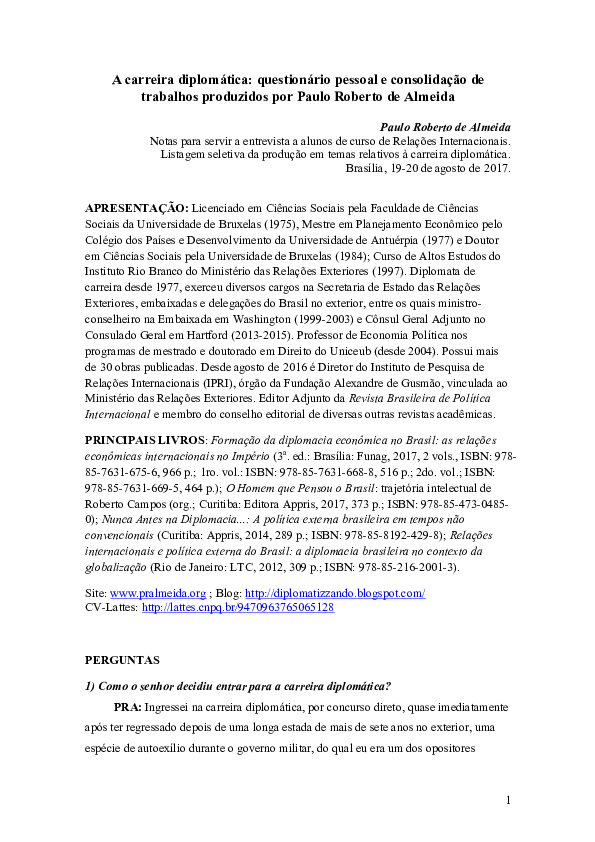
A carreira diplomatica: questionario pessoal e consolidacao de trabalhos produzidos por Paulo Roberto de Almeida
Paper Thumbnail
Author Photo Paulo Roberto de Almeida
View PDF ▸ Download PDF ⬇


ABSTRACT
Resposta a questionário sobre a carreira diplomática e listagem dos trabalhos pessoais sobre a preparação à carreira e o desempenho na diplomacia.

Your recent reading history:

De poderes, armas e um barão assinalado - Dante Lima (circulado entre diplomatas)

Uma crônica de um colega muito querido de todos os diplomatas: Dante Lima

DE PODERES, ARMAS E UM BARÃO ASSINALADO

“A diplomacia sem as armas é como a música sem os instrumentos”(Otto von Bismarck)

Mas, existem armas e armas. Há poder e poder.
“Soft power”. Foi o poder ao que aprendi a lançar mão ao longo de minha carreira como diplomata. Claro que houve situações em que a defesa dos interesses do Brasil e de cidadãos brasileiros me fizeram atuar no campo da “real politics", na diplomacia política ou consular. Não fiz mais que a minha obrigação de diplomata, nada que qualquer colega não teria feito. Essa é nossa missão.
Mas agindo assim, os diplomatas brasileiros recorrem ao nosso “soft power”, esse outro poder, essa idiossincrasia da nossa postura diplomática. Poder menos contundente na aparência, sem o “big stick” que - de resto - nunca brandimos. Mas, efetivo e eficiente na sua essência.
Não foi diferente comigo quando, sob instruções ou por índole ou afeição a esse jeito brasileiro de ser, vali-me dessa boa imagem de que goza o Brasil.
Acho que assim é que deve ser feito. Vale dizer, construir uma atmosfera de cordialidade e respeito em torno da diplomacia brasileira e de suas atitudes. Isso, é claro, emana da nossa escola e de nossa formação. Mas, sobretudo, do berço, desse berço esplêndido chamado Brasil.
“Soft power” e diplomacia cultural.
Lembro que cheguei a Belgrado com a bagagem carregada de quinquilharias alusivas ao Brasil, camisetas, flâmulas, bonés que eu comprei naquele espaço do Rio que chamam de Saara, antes da viagem, depois da sabatina no Senado em Brasília.
Foi assim que, poucas semanas antes da Copa do Mundo de 2006, a nossa Embaixada soube que a Prefeitura de Belgrado estava organizando uma mini-Copa do Mundo, com equipes de escolas primárias da cidade representado as 32 seleções da competição. Armaram um campinho de futsal com piso sintético na Trg República (Praça da República), no centro da cidade. Convoquei meus colaboradores e fomos pra lá conferir. Me apresentei ao Prefeito, e fiz distribuir regalos e mimos, inclusive a bola verde-amarela do jogo final: Brasil x Suécia. A Suécia foi a campeã. Mas os outros meninos também ganharam presentinhos.
Ao final das celebrações fui procurado por um grupo de pais dos alunos, que chamaram a atenção para o fato de que, dos 32 países da Copa, apenas o Embaixador do Brasil se fez presente, prestigiando a iniciativa.
A partir daí, e tão logo retornadas as aulas, recebi muitos convites de Diretores de escolas para apresentações sobre o Brasil. E foram muitas iniciativas da Embaixada, desde a participação em programas de rádio de fim de semana da BG-202, sobretudo o “Brazilska Corba” (literalmente, Sopa Brasileira) a exibição de filmes brasileiros na Cinemateca Iugoslava. Todo ano havia uma “Semana do Filme Brasileiro”.
Durante a Copa do Mundo de Futebol de 2006, a Embaixada fechou um espaçoso e popular “sports bar” em zona nobre de Belgrado. Farta distribuição de camisetas e adereços verde-amarelos. A fábrica de cerveja Jelen Pivo, na época pertencente à IMBEV, contribuiu para o patrocínio do evento.
Ademais, o Embaixador do Brasil passou a ser com frequência convidado para a entrega de medalhas em competições esportivas escolares. Não apenas na Capital, mas em cidades próximas.
Na área das chamadas “performing arts”, a Embaixada sempre patrocinou a participação do Brasil nos diferentes festivais de Belgrado, piano, violão, dança, jazz, etc.
Tudo isso não seria possível se o Brasil e os brasileiros não gozassem de uma ótima imagem e grande simpatia na alma e no coração dos sérvios, que nunca esqueceram o nosso apoio em momentos críticos da história recente da país, como a manutenção de nossa Embaixada aberta durante os bombardeios da OTAN em 1999 e no caso da secessão do Kossovo, província cuja independência unilateral o Brasil nunca reconheceu.
Dito isso, recordo ter recebido há dias uma mensagem de e-mail de um funcionário local da Embaixada em Abidjan, onde servi de 1983 a 1986. Sylla Mory Yaby;

“Je me rappelle très bien des nombreux matches ( jogos) de football organisés régulièrement, à votre initiative contre des équipes des villages environnant d'Abidjan. Je me souviens de votre l'initiative quand nous sommes allés jouer contre une équipe de villageois sur un terrain situé en pleine plantations de palmiers ( dênde ) dans la région de Bonoua, après la ville de Grand Bassam. C'était tellement vivant, cordial et amical avec tous ces villageois qui voyaient pour la première fois une équipe ( composés de brésiliens ) venir jouer contre eux. C'était une diplomatie de proximité que vous avez inventée.

Chef Dante, en plus de tout ce que je viens de relater, vous avez été pour moi quelqu'un de bien et un excellent Chef car, c'est vous qui m'avez tout faciliter en intégrant l'Ambassade, permis de me réaliser en créant aujourd'hui une famille heureuse. Merci pour cela. Qu'Allah vous bénisse et ainsi que tous les membres de votre Famille”.
Sylla faleceu logo depois.
Mas a memória do nosso soft power ficou por ali.
Ali e alhures onde pude exercê-lo com sentido de missão.

ZIRIGUIDUM IN SIGUIDUNUM
(ou o quase malogro de uma pretensa boa ideia)

Belgrado, Sérvia, Embaixada do Brasil. O povo sérvio gostava muito da cultura brasileira. Na Embaixada fazíamos muita coisa a baixo custo, como, por exemplo, os já populares “bate-papos com o Brasil” que a dedicada colega Rujiza criou e organizava. Aulas informais de língua e cultura brasileiras num bar da esquina, depois do expediente. Todo mundo gostava. Difusão cultural quase a custo zero.
A emissora local de rádio BG-202 criou um programa de uma hora aos sábados, dedicado à música e à cultura brasileira.
A Embaixada contribuía com uma módica subvenção e meu filho André fazia dupla com um jornalista sérvio na apresentação do programa. Eu cedia livros e discos que eram usados para transmissão e debates no programa. O programa de rádio levava para a emissão toda personalidade brasileira de passagem pelo país.
Eu até conhecia a expressão latina “Sutor, ne supra crepidam” (sapateiro, não vá além do sapato), mas não quis desperdiçar tamanho ambiente favorável e a avidez que eu via na sede de consumo cultural brasileira na Sérvia, e pretendi dar um passo mais largo que a própria perna. Menos mal que minha perna nunca foi assim muito longa…E fui além do sapato. . .
Uma vez sobrou uma graninha da dotação cultural da Embaixada. Pensei em levar adiante um projeto de difusão adicional da música brasileira no país.
Mas, afinal feitos os cálculos, faltaram uns caraminguás. Meti a mão na minha rasa algibeira e botei mais alguns cobres e produzimos uns CDs, com coletâneas de música brasileira. Impecavel seleção, modéstia à parte. Distribuição gratuita. Nada de venda, fui logo avisando.
Na hora de escolher o título do CD, deu-se um debate. E pretendi fazer-me de engraçado. Lembrei-me de uma instalação que a Prefeitura de Belgrado montara no alto da outrora fortaleza turca de Kalemegdan, que sobranceia o encontro das águas dos rios Danúbio e Sava. A pororoca balcânica. A tal instalação trazia a lista dos nomes que a capital tivera em diversas fases de sua longa história de país invadido e conquistado.
O primeiro nome de Belgrado fora SIGUIDUNUM, palavra de origem ceuta, remontando à época em que uma certa tribo ceuta colonizou a área no século III a.C., após a invasão gaulesa dos Bálcãs.
Perfeito. Estava criado o sonoro título do projeto: “Ziriguidum in Siguidunum”. Eu era mesmo um craque, pensei comigo, desses que gostam de brincar com as palavras. Que grande achado.

Mas, qual o que. Não vingou minha brilhante ideia. Ninguém, sérvio ou brasileiro, foi capaz de captar a mensagem do “amado Mestre”, como pretenderia o Rolando Lero, na Escolinha do Professor Raimundo.
Acabou sendo algo como o prosaico “o Brasil musical em Belgrado”.
Mas as músicas eram muito boas, tipo Tom e Vinícius, Chico, Caetano, Gil, Noel Rosa, Cartola e outros, escolhidos a dedo. E a coração.

Claro, o primeiro volume esgotou-se rapidamente. Meus amigos sérvios (mas não só) proprietários de barzinhos, pediram mais, tamanho o sucesso e a demanda. Não pude, contudo, deixar de estranhar. Fui lá conferir. E descobri que os caras estavam vendendo meus CDs. Quase chorei de raiva. Apesar da clara menção: “Slobodna distribucija, prodaja zabranjena” (Distribuição gratuita, venda proibida). E mandei produzir mais CDs.
Fazer o que?
“Soft power” é (mais ou menos) isso.
Dante Lima


Postagem em destaque

Livro Marxismo e Socialismo finalmente disponível - Paulo Roberto de Almeida

Meu mais recente livro – que não tem nada a ver com o governo atual ou com sua diplomacia esquizofrênica, já vou logo avisando – ficou final...