HOW TO TURN A ROUND TABLE INTO A PYRAMID: A LESSON IN CHINESE GEOMETRY FOR TRUMP AND PUTIN
Xi Jinping seated two presidents at a table of equals, then demonstrated who was really in charge without firing a single shot. A masterclass in diplomacy that the West will remember for a long time.
|
| |||||||||||||||


I. THREE PRESIDENTS AND ONE VERY PATIENT CHINESE MAN
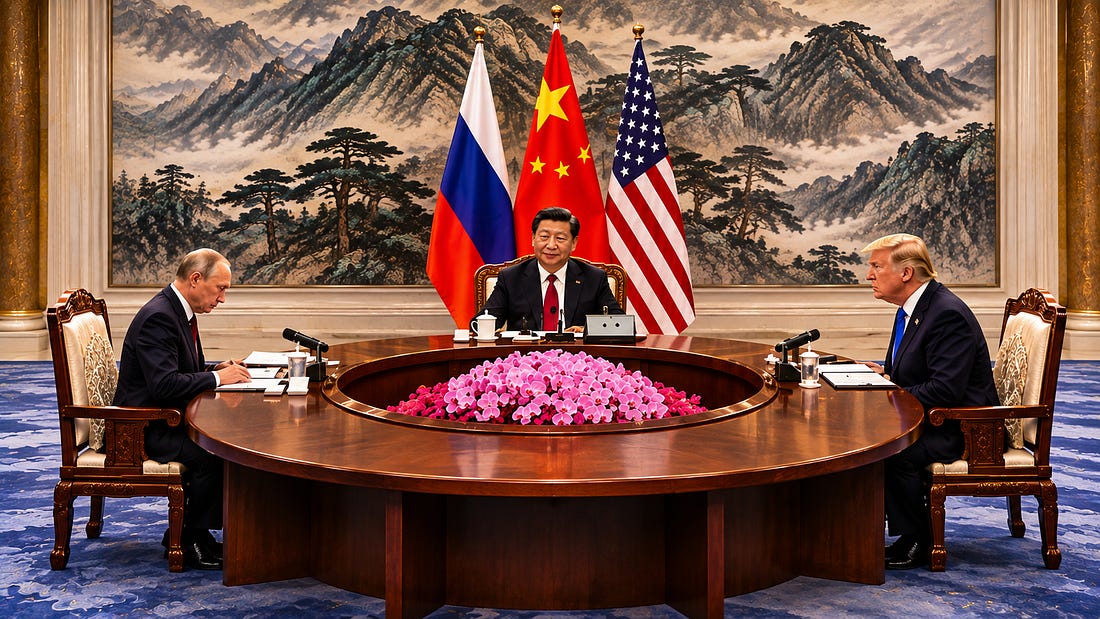 |
There is a wonderful principle in Chinese political philosophy: while Europeans argue, Americans threaten, and Russians wave their nuclear clubs around, a Chinese man sits quietly beside a river, waiting for the current to deliver everything he needs. Preferably along with the possessions of his drowned competitors. On November 19, 2026, Xi Jinping demonstrated precisely this ancient wisdom by staging a remarkable little diplomatic performance at his Kylin Villa residence in Shenzhen, featuring two exceptionally vain gentlemen: Donald Trump and Vladimir Putin. The performance was so elegantly arranged that both guests will probably spend months telling their citizens about their magnificent diplomatic victories, never suspecting that neither had been offered the leading role. One has spent almost five years trying to conquer Ukraine and still cannot even deal with Mala Tokmachka. The other has managed, in a relatively short period, to antagonize so many allies that compiling a list of countries offended by the American president is gradually becoming a separate branch of international statistics. And so these two giants of political thought arrived to meet a man who had been in no hurry whatsoever, had promised nobody anything, and had maintained an almost supernatural calm until the very last moment. Xi understood perfectly well that both men needed this meeting considerably more than he did. Putin needed to prove that Russia still belonged to the exclusive club of great powers. Trump needed to demonstrate his extraordinary ability to negotiate with absolutely anyone, preferably in front of several hundred cameras. The Chinese leader graciously allowed both men to obtain what they wanted. Naturally, within the boundaries of the stage he had prepared for them.
The beauty of the entire affair is that Xi did not need to deliver a historic speech, threaten tariffs, parade intercontinental missiles, or issue another ultimatum to demonstrate his superiority. He simply invited his guests to sit at a round table. What could possibly be more democratic? A circle has no corners, no beginning, no end, and no obvious seat of authority. That is precisely why diplomats have used such furniture for centuries whenever they need to accommodate several people, each firmly convinced that the planet revolves exclusively around his own personality. But Chinese civilization has existed long enough to understand something rather important: the absence of corners does not mean the absence of hierarchy. In the Middle Kingdom, the art of diplomatic humiliation was being perfected long before the United States, the Russian Federation, or the modern political television talk show had even been imagined. Ancient emperors did not need to explain to foreign ambassadors how insignificant their claims to global importance really were. It was enough to position the chairs correctly, establish the distance to the throne, determine the height of the platform, and decide who would be permitted to cross the threshold first. Modern China has absorbed these lessons remarkably well. And the Reuters photograph taken by Carlos Barria became a magnificent illustration of how two thousand years of diplomatic experience can defeat three presidential egos using nothing more sophisticated than furniture.
II. THE GEOMETRY LESSON TWO PRESIDENTS APPARENTLY MISSED
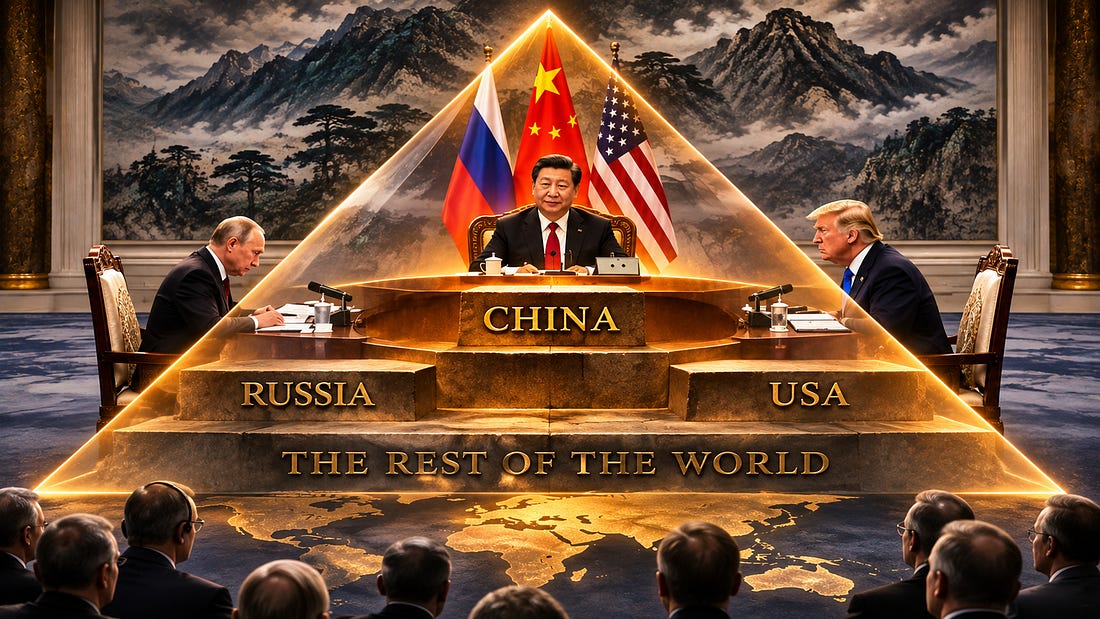
Imagine a simple exercise from a school mathematics textbook. You have a circle and three people who must be seated at equal distances from one another. Any reasonably attentive twelve-year-old could solve the problem in seconds: divide 360 degrees by three and position the chairs 120 degrees apart. The result is an equilateral triangle inscribed within a circle. No superior position, no subordinate position, complete geometric equality. This was apparently the symbolism that commentators at The National saw in the round table, suggesting that the Chinese organizers intended to demonstrate the equality of three nuclear powers. What charming innocence! The Chinese, of course, know their multiplication tables and are perfectly capable of dividing 360 by three. But they also understand something else: geometry is far too important a discipline to be entrusted exclusively to mathematicians. So the chairs were arranged quite differently. Xi Jinping occupied the twelve o'clock position on an imaginary clock face. Putin sat at nine o'clock, and Trump at three. The lower arc of the circle was thoughtfully left empty for photographers and television cameras. Instead of an equilateral triangle, the arrangement produced a composition with one central figure and two symmetrical supporting elements. The Chinese chairman faces the cameras directly, while the presidents of Russia and the United States are turned sideways toward him. What we are looking at is no longer a round table of equal powers. It is a carefully constructed visual pyramid. And at its summit sits a man who did not even bother to explain to the other two what had just happened.
 |
But the seating arrangement was only the beginning. Look at the national flags. The Russian tricolor, China's red banner, and the American Stars and Stripes were not positioned behind their respective presidents, as the elementary logic of diplomatic equality might suggest. All three flags were gathered directly behind Xi Jinping, with the Chinese flag rising precisely above his head. The resulting picture is extraordinary: Russia and America are symbolically present within a space whose undisputed center is China. Behind Putin, a bare pale wall. Behind Trump, another bare pale wall. Behind the Chinese chairman, three great powers, a traditional landscape featuring mountains and pine trees, and the entire carefully orchestrated grandeur of the state residence. Spain's El País explained the pine trees as a traditional Chinese symbol of hospitality. Quite possibly. But hospitality in this composition has a rather peculiar character: the host receives an entire symbolic universe, while the guests are permitted to admire its decorations. Completing the picture is an extravagant arrangement of pink orchids occupying the center of the table. The flowers are so abundant that if the two presidents wished to exchange glances, they would have to search for each other across an entire botanical garden. Perhaps that was precisely the intention. Why should Trump look at Putin, or Putin at Trump, when between them sits the man through whom they are now being invited to contemplate the rest of the world?
III. THE RIGHT HAND, THE LEFT HAND, AND THE CHINESE TRAP
The story of the Chinese chairman's right and left hands deserves particular admiration. Under modern international diplomatic protocol, the seat immediately to the host's right is traditionally considered the place of honor. That was where Vladimir Putin found himself. Russian propaganda immediately received a wonderful excuse for national celebration. Kremlin television commentators, as reported by the American network GPB, enthusiastically broadcast footage of the meeting, presenting it as proof that Moscow had finally returned to the highest league of world politics. After almost five years of war, sanctions, isolation, and endless speeches about multipolarity, Putin was finally sitting beside the president of the United States and the leader of China. And on the host's right-hand side, no less! What more could a man possibly want after once expecting to capture Kyiv in a matter of days? But this is where things become particularly entertaining. In traditional Chinese state ceremonial practice, the left side has historically enjoyed special precedence. And to Xi Jinping's left, as you may have guessed, sat Donald Trump. Thus, the Chinese organizers managed to award both guests a symbolic gold medal for first place. Putin could return home and announce that he had received the most prestigious seat according to international protocol. Trump could just as happily regard himself as the guest of honor according to Chinese tradition. Both could congratulate themselves on their diplomatic triumphs, while the only person who had actually assigned the seats and established the rules of the game remained Xi Jinping. It was the diplomatic equivalent of an old joke about two roosters, each assured that he had won the fight, while the farmer quietly collected the eggs.
Unfortunately for Moscow, the illusion of equality began to evaporate as soon as anyone looked beyond the round table. GPB analysts noted the revealing differences in the receptions organized for the two visitors. Xi personally came to the aircraft steps to welcome Trump, posed beside him for a joint photograph, and seated the American president at his own table during the official banquet. Putin received a considerably more modest airport reception and a separate table at dinner. Beijing was being exquisitely practical. The Russian president was given enough attention to demonstrate international recognition to his domestic audience, but not so much that anyone might mistake him for China's principal partner. Even during the three-way conversation itself, as The Times of Israel and El País emphasized, there were no ministers, advisers, or interpreters seated at the table. The three leaders were left alone before the cameras, without their usual entourages to lend the occasion the appearance of a grand international conference. Xi sat upright, calm, wearing a faint smile and a red tie matching the Chinese flag behind him, with a traditional covered teacup and only a minimum of paperwork before him. Putin hunched over a pile of documents like a student who had just discovered the examination questions and was desperately searching his notes for the answers. Trump, wearing a bright blue tie and accompanied by a thin folder, maintained his familiar presidential posture, looking across the orchids toward his Chinese host. And only China's state broadcaster CCTV made no particular effort to pretend that everyone was equal, explicitly describing Xi Jinping as chairing the meeting. While the guests searched for evidence of their own diplomatic victories, the host did not even consider concealing who was running the proceedings.
IV. A NEW YALTA TO WHICH EUROPE WAS NOT INVITED
Yet behind all this almost theatrical elegance lies something that is not remotely amusing. Three leaders of nuclear powers are sitting around a table discussing international relations without Ukraine, without the European Union, and without representatives of the countries whose futures are directly affected by the decisions of great powers. It is hardly surprising that commentators in TIME and The Guardian saw the historical shadow of the 1945 Yalta Conference hanging over the scene. Back then, Stalin, Roosevelt, and Churchill discussed the postwar organization of the world primarily through the interests of their own countries. Eight decades later, the suits, furniture, flags, and geographical location have changed, but the temptation to divide the planet into spheres of influence has not disappeared. Indeed, the photograph from Shenzhen seems almost deliberately designed to illustrate that temptation. Three men, three states, three nuclear arsenals, and an enormous world invited to observe proceedings from a respectful distance. Brookings Institution expert Patricia Kim pointed out in comments to Reuters that Beijing had carefully avoided mentioning either Ukraine or Iran, preferring general declarations about harmony among great powers. And that silence was perhaps more revealing than any official statement. Because diplomatic harmony that leaves no room for the victims of aggression can very easily become a convenient arrangement for coordinating the interests of those who possess sufficient military power.
This raises a question not so much for China as for the West itself. How did a world that spent eighty years after the Second World War constructing international institutions, proclaiming universal values, defending free trade, and promising never again to permit the partition of Europe find itself reduced to the role of spectator at a Chinese diplomatic performance? The answer is uncomfortable precisely because it consists of countless entirely deliberate decisions. For decades, Western countries transferred manufacturing to China, supplied it with technology, financed its industrial development, and convinced themselves that economic integration would inevitably produce political liberalization. At the same time, European governments purchased Russian energy, American administrations alternated between attempts to reset relations with Moscow and efforts to negotiate strategic stability, and international organizations increasingly discovered that their resolutions were worth very little without the willingness to defend their own principles. Meanwhile, China was building factories, ports, railways, a navy, and its own system of global influence. It did not need to stage daily tantrums, demand immediate recognition of its greatness, or announce the arrival of a new world order after every telephone conversation. It simply worked toward the future. And now Chairman Xi can afford the luxury of sitting at the center of a round table while the presidents of two other powers explain to their voters why their particular seats were the most prestigious.
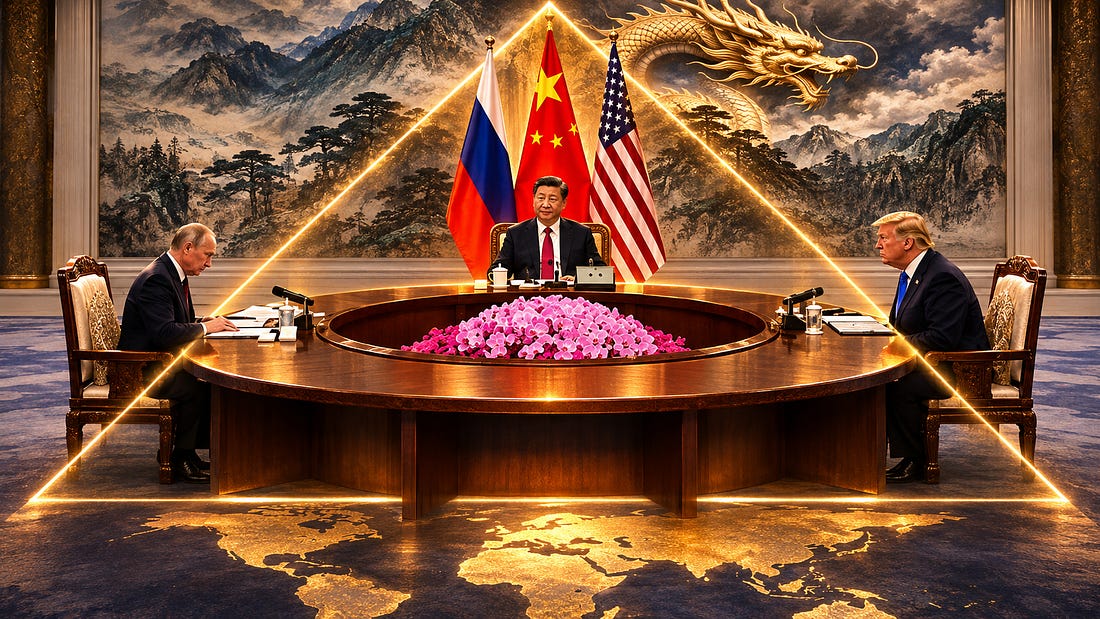 |
Of course, we should not confuse an expertly staged photograph with the final distribution of global power. China remains an extraordinarily powerful country, but neither the United States nor Europe, and certainly not Ukraine, has disappeared from the political map merely because Chinese protocol decided to demonstrate the host's superiority. Nevertheless, the symbolism of this scene is impossible to ignore. Putin, who dreamed of a new Yalta and of Russia being recognized as an equal master of the world, found himself playing a supporting role in a Chinese production. Trump, accustomed to turning every international meeting into a demonstration of his personal magnificence, unexpectedly discovered himself incorporated into someone else's composition. And Xi Jinping obtained exactly what he wanted: an image in which two of the loudest claimants to global leadership sit on either side of him, almost like specially invited witnesses to a historic shift in the balance of power. The most remarkable thing is that he never even had to raise his voice. A few chairs, three flags, a bed of orchids, and a photographer provided with the perfect position were sufficient.
That is the central lesson of Chinese geometry. You can call a table round as often as you like, but when one man chooses the seats, arranges the flags, determines the camera angles, and chairs the meeting, equality exists primarily in the imagination of the invited guests. The West spent far too long assuming that the international order it had created would continue functioning automatically, without constant effort to defend it. Now it is being shown how easily that order can be transformed into an elegant backdrop for an entirely different political architecture. And the bitterest irony is watching certain Western leaders help construct that architecture themselves, convinced that the place at the summit has been reserved especially for them.
Now take another look at the photograph from Shenzhen. Are you really looking at a round table of three equal powers? Or at a pyramid whose summit is occupied by a man who managed to convince the other two that they, too, were sitting at the top?


Nenhum comentário:
Postar um comentário