terça-feira, 25 de março de 2025

Consolidating Europe’s Eastern Frontiers: the Options for Ukraine and the Continent - Andriy Zagorodnyuk, Alina Frolova and Oleksandr Khara (RUSI)

Um relatório sobre a segurança das fronteiras europeias e que também tem a ver com a paz e a segurança internacional, num momento em que o suposto líder do Ocidente abandona seus aliados europeus e da OTAN e se torna grande amigo do maior autocrata mundial e promotor de violações em série do Direito Internacional.
A questão não interessa apenas à Europa centra e oriental, e sim ao mundo inteiro, assim como ao futuro do multilateralismo, atualmente em perigo de desaparecer.

Consolidating Europe’s Eastern Frontiers: the Options for Ukraine and the Continent


Andriy Zagorodnyuk, Alina Frolova and Oleksandr Khara

RUSI, 
Royal United Services Institute)


Come a ceasefire in Ukraine, the border to Europe’s East will remain a line of tension with no end in sight, necessitating new concepts for collective defence.

Almost two months into President Trump’s tenure in the White House, his promised and highly publicised quick resolution of Russia’s war in Ukraine remains as unclear and confusing as ever. Following a controversial Oval Office meeting with President Zelensky, Ukraine took steps to mend relations with the US administration, first proposing a staged ceasefirelater accepting a US proposal for a 30-day ceasefire and most recently a ceasefire on energy infrastructure.

Moscow’s position – that it seeks a comprehensive agreement rather than interim measures – is a familiar tactic. Russia wants to signal that it is in no hurry, while continuing to use violence as leverage against Ukraine and, more importantly, against a US administration eager for a quick resolution. It remains highly uncertain whether any ceasefire will actually take hold and be upheld – and, crucially, whether the US will press for more concessions from Russia or from Ukraine.

For Ukraine, the prospect of a sustainable end to the war is undoubtedly a commendable goal. There is no doubt that the country is suffering gravely from the violence, and peace remains its greatest aspiration. However, the credibility and reliability of any peace arrangements are absolutely critical to ensure – peace will only be as robust as the means by which it is protected.

Russia’s Approach to Negotiations

Amidst the uncertainty and contradictions surrounding the US-led peace efforts, as well as Washington’s shift to deprioritise European security, Russia’s fundamental objectives remain unchanged. Intelligence specialists and analysts widely agree that Russia continues to pursue its original strategy of undermining Ukraine and Europe’s security architecture. Every action Moscow takes is ultimately geared towards achieving these enduring goals.

Feeling relatively secure in its current position and ready to exploit the US administration’s stated commitment to ending the war through diplomacy, Russia has two options. Either continue hostilities or attempt to gain an advantage through diplomatic manoeuvres. Any diplomatic breakthrough that Russia achieves will, however, be incorporated into its broader grand strategy. There is a high probability that the Kremlin will then use any cessation or reduction of hostilities to prepare for the next phase of its military campaign. If the US manages to broker a comprehensive ceasefire, Russia will likely treat it as an operational or strategic pause, a window of opportunity to strengthen its position before launching a decisive strike.

If Moscow manages to negotiate the lifting of sanctions in exchange for a ceasefire, its militarised economy will quickly regain strength, and in a very short time Russia could once again emerge as a formidable military force

Should this plan succeed, a renewed Russian offensive could deal a devastating blow both to Ukraine and to Europe’s security. Moscow views the current situation as a historic opportunity, where a convergence of favourable conditions creates the perfect storm. The US administration no longer considers the Russian regime an outright adversary and has repeatedly failed to condemn its numerous war crimes and genocidal policies. It refuses to identify Russia as the aggressor and openly discusses "enormous economic opportunities" and the prospect of normalisation – something that, until now, would have been unthinkable.

The United States Risks Facilitating Further Russian Aggression

As the cornerstone of NATO and European security, the United States’ ambiguous position creates deep uncertainty about its response should Russian aggression expand into other European countries. If Moscow manages to negotiate the lifting of sanctions in exchange for a ceasefire, its militarised economy will quickly regain strength, and in a very short time Russia could once again emerge as a formidable military force.

Today, Russia is exhausted and severely weakened by its military failures in Ukraine. It lacks the ability to amass the necessary mass of equipment, and it is visibly running out of personnel. Equally significant is the fact that its warfighting methods are no longer effective – even the brutal human-wave assaults that proved successful in 2023 and 2024 are now failing to deliver decisive results.

A ceasefire would provide Russia with the time it needs to reassess its approach and rebuild a military force based on new operational concepts. The Russian war economy is too deeply entrenched to be quickly dismantled or converted back to a civilian model, but it is unlikely that de-escalation is even a strategic objective. Instead, Moscow is likely to be motivated by a drive to compensate for past underperformance coupled with a sense of strategic opportunity created by US policy shifts. A ceasefire is, therefore, likely to lead to a dramatic new phase of Russian militarisation.

Historical precedents support this possibility. Iraq’s military re-emerged in 1991 after enduring the hardships of the Iran-Iraq War, while revanchist ambitions fuelled Nazi Germany’s military expansion following early setbacks. Russia may well follow a similar trajectory, using the lessons of this war to rebuild an even stronger force and emerge from its war of attrition in Ukraine with a revamped military – its own version of a new ‘Grande Armée’.


The mere presence of such a revitalised Russian force along Europe’s borders would constitute an existential threat to its neighbours, granting Moscow immense leverage over the region. Beyond direct military pressure, Russia would certainly employ a full spectrum of hybrid warfare tactics, including political coercion, cyber operations, and economic manipulation. It could also destabilise multiple regions, including the Arctic, the Baltic, Balkans, Poland, the Black Sea, and the Mediterranean. Ukraine, of course, would remain at the highest risk, with a renewed Russian offensive highly probable.

If the Black Sea Straits are reopened, it would enable Moscow to rebuild its Black Sea Fleet, once again posing a threat to freedom of navigation, endangering Ukrainian ports, and extending the threat to Moldova from the maritime domain.

The Imperative of Building European Deterrence

The only way to prevent this scenario is to recognise the severity of the threat and build a force capable of making Russian aggression futile. Given Russia’s demonstrated willingness to absorb significant losses, deterrence by punishment is unlikely to be effective. Instead, only deterrence by denial – ensuring that any future attack would be impossible or overwhelmingly costly – can secure lasting peace in the region.

This deterrence strategy must no longer be viewed as simply assisting Ukraine in isolation from NATO Europe. Russia has long been recognised as a pan-European threat – while Ukraine remains Putin’s primary focus, it is not his only target. Therefore, deterrence must be pan-European, treating Ukraine’s security as an integral part of the broader European defence architecture. While the Europeans are trying to persuade US administration to provide them with a backstop, the probability, extent and reliability of such support are unclear.

The most effective way for coalition governments and militaries to engage fully is to launch a dedicated operation aimed at countering the risk of a renewed Russian attack

As the existing structures of NATO and the EU cannot serve as the foundation for this effort, the only viable solution is the formation of a coalition of the willing, committed to ensuring that Russia is permanently denied the ability to wage expansionist war. Security arrangements must incorporate all fundamental elements of effective deterrence: they must be credible, rooted in capabilities proportionate to the threat, and clearly communicated to both Russia and the wider international community.

Moreover, they must be built on concepts of future warfare rather than outdated strategies. Legacy methods will prove ineffective against a Russian force that has adapted its doctrine based on lessons learned and technological advancements.

One of the key lessons from three years of war is that the most effective way for coalition governments and militaries to engage fully is to launch a dedicated operation aimed at countering the risk of a renewed Russian attack. Such an operation should be coordinated through a joint headquarters, with each participating state undertaking the necessary organisational steps within their respective ministries of defence to ensure its implementation. Those familiar with military structures understand that only an active, ongoing operation enables proper resource allocation, rapid decision-making, and the deployment of dedicated personnel. Military actions must be governed by structured operational planning, integrated command structures, and strict operational timelines.

For the purposes of this article, such an operation will be referred to as the Eastern Frontier Operation.

Integrating Ukraine’s Defence into European Deterrence

The coalition participants must recognise that Russia will be vocally opposed to this initiative from the outset. Moscow has a well-established pattern of justifying its aggression through victim-blaming narratives, claiming that the ‘true causes’ of the war lie elsewhere. Every instance of international military cooperation with Ukraine has been framed by Russia as a provocation or justification for its own aggression.

Policymakers must be fully aware of these tactics, resist falling into Russia’s narrative traps, and remain firm in establishing robust security arrangements. Any form of self-deterrence in setting up these measures would weaken the region and increase the risk of renewed hostilities.

As of now, we can identify seven potential formats in which Western forces could participate in the operation

The Ukrainian component of the Eastern Frontier Operation must be designed to enable Ukraine to withstand and successfully repel a potential future full-scale Russian attack. This comprehensive defensive capability should integrate the Ukrainian defence forces, the country’s full mobilisation potential, and dedicated resources provided by allied nations.

The operational framework must be structured as a multi-domain effort, encompassing the generation, sustainment, and deployment of capabilities across land, air, maritime, cyber, and information domains. Implementing this strategy will be an extremely complex undertaking, requiring meticulous planning and substantial contributions from coalition participants. As of now, we can identify seven potential formats in which Western forces could participate in the operation.

The most committed form of participation would be the direct deployment of troops in Ukraine, with active engagement in the event of renewed Russian aggression. This scenario, often referred to as ‘boots on the ground’, has been widely debated. The presence of land forces may, however, be less effective compared to other strategic options. A more impactful approach could be ‘airmen boots’ – the deployment of aerial and air defence units to protect Ukrainian airspace from Russian strikes.

One of the most compelling alternative proposals is a ‘Sky Shield over Ukraine’, a concept involving the air policing of Ukrainian airspace, particularly over its western and central regions, to defend against Russian missile and air strikes. This initiative could establish a large safe zone, enabling social stability and economic recovery, while allowing the Ukrainian Air Force to concentrate its resources on defending the eastern front.

Past phases of the Russo-Ukrainian war have been marked by repeated ceasefire violations and mutual accusations, which the OSCE Special Monitoring Mission failed to address effectively due to its limited access and inadequate equipment

A third option for Western assistance could be monitoring the ceasefire. A dedicated monitoring mission, equipped with advanced technology and surveillance tools, would be essential to maintaining constant situational awareness. Past phases of the Russo-Ukrainian war have been marked by repeated ceasefire violations and mutual accusations, which the OSCE Special Monitoring Mission failed to address effectively due to its limited access and inadequate equipment.

A fourth option involves remote capability support, including the provision of real-time intelligence, training, technical advice, and maintenance. This could also extend to remote operations, such as defensive cyber operations and information warfare, which would strengthen Ukraine’s ability to counter Russian aggression without requiring a direct Western presence.

A fifth option is the creation of strategic reserves for Ukraine in the form of pre-positioned military assets and capabilities. These resources would be immediately available, stored in secure locations in Eastern Europe, and operated by the coalition headquarters. Such facilities could function as a network of depots, housing weapons, ammunition, and essential military equipment near Ukraine’s borders. In the event of renewed hostilities, these reserves would enable the rapid mobilisation and rearmament of Ukrainian forces, allowing them to counter a large-scale Russian offensive effectively. These warehouses would store additional armaments, spare parts, ammunition, expendables, communication systems, and other critical supplies.

Another crucial form of support would be the direct provision of modern Western equipment to Ukraine’s defence forces. The most pressing requirement is sufficient ground-based air defence systems and advanced tactical aviation to prevent Russia from establishing air superiority. If Ukraine achieves air dominance over its own territory, the likelihood of a renewed Russian offensive will be significantly reduced.

Ukraine must have long-range missile systems capable of striking deep into enemy territory, targeting command and control centres, logistics hubs, and supply lines

Additionally, Ukraine must have long-range missile systems capable of striking deep into enemy territory, targeting command and control centres, logistics hubs, and supply lines. Precision strikes on these key assets would significantly weaken Russia’s capacity to sustain large-scale military operations.

While warfare technologies continue to evolve, certain core military assets remain indispensable. Ukraine will continue to require artillery, MRAPs (mine-resistant ambush-protected vehicles), and firearms, all of which are essential for sustained ground operations.

Finally, the allies can further strengthen Ukraine’s long-term defence capabilities by enhancing support for its domestic defence industry, particularly in areas where Ukraine is already technologically advanced. The development of Ukraine’s defence sector is well underway and should be expanded and accelerated. This includes investment in unmanned systems, electronic warfare technologies, and other critical defence innovations.

Building a force capable of credibly deterring and repelling Russian aggression will be a formidable challenge. However, the coalition’s collective technological, industrial, and economic resources far exceed those of Russia, making this goal fully achievable. Through joint efforts, a unified threat assessment, decisive action, and resilience against Russian intimidation, the coalition can forge a security framework that ensures long-term peace and stability across the region.


© Andriy Zogorodnyuk, Alina Frolova and Oleksandr Khara, 2025, published by RUSI with permission of the authors.

The views expressed in this Commentary are the authors’, and do not represent those of RUSI or any other institution.

 

Nuvens negras começam a amontoar no horizonte - Paulo Roberto de Almeida

Nuvens negras começam a amontoar no horizonte

Paulo Roberto de Almeida

 Não gostaria de ser ave de mau agouro, mas ao analisar os dados e os debates da atualidade corrente, estou vendo no horizonte algumas nuvens negras para os próximos meses, no segundo semestre e no começo de 2026:

1) Os americanos vão despertar num país muito pior do que na atualidade, com mais inflação, mais recessão, mais conflitos externos e uma desafeição geral dos países europeus e parte considerável do assim chamado Sul Global em relação ao Trump e aos EUA, e portanto, uma aproximação com a China, que está se comportando de maneira a confirmar isso: um elefante na loja de cristais, enquanto a China só observa e retira benefícios desse retraimento do outrora grande líder do Ocidente (agora um vulgar amigo de um procurado pelo TPI, aliás dois, Putin, um assassino cleptocratra confirmado, e Netanyahu, um genocida também incluído no rol dos criminosos de guerra).
2) Os brasileiros vão descobrir que as políticas distributivistas e assistencialistas de Lula não vão conseguir baixar a inflação, e vão continuar tão endividados quanto são, atualmente. A política vai continuar polarizada, os partidos do Centrão (traidores como sempre foram) não vão garantir o apoio que o governo precisa para passar seus projetos, sobretudo os fiscais e tributários. As pesquisas de opinião vão continuar negativas, o que levará o governo a aprofundar o populismo, o que só vai servir, consequentemente, para deteriorar ainda mais o cenário econômico. Ou seja, uma corrida ladeira abaixo.

O duro está em suportar, mais do que a desfaçatez da aristocracia do Judiciário, com seus penduricalhos pornográficos e a esbórnia com o dinheiro público, a prepotência de Trump e seus aspones desqualificados. Eles conseguiram perturbar, com a ajuda de Putin, a segurança e a paz no mundo, e vão levar à aceleração da fragmentação do cenário internacional.

Sorry pelo pessimismo, again...
Paulo Roberto de Almeida
Brasília, 25 de março de 2025

Trapaça econômica na Argentina: a manipulação do câmbio por Javier Milei - Marcelo Guterman

Trapaça econômica


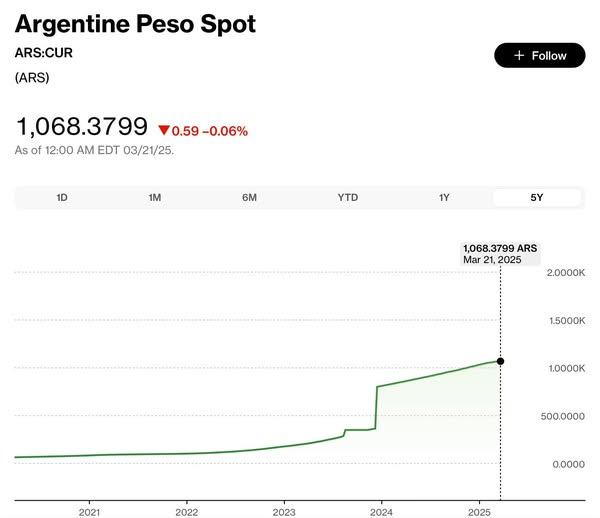
Quando Milei assumiu, empunhando a sua motosserra, apontei uma inconsistência grave de sua política macroeconômica: ao invés de liberar o câmbio, Milei optou por uma maxidesvalorização do peso e subsequente regime de câmbio administrado. Era o justo oposto de alguém que havia prometido acabar com o Banco Central e adotar o dólar como moeda.

Seus fãs o defenderam, dizendo que não dava para liberar o câmbio logo de cara, com todas as distorções acumuladas pela economia argentina nas últimas décadas. Era preciso, primeiro, arrumar a casa, para, depois, liberar o câmbio. Justo. Ainda que, observei, esse tipo de política vai armando uma armadilha ao longo do tempo, pois o câmbio administrado é uma espécie de crack, que vai viciando o usuário ao longo do tempo, ao permitir ancorar a inflação sem muito esforço.

O gráfico do peso argentino (abaixo) é idêntico ao gráfico do Real entre 1995 e 1999, quando adotamos o mesmo regime de câmbio administrado.

Durou quase 4 anos, mas foi pelos ares depois da crise que se abateu sobre os mercados emergentes, atingindo México em 1995, tigres asiáticos em 1997, Rússia em 1998, Brasil em 1999 e, finalmente, Argentina em 2001, todos obrigados a abandonar regimes de câmbios administrados. No Brasil, substituímos o câmbio administrado pelas taxas de juros mais altas do mundo, pois não conseguimos eliminar as distorções de nossa economia. Deste grupo, a Argentina foi a única que voltou a administrar o câmbio, e, não coincidentemente, o único que ainda depende do FMI para enfrentar crises de balanço de pagamentos.

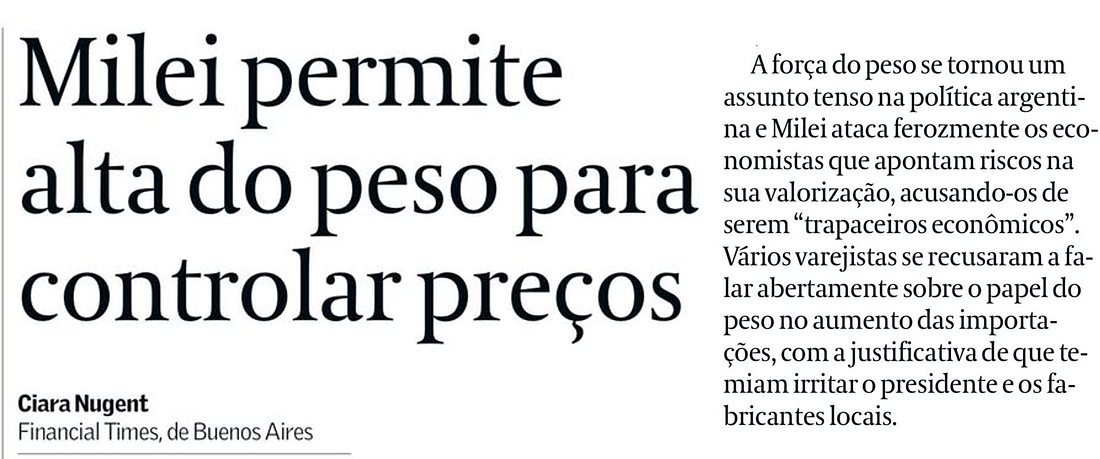
Milei chama de “trapaceiros econômicos” aqueles que apontam as distorções que voltam a se acumular na economia argentina. Na verdade, é o câmbio administrado a verdadeira trapaça econômica.

Blog do Marcelo Guterman é uma publicação apoiada pelos leitores.


China Has Already Remade the International System - Michael B.G. Froman (Foreign Affairs) (via Mauricio David)

 Dica de leitura, proposta por Mauricio David

(repostando um trabalho que elaborei recentemente para uma aula: 4869. “Relações Estados Unidos-China: uma visão não imperial”, Brasília, 11 março 2025, 7 p. Notas para aula, Disponível na plataforma Academia.edu (link: https://www.academia.edu/128207302/4869_Relacoes_Estados_Unidos_China_consideracoes_historico_geopoliticas_2025_); blog Diplomatizzando (14/03/2025, link: https://diplomatizzando.blogspot.com/2025/03/relacoes-estados-unidos-china.html).


 "China Has Already Remade the International System- How the World Adopted Beijing's Economic Playbook" (by Michael B.G. Froman-Presidente do Council on Foreign Relations)


Chamo a atenção dos nossos interlocutores que se interessam pela economia política internacional - em especial os nossos queridos e admirados embaixador Rubens Ricupero (ex-diretor geral da Unctad por dois períodos) – e o embaixador Paulo Roberto de Almeida (o mais prolífico dos experts do Itamaraty em política internacional) – para este artigo do Presidente do Council on Foreign Affairs sobre as reconfigurações do Sistema Internacional. Em um ensaio com dados e análises relevantes, o Presidente do Council on Foreign Affairs introduz considerações de extrema relevância para que possamos entender o conflito entre a China e os Estados Unidos que está em curso. Ao contrário das análises tolas e superficiais que vicejam na nossa grande imprensa escrita e televisada ( confesso que não aguento mais ler e ouvir as análises sobre o que chamam de “guerra tarifária” supostamente iniciada por Trump – todos eles bradam veementemente sobre o iminente fracasso das medidas protecionistas de Trump, o “demônio solto na arena internacional...”, misturando previsões catastrofistas com desejos ocultos que só Freud poderia explicar...

Por tudo isto, o artigo do Michael Froman merece uma leitura e reflexão atenta, o que muito recomendo...

MD

.-.-.-.-.-.-.-.-.-.-.-.-.-.-.-.-.-.-.-. 

... In the 1990s and the early years of this century, there was every indication that China was on an inexorable march toward economic liberalization. Building on a process that began in the late 1970s under the Chinese leader Deng Xiaoping, China opened up to foreign investment. President Jiang Zemin and Premier Zhu Rongji then kept China on a remarkable, if painful, path of economic reforms. They restructured state-owned enterprises and fired tens of millions of their workers, created more space for private sector activity, allowed businesses to adjust prices in response to market conditions, and ushered in China’s entry to the World Trade Organization...

... From 2009 to 2017, I served first as deputy national security adviser for international economic affairs and then as U.S. trade representative. During that time, I consistently warned my Chinese counterparts that the benign international environment that had enabled China’s success would disappear unless Beijing modified its predatory economic policies. Instead, China largely maintained its course of action. If anything, it doubled down on its approach. When Xi came to power in 2012, he effectively ended the era of “reform and opening” that had already stalled under Hu, set China on a course to dominate critical technologies, increased production to the point of overcapacity, and committed to export-led growth. Today, as the economist Brad Setser has noted, China’s export volume is growing at a rate three times as fast as global trade. In the automotive sector, it is on a trajectory to have the capacity to produce two-thirds of the world’s automotive demand. And its dominance extends beyond cars; China also produces more than half the global supply of steel, aluminum, and ships...

... China’s electric vehicle manufacturers innovate faster and produce high-quality vehicles far more cheaply than U.S. firms; some Chinese vehicles are as much as 50 percent less expensive than their American equivalents, and China accounts for nearly 60 percent of global electric vehicle sales worldwide. China’s battery producers, solar panel manufacturers, and clean energy equipment companies have similar advantages...

...  it is important to recognize a fundamental truth: the United States is now operating largely in accordance with Beijing’s standards, with a new economic model characterized by protectionism, constraints on foreign investment, subsidies, and industrial policy—essentially nationalist state capitalism...

... In the war over who gets to define the rules of the road, the battle is over, at least for now. And China won...

.-.-.-.-.-.-.-.-.-.-.-.-


China Has Already Remade the International System

How the World Adopted Beijing’s Economic Playbook

Michael B. G. Froman

Foreign Affairs, March 25, 2025


MICHAEL B. G. FROMAN is President of the Council on Foreign Relations. He served as U.S. Trade Representative from 2013 to 2017 and Deputy National Security Adviser for International Economic Affairs from 2009 to 2013.


In early February, as he flew in Air Force One above the body of water he’d recently renamed the Gulf of America, President Donald Trump declared that he would levy tariffs on all imported steel and aluminum. Two weeks later, he issued a presidential memorandum laying out new guidance for screening investment from Chinese firms in the United States and U.S. firms into China. And throughout the early weeks of his administration, Trump has emphasized the importance of bringing manufacturing back home, telling firms that, to avoid tariffs, they should make their products in the United States.

Tariffs and protectionism, restrictions on investment, measures designed to drive domestic production: Washington’s economic policy suddenly looks an awful lot like Beijing’s policies over the last decade or so—like Chinese policy with American characteristics.

The U.S. strategy of engagement with China was based on the premise that, if the United States incorporated China into the global rules-based system, China would become more like the United States. For decades, Washington lectured Beijing about avoiding protectionism, eliminating barriers to foreign investment, and disciplining the use of subsidies and industrial policy—with only modest success. Still, the expectation was that integration would facilitate convergence.

There has indeed been a fair degree of convergence—just not in the way American policymakers predicted. Instead of China coming to resemble the United States, the United States is behaving more like China. Washington may have forged the open, liberal rules-based order, but China has defined its next phase: protectionism, subsidization, restrictions on foreign investment, and industrial policy. To argue that the United States must reassert its leadership to preserve the rules-based system it established is to miss the point. China’s nationalist state capitalism now dominates the international economic order. Washington is already living in Beijing’s world.

OPENING UP?

In the 1990s and the early years of this century, there was every indication that China was on an inexorable march toward economic liberalization. Building on a process that began in the late 1970s under the Chinese leader Deng Xiaoping, China opened up to foreign investment. President Jiang Zemin and Premier Zhu Rongji then kept China on a remarkable, if painful, path of economic reforms. They restructured state-owned enterprises and fired tens of millions of their workers, created more space for private sector activity, allowed businesses to adjust prices in response to market conditions, and ushered in China’s entry to the World Trade Organization.

Jiang and Zhu declared repeatedly that China would inevitably continue to open up. Many in the West went so far as to believe that this economic liberalization would lead to China’s political liberalization, that a capitalist society would become a more democratic one over time. That assumption proved false. China’s leaders never seriously contemplated political reform, but China’s economic advancement was impressive nonetheless. The country’s GDP grew from $347.77 billion in 1989 to $1.66 trillion by 2003 to $17.79 trillion in 2023, according to the World Bank. Hopes were high that integrating China into the rules-based trading system could lead to a more peaceful and more prosperous world. Globalization did lift more than a billion people out of poverty, an astounding feat. But the benefits of that progress were not evenly shared, and some workers and communities in industrialized countries ended up paying the price for the rise of the rest.

Then President Hu Jintao entered the picture, followed by President Xi Jinping. China’s economic trajectory turned out to be less linear and less inevitable than initially expected. Under Hu, China leaned more heavily into state intervention in the economy by aiming to create “national champions” in strategic sectors through massive subsidies. In other words, the government expanded its role rather than pursuing further market liberalization. At the same time, a flood of cheap Chinese imports accelerated the trend toward deindustrialization in the United States—and did so at a rate that few, if any, fully anticipated. China became the world’s manufacturing floor, overtaking the manufacturing giants of Japan and Germany in the first decade of this century. In 2004, China made up nine percent of the world’s manufacturing value added, leapfrogging to a massive 29 percent in 2023, according to the World Bank.

HOW CHINA WON

Washington pressed Beijing to deliver on its reform agenda throughout this period, urging China to open its markets and refrain from imposing high tariffs and other barriers on products being exported from the United States. It advocated for U.S. firms to be allowed to invest in China without being excluded from certain sectors or required to enter joint ventures with—and transfer U.S. technology to—local firms. And Washington demanded that the Chinese government stop subsidizing the production and export of goods, which distorted the global marketplace. But this litany of complaints fell largely on deaf ears.

In 2009, the Obama administration led an effort to terminate the Doha Round—a multilateral trade negotiation under the WTO launched in 2001. It did so in large part because the resulting agreement would have enshrined China permanently as a “developing country” under WTO rules. This would have allowed China to enjoy “special and differential treatment,” which meant that China would have been able to avoid assuming the same level of obligations and disciplines—on market access, intellectual property rights protection, and other issues—as the United States and other industrial countries. Washington faced near-universal criticism at the time for encouraging a rethink of the premises of the negotiation. But it was clear even then that, left unaddressed, China’s economic practices would significantly disrupt the global trading system.

The United States is already living in China’s world.

Similar concerns motivated the Obama administration to pursue the Trans-Pacific Partnership (TPP), a high-standard trade agreement negotiated among 12 countries around the Pacific Rim. This initiative was designed to give countries in the Asia-Pacific region an attractive alternative to the model China offered. It brought together a group of diverse countries that were willing to set strong labor and environmental protections, limit the use of subsidies, impose discipline on state-owned enterprises, and address various China-specific concerns, such as intellectual property rights protection. By the time TPP negotiations were completed in 2015, however, trade agreements—even those designed to counterbalance China—had become politically toxic at home, and the United States ended up pulling out of the agreement.

From 2009 to 2017, I served first as deputy national security adviser for international economic affairs and then as U.S. trade representative. During that time, I consistently warned my Chinese counterparts that the benign international environment that had enabled China’s success would disappear unless Beijing modified its predatory economic policies. Instead, China largely maintained its course of action. If anything, it doubled down on its approach. When Xi came to power in 2012, he effectively ended the era of “reform and opening” that had already stalled under Hu, set China on a course to dominate critical technologies, increased production to the point of overcapacity, and committed to export-led growth. Today, as the economist Brad Setser has noted, China’s export volume is growing at a rate three times as fast as global trade. In the automotive sector, it is on a trajectory to have the capacity to produce two-thirds of the world’s automotive demand. And its dominance extends beyond cars; China also produces more than half the global supply of steel, aluminum, and ships.

Eventually, even American businesses, which had always been the ballast in the bilateral relationship, soured on China as their intellectual property was stolen or forcibly licensed, their market access to China was severely restricted or delayed, and China’s subsidies and preferences for domestic firms ate into their opportunity. Without any semblance of reciprocity, the relationship deteriorated. Politicians of both parties and the American public hardened their stance on China. European and major emerging economies grew hostile to Beijing’s policies, as well. In short, the benign international environment disappeared.

Working on an electric vehicle production line in Zhejiang province, China, March 2025Working on an electric vehicle production line in Zhejiang province, China, March 2025Florence Lo / Reuters


Washington, having failed to convince Beijing to change its predatory economic policies or to move forward with an alternative trading bloc to counterbalance China, was left with one option: the United States had to become more like China. After decades of berating China for imposing high tariffs and other restrictions on U.S. exports, the United States is now putting up the same barriers. As calculated by the economist Chad Bown, Trump imposed tariffs that increased the average rate on imports from China from three percent to 19 percent in his first administration, covering two-thirds of all imports from China. President Joe Biden maintained those tariffs and added tariffs on other Chinese products, including personal protective equipment, electric vehicles, batteries, and steel, slightly increasing the average tariff on imports from China. Less than two months into his second administration, Trump has imposed an additional 20 percent tariff on all U.S. imports from China—a bigger move than the tariffs of his first administration and the Biden administration combined.

Similarly, the United States changed its approach from opposing barriers to most bilateral investment flows to severely restricting China’s investment in the United States and U.S. investment in certain sensitive sectors in China. Annual Chinese investment in the United States plummeted from $46 billion in 2016 to less than $5 billion in 2022, according to the Rhodium Group. And, having urged Beijing to abandon subsidy and industrial policies, Washington itself went all-in on industrial policy during the Biden administration, laying out at least $1.6 trillion on the 2021 Infrastructure Investment and Jobs Act, the 2022 CHIPS and Science Act, and the 2022 Inflation Reduction Act.

IF YOU CAN’T BEAT THEM, JOIN THEM

To take the Chinese approach one step further could mean adopting a key tool in Beijing’s toolbox: requiring Chinese firms that invest abroad to establish joint ventures with domestic firms and engage in technology transfers. Such a strategy could enhance not just American industrial competitiveness but also that of other countries negatively affected by China’s overcapacity, including many in Europe.

Take the clean energy sector as an obvious example. China’s electric vehicle manufacturers innovate faster and produce high-quality vehicles far more cheaply than U.S. firms; some Chinese vehicles are as much as 50 percent less expensive than their American equivalents, and China accounts for nearly 60 percent of global electric vehicle sales worldwide. China’s battery producers, solar panel manufacturers, and clean energy equipment companies have similar advantages.

In the United States, China’s market share in electric vehicles is nearly nonexistent. Current tariffs and other restrictions are likely to prevent any future influx of imports. At the same time, European auto manufacturers, particularly those in Germany, are getting squeezed by domestic preference policies and the competitiveness of domestic firms in the Chinese market, which they have depended on for growth. And lately, China has been making inroads in the European market, too. The European market share of Chinese electric vehicles grew from virtually zero percent in January 2019 to over 11 percent in June 2024.

Following the United States’ lead, Europe introduced tariffs on Chinese-made electric vehicles late last year. This slowed the growth in China’s market share. But just holding off a rise in imports may not solve the European auto industry’s problems. To maintain jobs and manufacturing capacity, Europe appears to be open to Chinese investment in electric vehicle production in Europe. (By contrast, it is unclear whether Trump would welcome such investment or would continue to ban Chinese electric vehicles in the U.S. market because of their potential to track citizens’ movements or shut down traffic.) If Europe is to avoid becoming merely a destination for final assembly of Chinese electric vehicles, it might have to borrow a tactic from Beijing and require Chinese companies to enter into joint ventures with European firms and transfer technology and know-how to them.

HOW TO OUT-CHINA CHINA

It is not yet clear whether the United States can outmaneuver China with its own playbook. Beijing seems to have near-unlimited capacity to mobilize capital and manipulate trade and investment policy in service of its long-term objectives. Washington’s Inflation Reduction Act and the CHIPS and Science Act, meanwhile, were more likely historic anomalies than first steps in a broader trend toward greater industrial policy, given the uneasiness among Republican lawmakers over their passage. Indeed, even as he seeks to boost the U.S. semiconductor industry, Trump has called for the repeal of the CHIPS and Science Act, which provides subsidies for semiconductor manufacturing. The subsidies provided by the Inflation Reduction Act are likely to face political challenges, too.

There is an active debate over whether the Biden administration got sufficient bang for its industrial policy buck beyond a few key sectors. U.S. investment in manufacturing has surged, and arguably industrial capacity has expanded. But as the economist Jason Furman pointed out in Foreign Affairs earlier this year, “The proportion of people working in manufacturing has been declining for decades and has not ticked back up, and overall domestic industrial production remains stagnant—in part because the fiscal expansion Biden oversaw led to higher costs, a stronger dollar, and higher interest rates, all of which have created headwinds for the manufacturing sectors that received no special subsidies from the legislation he championed.” Wherever one comes down in this debate, one thing is clear: even in the sectors that the Biden administration subsidized, such as semiconductors and green energy, the path to regaining global leadership is long and uncertain.

The United States may play the protectionist game as well as others, but soon, inflation, higher costs of living, and job losses in industries or sectors affected by other countries’ retaliation will begin to bite. Trump appears to believe that a wall of tariffs—as well as the uncertainty about whether tariffs are on or off at any particular moment in time—is a powerful incentive for companies to locate their production in the United States, where they can be sure their goods will not be subject to tariffs. But as a general matter, companies that consider making the necessary capital investments to spur industrial production in the United States are looking for predictable policy environments, not tariffs that are imposed in the morning and withdrawn in the afternoon. Most may decide to sit on the sidelines, keeping their powder dry, until it becomes clearer what tariffs are going into effect, against whom, and for how long.

After berating Beijing for its restrictions, Washington is putting up the same barriers.

The historical record of tariffs driving expanded production and manufacturing jobs in the United States is far from definitive. Take, for example, the tariffs imposed by Trump in 2018 on Chinese imports. As a 2024 paper by Federal Reserve researchers Aaron Flaaen and Justin Pierce found, “Tariff increases enacted since early 2018 are associated with relative reductions in U.S. manufacturing employment and relative increases in producer prices. In terms of manufacturing employment, rising input costs and retaliatory tariffs account for the negative relationship, and the contribution from these channels more than offsets a small positive effect from import protection.” Some research estimates 75,000 lost downstream manufacturing jobs as a direct result of the tariffs, not to mention additional losses from retaliatory tariffs. The economic experts Benn Steil and Elisabeth Harding have also found that productivity in the U.S. steel industry tanked while productivity in other sectors rose since Trump imposed 25 percent tariffs on steel imports in March 2018. Output per hour in the U.S. steel industry has tumbled by 32 percent since 2017.

Perhaps Trump’s approach to moving production back to the United States will bear fruit, but for that to happen, the U.S. government would have to permit foreign firms to actually make such investments. Both Biden and Trump opposed the Japanese company Nippon Steel’s acquisition of U.S. Steel, and U.S. policymakers are still debating whether Saudi Arabia’s Public Investment Fund can acquire a controlling stake in the PGA Tour, which organizes U.S. golf tournaments—hardly a critical industry.

The United States and others are imitating China in large part because China succeeded in a way that was unexpected. Its success in electric vehicles and clean technology did not come from liberalizing economic policies but from state interventions in the market in the name of nationalist objectives. Whether or not the United States can compete with China on China's playing field, it is important to recognize a fundamental truth: the United States is now operating largely in accordance with Beijing’s standards, with a new economic model characterized by protectionism, constraints on foreign investment, subsidies, and industrial policy—essentially nationalist state capitalism. In the war over who gets to define the rules of the road, the battle is over, at least for now. And China won.


Apelo da Comunidade Acadêmica Internacional em Apoio aos Estudantes e Professores Sérvios

 Apelo da Comunidade Acadêmica Internacional em Apoio aos Estudantes e Professores Sérvios

Publicado em 25/03/2025


Há alguns meses, a Sérvia tem sido palco de protestos sem precedentes, iniciados como reação ao desabamento da cobertura de uma estação de trem recém-reformada em Novi Sad (a segunda maior cidade do país) em 1º de novembro de 2024, que vitimou 15 pessoas e feriu gravemente outras duas. Apesar de seu caráter pacífico, as manifestações têm sido alvo de intensa repressão policial por parte do governo. Em 15 de março de 2025, durante uma das maiores passeatas ocorridas desde então na capital, Belgrado, foi registrado o uso de uma arma sônica de longo alcance (considerada ilegal), além de armamento não letal, pelas forças de segurança.

Solidária aos manifestantes sérvios, a comunidade acadêmica internacional se articulou para denunciar a repressão violenta. Em poucos dias, o apelo em apoio a estudantes e docentes da Sérvia reuniu mais de 4.000 assinaturas de professores e pesquisadores de diversas áreas do conhecimento, em todo o mundo. Entre os signatários encontram-se figuras proeminentes, como Nancy Fraser, Slavoj Žižek, Judith Butler, Vladmir Safatle, Kohei Saito e Annie Ernaux, laureada com o Prêmio Nobel de Literatura. Esta mobilização reflete uma profunda preocupação com a opressão brutal que visou os estudantes e acadêmicos que protestavam em Belgrado. Abaixo, reproduzimos o texto traduzido na íntegra.


Expressamos a nossa profunda preocupação em relação aos incidentes violentos ocorridos durante os protestos estudantis em Belgrado, onde manifestantes pacíficos, incluindo estudantes e professores, foram expostos a armas não letais, resultando em ferimentos e grave angústia.

Os relatos de uma inexplicável e potente perturbação sônica que causou pânico em massa e movimentos de debandada entre a multidão levantam questões alarmantes sobre as táticas utilizadas contra cidadãos pacíficos que exerciam os seus direitos fundamentais. O uso deliberado e ilegal de meios concebidos para incitar medo, confusão e desordem numa reunião pública constitui uma grave violação dos Direitos Humanos, incluindo o direito à reunião pacífica, o direito à integridade física e, em última instância, o direito à vida.

Os protestos estudantis surgiram como resposta ao trágico colapso de uma estrutura de cobertura que vitimou 15 pessoas, desastre esse que exemplifica as consequências da corrupção sistêmica, da falência institucional e da falta de responsabilização. A sua exigência pelo Estado de direito e por instituições funcionais não só é legítima, mas também essencial para evitar futuras tragédias e garantir um sistema de governo justo e responsável.

Para além desses acontecimentos preocupantes, condenamos veementemente a campanha de intimidação e difamação contra o reitor da Universidade de Belgrado. Os ataques direcionados contra o reitor, que tem defendido a integridade acadêmica e os direitos dos estudantes, escalaram para uma campanha aberta conduzida por figuras públicas pró-regime que apelam à sua prisão. Essa tentativa descarada de intimidação representa um esforço mais amplo para silenciar vozes críticas dentro do ensino superior e enfraquecer a autonomia das instituições acadêmicas.

Apelamos às autoridades Sérvias para que conduzam uma investigação imediata e transparente sobre os acontecimentos do protesto, de modo a responsabilizar aqueles que recorreram a meios ilegais contra os manifestantes, e garantam a segurança dos estudantes, do corpo docente e de todos os cidadãos que participam na expressão pacífica das suas opiniões.

Estamos solidários com os nossos colegas e estudantes na Sérvia e apelamos às universidades, instituições de investigação e pesquisa, e redes acadêmicas em todo o mundo para que se juntem a nós na condenação desse ato e na reafirmação do nosso compromisso partilhado com os direitos humanos fundamentais.

19 de março de 2025


Entre os signatários estão: Annie Ernaux, laureada com o Prêmio Nobel de Literatura; Axel Honneth, Universidade de Columbia; Etienne Balibar, Université Paris-Nanterre; Jacques Rancière, Université Paris 8; Judith Butler, Universidade da Califórnia, Berkeley; Kohei Saito, Universidade de Tóquio; Nancy Fraser, New School for Social Research; Slavoj Žižek, Universidade de Liubliana; Thomas Piketty, École de Hautes Études en Sciences Sociales e Paris School of Economics; Vladimir Safatle, Universidade de São Paulo; Wolfgang Streeck, Instituto Max Planck; Mauricio Dias David, BNDES/UERJ/UFF

Se você faz parte da comunidade acadêmica e deseja apoiar este apelo, pode assiná-lo através do formulário disponível no botão abaixo:

EM APOIO AOS PROFESSORES E ESTUDANTES SÉRVIOS


Eu assinei, faça vc também. Aqui o link e o manifesto (Microsoft form): 


https://forms.office.com/e/jnVLs00DLW


Appeal by the International Academic Community in Support of Serbian Students & Professors

We express our deepest concern over the violent incidents during the student-led protests in Belgrade, where peaceful demonstrators, including students and professors, were exposed to non-lethal weapons, resulting in injuries and severe distress. 

The reports of an unexplained, powerful sonic disturbance causing mass panic and stampede-like movements among the crowd raise alarming questions about the tactics employed against peaceful citizens exercising their fundamental rights. This illegal deliberate use of means designed to incite fear, confusion, and disorder in a public gathering represents a grave violation of human rights, including the right to peaceful assembly, the right to physical integrity, and ultimately, the right to life. 

The student protests emerged as a response to the tragic collapse of a canopy that claimed 15 lives, a disaster that epitomizes the consequences of systemic corruption, institutional failure and lack of accountability. Their demand for the rule of law and functional institutions is not only justified but essential for preventing future tragedies and ensuring a just and responsible governance system. 

In addition to these concerning events, we strongly condemn the intimidation and smear campaign directed at the rector of the University of Belgrade. The targeted attacks against the rector, who has stood in defense of academic integrity and students' rights, have escalated into an open campaign led by pro-regime public figures calling for his arrest. This blatant attempt at intimidation represents a broader effort to silence critical voices within higher education and undermine the autonomy of academic institutions. 

We call upon the Serbian authorities to conduct an immediate and transparent investigation into the events of the protest, to hold accountable those responsible for the use of unlawful means against demonstrators, and to ensure the safety of students, faculty, and all citizens who engage in peaceful expression. 

We stand in solidarity with our colleagues and students in Serbia and urge universities, research institutions, and academic networks worldwide to join us in condemning this act and reaffirming our shared commitment to basic human rights.


The list of signatories: 

Coloquei a lista dos assinantes, até as 17h30 de 25/03/2025, neste link: 
1.

As Cinco Estações do Amor, de João Almino, nova edição

AS CINCO ESTAÇÕES DO AMOR

João Almino


240 págs. | R$ 69,90


Ed. Record| Grupo Editorial Record


O amor na virada do século

Um grupo de amigos de Brasília que se conhece desde a juventude, ainda no período da ditadura militar, se reencontra anos depois. Originalmente lançado em 2001, As cinco estações do amor, de João Almino, retorna às livrarias com novo projeto gráfico, seção inédita de fortuna crítica, com textos de nomes como Heloísa Teixeira (ex-Buarque de Hollanda), Silviano Santiago,  José Castello, João Gilberto Noll e Luiz Ruffato, e orelha assinada por Adriana Lisboa. Vencedor do Prêmio Casa de las Américas em 2003, foi traduzido para diversas línguas, como espanhol, inglês e italiano.


Embora meus romances sejam lidos de forma independente, criei personagens levados de um a outro. Ana, citada no primeiro e personagem do segundo, narra o terceiro. Toda a obra trata da memória: neste, Ana/Diana tenta esquecer o passado e viver do instante.  No seguinte, um fotógrafo, agora cego, para reviver a emoção de 62 fotos, só pode fazê-lo rememorando o passado. Através de seu grupo dos ´inúteis´, que inclui uma desaparecida política, Ana passa em revista, em três décadas, a transformação, inclusive a do transexual Norberto/Berta. A crítica denominou os primeiros romances de A Trilogia de Brasília. Os demais  também se  passariam numa Brasília distópica de gente comum.”  João Almino 


As cinco estações do amor é uma obra fascinante que explora as transformações que marcaram o Brasil nas últimas três décadas. Oferecendo, como descreve o próprio autor, “uma reflexão contemporânea sobre os dilemas de uma juventude perdida, a violência, os papéis sexuais e as mutações no amor e amizade”, o terceiro romance de João Almino se apresenta como uma metáfora engenhosa sobre o fim de uma era e a ilusão do surgimento de um novo homem.

O livro contrapõe a Brasília atual, marcada pela violência, à cidade que os personagens conheceram em sua juventude, um lugar onde a utopia parecia possível. Com uma linguagem cativante, a obra é narrada do ponto de vista feminino, pela personagem Ana, que busca “um sentido para o vazio do Planalto Central”. A trama tem, como fio condutor, a história de um amor possível e nem um pouco idealizado, e, a partir dele, João Almino analisa, além da relação exclusivamente erótica, várias manifestações do amor: o desejo de completar-se no outro, o amor-paixão – uma espécie de servidão voluntária –, o amor não correspondido, o desejo de posse, o amor faminto, entre outros. Através dessas múltiplas manifestações, o autor reinterpreta temas universais como amor e amizade, investigando como o sexo e a sexualidade interferem na percepção e vivência dessas emoções.


SOBRE O LIVRO

“É interessante ver de que maneiras o romance, originalmente lançado em 2001, também se ressignifica nos nossos dias. Se, “desfeita a ilusão juvenil”, a narradora de João Almino busca o outro à altura do seu sonho, também nos recorda, sóbria, que “a realidade que desconhecemos é sempre maior que todos os sonhos que sonhamos”. Já não falta o mar. Basta a Brasília, a liberdade de um céu imenso.” – Adriana Lisboa 

“É um estilo necessário na atual ficção brasileira.”  João Gilberto Noll

“Almino pertence à estirpe daqueles autores que expõem e examinam os estados de alma dos personagens, amplificando as possibilidades de apreensão e reflexão sobre o fato narrado.” – Luiz Ruffato

“A literatura de João Almino é contemporânea; sem ilusões, impiedoso com as utopias e os sonhos fáceis, ele escreve não como o retratista que deseja reproduzir o real, para celebrá-lo, mas como o carrasco que, pisando o real, nos empurra de cara no chão.”  José Castello


CONHEÇA TAMBÉM

O que Machado de Assis diria se escrevesse sobre a realidade contemporânea? Em Homem de papel, João Almino resgata o personagem-narrador conselheiro Aires, transportando-o para os dias atuais. Se no machadiano Esaú e Jacó o conselheiro está numa trama sobre dois irmãos que disputam a mesma mulher e defendem regimes políticos contrários (Monarquia e República), aqui ele ganha protagonismo metamorfoseado em livro, do qual consegue dar escapadelas para o mundo real, regido pela ignorância e estupidez. Oitavo romance do escritor, Homem de papel foi finalista dos prêmios São Paulo de Literatura e Jabuti.  


SOBRE O AUTOR

João Almino nasceu em Mossoró, RN. Um dos nomes mais importantes da literatura nacional, tem sido aclamado pela crítica por seus romances Ideias para onde passar o fim do mundo (indicado ao Jabuti), Samba-enredo, As cinco estações do amor (Prêmio Casa de las Américas), O livro das emoçõesCidade livre (Prêmio Passo Fundo, finalista do Jabuti e Portugal Telecom), Enigmas da primavera (finalista do Prêmio São Paulo de Literatura), Entre facas, algodão Homem de papel (finalista do Prêmio São Paulo de Literatura e semifinalista do Jabuti). Membro da ABL, com romances publicados na Argentina, Espanha, EUA, França, Holanda, Itália e México, entre outros, diplomata e autor de ensaios literários, seus escritos são também referência no tema do autoritarismo.


Asilo diplomático? Seria interessante... - Paulo Roberto de Almeida

 Asilo diplomático? Seria interessante...

Paulo Roberto de Almeida

Acredito que JB está seriamente inclinado a tentar um "asilo diplomático" em alguma embaixada de Brasília. São poucas as que permitiriam isso.

Acredito também que a PF não deveria fazer nenhum movimento para impedi-lo. Condenado a mais de 40 anos de prisão, JB não aguentaria (nem aguentariam com ele) mais do que um ou dois anos na embaixada, depois seria gentilmente conduzido às grades. As embaixadas sabem que não podem permitir que ele tenha atividades políticas na condição de asilado, e só atrapalharia a vida do embaixador (se na residência) ou dos demais diplomatas (se na chancelaria).
Acho que seria até econômico para o Brasil: não precisaria sustentá-lo, nem a sua tropa de aspones, durante o tempo que ali passaria. Poderia ser até o final (talvez até antecipado) da presidência Trump e a "normalização" das relações exteriores dos EUA. O Bananinha poderia até visitá-lo e fazer um comício na porta da embaixada. Alimenta a imprensa, sem qualquer efeito jurídico.
Vá JB! Escolha a sua embaixada, e prepare a declaração de fuga do sistema jurídico "ilegal" do Brasil.
Será um espetáculo à parte, mas dessa vez sem a presença do próprio (salvo filmagens clandestinas dentro dos locais).
Apenas relembrando: o mais longevo asilo diplomático numa embaixada, historicamente registrado, talvez tenha sido o do cardeal Mindszenty, da Hungria, refugiado na embaixada americana em Budapeste, desde a invasão soviética de 1956 até 1971. Dá tempo de escrever vários livros, mas não creio que essa seria a ocupação principal do JB: ele ficaria no celular, dedilhando coisas inúteis aos seguidores.
Paulo Roberto de Almeida
Brasília, 25/03/2025

Defesa e soberania nacional - Rubens Barbosa (Estadão)

Opinião : Defesa e soberania nacional

Num mundo de incertezas, não se pode mais ignorar as atuais vulnerabilidades das Forças Armadas
Por Rubens Barbosa
Estadão, 25/03/2025

A evolução da economia global e a ordem política internacional nunca estiveram tão incertas e inseguras. A mudança da política externa dos EUA em relação à Rússia, aos aliados europeus e à Otan, caso mantida nos próximos anos, acarretará profundos impactos em todos os países, sobretudo nos em desenvolvimento. As transformações no cenário internacional terão consequências nos seus esforços para alcançar os objetivos relacionados ao desenvolvimento econômico e social e à segurança para a preservação da soberania nacional.
O Brasil é uma potência média, a 10.ª economia do mundo, 210 milhões de habitantes e território continental, cujo objetivo é se tornar um país plenamente desenvolvido. A estratégia nacional, além do desenvolvimento, deveria ter como objetivo a segurança interna e externa, levando em conta o ambiente internacional de que extraímos recursos, know-how, tecnologia e investimentos para o desenvolvimento do País, mas que também poderá vir a representar ameaças à soberania nacional.
As grandes vulnerabilidades na área da Defesa são a quase completa dependência do fornecimento de equipamento bélico dos EUA e da Otan e a imprevisibilidade orçamentária. A Lei Orçamentária aprovada pelo Congresso não reflete as necessidades reais das Três Forças, cujas despesas discricionárias estão muito abaixo do que seria necessário para atender aos projetos especiais. A obsolescência dos equipamentos, especialmente os da Marinha, e a falta de previsibilidade orçamentária dificultam um planejamento de médio e longo prazos, agravado agora pela instabilidade no cenário global. As áreas prioritárias definidas na Estratégia Nacional de Defesa, cibernética, nuclear e espacial, requerem investimentos, que são insuficientes. A Base Industrial de Defesa se ressente da baixa aquisição de seus produtos pelo governo (diferente do que ocorre em outros países), da falta de apoio oficial para o financiamento das exportações e de maior estímulo à pesquisa e desenvolvimento no setor. O esforço para uma autonomia gradual das Forças Armadas exige um planejamento de longo prazo (10 a 20 anos), que deveria incluir o processo de atualização conceitual das Três Forças, material e orçamentário, com a redução de seu efetivo, com maior mobilidade e aquisição de equipamentos modernos e mais adequados às realidades das novas formas de ameaças internas e externas, com a criação de uma base logística de defesa, independente do Ministério da Defesa, como ocorre em outros países desenvolvidos para racionalizar a aplicação dos investimentos. Tudo isso acarretaria uma redução no custo de pessoal e um gasto mais eficiente.
No entorno geográfico, o Brasil tem fronteira com dez países, crescentes problemas com o crime transnacional pelo tráfico de drogas, de armas e, mais recentemente, pelo garimpo ilegal na Amazônia. No litoral, a proteção dos campos de petróleo no território marítimo e o crime transnacional são preocupações. Nas duas frentes, as Forças Armadas não estão adequadamente equipadas para a defesa da soberania e do território nacionais. Em tempos em que se menciona a possibilidade de aquisição da Groenlândia e a retomada do Canal do Panamá, é bom lembrar a riqueza mineral e a biodiversidade da Amazônia, sem falar na disponibilidade da água, cada vez mais fatores estratégicos. Por outro lado, numa região livre de conflitos armados surgiu a ameaça de a Venezuela atacar a Guiana para atender a reivindicação territorial, o que representa um desafio para a Defesa nacional e poderia acarretar a presença de bases militares externas na América do Sul, contrariando a tradicional posição do governo brasileiro.
Nesse contexto, cresce a necessidade de definir, dentro do objetivo nacional de segurança, uma estratégia de Defesa. Essa necessidade, imposta agora de fora para dentro, esbarra em dois obstáculos: a cultura nacional e a vontade política interna. O contexto histórico tem direta influência sobre esses dois fatores: de um lado, a ausência de conflitos armados nos últimos 150 anos e de uma evidente ameaça externa que ponha em risco nosso território, e, de outro lado, as reservas políticas em relação às Forças Armadas em razão das sucessivas interferências na vida política do País desde o início da República, em 1889.
Num mundo de incertezas, não se pode mais ignorar as atuais vulnerabilidades das Forças Armadas e a necessidade do fortalecimento da indústria nacional de Defesa. E, com base na nova atitude profissional das Forças Armadas nos últimos 40 anos, examinar, de forma transparente, a normalização do relacionamento entre civis e militares com a definição de regras e práticas de um efetivo controle do Executivo, Legislativo e Judiciário sobre os militares, como em muitos países. A reformulação do artigo 142 da Constituição e a aprovação da PEC sobre a participação de militares na política devem ser examinadas dentro desse contexto. Com isso, seria virada uma página delicada da história nacional e seriam superadas as resistências para o fortalecimento institucional da Forças Armadas.
Neste novo cenário interno e externo, torna-se urgente incluir a Defesa na discussão sobre o lugar do Brasil no mundo e sobre seus objetivos de médio e longo prazos, acima da divisão e da polarização interna.

Presidente do Instituto de Relações Internacionais e Comércio Exterior (Irice), foi embaixador do Brasil em Londres (1994-99) e em Washington (1999-2004)

https://www.estadao.com.br/opiniao/rubens-barbosa/defesa-e-soberania-nacional/

O mundo atemorizado por dois ditadores desequilibrados - Paulo Roberto de Almeida

 O mundo atemorizado por dois ditadores desequilibrados.

Paulo Roberto de Almeida


Um, sem declarar guerra pela via tradicional, iniciou uma terrível guerra de agressão contra um vizinho, com o objetivo de, na verdade, atemorizar todo um continente, democrático, mas adepto de um velho pacifismo, em tempos novamente conturbados.

O outro, do qual se teme alguma disfunção cerebral, começou a disparar mísseis tarifários a torto e a mais torto, ameaçando antigos amigos e outros, escolhidos ao acaso, com uma guerra comercial que já destruiu meio sistema multilateral de comércio (o resto, precariamente se mantém quieto).


Eu sinceramente não sabia que o mundo normal (ou quase) fosse tão frágil ante ameaças de ditadores desequilibrados. Quando vai terminar essa passividade?

Paulo Roberto Almeida

Brasília, 25/03/2025

Postagem em destaque

Livro Marxismo e Socialismo finalmente disponível - Paulo Roberto de Almeida

Meu mais recente livro – que não tem nada a ver com o governo atual ou com sua diplomacia esquizofrênica, já vou logo avisando – ficou final...