Temas de relações internacionais, de política externa e de diplomacia brasileira, com ênfase em políticas econômicas, viagens, livros e cultura em geral. Um quilombo de resistência intelectual em defesa da racionalidade, da inteligência e das liberdades democráticas. Ver também minha página: www.pralmeida.net (em construção).
Vários argumentos corretos neste editorial do Estadão, mas duas grandes deficiências de compreensão e equívocos de compreensão quanto à natureza dos problemas. Primeiro, ao falar de um alegado "custo Brasil", como se ele fosse uma fatalidade natura, criação de ninguém, ou de todos conjuntamente, como se fosse algo unificado, uma grande bola de ferro que amarra a nação, e que bastaria cortar para o Brasil se soltar e deslanchar galhardamente, quando não existe nenhum "custo Brasil". O que existe é um "custo do Estado brasileiro", pois todas essas amarras, são muitas, foram sendo criadas gradativamente pelos governos, pelo Congresso, pelo lobby dos empresários, pela ação nefasta de economista e tecnocratas aloprados, e isso vai demorar muito tempo para se desfazer começando pela identificação de cada um dos problemas e seu desmantelamento sistemático. Em segundo lugar, por pedir "medidas" para corrigir os problemas. Ora, o problema está justamente nas "medidas", nas políticas setoriais que são feitas para corrigir supostas "falhas de mercado", quando o que existe são FALHAS DE GOVERNO. Contraditória essa demanda do Estadão: a sociedade precisa ser libertada do Estado, para que cada um busque o seu sucesso num ambiente de liberdade econômica para investimento, baixa tributação e regulação não intrusiva. Paulo Roberto de Almeida
01:10:35 | 25/02/2020 | Economia | O Estado de S. Paulo | Notas & Informações | BR
O lado externo da mediocridade
Com mais um tombo da exportação e déficit comercial de US$ 2,56 bilhões, o ano começou mal para as contas externas. Com reservas de US$ 359,39 bilhões, o País continuou capaz de pagar suas contas sem dificuldade, mas o sinal amarelo nas transações correntes ficou mais forte. Janeiro terminou com um déficit mensal de US$ 11,88 bilhões nessa conta. Em 12 meses o resultado negativo chegou a US$ 52,28 bilhões, valor correspondente a 2,85% do Produto Interno Bruto (PIB). O buraco ainda foi coberto facilmente, nesse período, com o ingresso líquido de US$ 78,35 bilhões de investimento estrangeiro direto. Mas o tamanho do rombo começará a chamar a atenção dos analistas, se o balanço externo do Brasil continuar piorando. Não há ponto preciso onde o alerta se torne assustador, mas um déficit acima de 3% do PIB é com frequência considerado motivo de séria preocupação.
Em janeiro, o investimento direto ficou em US$ 5,62 bilhões, bem abaixo do necessário para equilibrar o jogo nesse mês. O balanço foi divulgado na sexta-feira passada pelo Banco Central (BC).
No Brasil, a segurança do setor externo depende normalmente de um bom superávit na balança de mercadorias. A conta de serviços, onde se incluem viagens, fretes e seguros, entre outros itens, é geralmente deficitária. A movimentação de rendas (como juros, lucros, dividendos e remessas particulares) também é em geral fechada no vermelho. Na tradição brasileira, o superávit comercial atenua o desequilíbrio e permite manter em nível administrável o déficit em transações correntes.
Um déficit moderado pode ser vantajoso, quando financiado de forma segura com dinheiro vindo de fora. A poupança externa absorvida complementa a interna e permite elevar o investimento na capacidade produtiva, favorecendo o crescimento da economia.
Mas o quadro é muito menos tranquilo e há motivos especiais para preocupação. As contas tendem a ficar mais apertadas quando a economia cresce e a demanda de importações aumenta. É normal e saudável o aumento de gastos com produtos de consumo, matérias-primas, bens intermediários destinados à produção e bens de capital, como máquinas e equipamentos. Mas a piora do comércio vem ocorrendo numa fase de baixa expansão econômica. Não é, portanto, sinal de condição saudável, mas sintoma de sérios problemas.
Alguns desses problemas são externos. A disputa comercial entre os governos americano e chinês, o protecionismo crescente e a desaceleração do comércio global são exemplos óbvios.
São evidentes, também, as perdas associadas à crise na Argentina, terceiro maior mercado para exportações brasileiras. Além disso, o mercado argentino absorve grande parcela das exportações da indústria brasileira.
Mas os problemas made in Brazil são os mais importantes. Há o chamado custo Brasil, composto de vários fatores, como deficiência logística, entraves burocráticos, capital muito caro, incerteza jurídica, insegurança pública, má tributação, escassez de mão de obra qualificada e pouca inovação.
Esses problemas são emoldurados por erros políticos, como proteção exagerada e pouca integração nas cadeias produtivas globais. A excessiva dependência das compras argentinas de bens industriais e a relação quase colonial com a China exemplificam essas falhas, agravadas no período petista. O presidente Michel Temer ensaiou atacar alguns desses problemas com o colega argentino Mauricio Macri, mas a tentativa pouco avançou. O melhor resultado foi a conclusão das negociações entre Mercosul e União Europeia, consumada na gestão do presidente Jair Bolsonaro, mas garantida pelo governo precedente.
As promessas do atual governo de maior integração internacional foram pouco além da retórica. Também modestos foram os avanços no resgate da indústria. Permanece o cenário de economia em marcha lenta, com pouco investimento e projeções baixas para os próximos anos. O balanço externo reflete o marasmo interno e a pobreza das medidas para dinamizar a indústria.
Este jornalista uma série de argumentos científicos para desmentir as suposições idiotas dos terraplanistas, que sequer possuem o mínimo de educação para considerar tal tipo de diálogo.
The weather helps disprove the flat-Earth hypothesis
The Earth is round. It may seem like an obvious fact that we’ve understood since primary school, but for a body of “Flat Earthers,” the concept of a globe-shaped Earth is paramount to what they claim is the biggest conspiracy theory ever to exist. Their science is laughable, their evidence baseless and their claims prone to falling flat — pun intended — but that hasn’t stopped Flat Earthers from devoting a lot of effort to a cause that lacks dimension.
That cause turned deadly over the weekend when “Mad” Mike Hughes, “self-styled daredevil, flat-Earth theorist and limousine-jumping stuntman” died in a rocket accident while trying to prove the flat-Earth hypothesis correct.
But even the weather shows the Earth isn’t flat. Here’s how.
If the flat-Earth hypothesis were true …
You would be crushed to death
Because of the way gravity works, which we all encounter in our daily lives, every molecule of air would be drawn to the Earth’s center of mass. Because the Earth is a globe, this means the atmosphere settles around the Earth, pulled toward Earth’s center, but is stopped by the Earth’s surface. The air pressure depends on height through a relationship known as hydrostatic balance. But in most places where we live, the air pressure is within tolerable limits.
But if the Earth were flat, a disproportionately large chunk of the air would be drawn toward the center of the “disk” that Flat Earthers believe in. Air pressure would range from near zero — or no atmosphere — at the edge of the disk to massive values toward the middle. So if you lived in, say, Australia or southern South America, you’d probably suffocate from a deficit of oxygen. And if you lived too close to the North Pole, you’d end up getting crushed by the weight of the atmosphere.
Rain and hail would fall sideways, and you might drown
On a flat Earth, the pull of gravity would be directed toward the planet’s middle. Flat Earthers contend that’s the North Pole. So rain, hail and every other form of precipitation would fall toward the North Pole.
At the pole, and close to it, all that precipitation in the air would converge and eventually pile up. Above and near the pole, the moisture would pile up high into the sky. The oceans would bulge up too. With the temperatures that exist at the North Pole, it might freeze — leaving giant ice pylons towering high into the sky. Some of it could be liquid, so there would be a column of water suspended in midair.
Through that same process, a rocket launched into the air would eventually find itself returning toward the North Pole, rather than the Earth’s surface.
The sun would never set
Flat Earthers believe the sun and moon are 32 miles wide and dance around some 3,000 miles above a Frisbee-shaped Earth. (trekky0623/Flat Earth Society)
Have you ever experienced nighttime? Then you’ve witnessed proof that the Earth isn’t flat.
Flat Earthers say the sun is 32 miles wide — or about the diameter of the city of Houston. And they argue that the sun rides around in circles about 3,000 miles above the Earth.
If this were the case, the sun would never set. Because the Earth is supposedly flat, there would be nothing for the sun to set below if it were to travel along such an arc.
A schematic diagram produced by the Flat Earth Society. (Flat Earth Society)
I crunched the numbers based on what the flat-Earth proponents say. Even in the dead of winter, the sun would never drop below 14.7 degrees altitude in Washington, D.C. That’s about the same height the sun appears around 7 p.m. on July evenings.
We would all freeze … or burn
The sun rises behind the buildings of the banking district in Frankfurt, Germany, on Feb. 8. (Michael Probst/AP)
Flat Earthers say the sun is 32 miles wide. (Side note: I checked their math twice and found an error. If the sun were really only 3,000 miles above us, as they claim, it would have to be about 27.9 miles wide, not 32. But even that is ignoring other problematic issues.)
For the sake of argument, let’s say the sun is 32 miles wide. And it’s parked 3,000 miles above flat Earth’s surface. If we keep their tiny sun at the same temperature as the actual sun (which is really roughly 865,000 miles in diameter), we can do the math to figure out how much solar radiation we would get.
It may surprise you to learn that the flat-Earth disk has nearly two and a half times the surface area as the actual curved version of Earth. If we assume the Flat Earthers’ tiny sun is heating it all, we’d freeze — missing out on more than a third of the solar radiation we actually get from the sun.
In other words, human life wouldn’t exist.
But let’s say we keep the surface area of the flat Earth the same as our actual planet. If we distributed the same intercepted solar energy over that Earth, we would be way, way too hot. Most, if not all, locations on Earth would be uninhabitable.
Lunar eclipses? Well … no.
A total lunar eclipse on Jan. 20, 2019. (Kevin Wolf/Flickr)
You may have seen the moon plunged into a blood-red hue during a total lunar eclipse, with dim sunlight passing through the atmosphere bathing the moon in its eerie glow. Lunar eclipses are much more readily visible than solar eclipses. But Flat Earthers have an alternate explanation for what makes a lunar eclipse.
In reality, it’s an alignment in which the Earth intercedes between the sun and moon, eclipsing moon-bound sunlight. But such a lineup wouldn’t be possible, according to Flat Earthers, who say the sun and moon are constantly drifting in circles above a flat Earth’s surface.
Instead, their hypothesis is that a “shadow object” orbiting the sun enters a lineup between the sun and the moon. This shadow object, also dubbed the “antimoon,” apparently is translucent. That, they say, filters out some — but not all — of the light.
Based on what the Flat Earth Society has published, this is a schematic of what a flat-Earth lunar eclipse would entail. However, from different positions, a different eclipse would be seen. Moreover, A and C are not visible during existing eclipses, further disproving their theory. (Flat Earth Society, adapted by Matthew Cappucci)
But wait a second … ignoring for the moment the fact that the sun would never set on a flat Earth, this is still impossible.
When we see the partial phases of a lunar eclipse, we witness the moon disappearing behind the round edge of Earth’s shadow — not a flat shadow.
A view of a partial lunar eclipse above Katowice, Poland, on Aug. 7, 2017. Note the curvature to the Earth's encroaching shadow. (Andrzej Grygiel/EPA-EFE/Shutterstock)
However, if the flat-Earth theory were true, millions of people perpendicular to the sun-moon lineup would see a fully eclipsed first- or last-quarter moon. That doesn’t happen.
Flat Earthers also struggle to explain moon phases. If their theory were correct, everyone on Earth would see a different moon phase at the same time depending on which “side” of the supposedly 32-mile-wide moon they were on. That simply doesn’t happen.
The jet stream? Forget about it.
A powerful dip in the jet stream sparks a slew of wild weather across the Lower 48 in October. (PivotalWeather.com)
The jet stream forms over steep temperature gradients at the mid-latitudes; it’s driven by the thermal wind, which helps distribute heat energy through the atmosphere. The swiftly moving river of air screams eastward, its poleward tendency balanced by the Coriolis force. The Coriolis force stems from the Earth’s rotation.
In the Northern Hemisphere, the Coriolis force deflects air parcels to the right; south of the equator, it’s to the left.
But without a rotating system, we’d have no jet stream snaking its way about the poles. We’d have no big sprawling storm systems like nor’easters. We’d have no spinning areas of high or low pressure. Those air masses might still exist, but there would be no “rule” to their orientation or spin. Any weak spin would be random.
Despite this, tornadoes and waterspouts could still exist on a flat Earth. Those depend on smaller-scale wind dynamics and can’t “feel” the Earth’s rotation. However, at present, nearly all tornadoes in the hemisphere spin counterclockwise because the larger-scale storm systems that give rise to them do “feel” the Coriolis force. Those larger-scale mid-latitude systems encourage supercell thunderstorms and tornadoes to spin in one particular way.
There would be no hurricanes
Hurricane Dorian near peak intensity in early September. Hurricanes would not exist on a flat Earth. (NOAA/RAMMB)
Hurricanes couldn’t form either. It’s the same reason there are no hurricanes on (or near) the equator — the strength of the Coriolis force is zero there.
The aurora australis would have some issues
Aurora australis near the South Pole Atmospheric Research Observatory in Antarctica. (Patrick Cullis/NOAA/AP)
The flat-Earth “model” has a clear-cut North Pole, but what about a South Pole? The flat-Earth movement says the southern edge of the world is bordered by ice — Antarctica. It appears there is no definitive South Pole in the model, however.
For starters, the southern lights, or aurora australis, are routinely visible in Antarctica and occasionally in southern Tasmania and New Zealand. That’s because of their proximity to the magnetic South Pole. No South Pole, no southern lights. One point for a round Earth.
But moreover, the Earth’s magnetic field results from its spinning, superheated core largely composed of iron. It’s so hot, but under so much pressure, that some hypothesize it may be in plasma form despite behaving like a solid. That spinning mass is what generates Earth’s protective magnetic field.
Magnets have a north and south pole. If the North Pole exists, as it does in the flat-Earth theory, then typically the South Pole would be beneath it, on the “underside” of Earth, rather than near Antarctica. It’s another gap that Flat Earthers can’t explain.
If they do discount the idea of Earth’s core or magnetism, then where do the lights come from? If they buy the idea of a spinning magnetic core, where would you put the 750-mile-wide mass? Flat Earthers have yet to explain any of this.
Ocean currents would be screwy
Ocean currents on a flat Earth would be downright weird. The lack of the Coriolis force, coupled with virtually sideways gravity, along with the method and distribution of heating, would lead to truly bizarre current behavior.
All the existing ocean currents in the world can be explained in tandem with the proven fact of a round Earth. Yet again, Flat Earthers can’t round out their arguments.
Um presidente que constrói sua política dividindo a sociedade é algo nocivo para o país e em primeiro lugar para o funcionamento do sistema político.
Quem faz isso atua contra seus próprios interesses.
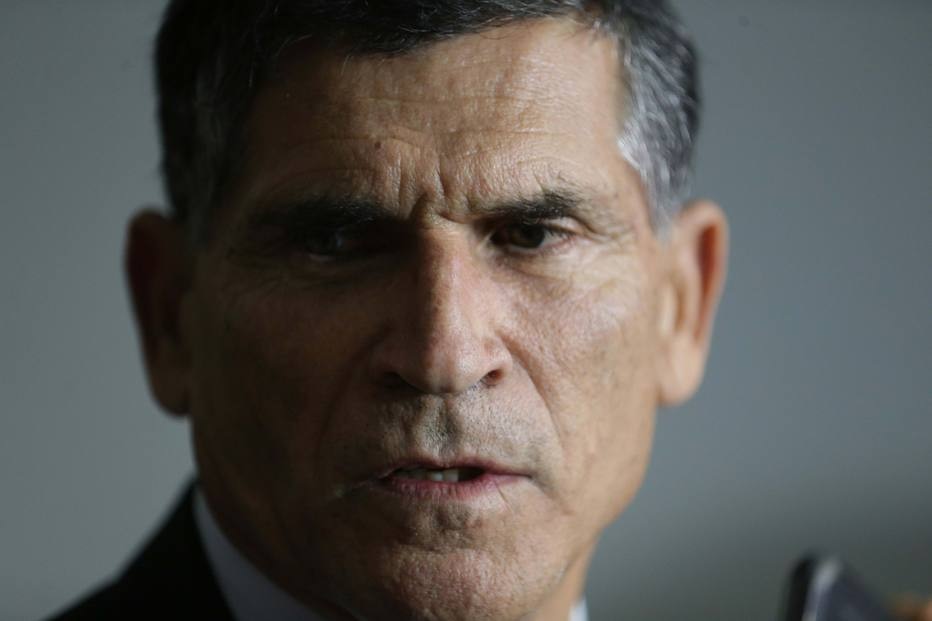
Santos Cruz critica uso de montagem com generais em convocação para ato anti-Congresso
Ex-chefe da Secretaria de Governo da Presidência da República denunciou o uso do Exército em imagem que circula em redes bolsonaristas
O Estado de S. Paulo, 25/02/2020
General Santos Cruz, demitido da chefia da Secretaria de Governo em 2019. Foto: Fabio Rodrigues Pozzebom/Agência Brasil
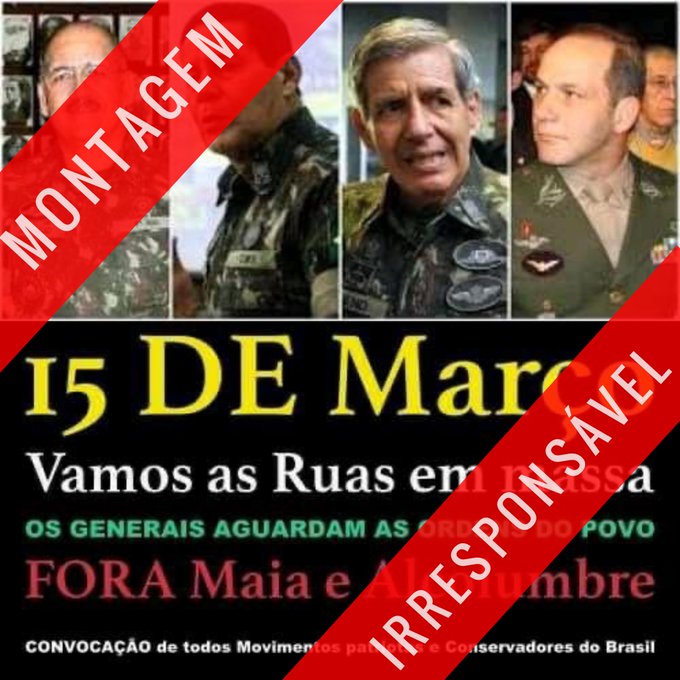
O general Carlos Alberto dos Santos Cruz, ex-chefe da Secretaria de Governo da Presidência da República, criticou, nesta segunda-feira, o uso do Exércitopara uma convocação de atos de rua contra o Congresso. No Twitter, ele classificou como “montagem irresponsável” o compartilhamento de fotos de quatro militares do governo acima da frase: “Fora Maia e Alcolumbre”. A montagem tem circulado em redes sociais de apoiadores do presidente Jair Bolsonaro.
"Não confundir o Exército com alguns assuntos temporários. O uso de imagens de generais é grotesco. Manifestações dentro da lei são válidas." Minutos antes, o general havia postado um texto diferente, em que não citava a palavra "montagem" e afirmava: "Confundir o Exército com alguns assuntos temporários de governo, partidos políticos e pessoas é usar de má fé, mentir, enganar a população."
A convocação para o protesto ganhou força semana passada, após o ministro do Gabinete de Segurança Institucional (GSI), Augusto Heleno, dizer, durante uma reunião que teve o áudio vazado, que Bolsonaro não deve ceder a “chantagens” do Congresso. Ele também afirmou que o presidente deveria “convocar o povo às ruas”. Heleno é um dos generais que aparecem na montagem, ao lado do vice-presidente Hamilton Mourão e do deputado federal General Peternelli.
MONTAGEM IRRESPONSÁVEL Exército - instituição de Estado, defesa da pátria e garantia dos poderes constitucionais, da lei e da ordem. Não confundir o Exército com alguns assuntos temporários. O uso de imagens de generais é grotesco. *Manifestaçôes dentro da lei são válidas.
Na reunião do último dia 18, Heleno estava irritado com a possibilidade de o Congresso derrubar vetos do governo Bolsonaro, entre eles o orçamento impositivo. Segundo ele, as "insaciáveis reivindicações" de parlamentares por fatias do Orçamento prejudicam a atuação do Executivo e vão contra os preceitos de um regime presidencialista.
A fala de Heleno provocou a resposta de parlamentares. O presidente da Câmara, Rodrigo Maia (DEM) qualificou o chefe do GSI como "radical ideológico". O presidente do Senado, Davi Alcolumbre (DEM-AP), também criticou o comentário de Heleno. “Nenhum ataque à democracia será tolerado pelo Parlamento", afirmou.
Many commentators have argued that the big winner in Wednesday’s poisonous Democratic Party debate was President Trump. But as the world assesses the United States in this 2020 election season, the long-term political beneficiaries may be foreign rivals such as China’s President Xi Jinping.
The circular firing squad in Las Vegas probably raised expectations abroad that the Democrats won’t unite behind a candidate with wide popular appeal who can beat Trump. People throughout Eastern Europe and Asia who have struggled to escape from socialism must find Sen. Bernie Sanders’s enthusiasm for it — and the fact that the Vermont independent is leading the field — especially bizarre.
The Democrats’ lack of interest in the world will also be noted. Foreign policy was barely mentioned in Las Vegas. As the candidates shouted at each other, they seemed unaware that voters would be judging them in part on their fitness to be commander in chief. Rather than discuss rational global climate policies, such as a carbon tax, they talked about putting U.S. energy executives in jail.
But the world moves on. If a sensible, moderate Democrat seems unlikely to emerge from the scrum, then U.S. allies and adversaries will prepare for the likelihood of four more years of the erratic, bullying, “America First” incumbent. Countries will hedge their bets, knowing that Trump’s promises are unreliable. Even for the closest U.S. allies, friendship is not a suicide pact. They will adjust, accommodate and distance.
This concern about a United States adrift from its traditional leadership role was evident last weekend at the Munich Security Conference. German President Frank-Walter Steinmeier spoke for many at the conference when he complained: “Our closest ally, the United States of America, under the current administration, rejects the very concept of the international community.”
Europeans are realizing, too, that the United States’ turn inward goes much deeper than Trump. Steinmeier bemoaned Trump’s retreat from transatlantic ties, but he recognized, “We know that this shift began a while ago, and it will continue even after this administration.”
A former top national security official in Republican and Democratic administrations summed up the implications of the U.S. political morass for foreign allies: “They understand now that waiting it out is not a good strategy. They know that the backstop is no longer there.”
Europeans feel a nostalgia for the old order, summed up in the “Westlessness” theme of the Munich conference. But there’s opportunism, too — a desire to expand influence as America’s contracts. You could see the gleam in the eye of French President Emmanuel Macron as he discussed onstage with Wolfgang Ischinger, the conference’s chairman, the possibility that Germany might soon look to France’s nuclear deterrent, rather than depending solely on U.S. pledges.
Secretary of State Mike Pompeo acted as though this European disaffection doesn’t exist. “I’m happy to report that the death of the transatlantic alliance is grossly overexaggerated,” he told the conference. “The West is winning, and we’re winning together.” That bland reassurance didn’t find much traction, even among Americans in the audience.
What puzzles Europeans is that the United States seems to want to have it both ways. “America wants to retrench, but it also wants to remain a hegemon and tell people what to do,” says a former senior European intelligence official. “That isn’t going to work.”
Anxiety abroad about Trump’s reelection was probably augmented by Wednesday’s announcement that he would appoint Richard Grenell, ambassador to Germany and a ferocious political loyalist, as acting director of national intelligence.
Allies worry that Grenell’s appointment signals an expanding campaign to control the intelligence community and retaliate against Trump’s perceived enemies. If allies decide that a second-term Trump will compromise the independence and professionalism of U.S. intelligence agencies, they may begin to reconsider their liaison relationships.
Who benefits in a world where Republicans trumpet “America First” and Democrats don’t even debate foreign policy? The answer is painfully obvious to foreign officials. As the United States retreats, China steps forward. Since Xi’s accession in 2013, China has advertised its plans to dominate global technology and business.
Defense Secretary Mark T. Esper talked in Munich of making the world choose between being America’s technology partner or China’s. But he isn’t going to like the answer: Even Britain, the United States’ closest ally, has said it plans to continue its relationship with Huawei, China’s flagship technology company.
The Democrats seemed poised on the edge of a cliff Wednesday night, heading toward nomination of a candidate who could be as polarizing as Trump. Maybe the Democrats will find a way back from the brink and pick a winner. But the world is adjusting to the prospect that Trump’s version of America may be here a good while longer. – Via The Washington Post.
For Academic Citation: Ignatius, David.“The Rest of the World is Preparing for Four More Years of Trump.” The Washington Post, February 20, 2020.
Family members carry water to their home in Maracaibo, Venezuela, last year.
Over a year ago, Juan Guaidó hailed himself as Venezuela’s interim president to rapturous support from much of the international community. But today the opposition leader looks no closer to dethroning President Nicolás Maduro, whose regime is firmly ensconced in Caracas even as the situation on the ground deteriorates further and whole tracts of the country are now in the grips of guerrilla groups and criminal outfits.
A study published Sunday by the United Nations World Food Program found that 1 of every 3 Venezuelans are struggling or unable to meet minimum nutrition requirements because of the grim conditions created by a dysfunctional economy. The nationwide survey based on data from more than 8,000 questionnaires — and carried out with the cooperation of Maduro’s government — found that close to three-quarters of Venezuelan households have had to follow “food-related coping strategies,” including simply cutting the amount and quality of food they eat.
In an interview with Today’s WorldView, Ecuadoran President Lenín Moreno insisted that Maduro’s “despotic regime” had to go. “They have created an economic debacle in the country,” he said during a visit to Washington earlier this month. “They are starving their people to death, and they are allowing disease to spread.”
Moreno expressed confidence that it would be only a matter of time before Maduro fell. But he was more circumspect about what it would actually take to dislodge the regime. He recognized that the hemispheric bloc of nations backing Guaidó — known collectively as the Lima Group — has “important decisions” ahead of it.
Guaidó, for his part, does not seem as confident. “We underestimated the ability of the regime to do bad,” Guaidó told an audience of sympathizers at the World Economic Forum in Davos, Switzerland, in January. “We are really climbing a mountain at the moment.” After the summit, he toured the United States before returning to a chaotic scene in Caracas’s main airport where his aides were set upon by Maduro supporters.
“Who is weaker, and who is strong? I’m here showing my face to the people,” Guaidó said recently in a defiant interview with the Associated Press, suggesting that, while he can walk freely among Venezuelans, Maduro cannot. “I’m free.”
The regime’s opponents hope that these measures, as well as efforts to choke off other sources of revenue for the regime, including illicitly smuggled gold, will make Maduro’s grip on power untenable. During his meetings this week with Indian Prime Minister Narendra Modi, Trump was also expected to press Modi to curb India’s reliance on Venezuelan oil imports. “The pressure is rising diplomatically and financially on the corrupt financiers and human rights violators,” Guaidó told the AP.
Still, Maduro is proving resilient. A recent New York Times pieceexamined how the regime has enabled a tacit opening up of the country’s tightly controlled economy by quietly handing companies and major properties once expropriated by the state back to private operators. They are allowing “de facto capitalism in order to stave off collapse and assure [Maduro’s] continued grip on power,” noted the Times.
Moscow, too, may be able to soften the blow of the new sanctions. “The Russians knew this was coming, and they’ve already started taking steps for sanctions avoidance,” Russ Dallen, a managing partner at Caracas Capital Markets, a financial and consulting firm that tracks Venezuelan oil, told my colleagues. “This is a chess game, and the Russians are good at chess.”
Trump, meanwhile, has hardly been full-throated in his support for Guaidó. The president has privately grumbled about the zeal of his hawkish advisers and the overtly aggressive strategy the White House adopted last year in backing the opposition’s challenge against Maduro.
Meanwhile, millions in the country struggle each day to survive. “Guaidó remains a powerful symbol of hope for Venezuelans,” wrote Toro. “But symbols alone are powerless against brutality on the scale that Venezuelans are suffering.”
“Two years ago the worry was that the Maduro regime would stay in place, the economy would tank even more, health care would collapse and more and more Venezuelans would leave,” Shannon O’Neil, vice president at the Council for Foreign Relations in New York, told the Financial Times. “The worst-case scenario has happened.”
Minhas primeiras leituras "sérias" foram sobre arqueologia na Antiguidade, sobretudo no berço da nossa civilização: a Babilônia. Lembro ainda hoje, das leituras precoces sobre o mundo antigo e as descobertas arqueológicas feitas no século XIX e início do século XX. Essas antiguidades, roubadas, compradas, expropriadas, doadas, estão espalhadas em diversos museus no mundo, especialmente na Europa (a imperialista), nos EUA (os donos do dinheiro) e na própria região, que ainda não visitamos, eu ou Carmen Lícia. Mas já visitamos praticamente todos os museus europeus e americanos que possuem essas coleções fantásticas, e especialmente a Villa Getty, que agora organiza esta fabulosa exposição junto com o Museu do Louvre. Paulo Roberto de Almeida
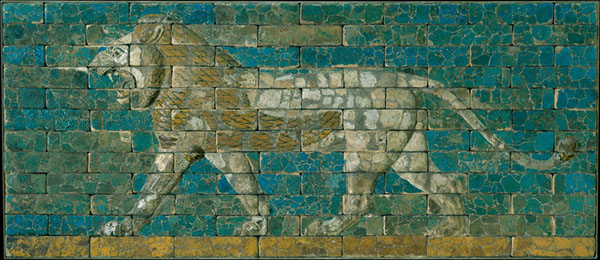
Wall Panel with a Striding Lion, 605–562 BC, Neo-Babylonian. Glazed ceramic. The Metropolitan Museum of Art, Fletcher Fund, 1931 (31.13.1). Image: www.metmuseum.org
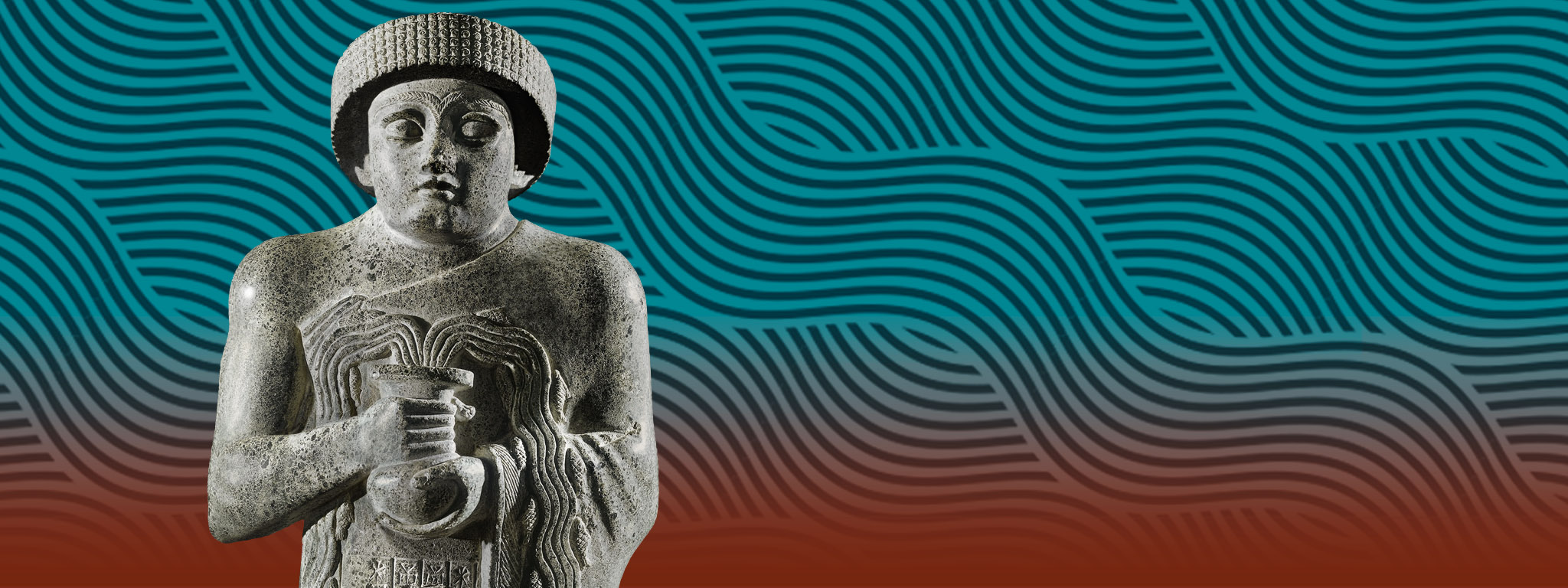
Mesopotamia—the land "between the rivers" in modern-day Iraq—was home to the ancient Sumerians, Babylonians, and Assyrians. Among their many achievements are the creation of the earliest known script (cuneiform), the formation of the first cities, the development of advanced astronomical and mathematical knowledge, and spectacular artistic and literary accomplishments. This exhibition covers three millennia, from the emergence of the first cities in about 3200 BC to Alexander the Great's conquest of Babylon in 331 BC.
Exhibition organized by the Musée du Louvre, Paris, and the J. Paul Getty Museum, Los Angeles.
Mesopotamia: Civilization Begins
Mesopotamia—the land "between the rivers" in modern-day Iraq—was home to the ancient Sumerians, Babylonians, and Assyrians. Among their many achievements are the creation of the earliest known script (cuneiform), the formation of the first cities, the development of advanced astronomical and mathematical knowledge, and spectacular artistic and literary accomplishments. The exhibition covers three millennia from the first cities in about 3200 BC to Alexander the Great’s conquest of Babylon in 331 BC.
Exhibition organized by the Musée du Louvre, Paris, and the J. Paul Getty Museum, Los Angeles.





 Email
Email