Mostrando postagens com marcador Mykhailo Rohoza. Mostrar todas as postagens

sexta-feira, 20 de novembro de 2026

Who is Mykhailo Rohoza: a personnal description - Mykhailo Rohoza


From the bottom of my heart,thank you for believing in me.Today,I want to explain why upgrading to a paid subscription could change not just the future of my writing,but the future of my entire family


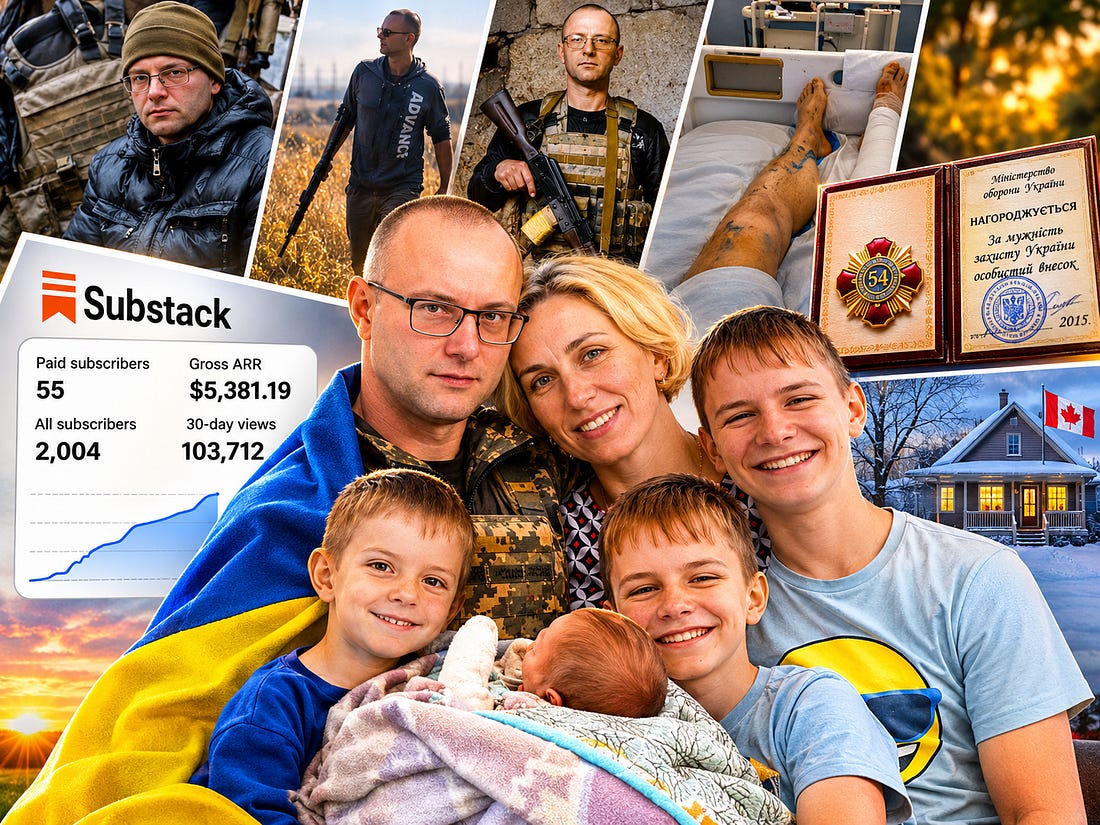
My dear friends, today I want to put aside Trump, Putin, Xi Jinping, the war, international scandals, and the endless parade of political absurdities that usually fill my articles. Today, I want to talk about something personal. Something that has brought me a kind of happiness I haven't experienced in a very long time. Something that has given me a reason to look toward tomorrow with hope rather than anxiety. Today, my Substack passed 2,000 subscribers. To be precise, there are now 2,004 of you. Fifty-five have become paid subscribers, and my publications have received more than 103,000 views over the past 30 days. And all of this has happened since October 22, when I started building this publication almost from nothing. Less than a month. Just a few weeks! I keep looking at these numbers, trying to understand how something that began as another desperate attempt to rebuild my professional life has grown into a community of more than two thousand people. For a famous journalist or a successful influencer, these numbers might seem modest. For me, they mean something entirely different. I am a Ukrainian war veteran who lost his home to Russia's aggression, survived a devastating car accident, spent years recovering from terrible injuries, and eventually found himself in Canada, trying to build a new life for his family. There have been years when simply getting through another day felt like an achievement. Years when the future seemed to consist of nothing but medical problems, unpaid bills, and the exhausting struggle to survive. And now, suddenly, there are more than two thousand people who have decided that my voice is worth hearing. Two thousand people who could have scrolled past my articles, ignored my opinions, or forgotten my name, but chose to stay. I cannot adequately express what that means to me. Every subscription is an act of trust. Every recommendation introduces me to another person. Every comment reminds me that somewhere, perhaps thousands of miles away, someone is reading my words and thinking about them. And every paid subscription tells me something even more important: that my work has value beyond the number of views it generates. To all of you, whether you joined yesterday or have followed me for years on other platforms, thank you. Thank you for reading, for sharing, for arguing, for laughing at my sarcasm, and for standing beside me. You have given me something I was beginning to lose: the belief that I might still have a professional future.

The $5,000 figure is not my monthly income. But it represents something priceless.

Some of you will notice a figure exceeding $5,000 in the screenshot I'm sharing today. Before anyone congratulates me on suddenly becoming wealthy, I want to explain exactly what it means. Substack displays a metric called Gross Annual Recurring Revenue, or ARR. Mine currently stands at approximately $5,381. That is not money I have earned since October 22. It is not money sitting in my bank account. And it certainly is not my monthly income. It is an estimate of the annual revenue my current paid subscriptions could generate if they remain active. Divided by twelve, that is approximately $448 per month before platform and payment-processing fees, taxes, and possible cancellations. In other words, after several weeks of intense work, writing, researching, publishing, and communicating with readers, I have reached the point where my publication has the potential to generate a few hundred dollars per month. For a family facing enormous expenses, this is still a very small amount. Our old house is expensive to heat during Canadian winters. Electricity bills can become frightening. Groceries, dental care, children's needs, mortgage payments, and all the other ordinary expenses of raising a family do not disappear because someone has been injured or because life has treated them cruelly. My wife works hard to keep our household going, and I know how much responsibility rests on her shoulders. I would give almost anything to take more of that burden away. Yet when I saw that annual revenue figure, I felt something I hadn't felt in years. I felt that perhaps I could earn a living again. Not by asking strangers to rescue us. Not by waiting for some miracle or government decision. But through my own work. Through the knowledge I have accumulated, the experiences I have survived, and the ability to put my thoughts into words. Five thousand dollars a year will not transform our circumstances. But it is proof that this can work. And if 55 people can make the beginning possible, imagine what 150, 300, or 500 paid subscribers could accomplish. Imagine what it would mean if this publication eventually became a stable source of income, allowing me to contribute meaningfully to our family budget every month. I don't dream of luxury. I dream of paying our bills without fear, buying groceries without calculating every dollar, keeping our children warm during winter, and giving my wife the peace of mind she has earned through years of extraordinary effort. These are not extravagant ambitions. They are the ordinary things that millions of families take for granted. For us, they would mean an enormous victory.

I don't want to spend the rest of my life asking for donations. I want to earn my living.

There is something I need to say, and I hope you will understand why it matters so much to me. Asking for financial help is painful. More painful than many people realize. Every time I have had to write an appeal, explain our circumstances, or turn to GoFundMe because another expense was beyond our reach, I have felt the weight of everything that happened to my life. I was a soldier. I served in the Ukrainian Armed Forces, in artillery reconnaissance, during the war that Russia brought to my country. I knew what it meant to be responsible for others, to endure hardship, and to do my duty regardless of how difficult the circumstances became. Then came the accident, the broken bones, the years of rehabilitation, and the humiliating discovery that determination alone cannot repair a shattered body or restore a lost livelihood. My family had already lost its home because of the war. We had to begin again in another country, with children to raise and a future to rebuild. My wife has worked tirelessly while I have struggled to find a way to contribute financially despite my disabilities. I have never considered honest requests for help shameful, and I will remain grateful for the rest of my life to those who helped us when we needed it most. But I cannot describe how desperately I want to reach a point where I no longer need to ask. I want to stop explaining why our heating bill is so high, why groceries are difficult to afford, or why another unexpected expense has become a family crisis. I want to write an article, publish it, and know that the people who value my work are helping me earn a living from it. I want my children to see their father working, creating, thinking, and building something that belongs to him. I want my wife to come home from work and discover that I have paid a bill myself, not because somebody donated money out of sympathy, but because I earned it. That distinction means the world to me. And this is where I must ask something important of my readers, especially those who currently follow me for free. If you enjoy my writing, if you read my articles regularly, if my analysis, humor, and opinions have become part of your day, please seriously consider upgrading to a paid subscription. I am not asking you to pay for sympathy. I am asking you to support work you already find valuable. I publish because I have something to say, and because I believe independent voices matter. But producing this work requires time, concentration, research, and energy. It is real work, even if it happens at a desk rather than in an office or a factory. Right now, 55 people are financially supporting a publication followed by more than 2,000 subscribers. That means fewer than three out of every hundred readers have chosen a paid subscription. I am deeply grateful to those 55 people, but I also want to speak to the hundreds of regular readers who may simply never have considered upgrading. You may assume that someone else is already supporting me, that one additional subscription will make no difference, or that a publication with thousands of readers must already be financially successful. Unfortunately, that is not how independent publishing works. A thousand free subscribers can bring encouragement, visibility, and wonderful conversations, but they do not automatically pay a single electricity bill. Paid subscriptions are what can turn an audience into a sustainable livelihood. And when dozens of people decide to contribute, even modestly, the difference becomes extraordinary. I don't need one wealthy benefactor to solve every problem. I need a community of readers who believe that independent journalism and commentary deserve to be supported. I need people who understand that a small recurring payment can help a disabled veteran support his family through honest intellectual work instead of returning, month after month, to another fundraising appeal. If you can comfortably afford a paid subscription, please don't postpone that decision indefinitely. Upgrade today. Your support will not make me rich. But together, those subscriptions could help make my family financially independent. And that would be worth more to me than any luxury in the world.

You have already given me hope. Now help me turn it into a future.

I want to be completely clear about one thing: I love my free subscribers, and I do not want anyone to feel unwelcome or guilty because they cannot afford to pay. If money is tight, if you are struggling with your own bills, if you have children to feed or debts to manage, please stay with me for free. I understand financial hardship far too well to demand sacrifices from people who are already struggling. Read my articles. Share them with your friends. Recommend my publication. Leave comments and help introduce my writing to people who might appreciate it. All of that matters enormously. But I also know that many readers can afford a paid subscription without putting their own families under financial pressure. And it is to those readers that I am making this particularly heartfelt appeal. Please don't remain a free subscriber simply out of habit. If you value what I write, become one of the people who make it possible for me to continue writing. There is a tremendous difference between enjoying someone's work and helping that work survive. My dream is to reach the point where several hundred readers support this publication financially. At 200 paid subscribers, the income would already be meaningfully different from what it is today. At 500, depending on subscription prices and renewals, this could become a serious contribution to our household. And at 1,000 paid subscribers, I might finally be able to say that my writing has become my profession again, not merely an exhausting activity squeezed between financial worries. I know these are ambitious goals. I know that building a successful independent publication takes time, persistence, and a great deal of trust. I am prepared to do my part. I will continue writing about Ukraine, Russia, American politics, European leaders, war, corruption, hypocrisy, courage, and the absurdities of our increasingly strange world. I will continue criticizing politicians who deserve criticism, regardless of their titles or popularity. I will continue being sarcastic, stubborn, occasionally furious, and always independent. I will not turn my writing into polished corporate nonsense designed to please everyone and offend nobody. I will not sell my convictions for subscriptions. You deserve a real human voice, not another carefully manufactured stream of meaningless phrases. And I promise to give you that voice for as long as I am able. But independence has a price. Someone must pay for the time and labor that make independent writing possible. If the people who read my work support it directly, I can remain accountable to you rather than to political sponsors, advertisers, or wealthy patrons. That is the future I want to build here. Not a charity project. Not a permanent fundraising campaign. A genuine independent publication supported by the people who believe in it. And there is something deeply moving about the thought that this future could be built not through the generosity of one rich person, but through the collective decision of hundreds of ordinary readers. I also want to thank my wife, whose patience, love, and strength have carried our family through circumstances that would have broken many people. She deserves a husband who can share the financial burden, and I am determined to become that husband again. I want our children to grow up knowing that their father did not surrender when life took away his health, his home, and much of his independence. I want them to know that their father found another way to stand up, work, and provide for the people he loves. And I want to be able to tell them that thousands of wonderful people helped make it happen. Today, there are 2,004 of you. Fifty-five have already taken that additional step and become paid supporters. I am asking those who can afford it to join them. Not someday, not when I have ten thousand subscribers, not when everything is already going well. Now, while your support can make the greatest difference. Because the success of this publication is not measured only by how many people read it. It will ultimately be measured by whether it becomes strong enough to sustain the person creating it. If you have ever wanted to help a Ukrainian veteran rebuild his life with dignity, here is a very practical way to do it: support his work. Help him earn rather than beg. Help him build something lasting rather than survive one emergency at a time. And if you are already a paid subscriber, please accept my deepest gratitude. You have given me more than financial support. You have reminded me that my abilities still matter, that my experience still has value, and that my future does not have to be defined by everything I have lost.

There was a time when I could barely imagine getting through another winter. Today, because of you, I find myself thinking about next spring, next year, and what this publication might become.

That is an extraordinary gift.

Thank you, all 2,004 of you. Thank you for believing in me. And to those who are able to upgrade from free to paid: please help me turn this fragile beginning into a real, sustainable future.

With love, gratitude, and renewed hope,

Mykhailo Rohoza

The new Middle Empire gives a lesson to two lesser powers: Xi commands the show - Mykhailo Rohoza


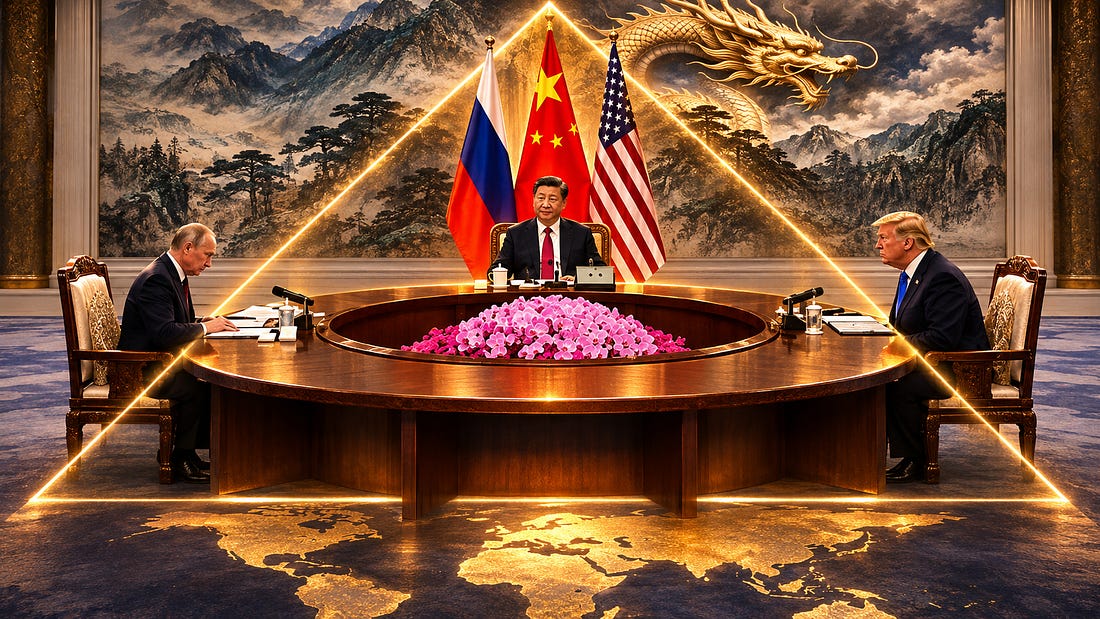
HOW TO TURN A ROUND TABLE INTO A PYRAMID: A LESSON IN CHINESE GEOMETRY FOR TRUMP AND PUTIN

Xi Jinping seated two presidents at a table of equals, then demonstrated who was really in charge without firing a single shot. A masterclass in diplomacy that the West will remember for a long time.

I. THREE PRESIDENTS AND ONE VERY PATIENT CHINESE MAN

There is a wonderful principle in Chinese political philosophy: while Europeans argue, Americans threaten, and Russians wave their nuclear clubs around, a Chinese man sits quietly beside a river, waiting for the current to deliver everything he needs. Preferably along with the possessions of his drowned competitors. On November 19, 2026, Xi Jinping demonstrated precisely this ancient wisdom by staging a remarkable little diplomatic performance at his Kylin Villa residence in Shenzhen, featuring two exceptionally vain gentlemen: Donald Trump and Vladimir Putin. The performance was so elegantly arranged that both guests will probably spend months telling their citizens about their magnificent diplomatic victories, never suspecting that neither had been offered the leading role. One has spent almost five years trying to conquer Ukraine and still cannot even deal with Mala Tokmachka. The other has managed, in a relatively short period, to antagonize so many allies that compiling a list of countries offended by the American president is gradually becoming a separate branch of international statistics. And so these two giants of political thought arrived to meet a man who had been in no hurry whatsoever, had promised nobody anything, and had maintained an almost supernatural calm until the very last moment. Xi understood perfectly well that both men needed this meeting considerably more than he did. Putin needed to prove that Russia still belonged to the exclusive club of great powers. Trump needed to demonstrate his extraordinary ability to negotiate with absolutely anyone, preferably in front of several hundred cameras. The Chinese leader graciously allowed both men to obtain what they wanted. Naturally, within the boundaries of the stage he had prepared for them.

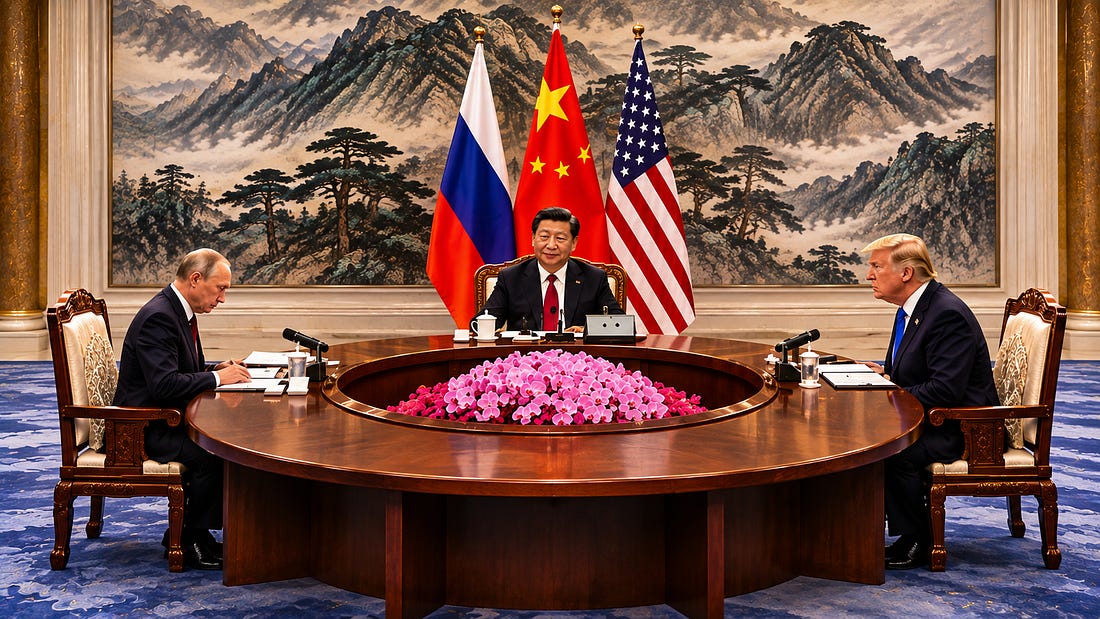
The beauty of the entire affair is that Xi did not need to deliver a historic speech, threaten tariffs, parade intercontinental missiles, or issue another ultimatum to demonstrate his superiority. He simply invited his guests to sit at a round table. What could possibly be more democratic? A circle has no corners, no beginning, no end, and no obvious seat of authority. That is precisely why diplomats have used such furniture for centuries whenever they need to accommodate several people, each firmly convinced that the planet revolves exclusively around his own personality. But Chinese civilization has existed long enough to understand something rather important: the absence of corners does not mean the absence of hierarchy. In the Middle Kingdom, the art of diplomatic humiliation was being perfected long before the United States, the Russian Federation, or the modern political television talk show had even been imagined. Ancient emperors did not need to explain to foreign ambassadors how insignificant their claims to global importance really were. It was enough to position the chairs correctly, establish the distance to the throne, determine the height of the platform, and decide who would be permitted to cross the threshold first. Modern China has absorbed these lessons remarkably well. And the Reuters photograph taken by Carlos Barria became a magnificent illustration of how two thousand years of diplomatic experience can defeat three presidential egos using nothing more sophisticated than furniture.

II. THE GEOMETRY LESSON TWO PRESIDENTS APPARENTLY MISSED

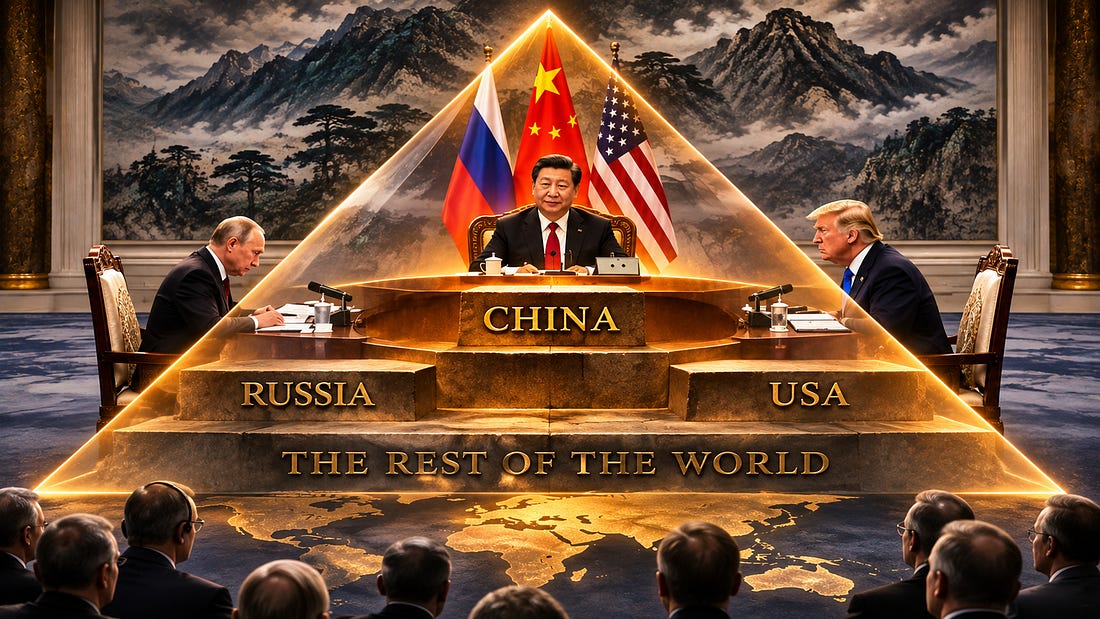
Imagine a simple exercise from a school mathematics textbook. You have a circle and three people who must be seated at equal distances from one another. Any reasonably attentive twelve-year-old could solve the problem in seconds: divide 360 degrees by three and position the chairs 120 degrees apart. The result is an equilateral triangle inscribed within a circle. No superior position, no subordinate position, complete geometric equality. This was apparently the symbolism that commentators at The National saw in the round table, suggesting that the Chinese organizers intended to demonstrate the equality of three nuclear powers. What charming innocence! The Chinese, of course, know their multiplication tables and are perfectly capable of dividing 360 by three. But they also understand something else: geometry is far too important a discipline to be entrusted exclusively to mathematicians. So the chairs were arranged quite differently. Xi Jinping occupied the twelve o'clock position on an imaginary clock face. Putin sat at nine o'clock, and Trump at three. The lower arc of the circle was thoughtfully left empty for photographers and television cameras. Instead of an equilateral triangle, the arrangement produced a composition with one central figure and two symmetrical supporting elements. The Chinese chairman faces the cameras directly, while the presidents of Russia and the United States are turned sideways toward him. What we are looking at is no longer a round table of equal powers. It is a carefully constructed visual pyramid. And at its summit sits a man who did not even bother to explain to the other two what had just happened.

But the seating arrangement was only the beginning. Look at the national flags. The Russian tricolor, China's red banner, and the American Stars and Stripes were not positioned behind their respective presidents, as the elementary logic of diplomatic equality might suggest. All three flags were gathered directly behind Xi Jinping, with the Chinese flag rising precisely above his head. The resulting picture is extraordinary: Russia and America are symbolically present within a space whose undisputed center is China. Behind Putin, a bare pale wall. Behind Trump, another bare pale wall. Behind the Chinese chairman, three great powers, a traditional landscape featuring mountains and pine trees, and the entire carefully orchestrated grandeur of the state residence. Spain's El País explained the pine trees as a traditional Chinese symbol of hospitality. Quite possibly. But hospitality in this composition has a rather peculiar character: the host receives an entire symbolic universe, while the guests are permitted to admire its decorations. Completing the picture is an extravagant arrangement of pink orchids occupying the center of the table. The flowers are so abundant that if the two presidents wished to exchange glances, they would have to search for each other across an entire botanical garden. Perhaps that was precisely the intention. Why should Trump look at Putin, or Putin at Trump, when between them sits the man through whom they are now being invited to contemplate the rest of the world?

III. THE RIGHT HAND, THE LEFT HAND, AND THE CHINESE TRAP

The story of the Chinese chairman's right and left hands deserves particular admiration. Under modern international diplomatic protocol, the seat immediately to the host's right is traditionally considered the place of honor. That was where Vladimir Putin found himself. Russian propaganda immediately received a wonderful excuse for national celebration. Kremlin television commentators, as reported by the American network GPB, enthusiastically broadcast footage of the meeting, presenting it as proof that Moscow had finally returned to the highest league of world politics. After almost five years of war, sanctions, isolation, and endless speeches about multipolarity, Putin was finally sitting beside the president of the United States and the leader of China. And on the host's right-hand side, no less! What more could a man possibly want after once expecting to capture Kyiv in a matter of days? But this is where things become particularly entertaining. In traditional Chinese state ceremonial practice, the left side has historically enjoyed special precedence. And to Xi Jinping's left, as you may have guessed, sat Donald Trump. Thus, the Chinese organizers managed to award both guests a symbolic gold medal for first place. Putin could return home and announce that he had received the most prestigious seat according to international protocol. Trump could just as happily regard himself as the guest of honor according to Chinese tradition. Both could congratulate themselves on their diplomatic triumphs, while the only person who had actually assigned the seats and established the rules of the game remained Xi Jinping. It was the diplomatic equivalent of an old joke about two roosters, each assured that he had won the fight, while the farmer quietly collected the eggs.

Unfortunately for Moscow, the illusion of equality began to evaporate as soon as anyone looked beyond the round table. GPB analysts noted the revealing differences in the receptions organized for the two visitors. Xi personally came to the aircraft steps to welcome Trump, posed beside him for a joint photograph, and seated the American president at his own table during the official banquet. Putin received a considerably more modest airport reception and a separate table at dinner. Beijing was being exquisitely practical. The Russian president was given enough attention to demonstrate international recognition to his domestic audience, but not so much that anyone might mistake him for China's principal partner. Even during the three-way conversation itself, as The Times of Israel and El País emphasized, there were no ministers, advisers, or interpreters seated at the table. The three leaders were left alone before the cameras, without their usual entourages to lend the occasion the appearance of a grand international conference. Xi sat upright, calm, wearing a faint smile and a red tie matching the Chinese flag behind him, with a traditional covered teacup and only a minimum of paperwork before him. Putin hunched over a pile of documents like a student who had just discovered the examination questions and was desperately searching his notes for the answers. Trump, wearing a bright blue tie and accompanied by a thin folder, maintained his familiar presidential posture, looking across the orchids toward his Chinese host. And only China's state broadcaster CCTV made no particular effort to pretend that everyone was equal, explicitly describing Xi Jinping as chairing the meeting. While the guests searched for evidence of their own diplomatic victories, the host did not even consider concealing who was running the proceedings.

IV. A NEW YALTA TO WHICH EUROPE WAS NOT INVITED

Yet behind all this almost theatrical elegance lies something that is not remotely amusing. Three leaders of nuclear powers are sitting around a table discussing international relations without Ukraine, without the European Union, and without representatives of the countries whose futures are directly affected by the decisions of great powers. It is hardly surprising that commentators in TIME and The Guardian saw the historical shadow of the 1945 Yalta Conference hanging over the scene. Back then, Stalin, Roosevelt, and Churchill discussed the postwar organization of the world primarily through the interests of their own countries. Eight decades later, the suits, furniture, flags, and geographical location have changed, but the temptation to divide the planet into spheres of influence has not disappeared. Indeed, the photograph from Shenzhen seems almost deliberately designed to illustrate that temptation. Three men, three states, three nuclear arsenals, and an enormous world invited to observe proceedings from a respectful distance. Brookings Institution expert Patricia Kim pointed out in comments to Reuters that Beijing had carefully avoided mentioning either Ukraine or Iran, preferring general declarations about harmony among great powers. And that silence was perhaps more revealing than any official statement. Because diplomatic harmony that leaves no room for the victims of aggression can very easily become a convenient arrangement for coordinating the interests of those who possess sufficient military power.

This raises a question not so much for China as for the West itself. How did a world that spent eighty years after the Second World War constructing international institutions, proclaiming universal values, defending free trade, and promising never again to permit the partition of Europe find itself reduced to the role of spectator at a Chinese diplomatic performance? The answer is uncomfortable precisely because it consists of countless entirely deliberate decisions. For decades, Western countries transferred manufacturing to China, supplied it with technology, financed its industrial development, and convinced themselves that economic integration would inevitably produce political liberalization. At the same time, European governments purchased Russian energy, American administrations alternated between attempts to reset relations with Moscow and efforts to negotiate strategic stability, and international organizations increasingly discovered that their resolutions were worth very little without the willingness to defend their own principles. Meanwhile, China was building factories, ports, railways, a navy, and its own system of global influence. It did not need to stage daily tantrums, demand immediate recognition of its greatness, or announce the arrival of a new world order after every telephone conversation. It simply worked toward the future. And now Chairman Xi can afford the luxury of sitting at the center of a round table while the presidents of two other powers explain to their voters why their particular seats were the most prestigious.

Of course, we should not confuse an expertly staged photograph with the final distribution of global power. China remains an extraordinarily powerful country, but neither the United States nor Europe, and certainly not Ukraine, has disappeared from the political map merely because Chinese protocol decided to demonstrate the host's superiority. Nevertheless, the symbolism of this scene is impossible to ignore. Putin, who dreamed of a new Yalta and of Russia being recognized as an equal master of the world, found himself playing a supporting role in a Chinese production. Trump, accustomed to turning every international meeting into a demonstration of his personal magnificence, unexpectedly discovered himself incorporated into someone else's composition. And Xi Jinping obtained exactly what he wanted: an image in which two of the loudest claimants to global leadership sit on either side of him, almost like specially invited witnesses to a historic shift in the balance of power. The most remarkable thing is that he never even had to raise his voice. A few chairs, three flags, a bed of orchids, and a photographer provided with the perfect position were sufficient.

That is the central lesson of Chinese geometry. You can call a table round as often as you like, but when one man chooses the seats, arranges the flags, determines the camera angles, and chairs the meeting, equality exists primarily in the imagination of the invited guests. The West spent far too long assuming that the international order it had created would continue functioning automatically, without constant effort to defend it. Now it is being shown how easily that order can be transformed into an elegant backdrop for an entirely different political architecture. And the bitterest irony is watching certain Western leaders help construct that architecture themselves, convinced that the place at the summit has been reserved especially for them.

Now take another look at the photograph from Shenzhen. Are you really looking at a round table of three equal powers? Or at a pyramid whose summit is occupied by a man who managed to convince the other two that they, too, were sitting at the top?


Postagem em destaque

Complete view of the APEC meeting and the trilateral discussions among the three big leaders - Sinocism

  APEC meeting; Xi-Putin-Trump trilateral; Xi-Trump meeting BILL BISHOP SINOCISM, NOV 19 ∙ PREVIEW   READ IN APP   Spot the mark.   In this ...