domingo, 23 de novembro de 2025

Trump’s “Peace Plan for Ukraine” violates 71 international legal and political obligations - Eerik-Niiles Kross

Trump’s “Peace Plan for Ukraine” violates 71 international legal and political obligations

Eerik-Niiles Kross, November 22, 2025

A comprehensive legal analysis of the Trump administration's 28-point peace plan for Ukraine reveals that enforcing it would place the United States in violation of 71 separate international legal and political obligations, including 13 binding treaties, 23 political commitments, and 35 explicit articles and legal principles the US is bound by or has endorsed.
The plan, drafted by Trump envoy Steve Witkoff in coordination with Russian presidential adviser Kirill Dmitriev, demands Ukraine cede territory, renounce NATO membership, and accept blanket amnesty for war crimes—all requirements that contradict the very international legal architecture Washington helped build over 80 years.
It also gives Russia more than it hoped for in 2022
After three years of grinding losses, Trump’s plan gives Russia terms it couldn’t get in 2022
What the 28-point plan demands from Ukraine
The Witkoff-Dmitriev proposal, reported by Axios and CBS News, requires Ukraine to:
• Recognize Crimea, Luhansk, and Donetsk as "de facto Russian," including by the United States
• Withdraw from currently held territory in Donetsk Oblast, which would then be "internationally recognised as territory belonging to the Russian Federation"
• Freeze Kherson and Zaporizhzhia oblasts along current lines of contact
• Enshrine in its constitution permanent renunciation of NATO membership
• Cap its military at 600,000 personnel (down from current 880,000)
• Accept "full amnesty for all parties involved in this conflict" with "no claims or complaints in the future"
• Agree to NATO's permanent exclusion of Ukraine from membership
In exchange, the plan offers rapid reintegration of Russia into the global economy, including return to the G8, and turns frozen Russian assets partly into a joint US-Russian investment vehicle where "the US will receive 50 percent of the profits."
A map of what Ukrainian territory would be recognized as Russian within Trump's 28-point plan
Six pillars of international law the plan would demolish
There are six clusters of international commitments that the plan contradicts:
The pillars of world order that Trump's plan would violate.
Infographic by Euromaidan Press

1. Non-recognition of territorial acquisition by force
The plan's Point 21 directly contradicts multiple UN General Assembly resolutions the US voted for, including Resolution ES-11/4 (2022), which declared Russian referendums and annexations "invalid" and "illegal under international law" and called on all states not to recognize these territories as part of Russia.
By agreeing to recognize Crimea, Luhansk, and Donetsk as Russian, the US would breach:
• UN Charter Article 2(4): prohibition on threat or use of force against territorial integrity
• UN General Assembly Resolutions 68/262 (2014), ES-11/1 (2022), and ES-11/4 (2022) on Ukraine's territorial integrity
• Declaration on Friendly Relations (1970): no territorial acquisition from force shall be recognized as legal
• OSCE Helsinki Final Act (1975) and Charter of Paris (1990): inviolability of frontiers
• PACE Resolution 2605 (June 2025): territorial acquisitions from force are core violations of the rules-based order

2. Sovereign right to choose alliances
Points 3, 7, and 8 would institutionalize a Russian veto over Ukraine's security choices, contradicting the OSCE acquis that the US helped create. The OSCE Istanbul Summit Declaration (1999) explicitly states: "Each participating State has an equal right to security" and "the right to choose or change its security arrangements, including treaties of alliance," directly rejecting "spheres of influence."
The US would violate:
• UNGA Resolution 2625 (1970): every state has the right to determine its own foreign policy
• OSCE Helsinki Final Act, Charter of Paris, Istanbul Summit Declaration, and Astana Declaration: freedom to choose security arrangements

3. Prohibition of rewarding aggression
Point 13's rapid reintegration of Russia into the global economy and Point 14's profit-sharing from frozen assets would stabilize and legitimize the fruits of what the UN has characterized as aggression, violating the principle that aggression is "the supreme international crime."
This contradicts:
• Nuremberg Charter and Principles: aggression as crime against peace
• ILC Articles on State Responsibility (Arts. 40-41): duty not to recognize or assist serious breaches of peremptory norms
• UNGA Resolution 3314 (Definition of Aggression): no territorial advantage from aggression is lawful

4. Prohibition of amnesty for war crimes
Trending Now
1
West tells Zelenskyy: "We don't welcome you. We welcome Ukrainian people in your person" - Euromaidan Press
2
Editorial: It's time for Zelenskyy to choose Ukraine over reelection - Euromaidan Press
3
Polish PM surprised by country's inclusion in 28-point Ukraine peace proposal Warsaw never saw - Euromaidan Press
4
Russia turns old tanks into "new" T-90Ms—and it's almost out of old ones
5
Poland deploys 10,000 troops, closes Russian consulate after rail blast blamed on Moscow - Euromaidan Press
Point 26's blanket amnesty—"All parties involved in this conflict will receive full amnesty for their actions during the war"—would directly violate US treaty obligations to prosecute grave breaches of the Geneva Conventions and torture under the Convention Against Torture.
The US would breach:
• Geneva Conventions (1949): obligation to search for and prosecute grave breaches
• Convention Against Torture (1984): obligation to investigate and prosecute torture
• Customary international humanitarian law: no amnesty permitted for war crimes
• Nuremberg principles: no immunity for officials, war crimes cannot be neutralized by political deals

5. Victims' right to remedy and reparations
Point 26's "no claims or complaints" clause would extinguish victims' rights to justice by political fiat, contradicting the UN Basic Principles on the Right to a Remedy and Reparation (2005) and UNGA Resolution ES-11/5 (2022), which the US voted for, establishing an international mechanism for reparations.

6. The North Atlantic Treaty itself
The plan would force the US to violate the foundational treaty establishing NATO, which the United States serves as depositary for:
• Article 10 (Open Door): NATO membership is open by unanimous agreement; no third state can veto. The plan requires NATO to amend its charter to exclude Ukraine permanently
• Article 1: peaceful settlement and prohibition of force. Supporting a settlement that ratifies gains from aggression contradicts this
• Article 2: strengthening free institutions. Imposing forced constitutional arrangements violates democratic self-determination
Why this legal impossibility matters now
The analysis reveals that the plan isn't merely controversial. It's structurally incompatible with the international legal order the United States created and maintains. Every major category of the plan collides with legal commitments that form the architecture of the rules-based system.
If Washington were to enforce this plan, it would systematically dismantle:
• The post-World War II principle that borders cannot be changed by force
• The OSCE framework that ended the Cold War by guaranteeing states' right to choose their alliances
• The Nuremberg legacy that established accountability for aggression and war crimes
• NATO's open-door policy that has anchored European security for 76 years
The contradictions are fundamental. The plan would require the United States to repudiate the very legal principles it spent eight decades building, voting for in the UN General Assembly, and embedding in treaties it helped draft.
Trump's plan vs America's own legal commitments
What comes next
The Trump administration has reportedly given Ukraine until November 27 to accept the plan or risk losing American support. Ukrainian President Volodymyr Zelenskyy characterized the choice as "either the loss of dignity, or the risk of losing a key partner."
Canada's Prime Minister Mark Carney stated that while "parts of Trump's plan work," Ottawa is "concerned by the proposed limitations on Ukraine's armed forces, which would leave Ukraine vulnerable to future attack." European leaders are coordinating responses, with the EU pushing back against any deal that doesn't reflect Kyiv's positions.
Russia has rejected the plan despite its favorable terms, with senior Duma member Yevgeny Zhuravlyov dismissing it as a "provocation," insisting only full military victory is acceptable. This suggests the plan may be less a genuine peace proposal than a framework designed to shift blame for continued war onto Ukraine should Kyiv reject it.
It is clear what choosing this path would mean: the United States would trade the rules-based international order it created for a transactional deal that legitimizes conquest, rewards aggression, and establishes precedents that would echo across every territorial dispute globally.
Explore further
Trump-backed peace plan lands in Kyiv, testing Ukraine’s resolve amid war and corruption scandal
Eerik N Kross
Eerik-Niiles Kross is a former Director of Intelligence for Estonia and a current Member of Parliament. He serves as the PACE General Rapporteur on Russian Democratic Forces.

A nova política dos EUA para as Américas e o Brasil - Rubens Barbosa (Interesse Nacional)

A nova política dos EUA para as Américas e o Brasil


A doutrina Monroe está sendo atualizada para as realidades do século XXI e de acordo com as novas prioridades e interesses do governo norte-americano. Ainda está muito cedo para ver se essa nova política de Washington em relação às Américas vai se manter como um dos braços de atuação do Departamento de Estado.

Essa nova atitude de Washington para com as Américas cria grandes desafios para a política externa do PT, com tradicional política antiamericana. Até o final do governo Lula, por muitas vezes, poder-se-á identificar contradições entre a ideologia do PT e os interesses nacionais.

Por Rubens Barbosa, coordenador editorial do portal Interesse Nacional

Clique aqui para ler o editorial da semana

https://interessenacional.us17.list-manage.com/track/click?u=b838fc839fc674ae04ae9e142&id=13f1e98d27&e=42320605d3

A nova política dos EUA para as Américas e o Brasil

A doutrina Monroe está sendo atualizada para as realidades do século XXI e de acordo com as novas prioridades e interesses do governo norte-americano. Essa nova atitude de Washington para com as Américas cria grandes desafios para a política externa do PT, com tradicional política antiamericana.

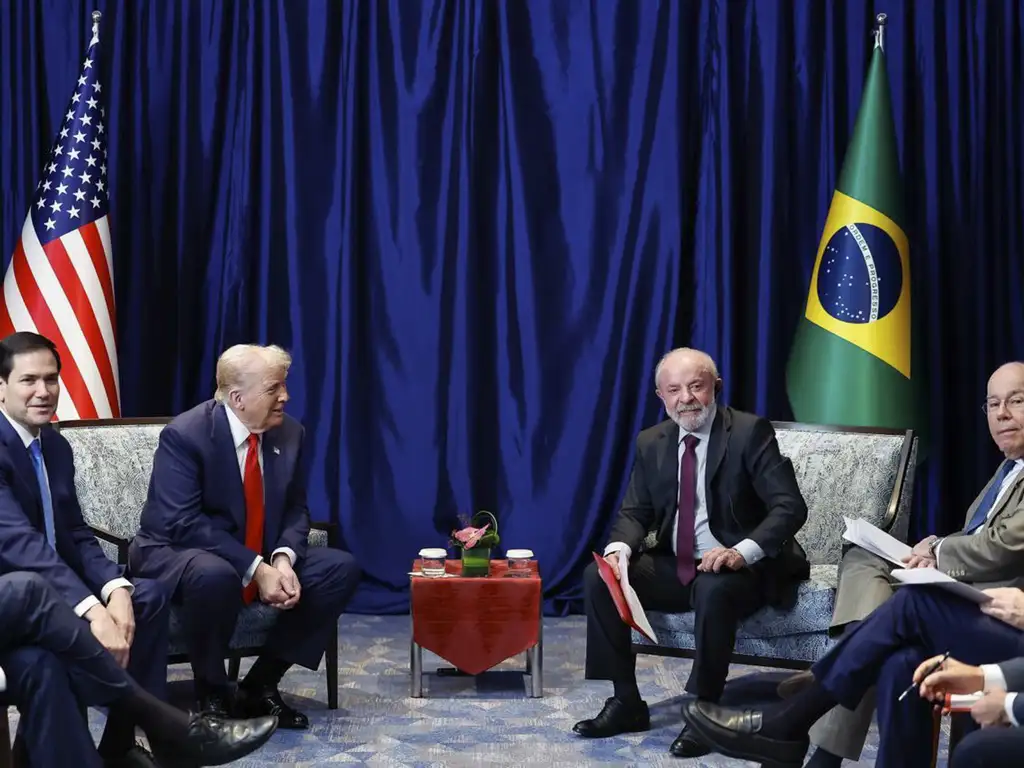
Luiz Inácio Lula da Silva durante encontro com Donald Trump na ASEAN (Foto: Ricardo Stuckert/PR)

O governo de Washington parece começar a focalizar mais de perto seus interesses no Hemisfério Ocidental do que em outras áreas do mundo. 

No início do ano, prometeu ocupar o Canal do Panamá, tornar o Canadá o 51º Estados dos EUA e alterou o nome do Golfo do México para Golfo da América. Durante o ano, muitas ações proativas na região. Na semana passada, três medidas e iniciativas foram nessa direção.

O anúncio de novas medidas tarifárias para reduzir os custos no mercado norte-americano de produtos agrícolas e pecuários, sem produção ou com pequena produção local, foram isentos das tarifas recíprocas (10%), mas continuaram a ser cobradas outras tarifas que incidem sobre esses produtos.

 Ao mesmo tempo, foi anunciada a conclusão de acordos comerciais com a Argentina, Equador, Guatemala e El Salvador. 

‘A redução de 10% beneficia alguns produtos brasileiros, mas é discriminatória contra o Brasil’

A redução de 10% beneficia alguns produtos brasileiros, mas é discriminatória contra o Brasil porque os acordos anunciados com os países latino-americanos deixam produtos que competem com os brasileiros com tarifa zero. 

No caso da Argentina, foi negociado um amplo acordo de comércio e investimentos, que, em uma primeira análise, não se choca com as regras do Mercosul.

Mauro Vieira foi recebido no Departamento de Estado por Marco Rubio. Na oportunidade, discutiram reservadamente temas de interesse dos dois países, e o ministro brasileiro entregou uma nova proposta para o começo das negociações comerciais. Segundo foi informado, esperava-se para o início da semana a marcação de data para o encontro técnico, o que não aconteceu até sexta-feira (21). 

‘A retirada dos 40% de tarifas para muitos produtos não teve nada que ver com as negociações bilaterais com o Brasil. Foram determinadas por direto interesse norte-americano’

As medidas anunciadas por Trump na semana passada e a retirada, na quinta (20), dos 40% para muitos produtos, não tiveram nada que ver com as negociações bilaterais com o Brasil. Foram determinadas por direto interesse norte-americano, apesar da ação política de Lula e de Mauro Vieira.

O governo norte-americano anunciou que, em breve, dará início a operação “Lança do Sul”, grande ação militar para combater o narcoterrorismo. 

Trump mencionou publicamente que já tinha tomado a decisão sobre o que fazer em relação à Venezuela. 

O governo norte-americano tem duas opções tendo em vista a grande mobilização naval e de soldados no Caribe: atacar com mísseis alguns alvos militares ou de narcotraficantes em território venezuelano ou executar uma operação de comando para derrubar e sequestrar o presidente Nicolás Maduro. 

Para isso, teriam de contar com a divisão das Forças Armadas venezuelanas e o apoio de parte delas para chegar a Maduro. Além disso, para combater os narcoterroristas, o presidente norte-americano não descarta atacar o México.

‘Parece evidente que houve uma mudança nas prioridades da política externa e de defesa dos EUA em relação a América Latina e Caribe, na busca de reafirmar a nova realidade geopolítica global’

Parece evidente que houve uma mudança nas prioridades da política externa e de defesa dos EUA em relação a América Latina e Caribe, na busca de reafirmar a nova realidade geopolítica global em que áreas de influência começam a ser estabelecidas. 

As três ações acima mencionadas indicam essa nova atitude de Washington e o poderio naval trazido para o Caribe é um recado para potências extrarregionais (China e Rússia) não interferirem no que vier a ser realizado na Venezuela.

É uma dramática mudança na política externa de Washington com as Américas se transformando no principal teatro de operações no exterior. 

Além das ameaças militares, Trump aplicou elevadas tarifas, duras sanções e pressões aos países da região, em clara afirmação de força como prova de sua área de influência e interesse em explorar ao máximo benefícios das reservas minerais e outras.

‘A doutrina Monroe está sendo atualizada para as realidades do século XXI’

A doutrina Monroe está sendo atualizada para as realidades do século XXI e de acordo com as novas prioridades e interesses do governo norte-americano. Ainda está muito cedo para ver se essa nova política de Washington em relação às Américas vai se manter como um dos braços de atuação do Departamento de Estado.

Essa nova atitude de Washington para com as Américas cria grandes desafios para a política externa do PT, com tradicional política antiamericana. Até o final do governo Lula, por muitas vezes, poder-se-á identificar contradições entre a ideologia do PT e os interesses nacionais.


Presidente e fundador do Instituto de Relações Internacionais e Comércio Exterior (IRICE). É presidente do Conselho Superior de Comércio Exterior da FIESP, presidente da Associação Brasileira da Indústria de Trigo (Abitrigo), presidente do Centro de Defesa e Segurança Nacional (Cedesen) e fundador da Revista Interesse Nacional. Foi embaixador do Brasil em Londres (1994–99) e em Washington (1999–04). É autor de Dissenso de Washington (Agir), Panorama Visto de Londres (Aduaneiras), América Latina em Perspectiva (Aduaneiras) e O Brasil voltou? (Pioneira), entre outros.

Agora sim: condições ideais para escrever suas memórias - Paulo Roberto de Almeida

Agora sim: condições ideais para escrever suas memórias

Paulo Roberto de Almeida 

Quando eu era secretário e até conselheiro diplomático, tínhamos diárias muito espartanas, 200 e poucos dólares, para participar de conferências ou reuniões  de serviço em cidades relativamente caras: Genebra, NY, Paris, Washington.

Recorríamos aos colegas amigos para poupar o taxi do aeroporto distante, por vezes até hospedagem. Do contrário, tinha de ser um hotelzinho modesto, três estrelas, quartinho pequeno, TV, frigo, banheiro ainda menor.

Acabo de assistir as imagens das novas acomodações exclusivas do condenado a 27 anos, mas que ainda não começou a cumprir a pena.

Pois elas me lembraram os quartinhos modestos das missões diplomáticas.

Pois eu acho que o ex-presidente, agora sem chance de voltar para a política e teoricamente limitado em sua capacidade de receber milhões via Pix dos devotos, beatos e outros idiotas seduzidos pelas lições de machismo e de propensões claramente autoritárias na política, tem uma excelente oportunidade para finalmente começar a escrever suas memórias, certamente medíocres, de tenente terrorista a capitão alçado a chefe de generais, que sem dúvida o desprezavam, mas que aproveitaram ao máximo as benesses do poder.

Ele terá tempo suficiente, nos próximos meses e anos, para redigir páginas enaltecedoras de uma carreira medíocre, mas bastante enriquecedora (das rachadinhas às rachadonas, com cartão corporativo).

Depois, vai ser preciso contratar um revisor de Português para polir a linguagem tosca e a redação sofrível do golpista incompetente e covarde.

Editora não vai ser problema, inclusive uma edição paga (pelos apoiadores da tropa golpista).

Acho que só falta uma estante para acomodar livros de Direito, de História do Brasil e algum manual de redação.

É tudo o que espero do cara que ainda precisa pagar pelos 700 mil mortos durante a pandemia, segundo o pastor  Ismael, que quase foi linchado pelos reunidos na “vigília libertadora” da fatídica sexta-feira de derretimento da  tornozeleira eletrônica.

O quartinho modesto me fez relembrar a primeira metade da minha carreira diplomática; gostei!

Paulo Roberto de Almeida

Brasília, 23/11/2025


A “boa versão” ainda não está pronta - Paulo Roberto de Almeida

 A “boa versão” ainda não está pronta


Todos sabem dos constrangimentos causados à diplomacia profissional do Palácio do Itamaraty pelos “eflúvios” e improvisos produzidos pela diplomacia presidencial personalista do Palácio do Planalto. 

Mas nada se compara à vergonha que devem estar passando os colegas do Departamento de Estado e o próprio Secretário de Estado Marco Rubio.

E não é que se descobre agora que o Plano Trump para a “paz” na Ucrânia foi passado, num hotel de luxo em Miami, por um representante especial de Putin ao ignorante e despreparado “representante” de Trump para os assuntos da Ucrânia (e do Oriente Médio também) e apresentado ao líder ucraniano Zelensky como se fosse um legítimo plano “americano” (mesmo numa tradução sofrível do russo ao inglês), com curtíssima data de aceite? 

Agora que a farsa foi revelada, e confirmada, Zelensky poderia devolver a cópia ao Trump e solicitar um novo “plano de paz” em papel timbrado do Departamento de Estado.

Minha solidariedade aos colegas diplomatas profissionais do State Department: sei como deve ser duro saber que trapalhadas externas ao serviço arranham a credibilidade externa da diplomacia profissional.

Paulo Roberto de Almeida

Diplomata aposentado

Brasília, 23/11/2025


Minha sugestão para a cerimônia de entrega do Prêmio Nobel da Paz 2025 - Paulo Roberto de Almeida

Minha sugestão para a cerimônia de entrega do Prêmio Nobel da Paz 2025:

Acredito que ele deveria ser entregue ao verdadeiro eleito nas eleições presidenciais de 2024, embaixador Edmundo González, que faria um discurso propondo um processo de transição para o retorno da Venezuela à democracia e leria uma mensagem da ganhadora, Maria Corina Machado, lider da oposição, atualmente escondida em seu próprio país. 

Talvez ela queira ser “extraída” da Venezuela com a ajuda dos americanos, para comparecer à cerimonia de Oslo, como os serviços especiais americanos já fizeram no caso de colegas dela refugiados na embaixada argentina, teoricamente sob a guarda da diplomacia brasileira, mas não creio que esta seja a melhor solução para o complicado impasse atual entre Trump e Maduro: qualquer “ajuda” americana nesse processo representaria uma intromissão indevida do governo Trump nos assuntos internos da Venezuela.

Paulo Roberto de Almeida

Brasília, 23/11/2025

Here is a real 28-Point Peace Plan - Centre for Eastern European Democracy

Here is a real 28-Point Peace Plan 

Centre for Eastern European Democracy

November 22, 2025


I. Core Principles of a Just Peace 

1. Peace must be anchored in international law — not coercion, spheres of influence, or great-power deals.

2. Borders cannot be changed by force.This post-WWII principle protects global stability.

3. Ukraine’s territorial integrity is non-negotiable, including Crimea and all territories occupied from 2022–2025. No outside power may restrict Ukraine’s right to defend itself.

4. Responsibility for the war lies with the aggressor.

5. European security requires accountability, not appeasement of dictators with imperial ambitions.

6. Ukraine’s future belongs solely to its democratically elected government — not foreign autocrats imposing language rules, religious control, or colonial versions of history.


II. Conditions for Ending Hostilities 

7. Complete withdrawal of Russian forces from all Ukrainian territory.

8. Total cessation of missile, drone, and artillery attacks on civilians and infrastructure.

9. Deployment of an international monitoring mission to verify compliance and protect civilians.

10. Immediate return of all Ukrainian POWs, abducted children and unlawfully detained civilians.

11. Restoration of Ukraine’s full control over its international borders.

12. Secured navigation in the Black Sea through multinational maritime cooperation.


III. Security Guarantees for a Lasting Peace 

13. Long-term, binding security guarantees for Ukraine from a coalition of democratic states.

14. Accelerated NATO integration — based solely on Ukraine’s progress, not Russian approval.

15. Deepened EU accession support, reconstruction funding, and institutional alignment.

16. A permanent, structural sanctions architecture to deter renewed Russian aggression.

17. Automatic punitive sanctions triggers for any ceasefire violations.

18. Strengthened Eastern European defense infrastructure, including forward deployments and integrated air and missile defense systems.


IV. Justice, Accountability & Human Rights 

19. Establish a special international tribunal to prosecute Russia’s leadership for genocide and aggression. Russia must surrender Vladimir Putin to the International Criminal Court and cooperate with ICC prosecutions.

20. Comprehensive documentation and prosecution of all war crimes, including genocide, torture, deportations, and deliberate attacks on civilians.

21. Mandatory reparations financed through frozen Russian sovereign assets.

22. Safe, verifiable return of all kidnapped and unlawfully deported Ukrainian children.


V. Reconstruction, Recovery & Democratic 

Rebuilding

23. A Marshall Plan–style reconstruction effort to address over $500 billion in damages, financed by more than $300 billion in seized Russian assets and allied support.

24. Strengthening Ukraine’s democratic institutions, anti-corruption systems, and transparent governance.

25. Support for full energy independence — renewables, nuclear safety, and integration into the European energy market.

26. Rebuilding critical infrastructure (schools, hospitals, transport, digital networks) and ensuring Russian return of all stolen Ukrainian cultural and historical artifacts such as art works, icons, embroidery, rare historical secular and liturgical texts, jewelry, and similar national treasures from Ukrainian museums, churches, monasteries, universities, schools, art galleries, government buildings, and other institutions housing or storing rare artifacts of national and historical importance


VI. Russia’s Path Back to International Legitimacy 

27. Russia can reenter the global economy only after meeting core conditions: full withdrawal, reparations, and cooperation with justice mechanisms.

28. Russia must abandon its imperial ambitions and formally acknowledge its wrongdoings to earn its place alongside free nations in this world.

Putin está perdendo a guerra de agressão contra a Ucrânia- a IA tente poderar os argumentos de minha postagem

Como já feito em ocasiões precedentes, Airton Dirceu Lemmertz submeteu minha postagem imediatamente anterior a esta ao crivo da IA,e essa Senhora bem-informada e tentativamente equilibrada, tenta ponderar os argumentos nela contidos. Acho o exercicio muito util, e recebo com prazer esses exercicios de computação desenfreada, com meus agradecimentos ao Airton pelo trabalho efetuada.

Doravante, vou passar a chamar a IA de Senhora Bem-Informada, ainda que excessivamente prudente, ou seja, muddle term.

Paulo Roberto de Almeida 

Brasília, 23/11/2025


 " A guerra de Putin na Ucrânia forneceu-lhe uma justificativa para sufocar a dissidência na Rússia, redirecionando vastos recursos para transformar a economia russa em produção militar, patrocinando esforços para derrubar governos que apoiam a Ucrânia e preparando-se para novas invasões que restabelecerão o império russo e consolidarão seu legado como um Stalin moderno. Apesar de tudo isso, Putin ainda está perdendo a guerra na Ucrânia. Esse conflito está consumindo homens e equipamentos a um ritmo insustentável. Além disso, tem sido um desastre estratégico. A guerra fortaleceu o nacionalismo ucraniano. Energizou os membros europeus da OTAN e levou a Finlândia e a Suécia a aderirem à OTAN, o que dobrou a extensão da fronteira da OTAN com a Rússia. Destruiu o mito da superioridade militar russa. Acabou com as exportações de gás natural russo para a União Europeia, que haviam sido cuidadosamente cultivadas por décadas. Levou à emigração de mais de meio milhão dos melhores e mais brilhantes russos. A maioria dos países da OTAN está agora rearmando e expandindo seus exércitos. O Produto Interno Bruto (PIB) combinado dos países da UE, de US$ 19,4 trilhões em 2024, somado ao PIB do Reino Unido, de US$ 3,6 trilhões, totalizou mais de US$ 23 trilhões, enquanto o PIB da Federação Russa, em 2024, foi de US$ 2,1 trilhões. A longo prazo, a Rússia não pode competir com a Europa Ocidental. A Europa pode arcar com o apoio da economia e do esforço de guerra da Ucrânia, enquanto os países europeus intensificam suas indústrias de defesa e infraestrutura militar. Putin acabará perdendo não apenas a guerra na Ucrânia, mas também seu sonho de um novo império russo. ". ANALISE DE MODO CRÍTICO E DETALHADO O CONJUNTO DE INFORMAÇÕES DO TEXTO ACIMA, ENTRE ASPAS.


O texto em análise apresenta uma perspectiva crítica e unilateral sobre a guerra na Ucrânia, argumentando que, apesar de Putin ter usado o conflito para consolidar poder interno e redirecionar recursos, ele está perdendo a guerra devido a reveses estratégicos e à superioridade econômica de longo prazo do Ocidente. A análise detalhada a seguir examina os principais argumentos, pesando suas validades e nuances com base em informações factuais. 
* Análise Crítica Detalhada dos Argumentos 
1. Consolidação Interna e Economia de Guerra: 
- Argumento do texto: Putin usou a guerra como justificativa para sufocar a dissidência e transformar a economia russa em produção militar, agindo como um "Stalin moderno".
- Análise: Este argumento é em grande parte corroborado por fatos observáveis. Houve um aumento significativo na repressão à oposição e à mídia independente na Rússia desde o início da invasão, com novas leis que criminalizam a "desinformação" sobre a guerra. Economicamente, a Rússia mudou seu foco para uma economia de guerra, com gastos militares representando uma fatia recorde do PIB em 2024 (cerca de 8,7%). Isso impulsionou um crescimento do PIB russo notavelmente forte em 2024, superando muitas economias ocidentais, embora esse crescimento seja impulsionado pelo complexo militar-industrial e não por uma economia civil saudável e diversificada. 
2. "Putin ainda está perdendo a guerra" / Ritmo Insustentável: 
- Argumento do texto: O conflito está consumindo homens e equipamentos a um ritmo insustentável.
- Análise: A avaliação de "perder a guerra" é complexa e subjetiva, dependendo dos objetivos definidos. A Rússia sofreu perdas significativas de pessoal e equipamento. No entanto, a Ucrânia também sofreu perdas pesadas e tem enfrentado desafios no recrutamento e na dependência contínua de apoio externo. A Rússia demonstrou uma capacidade surpreendente de absorver sanções e continuar sua produção militar, ajustando-se para um conflito de longo prazo. O "ritmo insustentável" é uma avaliação que se aplica a ambos os lados em uma guerra de atrito. 
3. Desastre Estratégico e Fortalecimento da OTAN: 
- Argumento do texto: A guerra fortaleceu o nacionalismo ucraniano, energizou a OTAN e levou Finlândia e Suécia a aderirem à aliança, dobrando a fronteira da OTAN com a Rússia.
- Análise: Esta é uma das consequências estratégicas mais evidentes e um revés claro para os objetivos declarados de Putin de impedir a expansão da OTAN. A adesão da Finlândia e da Suécia, que abandonaram décadas de neutralidade, é uma derrota política e militar significativa para Moscou, transformando o Mar Báltico em grande parte em um "lago da OTAN". O nacionalismo ucraniano foi inegavelmente fortalecido pela agressão externa. 
4. Destruição do Mito da Superioridade Militar Russa: 
- Argumento do texto: A guerra destruiu o mito da superioridade militar russa.
- Análise: Inicialmente, a falha russa em capturar Kiev rapidamente e os problemas logísticos expuseram fraquezas. No entanto, as forças russas se adaptaram e demonstraram resiliência e capacidades em guerra de atrito e uso de artilharia em massa. Embora a campanha não tenha sido a operação rápida que muitos esperavam, a Rússia ainda ocupa cerca de 20% do território ucraniano e continua avançando em algumas áreas. A percepção de "superioridade" pode ter mudado, mas a Rússia permanece uma força militar formidável. 
5. Consequências Econômicas e Comparação do PIB: 
- Argumento do texto: O fim das exportações de gás para a UE, a emigração de cérebros russos e a disparidade do PIB Ocidental (US$ 23 trilhões combinados da UE + UK versus US$ 2,1 trilhões da Rússia em 2024) significam que a Rússia não pode competir a longo prazo.
- Análise: Os dados do PIB são amplamente consistentes com as estimativas (PIB da UE em torno de US$ 19,4 trilhões, Reino Unido cerca de US$ 3,6 trilhões, Rússia cerca de US$ 2,1 trilhões). A disparidade econômica é de facto vasta. A Rússia perdeu mercados de gás importantes, mas redirecionou exportações para a China e a Índia e beneficiou-se do aumento dos preços globais de energia após a invasão. A emigração de profissionais qualificados é um problema de longo prazo para a Rússia. A conclusão de que a Rússia "não pode competir a longo prazo" é uma projeção plausível com base em fundamentos econômicos, mas a capacidade da Rússia de sustentar a guerra no médio prazo, alavancando a sua economia de guerra, tem sido maior do que muitos analistas previram inicialmente. 
* Conclusão 
O texto oferece uma análise forte e coerente dos reveses estratégicos e das vulnerabilidades econômicas da Rússia a longo prazo. Os argumentos sobre o fortalecimento da OTAN e a vasta diferença de recursos econômicos são bem fundamentados. No entanto, a conclusão de que Putin "está perdendo" a guerra é uma simplificação. A Rússia adaptou-se, mobilizou sua economia para o conflito e continua a lutar, enquanto as potências ocidentais enfrentam desafios políticos internos para manter um apoio consistente à Ucrânia. A vitória ou derrota dependerá da resiliência contínua de ambos os lados e da evolução do apoio internacional.

Fonte (Gemini, a IA do Google):
https://www.google.com/search?q=%22+A+guerra+de+Putin+na+Ucr%C3%A2nia+forneceu-lhe+uma+justificativa+para+sufocar+a+dissid%C3%AAncia+na+R%C3%BAssia%2C+redirecionando+vastos+recursos+para+transformar+a+economia+russa+em+produ%C3%A7%C3%A3o+militar%2C+patrocinando+esfor%C3%A7os+para+derrubar+governos+que+apoiam+a+Ucr%C3%A2nia+e+preparando-se+para+novas+invas%C3%B5es+que+restabelecer%C3%A3o+o+imp%C3%A9rio+russo+e+consolidar%C3%A3o+seu+legado+como+um+Stalin+moderno.+Apesar+de+tudo+isso%2C+Putin+ainda+est%C3%A1+perdendo+a+guerra+na+Ucr%C3%A2nia.+Esse+conflito+est%C3%A1+consumindo+homens+e+equipamentos+a+um+ritmo+insustent%C3%A1vel.+Al%C3%A9m+disso%2C+tem+sido+um+desastre+estrat%C3%A9gico.+A+guerra+fortaleceu+o+nacionalismo+ucraniano.+Energizou+os+membros+europeus+da+OTAN+e+levou+a+Finl%C3%A2ndia+e+a+Su%C3%A9cia+a+aderirem+%C3%A0+OTAN%2C+o+que+dobrou+a+extens%C3%A3o+da+fronteira+da+OTAN+com+a+R%C3%BAssia.+Destruiu+o+mito+da+superioridade+militar+russa.+Acabou+com+as+exporta%C3%A7%C3%B5es+de+g%C3%A1s+natural+russo+para+a+Uni%C3%A3o+Europeia%2C+que+haviam+sido+cuidadosamente+cultivadas+por+d%C3%A9cadas.+Levou+%C3%A0+emigra%C3%A7%C3%A3o+de+mais+de+meio+milh%C3%A3o+dos+melhores+e+mais+brilhantes+russos.+A+maioria+dos+pa%C3%ADses+da+OTAN+est%C3%A1+agora+rearmando+e+expandindo+seus+ex%C3%A9rcitos.+O+Produto+Interno+Bruto+%28PIB%29+combinado+dos+pa%C3%ADses+da+UE%2C+de+US%24+19%2C4+trilh%C3%B5es+em+2024%2C+somado+ao+PIB+do+Reino+Unido%2C+de+US%24+3%2C6+trilh%C3%B5es%2C+totalizou+mais+de+US%24+23+trilh%C3%B5es%2C+enquanto+o+PIB+da+Federa%C3%A7%C3%A3o+Russa%2C+em+2024%2C+foi+de+US%24+2%2C1+trilh%C3%B5es.+A+longo+prazo%2C+a+R%C3%BAssia+n%C3%A3o+pode+competir+com+a+Europa+Ocidental.+A+Europa+pode+arcar+com+o+apoio+da+economia+e+do+esfor%C3%A7o+de+guerra+da+Ucr%C3%A2nia%2C+enquanto+os+pa%C3%ADses+europeus+intensificam+suas+ind%C3%BAstrias+de+defesa+e+infraestrutura+militar.+Putin+acabar%C3%A1+perdendo+n%C3%A3o+apenas+a+guerra+na+Ucr%C3%A2nia%2C+mas+tamb%C3%A9m+seu+sonho+de+um+novo+imp%C3%A9rio+russo.+%22.+ANALISE+DE+MODO+CR%C3%8DTICO+E+DETALHADO+O+CONJUNTO+DE+INFORMA%C3%87%C3%95ES+DO+TEXTO+ACIMA%2C+ENTRE+ASPAS.&rlz=1C2GCEA_enBR1094BR1098&sca_esv=e816a71fa66a67a5&sxsrf=AE3TifPuLxEm50I-c7wUuP7XCpdtIsovgw%3A1763865726021&source=hp&ei=fXQiaa_SPPG_5OUPvsC7kQ4&iflsig=AOw8s4IAAAAAaSKCjpJSD20vLBzk_QtBrNwL1xVVq4rV&aep=22&udm=50&ved=0ahUKEwjvhJ7wn4eRAxXxH7kGHT7gLuIQteYPCBE&oq=&gs_lp=Egdnd3Mtd2l6IgBIAFAAWABwAHgAkAEAmAEAoAEAqgEAuAEByAEAmAIAoAIAmAMAkgcAoAcAsgcAuAcAwgcAyAcA&sclient=gws-wiz&mstk=AUtExfBIoF5-ZCEmUEDjax0mfr4gLrU5692TJ-sOdioicxTY4gBlFXL62H3RvMzIVoIROI-ARi0gFfA9E94CWrFLBppo9aoLmFgIRCkyS-4hg2FWvxQ9w70CWKMJCKP1O7kzrCk0msCPS8pboDHXXkzIDfSJCMciXHd_QMje82jkhvkXWv7MxXWccK1UkJ4JXBPuYhowZ8trI2fV7U1pYkNC0sjBb4b-J8OQ9itZdMSduhYgTJBYmjMGsgN365ZJvACGBzKT4Pw3jyxt6OEs3SMkx_imbEhPiFqUSHk&csuir=1&mtid=23QiadfFJua-5OUP6d-IkQ8 

The Witkoff-Dmitriev peace plan annotated - Lawrence Freedman

Os 28 pontos do Plano Trump-Putin para a capitulação da Ucrânia comentados por um especialista no assunto:

The Witkoff-Dmitriev peace plan annotated
Lawrence Freedman
Nov 21, 2025
https://samf.substack.com/p/the-witkoff-dmitriev-peace-plan-annotated

We now know a bit more about the process which led to the new peace plan and we now have a copy of its contents, to which I will turn soon.

Yesterday I noted that the plan, which was largely drafted by Steve Witkoff and Kirll Dmitriev, neither of whom are professional diplomats, was slanted in Russia’s favour, had been leaked by Dmitriev apparently to give it a push, had not been negotiated with either Kyiv or Moscow, and that many provisions were unclear even though the stories insisted that it was to be presented to Kyiv as a fait accompli.

With more reporting since I posted it seems that the proposal is more developed and has involved more people around the Trump administration. My guess is that as people looked at the plan it was starting to get pushback (possibly from Ukrainians) and that Dmitriev leaked it to give it a higher status and invest it with momentum, but that is only a guess.

At any rate if that is what was intended it succeeded as it is now being discussed as something real and in play. But it is clearly insufficiently developed to be presented as a fait accompli, and contrary to the original leaks, that will not now happen. This is not least because the Russians have been blindsided and are unhappy with the process and some of the content. So it is up for consultation and discussion with both sides.

We can now go further because a copy of the ‘28 point plan’ is in circulation, which I assess below. In key provisions, most importantly the territorial, but also in limiting the Ukrainian army and keeping Ukraine out of NATO, it reflects a Russian ‘wish list’, but it is only to fair to acknowledge that in some respects, notably on security guarantees and reconstruction, it tries to offer something to Ukraine. The effort appears to be one of trying to come up with a package that could work for both sides, though requiring both to make concessions.

By the nature of the conflict, the most important concessions come from Ukraine as it was the victim of aggression and it is its territory and not Russia’s that is occupied. But there is a lot in this that Russia still won’t like or at least will want to reframe. As important, it’s a dog’s breakfast, with some strange provisions, leaving open many questions for contentious interpretation and potential reframing.

I’ve provided annotations, noting the issues it raises. Others I’m sure will pick up points I’ve missed.

Ukraine’s sovereignty will be confirmed.

A full and comprehensive non-aggression agreement will be concluded between Russia, Ukraine, and Europe. All ambiguities of the past 30 years will be considered resolved.

[What ambiguities? Promises of non-aggression have been made before, for example in the 1997 Founding Act, so while these are good things to say it remains unclear how much they can be trusted]

Russia is expected not to invade neighboring countries, and NATO will not expand further.

[No membership of NATO for Ukraine, and also in this formulation, any other potential candidates, has been a feature of Trump plans from the start. What is ‘an expectation not to invade.’ It imposes no obligations. A simple ‘will not’ would suffice.]

A dialogue between Russia and NATO, mediated by the United States, will be held to address all security issues and create conditions for de-escalation, in order to ensure global security and increase opportunities for cooperation and future economic development.

[How can the US ‘mediate’ a dialogue between Russia and an alliance of which it is a part? Otherwise similar aspirations have been found in previous treaties].

Ukraine will receive reliable security guarantees.

[More on this below].

The size of the Armed Forces of Ukraine will be limited to 600,000 personnel.

[This is more than envisaged under previous Russian proposals - in 2022 it was 85,000 - but why is it needed for a sovereign country? There is no mention of limitations on particular classes of weapons - aircraft, tanks etc. There are no restrictions envisaged on Russian forces.]

Ukraine agrees to enshrine in its constitution that it will not join NATO, and NATO agrees to include a provision in its charters that Ukraine will not be admitted in the future.

[Ukraine aspires to join NATO. Its constitution can be changed to preclude that, though this will be contentious. It can then be changed back again at a later date. If this is referring to the 1949 Washington Treaty that was signed and sealed in 1949. It has only been amended to take account of new members. The NATO Council could certainly promise not to admit Ukraine, although it could also change its mind].

NATO agrees not to station troops in Ukraine.

[There goes the Coalition of the Willing (CoW), or at least the part of the plan that envisaged small European military contingents backing up Ukrainian front line forces (which would now also be limited).]

European fighter jets will be stationed in Poland.

[It’s an odd statement, as it is up to Poland, but I presume this is intended to rescue the part of the CoW plan that envisaged air support that could impose a no-fly zone. I can’t imagine Russia will be delighted by this but in practice it could happen anyway. No mention of potential role for CoW naval forces.]

U.S. guarantee:

The United States will receive compensation for providing the guarantee.

[What does this mean? From whom, in what form and how much? A security guarantee is a promise to act in certain contingencies. It doesn’t cost much to make the promise. This plays to Trump’s transactional view of alliance security but it is a weird insertion in a peace treaty]

▪️ If Ukraine invades Russia, it will lose the guarantee.

[Of course unlikely but remember that the Russian pretext for the full-scale invasion was that Ukrainian forces were ‘invading’ the Luhansk enclave]

▪️ If Russia invades Ukraine, then in addition to a decisive and coordinated military response, all global sanctions will be reinstated, recognition of new territory and all other benefits of this deal will be revoked.

[Well unless the US intends to do it all by itself ‘decisive and coordinated’ means a NATO response and not just a US one (so does NATO get compensated?). In fact this has more automaticity than NATO’s Article V. So Ukraine should be happy with this but for the same reason Russia will not. Once sanctions have been removed it will not be easy to reinstate them. If Ukrainian territories have been integrated into Russia does that mean that the US would lead a fight to get them back or just withdraw recognition?]

▪️ If Ukraine, without cause, launches a missile at Moscow or Saint Petersburg, the security guarantee will be considered void.

[But Rostov would be OK? And what would be sufficient cause to justify a missile launch? Another weird clause.]

Ukraine has the right to EU membership and will receive short-term preferential access to the European market while this issue is under consideration.

That is up to EU but nice if Russia conceded as this whole wretched business began when Putin tried to stop Ukraine signing an association agreement with the EU in 2013]

A powerful global package for Ukraine’s reconstruction, including but not limited to:

a. Creation of a Ukraine Development Fund to invest in fast-growing sectors, including technology, data centers, and artificial intelligence.
b. The United States will cooperate with Ukraine to jointly restore, develop, modernize, and operate Ukraine’s gas infrastructure, including pipelines and storage.
c. Joint efforts to rebuild war-affected territories to restore, reconstruct, and modernize cities and residential areas.
d. Infrastructure development.
e. Extraction of minerals and natural resources.
f. The World Bank will develop a special financing package to accelerate these efforts.

[In principle all good but this will require a lot of money. (e) presumably refers to the US-agreement on minerals but it is not explicit]

Russia will be reintegrated into the global economy:

a. Sanctions relief will be discussed and agreed upon gradually and individually.
b. The United States will conclude a long-term economic cooperation agreement aimed at mutual development in the spheres of energy, natural resources, infrastructure, artificial intelligence, data centers, Arctic rare-earth mining projects, and other mutually beneficial corporate opportunities.
c. Russia will be invited to return to the G8.

[Not surprising but Russia will worry that (a) will be a slow process, and it is very dependent upon EU and UK so they will need to agree package. This is their major leverage over the fate of this plan

Equally it is not for the US to decide alone if Russia can rejoin the G7. It has to be agreed by the other members]

Frozen assets will be used as follows:

US$100 billion of frozen Russian assets will be invested in U.S.-led efforts for Ukraine’s reconstruction and investment. The United States will receive 50% of the profits from this initiative.
Europe will add US$100 billion to increase the investment available for Ukraine’s reconstruction. European frozen assets will be unfrozen.
The remaining frozen Russian assets will be invested in a separate U.S.–Russia investment vehicle that will implement joint projects in designated areas. This fund will aim to strengthen relations and increase shared interests to create a strong incentive not to return to conflict.

[I can’t believe that Russia will agree to any of this. They want their assets back. Equally Ukraine wants them as reparations for all the losses they have suffered - and even then it will not be enough. What is with the US making a profit from this?]

A joint U.S.–Russia security working group will be established to facilitate and ensure implementation of all provisions of this agreement.

[At the very least Ukraine should also be part of this process, otherwise it is wholly reliant on the US to look after its interests when it has been doing the mediating. Russia will continue to accuse Ukraine of breaking provisions and Ukraine needs to be able to defend its position and point to areas of Russian non-compliance. As drafted denies Ukraine any agency over the implementation ]

Russia will codify a non-aggression policy toward Europe and Ukraine.

[Following the UN Charter would be a start. I’ve no idea what this could mean. Non-aggression should not be conditional.]

The United States and Russia will agree to extend nuclear non-proliferation and arms control treaties, including the START I Treaty.

[The non-proliferation is not time limited so it does not need extension. I presume they mean New START rather than START 1, and its extension would be welcome.]

Ukraine agrees to remain a non-nuclear state in accordance with the Nuclear Non-Proliferation Treaty.

The Zaporizhzhia Nuclear Power Plant will be put into operation under IAEA supervision, and the electricity produced will be distributed equally between Russia and Ukraine — 50:50.

[This assume Zaporizhzhia remains de facto part of Russia see below]

Both countries commit to implementing educational programs in schools and society aimed at fostering understanding and tolerance of different cultures and eliminating racism and prejudice:

a. Ukraine will adopt EU rules on religious tolerance and protection of linguistic minorities.
b. Both countries will agree to abolish all discriminatory measures and guarantee the rights of Ukrainian and Russian media and education.
c. All Nazi ideology and activity must be rejected and prohibited.

[Well good luck with all of that if it is supposed to apply to Russia. As the Kremlin has adopted its own self-serving definition of what constitutes Nazi ideology and activity (more or less anything hostile to Russia) we can only guess how this would be used. Equally interesting to see how Ukrainian rights are to be protected in Russia.]

Territories:

a. Crimea, Luhansk, and Donetsk will be recognized as de facto Russian, including by the United States.
b. Kherson and Zaporizhzhia will be frozen along the line of contact, effectively granting de facto recognition along that line.
c. Russia will relinquish other agreed territories it controls outside the five regions.
d. Ukrainian forces will withdraw from the part of Donetsk Oblast they currently control, and this withdrawal zone will be considered a neutral demilitarized buffer zone, internationally recognized as territory belonging to the Russian Federation. Russian forces will not enter this demilitarized zone.

[This meets Russia’s core territorial demand, although with some strange twists. De facto is less than de jure. It normally refers to a situation that exists in reality and cannot easily be changed, but is not necessarily recognized in law. In the event of a ceasefire being agreed it was always safest to assume that the occupied territories would become de facto Russian, without being recognised as such by Ukraine or the wider international community (as with Crimea). De jure refers to situations that are legally recognised and have official status. Russia has incorporated the four claimed oblasts into its constitution and wants them officially recognised. At any rate you don’t formally recognise something as de facto - it just is. So this would be meaningless. Russia will want de jure.

Turning the remaining part of Donetsk into a neutral demilitarised zone is an odd sort of compromise. First this is full of Ukrainian defences, including minefields (there are no reference to demining anywhere in the document). Demilitarising it would be no small matter. And if it is part of Russia - even if de facto - how can it be neutral. Ukrainians also live there. Are they supposed to abandon their homes or become Russian or have some limbo status because they are in neutral territory?]

After future territorial arrangements are agreed, both Russia and Ukraine commit not to alter them by force. Any security guarantees will not apply if this obligation is violated.

Russia will not obstruct Ukraine’s use of the Dnipro River for commercial activities, and agreements will be reached on the free transport of grain through the Black Sea.

[There were agreements on this in the past which Russia abandoned]

A humanitarian committee will be created to resolve outstanding issues:

a. All remaining prisoners and bodies will be exchanged on an “all for all” basis.
b. All civilian detainees and hostages, including children, will be returned.
c. A family reunification program will be implemented.
d. Measures will be taken to alleviate the suffering of victims of the conflict.

[Hard to object but not exactly strong on detail]

Ukraine will hold elections in 100 days.

[There is a need for Ukrainian elections but it also requires the conditions for them to be conducted safely. Can the residents of Donetsk vote? At rate elections are up to the Ukrainians as a sovereign country. Why not include a demand for free and fair Russian elections?]

All parties involved in this conflict will receive full amnesty for actions during the war and agree not to bring claims or pursue grievances in the future.

[War crimes go unpunished].

This agreement will be legally binding.
Its implementation will be monitored and guaranteed by a Peace Council chaired by President Donald J. Trump. Sanctions will be imposed for violations.

[This is modelled on Gaza. How does it relate to point 15 or indeed the other provisions on guarantees? What happens when Trump goes? Who will be on this Peace Council? What will be the terms of reference? Most peace treaties will have provisions to deal with disputes and if necessary provide for arbitration. With Gaza the Trump plan was backed by the great majority of regional states and the aim was to write Hamas out of the script. The military and political relationships were quite different.]

Once all parties accept this memorandum, a ceasefire will take effect immediately after both sides withdraw to the agreed points for the start of the agreement’s implementation.

Wisely Zelenskyy has said he’ll work with the Americans on the plan. He might as well wait until the Russians formulate a response. For now their reaction has been muted. If the Russians just accepted it they could claim a sort of victory but it would not quite be on their terms. As I surmised yesterday and have shown above this is not a fully developed plan which could be presented, as was the Gaza plan, on a take it or leave it basis. Even then Netanyahu fiddled with the details at the end.

This is a plan that even if there was no change to the underlying principles and concessions would require a lot more work, and so will delay a ceasefire. As soon as both sides can object and amend that will lead to a protracted negotiation and so even more delay. The advantage is that having a plan set down allows one to see the pitfalls. It does not necessarily enable one to see a way though them.

Comment is Freed relies on readers’ support. A monthly subscription is £4.50 and an annual one is £45. We typically post 2-3 times a week and the majority of posts are paywalled.

Thanks for reading Comment is Freed! This post is public so feel free to share it.

Postagem em destaque

Livro Marxismo e Socialismo finalmente disponível - Paulo Roberto de Almeida

Meu mais recente livro – que não tem nada a ver com o governo atual ou com sua diplomacia esquizofrênica, já vou logo avisando – ficou final...