segunda-feira, 8 de agosto de 2016

Olimpiadas: quem fica com a medalha de ouro do sobrepreco e da corrupcao?

Os russos nos ganham em matéria de sobrepreço, e de corrupção, mas os chineses não ficam atrás.
Que tal criar a medalha de ouro do sobrepreço e da corrupção?
Paulo Roberto de Almeida


Espioes eletronicos, predadores comerciais: anuncio de Nunca Antes na Diplomacia

Não sou paranoico, mas sei que estamos cercados de todos os lados por espiões não revelados (elementar meu caro Watson do cerrado).
Já não é a primeira vez que constato, ao abrir a página do Antagonista, até aqui a minha página favorita de fofocas políticas e fuzilamento dos lulopetistas, um anúncio silencioso, mas gritante, acima ou à direita da minha tela. Este aqui:

R$61,00
Só hoje! Oportunidade única. Grandes Ofertas. Em até 12x s/ Juros e Frete Grátis*

 
Pronto, descobriram onde eu estou, e querem me fazer comprar o meu próprio livro a todo custo, ou melhor, a um custo elevado.
O mesmo livro está sendo vendido na Cultura a um preço bem inferior.
Mas o fato é que descobriram onde eu me escondo, e vivem me cercando.
Bando de espiões.
Vou ter de comprar o livro para cessar o assédio?
Paulo Roberto de Almeida 
 
Em todo caso, aqui está a informação:

Uniceub (Brasilia) promove encontro e dialogos sobre corrupcao - 10/08/2016

O UniCEUB receberá grandes nomes do Direito para a palestra Democracia, corrupção e justiça: diálogos para um país melhor, a ser realizada na próxima quarta-feira, 10 de agosto.

Confira a lista dos palestrantes:

• Ministro Luís Roberto Barroso, do Supremo Tribunal Federal (STF) e presidente do IDCON;
• Professora Susan Rose-Ackerman, da Universidade de Yale;
• Procurador Deltan Dallagnol, do Ministério Público Federal (MPF);
• Professor Oscar Vilhena, da Fundação Getúlio Vargas (FGV/SP);
• Juiz federal Sérgio Moro, da 13ª Vara Criminal Federal de Curitiba;
• Ministro Carlos Ayres Britto, ex-presidente do Supremo Tribunal Federal (STF) e presidente do CBEC - Centro Brasileiro de Estudos Constitucionais.

O evento, que ocorrerá no auditório Elza Moreira Lopes para convidados, será transmitido ao vivo, a partir das 9 horas. Você poderá acompanhar a transmissão simultânea das seguintes formas:

Canal do UniCEUB no YouTube;
• Auditório do Bloco 1, campus da Asa Norte;
• Auditório do Bloco 2, campus da Asa Norte;
• Auditório da Biblioteca, campus da Asa Norte;
• Auditório do Bloco 8, campus da Asa Norte;
• Sala 3018, Bloco 3 do campus da Asa Norte;
• Auditório do campus II de Taguatinga.

Realização: Instituto de Diálogos Constitucionais - IDCON
Uniceub, Brasília, DF

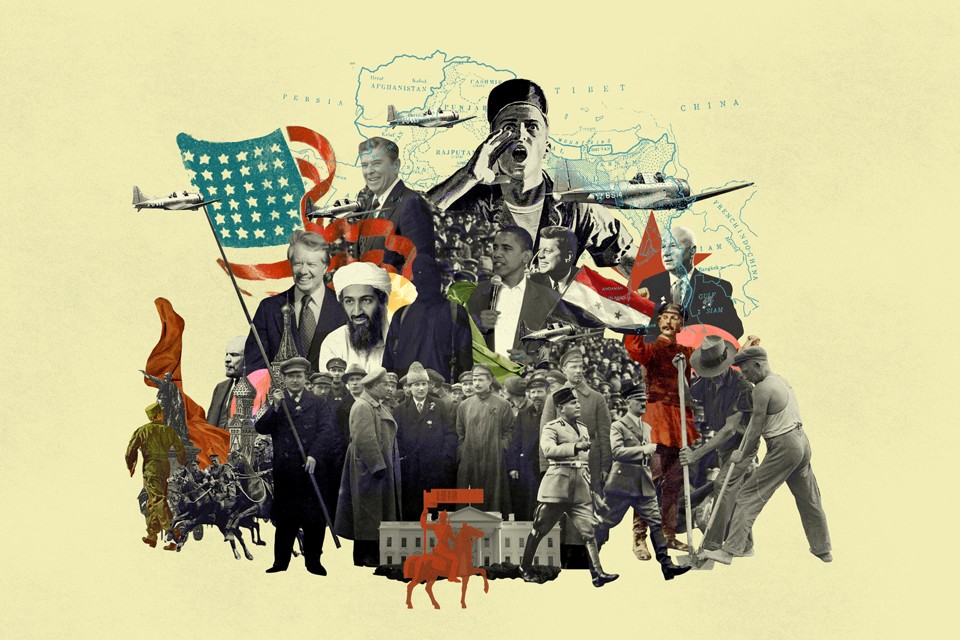
Applied History Project - Graham Allison, Niall Ferguson (Harvard Univesity)

Presidentes precisam, realmente, do conselho de historiadores? Precisam de um Conselho Assessor de Historiadores, como hoje possuem um para assuntos econômicos?
Duvidoso que assim seja, ou melhor: seria desejável que assim fosse, mas eles provavelmente não têm tempo, nem paciência, para ficarem se encantando com histórias passadas para iluminar o presente e ficar planejando o futuro.
Não tenho certeza de que os dois historiadores que assinam esta opinião pretendam criar um Historian of the Presidency Office, ou estejam buscando um emprego no próximo governo, mas parece bem assim: conselheiros do príncipe desejando evitar, por exemplo, uma nova confrontação estilo Guerra Fria, desta vez envolvendo a vigorosa China, ou mesma a decadente Rússia.
Vamos ler, em todo caso...
Paulo Roberto de Almeida 


Why the President Needs a Council of Historians

The Atlantic, September 2016 Issue


It isn’t enough for a commander in chief to invite friendly academics to dinner. The U.S. could avoid future disaster if policy makers started looking more to the past.
 
It is sometimes said that most Americans live in “the United States of Amnesia.” Less widely recognized is how many American policy makers live there too.
Speaking about his book Doomed to Succeed: The U.S.-Israel Relationship From Truman to Obama, the American diplomat Dennis Ross recently noted that “almost no administration’s leading figures know the history of what we have done in the Middle East.” Neither do they know the history of the region itself. In 2003, to take one example, when President George W. Bush chose to topple Saddam Hussein, he did not appear to fully appreciate either the difference between Sunni and Shiite Muslims or the significance of the fact that Saddam’s regime was led by a Sunni minority that had suppressed the Shiite majority. He failed to heed warnings that the predictable consequence of his actions would be a Shiite-dominated Baghdad beholden to the Shiite champion in the Middle EastIran.
The problem is by no means limited to the Middle East or to Bush. President Obama’s inattention to the deep historical relationship between Russia and Ukraine led him to underestimate the risks of closer ties between Ukraine and Europe. “I don’t really even need George Kennan right now,” President Obama told The New Yorker for a January 2014 article, referring to the great Cold War–era diplomat and historian. By March, Russia had annexed Crimea.
To address this deficit, it is not enough for a president to invite friendly historians to dinner, as Obama has been known to do. Nor is it enough to appoint a court historian, as John F. Kennedy did with Arthur M. Schlesinger Jr. We urge the next president to establish a White House Council of Historical Advisers. Historians made similar recommendations to Presidents Carter and Reagan during their administrations, but nothing ever came of these proposals. Operationally, the Council of Historical Advisers would mirror the Council of Economic Advisers, established after World War II. A chair and two additional members would be appointed by the president to full-time positions, and respond to assignments from him or her. They would be supported by a small professional staff and would be part of the Executive Office of the President.
For too long, history has been disparaged as a “soft” subject by social scientists offering spurious certainty. We believe it is time for a new and rigorous “applied history”—an attempt to illuminate current challenges and choices by analyzing precedents and historical analogues. We not only want to see applied history incorporated into the Executive Office of the President, alongside economic expertise; we also want to see it developed as a discipline in its own right at American universities, beginning at our own. When people refer to “applied history” today, they are typically referring to training for archivists, museum curators, and the like. We have in mind a different sort of applied history, one that follows in the tradition of the modern historian Ernest May and the political scientist Richard Neustadt. Their 1986 book, Thinking in Time, provides the foundation on which we intend to build.
Mainstream historians take an event, phenomenon, or era and attempt to explain what happened. They sometimes say that they study the past “for its own sake.” Applied historians would take a current predicament and try to identify analogues in the past. Their ultimate goal would be to find clues about what is likely to happen, then suggest possible policy interventions and assess probable consequences. You might say that applied history is to mainstream history as medical practice is to biochemistry, or engineering is to physics. But those analogies are not quite right. In the realm of science, there is mutual respect between practitioners and theorists. In the realm of policy, by contrast, there is far too often mutual contempt between practitioners and academic historians. Applied history can try to remedy that.
Imagine that President obama had a Council of Historical Advisers today. What assignments could he give it?
Start with the issue that the president and his national-security team have been struggling with most: isis. Recent statements indicate that the administration tends to see isis as essentially a new version of al-Qaeda, and that a top goal of U.S. national-security policy is to decapitate it as al-Qaeda was decapitated with Osama bin Laden’s assassination. But history suggests that isis is quite different in structure from al-Qaeda and may even be a classic acephalous network. When we searched for historical analogues to isis, we came up with some 50 groups that were similarly brutal, fanatical, and purpose-driven, including the Bolsheviks of the Russian Revolution. By considering which characteristics of isis are most salient, a Council of Historical Advisers might narrow this list to the most relevant analogues. Study of these cases might dissuade the president from equating isis with its recent forerunner.
The U.S. government’s response to the 2008 financial crisis illustrates the value of this approach. That September saw the biggest shock to the world economy since the Great Depression. In a stroke of luck, the chairman of the Federal Reserve at the time, Ben Bernanke, was a student of earlier financial crises, particularly the Depression. As he wrote in his 2015 memoir, “The context of history proved invaluable.” Bernanke’s Fed acted decisively, using unprecedented tools that stretched—if not exceeded—the Fed’s legal powers, such as buying up mortgage-backed and Treasury securities in what was called quantitative easing. Bernanke’s knowledge of the Depression also informed the Fed’s efforts to backstop other central banks.
To be sure, historical analogies are easy to get wrong. “History is not, of course, a cookbook offering pretested recipes,” observed Henry Kissinger, the most influential modern practitioner of applied history. “It can illuminate the consequences of actions in comparable situations, yet each generation must discover for itself what situations are in fact comparable.” Amateur analogies were commonplace in the wake of September 11, ranging from President Bush’s invocation in his diary of Pearl Harbor to the parallels drawn by his administration between Saddam and the Axis leaders in World War II. To guard against such faulty parallels, May advised students and policy makers to follow a simple procedure: Put the comparison you are considering—for example, isis and the Bolsheviks—on a sheet of paper, draw a line down the page, and label one column “similar and the other “different.” If you are unable to list three points of similarity and three of difference, you should consult a historian.
Were a Council of Historical Advisers in place today, it could consider precedents for numerous strategic problems. For example: As tensions increase between the U.S. and China in the South and East China Seas, are U.S. commitments to Japan, the Philippines, and other countries as dangerous to peace as the 1839 treaty governing Belgian neutrality, which became the casus belli between Britain and Germany in 1914?
The council might study whether a former president’s handling of another crisis could be applied to a current challenge (what would X have done?). Consider Obama’s decision to strike an imperfect deal to halt or at least delay Iran’s nuclear program, rather than bombing its uranium-enrichment plants, as Israeli Prime Minister Benjamin Netanyahu hoped he might. Obama’s deliberations have significant parallels with Kennedy’s decision during the Cuban missile crisis to strike a deal with Nikita Khrushchev, rather than invading Cuba or learning to live with Soviet missiles off Florida’s coast.
A president might also ask the council “what if?” questions. What if some action had not been taken, or a different action had been taken? (These questions are too seldom asked after a policy failure.) In this spirit, the next president could ask the council to replay 2013. What if Obama had enforced his “red line” against the Assad regime, rather than working with Russia to remove Syrian chemical weapons? Was this decision, as critics maintain, the biggest error of his presidency? Or was it, as he insists, one of his best calls?
Finally, the council might consider grand strategic questions, including perhaps the biggest one of all: Is the U.S. in decline? Can it surmount the challenges facing it, or will American power steadily erode in the decades ahead?
Both Hillary Clinton and Donald Trump offer answers to these questions. Indeed, Trump proposes to “make America great again,” implying that decline has already occurred, and to put “America first,” reviving a slogan with, to put it mildly, a problematic history. The presidential campaign thus far gives us little confidence that America’s history deficit is about to be closed.
We suggest that the charter for the future Council of Historical Advisers begin with Thucydides’s observation that “the events of future history … will be of the same nature—or nearly so—as the history of the past, so long as men are men.” Although applied historians will never be clairvoyants with unclouded crystal balls, we agree with Winston Churchill: “The longer you can look back, the farther you can look forward.”

About the Authors

·                Graham Allison is the director of the Belfer Center for Science and International Affairs at the Harvard Kennedy School, and a co-director of the Center's Applied History Project.
·                Niall Ferguson is a senior fellow at the Hoover Institution and a co-director of the Harvard Kennedy School’s Applied History Project. He is the author of Kissinger, 1923–1968: The Idealist.

Historia Aplicada: conselheiros do principe querem uma "assessoria historica" para o presidente (Harvard)

Acabo de ler, e achei interessante. Depois vou comentar...
Graham Allison é co-autor, com Philip Zelikow, do famoso The Essence of Decision, sobre a crise dos mísseis soviéticos em Cuba. Niall Ferguson não precisa de apresentação, não é mesmo?
Paulo Roberto de Almeida

Belfer Center for Science and International Affairs
Harvard University
 
Colleagues & Friends,

It is sometimes said that most Americans live in “the United States of Amnesia.” Less widely recognized is how many American policymakers live there, too. To address this deficit, Niall Ferguson and I have written an Applied History Manifesto, which appears in the September print issue of The Atlantic magazine. In it, we urge the candidates running for president to announce now that, if elected, they will establish a White House Council of Historical Advisers, analogous to the Council of Economic Advisers.

In an effort to revitalize Applied History both in universities and in policymaking, I am happy to announce that the Belfer Center is launching an Applied History Project. Niall Ferguson and I will serve as Co-Directors.

What is Applied History? In one line, it is the explicit attempt to illuminate current challenges and choices by analyzing historical precedents and analogues. We believe it is time to institutionalize historical analysis in the tradition of two great Harvard Kennedy School professors, Ernest May and Richard Neustadt – indeed, to create in universities beginning with Harvard a new and rigorous sub-discipline of Applied History.

The charter of the future Council of Historical Advisers should begin with Thucydides’s observation that “events of future history will be of the same nature – or nearly so – as the history of the past, so long as men are men.” Applied History does not offer a crystal ball – but which discipline does? We subscribe to Winston Churchill’s dictum, “The longer you can look back, the farther you can look forward.”

Imagine that President Obama had a Council of Historical Advisers today. What assignments could he give it? How might the Council respond? He could, for example, ask about ISIS: Have we ever seen anything like this before? If so, what did who do, and how did that work out? For this question and a number of others, see the Project’s new website.

Applied historians take current predicaments and identify precedents and analogues that offer clues about what is likely to happen, suggest possible policy interventions, and assess probable consequences. In the “Applied History Manifesto,” we provide a number of examples. The Project website also features a curated selection of exemplary instances of applied history, a basic bibliography, and a catalog of quotations and insights on the topic by scholars and statesmen.

If you have thoughts, please let me know.

VISIT APPLIED HISTORY WEBSITE
Graham Allison
Director, Belfer Center for Science and International Affairs
Subscribe to the Belfer Center

Venezuela: um retrato da tragédia de todo um povo - Diego Solis (Stratfor)

O autor me envia esta matéria impressionante sobre a derrocada espetacular de um país irmão que sofre imensamente sob os pés de esquizofrênicos serviçais do comunismo castrista.
Paulo Roberto de Almeida 

Venturing Into Caracas' Chavismo Bastion

   
 Text Size 
Appeasing and controlling Venezuela's colectivos is one of the government's most important objectives, and one that President Nicolas Maduro is struggling to fulfill. (DIEGO SOLIS)

Summary

By Diego Solis

Today, investigating what happens in the streets of Caracas means knowing that you are in for an adventure. It is a city where insecurity is the norm and chaos runs rampant; you can easily fall prey to petty criminals, kidnappers or, if you are unlucky enough, killers. As a field researcher, I knew that my stop in Caracas would be a risky endeavor. After all, I would be entering a country with one of the world's most tattered economies, where the $15 in my pocket was about as much as most Venezuelans make in a month.

But I knew that just as national leaders are compelled to do what they must to advance their countries' interests, I felt the need to head into the field to advance my own interest in understanding Venezuela's unstable and uncertain circumstances. After months of fruitless effort, I finally gained access to the country's most prominent and leftist neighborhood: the famous Barrio 23 de Enero, a part of town that has become the symbol of Latin America's Marxist guerrillas and the home of Caracas' feared colectivos

Barrio 23 de Enero in Caracas is the hub for Venezuela's colectivo militias. (Diego Solis/Stratfor)

Analysis

The history of Barrio 23 de Enero dates back to the mid-20th century, when scores of migrants fleeing economic hardship poured into Caracas to seek their fortunes in Venezuela's booming oil industry and businesses. Their arrival, atop a swelling local population, prompted Marcos Perez Jimenez — then the country's dictator — to build superblocks like Barrio 23 de Enero to satisfy the growing demand for housing. The pressure to pacify the people living in these superblocks has not eased much over the years, and it continues to create problems for the Venezuelan government.

The superblocks of Barrio 23 de Enero. (Diego Solis/Stratfor) 

After Jimenez was overthrown on Jan. 23, 1958, the residents gave their superblock (formerly known as 2 de Diciembre) a new name to commemorate the birth of Venezuelan democracy: 23 de Enero, or "the 23rd of January" in Spanish. But as the years passed, social inequality and poverty chipped away at the optimism that the coup had engendered among the Venezuelan people. Eventually, these factors gave rise to left-leaning urban movements, such as the Tupamaros and the Simon Bolivar Coordinator, which became fierce opponents of the center-right governments established in the wake of the Jimenez dictatorship. These movements also became some of Hugo Chavez's strongest backers when he assumed the presidency in 1999, and under his rule, they flourished.

Deconstructing the Colectivos' Political Identity

But knowing the history of Barrio 23 de Enero is not enough to understand its colectivos. We must also understand how their political identities are formed, so that we can better analyze their goals and constraints, as well as how they might shape the course of Venezuela's socio-economic and political crises. To get more insight on the issue, I interviewed the neighborhood's residents and members of its colectivos. The answers they provided were telling. 

A Legacy of Pain and Purpose

Traditionally, colectivos are understood to be radical, left-wing armed groups that support Venezuela's ruling party in exchange for patronage. But they see themselves as much more than that, as social organizations born from repression. I spoke to colectivo members in Caracas, including several high-ranking figures of the Simon Bolivar Coordinator and Alexis Vive — two of Barrio 23 de Enero's most powerful groups. Together, the words those interviewed used most were "repression," "revolution," "revolutionary," "the fight," "social transformation," "recovered spaces," "bourgeois," "stateless opposition" and "Fourth Republic" (a reference to the period in Venezuela's history between the fall of Jimenez and the rise of Chavez). One colectivo member even told me:

"You have no idea how much pain we endured during the Fourth Republic… the security apparatus of Carlos Andres Perez, with the objective to keep us at bay because of our ideology and activism, without previous warning would bring the police into the neighborhood and shoot us like dogs if they have to."

Aside from social inequality, it is this history of pain and unaddressed grievances that has molded the identities of the colectivo leadership and that has been passed on to recruit and assimilate new members.

Tightly interwoven with this narrative is the pressing need to push ahead with Chavez's revolution, his goals for social transformation and justice — a cause popularly termed "the fight." As another colectivo member told me, "We are not going to be ruled by a stateless opposition that receives orders in English; they have no identification with Latin America and so the fight must continue." Many of the colectivos in Barrio 23 de Enero use the fight as a cause around which to rally their ranks. One woman in a Bolivarian militia even told me: Chavez "made the invisible visible. And we will not go back to the Fourth Republic… We will fight for what our commander gave and left us."

It is clear that the fear of losing the benefits they enjoyed under Chavez's rule is driving the colectivos to support his legacy — even if, for now, it means supporting the increasingly unpopular President Nicolas Maduro in spite of the economic hardship their families and neighborhoods are suffering.

Bare shelves greet shoppers at one Caracas grocery store. (Diego Solis/Stratfor)

Symbols of Solidarity

The colectivos' shared sense of past and purpose is reflected not only in their discourse but also in the symbols that appear in the murals scattered throughout Barrio 23 de Enero. One in particular, a depiction of Jesus Christ at the Last Supper accompanied by, among other revolutionary heroes, Simon Bolivar and Karl Marx, left me in awe. A resident commented, as I looked at it,

"Jesus Christ, if you think about it, was a true revolutionary, for he challenged the status quo of his epoch, fought and gave his life for the poor. To me, as a resident of 23 de Enero, seeing the picture of Jesus motivates me to be a collectivist and less individualist, even if I am suffering as much as my neighbor is suffering."

A Caracas mural depicting the Last Supper populated by faces of revolutionary historical figures. (Diego Solis/Stratfor)

The mural was only one of hundreds dotting Caracas' superblocks and shantytowns, telling stories of Latin American identity through the eyes of the nation's left. But upon closer inspection, I realized that it was not just Latin America being represented in those murals; in some neighborhoods, Palestine and Spain's Basque country featured prominently as well. When I asked one of my guides why there were so many "solidarity murals," as the locals called them, he bluntly replied, "Their fight is our fight." The response was not wholly surprising, given Chavez's vocal support for the Palestinian cause and Madrid's numerous accusations of Venezuela harboring Basque separatists suspected of terrorism.

After piecing together the many symbols Barrio 23 de Enero's residents have chosen to represent themselves, I've realized something important: To the colectivos, Chavez embodied them all, from Simon Bolivar and Karl Marx to the Palestinians and the Basque separatists. He fought for unity and for the underdog, for a cohesive Latin America and for Venezuela's poor. Though Maduro has tried to capitalize on this powerful image, using the symbol of Chavez to secure the votes of the late president's ardent supporters, the colectivos know that Maduro is no Chavez. Instead, the president's failed economic policies have only worsened the identity crisis afflicting Barrio 23 de Enero.

Competition and Conflict

This is not to imply, though, that the colectivos have a single identity — quite the opposite. The colectivos are individual clans, each seeking to serve as a counterbalance to the others as they vie for resources, territory and power. The clans generally recruit their members from among the residents living within the superblocks of Barrio 23 de Enero. The superblocks often have their own colectivos, which, in turn, have their own "coordinators" or leaders. According to one of my guides,

"There are more than 60 colectivos, some of them have their own personal objectives, like education, where others are inherently linked with government officials, and others, yet the smallest and newest self-label themselves as colectivos, just to inspire fear, but in reality they are criminal bands."

Though colectivos are often described as government-sponsored militias, their structures and objectives are typically far more complicated. In fact, many of the most well-known colectivos today — Alexis Vive, La Piedrita and Tupamaros, to name a few — no longer define themselves as such, but as "social organizations" or "foundations." (The Tupamaros are even evolving into a political party.) Some of the colectivo leaders I spoke to told me the reason for this was to gain legitimacy and funding, particularly for social projects, which have become the biggest focus of Barrio 23 de Enero's colectivos. Health care, education, recreation and environmental initiatives have become the groups' primary method of achieving their goal to transform the social spaces that they manage.

The Alexis Vive group is one of the more well-known colectivos in Venezuela. Its focus has shifted to supporting social causes. (Diego Solis/Stratfor)

Of course, not all of the colectivos' activities are so charitable. Some also lead security operations at the government's behest or assist the police in handling opposition-led protests, a fact that has created friction in the neighborhood. One resident said,

"It is one particular sector of La Piedrita Colectivo that is heavily armed — and this is why some residents, including other colectivos, have had problems with them; they think they own certain areas of the neighborhood when they don't or they give other peaceful colectivos a bad image."

A Structure That Will Not Fall Easily

Appeasing, stabilizing and controlling the colectivos of Barrio 23 de Enero is one of the most important imperatives of the Venezuelan presidency. The neighborhood is less than 5 kilometers (3 miles) from the Miraflores and White palaces, which respectively host the presidency and the military elite, and it will vehemently protect its funding and autonomy. But the colectivos gained what power they have by aligning with Chavez; even if they disagree with Maduro's policies, they still have reason to serve the government to keep its patronage flowing.

The opposition-led protests, then, are unlikely to unseat Maduro on their own. But if the residents of Barrio 23 de Enero, who number more than 120,000, become dissatisfied enough to break ranks with the government, the legitimacy of Maduro's administration will be undermined, particularly if Barrio 23 de Enerowere to encourage the nearby low-income neighborhoods of La Pastora and El Polvorin to join it. One thing became clear over the course of my research: The colectivos are angry and are frustrated with Maduro's economic policies. Even if his administration sticks to Chavez's model of supporting the groups with money and government aid, there is no guarantee that it will be enough to stop them from protesting his measures.

But Maduro's unpopular policies raise an even bigger concern for the colectivos. Should the president's plummeting popularity give the Venezuelan opposition room to unseat the ruling party, the next government could seek to rein in the colectivos by reducing their power and autonomy. Such an outcome would provoke heavy resistance, whether through violence or protests, because as I was repeatedly told in Barrio 23 de Enero, "Once you are part of this place, we protect our own, even if we have to die in battle."

Diego Solis
Latin America Regional Director

STRATFOR - Global Intelligence
Phone: 512.925.8631

Introducing the Stratfor Mobile App:
Click on the Google play or iTunes button to download the app for FREE
  
Connect with us on: Twitter Facebook | LinkedIn | YouTube  

Postagem em destaque

Livro Marxismo e Socialismo finalmente disponível - Paulo Roberto de Almeida

Meu mais recente livro – que não tem nada a ver com o governo atual ou com sua diplomacia esquizofrênica, já vou logo avisando – ficou final...