BY MAX FISHER
The Washington Post blog World View, December 2, 2013, at 9:30 am
Temas de relações internacionais, de política externa e de diplomacia brasileira, com ênfase em políticas econômicas, viagens, livros e cultura em geral. Um quilombo de resistência intelectual em defesa da racionalidade, da inteligência e das liberdades democráticas. Ver também minha página: www.pralmeida.net (em construção).
Israel’s national security neoliberalism at a breaking point?
Adam Tooze
Chartbook 231, July 6, 2023
The news about Israel has three faces - the escalating violence of the occupation, the constitutional crisis unleashed by Netanyahu’s far-right government and an economic success story that has made Israel the darling of the tech economy and an attractive partner for international players including the oil-rich Arab world. On the podcast, Cameron Abadi and I attempted to draw some of these facets together. You can listen to our conversation here.
***
In much recent commentary focused on Israel’s domestic constitutional crisis, there are suggestions that an illiberal turn in Israel’s politics might put in jeopardy its flourishing high-tech economy and thus its overall economic strength. This is no doubt an appealing narrative for those who think of globalization and high-tech as forces of liberalization. But how plausible is this scenario in light of Israel’s 75-year history?
If we stand back and draw a sketch map of the evolution of Israel’s political economy, what predominates are macroeconomic forces and fundamental issues of national security strategy not internal politics or culture wars. For the last twenty five years, despite the narrative around the putatively liberal and cosmopolitan culture, Israeli politics and grand strategy have been balancing considerable tension between its growth model, its unresolved security situation and mounting domestic socio-economic pressures. If high-tech worries about Netanyahu’s illiberalism were to be the straw that breaks the camel’s back it would be, to say the least, a surprise.
****
If we review Israel’s 75 years history, we can distinguish four distinct phases each defined by Israel’s insertion into a wider economic and security context:
The phase of construction from the 1940s to 1967
The phase of war and crisis from 1967 to 1985
The moment of the peace process and globalization from 1985 to 2000
The phase of national security neoliberalism or “hawkish neoliberalism” (Krampf) from 2000 to the present.
Each of these phases is associated with its own historical narrative. But rather than treating each as radically distinct, we need to connect them together. This is important to avoid falling into the trap of contemporary clichés, which are heavily invested in the idea that modern Israel and its “high-tech” “entrepreneurial economy” mark a radical break with Israel’s “socialist” past. In fact, a deep continuity connects each phase, a continuity made up of the evolution of Israel’s ruling elite - a deliberately capacious phrase - and its shifting strategies of power and accumulation. Though analysts from different camps put more emphasis on the state (Krampf) or capital (Bichler and Nitzan), they agree in seeing an intelligible and continuous evolution of strategies, rather than a series of dramatic discontinuities. If there are discontinuities they come, above all, from the side of national security rather than issues of liberalism or illiberalism.
***
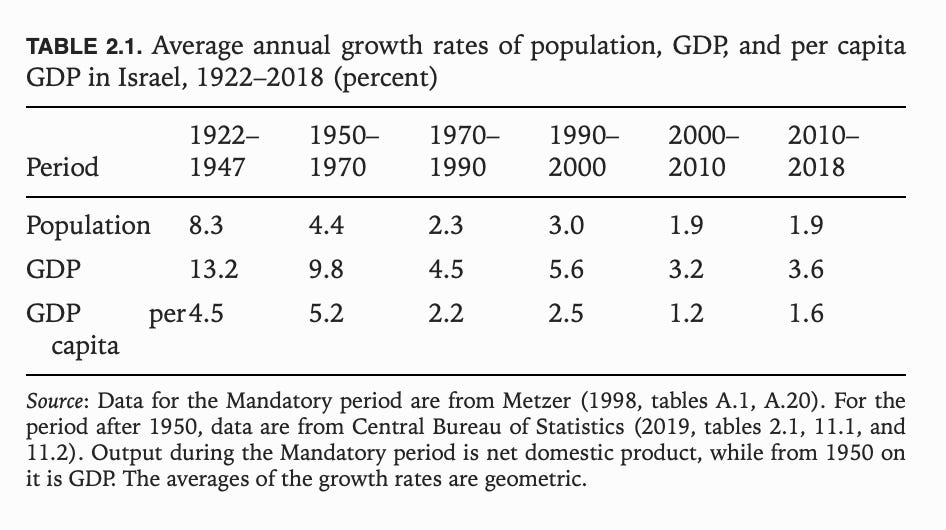
The first phase, now demonized as the phase of Israeli socialism or even “communism”, is the phase which actually established the state and delivered its period of most rapid growth, by far. Israel’s growth in the 1950s and 1960s was amongst the most rapid in the world and that means it was spectacular. Indeed, for context, even the period of crisis-ridden transition in the 1970s and 1990s had higher growth rates than those which are so enthusiastically celebrated today.
Source: Zeira 2021
In making long-run comparisons it is obviously true that Israelis on average today enjoy a vastly higher standard of living than they did fifty years ago. But levels are not the same as growth rates. As elsewhere, in Israel too, the neoliberal era has been one of relatively disappointing growth. At the very least, if market economics was not actually bad for economic growth it was not positive enough in its effects to offset structural forces of retardation.
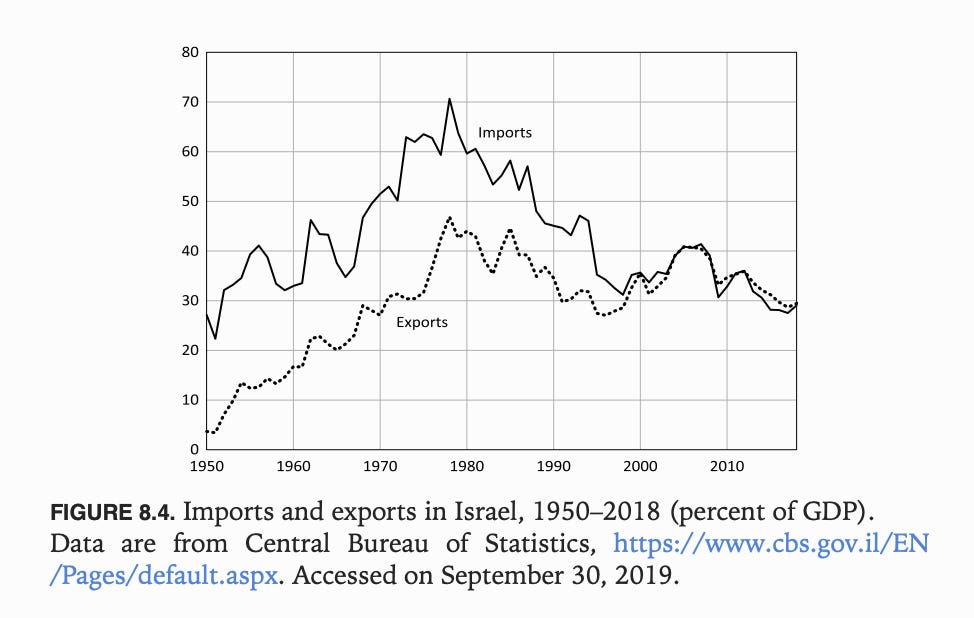
Again contrary to the familiar narrative, a striking feature of Israel’s early decades was the country’s openness to economic flows of all kinds. As it expelled the Palestinian population, it absorbed a huge influx of Jewish migrants. The expanding settler colonial society sucked in foreign goods and it financed the resulting trade deficit by foreign funding, starting with reparations paid by West Germany. Israel today - in the much-vaunted age of globalization - is, in proportional terms, less open to the world economy than it was in the 1960s, above all because its imports were then much larger as a share of GDP.
Source: Zeira 2021
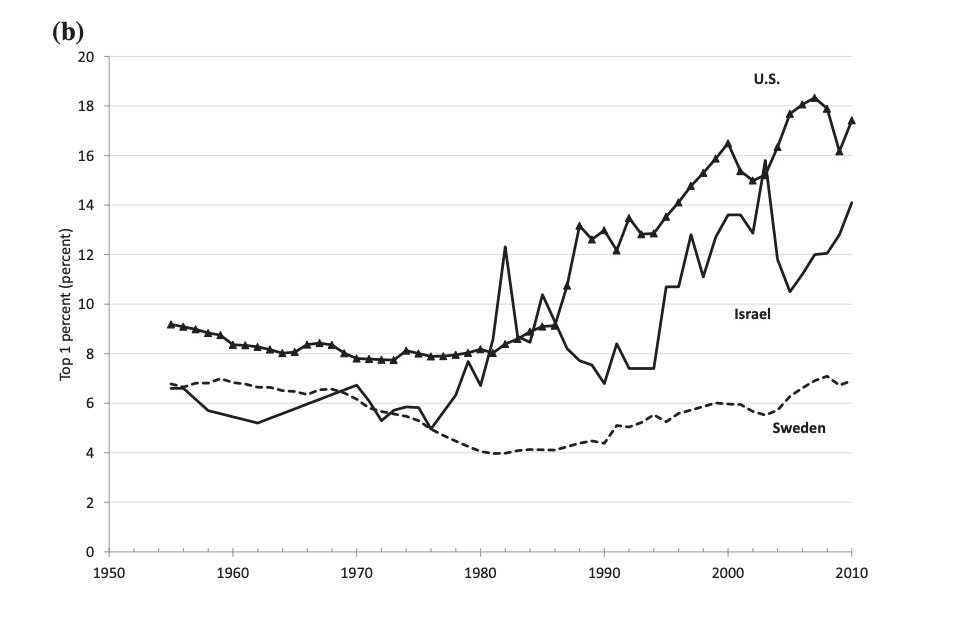
The imported goods and labour was put to good use. Under the social democratic model, anchored in the Labour party, kibbutz, organized labour movement and state-owned industry, Israel experienced dramatic agricultural and urban development. In addition, one of the defining feature of Israel’s political economy in its first decades was equality. By the 1970s, Israel had one of the lowest Gini coefficients in the world. The share of income going to the top 1 percent was as low as that in Sweden. Today it is almost as high as in the United States.
Source: The Privatization of Israel, 314.
In the 1950s and 1960s labour productivity soared. In the socialist period Israel was truly catching up with the United States. Since the 1980s it has been merely tracking the leading economy of the capitalist West.
***
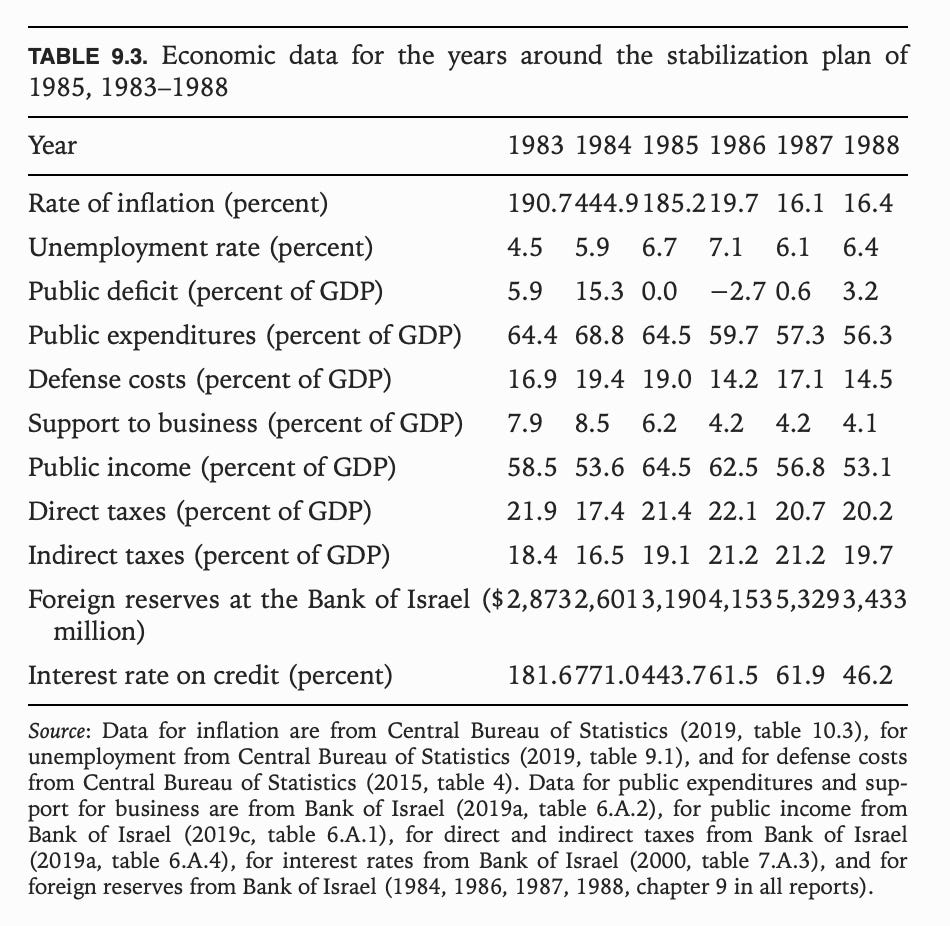
Growth at the rate of the 1950s and 1960s was not destined to last - not in Israel any more than in any other of the growth miracles that followed World War II. Everywhere, the transition from super fast “catch-up” growth to slower growth from the 1970s onwards was painful. In every case it involved a complex transition of growth strategies within the elites, often with social democrats (e.g. UK Labour) or centrists (Democrats in the USA) paving the way for the neoliberal transition that began in earnest the 1980s. Israel followed this pattern in dramatic form, with a period of stagflation culminating with a hyperinflationary burst and abrupt stabilization in 1985.
But to treat Israel as just another case of a runaway corporatism that needed a rebalancing of capital and labour and strong leadership by a central banker - in Israel’s case the legendary Stanley Fischer - is to miss the woods for the trees. The shock of 1973 did not just happen to Israel. The oil shock was unleashed by the climax of four Arab-Israeli wars, a struggle in which Israel was fighting for its survival. That existential struggle shaped all the parameters of economic policy and the pressure did not start in 1973. As in so many other respects it was the 1967 war that was decisive.
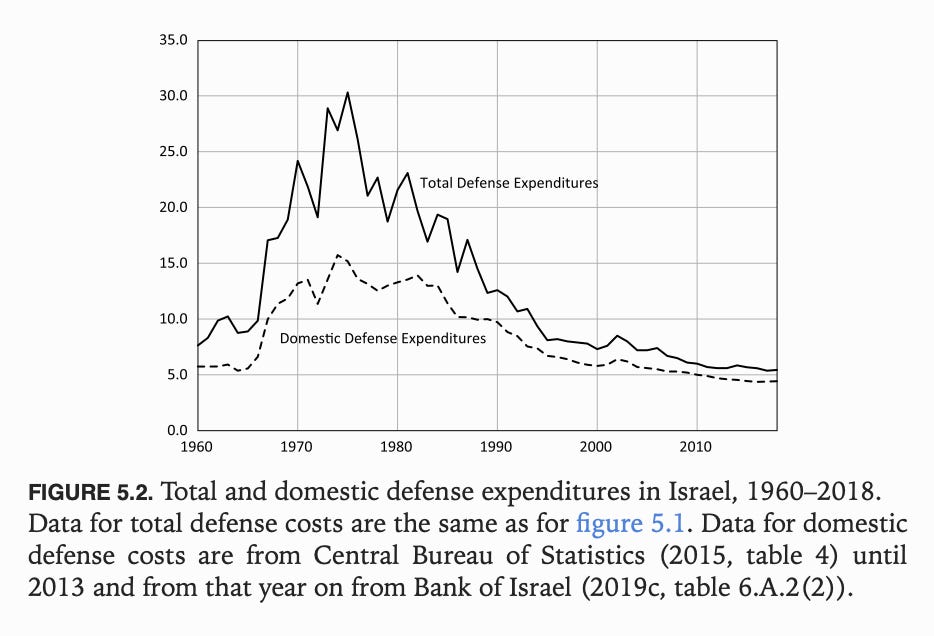
Given the scale of Israel’s victory in 1967, it was clear that the Arab world would react and that Israel must prepare to defend its huge territorial gains. Israel was built on war - in 1948 and 1956. But from 1967 onwards military spending surged to unprecedented levels and after the shock of 1973 it continued at extraordinarily high levels. At its peak defense spending amounted to 30 percent of GDP with half of that coming in the form of defense imports. With that kind of burden, macroeconomic imbalance is more or less inevitable.
Source: Zeira 2021
The 1979 peace agreement with Egypt may not have brought peace to the Middle East in comprehensive sense. It left the fate of the Palestinian people undecided. But as Zeira points out in his excellent survey, The Israeli Economy, there is a world of difference between maintaining an occupation regime over a lightly armed civilian population, however brutal, and fighting all-out war of national survival. The peace deal with Egypt turned Israel’s security problem from an impossible burden to a manageable economic and fiscal problem. It was this security settlement that gave monetary stabilization and central bank leadership a chance. The story is brilliantly told in Krampf’s The Israeli Path to Neoliberalism (2018).
Israel’s economic and financial crisis in the early 1980s was dramatic in its impact. The banking system failed and had to be bailed out. In 1985 Israel had no option but to throw itself on the mercy of the United States to help soften the blow of stabilization. The shock to the government budget and the social and economic model it supported was severe and felt in higher taxation, slashed subsidies and eventually also in much reduced military spending.
Source: Zeira 2021
***
From the mid 1980s onwards, the Labour party - above all through the leadership of Shimon Peres - embraced a threefold policy of domestic transformation, peacemaking and privatized globalization. The degree of Israel’s openness actually declined as it moved away from massive dependence on foreign aid, but in the new era of globalization was that it was private trade and finance not government transfers that dominated Israel’s balance of payments.
In the 1990s the efforts to conclude peace not only with Egypt but to find a resolution of the Palestinian question, went hand in hand with a vision of Israel as the leader of wider Middle Eastern development. A two-state solution, for which a roadmap was established at Oslo (1993), combined with the economic accords of Paris (1994), would open the path to a broader Middle East economic integration, pacification and prosperity. Peres conceived this explicitly on the model of European integration. In 1993, as Europe was set fair to incorporate much of the former Soviet sphere, Peres wrote:
“Ultimately, the Middle East will unite in a common market—after we achieve peace. And the very existence of this common market will foster vital interests in maintaining the peace over the long term” (Peres, 1993, p. 99) (cited in Krampf, The Israeli Path, 219)
As in Europe the precondition for this pacification and stabilization by way of economic integration was US hegemony. What mattered for Israel by the 1990s was no longer simply US government aid, but global capital flows superintended by the United States as the hegemon.
With the Gulf War of 1990-1991, the United States had entered the Middle East more decisively than ever before. The oil industry was globalizing, diluting OPEC’s power. This was the moment that the new vision of a globalized Israel, epitomized by Tel-Aviv’s combination of Bauhaus and Silicon Valley, took off. During his first stint as Prime Minister in the 1990s Netanyahu boasted that Israel was on its way to becoming a
‘high-technology “tiger”’. Israel, in his view, was ‘the Silicon Valley of the Eastern Hemisphere’ and ‘one of the great technological and entrepreneurial successes in the world’. Although the panacea didn’t prevent him from losing the elections, his Labour successor, Barak, was equally enthusiastic. Israel, he declared, was evidently ‘different from any other place in the world’, a country of ‘enormous vitality stemming from the richest possible genetic pool’, which helped it become ‘the most powerful of all states lying in a 1,500 km radius from Jerusalem’.
The growth of the new high-tech economy was accompanied by privatization and deregulation. But to think of this as a “triumph of capitalism”, or victory “of the market over the state” is naive. As Bichler and Nitzan show in gloriously seedy detail, Israel’s high-tech sector was anything but a model of “free competition”. The breakthrough of “private business” relied on state-brokered deals between satellite and cable TV groupings that operated in a highly oligopolistic fashion. Israel’s high-tech start-ups, like their American counterparts, benefited in no small degree from spin-offs from the military-industrial complex.
Meanwhile, the single biggest driver of growth was not deregulation or privatization but the ongoing accumulation of human capital. The labour pool was not just a matter of genetics. It was provided with skills by Israel’s high-functioning public education system and the extraordinary endowment of education brought with them by migrants from the former Soviet Union - socialism twice over you might say. And where the labour pool was not attractive enough, the Israeli government was more than willing to help. Overall the level of public subsidy for business decreased in the course of budget cuts after 1985, but for privileged players like chipmaker Intel, Israel rolled out the red carpet.
As the data show, the optimism of the 1990s was more than just hype. Growth recovered to half the rate of the socialist 1950s and 1960s, impressive enough by global standards. But it did not last. The tech sector was hit hard by the bursting of America’s dot.com bubble. Meanwhile, the optimistic vision of globalization was short-lived. Elsewhere this was a matter of growing inequality and the China shock. And Israel experienced that on a dramatic scale. Inequality surged more rapidly than practically anywhere in the world. By 2011 this would trigger mass protests against excessive housing costs and mounting disparities in living standards.
But in the Middle East, the end of 1990s optimism took a more dramatic and violent turn. Within Israel itself, Rabin’s assassination and Netanyahu’s ascent to leadership signaled the rejection of the Two-State model. The collapse of the Palestinian peace process triggered the outbreak of the second Intifada in 2000. And then the wider regional frame was blown to pieces by 9/11 and America’s War on Terror.
***
Since the early 2000s Israel’s elite has been managing profound tension between its economic strategy of globalization and the destabilized security environment. The synthesis of the 1990s, in which peace and globalization went hand in hand, was gone for good. But there was also no way back to the militarized national economy of the founding era. The retreat of the military from the dominant position in Israel’s political economy has proven permanent. The current mood of anxiety around the “people’s army” are indicative of the questions being asked about the viability of the mass conscription model.
There is no doubt a settler colonial logic at work in the exploitation of the occupied territories. The settlements themselves now account for 10 percent of the Jewish population thus constituting a significant slice of the economy, which in sheer size is on a par with the celebrated high-tech sector. Meanwhile the brutal experiments in counter-insurgency and surveillance offer new opportunities for military-industrial growth in privatized security and in the technologies of repression. To add to the. bitter irony, the system is fed with outside flows of funding for the Palestinian Authority.
These are logics that are compelling at a micro level, for particular actors. But at the broader, strategic level they do not add up. The collapse of the 1990s two-state vision left Israel with a contradiction between its world economic integration and its unresolved domestic security situation. As astute observers like Assaf Adivnoted already in 2007: “(Israel) is torn, in other words, between the refugee camps of Nablus and the cafés of Tel Aviv. With no leadership to resolve these oppositions and close social gaps, Israel today is just plain stuck.”
The contradiction between the notionally liberal values of globalized business and the realities of life in Israel has been plainly apparent for decades. Though this tension cannot be resolved it can be managed by a strategy in which, as Krampf argues, Netanyahu has been a pivotal figure and Israel’s high-tech businesses have been willing helpers.
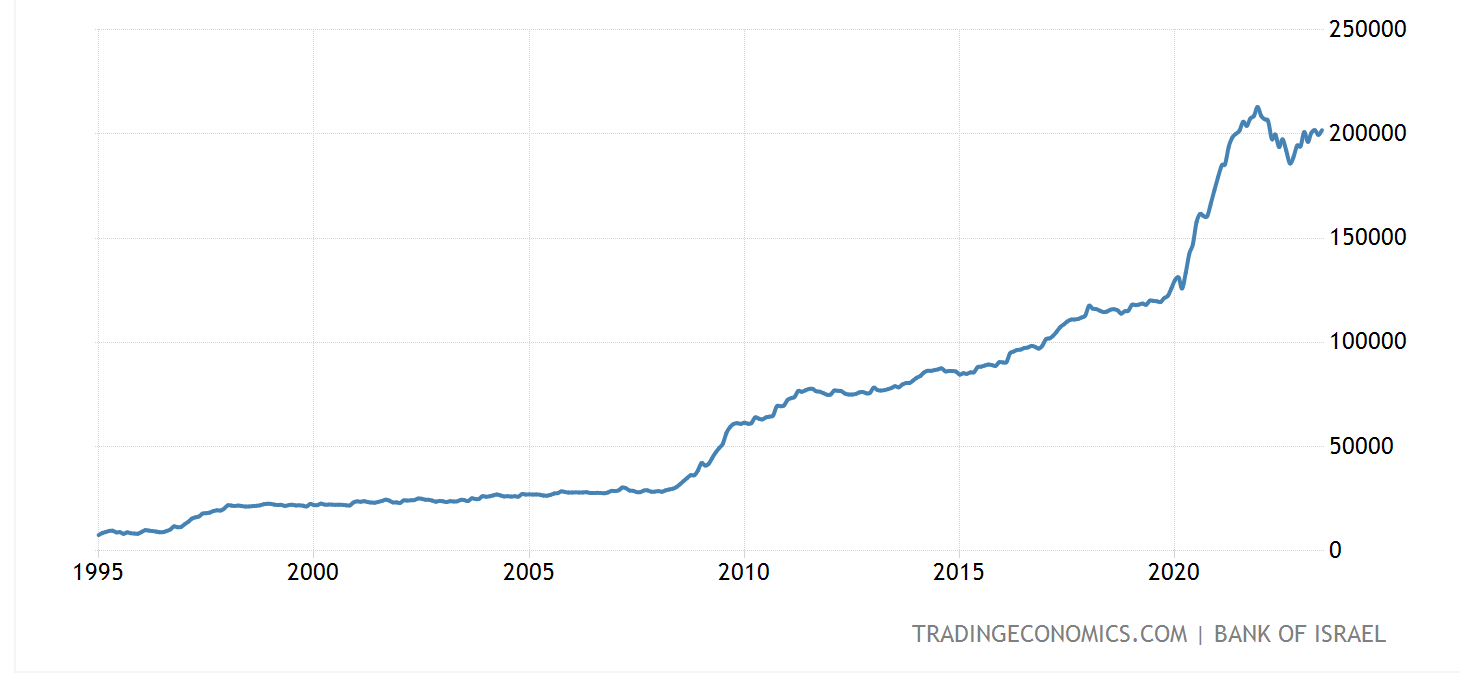
If Israel’s right-wing from the late 1990s onwards saw no realistic prospect of a true Two-State solution, then they needed to be prepared to uphold an apartheid regime if necessary against outside pressure. That would require Israel to secure its independence from its friends as well as its enemies. That meant putting a premium on reducing Israel’s current account deficit and enhancing its resilience in the face of outside shocks. From a country of chronic trade deficits, dependent on external funding, Israel from the mid 1990s onwards turned itself into a country of current account surplus, whilst progressively accumulated an ever larger war chest of foreign reserves.
Israel’s FX reserves in $ millions.
To reiterate the point made earlier, Israel has achieved this turn around in its current account not through a dramatic surge in exports. Today, exports as a share of GDP are lower than at their peaks in the early 2000s or the 1980s. The balance has been closed because imports have fallen, in line with the relative reduction in external assistance and other inter-governmental funding. But the net effect is that Israel’s foreign exchange reserves have surged underpinning a strategy of “self-insurance” not entirely dissimilar to that of Russia or China. Assuming that US sanctions against Israel are not on the cards (the shock Russia has experienced and the scenario that must worry Beijing), a reserve of $200 billion means that Israel can be relaxed about the future of US aid, which currently stands at $ 3 billion per annum. This is the core of what Krampf calls Israel’s calculus of “hawkish neoliberalism”.
***
At the same time as macroeconomic policy has been reinterpreted in national security terms, Netanyahu’s approach to the problem of the occupied territories has been to look not for a political settlement, but for what he calls an “economic peace”.
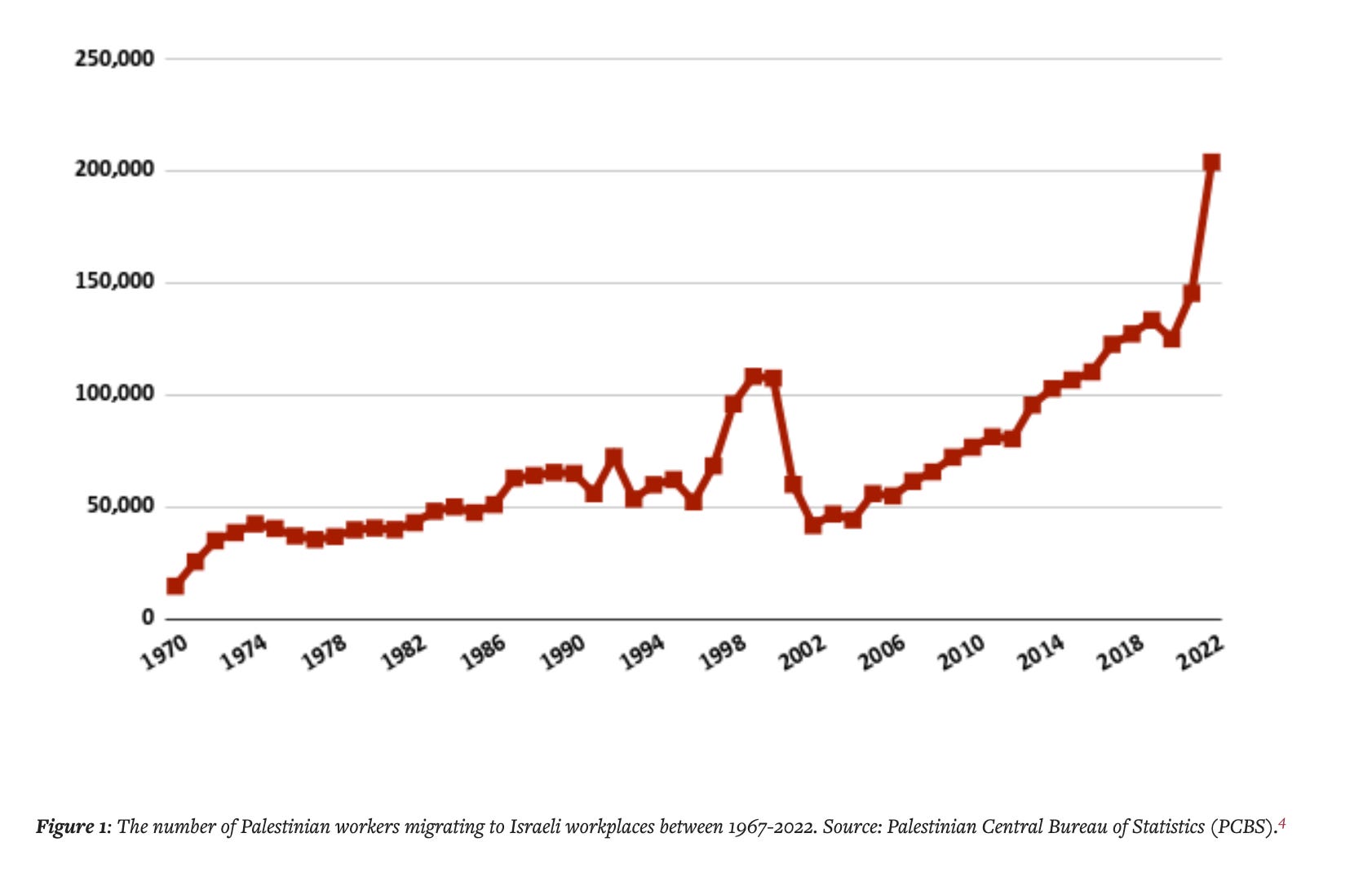
The idea is that if the Palestinian authority can offer its people better material circumstances, then this will defuse the conflict. As Tariq Dana shows in a fascinating study, this approach was met on the Palestinian side between 2006 and the 2010s by the economic vision of PA Prime Minister Salam Fayyad. It received enthusiastic backing from the Americans and Europeans, notably in the form of US Secretary of State John Kerry’s $4 billion economic plan to boost the Palestinian economy launched at the World Economic Forum in Jordan May 2013. On the side of the Palestinian authority this involved a series of measures to promote private economic development that were loudly applauded by the World Bank. Meanwhile, radical opposition in the refugee camps, notably Jenin, was repressed. And the PA worked with Israel both to establish Export Processing Zones (enclaves within enclaves in the occupied territories) and to promote Palestinian employment in Israel.
As Habbas points out, it is an approach that willfully refuses the inherently political nature of the conflict and the impossibility of actually achieving substantial economic development in the face of disenfranchisement and uncertainty.
These tensions would have been hard enough to manage if Israel had carried through on its commitment to reduce settlements, or even just preserved the status quo of the 1990s. But, instead, Israel’s governments have not just permitted but promoted the expansion of settlements.The result is a progressive fragmentation of the Palestinian territories that inflicts poverty and misery on their 4.5 million Palestinian inhabitants (2.7 million in West Bank and 1.8 million in Gaza). According to UN estimates presented in the spring of 2023, the economic losses inflicted on the Occupied Territories through Israeli restrictions and blockades alone amount to: “25.3 per cent of West Bank gross domestic product (GDP) and the cumulative GDP loss in 2000–2020 is estimated at $50 billion ($45 billion in constant 2015 dollars), which is about three times the West Bank GDP and over 2.5 times the Palestinian GDP in 2020.”
The latest iteration of the policy of “economic peace” consists in a program known as “Shrinking the Conflict”. Proposed in 2018 by philosopher Micah Goodman this starts from the premise that Jewish Israelis do not want to face the demographic implications of a One-State solution, or the security implications of a true Two-State solution. Instead, it recommends the management of “the conflict below the threshold of war, while improving the fabric of life for the Palestinian population.” Proposals to end intrusive security monitoring fail in the face of the violence between insurgent Palestinians, Jewish settlers and Israeli security forces. So what “shrinking the conflict” amounts to are intensified efforts to create parallel, apartheid-style transport infrastructure in which Palestinians, settlers and (Jewish) Israeli society interact as little as possible. It is a surreal logistical answer to an unresolved political problem.
***
As Krampf puts it, Israel’s entire economic model and grand strategy has rested for almost a generation on cognitive dissonance:
What I call the Netanyahu doctrine is based on geographic, institutional, and even mental separation between Israel as a globalized economy and Israel as a state that occupies a territory and engages in a territorial conflict.
There are at least four axes of tension and cognitive dissonance at play here
Between Israel and the Palestinians.
Between Israel’s occupation regime and global liberal norms and active solidarity with Palestine.
Between Israel’s growth strategy and the social balance of Israeli society, as measured in inequality and sensitive indicators and housing costs.
Finally, there are the ideological and cultural differences within the Jewish population of Israel which Netanyahu’s coalition have forced into the open and intersect with global culture wars along lines familiar from the United States, Brazil, Russia, India and Australia.
Under the impression of the 2011 social protests, Kraft speculates that the third axis of tension is the greatest blindspot of Israel’s geoeconomic strategy. It will be undercut by the social tensions it unleashes.
The media coverage being given to the Angst of some liberal Israeli entrepreneurs in the face of the current illiberal turn no doubt reflects real worries in Tel Aviv. But in truth Israel’s political economy has existed in profound tension since the collapse of the peace process in the late 1990s. As far as Netanyahu and his coalition are concerned the constitutional changes they are promoting will actually make those tensions easier to manage, by preventing interference by liberal hangovers in the judiciary.
The bigger question surely is how far the right-wing course pursued by Israel alienates not just tech entrepreneurs but potential partners in the Abraham Accords. The accords seemed to offer Israel the chance of restarting the 1990s vision of a regional growth club, without having to resolve the Palestinian question. A wider economic peace - in Netanyahu’s terms. But as tempting as it may be for Israeli and other strategists to think in those terms, you cant go back to the 1990s. The Occupied Territories are an open wound and the world Israel is navigating today is far more multipolar than that in the 1990s. One aspect of that is the emergence of China as a key player. But another aspect is the heft of Israel’s putative partners in the Middle East. Israel’s is not the only economy in the region to have gone through a developmental spurt in recent decades. Turkey’s economy is almost twice the size of Israel. Saudi Arabia’s is more than three times larger than Israels. Even the economy of the UAE today plays in the same league as Israel.
And if Israel has made itself relatively proof against pressure from Washington, so too have its neighbors. They pursue independent regional foreign policies and entertain relations with both China and Russia, which are far from pleasing to Washington. This offers new opportunities for Israel’s strategists. But also, as the Chinese brokered rapprochement between Saudi Arabia and Iran suggests, new risks. If the last 75 years are anything to go by, it is less the question of Israel’s liberalism that will be decisive, than the way it navigates this forcefield.
Transcrvo a partir de Carmen Lícia Palazzo:
Há mais de 20 anos acompanho as análises de THOMAS FRIEDMAN.
Ele é, na minha modesta opinião, mas também na opinião de muitos que são bem mais competentes do que eu no tema, um grande especialista, respeitado tanto no dito Ocidente quanto em vários meios do Oriente Médio. Por isso compartilho seus artigos e recomendo sempre a leitura.
Sim, o atentado terrorista do Hamas foi de uma barbárie assustadora, o que não impede que seja hora de refletir sobre todo o contexto e sobre o que virá no futuro, dependendo da ação de muitos atores. É assim que e faz análise e é por isso que os especialistas são MUITO, MUITÍSSIMO NECESSÁRIOS.
CLP
Da Guerra dos Seis Dias à Guerra das Seis Frentes em Israel
"Por Thomas Friedman
26/10/2023 | 20h00
Quem se importa com Israel deveria estar mais preocupado agora do que em qualquer outro momento desde 1967. Naquele ano, Israel derrotou os Exércitos de três Estados árabes — Egito, Síria e Jordânia — no conflito que ficou conhecido como Guerra dos Seis Dias. Hoje, quem olha com atenção percebe que Israel trava a Guerra das Seis Frentes.
Esta guerra é travada diretamente e por intermédio de atores não estatais, Estados-nação, redes sociais, movimentos ideológicos, comunidades da Cisjordânia e facções políticas israelenses — e é a guerra mais complexa que já cobri. Mas uma coisa está clara para mim: os israelenses não são capazes de vencer esta guerra em seis frentes sozinhos; eles só serão capazes de vencer se Israel — e os Estados Unidos — conseguirem reunir uma aliança global.
Desafortunadamente, Israel tem hoje um primeiro-ministro, Benjamin Netanyahu, e uma coalizão de governo que não pretendem nem são capazes de construir o fundamento necessário para sustentar essa aliança global. Esse fundamento é declarar o fim da expansão dos assentamentos coloniais de Israel na Cisjordânia e reformular as relações de Israel com a Autoridade Palestina, para que a entidade se torne uma parceira palestina legítima e crível, capaz de governar a Faixa de Gaza pós-Hamas e forjar uma solução maior de dois Estados incluindo a Cisjordânia.
Tanques israelenses e veículos blindados montados perto da Faixa de Gaza, no sul de Israel, no sábado, 21 de outubro de 2023.
Tanques israelenses e veículos blindados montados perto da Faixa de Gaza, no sul de Israel, no sábado, 21 de outubro de 2023. Foto: Sergey Ponomarev / NYT
É estrategicamente e moralmente incoerente Israel pedir aos seus melhores aliados ajuda para buscar justiça em Gaza e ao mesmo tempo pedir-lhes que façam vista grossa enquanto o Estado judaico constrói um reino colonial na Cisjordânia com objetivo expresso de anexação.
Isso não vai funcionar. Israel não será capaz de produzir o tempo, a assistência financeira, a legitimidade, o parceiro palestino e os aliados globais que precisa para vencer esta guerra em seis frentes.
E todas as seis frentes estão neste momento à vista de todos.
Na primeira, Israel trava uma guerra em escala total contra o Hamas dentro e no entorno de Gaza, na qual, conforme podemos ver agora, o Hamas ainda detém tanta capacidade residual que conseguiu lançar um ataque anfíbio contra os israelenses na terça-feira e na quarta disparou foguetes de longo alcance contra as cidades portuárias de Eilat, no sul de Israel, e Haifa, no norte.
Neste mundo do ‘nunca antes’, mais de tudo está acontecendo, e mais rápido. A geopolítica fragmentada e um ecossistema global abalado representam riscos existenciais para a humanidade
É assustador ver quantos recursos o Hamas desviou para construir armas em vez de capital humano em Gaza — e quão eficazmente o grupo escondeu isso de Israel e do mundo. De fato é difícil não notar o contraste entre a evidente pobreza humana em Gaza e a riqueza em armamentos que o Hamas construiu e tem acionado.
O Hamas sonha há muito tempo com a unificação dos fronts em torno de Israel, regionalmente e globalmente. A estratégia de Israel sempre foi agir de maneiras que evitem isso — até que a atual coalizão de Netanyahu, de judeus ultraortodoxos e supremacistas, chegou ao poder em dezembro e começou a se comportar de maneiras que de fato ajudaram a fomentar a unificação de todos os inimigos de Israel.
De que maneiras? Os supremacistas judeus no gabinete de Netanyahu começaram imediatamente a desafiar o status quo do Monte do Templo, em Jerusalém, reverenciado por muçulmanos, que se referem ao local como Nobre Santuário, onde fica a Mesquita de Al-Aqsa.
O governo Netanyahu começou a movimentar-se para impor condições muito mais duras aos palestinos da Cisjordânia e de Gaza presos nas penitenciárias israelenses. E estabeleceu planos para uma enorme expansão nos assentamentos de Israel na Cisjordânia para impedir que um Estado palestino contíguo possa existir algum dia por lá. É a primeira vez que um governo israelense torna a anexação da Cisjordânia um objetivo declarado em seu pacto de coalizão.
Além disso tudo, os EUA pareciam próximos de forjar um acordo para a normalização das relações diplomáticas e comerciais entre Arábia Saudita e Israel — realização que coroaria o esforço de Netanyahu no sentido de provar que Israel pode ter relações normais com Estados árabes e muçulmanos sem ter de ceder nenhum centímetro aos palestinos.
O que nos leva à segunda frente: Israel contra o Irã e seus apoiadores — ou seja, o Hezbollah no Líbano e na Síria, milícias islamistas na Síria e no Iraque e a milícia houthi no Iêmen.
Todos os grupos lançaram, nos dias recentes, drones e foguetes contra Israel e forças dos EUA no Iraque e na Síria. Eu creio que o Irã — assim como o Hamas — considerou o esforço americano-israelense de normalização de relações entre Israel e Estados árabes-muçulmanos uma ameaça estratégica que teria isolado Teerã e seus aliados na região. Ao mesmo tempo, acredito que o Hezbollah passou a perceber que, se Israel aniquilar o Hamas, conforme declarou que fará, o grupo xiita libanês será o próximo. Portanto, o Hezbollah decidiu que, no mínimo, precisa abrir um segundo front de baixa intensidade contra Israel.
Uma foto tirada da cidade de Sderot, no sul de Israel, em 26 de outubro de 2023, mostra foguetes disparados da Faixa de Gaza em direção a Israel, em meio às contínuas batalhas entre Israel e o movimento palestino Hamas.
Uma foto tirada da cidade de Sderot, no sul de Israel, em 26 de outubro de 2023, mostra foguetes disparados da Faixa de Gaza em direção a Israel, em meio às contínuas batalhas entre Israel e o movimento palestino Hamas. Foto: JACK GUEZ / AFP
Como resultado, Israel foi forçado a retirar cerca de 130 mil civis das proximidades da fronteira norte, assim como dezenas de milhares de pessoas da região próxima à fronteira sudoeste, com Gaza. Esses deslocamentos colocam uma pressão enorme por moradia sobre o tesouro israelense.
A terceira frente é o universo das redes sociais e outras narrativas digitais sobre quem é bom ou mau. Quando o mundo torna-se interdependente, quando — graças a smartphones e redes sociais — nada permanece oculto e nós conseguimos ouvir uns aos outros sussurrar, a narrativa dominante adquire um valor estratégico verdadeiro.
Essa rede social ser manipulada com tanta facilidade pelo Hamas ao ponto do episódio de um míssil palestino que falhou e atingiu um hospital em Gaza ter tido a culpa atribuída a Israel é profundamente perturbador, porque essas narrativas moldam decisões de governos e políticos tanto quanto relações entre diretores-executivos e seus funcionários. Estejam avisados: se Israel invadir Gaza, corporações do mundo inteiro se verão diante de demandas em competição de seus empregados para denunciar Israel ou o Hamas.
Por que Israel está agindo desta forma? Leia artigo de Thomas Friedman
Essa guerra entre Israel e Hamas faz parte de uma escalada de loucura que vem ocorrendo nessa vizinhança, mas que se torna cada vez mais perigosa a cada ano
A quarta frente é a luta intelectual-filosófica entre o movimento progressista internacional e Israel. Creio que alguns elementos desse movimento progressista, que, bem sei, é grande e diverso, perderam suas estribeiras morais sobre este tema. Por exemplo, eu vi numerosas manifestações em universidades americanas que essencialmente culpam Israel pela invasão horrenda do Hamas, argumentando que o grupo travou uma “luta anticolonial” legítima.
Esses manifestantes progressistas parecem acreditar que o Estado de Israel inteiro é uma empresa colonial — não apenas os assentamentos na Cisjordânia — e portanto o povo judeu não tem direito à autodeterminação nem à autodefesa em sua terra ancestral, seja dentro ou fora das fronteiras pré-1967.
E para uma comunidade intelectual aparentemente preocupada com nações que ocupam outras nações e lhes nega direito ao autogoverno, nós não vemos muitas manifestações progressistas contra a maior potência opressora no Oriente Médio hoje: o Irã.
O presidente iraniano, Ebrahim Raisi, ao centro, ouve o comandante da Guarda Revolucionária, general Hossein Salami, ao centro, à esquerda, enquanto analisa um desfile militar anual que marca o aniversário do início da guerra contra o Irã pelo ex-ditador iraquiano Saddam Hussein, em frente ao santuário do falecido fundador revolucionário Ayatollah Khomeini, nos arredores de Teerã, Irã, sexta-feira, 22 de setembro de 2023.
O presidente iraniano, Ebrahim Raisi, ao centro, ouve o comandante da Guarda Revolucionária, general Hossein Salami, ao centro, à esquerda, enquanto analisa um desfile militar anual que marca o aniversário do início da guerra contra o Irã pelo ex-ditador iraquiano Saddam Hussein, em frente ao santuário do falecido fundador revolucionário Ayatollah Khomeini, nos arredores de Teerã, Irã, sexta-feira, 22 de setembro de 2023. Foto: Vahid Salemi / AP
Além de reprimir suas próprias mulheres em busca de mais liberdade de pensamento e vestimenta, Teerã controla efetivamente quatro Estados árabes — Líbano, Síria, Iêmen e Iraque — por meio de seus aliados. O Líbano, um país que conheço bem, há um ano não consegue eleger um novo presidente que não se curve constantemente aos desejos e interesses de Teerã. Infelizmente, libaneses independentes são incapazes de remover a influência do Irã de seu Parlamento e Executivo, que é exercida em grande medida através dos canos das armas do Hezbollah. O site Middle East Eye noticiou que, em 2014, o representante da cidade de Teerã no Parlamento iraniano Ali Reza Zakani gabou-se sobre a maneira que o Irã passou a controlar quatro capitais árabes: Bagdá, Damasco, Beirute e Sanaa, Iêmen.
Reduzir essa luta incrivelmente complexa de dois povos por uma mesma terra a uma guerra colonial é uma desonestidade intelectual. Ou, conforme afirmou o escritor israelense Yossi Klein Halevi no jornal Times of Israel na quarta-feira: “Colocar a culpa da ocupação e suas consequências totalmente em Israel é desprezar o histórico das ofertas de paz israelenses e da rejeição palestina. Rotular Israel como mais uma criação colonialista é distorcer a história singular do retorno de um povo arrancado de sua terra, em sua maioria refugiados de comunidades judaicas destruídas no Oriente Médio”.
Mas vejam o que mais é desonesto intelectualmente: comprar a narrativa da direita israelense favorável aos assentamentos, neste momento disseminada amplamente dentro de Israel, de que a violência de Hamas é tão selvagem que claramente não tem nada a ver com nada que os colonos tenham feito — portanto, não há problemas em erguer mais assentamentos.
Minha visão: trata-se de uma disputa territorial entre dois povos que reivindicam a mesma terra, que precisa ser dividida da maneira mais equitativa possível. Essa concessão mútua é o fundamento de qualquer sucesso contra o Hamas. Portanto, se você é favorável a uma solução de dois Estados, você é meu amigo e se você é contra uma solução de dois Estados, você não é meu amigo.
A quinta frente é dentro de Israel e dos territórios ocupados. Na Cisjordânia, colonos judeus de direita estão atacando palestinos e perturbando os esforços do Exército de Israel de manter o controle em colaboração com as forças de segurança da Autoridade Palestina (AP), liderada por Mahmoud Abbas. Nós temos de lembrar que a AP reconheceu o direito de Israel existir como parte dos Acordos de Oslo. Seria terrível que essa frente exploda em um confronto entre a AP e Israel, porque desse modo haveria pouca esperança para se obter ajuda da autoridade para governar Gaza.
A fumaça preta surge do leste da Cidade de Gaza, quinta-feira, 26 de outubro de 2023, após os ataques aéreos israelenses.
A fumaça preta surge do leste da Cidade de Gaza, quinta-feira, 26 de outubro de 2023, após os ataques aéreos israelenses. Foto: Abed Khaled / AP
Mas também não haverá nenhuma esperança para isso se os palestinos na Cisjordânia e espalhados pelo mundo não insistirem na construção de uma Autoridade Palestina mais eficaz e sem corrupção. Faz tempo que isso é necessário — e não é apenas culpa de Israel isso não ter acontecido; os palestinos também colaboraram.
A sexta frente é dentro de Israel, principalmente entre seus cidadãos judeus. Essa frente está oculta momentaneamente, mas à espreita logo abaixo da superfície. É o confronto ocasionado pela estratégia permanente de Netanyahu na política doméstica: dividir para conquistar. Netanyahu construiu toda sua carreira política colocando grupos da sociedade israelense uns contra os outros, erodindo o tipo de coesão social que é essencial para vencer a guerra.
Seu governo levou essa estratégia ao extremo logo que assumiu, em dezembro, movimentando-se imediatamente para furtar da Suprema Corte israelense seu poder de revisar decisões do Executivo e do Legislativo. Nesse processo, Netanyahu levou dezenas de milhares de israelenses às ruas todos os sábados para proteger sua democracia e fez com que pilotos da Força Aérea e outros combatentes de elite suspendessem seus plantões de reservistas afirmando que não serviriam a um país que ruma para a ditadura. Seu governo dividiu e distraiu Israel e suas Forças Armadas exatamente na hora errada — se é que já houve uma hora boa.
Os erros de cálculo dos líderes de Israel e de Gaza estão sendo revelados
Como você vence uma guerra em seis frentes? Repito: somente com uma aliança de pessoas e nações que acreditam em valores democráticos e no direito de todos os povos à autodeterminação. Enquanto não produzir um governo capaz de gerar essa aliança, e a não ser que o faça, Israel não terá o tempo, os recursos, o parceiro palestino e a legitimidade que precisa para derrubar o Hamas em Gaza, estará lutando principalmente ao lado dos EUA como seu único aliado verdadeiro e sustentável.
E muito da força dessa aliança reside hoje em Joe Biden e no fato de que ele traz para esta crise um conjunto de princípios centrais e fundamentais a respeito do papel dos EUA no mundo: o certo contra o errado, a democracia contra a autocracia. Poderá demorar para termos novamente um presidente com esses instintos.
Em outras palavras, Biden criou capital de giro diplomático — que vem com um prazo limite — tanto para os israelenses quanto para a Autoridade Palestina. Ambos devem usá-lo sabiamente. / TRADUÇÃO DE GUILHERME RUSSO"
Several Israeli companies have established themselves in the Indian market, reinforcing the economic ties between the two countries.

India and Israel, two countries characterized by diverse cultures and storied histories, have been cultivating their diplomatic ties for many years. These bilateral relations go beyond the realm of politics and diplomacy, encompassing trade, investments, and collaborations in various industries. In this article, we delve into the vibrant partnership between India and Israel, with a specific focus on trade, investments, and the prospective sectors for cooperation. This exploration provides valuable information for students and individuals interested in the fields of international relations and business.
The trade partnership between India and Israel has thrived and proven advantageous for both nations. India predominantly exports pearls, precious stones, chemical and mineral products, machinery, electrical equipment, textiles, and plastics to Israel. Conversely, India imports machinery, electrical equipment, base metals, defense-related equipment, machinery, transport equipment, and chemical and mineral products from Israel. This trade flow underscores the increasing economic interconnectedness between these two countries.
National Games 2023 Medal Tally: Check The Complete List Of Winners
| Israeli Products & Brands in World | Service or Product Name |
| Angel Bakeries | Commercial bakery |
| Babylon | Software Company |
| Berman’s Bakery | Commercial bakery |
| Bezeq | Telecommunications |
| CardiacSense | Wearable Tech |
| Castro | Fashion Brand |
| Dan hotels | Hotel Chain |
| Fox | Fashion Brand |
| Haaretz | News Media Company |
| Israir | Airline Company |
| Isrotel | Hotel Chains |
| Fiverr | Online Freelancer Social Media |
| Monday.com | Software Development |
| Max Brenner | International Chocolate Brand |
| Mobileye | ADAS Developers |
| Radwin | Wireless broadband Communications |
| Slingshot | Whiskey Brand |
| Tempo Beer | Brewery Company |
| Mul-T-Lock | Smart Lock Company |
| Uzi | Submachine Gun |
| Yokohama | Tyre Company |
| Wix.com | Software Company |
Drugs, Health, Medicine & Food Products
Food & Dairy Products
Clothing & Fashion Accessories
The following is a comprehensive list of Israeli companies operating in India.
Israel has earned the moniker “Start-up Nation” owing to its significant presence of pioneering technology firms. The country has spawned a multitude of successful startups across diverse sectors, including cybersecurity, artificial intelligence, biotechnology, medical devices, and clean energy. These Israeli enterprises have not only transformed their respective industries but have also been the subject of acquisitions or collaborations with major global corporations.
Israel is a big player when it comes to selling fresh fruits, especially citrus fruits like oranges, grapefruit, and tangerines. They even created a special grapefruit-pomelo mix! In total, Israel grows over forty different kinds of yummy fruits.
But it’s not just fruits; Israel is also into other stuff. They bring in things like oil, machines, diamonds, and transportation equipment from other countries. When they look at what they send out, it’s a mix of different goods:
Israel is also super smart. They spend a lot of money on research and development, which means they figure out cool, high-tech stuff. They’re really good at making things like airplanes, top-notch defense technology, and scientific instruments. All these smarts help them sell about $17 billion worth of these high-tech goods to other countries, which is almost one-third of all the things they sell abroad.
Israel’s economic approach aims to sustain growth by progressively incorporating the national economy into global markets. Despite facing challenges such as rapid population growth, boycotts from the majority of Arab nations, substantial defense spending, a scarcity of natural resources, elevated inflation rates, and a limited domestic market hindering the advantages of mass production, Israel has made strides in achieving these objectives.
However, the economic progress has not been uniform. Economic disparities are notable among Israeli Jews, with significant gaps, while Israeli Arabs frequently find themselves at the lower end of the economic spectrum.
Israel has made significant investments in India, although it remains a minor contributor in terms of FDI. The presence of major Israeli companies in India such as Avgol Nonwovens, Teva Pharmaceutical Industries Limited, and others has contributed to the economic partnership.
The presence of Israeli companies has significantly strengthened bilateral trade relations in the Indian market. India has experienced the influence of several renowned Israeli brands, including Alumayer, Plasson, Huliot, Metzerplas, IDE, Netafim, Naa’n Dan Jain, Rivulis, NeoLynk, Ecoppia, Aqwise, Polemix, Eli Hajaj, and Avgol Nonwovens.These enterprises make a substantial contribution to the local economy and have established a notable presence in states like Madhya Pradesh, where Teva Pharmaceutical Industries Limited and Avgol have set up their operations.
Teva Pharmaceutical Industries Limited and Avgol, two Israeli firms, have expanded their presence in Madhya Pradesh, India, contributing to the region’s economic growth. Israel ranks second globally in terms of the number of startup businesses, trailing only the United States. Additionally, it holds the third position for the most NASDAQ-listed companies, following China and the United States.
Several Israeli companies have established themselves in the Indian market, reinforcing the economic ties between the two countries. These include Avgol Nonwovens, Rivulis, NeoLynk, Ecoppia, Naa’n Dan Jain, Aqwise, Polemix, Eli Hajaj, Alumayer, Plasson, Huliot, Metzerplas, IDE, and Netafim, among others.
Teva Pharmaceutical Industries Limited and Avgol are among the Israeli companies that have set up operations in the Indian state of Madhya Pradesh, contributing to the local economy.
India and Israel have identified several sectors with the potential for collaboration:
Defence: Israel is a key supplier of defence equipment to India. This collaboration strengthens both countries’ security and technology capabilities.
Agritech: Both nations can benefit from collaboration in agricultural technology, sharing expertise in areas like precision farming, irrigation, and sustainable agriculture.
Food Processing: Joint ventures in food processing can enhance the quality and efficiency of food production in India, benefiting farmers and consumers.
Electronics: Collaboration in the electronics sector can lead to the development of innovative technologies and products, further boosting the technology ecosystem in both countries.
Meu mais recente livro – que não tem nada a ver com o governo atual ou com sua diplomacia esquizofrênica, já vou logo avisando – ficou final...