terça-feira, 2 de novembro de 2021

Warren Cohen on the American diplomacy and East Asia - H-Diplo

 Depoimento de um grande historiador das relações internacionais e da política externa americana:

H-Diplo Essay 383- Warren I. Cohen on Learning the Scholar's Craft

H-Diplo Essay 383- Warren I. Cohen on Learning the Scholar's Craft

by George Fujii

H-Diplo Essay 383

Essay Series on Learning the Scholar’s Craft: Reflections of Historians and International Relations Scholars 
2 November 2021

Learning the Scholar’s Craft: Twists and Turns in the Life of a Very Lucky Man

https://hdiplo.org/to/E383
Series Editor: Diane Labrosse | Production Editor: George Fujii

Essay by Warren I. Cohen, University Distinguished Professor Emeritus, University of Maryland, Baltimore County and Michigan State University

Columbia College did not require a major when I was an undergraduate.  I didn’t take my first history course until my junior year, although I had worked earlier with Peter Gay, the great scholar of modern Europe intellectual history, when he was an assistant professor in the Government Department teaching Contemporary Civilization in Columbia’s core curriculum—lots of Freud.  I enjoyed the survey of American history and enrolled in a wonderful colloquium in American history my senior year—8 students, 3 professors, weekly essays.

As I approached graduation, I was unsure of what to do.  I had started pre-med, planning to become a psychiatrist, but my freshman chemistry class met Tuesday, Thursday, and Saturday at 8 in the morning and my lab was scheduled for 9-1 Saturday.  These times proved inconsistent with my social life to which I gave priority.  I considered going to law school and in my senior year applied to Yale.  My friends at Harvard and Columbia law schools were suffering and Yale seemed more humane.  I also applied to the graduate history program at Columbia and to the Fletcher School of Law and Diplomacy, which I did on a dare, having been told I had no chance of being admitted.  Yale put me on the waiting list.  I was outraged and withdrew.  They had admitted my cousin two years earlier and the Columbia faculty we shared thought I was the sharper of the two.  I was accepted by both Columbia and the Fletcher School.  Harry Carman, then the much beloved Dean Emeritus of Columbia College, said: “Cohen, you’ve lived all your life in New York, go to Boston.”  So I did.

Having applied to the Fletcher School, in the second semester of my senior year I enrolled in a beginning class in international relations taught by a young assistant professor, Ken Waltz.  Neither of us was particularly impressed by the other.  Forty or so years later, when he was generally acknowledged to be the leader in the field, we spent a few days together at a conference in Kuala Lumpur and delighted in memories of the course and of his first and my last year at Columbia.

At the Fletcher School, where I studied American diplomatic history, I developed close friendships with two Japanese students: Shijuro Ogata, who later became #2 in the Bank of Japan, and Chusei Yamada, who served as Japan’s ambassador to India and Egypt.  I became very interested in Japan—the food and the history.  After graduation, I enlisted in the navy and chose to serve as a line officer in the Pacific Fleet, hoping in vain to be deployed to Japan.  I enjoyed shipboard life (I was qualified to run a destroyer escort before I had a driver’s license) and toyed with staying in the navy, but I’d married along the way and we had a son.  Unable to perceive of how I could be a father when I was always somewhere in the Pacific, I decided to study for a Ph.D. in Japanese history.

At the time the leading scholar in Japanese history was Marius Jansen, who taught at the University of Washington.  My wife was eager to stay in the northwest and so I applied and was accepted in the UW Ph.D. program in history.  Unfortunately, when I arrived in Seattle, Marius had left for Princeton and there was no one there to replace him. 

Unable to study Japanese history.  I decided to start with American diplomatic history under the direction of W. Stull Holt—about whom I’d heard good things from a friend who’d taken a summer school class with him at Harvard.  Stull, who had been a fighter pilot in World War One, was outraged when he was not allowed to fly when he reenlisted in December 1941 (he served out the war as a colonel in intelligence with dozens of other historians).  His hostility towards the Japanese was at least equal to his hostility towards the Nazis.  He insisted that I study the Chinese language instead, claiming mistakenly that Japanese would then be easy.  And that was how I ended up focusing on Chinese-American relations.

Initially, the subject of my dissertation was going to be American perceptions of the Chinese Communists during World War II. I wanted to address the question of when the US Government realized the Chinese Communist Party (CCP) was likely to take control of China after the war.  Unable to get a fellowship to allow me to work in the State and Defense Department archives in Washington, I wrote instead about a group of historians and journalists known as “revisionists,” who, in the interwar period, had argued it was a mistake for the U.S. to have intervened in the First World War.  I had become interested in them because Ruhl Bartlett, a leading diplomatic historian with whom I did not get along at Fletcher, despised them.  I could do the research for this subject without ever leaving the UW library.  It was a little tricky because Stull had no use for them either.  The dissertation became my first book: The American Revisionists and the Lessons of Intervention in World War I.[1]

My Chinese language proficiency (never great) declined in the year in which I wrote my dissertation and the year I taught at UC Riverside, but I had a stroke of luck shortly after I joined the faculty at Michigan State in 1963.  MSU had played a major role in the U.S. Agency for International Development (USAID) program on Taiwan that ended in 1964.  The presidents of MSU and National Taiwan University (NTU) wanted to maintain a relationship and decided on a faculty exchange.  NTU wanted someone in American history and no one else on campus had any interest in spending a year on Taiwan, so off we went—for what proved to be two wonderful years in which my wife and two young children learned to speak Chinese and my language skills improved.  I gained access to the archives of the Bureau of Investigation, where all the documents that Kuomintang intelligence had collected from the Chinese Communists were filed.  MSU asked me to stay a second year, and paid for me to spend the summer between academic years in Hong Kong at the Chinese Research Center, which had the finest collection of post 1949 Chinese Communist documents and publications.  There I became friends with Dick Solomon and Mike Oksenberg, who later served as China policy advisers to national security advisors Henry Kissinger and Zbigniew Brzezinski respectively.  I subsequently wrote the first two articles on the development of CCP policy toward the United States since the creation of the Party.[2] Unbeknownst to me at the time, publication of my articles was funded by the CIA.

Two years after I returned from Taiwan, an American Council of Learned Societies (ACLS) grant allowed me to spend the summer in Washington, D.C., where I read in the State Department archives, gaining much of the information that helped round out what I had found in Taiwan and became the basis of my second book, America’s Response to China (now in its 6th ed.) [3]  The book was published originally by John Wiley & Sons in a series edited by Bob Divine. The Wiley agent at UCR urged me to write it and offered an advance that was irresistible to me and my hungry family.  In the archives, I also came across material that contributed to my third, fourth, and fifth books.[4]

It was in 1967 that I met Dorothy Borg, then at Columbia, who was probably the single most influential person in my career.  Dorothy was determined to create a new field, American-East Asian Relations, equivalent to American or Asian history.  Bob Scalapino, the leading Asianist at UC-Berkeley, had once explained to me that I had not been awarded a Ford Foundation research fellowship because I was neither an Americanist nor an Asianist.  Dorothy was determined to change that.  Scholars working in the field would be expected to master the language and culture of at least one Asian country as well as of the United States.  John Fairbank, then the country’s leading China scholar, and Ernest May of Harvard both supported her in this effort.  Indeed, John spoke of the need for such scholars in his American Historical Association (AHA) Presidential Address in 1967.  Dorothy oversaw the creation of an AHA Committee on American East Asian Relations—a committee that moved to the Society for Historians of American Foreign Relations (SHAFR) when AHA politics interfered with selections of its membership.  May was the initial chair of the committee, but it was Akira Iriye, who became a close friend, who was the driving force.  He chaired it after Ernest—and I chaired it after Iriye.  In 1971 I ran an AHA program on American-East Asian relations at Columbia.  In 1984, I entitled my SHAFR Presidential address “American-East Asian Relations: Cutting Edge of the Historical Profession.”

In 1969, Borg organized the first Japanese-American conference on Japanese-American relations 1931-1941, the papers for which became the prize-winning book, Pearl Harbor as History.[5] She asked me to present an essay on the influence of private groups such as the National Council for the Prevention of War, the American Committee for Non-Participation in Japanese Aggression, and the Committee to Defend America by Aiding the Allies, on American policy.  The counterpart Japanese essay was written by Sadako Ogata, wife of my Fletcher School friend (and later Japan’s ambassador to the UN and UN High Commissioner for Refugees).  Eager to impress Borg, I probably did more research for that article than any other I’ve written.[6] Out of that research came the ideas for two subsequent books, the poorly named Chinese Connection—a title forced on me by my publisher despite the fact that much of the book was about relations with Japan (my original title was “China, Japan and the Three Wise Men”—May thought it would end up shelved with books on religion. My research indicated the importance of the peace movement and led in part to my Empire Without Tears.

I had come across Dean Rusk’s name in my research on U.S.-China relations and was puzzled by how a man who was so obviously able could have performed so poorly as secretary of state.  When the Sam Bemis-Bob Ferrell series on American Secretaries of State was ready for Rusk, I volunteered to write it.  I had long been interested (perhaps as a remnant of my early interest in psychiatry) in how exceptionally able men went wrong:  Harry Elmer Barnes in American Revisionistsand George Sokolsky in The Chinese Connection, as well as Rusk.  In the course of writing the book, I had several meetings with Rusk.  We had agreed that I would send him sections of the book as I wrote them and he would call my attention to any errors or omissions.  He would not question my judgments.  The process worked well until we got to the chapters on Vietnam when he decided that he would rather watch the Georgia v. Georgia Tech football game on TV than talk about what I had written.  He wrote to me after the book was published taking exception to my conclusions—which, in retrospect, may have been a bit harsh.

Of all the books I’ve written and all the money the Luce Foundation committed to my work and conferences Iriye and I chaired, the Foundation’s leadership was most pleased by East Asian Art and American Culture, published in 1992[7].  Akira was always pushing me to focus more on culture in my writings.  But the major force behind the decision to write the book was an unsuccessful effort to save my marriage, which had been strained by my research travels and time spent writing.  My wife was a studio artist with a deep interest in Asian art history.  We had written a joint article for one of Iriye’s University of Chicago symposia and Luce gave us a large grant to write the book.  The domestic problem was not solved, but Asian art historians and curators loved the book (more than diplomatic historians, few of whom other than Akira and Frank Ninkovich, understood what I was doing).  At a conference at which I spoke at the Frick in 2012, I was astonished to learn from the keynote address by the Metropolitan Museum of Art’s Asian art curator that I had created a new subfield of art history.

I’m not sure how the idea for the Cambridge History of American Foreign Relations emerged.  Akira, Walter LaFeber, and I were thinking about celebrating our 50th birthdays by each writing one of the volumes.  Walt would obviously write the second volume, from the Civil War to World War One.  Akira would prepare the third, from the First World War through the Second.  I thought I might try the first after a conversation with Ernest about using contemporary IR theory to write about the late eighteenth and early nineteenth centuries.  Then I asked John Lewis Gaddis to write the Cold War volume, but he demurred.  I decided to write it instead, and to ask Bradford Perkins from the University of Michigan to write the first one.  Perkins was older than we were, but he was in a class by himself as a scholar of late-eighteenth and early nineteenth century American diplomacy.  Initially, Brad was too busy, but a few years later he asked if we were still interested and we went ahead with it.  My Cold War book[8]was intended to give more stress to Asia, less to Europe.  I obviously succeeded: May reviewed the series favorably for Foreign Affairs, but expressed wonder how anyone could write about the Cold War without mentioning West German Chancellor Konrad Adenauer.

John Gaddis and I had become friends at one of Borg’s conferences and when he obtained funding from the MacArthur Foundation for the Cold War History Project, he asked me to join him with primary responsibility for the Asian side and he made the project an extraordinary success.  We were joined by Sam Wells, then deputy director of the Woodrow Wilson International Center for Scholars, when we decided to base the operation at the Center (where I at later became director of the Asia Program).  I always teased John about being what passed for a liberal in Texas.  He found my later writings on American foreign relations too critical, especially when I wrote about the presidency of George W. Bush.

Toward the end of the twentieth century, I decided to write a book for which I had few qualifications: East Asia at the Center: Four Thousand Years of Engagement with the World.[9] I had been struck by the discovery of Chinese pot shards in a thirteenth-century village I visited after a safari in Kenya.  I enjoyed the reading, and found all sorts of things that astonished me.  The book was well received, with few references to the arrogance displayed.  I am currently preparing a second edition.

One of my great interests has long been human rights.  I’ve been involved for many years with the American Civil Liberties Union (ACLU), Amnesty International, Doctors Without Borders, Human Rights Watch, the National Association for the Advancement of Colored People (NAACP) Legal Defense Fund, Planned Parenthood, and others.  When I went back to the Rockefeller Center at Bellagio in 2000, I began work on series of essays on twentieth-century people whose efforts I admired: Margret Sanger, Jack Greenberg (NAACP Legal Defense Fund), Muslim feminists, Chinese dissidents, Aung Sang Suu Kyi, Eleanor Roosevelt, Vaclav Havel, Pope John XXIII (my personal favorite) and others.  Of course, I included Gandhi and Martin Luther King.  In the course of my research I discovered that some of them were less saintly than I had imagined.  Sanger’s interest in eugenics and Gandhi’s relationships with women were appalling.  Once again, the publisher insisted on a title I didn’t like: Profiles in Humanity: The Battle for Peace, Freedom, Equality, and Human Rights.[10] Along those lines, I was outraged when the Board at Cambridge University Press refused to use the title I had chosen for a collection of essays I edited on the Chinese takeover of Hong Kong.  I called it “Red Star over Hong Kong.”[11]  The Board apparently feared it would offend the British authorities responsible for the deal.

Along the way, I edited eight volumes, some with Akira, usually derived from conferences on American-East Relations that one or the other of us chaired.  I also co-edited one with Nancy Bernkopf Tucker (my second wife—thanks to Dorothy who introduced us and to Bellagio where it all began many years later) on Lyndon Johnson’s foreign policy.  In that book she wrote the essay on China and I was left with the Middle East.[12]

Other than Profiles and the 5th and 6th editions of America’s Response, and my 2000 Reischauer Lectures for Harvard,[13]most of my writing in the last 20 years has been focused on American policy.  I wrote America’s Failing Empire [14]at the request of Ron Edsforth, a former student who was editing a series for Blackwell.  I wanted to explain the weakness of the U.S. approach to foreign affairs after the Cold War and to reveal the foolishness of policies pursued by President Bill Clinton and by George W. Bush in his first administration—the book was published in 2005.

My most recent book, A Nation Like All Others,[15] was written as a result of pressure from friends and my editors at Columbia University Press—all of whom were eager to shake me out of the paralysis I suffered after Nancy’s death.  Back in the 1960s, the University of Chicago Press had a series on American Civilization and the editor, Daniel Boorstin, asked Stull Holt to write the volume on American foreign policy.  Stull wanted to wait until the war in Vietnam was over and it took too long.  He never was able to write it.  I thought that as his former student, it was my responsibility to write the short one-volume history of America in world affairs, beginning to end (c.2018)—although I wrote it for Columbia rather than the University of Chicago Press.  I intended it to be my last book, filled with my idiosyncratic reflections on American policy from the eighteenth century to the present.  The title tells the story; how I came to realize how my youthful vision of American exceptionalism eroded.

I had one additional experience over the years of possible interest to young historians.  I’ve written hundreds of book reviews and somewhere along the line I became frustrated by the word limitations imposed by the journals.  I think the American Historical Review was giving me 600 words.  I discovered to my delight that I could write them for the Times Literary Supplement, the Los Angeles Times Book Review(back when it was the best in the country) and others and be allowed 1500-2000 words.  And, unlike academic journals, book reviewers for these publications actually got paid for them.

Finally, I want to note that much of what happened in my career was fortuitous and I benefitted at least as much from good luck as from ability.  I won a taxi-cab company scholarship that allowed me to go to Columbia and the Fletcher School.  I got my Ph.D. in 1962 when there were jobs aplenty—and when publishers often begged one to take advances and write a book for them.  My first book, American Revisionists, probably would not have been publishable in an era like this one.  And I was fortunate to encounter Stull Holt, Dorothy Borg, Akira Iriye, Nancy Bernkopf Tucker—and others named in my acknowledgments.


Warren I. Cohen is Distinguished University Professor, Emeritus, at the University of Maryland, Baltimore County and Michigan State University.  He has written 13 books and edited eight others.  He is currently preparing a new edition of East Asia at the Center.  He has served as editor of Diplomatic History, president of the Society of Historians of American Foreign relations, and chairman of the Department of State Advisory Committee on Historical Diplomatic Documentation.  He has been a consultant on Chinese affairs for various governmental organizations.


Notes

[1] Warren I. Cohen, The American Revisionists and the Lessons of Intervention in World War I (Chicago: University of Chicago Press, 1967).

[2] Cohen, “Development of Chinese Communist Policy Toward the United States, 1922-1933,” Orbis 11 (1967): 219-237; Cohen, “Development of Chinese Communist Policy Toward the United States, 1934-1945,” Orbis 11 (1967): 551-569.

[3] Cohen, America’s Response to China, (New York: John Wiley & Sons, 1971).

[4] Cohen, Chinese Connection: Roger S. Greene, Thomas W. Lamont and American-East Asian Relations (New York: Columbia University Press, 1978); Cohen, Dean Rusk(Totowa: Cooper Square Publishers, 1980); Cohen, Empire Without Tears: America’s Foreign Relations 1921-1933 (New York: Alfred A. Knopf, 1987).

[5] Dorothy Borg and Shumpei Okamoto, eds., with Dale K. Finlayson, Pearl Harbor as History: Japanese-American Relations 1931-1941 (New York: Columbia University Press, 1973).

[6] Cohen, “The Role of Private Groups in the United States,” in Borg and Okamoto, ed., Pearl Harbor as History,421-458.

[7] Cohen, East Asian Art and American Culture (New York: Columbia University Press, 1992).

[8] Cohen, America in the Age of Soviet Power, 1945-1991 (Cambridge: Cambridge University Press, 1993).

[9] Cohen, East Asia at the Center: Four Thousand Years of Engagement with the World (New York: Columbia University Press, 2000).

[10] Cohen, Profiles in Humanity: The Battle for Peace, Freedom, Equality, and Human Rights (Lanham: Rowman & Littlefield, 2009).

[11] Cohen and Li Zhao, eds., Hong Kong Under Chinese Rule (Cambridge: Cambridge University Press, 1997).

[12] Cohen and Nancy Bernkopf Tucker, eds., Lyndon Johnson Confronts The World: American Foreign Policy 1963-1968 (Cambridge: Cambridge University Press, 1995).

[13] Cohen, The Asian American Century (Cambridge: Harvard University Press, 2002).

[14] Cohen, America’s Failing Empire (Oxford: Blackwell Publishing, 2005).

[15] Cohen, A Nation Like All Others (New York: Columbia University Press, 2018).

segunda-feira, 1 de novembro de 2021

Falecimento de um grande historiador: Ricardo Salles; nota da ABPHE

Morte de um grande historiador: Ricardo Salles; dele gostei muito de Nostalgia Imperial, mas ele tinha muito mais do que esse livro.

Caros sócios e sócias,
A Associação Brasileira de Pesquisadores em História Econômica (ABPHE) lamenta com profundo pesar o falecimento precoce do Prof. Ricardo Henrique Salles, professor titular da Universidade Federal do Estado do Rio de Janeiro - UNIRIO e pesquisador do CNPq. Em sua profícua trajetória acadêmica, Ricardo Salles desvendou sob novos prismas as bases materiais da sustentação do Estado imperial e da reprodução da escravidão no Brasil oitocentista, sobretudo em seu núcleo no Vale do Paraíba. Desde a graduação na PUC Rio até seu doutorado em história na Universidade Federal Fluminense, Salles teve sua orientação conduzida pelo Prof. Ilmar Rolhoff de Mattos, cujas ideias ampliou e trouxe novos aportes. Combinando uma sólida fundamentação em bases documentais e uma ampla perspectiva teórica de matriz gramsciana, suas pesquisas históricas navegaram entre a economia, a sociologia e a política, entre as quais destacamos: E o Vale era o escravo. Vassouras - século XIX. Senhores e escravos no Coração do Império (2008), Nostalgia imperial. Escravidão e formação da identidade nacional no Brasil do Segundo Reinado (1996, 2. ed, 2013), Joaquim Nabuco. Um pensador do Império (2002) e Guerra do Paraguai: escravidão e cidadania na formação do exército (1990). Em conjunto com outros historiadores, também coordenou várias obras importantes para a compreensão da história brasileira no século XIX, como A Segunda Escravidão e o Império do Brasil em perspectiva histórica (2020), Escravidão e capitalismo histórico no século XIX. Cuba, Brasil e Estados Unidos (2016), O Vale do Paraíba e o Império do Brasil nos quadros da segunda escravidão (2015), O Brasil Imperial (2009). Foi presidente da ANPUH-RJ e coordenador do Grupo de Pesquisa “O Império do Brasil e a Segunda Escravidão”. Na ABPHE, Ricardo Salles teve contato frequente com seus sócios e colegas, participando de mesas-redondas e coordenando sessões em eventos da associação, bem como influenciando a todos com suas obras e posições teóricas. Nesse momento de grande tristeza e de estupor diante da perda precoce, a ABPHE manifesta sua solidariedade aos familiares, colegas e estudantes que acompanharam e conviveram com o Prof. Ricardo Salles.

Diretoria ABPHE - 2021/2023

Observação: a cremação ocorrerá dia 2 de novembro às 16h30 e o velório a partir das 13h30 cap. 8 do Cemitério Memorial do Carmo (Rua Monsenhor Manoel Gomes, 287 – Cajú – Rio de Janeiro). 

Sobre nosso cenário de estagnação quase insuperável - Paulo Roberto de Almeida

Sobre nosso cenário de estagnação quase insuperável


Paulo Roberto de Almeida

Diplomata, professor

(www.pralmeida.org; diplomatizzando.blogspot.com)


A responsabilidade maior pelo cenário de semi-destruição autoinfligida no e ao Brasil, desde a democratização pós-ditadura, cabe quase inteiramente à deterioração intelectual do estamento político, convertido numa quadrilha de sanguessugas predatórios, sem projetos para o país, apenas em proveito próprio, do seu enriquecimento pessoal.

Mas muitos dos retrocessos foram construídos ao longo das duas décadas de ditadura militar, um período de progressos materiais, mas de perda de qualidade do material humano com que são feitos países dotados de certa racionalidade na definição de suas prioridades nacionais. 

O Brasil dos militares — mas continuou da mesma forma sob a Nova República — se fez com total prioridade para as corporações e para os já ricos, no total desprezo por uma educação de massas de qualidade, o único requisito para diminuir a pobreza e aumentar a produtividade do capital humano.

Atenção: a despeito de o Brasil ser um país profundamente iníquo, nos níveis excessivamente altos de desigualdade estrutural, seu maior problema não é a desigualdade, a despeito de ela ser praticamente inaceitável. Sua prioridade está em eliminar a miséria e reduzir tremendamente a pobreza, sobretudo via educação, mercados, emprego, renda própria, não assistencialismo demagógico dos mesmos políticos que nos trouxeram ao horrível quadro de mediocridade atual.

Tentei ser sintético, evitando entrar em considerações mais amplas sobre as razões de nossa estagnação de 4 décadas, que possui fatores macro, micro, mas sobretudo de governança inepta, o que não deixa de ser um reflexo da deseducação do povinho miúdo, o popolo minuto, em oposição ao popolo grasso, de que falavam os italianos do Renascimento (leiam as Istorie Fiorentine, de Francesco Gucciardini e do próprio Maquiavel; pouco mudou desde então).


Paulo Roberto de Almeida

Brasília, 4005, 1 novembro 2021, 2 p.


How the European Map Has Changed Over 2,400 Years - Visual Capitalist

Excepcional: How the European Map Has Changed Over 2,400 Years

 https://visualcapitalist.us4.list-manage.com/track/click?u=787ca025a48482a42656aec0f&id=a9b069c9f2&e=72fdbad79d

Animation: How the European Map Has Changed Over 2,400 Years

Published on October 28, 2021

The history of Europe is breathtakingly complex. While there are rare exceptions like Andorra and Portugal, which have had remarkably static borders for hundreds of years, jurisdiction over portions of the continent’s landmass have changed hands innumerable times.

Today’s video comes to us from YouTube channel Cottereau, and it shows the evolution of European map borders starting from 400 BC. Empires rise and fall, invasions sweep across the continent, and modern countries slowly begin to take shape (with the added bonus of an extremely dramatic instrumental).

Below are nine highlights and catalysts that shifted the dividing lines of the European map:

146 BC – A Year of Conquest

146 BC was a year of conquest and expansion for the Roman Republic. The fall of Carthage left the Romans in control of territory in North Africa, and the ransack and destruction of the Greek city-state of Corinth also kickstarted an era of Roman influence in that region. These decisive victories paved the way for the Roman Empire’s eventual domination of the Mediterranean.

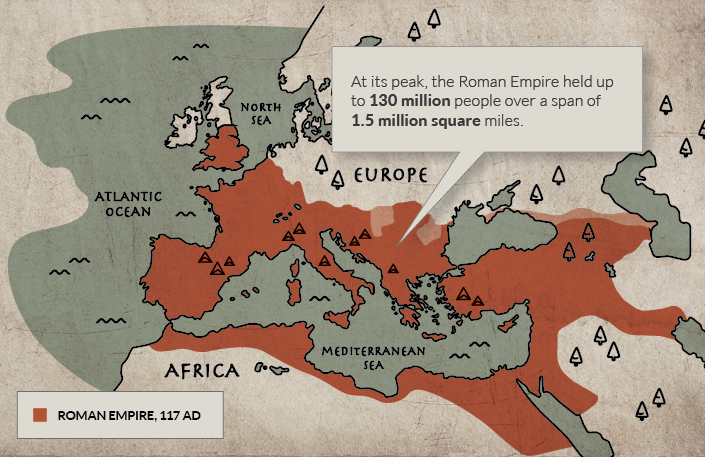
117 AD – Peak Roman Empire

The peak of the Roman Empire is one of the more dramatic moments shown on this animated European map. At its height, under Trajan, the Roman Empire was a colossal 1.7 million square miles (quite a feat in an era without motorized vehicles and modern communication tools). This enormous empire remained mostly intact until 395, when it was irreparably split into Eastern and Western regions.

Extent of the Roman Empire on European Map

370 AD – The Arrival of the Huns

Spurred on by severe drought conditions in Central Asia, the Huns reached Europe and found a Roman Empire weakened by currency debasement, economic instability, overspending, and increasing incursions from rivals along its borders. 

The Huns waged their first attack on the Eastern Roman Empire in 395, but it was not until half a century later—under the leadership of Attila the Hun—that hordes pushed deeper into Europe, sacking and razing cities along the way. The Romans would later get their revenge when they attacked the quarreling Goths and Huns, bouncing the latter out of Central Europe.

1241 – The Mongol Invasion of Europe

In the mid-13th century, the “Golden Horde” led by grandsons of Genghis Khan, roared into Russia and Eastern Europe sacking cities along the way. Facing invasion from formidable Mongol forces, central European princes temporarily placed their regional conflicts aside to defend their territory. Though the Mongols were slowly pushed eastward, they loomed large on the fringes of Europe until almost the 16th century.

1362 – Lithuania

Today, Lithuania is one of Europe’s smallest countries, but at its peak in the middle ages, it was one of the largest states on the continent. A pivotal moment for Lithuania came after a decisive win at the Battle of Blue Waters. This victory stifled the expansion of the Golden Horde, and brought present-day Ukraine into its sphere of influence.

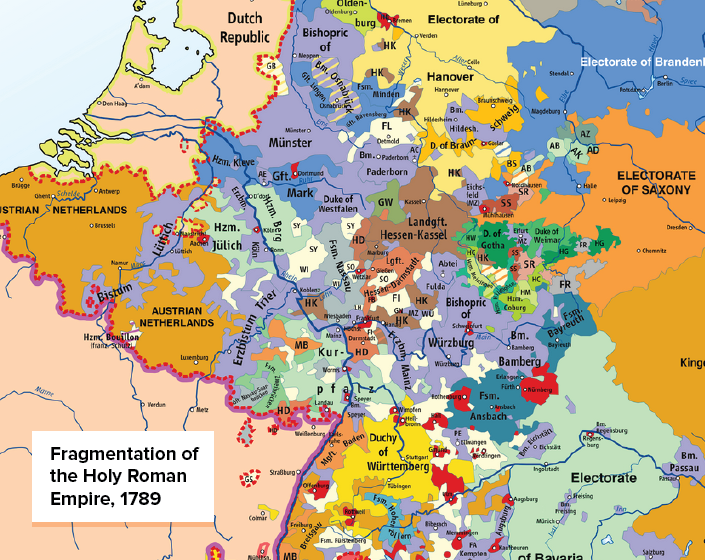
1648 – Kleinstaaterei

The end of the Holy Roman Empire highlights the extreme territorial fragmentation in Germany and neighboring regions, in an era referred to as Kleinstaaterei.

European map with Holy Roman fragments

Even as coherent nation states formed around it, the Holy Roman Empire and its remnants wouldn’t coalesce until Germany rose from the wreckage of the Franco-Prussian War in 1871. Unification helped position Germany as a major power, and by 1900 the country had the largest economy in Europe.

1919 – The Ottoman Empire

The Ottoman Empire—a fixture in Eastern Europe for hundreds of years—was in its waning years by the beginning of the 20th century. The empire had ceded territory in two costly wars with Italy and Balkan states, and by the time the dust cleared on WWI, the borders of the newly minted nation of Turkey began at the furthest edge of continental Europe.

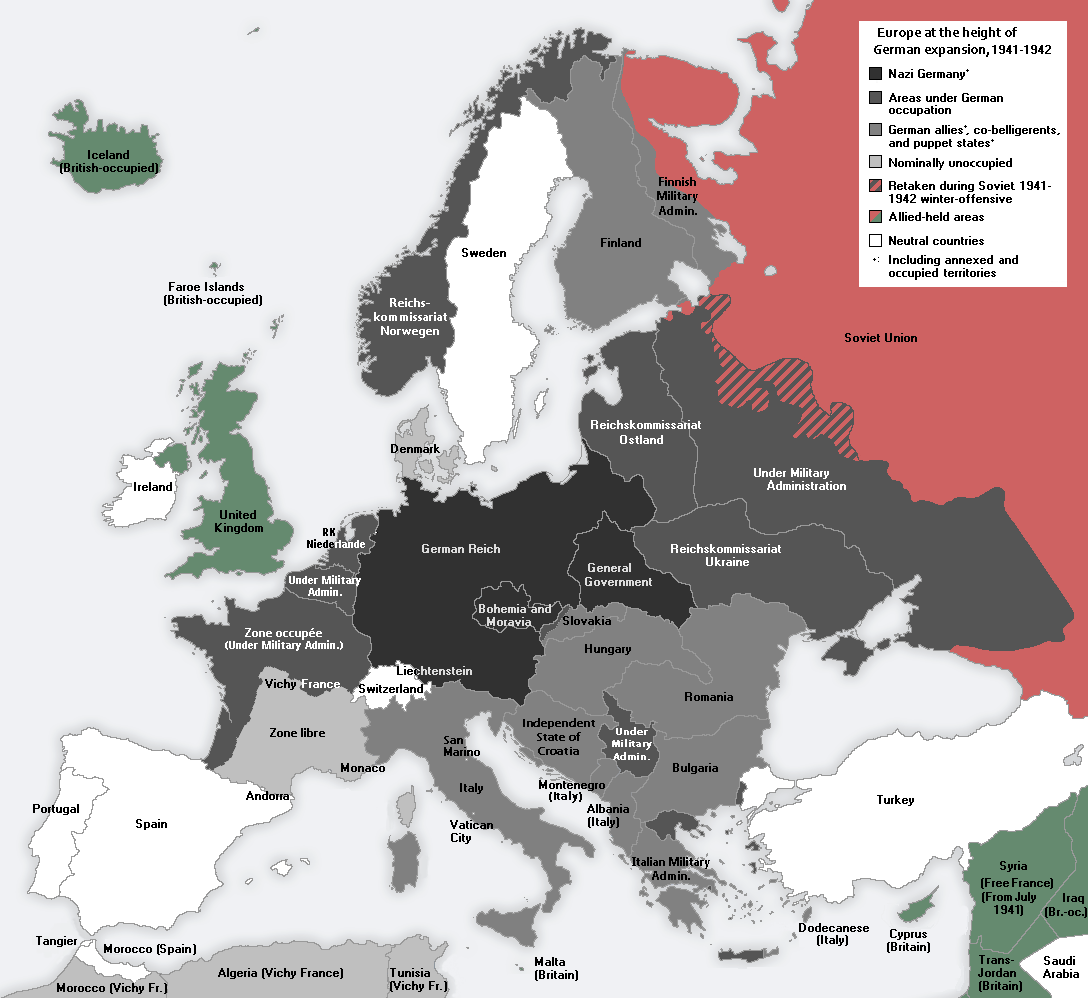
1942 – Expanding and Contracting Germany

At the furthest extent of Axis territory in World War II, Germany and Italy controlled a vast portion of continental Europe. The map below shows occupied land and areas of influence at the height of Germany’s territorial expansion.

Europe at the height of German military expansion

After the war, Germany again became fragmented into occupation zones—this time, overseen by the United States, France, Great Britain, and the Soviet Union. Germany would not be made whole again until 1990, when a weakening Soviet Union loosened its grip on East Germany.

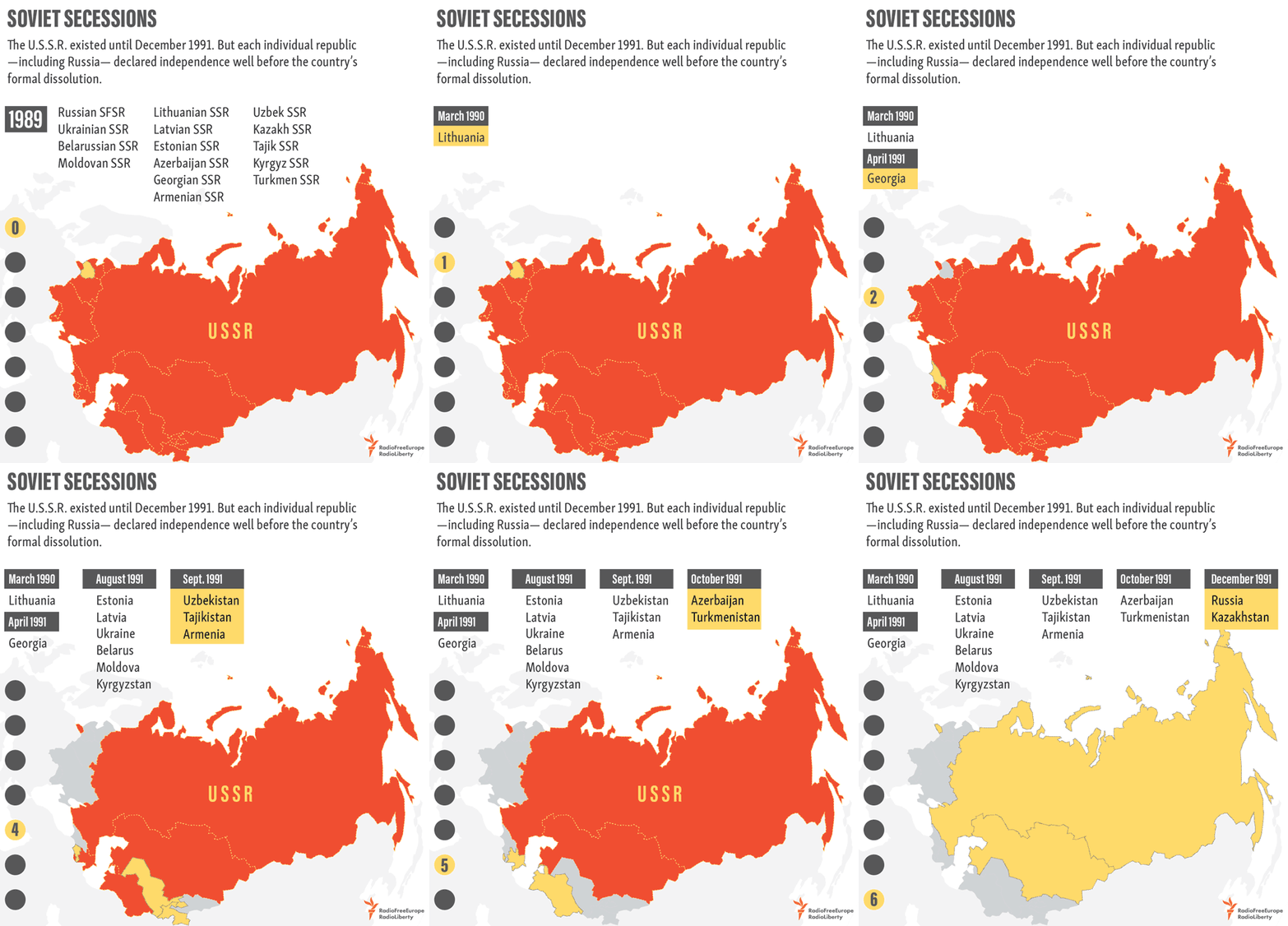
1991 – Soviet Dissolution

In the decades following WWII, the political boundaries of the European map remained relatively stable—that is, until the dissolution of the Soviet Union in 1991. Almost overnight, the country’s entire western border splintered into independent nations. When the dust settled, there were 15 breakaway republics, six of which were in Europe.

Soviet Union successions

Bonus: If you liked the video above, be sure to watch this year-by-year account of who ruled territories across Europe.

sábado, 30 de outubro de 2021

Depois da Grande Destruição de Dona Dilma, a Derrocada Final da economia brasileira pelo tesoureiro do capitão - Ricardo Bergamini e revistas

 Governo Bolsonaro desmoralizou o liberalismo no Brasil 

Ricardo Bergamini

www.ricardobergamini.com.br


Prezados Senhores 


Da mesma forma que nos próximos cem anos não saberemos o motivo da absolvição do grave crime militar praticado pelo general Pazuello, bem como da carteira de vacinação do Bolsonaro, os brasileiros não vão desejar ouvir a palavra “Liberalismo”, assim sendo o retorno do PT é irreversível. 


Guedes abandona as ilusões


Ao admitir que vai abandonar a âncora fiscal, governo Bolsonaro enterra o projeto liberal com que foi eleito em 2018 e abre espaço para o fisiologismo político e a farra dos gastos públicos. As consequências para a economia já são perceptíveis


Cláudio Gradilone e Paula Cristina


ISTOÉ DINHEIRO, 29/10/21


Pragmáticos, os alemães cunharam o termo “realpolitik”. Refere-se a uma abordagem essencialmente prática da política, voltada a objetivos concretos e sem influência da ideologia e da tradição. Na sexta-feira (22), o ministro da Economia, Paulo Guedes, mostrou-se um entusiasta da realpolitik. Ele colocou de lado sua ideologia favorável ao Estado mínimo, jogou às urtigas sua biografia e sua trajetória como defensor do liberalismo, para tornar-se operador-sênior do projeto de reeleição de Jair Bolsonaro.


O ponto fulcral da discussão foi o valor do Auxílio Brasil, ajuda mensal para os brasileiros de baixa renda que vai substituir o Bolsa Família e que deve durar até dezembro de 2022 — coincidentemente (ou nem tanto) após o segundo turno da eleição presidencial do ano que vem. Técnicos do Ministério da Economia defendiam um auxílio de R$ 300, mas a ala política do governo propunha R$ 400.


Menos do que o valor em si, a diferença permite a flexibilização do teto de gastos. Ou seja, uma pragmática permissão para o governo estourar os gastos e cortejar deputados para garantir palanques no pleito no ano que vem. A proposta, vista como derrota definitiva para qualquer projeto de controle das contas públicas, foi acolhida por Guedes e levou a várias baixas de peso na equipe econômica. “Não vamos tirar um dez na política fiscal e zero na política social, preferimos tirar um oito em fiscal em vez de dez e atender os mais frágeis”, disse Guedes na entrevista em que admitiu a capitulação, concedida ao lado de Bolsonaro.


A reação do mercado foi péssima, com alta dos juros pelo Banco Central, revisões para cima na inflação deste ano e para baixo no crescimento econômico para 2022. A realpolitik caracteriza-se pelo pragmatismo. E, pragmaticamente, os agentes econômicos abandonam as ilusões e se preparam para tempos turbulentos, como você verá nas páginas a seguir.


A imagem de Paulo Guedes que ilustra a abertura desta reportagem foi inspirada na capa da edição de 1 de novembro da revista americana Time, com Mark Zuckerberg


A DEMOLIÇÃO DO TETO DE GASTOS


LIBERAIS DE TAUBATÉ Um antiliberal como Bolsonaro e um suposto liberal como Guedes levam o País ao buraco. 


Diz o dito popular que o pior cego é o que não quer ver. Essa frase sem origem conhecida atravessa os tempos, é usada em ao menos 12 línguas e descreve com precisão a atabalhoada jornada de Paulo Guedes à frente do Ministério da Economia. Liberal de carteirinha, Guedes corteja o poder há tempos. Chegou a ser pré-sondado para o então Ministério da Fazenda no início do segundo mandato de Dilma Rousseff. No entanto, a oportunidade para conduzir a economia brasileira surgiu ao se tornar fiador de Jair Bolsonaro junto ao mercado. Guedes grampeou sua biografia ao projeto de poder de um presidente tosco, turrão, pouco democrático e historicamente estatista.


O resultado era tão previsível quanto 2 mais 2 são 4. A economia definha, indicadores despencam e o pedido constrangido para furar o teto de gastos cravou o último prego enferrujado no caixão sem enfeites de uma morte anunciada há meses: a do liberalismo da campanha eleitoral de 2018. Com o tempo, porém, ficou clara a inutilidade de tentar “civilizar” um presidente sero liberal. As dicas anunciavam que o teto de gastos racharia, as reformas não sairiam e o “posto Ipiranga” ficaria sem combustível na primeira briga com Bolsonaro.


Dito e feito. As brigas foram muitas. Cada uma causava uma baixa no ministério e 21 indicados de Guedes deixaram o governo. O primeiro foi Joaquim Levy, que deixou o BNDES em junho de 2019. A despedida mais recente foi a do Secretário de Tesouro e Orçamento, Bruno Funchal, na quinta-feira (21). Levy virou alvo de Bolsonaro logo no início do mandato, por negar-se a abrir uma “caixa preta” do BNDES que existia apenas na cabeça do capitão. Já Funchal, secretário por trás dos planos de Orçamento, saiu quando o teto de gastos rachou de vez.Um dos ex-secretários de Guedes afirmou à DINHEIRO que mais três frentistas vão pedir as contas. “O clima é de pressão política, Guedes trabalha por um projeto político”, disse um deles. E uma agenda política no Ministério é garantia de que a economia vai desabar.


R$ 96,5 bilhões é a estimativa do IFI de rombo no teto dos gastos ano que vem, muito acima dos R$ 40 bilhões necessários para o novo programa social do governo


Segundo o presidente do Instituto Fiscal Independente (IFI), Felipe Salto, o governo pegou poucos sinais de melhora da economia, como a diminuição da dívida pública e a alta na arrecadação, para justificar o abandono da âncora fiscal. “Já está claro que partiremos do zero em 2023”, disse. E criou-se a fantasia inflacionária que mudou a fórmula de cálculo do reajuste do teto. Atualmente, os números são atualizados aplicando-se o IPCA acumulado nos 12 meses até junho do ano anterior à vigência do limite de gastos. A ideia agora é adotar a correção da inflação de janeiro a dezembro. Segundo Salto, essa medida, com a manobra de empurrar as dívidas de precatórios para cima do teto somam R$ 95,6 bilhões — muito acima dos R$ 40 bilhões necessários para custear o Renda Brasil. “Ou seja, há outros R$ 55,6 bilhões para gastos acima do teto. O desmonte já se confirma”, disse.


Ao defender as mudanças, Bolsonaro faz parecer que essa era a única saída. Há muitas razões para contestar essa balela. A ex-secretária da Fazenda do Rio de Janeiro Célia Lins enumera algumas. “O governo poderia acabar com o abono salarial, com o seguro-defeso e com o seguro desemprego. Poderia eliminar as desonerações restantes na folha do pagamento”, disse ela. Também poderia eliminar os benefícios fiscais da Zona Franca de Manaus, elevar o Imposto sobre a Produção Industrial (IPI), passar a tributar as grandes fortunas e cobrar os maiores devedores do INSS.


O Conselho de Monitoramento e Avaliação de Políticas Públicas (CMAP) calculou que se a Receita Federal deixasse de permitir a dedução das despesas médicas no Imposto de Renda das pessoas físicas seriam arrecadados R$ 20 bilhões ao ano. E mais R$ 17 bilhões com o fim da isenção por grave acidente. Suficiente para fazer caber tudo abaixo do teto.


Um estudo da própria equipe de Guedes mostra que, se o benefício ficasse em R$ 300, não seria preciso furar o teto. Porém, o objetivo era furar, seguindo a regra do ex-ministro do Meio Ambiente Ricardo Salles: onde passa boi, passa boiada. O governo tem agora mais recursos para as emendas parlamentares, para elevar o salário das categorias mais baixas das Forças Armadas e dar um afago aos caminhoneiros. Para Bolsonaro está tudo resolvido. O plano é seguir a agenda populista e “deixar que o mercado precifique”. Mas, é impossível precificar um presidente que tem certeza de que 2 mais 2 são 5.


*Paula Cristina


AS PALAVRAS QUE AFETAM OS NÚMEROS


Ao confirmar na sexta-feira (22) que o governo estava renunciando ao teto de gastos, o ministro da Economia, Paulo Guedes, iniciou um dos mais drásticos processos de reversão de expectativas dos agentes econômicos dos últimos anos. Diferentemente da praxe, não demorou para o que era uma percepção se tornasse o discurso oficial. Na quarta-feira (27) o Comitê de Política Monetária (Copom) elevou a taxa Selic para 7,75% ao ano, uma alta de 1,5 ponto porcentual, e informou que em menos de dois meses, na reunião de dezembro, deverá haver outra alta dessa magnitude. Com isso, a Selic deve encerrar 2021 a 9,25% ao ano, maior patamar desde o governo de Michel Temer.


Mesmo redigido na linguagem sóbria e contida dos bancos centrais, o Comunicado que se seguiu ao anúncio da reunião não poderia ser mais claro sobre a gravidade da situação. “O Comitê avalia que recentes questionamentos em relação ao arcabouço fiscal elevaram o risco de desancoragem das expectativas de inflação”, informou. Isso “aumenta a assimetria altista no balanço de riscos” e “implica maior probabilidade de trajetórias para a inflação acima do projetado”. E também não deixou dúvidas quanto ao tratamento prescrito, afirmando que “neste momento, o cenário básico e o balanço de riscos indicam ser apropriado que o ciclo de aperto monetário avance ainda mais no território contracionista” mesmo sabendo que “essa decisão implica suavização das flutuações do nível de atividade econômica e fomento do pleno emprego”.


Em português de dia de semana, isso quer dizer que o Banco Central vai aumentar os juros até o fim deste ano e continuar a elevá-los no início de 2022 para conter a inflação. A alta de preços é um fenômeno global. Tanto nas economias desenvolvidas quanto nas emergentes, os preços vêm subindo devido a dois fatores. O primeiro é a brutal expansão monetária. Países que tinham folgas financeiras (e mesmo os que não as tinham) aumentaram o crédito e injetaram dinheiro na economia para suavizar os efeitos da pandemia. O segundo são os problemas no retorno à normalidade. As normalmente azeitadas correntes de comércio foram prejudicadas. A escassez mais visível é a de chips, que afeta a produção de veículos. Com isso, há distorções que elevam alguns preços.


“Fica difícil para o mercado precificar quais serão os próximos passos a serem dados pelo governo na política macroeconômica” Sergio Rial presidente executivo do Santander Brasil.


No entanto, no Brasil a alta de preços provocada pela escassez hídrica que encarece energia e comida tem mais uma causa. O governo está gastando muito, e as declarações de Guedes na sexta-feira confirmaram que isso deixou de ser um problema em Brasília. Não demorou para que os profissionais do mercado financeiro revisassem para pior seus prognósticos para o ano que vem.


Uma comparação simples entre indicadores financeiros mostra o tamanho do desprazer que a mudança provocou no mercado. Basta comparar as expectativas levantadas pelo próprio BC no Relatório Focus. No início de 2021, a Selic esperada para o fim do ano era de 3%. Agora, a previsão é de 9,25%. A inflação prevista subiu de 3,32% para 8,96%. Os números também são evidentes em mostrar o problema. Os juros de longo prazo no mercado futuro subiram de 4,2% no início do ano para 11,4% no fim de outubro, e o Ibovespa recuou 10,9%, caindo de 119 mil para 106 mil pontos.


O primeiro a refazer as contas foi o Itaú Unibanco. Logo na segunda-feira (25) o banco divulgou um relatório alterando sua projeção para o Produto Interno Bruto (PIB) de 2022. Em vez de uma alta de 0,5%, o banco agora espera uma retração de 0,5%. “Notícias sobre o aumento dos gastos fiscais aumentaram as dúvidas sobre o futuro do arcabouço fiscal no Brasil, que desde 2016 tem sido baseado em um teto de gastos ajustável (…) e sem uma âncora fiscal crível, a tarefa do Banco Central de manter a inflação na meta se torna mais difícil”, segundo o texto.


O banco diagnosticou a doença e foi preciso ao prescrever o tratamento. “Uma rápida retomada da agenda de reforma (…) fortaleceria a flexibilidade e resiliência fiscais e poderia ajudar a aliviar as condições financeiras e reduzir a incerteza.” Outros bancos também refizeram suas contas. Na terça-feira (26) o JP Morgan informou prever juros de 11,25% em abril do ano que vem, estimativa parecida com a do Citibank.Outros números já provam a piora das expectativas. Segundo a Comissão de Valores Mobiliários (CVM), 68 empresas cancelaram projetos de abrir capital na B3. Três delas interromperam o processo logo após o anúncio de rompimento do teto, em uma antecipação ao que está por vir.


INCONSISTÊNCIA Ao comentar os resultados recordes do Santander Brasil no terceiro trimestre, o presidente executivo, Sergio Rial, confirmou a preocupação. “Basta olhar a curva de juros de longo prazo e a percepção do risco Brasil para notar que houve uma piora nas expectativas”, disse ele. Na avaliação de Rial, o grande problema é a inconsistência nas narrativas do governo. “Havia uma agenda de simplificação tributária que simplesmente deixou de ser mencionada, e foi substituída por uma nova agenda de auxílio”, disse Rial. “Fica difícil para o mercado precificar quais serão os próximos passos a serem dados pelo governo na questão da política macroeconômica.”


-0,5% a previsão do itaú unibanco para o pib de 2022 é de retração. antes da fala de guedes, a projeção era de alta de 0,5%


Segundo Rial, essa indefinição amplifica a volatilidade do câmbio, o que é bastante danoso para a economia. Além de pressionar a inflação, um câmbio excessivamente volátil aumenta a percepção de risco e dificulta os investimentos. “O dólar pode estar em um patamar mais ou menos elevado, mas se houver estabilidade as empresas e os investidores se ajustam, mas muita oscilação é ruim.” E a conclusão, para Rial e os demais agentes econômicos, é uma só. A política monetária pode até ser assertiva, mas sem uma sinalização clara de equilíbrio das contas públicas no médio e no longo prazo, o custo da dívida interna se torna proibitivo. Uma lição que o liberal Paulo Guedes aprendeu bem em sua passagem por Chicago, mas que deve ter sido apagada pelo clima seco de Brasília: governo que gasta aumenta o risco, e país arriscado afugenta investidor.


*Cláudio Gradilone


ENTREVISTA: Vandick Silveira, Economista e CEO da Trevisan Escola de Negócios “O Brasil terá uma recessão técnica no último trimestre”


Com o governo minando suas melhores armas de controle da inflação e crescimento ao derrubar o teto de gastos, País entra em um espiral de juros alto, preços caros, dólar volátil e pressão internacional fatores que não serão resolvidos com um auxílio eleitoreiro de R$ 400. Veja as análises do economista:


PIB            


Em dezembro haverá uma leve contração do PIB, o que coloca o Brasil em recessão técnica. O crescimento será de até 3,5%.


AUXÍLIO BRASIL


É mais importante controlar a inflação do que dar dinheiro aos pobres. Porque dar dinheiro ao pobre, esse projeto populista e eleitoreiro dos R$ 400, você dá o dinheiro ao sujeito e conforme a inflação sobe forte, o poder de compra do auxílio despenca.


DESEMPREGO


Fica onde está. Não haverá grandes ganhos pois o Brasil não está crescendo. Cresceu em comparação a 2020, mas segue muito abaixo da base pré-pandemia, que já era deprimida.


TETO DE GASTOS


Não existia nenhuma razão para que a gente estourasse o teto de gastos para a camada mais pobre da população. Na verdade a gente podia dar até o dobro, R$ 800. É factível contando que tivesse uma contrapartida fiscal.


PONTO ALTO DO GOVERNO


A mudança na trajetória da dívida em 2019 foi a maior conquista deste governo, mas o ministério da Economia foi muito incompetente em contar isso. Foi isso que deu condições de se bancar o Auxílio Emergencial.


PAULO GUEDES


É frustrante essa posição. Subiu neste rabo de cometa desgovernado. Virou cabo eleitoral. Mostra que para ele vale mais estar como ministro do que ser um ministro eficaz.


ESTRUTURA FISCAL


Para o mercado, a estrutura fiscal do Brasil é insustentável. E a dívida vai ser insustentável sem teto de gastos. Temos uma só arma no arsenal para combater a inflação: é a política monetária, que em termos militares equivale a uma bomba atômica.


DÓLAR


A volatilidade seguirá na nossa moeda. Ficaremos nessa oscilação de R$ 5,50, R$5,60 até o final do ano. Ano que vem deve permanecer em um patamar de R$ 5,50, tudo isso sob condições normais.


PRIVATIZAÇÕES


O governo falou muito e não entregou nada. Somos perdedores contumazes nesse quesito.


CENÁRIO EXTERNO


Tudo indica que o FED deixará a taxa de juro negativa e entrará na positiva, ou neutra, em 2022. Isso vai provocar uma fuga de capitais de países como Brasil, que tem uma situação fiscal muito incerta. E não vamos poder contar com aquele crescimento pujante da China.


2023

Eu já conto com uma retração da economia brasileira ano que vem em torno de 0,5% a 1%. Isso pela dinâmica própria de um ano eleitoral e a situação fiscal. Agora, se houver essa movimentação no mercado externo, o BC terá que terá que ser mais agressivo e isso derrubará o crescimento. E ai sim pode cair muito mais de 1%.


*Edson Rossi e Paula Cristina


Postagem em destaque

Livro Marxismo e Socialismo finalmente disponível - Paulo Roberto de Almeida

Meu mais recente livro – que não tem nada a ver com o governo atual ou com sua diplomacia esquizofrênica, já vou logo avisando – ficou final...