sábado, 31 de julho de 2021

Quanto custou a guerra de 20 anos dos EUA no Afeganistão? US$ 2,26 trilhões - Adam Tooze

Seria preciso colocar esse custo em perspectiva com outras guerras nas quais os EUA se envolveram, não só o Iraque, mas vários outros conflitos também, como a guerra do Vietnã, desastrosa sob todos os aspectos, e o apoio que os EUA dão a seus "aliados" no Oriente Médio, na África e em outras regiões, a começar pela Alemanha na Europa e o Japão no Oriente.

Adam Tooze's Chartbook #29: Afghanistan's economy on the eve of the American exit. 

Twenty years on.

What do you do if you can see the end of your world approaching? Do you flee? Do you resign yourself? These questions were jarred into focus the other day by reports of desperate professional-class Afghans bracing for the likely return to power of the Taliban. For a large part of my adult life, the Western intervention in Afghanistan has been in the background. There was a time at Yale in the early 2010s when I was routinely teaching classes full of aid workers and veterans from Afghanistan. For a while, Stan McChrystal was a colleague. David Petraeus came for lunch. Though I had been fascinated with military history all my life, I had never been that close to a war. When you see the numbers it becomes easier to understand why the footprint of the Afghan war in American society was as large as it was. According to a widely cited shock statistics, the twenty year intervention in Afghanistan has cost the USA over $2.2 trillion dollars.
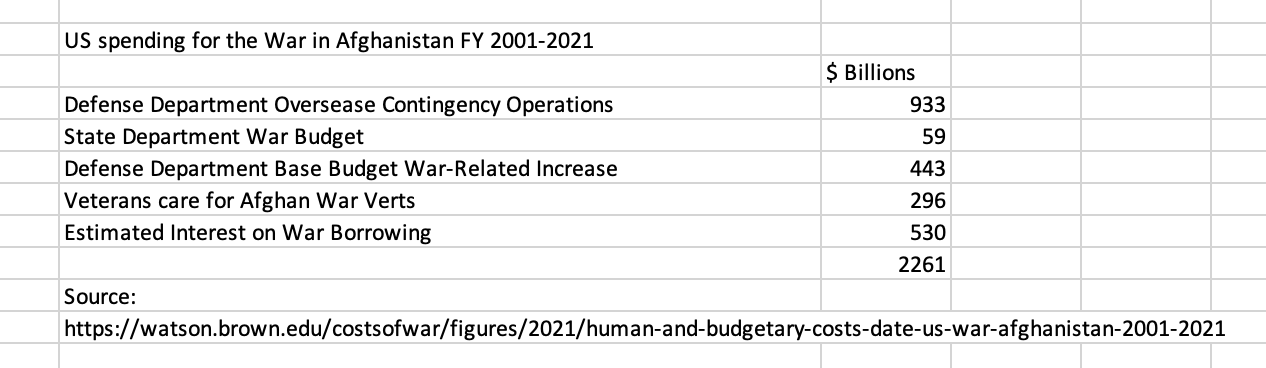
That is a staggering amount, but facing the imminent end of this twenty year engagement, I realized that I knew woefully little about the overall impact of Western intervention on Afghanistan, its economy and society. Ahead of the Western retreat, it seems that the very least one can do, is to take stock and sum up some basic facts. I only scratch the surface here. 

Grasping for some perspective it makes sense to put the last twenty years of Western intervention in Afghanistan in the context of a century of contested and often violent struggle over the country's modernization. On that earlier history, Humanitarian Invasion, by Timothy Nunan is a fascinating read. The revolution of 1978 and the Soviet intervention followed by Western sponsorship of the resistance turned Afghanistan into a battlefield in the late Cold War. It was a conflict of staggering proportions. 
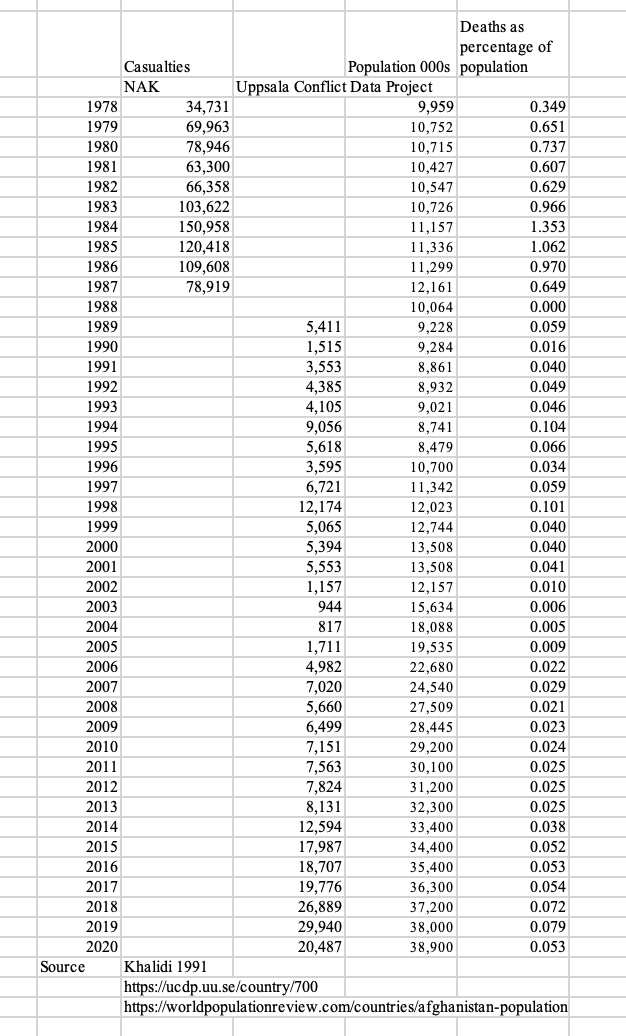
The figures from Khalidi for the Afghan-Soviet war are conservative. They cover only the period 1978-1987. They add up to a total death toll of 870,000. There are not unreasonable estimates that put overall mortality at twice that level. The scale of this violence in the 1980s dwarfs anything that followed. In 2019, 0.078 of the Afghan population were killed in clashes between government and Taliban forces. In 1984, a staggering 1.35 percent of the Afghan population fell victim to the war in a single year. In relation to population that is 19 times worse than the current casualty rate. 

I do not cite these figures to excuse or relativize the violence that has followed. More people were killed in Afghanistan in 2019 than at any time since the end of the Afghan-Soviet war. More than during the conquest of the country by the Taliban during the late 1990s. But, the scale of the 1980s cataclysm is staggering. The losses, at between 7 and 10 percent of total prewar population, are in the ball park of those suffered in Eastern Europe and the Balkans in World War II. Only very big wars with large civilian casualties have significant demographic impact. In the 1980s, Afghanistan’s population stopped growing. 

By comparison, the warlord and Taliban periods of the 1990s were relatively less lethal. That does not mean that they were good times. Not for Kabul, which in the 1990s was sucked into the fighting for the first time. Not for those Afghan women who had participated in the emancipatory politics and culture of the cities and found themselves living under the misogynistic regime of the Taliban. 

Going by the mortality data, the Western intervention in Afghanistan after 2001 at first continued the downward arc of violence. Measured in terms of the death toll, 2003 and 2004 were the most peaceful years that Afghanistan has enjoyed since the 1970s. But from 2006 the intensity of Taliban resistance surged and the Western alliance responded. Between 2009 and 2013, the US and its allies mounted something akin to a full-scale occupation. In 2011 the combined strength of the US, allied and Afghan forces deployed against the Taliban insurgency peaked at over 450,000. 
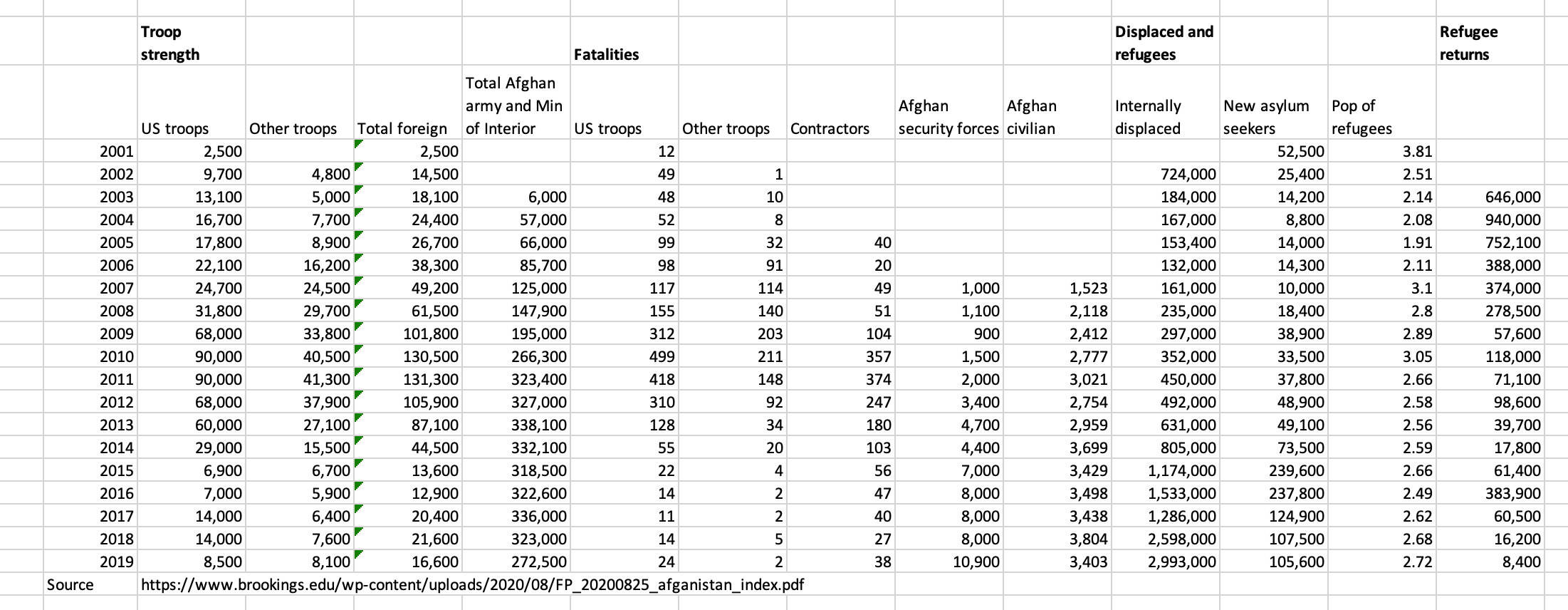
The casualties were never on a scale to compare with the Afghan-Soviet war. A better measure of the disruption is the internal displacement of population, which surged along with the scale of troops deployed. Beginning in 2014 there was a wave of asylum seeking abroad, which, in 2015 in Europe, merged with the “Syrian” refugee crisis.Then, as the draw down of Western military forces began in earnest and the Taliban mobilized, the scale of the fighting widened dramatically. The Afghan security forces began to take very serious casualties and internal displacement surged alarmingly. 

Seen from high altitude, the pattern of economic development in Afghanistan over the last twenty years follows a similar path. At first, Western aid was surprisingly small-scale and modest in conception. It built to a sudden crescendo in the early 2010s at the time of the US surge and has ebbed since. 
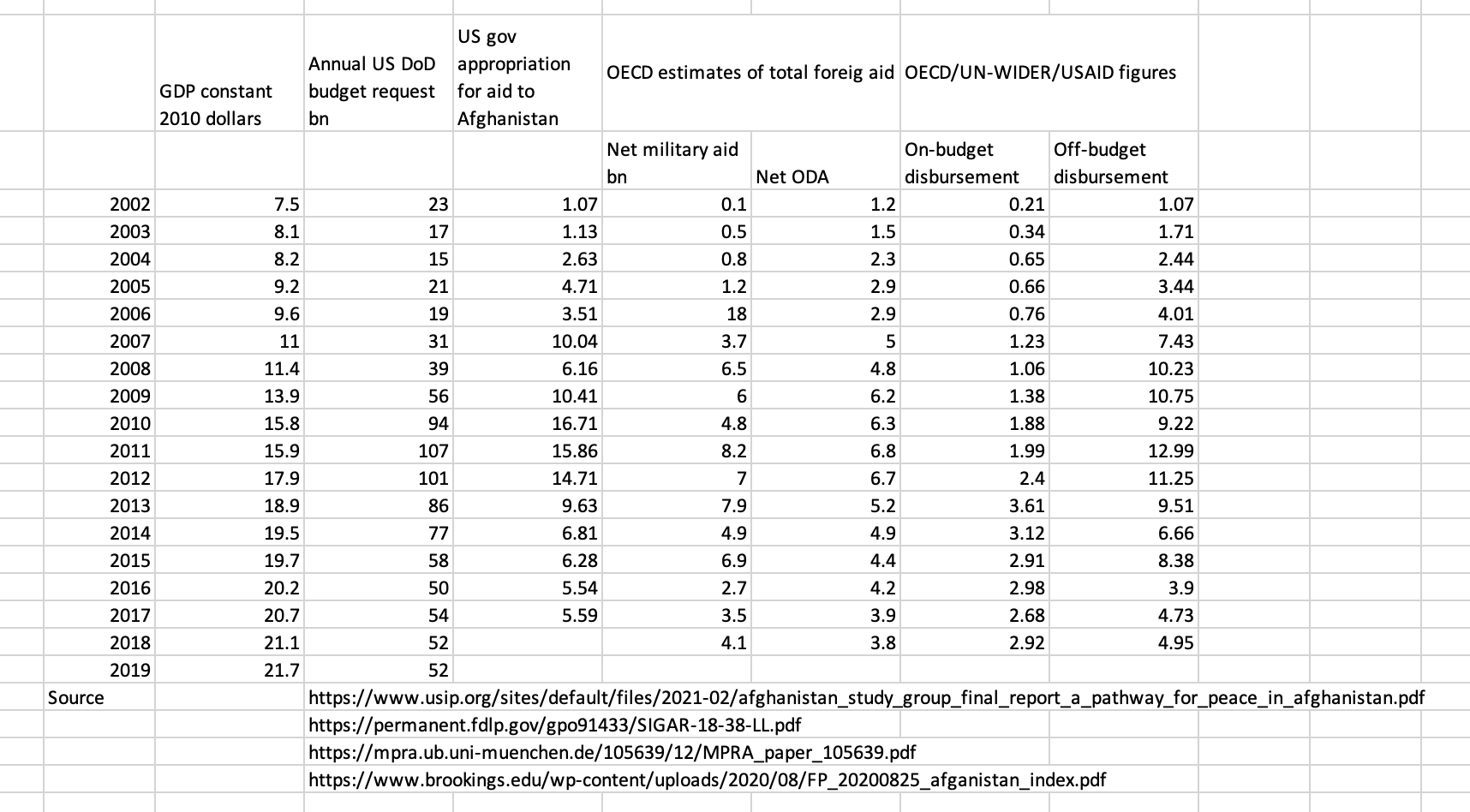
Given Afghanistan’s huge development challenges, one might think that economic development would have top priority. In fact, the ratio of military to civilian development spending was in the order of ten to one. But, the scale of Western involvement is staggering, nevertheless. In many years Western aid spending exceeded the measured size of Afghan GDP. The figures have a surreal, Alice in Wonderland quality. How could you fit so much aid money into such a small economy? Where did the money go? 

One obvious answer is that tens of billions were swallowed up by corruption and the grey economy. Wealthy Afghans became large property owners in the Gulf states. So crass are these divides that they call into question the very notion of an Afghan national economy as we normally understand it. All statistics are constructs. GDP is a particularly elaborate construction. And in the case of Afghanistan it obscures the fact that a national economy as we conventionally understand it, barely exists. On the ground there are “economies” of urban merchants and handicrafts and communities of hard scrabble farmers, but they did not constitute the kind of integrated circular flow as which we imagine a modern economy. Achieving a circular flow was actually a strategic issue in Afghanistan. A huge amount of effort went into the project of completing the ring road that notionally enables the circulation of goods and people around Afghanistan. The ring never closed. 
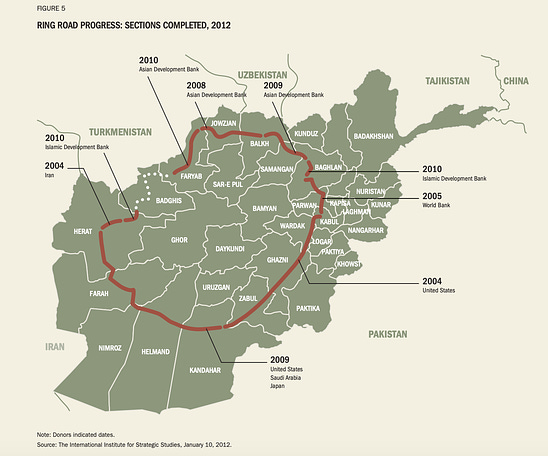
Source: SIGAR

Afghanistan’s most valuable crop is illegal opium. It does its best to show up nowhere in anyone’s accounts. But there can be little doubt that since the early 2000s, cultivation has progressively increased. 
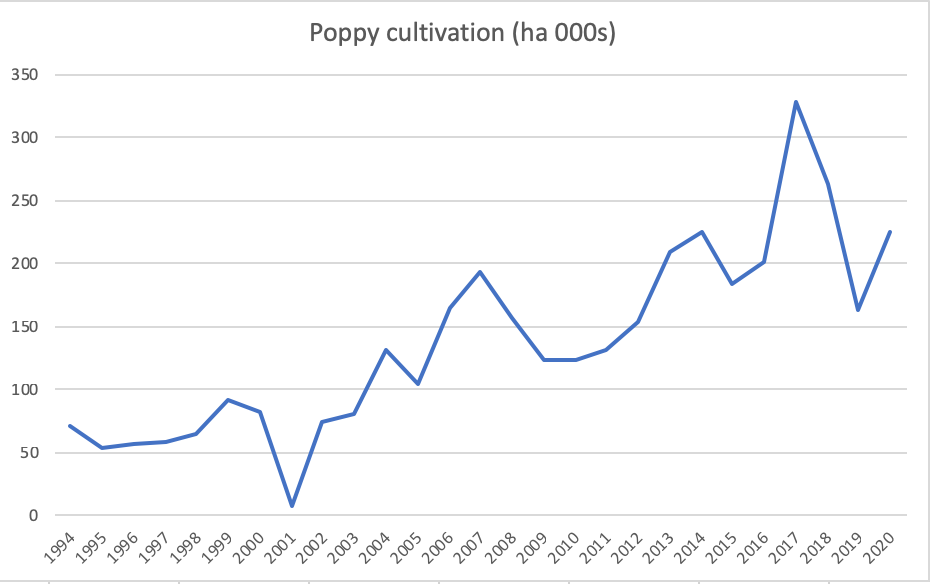
Source: UNODC

At farm-gate prices, in 2017 opium generated about $ 1.5 billion in income for Afghan peasants. The fortunes of the countryside fluctuate with heroine prices in the West.

For what they are worth, data for Afghanistan’s GDP per capita show a surge between 2000 and 2014. GDP per capita was driven upwards by injections of foreign spending and the restoration of ordinary farming and commerce, as security was restored. Since 2014, as aid dwindled and violence returns, GDP has stagnated. With a rapidly growing population, that means that GDP per capita is shrinking.
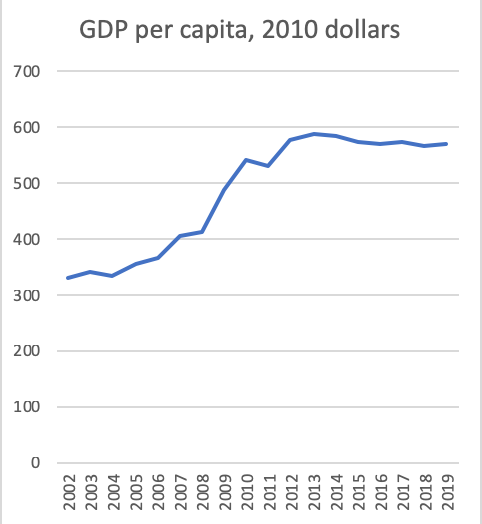
Source: Afghanistan Index

These data are clearly hedged by uncertainty. But other markers of modernization track the same curve. 
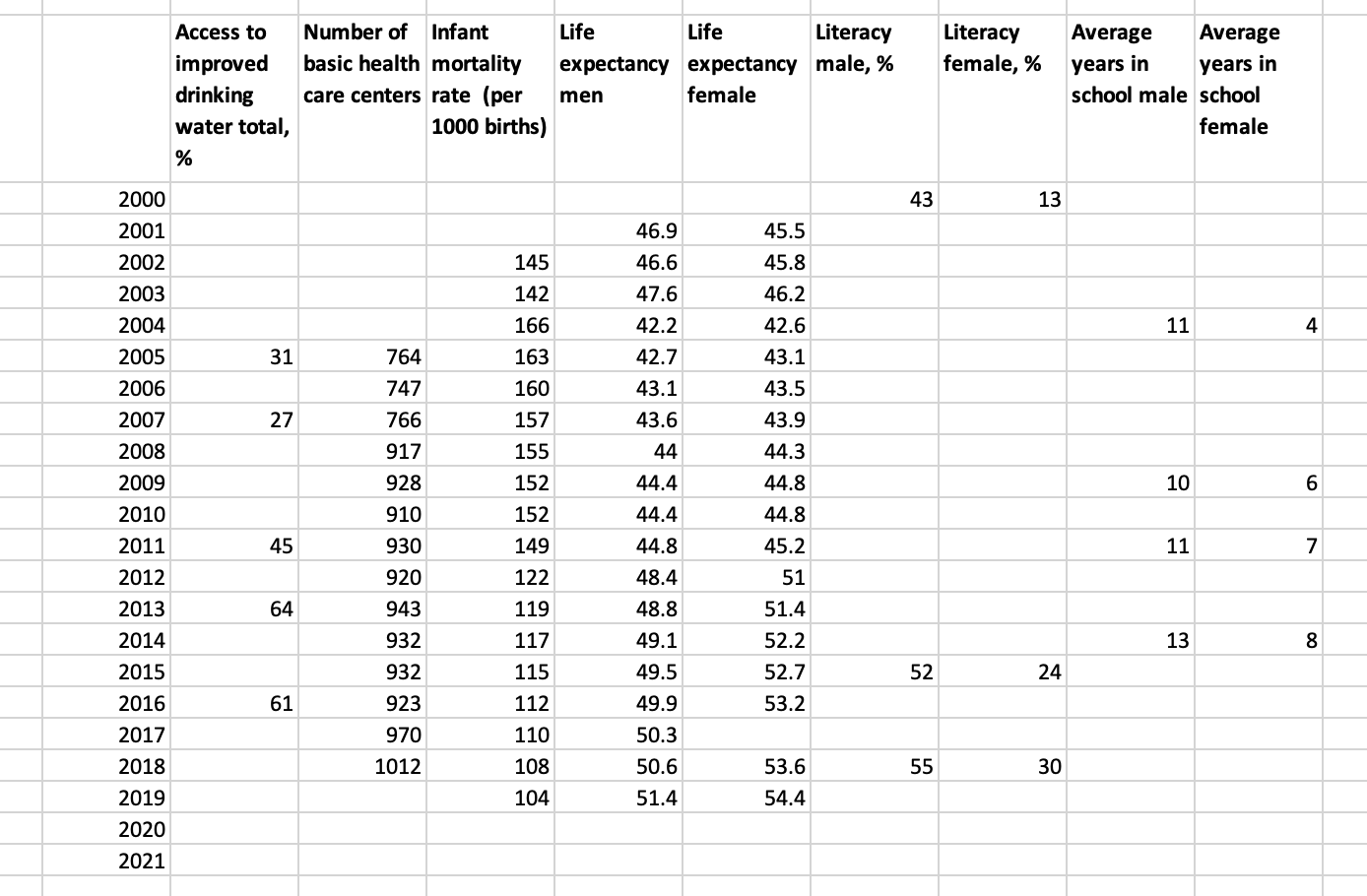
Source: Afghanistan Index

Life expectancy has increased. This is driven by a rapid fall in infant mortality and striking life expectancy gains for women, presumably, through much better maternal care. Whereas in 2000 Afghan men lived longer than women, now Afghanistan has the more normal pattern of women outliving their menfolk. 

From 30,000 in 2003, the number of students enrolled in Universities in Afghanistan has risen to more than 180,000. In 2018, there were 49,000 female students. 
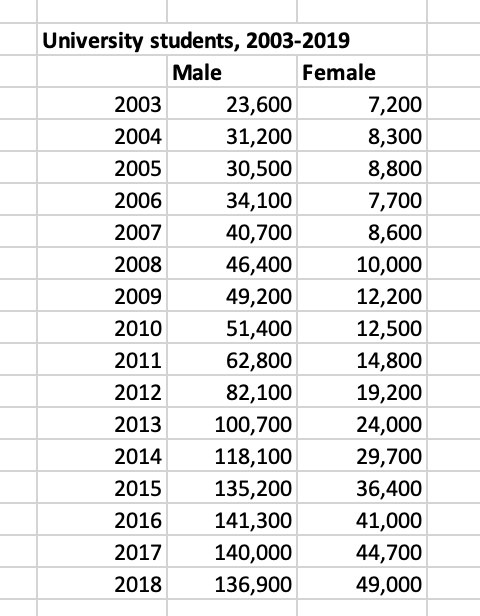
Source: Afghanistan Index

Like everyone else, Afghans are addicted to their cell phones. There are enough cell phone subscriptions for more than half the population. Cell phone providers are one of the few parts of Afghanistan’s modern economy that have truly flourished. To run phones, people need power. Electricity consumption per capita has gone up approximately four times since the 2000. To feed that growing demand, Afghanistan has expanded its own generating capacity. But, increasingly, Afghanistan has come to rely on power imports - from Uzbekistan, Iran and Turkmenistan - which account for almost 80 percent of its power needs. The inflow of aid covers Afghanistan’s yawning trade deficit. 
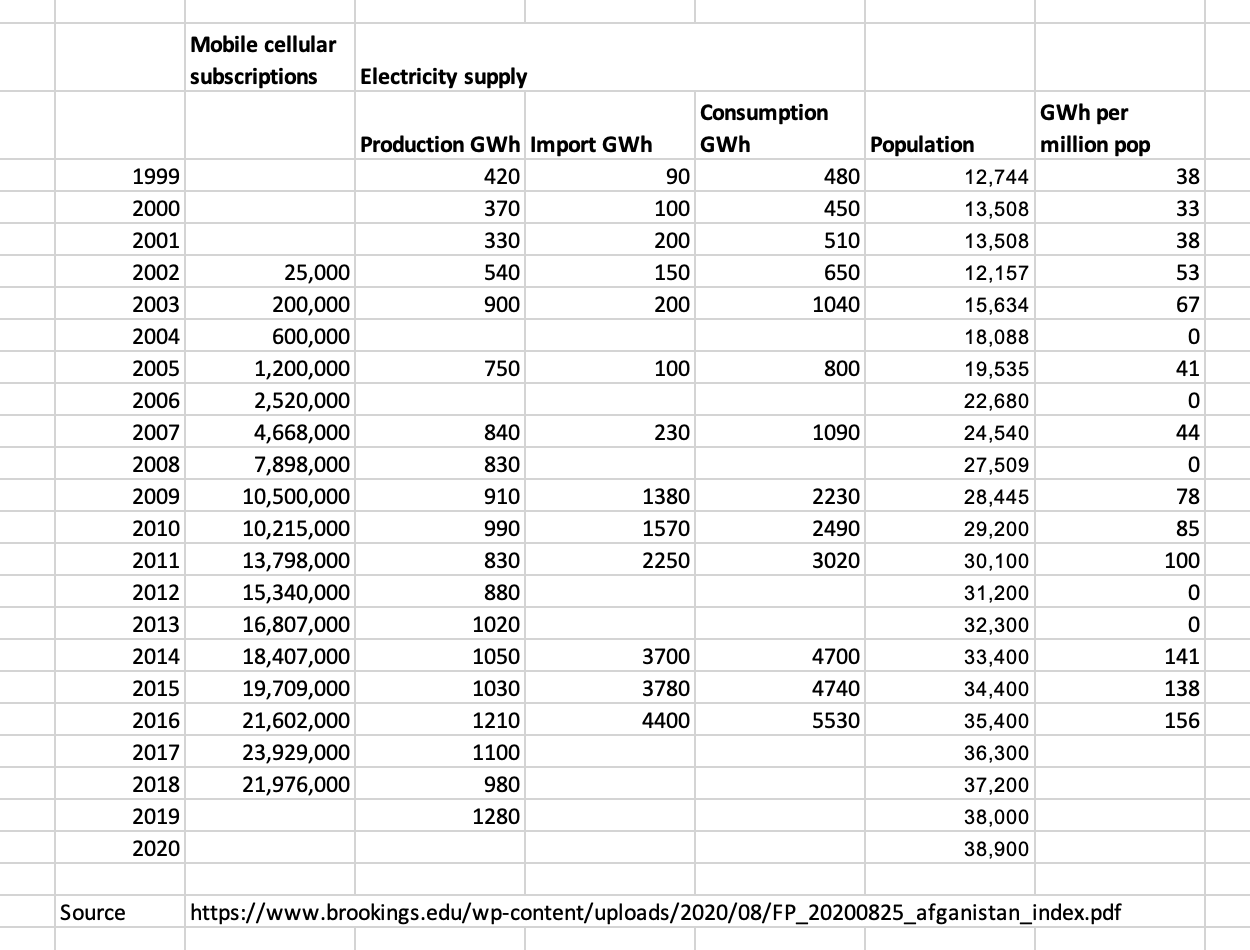
Source: Afghanistan Index

But for all the recorded signs of economic growth and modernization, there has been no success in poverty eradication. In fact, as per capita income increased, so did the rate of poverty. And in recent years, as growth has ground to a halt, the poverty rate has surged. Today, over half of Afghanistan’s population are officially counted as poor. 
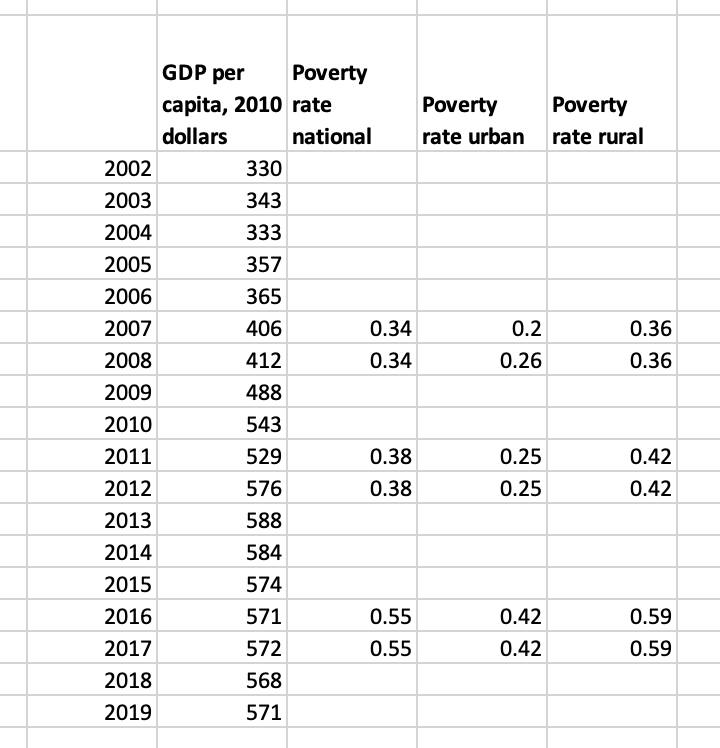
Source: Afghanistan Index

The defining feature of modern Afghanistan is uneven development and vast inequality. The six major cities Kabul, Mazar, Jalalabad, Herat, and Kandahar are a world apart from the other 28 provinces. Critics of the aid regime like Kate Clark refer to Afghanistan as a rentier state. Western aid funneled into a hierarchical and balkanized social and political system has given rise to a parallel economies. Elites have monopolized growth for themselves. Meanwhile, those at the bottom are left behind. The Taliban are sustained by resilient organization, by commitment and by an underground economy of considerable scope. But what ultimately keeps their movement alive is the misery of the Afghan countryside and the rage against pervasive corruption and injustice felt by so many young men. 

The Afghan political class and their outside backers have, periodically, shown an awareness of this basic connection. Ashraf Ghani, currently Afghanistan’s President, is a cultural anthropologist who earned his PhD from Columbia in the early 1980s with a thesis entitled, ‘Production and domination: Afghanistan, 1747-1901’. After taking several positions in US academia, he moved to the World Bank 1991 as lead anthropologist. Unsurprisingly, given this background, when he was Finance Minister under Karzai in the early 2000s, Ghani pushed a full suite of rural development programs. As they intensified their engagement with Afghanistan after 2006 the Americans became more and more focused on stabilization and development. Rural development programs were the essential complement to counterinsurgency operations. At their most grandiose America’s plans envisioned Afghanistan as a key staging post in a “New Silk Road”. General Dave Petraeus and a “tiger team” at the U.S. Central Command (CENTCOM) envisioned Afghanistan as a key link in a new transcontinental trade route. Trade and economic growth would fill the gap left when America’s troop surge wound down. On 20 July 2011 Secretary of State Hillary Clinton embraced the CENTCOM New Silk Road initiative in a speech she gave in Chennai, India. But the idea never took off. A few months after her Chennai speech, Clinton announced the Obama administration’s pivot to Asia, which was widely seen as a turn away from Afghanistan towards wider horizons. It would be China that took up the New Silk Road vision, with One Belt One Road in 2013. But, China’s BRI bypasses Afghanistan, leaving it to the Americans. 

Meanwhile, on the ground, the data told a depressing story of rural retardation. Whilst the rest of the Afghan economy grew rapidly between 2001 and 2013, agricultural output barely increased. 
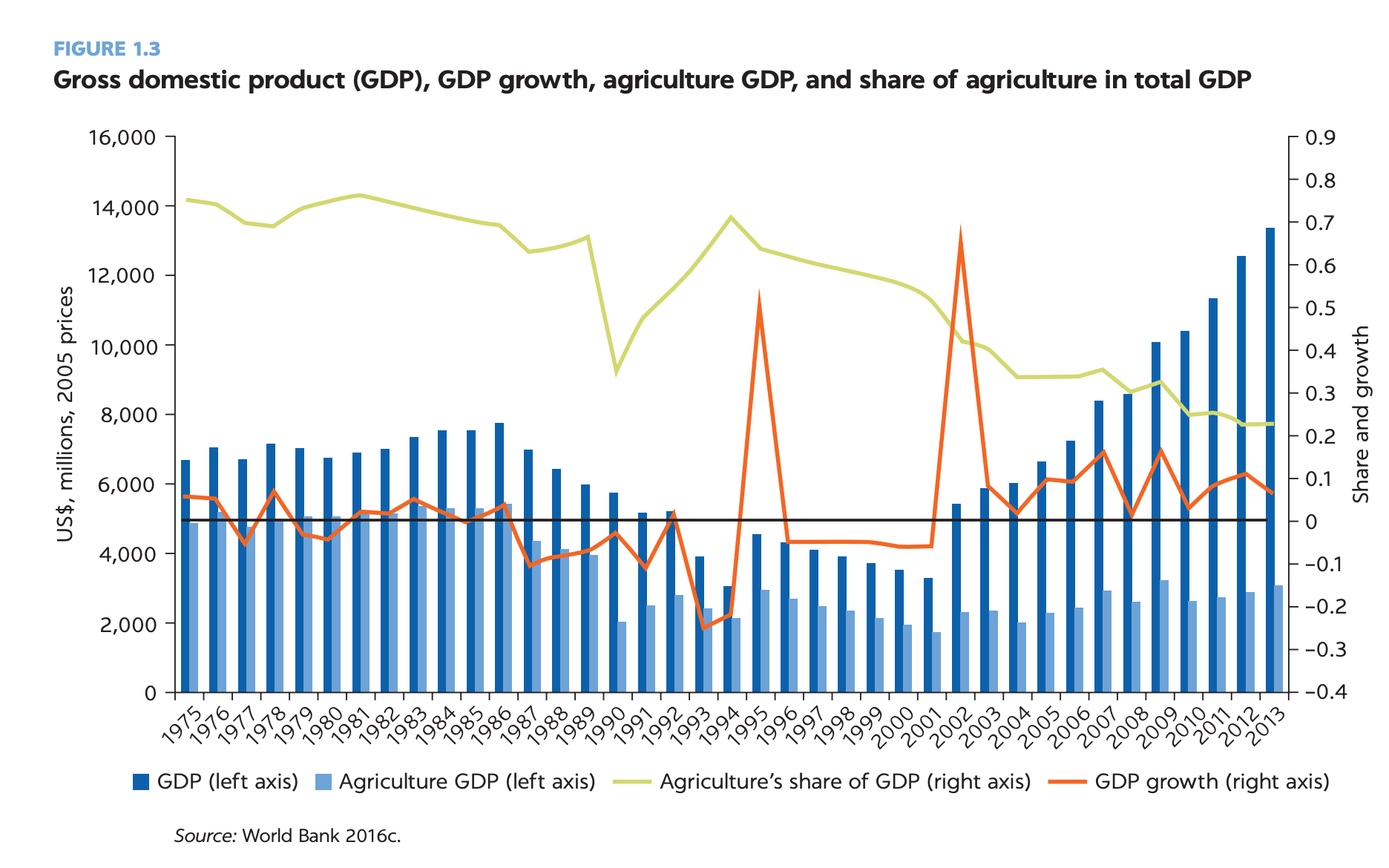
Source: World Bank

The failure of development not only makes the countryside a recruiting ground for the Taliban. It also increases vulnerability to natural shocks. In 2018 Afghanistan was wracked by drought. The rains returned in 2019. But in 2021, in the North and the West of the country, 2-3 million people who rely on rain-fed agriculture and natural pasturage are again facing disaster. As the US prepares its exit, the Norwegian Refugee Council is warning that “More than 12 million Afghans – one-third of the population – now face 'crisis' or 'emergency' levels of food insecurity.” 

With Afghanistan in crisis, the Taliban seem poised to sweep back to power. Once again they are exploiting a mood of crisis. But in the 1990s they took charge of a country eviscerated by the war with the Soviet Union. Afghanistan today is still poor, but it is not in the condition it was twenty five years ago. Kabul in the 1990s was a ruined city with a population of barely over a million. Today, it is a sprawling low-income metropolis, studded with high-rise offices and apartment blocks, with an official population of over 4 million. What kind of regime could be established by the Taliban over such a city? What kind of future can they deliver for Afghanistan and for their constituency in the countryside? Little wonder that the Taliban have been assiduously courting Beijing. Afghanistan needs all the friends it can get. 

Conversas e apresentações sobre diferentes aspectos do sistema internacional e da diplomacia brasileira - Clipping

Recebido do Clipping, curso preparatório à carreira diplomática: 

Enquanto o bate-papo com o ex-Embaixador Gelson Fonseca não chega, que tal assistir à algumas lives com grandes nomes sobre assuntos ligados à diplomacia? 

São 6 lives sensacionais sobre a arte da diplomacia dentro e fora do Itamaraty. 

Confira a playlist e assista quando quiser! 


2  

3  


5  

Semana dos Estudos Diplomáticos

6 vídeos408 visualizações
Última atualização em 23 de jun. de 2021

Conversas transformadoras sobre a arte de construir pontes, dentro e fora do Itamaraty. Convidados que fazem da diplomacia um propósito. 🎓 Pós-graduação em Estudos Diplomáticos: https://bit.ly/2PP9D8O​

19º Congresso Brasileiro de Direito Internacional - ABDI, Campo Grande (25-28/08/2021, virtualmente)

Convite recebido neste último dia de inscrição:


Professor Paulo Roberto de Almeida

Estimado amigo


É com alegria que comunico a realização do 19º Congresso Brasileiro de Direito Internacional, de forma virtual, entre os dias 25 e 28 de agosto de 2021.

Ao longo desses 19 anos, e de forma ininterrupta, muita coisa aconteceu especialmente para o aprimoramento na pesquisa do Direito Internacional com a publicação dos anais, o lançamento de teses e ideias durante o Congresso, a organização de apresentações e publicação de acordo com regras rigorosas para apresentação de trabalho, quando definimos um conselho científico de alto nível formado pelos senhores.

O Congresso reúne os principais nomes do estudo do Direito Internacional no Brasil e é foro aberto e democrático de todos nós como ambiente de expressão de ideias, estabelecimento de parcerias acadêmicas, produção de teses e posições acadêmicas.

Nesse sentido, eu ficarei muito feliz por contar com uma palestra sua no Congresso, de acordo com sua agenda, sobre tema que estiver pesquisando. Caso queira enviar um artigo para publicação em uma obra coletiva especial, ficaremos honrados em receber seu texto.

A confirmação de sua palestra, bem como a definição de sua participação, poderá ser feita diretamente no sistema do Congresso: https://sistemaabdi.com.br/2021/01/29/19-congresso-brasileiro-de-direito-internacional/. O artigo pode ser enviado para meu e-mail até 30 de setembro de 2021.

O convite formal segue anexo.

Cordialmente,

Professor Wagner Menezes

Department of International and Comparative Law 

Faculty of Law - University of São Paulo - USP - Brazil


The Wages of Destruction - Adam Tooze on the German economy under Hitler and during WWII - WW2TV

The Wages of Destruction

 Part of Reanalysed Week on WW2TV

https://www.youtube.com/watch?v=e_pZtzELV48

Professor Adam Tooze is a British historian who is a Professor at Columbia University and Director of the European Institute. From a start in modern German history with a special focus on the history of economics and economic history his interests have widened to take in a range of themes in political, intellectual and military history, across a canvas stretching from Europe across the Atlantic. 

https://adamtooze.com/ 

In today's show we look at Germany's wartime economy as explored by Adam's in his award winning book The Wages of Destruction. Our talking points will include the fact that after the Germans had failed to defeat Great Britain in 1940, the economic logic of the war drove them to an invasion of the Soviet Union. Hitler was constrained do so in 1941 to obtain the natural resources necessary to challenge two economic superpowers: the United States and the British Empire. 

That sealed the fate of the Third Reich because it was resource constraints that made victory against the Soviet Union impossible, especially when it received supplies from the Americans and the British to supplement the resources that remained under Soviet control. We will also talk about Strategic bombing, Albert Speer and also German's pre-WWII rearmament. 

Buy the book

USA https://bookshop.org/a/21029/97801431... 

UK https://uk.bookshop.org/a/5843/978014... 

You can become a Patron here https://www.patreon.com/WW2TV 

Please click subscribe for updates 

Social Media links: 

https://twitter.com/WW2TV 

https://www.facebook.com/WW2TV 

https://www.instagram.com/ww2tv/ 

WW2TV Bookshop - where you can purchase copies of books featured in my YouTube shows. 

Any book listed here comes with the personal recommendation of Paul Woodadge, the host of WW2TV.

For full disclosure, if you do buy a book through a link from this page WW2TV will earn a commission. 

UK - https://uk.bookshop.org/shop/WW2TV 

USA - https://bookshop.org/shop/WW2TV

https://www.youtube.com/watch?v=e_pZtzELV48


Teorias da conspiração no máximo da potência - Anne Applebaum (The Atlantic)

 Se vcs pensam que o Bolsonaro é maluco, vão gostar desta história (verdadeira) relatada pela Anne Applebaum, a autora de Gulag, Red Famine e Twilight of Democracy.

Nos EUA, terra da liberdade, tudo é possível, até um novo dilúvio, pois não faltarão Noés dispostos a construirem arcas gigantescas para abrigarem americanos e animais.

Paulo Roberto de Almeida


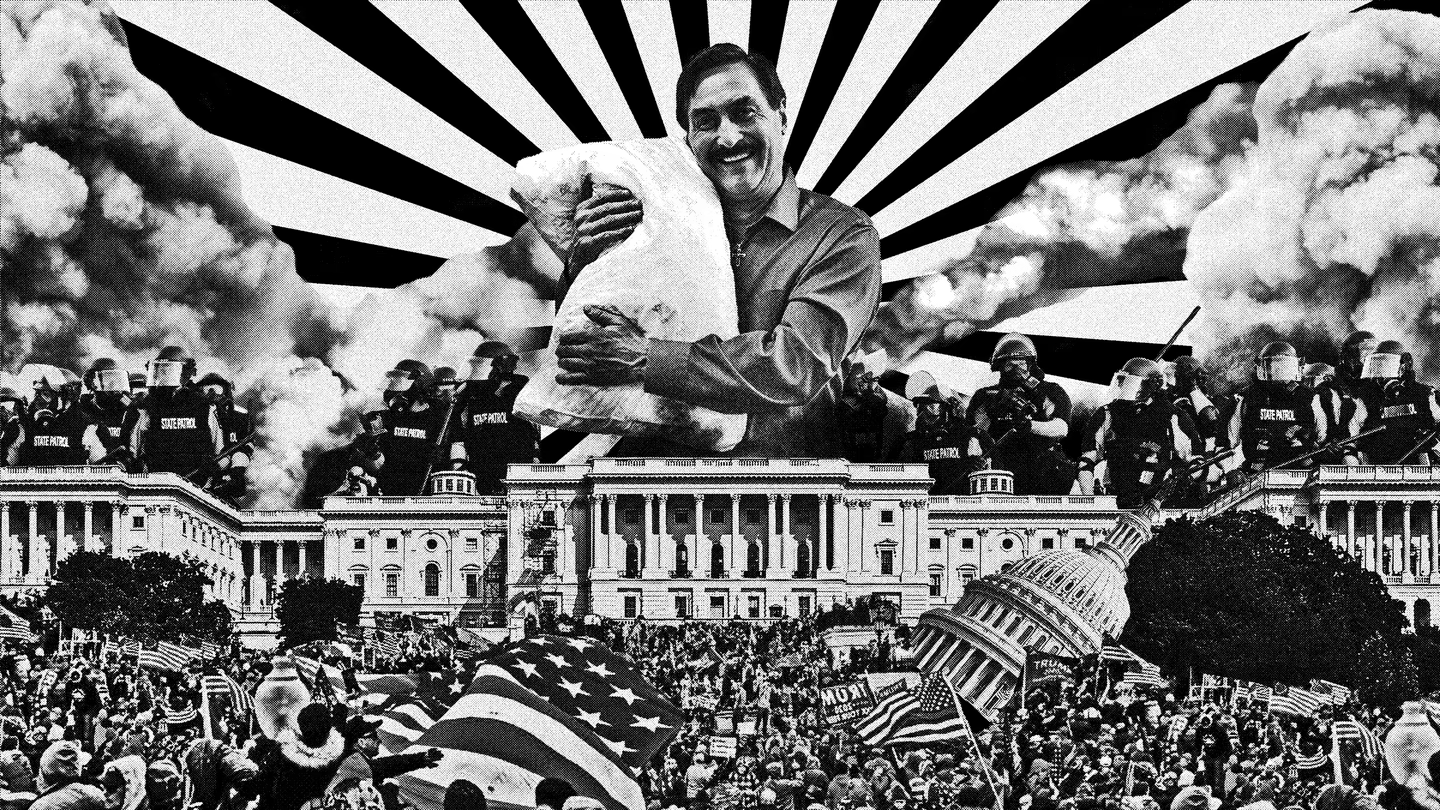
MyPillow Guy emerging out of a destroyed Capitol building amid a sea of MAGA supporters
Photo-illustration by Adam Maida / The Atlantic*

THE MYPILLOW GUY REALLY COULD DESTROY DEMOCRACY

In the time I spent with Mike Lindell, I came to learn that he is affable, devout, philanthropic—and a clear threat to the nation.

About the author: Anne Applebaum is a staff writer at The Atlantic, a fellow at the SNF Agora Institute at Johns Hopkins University, and the author of Twilight of Democracy: The Seductive Lure of Authoritarianism.

When you contemplate the end of democracy in America, what kind of person do you think will bring it about? Maybe you picture a sinister billionaire in a bespoke suit, slipping brown envelopes to politicians. Maybe your nightmare is a rogue general, hijacking the nuclear football. Maybe you think of a jackbooted thug leading a horde of men in white sheets, all carrying burning crosses.

Here is what you probably don’t imagine: an affable, self-made midwesterner, one of those goofy businessmen who makes his own infomercials. A recovered crack addict, no less, who laughs good-naturedly when jokes are made at his expense. A man who will talk to anyone willing to listen (and to many who aren’t). A philanthropist. A good boss. A patriot—or so he says—who may well be doing more damage to American democracy than anyone since Jefferson Davis.

I met Mike Lindell, the CEO of MyPillow, in the recording studio that occupies the basement of Steve Bannon’s stately Capitol Hill townhouse, a few blocks from the Supreme Court—the same Supreme Court that will, according to Lindell, decide “9–0” in favor of reinstating Donald Trump to the presidency sometime in August, or possibly September. I made it through the entirety of the Trump presidency without once having to meet Bannon but here he was, recording his War Room podcast with Lindell. Bannon has been decomposing in front of our eyes for some years now, and I can report that this process continues to take its course. I walked in during a break and the two men immediately gestured to me to join the conversation, sit at the table with them, listen in on headphones. I demurred. “Anne Applebaum … hmm,” Bannon said. “Should’ve stuck to writing books. Gulag was a great book. How long did it take you to write it?”

In the room adjacent to the basement studio, an extra-large image of a New York Times front page hung on the wall, featuring a picture of Bannon and the headline “The Provocateur.” A bottle of Bio-Active Silver Hydrosol, whatever that is, sat on the desk. The big-screen TV was tuned to MSNBC. This wasn’t surprising: In his podcasts, Bannon carries on a kind of dialogue with Rachel Maddow, playing her sound bites and then offering his own critique. Later, Lindell told me that if it weren’t for attacks by “the left”—by which he means Politico, the Daily Beast, and, presumably, me—his message would never get out, because Fox News ignores him.

Bannon, too, lives outside the Fox bubble these days. Instead, he inhabits an alternate universe in which every minute of every day seems to be entirely devoted to the discussion and analysis of “electoral fraud,” with just a little time devoted to selling wellness products and vitamins that, despite his claims, won’t actually cure COVID-19. Bannon’s podcast, which he says has millions of listeners (it is ranked 59th on Apple Podcasts, so he might be right), is populated by full-time conspiracy theorists, some of whom you have heard of and some of whom you probably haven’t: Peter “Trump Won in a Freakin’ Landslide” Navarro, Rudy Giuliani, Garland Favorito, Willis @treekiller35, Sonny Borrelli, the Pizzagate propagator Jack Posobiec, and, of course, Lindell. Bannon calls them up one by one to report on the current status of the Trump-reinstatement campaign and related fake scandals. There are daily updates. The guests talk fast and loud. It is very exciting. On the day I was at the studio, Bannon was gloating about how President Joe Biden was now “defending his own legitimacy”: “We are going to spring the trap around you, sir!” He kept telling people to “lawyer up.”

Even in this group, Lindell stands out. Not only is he presumably much richer than Garland Favorito and Willis @treekiller35; he is willing to spend his money on the cause. MyPillow has long been an important advertiser on Fox News, so much so that even Trump noticed Lindell (“That guy is on TV more than I am”), but has since widened its net. MyPillow spent tens of thousands of dollars advertising on Newsmax just in the week following the January 6 attack on the Capitol.

And now Lindell is spending on more than just advertising. Last January—on the 9th, he says carefully, placing the date after the 6th—a group of still-unidentified concerned citizens brought him some computer data. These were, allegedly, packet captures, intercepted data proving that the Chinese Communist Party altered electoral results … in all 50 states. This is a conspiracy theory more elaborate than the purported Venezuelan manipulation of voting machines, more improbable than the allegation that millions of supposedly fake ballots were mailed in, more baroque than the belief that thousands of dead people voted. This one has potentially profound geopolitical implications.

That’s why Lindell has spent money—a lot of it, “tens of millions,” he told me—“validating” the packets, and it’s why he is planning to spend a lot more. Starting on August 10, he is holding a three-day symposium in Sioux Falls (because he admires South Dakota’s gun-toting governor, Kristi Noem), where the validators, whoever they may be, will present their results publicly. He has invited all interested computer scientists, university professors, elected federal officials, foreign officials, reporters, and editors to the symposium. He has booked, he says variously, “1,000 hotel rooms” or “all the hotel rooms in the city” to accommodate them. (As of Wednesday, Booking.com was still showing plenty of rooms available in Sioux Falls.)

Wacky though it seems for a businessman to invest so much in a conspiracy theory, there are important historical precedents. Think of Olof Aschberg, the Swedish banker who helped finance the Bolshevik revolution, allegedly melting down the bars of gold that Lenin’s comrades stole in train robberies and reselling them, unmarked, on European exchanges. Or Henry Ford, whose infamous anti-Semitic tract, The International Jew, was widely read in Nazi Germany, including by Hitler himself. Plenty of successful, wealthy people think that their knowledge of production technology or private equity gives them clairvoyant insight into politics. But Aschberg, Ford, and Lindell represent the extreme edge of that phenomenon: Their business success gives them the confidence to promote malevolent conspiracy theories, and the means to reach wide audiences.

In the cases of Aschberg and Ford, this had tragic, real-world consequences. Lindell hasn’t created Ford-level havoc yet, but the potential is there. Along with Bannon, Giuliani, and the rest of the conspiracy posse, he is helping create profound distrust in the American electoral system, in the American political system, in the American public-health system, and ultimately in American democracy. The eventual consequences of their actions may well be a genuinely stolen or disputed election in 2024, and political violence on a scale the U.S. hasn’t seen in decades. You can mock Lindell, dismiss him, or call him a crackhead, but none of this will seem particularly funny when we truly have an illegitimate president in the White House and a total breakdown of law and order.

Lindell had agreed to have lunch with me after the taping. But where to go? I didn’t think it would be much fun to take someone inclined to shout about rigged voting machines and fake COVID-19 cures to a crowded bistro on Capitol Hill. Because Lindell is famously worried about Chinese Communist influence, I thought he would like to pay homage to the victims of Chinese oppression. I booked a Uyghur restaurant.

This proved a mistake. For one thing, the restaurant—the excellent Dolan Uyghur, in D.C.’s Cleveland Park neighborhood—was not at all close to Bannon’s townhouse. Getting there required a long and rather uncomfortable drive, in Lindell’s rented black SUV; he talked at me about packet captures the whole way, one hand on the steering wheel, the other holding up a phone showing Google Maps. Once we got there, he didn’t much like the food. He picked at his chicken kebabs and didn’t touch his spicy fried green beans. More to the point, he didn’t understand why we were there. He had never heard of the Uyghurs. I told him they were Muslims who are being persecuted by Chinese Communists. Oh, he said, “like Christians.” Yes, I said. Like Christians.

He kept talking at me in the restaurant, a kind of stream-of-consciousness account of the packet captures, his mistreatment at the hands of the media and the Better Business Bureau, the dangers of the COVID-19 vaccines, and the wonders of oleandrin, a supplement that he says he and everyone else at MyPillow takes and that he says is 100 percent guaranteed to prevent COVID-19. On all of these points he is utterly impervious to any argument of any kind. I asked him what if, hypothetically, on August 10 it turns out that other experts disagree with his experts and declare that his data don’t mean what he thinks his data mean. This, he told me, was impossible. It couldn’t happen:

“I don’t have to worry about that. Do you understand that? Do you understand I’ve been attacked? I have 2,500 employees, and I’ve been attacked every day. Do I look like a stupid person? That I’m just doing this for my health? I have better things to do—these guys brought me this and I owe it to the United States, to all, whether it’s a Democrat or Republican or whoever it is, to bring this forward to our country. I don’t have to answer that question, because it’s not going to happen. This is nonsubjective evidence.”

The opprobrium and rancor he has brought down upon himself for trying to make his case are, in Lindell’s mind, further proof that it is true. Stalin once said that the emergence of opposition signified the “intensification of the class struggle,” and this is Lindell’s logic too: If lots of people object to what you are doing, then it must be right. The contradictions deepen as the ultimate crisis draws closer, as the old Bolsheviks used to say.

But there is a distinctly American element to his thinking too. The argument from personal experience; the evidence acquired on the journey from crack addict to CEO; the special kind of self-confidence that many self-made men acquire, along with their riches—these are native to our shores. Lindell is quite convinced, for example, that not only did China steal the election, but that “there is a communist agenda in this country” more broadly. I asked him what that meant. Communists, he told me, “take away your right to free speech. You just told me what they are doing to these people”—he meant the Uyghurs. “I’ve experienced it firsthand, more than anyone in this country.”

The government had taken his freedom away? Put him in a reeducation camp? “I don’t see anybody arresting you,” I said. He became annoyed.

Okay, I’m not talking about the government,” he said. “I’m talking about social media. Why did they attack me? Why did bots and trolls attack all of my vendors? I was the No. 1 selling product of every outlet in the United States—every one, every single one, all of them drop like flies. You know why? Because bots and troll groups were hired. They were hired to attack. Well, now I’ve done investigations. They come out of a building in China.”

It is true that there has been some organized backlash against MyPillow, which is indeed no longer stocked by Bed Bath & Beyond, Kohl’s, and other retailers. But I suspect that this reaction is every bit as red-white-and-blue as Lindell himself: Plenty of Americans oppose Lindell’s open promotion of both election and vaccine conspiracy theories, and are perfectly capable of boycotting his company without the aid of Chinese bots. Lindell’s lived experience, however, tells him otherwise, just like his lived experience tells him that COVID-19 vaccines will kill you and oleandrin won’t. Lived experience always outweighs expertise: Nobody can argue with what you feel to be true, and Lindell feels that the Chinese stole the election, sent bots to smear his company, and are seeking to impose communism on America.

Although he describes the packet captures as “cyberforensics”—indisputable, absolute, irreversible proof of Chinese evildoing—Lindell is more careful about evidence that isn’t “nonsubjective.” When I asked him how exactly Joe Biden’s presidency was serving the interests of the Chinese Communist Party, for example, his reasoning became more circuitous. He didn’t want to say that Joe Biden is himself a Communist. Instead, when I asked for evidence of communist influence on Biden, he said this: “Inauguration Day—I’ll tell you—Inauguration Day, he laid off 50,000 union workers. Boom! Pipeline gone. The old Democrat Party wouldn’t lay off union workers.”

In other words, the evidence of Joe Biden’s links to the Chinese Communist Party was … his decision to close the Keystone XL pipeline. Similarly convoluted reasoning has led him to doubt the patriotism of Arizona Governor Doug Ducey as well as Georgia Governor Brian Kemp and Secretary of State Brad Raffensperger, all of whom deny the existence of serious electoral cheating in their states. “My personal opinion,” he told me, is that “Brian Kemp is somehow compromised and maybe could be blackmailed or in on it or whatever. I believe Raffensperger’s totally in on it.”

In on what? I asked.

“In on whatever’s going on …”

I asked if he meant the Chinese takeover of America. Was Raffensperger pro-China?

“I believe he’s pro-China.”

MyPillow Guy
Michael Reynolds / Getty; Adam Maida / The Atlantic

Alongside the American business boosterism, Lindell’s thinking contains a large dose of Christian millenarianism too. This is a man who had a vision in a dream of himself and Donald Trump standing together—and that dream became reality. No wonder he believes that a lot of things are going to happen after August 10. It’s not just that the Supreme Court will vote 9–0 to reinstate Trump. It is also that America will be a better place. “We’re going to get elected officials that make decisions for the people, not just for their party,” Lindell said. There will be “no more machines” in this messianic America, meaning no more voting machines: “On both sides, people are opening their eyes.” In this great moment of national renewal, there will be no more corruption, just good government, goodwill, goodness all around.

That moment will be good for Lindell, too, because he will finally be able to relax, knowing that “I’ve done all I can.” After that, “everything will take its course. And I don’t have to be out there every day fighting for media attention.” He won’t, in other words, have to be having lunch with people like me.

Alas, a happy ending is unlikely. He will not, on August 10, find that “the experts” agree with him. Some have already provided careful explanations as to why the “packet captures” can’t be what he says they are. Others think that the whole discussion is pointless. When I called Chris Krebs, the Trump administration’s director of the Cybersecurity and Infrastructure Security Agency, he refused even to get into the question of whether Lindell has authentic data, because the whole proposal is absurd. The heavy use of paper ballots, plus all of the postelection audits and recounts, mean that any issues with mechanized voting systems would have been quickly revealed. “It’s all part of the grift,” Krebs told me. “They’re exploiting the aggrieved audience’s confirmation bias and using scary yet unintelligible imagery to keep the Big Lie alive, despite the absence of any legitimate evidence."

What will happen when Lindell’s ideological, all-American, predicted-in-a-dream absolute certainty runs into a wall of skepticism, disbelief, or—even worse—indifference? If history is anything to go by … nothing. Nothing will happen. He will not admit he is wrong; he will not stop believing. He will not understand that he was conned out of the millions he has spent “validating” fake data. (One has to admire the salesmanship of the tech grifters who talked him into all of this, assuming they exist.) He will not understand that his company is having trouble with retailers because so many people are repulsed by his ideas. He will not understand that people attack him because they think what he says is dangerous and could lead to violence. He will instead rail against the perfidy of the media, the left, the Communists, and China.

Certainly he will not stop believing that Trump won the 2020 election. The apocalypse has been variously predicted for the year 500, based on the dimensions of Noah’s Ark; the year 1033, on the 1,000th anniversary of Jesus’s birth; and the year 1600, by Martin Luther no less; as well as variously by Jehovah’s Witnesses, Nostradamus, and Aum Shinrikyo, among many others. When nothing happened—the world did not end; the messiah did not arrive—did any of them throw in the towel and stop believing? Of course not.

Lindell mostly speaks in long, rambling monologues filled with allusions and grievances; he circles back again and again to electoral fraud, to the campaigns against him, to particular interviewers and articles that he disputes, some of it only barely comprehensible unless you’ve been following his frequent media appearances—which I have not. At only one moment was there a hint that this performance was more artful than it appeared to be. I asked him about the events of January 6. He immediately grew more precise. “I was not there, by the grace of God,” he said. He was doing media events elsewhere, he said. Nor did he want to talk about what happened that day: “I think that there were a lot of things that I’m not going to comment on, because I don’t want that to be your story.”

Not too long after that, I suddenly found I couldn’t take any more of this calculated ranting. (I can hear that moment on the recording, when I suddenly said “Okay, enough” and switched off the device.) Although he ate almost nothing, Lindell insisted on grabbing the check, like any well-mannered Minnesotan would. In the interests of investigative research, I later bought a MyPillow (conclusion: it’s a lot like other pillows), so perhaps that makes us even.

When we walked outside, I thought that I might say something dramatic, something cutting, something like “You realize that you are destroying our country.” But I didn’t. He is our country after all, or one face of our country: hyper-optimistic and overconfident, ignorant of history and fond of myths, firm in the belief that we alone are the exceptional nation and we alone have access to exceptional truths. Safe in his absolute certainty, he got into his black SUV and drove away.


*Photo-illustration images: MyPillow; AP; Brent Stirton / Michael Negro / Pacific Press / LightRocket / Getty 

Anne Applebaum is a staff writer at The Atlantic, a fellow at the SNF Agora Institute at Johns Hopkins University, and the author of Twilight of Democracy: The Seductive Lure of Authoritarianism.

Postagem em destaque

Livro Marxismo e Socialismo finalmente disponível - Paulo Roberto de Almeida

Meu mais recente livro – que não tem nada a ver com o governo atual ou com sua diplomacia esquizofrênica, já vou logo avisando – ficou final...