Diplomatizzando

Temas de relações internacionais, de política externa e de diplomacia brasileira, com ênfase em políticas econômicas, viagens, livros e cultura em geral. Um quilombo de resistência intelectual em defesa da racionalidade, da inteligência e das liberdades democráticas. Ver também minha página: www.pralmeida.net (em construção).

domingo, 12 de dezembro de 2021

Best books of 2021 - Foreign Affairs

Todo ano a Foreign Affairs reune as "pílulas" de suas resenhas ao longo de quatro números e os apresenta como chamariz para atrair assinantes. A revista vai fazer 100 anos em 2022, e certamente vai publicar um "Reader" de seus melhores artigos, como já fez em ocasiões anteriores, de datas comemorativas.

Paulo Roberto de Almeida

The Best of Books 2021

This Year’s Top Picks From Foreign Affairs’ Reviewers

December 9, 2021
Luci Gutiérrez

The best books we reviewed this year, selected by Foreign Affairs editors and book reviewers.

EDITORS’ PICKS

Book cover not available

China’s Good War: How World War II Is Shaping a New Nationalism

by Rana Mitter

In this deft, textured work of intellectual history, Mitter opens a window into the legacy of China’s experience during World War II, showing how historical memory lives on in the present and contributes to the constant evolution of Chinese nationalism. 

READ THE REVIEW
Book cover not available

Eat the Buddha: Life and Death in a Tibetan Town

by Barbara Demick

Demick’s reporting is resourceful and inspired, but her message is a dispiriting one: there is little the outside world can do to halt Beijing’s deliberate and systematic erosion of the distinctive cultures and traditions of Buddhist Tibetans and other minority groups within China.

READ THE REVIEW
Book cover not available

Prisoners of the Past: South African Democracy and the Legacy of Minority Rule

by Steven Friedman

Friedman examines the resilience of apartheid in South Africa, demonstrating how the old order has repeatedly prevented the new one from delivering on its promises of racial justice.

READ THE REVIEW
Book cover not available

A World Safe for Democracy: Liberal Internationalism and the Crises of Global Order

by G. John Ikenberry

In his most impressive work to date, Ikenberry presents liberal internationalism as a pragmatic political project, defending it against realists who dismiss it as utopianism and radicals who deride it as window-dressing for capitalist imperialism.

READ THE REVIEW

POLITICAL AND LEGAL

Book cover not available

Democracy Rules

by Jan-Werner Müller 

Müller argues in this important book that the forms of popular authoritarianism seen recently in Brazil, Hungary, India, Poland, and the United States constitute a threat to democracy but do not herald a return to the fascism of the 1930s.

READ THE REVIEW
Book cover not available

Dreamworlds of Race: Empire and the Utopian Destiny of Anglo-America

by Duncan Bell

In this superb work of intellectual history, Bell explores the ideas of some of the most intriguing figures of the late nineteenth century in the United Kingdom and the United States, delving into their dreams of a world-dominating Anglo-American political community united by race and empire.

READ THE REVIEW
Book cover not available

China, the UN, and Human Protection: Beliefs, Power, Image

by Rosemary Foot

In this groundbreaking study, Foot shows how China has worked behind the scenes at the UN to promote a vision of security that emphasizes economic development, a strong state, and social stability.

READ THE REVIEW

ECONOMIC | SOCIAL | ENVIRONMENTAL

Book cover not available

The Great Demographic Reversal: Ageing Societies, Waning Inequality, and an Inflation Revival

by Charles Goodhart and Manoj Pradhan

In this thought-provoking book, Goodhart and Pradhan describe how the integration of China and other emerging markets into the world economy led to rising inequality, stagnant wages, and low inflation—and what will change as those countries’ populations age.

READ THE REVIEW
Book cover not available

The Power of Creative Destruction: Economic Upheaval and the Wealth of Nations

by Philippe Aghion, Céline Antonin, and Simon Bunel

Aghion, Antonin, and Bunel explain how innovation can generate economic growth and help governments navigate the supply chain disruptions created by COVID-19. They argue that fostering such innovation requires striking a balance between too much competition and too little.

READ THE REVIEW
Book cover not available

The Spirit of Green: The Economics of Collisions and Contagions in a Crowded World

by William D. Nordhaus

Nordhaus emphasizes the indispensability of public policy interventions in the quest for a greener world, building on a lifetime of work incorporating the concept of externalities into the measuring of national income and the understanding of economic growth.

READ THE REVIEW

MILITARY | SCIENTIFIC | TECHNOLOGICAL

Book cover not available

You Don’t Belong Here: How Three Women Rewrote the Story of War

by Elizabeth Becker 

Becker delivers an enthralling biography of three female correspondents who reported on the Vietnam War, blending an account of the wider history with her protagonists’ growing doubts about the logic and legitimacy of the war.

READ THE REVIEW
Book cover not available

The Road Less Traveled: The Secret Battle to End the Great War, 1916–1917

by Philip Zelikow 

Zelikow addresses the question of whether U.S. President Woodrow Wilson could have mediated a peace deal in 1916 or 1917 to end World War I before the United States joined the fray—perhaps sparing the world the rise of Bolshevism in Russia and Nazism in Germany.

READ THE REVIEW
Book cover not available

The American War in Afghanistan: A History

by Carter Malkasian

Combining meticulous scholarship with a practitioner’s eye, Malkasian provides a full and authoritative account of U.S. involvement in Afghanistan over the past four decades, leading up to President Joe Biden’s decision earlier this year to withdraw U.S. troops.

READ THE REVIEW

THE UNITED STATES

Book cover not available

Tomorrow, the World: The Birth of U.S. Global Supremacy

by Stephen Wertheim

Wertheim explores when and why the United States embraced the global military supremacy that Americans have taken for granted for decades—and argues that this dominance has outlived its original purpose.

READ THE REVIEW
Book cover not available

An Ugly Truth: Inside Facebook’s Battle for Domination

by Sheera Frenkel and Cecilia Kang

With an impeccably sourced, highly readable volume based on hundreds of interviews and access to previously undisclosed documents from inside the company, Frenkel and Kang have produced an important addition to the literature on Facebook.

READ THE REVIEW
Book cover not available

Power and Liberty: Constitutionalism in the American Revolution

by Gordon S. Wood

Wood, seen by many historians as the greatest living scholar of the American Revolution, distills the core insights of his long career, covering power, liberty, concepts of representation and rights, slavery, and the emergence of a formidable judicial branch.

READ THE REVIEW

WESTERN EUROPE

Book cover not available

Not One Inch: America, Russia, and the Making of Post–Cold War Stalemate

by M. E. Sarotte

Sarotte weaves together the most engaging and carefully documented account currently available of East-West diplomacy in the decade after the Cold War—a period that set the tone for U.S. and European relations with Russia today.

READ THE REVIEW
Book cover not available

The Ambassadors: Thinking About Diplomacy From Machiavelli to Modern Times

by Robert Cooper

Cooper, a British diplomat who for many years was the European Union’s unofficial foreign policy guru, presents a sweeping reflection on 500 years of transatlantic statecraft.

READ THE REVIEW
Book cover not available

European Language Matters: English in Its European Context

by Peter Trudgill

Trudgill, a linguist, offers a pleasurable and humorous voyage of discovery into the chaos of the English language as it is spoken today by well over a billion people across the world.

READ THE REVIEW

WESTERN HEMISPHERE

Book cover not available

The Water Defenders: How Ordinary People Saved a Country From Corporate Greed

by Robin Broad and John Cavanagh

In this gripping page-turner, Broad and Cavanagh narrate the story of how a global coalition of environmental activists, labor unions, and religious leaders blocked a Canadian firm from opening a gold mine that threatened fragile watersheds in rural El Salvador.

READ THE REVIEW
Book cover not available

Amazônia

by Sebastião Salgado

Salgado, a famed Paris-based Brazilian documentary photographer, takes his camera deep into the Amazon rainforest, capturing both the startling beauty of nature and intimate, sensitive portraits of the everyday life of indigenous peoples.

READ THE REVIEW
Book cover not available

Civilizations: A Novel

by Laurent Binet. Translated by Sam Taylor

Binet playfully imagines a world in which the Aztecs and the Incas conquer western Europe, offering a redemptive fantasy that rescues history from the tragedy of the European destruction of the precolonial Americas.

READ THE REVIEW

EASTERN EUROPE AND FORMER SOVIET REPUBLICS

Book cover not available

Moscow Monumental: Soviet Skyscrapers and Urban Life in Stalin’s Capital

by Katherine Zubovich

Zubovich’s fascinating history of skyscrapers in Moscow—the city Joseph Stalin hoped to make “the capital of all capitals”—goes far beyond architectural design and looks at the social and political ramifications of monument building in the postwar Soviet Union.

READ THE REVIEW
Book cover not available

Substate Dictatorship: Networks, Loyalty, and Institutional Change in the Soviet Union

by Yoram Gorlizki and Oleg Khlevniuk

In their rigorous academic study based on a vast collection of archival documents and memoirs, Gorlizki and Khlevniuk trace the evolution of Soviet regional party leaders from the late 1940s to the 1970s.

READ THE REVIEW
Book cover not available

White Russians, Red Peril: A Cold War History of Migration to Australia

by Sheila Fitzpatrick

In this enthralling historical narrative, Fitzpatrick, one of the most prominent historians of the Soviet Union, traces the travails of the waves of Russian and Soviet refugees who arrived in Australia in the late 1940s and 1950s.

READ THE REVIEW

MIDDLE EAST

Book cover not available

Losing the Long Game: The False Promise of Regime Change in the Middle East

by Philip H. Gordon

Gordon brilliantly illustrates how repeated U.S. attempts at regime change in the Middle East have produced “no case of clear success, some catastrophic failures, and universally high costs and unintended consequences.”

READ THE REVIEW
Book cover not available

Global Jihad: A Brief History

by Glenn E. Robinson

In this remarkably comprehensive account of the evolution of political jihad, Robinson provides an accessible history and a provocative analysis of one of the most important political movements in the world over the last half century.

READ THE REVIEW
Book cover not available

Archive Wars: The Politics of History in Saudi Arabia

by Rosie Bsheer

Bsheer precisely and elegantly describes the Saudi regime’s attempts, across the reigns of several kings, to both collect and suppress documentation about the country’s past in an effort to construct a narrative that will legitimize its rule.

READ THE REVIEW

ASIA AND PACIFIC

Book cover not available

The Koreas: The Birth of Two Nations Divided

by Theodore Jun Yoo 

Placing individual stories against the backdrop of economic, social, political, business, and cultural trends, Yoo brings both clarity and nuance to the complex, interwoven histories of the two Koreas since 1945.

READ THE REVIEW
Book cover not available

The War on the Uyghurs: China’s Internal Campaign Against a Muslim Minority

by Sean R. Roberts

Roberts reports that the frighteningly effective Chinese campaign to eliminate Uyghur culture that started with mass internments in 2017 has now reached such an intense pitch that it has become a “cultural genocide.”

READ THE REVIEW
Book cover not available

Kashmir at the Crossroads: Inside a Twenty-First-Century Conflict

by Sumantra Bose

Bose traces episodes of violence and resistance in the contested territory of Kashmir over three-quarters of a century. His analysis suggests that peace is more remote than ever.

READ THE REVIEW

AFRICA

Book cover not available

Constraining Dictatorship: From Personalized Rule to Institutionalized Regimes

by Anne Meng

In this innovative and informative study of authoritarian regimes, Meng shows that regimes in which the ruler’s power is constrained by institutions last longer. The regimes of less constrained dictators, meanwhile, rarely survive.

READ THE REVIEW
Book cover not available

These Are Not Gentle People: Two Dead Men. Forty Suspects. The Trial That Broke a Small South African Town

by Andrew Harding

This disturbing narrative relates the 2016 deaths of two Black laborers at the hands of several dozen white farmers and the flawed, three-year trial that followed. Harding’s account grows inexorably into a searing indictment of contemporary South Africa.

READ THE REVIEW
Book cover not available

African Europeans: An Untold History

by Olivette Otele

In a sweeping history extending from the classical world to the twentieth century, Otele masterfully analyzes the changing relationship between Africa and Europe, particularly the hardening of racist European views about Africans.

READ THE REVIEW
More:
Best of Books

Recommended Articles

The Best of Books 2020

This Year’s Top Picks From Foreign Affairs’ Reviewers

The Best of Books 2019

This Year’s Top Picks From Foreign Affairs’ Reviewers

às dezembro 12, 2021 Nenhum comentário:
Enviar por e-mailPostar no blog!Compartilhar no XCompartilhar no FacebookCompartilhar com o Pinterest
Marcadores: best books, Book reviews, Foreign Affairs, selection

1914, the Urkatastrophe of the 20th century (Chartbook #57) - Adam Tooze

Um dos maiores historiadores do século XX retorna à catástrofe inicial de nossa era, a Grande Guerra.

Paulo Roberto de Almeida

1914, the Urkatastrophe of the 20th century 

Chartbook #57


On liberalism and the age of imperialism.

Adam Tooze
Dec 12, 2021CommentShare


WWI is clearly the “Urkatastrophe” - the original catastrophe - of the 20th century. Not just of the short twentieth century, from 1914 to 1991, but of the long twentieth century too. 

1914 is in the news again today as a way of understanding the mounting tension between China and the United States. In this historical analogy, the United States, the incumbent, is allotted the role of the British Empire, seeking to resist the challenger, China, which is placed in the position of the Kaiser’s Germany. (Btw: Apart from the weirdness of this analogy, it also assumes a pretty strong and contentious thesis on what actually happened in 1914. More on this another time.)

The line you take on the outbreak of the war in 1914 colors your entire vision of European and world history. One way of describing the situation is simple. In the words of my good friend Alexander Zevin, as quoted by Perry Anderson: ‘The structural reality is that the First World War took place over empires, for empires and between empires’.

A clash of Empires, for sure. How could it have been anything else? After all, all the great powers at the time were one or other type of empire. To add any value we need to be more precise in defining the historical conjuncture. 1914 was not simply a clash of Empires. The war was a product of a distinct conjuncture, well-labeled as the ‘age of imperialism’ . This conjuncture was defined not simply by empires butting up against each other, as they had for centuries. It was a new epoch defined by a new blend of expansive geopolitical claims, empires dynamized by nation-state mobilization at their core and the imbrication of those states with the interests of the latest generation of capitalist accumulation. All of this took place against the backdrop of a vision of history and global geography that was both grand and claustrophobic. The global frontier closed in the 1890s. The stage was set for the great play of world history to begin in earnest. 

Nor was this lost on contemporaries. The wide currency of imperialism theories dates to the moment of the Spanish-American war and the US invasion of the Philippines (1898-1899), the Boxer intervention (1899-1900) and the Boer War (1899-1902). The notion comes in different shades, ranging between J.A. Hobson’s liberal version to Lenin’s Bolshevik classic. 

Lenin’s analysis, like that of Rosa Luxemburg before him, is more holistic and deterministic than that of Hobson. They have in common that they described the current moment of imperialism as something new. 

The age of imperialism was clearly the final stage in a Western drive to expansion that began in the 15th century. It also continued the history global competition, which in the case of Britain and France went back to the 18th century. But in the late nineteenth century, this took on a radical new expansiveness and violence. Crucially, because it was now conceived of as taking place within a finite sphere. The frontier was closed and because the pressure of historical time and drama speeded up. The German phrase, Torschlusspanik, is apt. 

In this remarkable interview, the South African artist William Kentridgedefines it as:

The panic of closing doors. The fear of opening one door rather than another, and hearing it slam behind you, once you have made your decision; but maybe that decision is the wrong one, so you would rather stand paralysed in front of three doors to avoid making it. Torschlusspanik.

William Kentridge in interview with Peter Asden, “The art of war” for The Financial Times, 7/8 July 2018.

In 1959 the publication of William Appleman Williams’s Tragedy of American Diplomacy, and in 1961 Fritz Fischer’s Griff nach der Weltmacht, gave imperialism theory a new lease on life in the historical profession. 

Amidst the general resurgence of imperialism-talk in the context of Vietnam and Third World struggle, Fritz Fischer’s Germano-centric account of 1914 produced an extraordinary éclat. But as far as the July crisis of 1914 was concerned this was also the last great hurrah of imperialism theory. The critical onslaught against Fischer’s interpretation of the outbreak of the war helped to discredit models of imperialism more generally. It did not help that Fischer’s take on German responsibility got caught up with crude Sonderweg models that tried to identify the supposed abnormalities of Germany’s modernization. This involved tying undeniable and important differences in political organization, military command chain and strategic outlook to subtle and much harder-to-define national social-structural differences. It was an intellectual dead end. What got lost in the process was any awareness of the broader development both of global capitalism and imperialist competition. 

By the 1990s, whether or not historians have ascribed responsibility for the July crisis to Germany, the focus has shifted away from a broad-based analysis of imperialism (and the Sonderweg) to one based on politics, diplomacy, the arms race and military culture. Often this is associated with a stress on the July crisis as an event determined by the continental logic of Central Europe rather than the wider forces of global struggle - the scramble for Africa or imperial tension in Asia - that seemed to be implied by references to imperialism. 

Economic forces continue to play a key role in any plausible interpretation of World War I - in the form of Russia’s looming development and the costs of the arms race between the major power. But whereas under the sign of imperialism theory the link from geopolitical ambition to economic interests was made scandalously explicit, in more recent work the underlying economic dynamics are no longer foregrounded . The tight connection between the outbreak of war, imperial expansionism and capitalist competition has unravelled. 

If conventional historiography displaced imperialism and the discussion of capitalism from the center of the discussion, economists and economic historians were only too happy to concur. British economic historians of empire were in the vanguard of the academic attack on the first generation of imperialism theories. They never liked Lenin. 

The body of work on the 19th-century world economy that emerged in the 1990s, notably that jointly authored by Kevin O’Rourke and Jeffrey Williamson, treated the period before 1914 under the rubric of globalization, rather than imperialism. Theirs was not a panglossian history of globalization. Loosely following the model offered by Karl Polanyi’s classic The Great Transformation (1944) they focused on social tensions unleashed by mass migration and the grain invasion in Europe, which collapsed commodity prices and hurt the rural interest. But war lay outside their purview. 1914 was exogenous. Sarajevo appears as a nasty accident. 

In 2007 the Communications Director of the IMF remarked ruefully: “Alas a sniper's bullet on June 28, 1914, triggered a chain of events that reversed globalization.” Indeed, pushed to the limit, the neo-Polanyian school of economic history could be read as arguing that to understand the crises of globalization that arose in the early 20th century, you did not need the exogenous shock of World War I at all. Counterfactually, the “interwar crises” might well have happened even without the wars. 

It is strong stuff! 

Crucially, monopolies and militarism were not seen as constitutive of globalization, as imperialism theory à la J.A. Hobson would have it, but as antithetical to globalization. As Williamson and O’ Rourke put it with characteristic frankness, in their calculations of market integration they assume that ‘(i)n the absence of transport costs, monopolies, wars, pirates, and other trade barriers, world commodity markets would be perfectly integrated’. Globalisation, by their measure, would thus be complete if only power and politics did not get in the way. The fact that imperial rivalry actually led to major investments in transport infrastructure and enabled globalization is excluded by assumption. Likewise, there is little room for acknowledging the way that large-scale foreign lending - on the basis of an increasingly integrated capital market - supercharged the imperialist aggression of a rising power like Japan. Whilst “domestic” socio-economic stresses are admitted, economics and geopolitics are held at arms length. 

An economics squeamish about the question of power converged with an anti-Leninist historiography to squeeze out the question of imperialism and 1914. 

Whatever one thinks of the political and intellectual lineage of imperialism theory, this is obviously problematic. A useful theory of globalization must account for global conflict as endogenous to the process of global growth, rather than exogenous. 

My book Deluge sought to capture one element of that shift - the dramatic rise of the United States. For that reason it started, provocatively, in 1916. 

But, conscious of the need to face the “1914 question”, I addressed the question of the politics and economics of the war in a trio of essays that appeared at the same time as the book.

An essay with Ted Fertik queried whether WWI was really a break in the trajectory of globalization or could instead be seen as a phase in which globalization was rearticulated in violent ways. 

Another, argued not that WWI was a war of democracy v. autocracy, as Entente propaganda had it, but a war fought under democratic conditionsover what democratization might turn out to be in the 20th century. 

I will come back to both those arguments in later posts. 

Most pertinently, I contributed an essay to a volume edited by Alex Anievas explicitly on the question of “Capitalist Peace or Capitalist War? The July Crisis Revisited”. A full draft can be downloaded here. 

Adam Tooze Political Economy And The Jul...
570KB ∙ PDF File
Read now

You can find at least some of the footnotes necessary to support the following sketch argument in that pdf. 

Even within the sphere of mainstream academic social science, it is striking that compared to history or economics, political science has been far bolder and more interesting in advancing ways of explicitly connecting economics, politics and war. In arguments over the theories of “capitalist peace”, “democratic peace” and bargaining theories of war, economic development, or the lack of it, is tied to 1914. The PDF article discusses some of those debates as they stood around the anniversary in 2014. 

In this newsletter I want to make a more streamlined version of that argument. 

The key points are as follows:

The firewall drawn between “1914” and the story of the first globalization is ideological. But it is also a weak form of ideology - a silence rather than a strong thesis. Mainstream historical accounts of the July crisis in 1914 are, in fact, based, more often than not, on a modernization theory that dare not speak its name. Accounts such as Chris Clark’s Sleepwalkers rank Western European Empires and the scrappy Balkan protagonists in developmental terms. Meanwhile, economic accounts of the late 19th century that give a civilian-socio-economic analysis of the stresses of globalization and treat 1914 as exogenous, result not just in a whitewashing of global economic development, but in strange and counterfactual history of the early twentieth century.

Uncoupling geopolitics from socio-economic development is a problem not just for our understanding of 1914, but for the interwar period that follows. Not only is 1914 exogenized but you end up, for instance in Barry Eichengreen’s work, with an account of the interwar period to which the war itself is causally incidental. As I will argue in a future note, this points to a broader problem of articulating global power politics with international economic history in the early 20th century. 

In light of all this evasiveness, we should bring the concept of an age of imperialism back. 

In a remarkable article published in 2007, Paul Schroeder the doyen of European diplomatic history, asked how are we to characterise the sea-change that had clearly come over the international system in the generation before 1914. The world that the modern political science literature takes for granted, of multi-dimensional, full spectrum international competition was not a state of nature. It had taken on a new comprehensive form in the late nineteenth century. There is still no better concept, Schroeder insists to grasp this competition that embraced every dimension of state power –GDP growth, taxation, foreign loans – that made the constitution of Russia itself endogenous to grand strategic competition, than the concept of an ‘age of imperialism’. Schroeder is not, of course, appealing for a return to Lenin. But what Schroeder wishes to highlight is what it was that Lenin, Kautsky and other theorists of the 2nd international were trying to analyse and rationalise; namely the widely shared awareness that great power competition had become radicalised, expanded in scope, and had taken on a new logic of life and death. 

In this view of the age of imperialism the driver is not the competition of individual capitalists, harnessing nation states for their purposes, with Krupp or Vickers Armstrong, or Cecil Rhodes in the driving seat. The notion of imperialism that Schroeder invokes and I would subscribe to, is more general and ultimately framed by state power and politics. As far as the economy is concerned the key is the global balance of (geoeconomic) power, both as a specific construct - number of guns etc - and as a frame for thinking about the world. This links to my early work on the history of statistics. It is against the backdrop of the age of imperialism that both the concept of national economy and, as Quinn Slobodian has shown, the idea of the “Weltwirtschaft” take shape. We enter, in short, the world of mental mapping that we still inhabit today, the mapping that causes us to ask: when China will overtake the United States as the world’s largest economy? 

The basic point to be made about global economic growth before 1914 in connection with the outbreak of the war, is that it was uneven. Some national economies grew faster than others. This uneven economic development threatened to shift the military balance of power, by way of manpower, tax revenue and technological capacity as well as strategic assets like railways. And it was that which was a prime driver of the tensions and calculations that lead to war in 1914. 

Furthermore, this competition should not be understood merely in objectivist terms - the numbers of troops and speed of railways etc. If we want to understand decision-making we also need to grasp the way in which those differences were made sense of. How they fitted into visions of the present and the future. How they were framed as part of the great drama of world history. 

The logic of rivalrous uneven development played out in distinct force fields. 

The one most commonly invoked for purposes of historical analogy is Imperial Germany’s rivalry with Britain. This was no doubt serious. It could, at various points have lead to conflict. But, as far as the war that actually broke out in 1914 was concerned, it was an indirect contributor. By 1914, Britain had clearly won the naval arms race. It had sone so, not through superior industrial performance, but through strategic focus, determined technological development and the success of the Liberal government in forcing through a constitutional and a fiscal revolution. Britain had the tax base to compete. 

The military-industrial race that directly impelled the outbreak of war in 1914 was not naval but continental and it was not, in fact, one race, but two. 

The decisive axis was France-Germany-Russia. This revolved around the relative mobilization of national resources by France and Germany and the sporadic and unpredictable development of Russia. Russia was truly the swing variable. 

Russia was defeated by Japan in 1905 and had been shaken by revolution. On the other hand its huge size and enormous potential made it a looming threat as far as Germany and Austria were concerned. The Tsar and his ministers had huge freedom of action. It had a neutered parliamentary system. In Russia’s governing circles politicised nationalist protectionism was rampant. Added to which, with ample funding from France, Russia’s power was growing by the year and its expanding railway network was speeding its pace of mobilization. In the summer of 1912 Jules Cambon of France noted after a conversation with Germany’s Chancellor Bethmann-Hollweg that regarding Russia’s recent advances, 

the Chancellor expressed a feeling of admiration and astonishment so profound that it affects his policy. The grandeur of the country, its extent, its agricultural wealth, as much as the vigour of the population … he compared the youth of Russia to that of America, and it seems to him that whereas (the youth) of Russia is saturated with futurity, America appears not to be adding any new element to the common patrimony of humanity. 

The French themselves were extremely optimistic about Russia’s prospects. A year later French foreign minister Pichon received from Moscow a report commenting that 

there is something truly fantastic in preparation, …. I have the very clear impression that in the next thirty years, we are going to see in Russia a prodigious economic growth which will equal – if it does not surpass it – the colossal movement that took place in the United States during the last quarter of the 19th century. 

Was Russia a bankrupt? Or was it a steamroller? 

In 1913 the Kaiser’s government finally persuaded the Reichstag to agree to raise the size of peacetime army from 736,000 to 890,000. But the immediate response was to triggers the passage of the French three year conscription law and the promulgation of Russia’s ‘Great Programme’, which raised its peacetime strength by 800,000 by 1917. By 1914 Russia’s army strength was double that of Germany and 300,000 more than that of Germany and Austria combined with a target by 1916 of 2 million. Against this backdrop the Germans were convinced that by 1916–1917 they would have lost whatever military advantage they still enjoyed. This implied to them two things. First, Russia would be unlikely to risk a war until it reached something closer to its full strength. So Germany could risk an aggressive punitive policy in Serbia. If this containment were to fail, then 1914 would be a better moment to fight a major war than 1916 or 1917. 

But, no more than Anglo-German competition, was it a direct confrontation between France, Germany and Russia that triggered war in 1914. The stakes were too high for an open clash to happen there. 

What launched the war was a clash between their allies in a third zone of competition - the shatter-zone of the Habsburg and Ottoman Empires. The basic question that dominated the rivalry between the Balkan powers and their great power backers was the question of backwardness. This was in part political and military but it was also, crucially, economic. These were the poorest parts of the European economy. Could they catch up? Did any of them, the Bulgarian, Serbians, Austrians or the Tsarist Empire, actually have a place in the 20th century?

In a very general sense this three-sphere model: Anglo-German, Franco-German-Russian, Habsburg-Serb-Russian can clearly be ranked in terms of economic and political development. 

But that neat hierarchy is muddled by the fact that the logic of alliances dictated not separation of hierarchical levels but interconnection. For progressives in France and Britain, those who believed most firmly in the logic of progress, it was profoundly disturbing to find themselves from the 1890s onwards, drifting towards a strategic alliance with Tsarist Russia. 

On grounds of liberal political ethics an alliance between the French republic and the autocratic and anti-semitic regime of Tsarist Russia was clearly to be regarded as odious. But furthermore, if as liberals insisted, the domestic constitution of a society was predictive of its likely international behavior and its future prospects, then an alliance between a republic and an autocracy was questionable not merely on normative liberal, but on realist grounds. For a convinced liberal placing a wager on the survival of the Tsarist regime was a dubious bet at best. Tsarism’s army was huge and it was convenient to be able to count on the Russian steamroller. But could Tsarism really be relied upon as an ally? Might Tsarism not at some point seek a conservative accommodation with Imperial Germany? Furthermore, given liberals understanding of history, was the Tsar’s regime not doomed by its brittle political constitution and lack of internal sources of legitimacy? 

Following the defeat at the hands of the Japanese and the abortive revolution in Russia in 1905, Georges Clemenceau, an iconic figure of French radicalism before his entry into government in 1906 was particularly prominent in demanding that France should not bankroll the collapsing Tsarist autocracy. From Russia itself came pleas from liberals calling on France to boycott the loan to the Tsar. Poincaré typically cast the problem in legal terms. How was Russia to reestablish its bona fides as a debtor after the crisis of 1905? If Russia was to receive any further credits it must provide guarantees of their legal basis. That would require a constitution, precisely what the Tsar was so unwilling to concede. Meanwhile, France’s own democracy suffered damage as Russian-financed propaganda swilled through the dirty channels of the French press. The most toxic product of this multi-sided argument were the notoriously anti-semitic Protocols of the Elders of Zion a forgery generated by reactionary Russian political policemen stationed in Paris, who were desperate to persuade the Tsar that the French-financed capitalist modernisation of Russia was, indeed, a Jewish plot to subvert his autocratic regime. 

But the demands from French Republicans and Russian radicals were, in fact, to no avail. The international system had its own compulsive logic that might be modified but could not so easily be overridden by political considerations, however important they might be. The consequences of Bismarck’s revolution of 1866–1871 could not be so easily escaped. By the 1890s the triumphant consolidation of the German nation-state had created enormous pressure for the formation of a balancing power bloc anchored by France and Russia. This type of peace time military bloc might be a novelty in international relations. It might be odious to French radicals. But Tsarism knew it was indispensable. By 1905, Russia was too important both as a debtor and as an ally to be amenable to pressure. With the French demanding that foreign borrowing be put on a secure legal basis and the Duma parliament uncooperative, the Tsar’s regime simply responded by decree powers arrogating to itself the right to enter into foreign loans. 

Subscribe now

Desperate to escape this dependence on Russia, French radicals looked to the Entente with liberal Britain. Clemenceau indeed risked his entire political career in the early 1890s through his adventurous advocacy of an Anglo-French alliance, laying himself open to allegations that he was a hireling of British intelligence. And certainly some British liberals, Lloyd George notable amongst them, understood the 1904 Entente with France as a way of ensuring that there would be no war between the two ‘progressive powers’ in Europe. But Britain’s own concern for its imperial security was to pressing for it to be able to ignore the appeal of a détente with Russia. It was the hesitancy of the British commitment to France that combined with the Russian revival to push Paris back in the direction of Moscow. By 1912 the French republic was committing itself wholeheartedly not to regime change in Russia but to maximising its firepower. 

The appeal of the ‘liberal’ British option was not confined to France. In Germany too the idea of a cross-channel détente with Britain was attractive to those on the progressive wing of Wilhelmine politics. Amongst reformist social democrats there were even those who toyed with the idea of a Western democratic alliance against Russia, including both France and Britain. Bernstein reported that when he discussed the possibility of a Franco-German rapprochement with Jaures, the Frenchman had exclaimed that in that case France would lose all interest in the alliance with Russia and the ‘foundations would have been layed for a truly democratic foreign policy’. Beyond the ranks of the SPD, ‘Liberal imperialists’ speculated publicly about the possibility of satisfying Germany’s desire for a presence on the world stage, without antagonising the British. But in practice the Kaiser and his entourage, no doubt backed by a large segment of public opinion, could never reconcile themselves to the reality that they would forever play the role of a junior partner to the British Empire. Antagonism with Britain, however, implied an alliance system that bound Germany to the Habsburg Empire as its main ally. And this commitment was reaffirmed in 1908 by Bülow’s support for Austria’s abrupt annexation of Bosnia-Herzegovina. This in the eyes of many liberal imperialists in Berlin was to prove a tragic mistake. Richard von Kühlmann, a leading advocate of détente with Britain, who would serve as Germany’s foreign secretary during World War I and was driven out of office in the summer of 1918 as a result of clashes with Ludendorff and Hindenburg, would describe Berlin’s dependence on Vienna as the true tragedy of German power. From the vantage point of a liberal view of history, the true logic of World War I was a struggle over the inevitable dismantling of the Ottoman and Habsburg Empires. For a German liberal such as Kuehlmann for Berlin to have tied itself to the Habsburg Empire, a structure condemned by the nationality principle to historical oblivion, was a disaster. A true realism involved not sentimentality or blank cynicism but an understanding of history’s inner logic. A new Bismarck would, Kühlmann believed, have joined Britain in a partnership to oversee the dismantling of both Habsburg and Ottoman Empires, whose crisis was instead to result in the self-destruction of European power.

Instead, 1914 manifested an utter confusion of hierarchies. And in a historical moment characterized by extreme reflexivity it is hardly surprising that all these theories were anticipated and incorporated such that all sides derived justifications for their actions. Both the rally by German social democracy to national defense and Lenin’s defeatism were justified in terms of hierarchical notions of historical development. For both the pivot of the argument was Tsarist Russia. 

Subscribe now

At the time of the 1848 revolution and after both Marx and Engels had preached the need for a revolutionary war against reactionary Russia. Since the 1912 election the SPD had emerged as the largest party in the Reichstag. As a socialist party it was committed to a Marxist interpretation of history and thus to the cause both of progress and internationalism. It was also, of course, a mass party enrolling millions of voters many of whom were proud German patriots, who saw in August 1914 a patriotic struggle and an occasion for national cross class unity. Famously the party like virtually all its other European counterparts voted for war credits. But despite the abuse hurled at them by more radical internationalists, for the SPD as for other European socialists, it was not naked patriotism that triumphed in 1914. What overrode their internationalism was their determination to defend a vision of progress cast within a national developmental frame. World War I was a progressive war for German social democracy in that it was through the war that domestic reform would be won. It was not by coincidence that it was during the war that the Weimar coalition between the SPD, progressive liberals and Christian Democrats was forged. It was that coalition that delivered the progressive constitution of the Weimar Republic. This was a democratic expression of the spirit of August 1914. It was the first incarnation of Volksgemeinschaft in democratic form. It was defensive in inspiration. An Anglophile like Bernstein deeply regretted the war in the West, but there was no question where he stood in August 1914. The cause of progress in Germany would not be helped by surrendering to the rapacious demands of the worst elements of Anglo-French imperialism. If the Tsar’s brutal hordes were to march through Berlin, the setback to progress would be world historic. But it was not merely a revisionist like Bernstein who took this view. Hugo Haase, the later founder of the USPD, justified his support for the war on 4 August in strictly anti-Russian terms: ‘The victory of Russian despotism, sullied with the blood of the best of its own people, would jeopardise much, if not everything, for our people and their future freedom. It is our duty to repel this danger and to safeguard the culture and independence of our country’. 

Lenin himself employed a similar logic in developing his position on the war in 1914. In his September 1914 manifesto Lenin declared the defeat of Tsarism the ‘lesser evil”. Nor did Lenin shrink from making comparisons. In his letter to Shlyapnikov of 17 October, he wrote: “for us Russians, from the point of view of the interests of the working masses and the working class of Russia, there cannot be the smallest doubt, absolutely any doubt, that the lesser evil would be now, at once the defeat of tsarism in this war. For tsarism is a hundred times worse than Kaiserism.” Early in 1915 this line was reiterated in a resolution proposed to the conference of the exiled Bolshevik party that echoed Marx and Engels in 1848. All revolutionaries should work for the overthrow of their governments and none should shrink from the prospect of national defeat in war. But for Russian revolutionaries this was essential, because a “victory for Russia will bring in its train a strengthening of reaction, both throughout the world and within the country, and will be accompanied by the complete enslavement of the peoples living in areas already seized. In view of this, we consider the defeat of Russia the lesser evil in all conditions.” 

Lenin, of course, was at pains to distance himself from the logic of national defense that would seem to follow from his comment for German social democracy. Instead, he called on revolutionaries to raise the stakes by launching a civil war. But, given the difficulties that Lenin had in formulating his own position, it is hardly surprising that the SPD chose a more obvious path. A German defeat at the hands of the Russian army would be a disaster. So long as the main aim was defense against the Tsarist menace they could be won for a defensive war. And this was well understood on the part of the Reich’s leadership who by 1914 were convinced that they needed to bring the opposition party onside. To secure the solidity of the German home front it was absolutely crucial from the point of view of Bethmann Hollweg’s grand strategy during the July crisis that Russia must be seen to be the aggressor. Throughout the desperate final days of July Berlin waited for the Tsar’s order to mobilise before unleashing the Schlieffen Plan. As Bethmann Hollweg well understood, whatever Germany’s own entanglements with Vienna, only if the expectations of a modernist vision of history were confirmed by a first move on the Tsar’s part could the Kaiser’s regime count on the support of the Social Democrats, who were in their vast majority devoted adherents of a stage view of history that placed Russia far behind Imperial Germany. It was Russia’s mobilisation on 30 July 1914 that served as a crucial justification for a defensive war, which by 1915 had become a war to liberate the oppressed nationalities from the Tsarist knout, first the Baltics and Poland then Ukraine and the Caucasus. 

The logic of the imperialist age was at work here in multiple layers of determination. In the threat of being locked in life and death competition with Russia. In the significance of Russia’s railway development and the scale of its military mobilization. But also in assumptions about the aggression that such a regime would surely manifest and what the appropriate reaction of a progressive Empire like Germany should be. 

Most fundamentally what were at stake were conceptions of history. This subtle point is explicated by Schroeder himself in the telling image he chooses to illustrate the difference between the classical game of great power politics and the age of imperialism. 

The classical game of great power politics, Schroeder suggests, was like a poker game played by highly armed powers but with a sense of common commitment to upholding the game. It was thus eventful, but repetitive, highly structured and to a degree timeless. There was no closure. Win or lose, the players remained the same. Imperialism, by contrast, was more like the brutal and notoriously ill-defined game of Monopoly. Under the new dispensation the players’ sole aim was accumulation up to and including the out-right elimination of the competition through bankruptcy. As Eric Hobsbawm also pointed out, one of the novelties of the situation before 1914 was that great power status and economic standing had come to be identified and the terrifying aspect of capital accumulation was that it had not natural limit. 

The difference with regard to temporal dynamics is striking. Unlike an endlessly repeated poker round, as the game of Monopoly progresses, the piling up of resources and the elimination of players marks out an irreversible, ‘historical’ trajectory. Unselfconsciously Schroeder thus introduces into the discussion one of the most fundamental ideas suggested by Hannah Arendt in the critique of imperialism and capitalist modernity that she first developed in The Origins of Totalitarianism. What she described was precisely the colonisation of the world of politics by the limitless voracious appetites of capital accumulation. And for her too this brought with it a new and fetishistic relationship to history. 

If global capitalist development was tied up in a very deep way with dynamic that drove the powers to war in 1914, so too was its guiding ideology of liberalism. Liberalism is not imperialism’s other, as by 1918 would be suggested by Woodrow Wilson’s reworked version of liberal ideology. Nor, on the other hand, is it reducible to, or identical with imperialism, as some critics would allege. They undeniably existed within the same space and in the early 20th century constituted each other.

Liberalism could justify violent escalation - “the war to end all wars” etc. But that violent dialectic was only one possibility. The moment also gave rise to a new crop of theories of world order order and “ultra-imperialism” as advanced, for instance by Karl Kautsky and J.A. Hobson. 

The problem of finding a new global order in the early twentieth century, the idea that came to such prominence in the wake of World War I, is not best understood in terms of “idealism” or the soft tissue of a disempowered international civil society. As I argued in Deluge, the project of world order, is best understood, as a power-political project. 

And this is where the question of hegemony enters in. 

With the plausibility of empire as a means of global ordering having reached its limit, hegemony is a convenient term for a global ordering of power amongst the powerful. The concept is indispensable. But it is also a snare. 

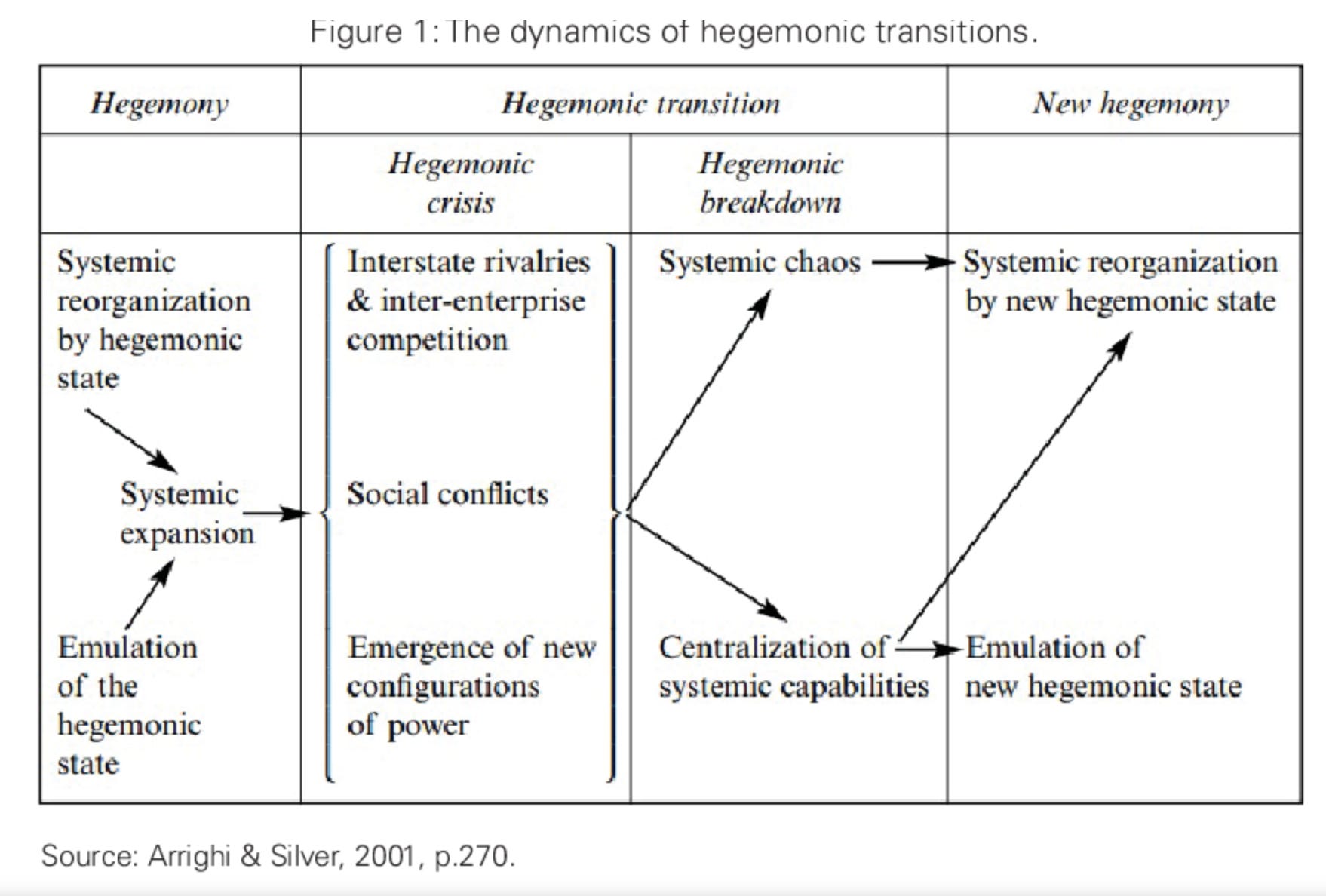
In the wake of the interwar crisis, analysts, taking inspiration from cyclical models of the development of capitalism, posited that hegemony was, if not a universal tendency, then certainly a recurring imperative of modern capitalism. To function well, the system needs a hegemon. Always! 

This was the thesis both of Kindleberger and Arrighi. 

The interwar crisis was the latest to result from a phase of hegemonic transition. In this case the baton dropped as it passed from the British Empire to the US.

There can be little doubt that a baton dropped. But what was at stake was not some ancient scepter of hegemonic power passed down from the Genoese to the Dutch, from them to the British and from there to the United States - the phrase is translatio imperii. 

That is of course an attractive idea for empire-builders, but its significance is as a piece of ideology rather than as an explanation. British power in the 19th century constituted the global condition, in Geyer and Bright’s terms, but it had precious little to do with hegemony as the US exercised it after 1945 - as instantiated in organizations like NATO and the European Community. Those were tools of order suited for an age of extremes. The problem of order is defined by the forces in play. The transhistoric notion of a hegemonic imperative fails to do justice to the explosive force of accumulation and state-formation unleashed from the middle of the nineteenth century i.e. the age of imperialism. To corral those forces, hegemony of a far more robust and intrusive kind was required. 

The British Empire did attempt to raise its game to match the challenges of the era. I take this to be the point of John Darwin’s indispensable Empire Project. But that radical new British ambition, to hold the global ring not at a distance, but through direct engagement of all the key players, suffered shipwreck in 1922 at Genoa. That was the moment, especially in comparison with the remarkable deal brokered at the naval conference in Washington, that America’s indispensability - in this conjuncture, at this moment - became undeniable. More on this to follow.


às dezembro 12, 2021 Nenhum comentário:
Enviar por e-mailPostar no blog!Compartilhar no XCompartilhar no FacebookCompartilhar com o Pinterest
Marcadores: Adam Tooze, Austrian Empire, autocracy, democracy, France, Great War, Imperial Germany, imperialism, liberalism, Russian czarism, Urkatastrophe

Um conceito hipócrita: "estabilidade estratégica" (na verdade, cada superpotência tentava assegurar sua preeminência) - H-Diplo

The National Security Archive: Strategic Stability and Instability during the Middle Years of the Cold War

by Malcolm Byrne
H-Diplo, December 12, 2021

"What an Insane Road We Are Both Following": Secretary of Defense Robert McNamara, June 1967

Neither Superpower Wanted to be in an “Inferior” Position and Both Sought Strategic Advantage

Edited by William Burr

Washington, D.C., December 10, 2021 –  As the United States engages in strategic stability talks with Russia and seeks similar talks with China, it is worth looking back to the origins of the concept and its early usage in the late 1950s and 1960s. Today, the National Security Archive posts selected White House and other high-level records that speak to “strategic stability’s” past – and continuing – impact on evaluations of new strategic systems and the risks of escalating the nuclear arms race.

The posting features documents, published for the first time by the National Security Archive, showing the earliest known usage of the term “strategic stability” in 1958.  Others published here first concern a notable December 1967 meeting in Moscow, when officially-connected U.S. and Soviet academics including Henry Kissinger and Paul Doty met to discuss arms control.   The U.S. participants shared their thinking about new strategic systems, fielded by both sides, that raised concerns about stability and first-strike risks.

One of the main voices in the debates over strategic stability in the 1960s was Defense Secretary Robert McNamara. During the Glassboro summit, McNamara had an exchange with Soviet Premier Alexei Kosygin about anti-ballistic missiles and the arms race in which he exclaimed: “What an insane road we are both following.”  Kosygin in reply complimented McNamara: “how well you speak.”

As contemporary leaders of the United States, Russia, and China face pressures of their own to ratchet up nuclear weapons levels, the issues and lessons revealed in internal discussions decades ago appear all the more salient.


H-Diplo Publication Schedule, 13 to 25 December

by Diane N. Labrosse

The H-Diplo publication schedule for the period 13 to 25 December is as follows:

Week of 13 December:

1. H-Diplo Roundtable Review of Victor McFarland. Oil Powers: A History of the U.S.-Saudi Alliance. New York: Columbia University Press, 2020. 

Introduction by Christopher Dietrich, Fordham University

Reviewers:

Gregory Brew, Texas National Security Review

Nathan J. Citino, Rice University 

Doug Little, Clark University

2. H-Diplo Essay Series on Learning the Scholar’s Craft: Reflections of Historians and International Relations Scholars.

Learning the Scholar’s Craft  

Essay by Sheila Fitzpatrick, Australian Catholic University (Melbourne), University of Sydney, and Professor Emerita, University of Chicago.

3. H-Diplo Article Review of Jeremy Friedman. “The Enemy of My Enemy: The Soviet Union, East Germany, and the Iranian Tudeh Party’s Support for Ayatollah Khomeini,” Journal of Cold War Studies 20:2 (2018): 3-37. 

Reviewed by Dmitry Asinovskiy, University of Amsterdam

4. H-Diplo Review of Abraham Denmark. U.S. Strategy in the Asian Century: Empowering Allies and Partners. New York: Columbia University Press, 2020.

Reviewed by Iain Henry, Australian National University

5. H-Diplo Article Review of Sheng Peng, “A ‘Gentleman’s Understanding’: British, French, and German Dual-Use Technology Transfer to China and America’s Dilemma during the Carter Administration, 1977-1981.” Diplomacy & Statecraft 32:1 (2021): 168-188. 

Reviewed by Jingdong Yuan, University of Sydney & Stockholm International Peace Research Institute

6. H-Diplo Review of Tanvi Madan, Fateful Triangle: How China Shaped U.S.-India Relations During the Cold War (Washington, D.C.: Brookings Institution, 2020).

Reviewed by Jayita Sarkar, Boston University

7. H-Diplo/ISSF Roundtable Review of Paul Avey. Tempting Fate: Why Nonnuclear States Confront Nuclear Opponents. Ithaca, NY: Cornell University Press, 2019.

Introduction by Lawrence Rubin, Georgia Institute of Technology

Reviewers:

Rebecca Davis Gibbons, University of Southern Maine

Kelly M. Greenhill, 2020-21 Leverhulme Trust Visiting Professor, SOAS

Jeffrey Kaplow, William & Mary 

Abigail S. Post, Anderson University

Week of 20 December:

1. H-Diplo Roundtable Review of Thea Riofrancos. Resource Radicals: From Petro-Nationalism to Post-Extractivism in Ecuador (Durham: Duke University Press, 2020).

Introduction by Murad Idris, University of Michigan

Reviewed by 

Alyssa Battistoni, Harvard University

Maxwell A. Cameron, The University of British Columbia

Lida Maxwell, Boston University

2. H-Diplo Essay Series on Learning the Scholar’s Craft: Reflections of Historians and International Relations Scholars.

Learning the Scholar’s Craft: Crossing into a Discipline

Danielle Fosler-Lussier, Ohio State University

3. H-Diplo Article Review of John Haynes and Harvey Klehr. “Framing William Albertson: The FBI”s ‘Solo’ Operation and the Cold War,” Journal of Cold War Studies. 22: 3 (Summer 2020): 63-85.

Reviewed by Jason Roberts, Quincy College

4. H-Diplo Article Review of Ingo Trauschweizer. “Berlin Commander. Maxwell Taylor and the Cold War’s frontlines, 1949-1951.” Cold War History 21:1 (2019)37-53. 

Reviewed by Armin Grünbacher, University of Birmingham

5.  H-Diplo Article Review of Ellen Gray, “Blind Loyalty? The Menzies Mission to Cairo during the 1956 Suez Canal Crisis. Diplomacy & Statecraft, 32:1 (June 2021): 86-113. 

Reviewed by Robert Bowker, Australian Ambassador to Egypt 2005-2008; Australian National University, Canberra, Australia

With best regards,

Diane Labrosse, H-Diplo managing editor


às dezembro 12, 2021 Nenhum comentário:
Enviar por e-mailPostar no blog!Compartilhar no XCompartilhar no FacebookCompartilhar com o Pinterest
Marcadores: Alexei Kosygin, China, Diane Labrosse, H-Diplo, Henry Kissinger, nuclear arms race, Soviet Union, strategic stability, USA, USSR

Uma nação à deriva - Paulo Roberto de Almeida

 Uma nação à deriva

Paulo Roberto de Almeida

Pintura de Rembrandt, por especial deferência do Guillermo Piernes.

Inacreditável o que acabo de ler no noticiário do dia: o Congresso quer aprovar imediatamente o Orçamento de 2022 para começar a gastar logo no início do ano as verbas aprovadas. O que eles estão programando CONTRA NÓS?

Aumento das emendas parlamentares de 7 para 16 bilhões, o maior aumento do Fundo Eleitoral de 2 para 5 bilhões (além da volta da propaganda “gratuita” em rádio e TV), e vários outros aumentos em seu favor.

E como fazer isso?

Ora, reduzindo as verbas dos ministérios e até gastos obrigatórios (constitucionais) como previdência e aposentadorias.

Ou seja, o ESTUPRO orçamentário continua de forma “legal”, e até mesmo “constitucionalizada”, por meio do CALOTE nas dívidas já judicializadas e, portanto, OBRIGATÓRIAS. 

O Brasil penetra numa terra de ninguém sancionada pelo estamento político patrimonialista e altamente CORRUPTO, da qual não se sabe quando sairá, talvez apenas ao cabo de uma longa e penosa DECADÊNCIA! 

Tudo isso às claras, aos olhos da cidadania ESTUPEFATA, e às vistas de elites econômicas absolutamente INERMES, e também de lideranças militares oportunistas (pois que obtidas por meio de ganhos exclusivos e vantagens pecuniárias ao longo dos últimos três anos), e que se mostraram CASTRADAS no seu senso de responsabilidade para com a nação.

O cenário que se desenha é praticamente o de uma ANOMIA governamental, dado o grau de inépcia total do dirigente máximo, que não dirige absolutamente NADA, pois está no modo SOBREVIVÊNCIA, sendo comandado como um autômato por líderes políticos totalmente comprometidos com o processo de EXTORSÃO que conduzem CONTRA A NAÇÃO!

Confesso minha revolta contra o espetáculo DEPRIMENTE a que assisto, totalmente consciente sobre o que isso significa de atraso IRREMEDIÁVEL para a vida da nação nesta, e talvez na próxima geração, sabendo que a ÚNICA arma de que disponho é este protesto solitário que só alcança os poucos leitores que por acaso me leem. 

E volto a me dar conta dos registros recentes que falam de DEZENAS DE MILHARES de brasileiros detidos na fronteira dos EUA e talvez de milhares de outros detentores de capital e de capacidade que estão se expatriando legalmente de um país que já não mais oferece segurança de um futuro decente para eles e para seus filhos.

O Brasil é um país SEM FUTURO? 

É o que pretendo tratar no meu próximo “clássico revisitado”, uma reescritura de um dos livros menos felizes de Stefan Zweig, 80 anos depois de seu suicídio, deprimido que estava por um outro “suicídio”, o da sua Europa, do Mundo de Ontem, as memórias que ele terminou de escrever no seu refúgio de Petrópolis.

Colocou o ponto final, escreveu uma Declaração e se despediu dos amigos e da vida. Morte no “paraíso”, como escreveu Alberto Dines na sua genial biografia.

Não corro esse risco, mas o que vejo é uma nação cometendo suicídio consigo mesma.

Paulo Roberto de Almeida

Brasília, 12/12/2021

às dezembro 12, 2021 Nenhum comentário:
Enviar por e-mailPostar no blog!Compartilhar no XCompartilhar no FacebookCompartilhar com o Pinterest
Marcadores: Brasil, nação à deriva, textos de Paulo Roberto de Almeida
Postagens mais recentes Postagens mais antigas Página inicial
Assinar: Comentários (Atom)

Postagem em destaque

Livro Marxismo e Socialismo finalmente disponível - Paulo Roberto de Almeida

Meu mais recente livro – que não tem nada a ver com o governo atual ou com sua diplomacia esquizofrênica, já vou logo avisando – ficou final...

  • 673) A formacao e a carreira do diplomata
    Uma preparação de longo curso e uma vida nômade Paulo Roberto de Almeida A carreira diplomática tem atraído número crescente de jovens, em ...
  • 561) Informações sobre a carreira diplomatica, III: desoficiosas...
    FAQ do Candidato a Diplomata por Renato Domith Godinho TEMAS: Concurso do Instituto Rio Branco, Itamaraty, Carreira Diplomática, MRE, Diplom...
  • Países de Maior Acesso aos textos PRA em Academia.edu - Paulo Roberto de Almeida
    Países de Maior Acesso aos textos PRA em Academia.edu (apenas os superiores a 100 acessos) Compilação Paulo Roberto de Almeida (15/12/2025) ...
  • Mercado Comum da Guerra? Acordo Militar EUA-Paraguai
    Mercado Comum da Guerra? O Mercosul deveria ser, em princípio, uma zona de livre comércio e também uma zona de paz, entre seus próprios memb...
  • Um prefácio meu sobre um livro de Dennys Xavier apresentando a obra de Thomas Sowell (2020) - Paulo Roberto de Almeida
    Reproduzo novamente uma postagem minha de 2020, quando foi publicado o livro de Dennys Xavier sobre Thomas Sowell   quarta-feira, 4 de março...
  • 'Memórias', do embaixador Marcos Azambuja, é uma aula de diplomacia - Elio Gaspari (FSP)
      Itamaraty   'Memórias', do embaixador Marcos Azambuja, é uma aula de diplomacia Embaixador foi um grande contador de histórias, ...
  • Israel Products in India: A complete list
      Israel Products in India: Check the Complete list of Israeli Brands! Several Israeli companies have established themselves in the Indian m...
  • Conversando com os Brics? Talvez, mas sem deixar de pensar… - Paulo Roberto de Almeida
     O Brics vai de vento em popa, ao que parece. Como eu nunca fui de tomar as coisas pelo seu valor de face, nunca deixei de expressar meu pen...
  • Pequeno manual prático da decadência (recomendável em caráter preventivo...) - Paulo Roberto de Almeida
    Pequeno manual prático da decadência (recomendável em caráter preventivo...)   Paulo Roberto de Almeida Colaboração a número especial da rev...

O que é este blog?

Este blog trata basicamente de ideias, se possível inteligentes, para pessoas inteligentes. Ele também se ocupa de ideias aplicadas à política, em especial à política econômica. Ele constitui uma tentativa de manter um pensamento crítico e independente sobre livros, sobre questões culturais em geral, focando numa discussão bem informada sobre temas de relações internacionais e de política externa do Brasil. Meus livros podem ser vistos nas páginas da Amazon. Outras opiniões rápidas podem ser encontradas no Facebook ou no Threads. Grande parte de meus ensaios e artigos, inclusive livros inteiros, estão disponíveis em Academia.edu: https://unb.academia.edu/PauloRobertodeAlmeida

Site pessoal: www.pralmeida.net.

Pesquisar este blog

Quem sou eu: Paulo Roberto de Almeida

Minha foto
Paulo Roberto de Almeida
Brasília, DF, Brazil
Ver meu perfil completo

Últimas Postagens:

  • ▼  2025 (1526)
    • ▼  dezembro (111)
      • Textos sobre guerra e paz, numa perspectiva histór...
      • "No One is Safe" Ukraine Strikes Putin's Palace as...
      • “A Paz como Projeto e Potência”, 4º seminário do C...
      • Madame Inteligência Artificial me corrige mais uma...
      • A paz como projeto e potência, com André Magnelli ...
      • Do que o chanceler acidental escapou: "1ª Turma do...
      • Quando a desgraça é bem-vinda… - Paulo Roberto de ...
      • The Berlin Leaders' Statement on Ukraine (December...
      • Book by Dani Rodrik: "Shared Prosperity in a Fract...
      • Efeitos a longo prazo do colonialismo português na...
      • Política externa e diplomacia do Brasil: convergê...
      • UM GRITO PELA DEMOCRACIA!, Manifesto pela Democrac...
      • Trabalhos selecionados sobre temas de paz e segura...
      • O quadro da produtividade latino-americana - Estud...
      • Las nuevas ultraderechas conservadoras y reacciona...
      • Conversando com os Brics? Talvez, mas sem deixar d...
      • Como diplomata, confesso que tenho vergonha da pol...
      • Uma paz não kantiana?: Sobre a paz e a guerra na e...
      • Mercado Comum da Guerra? Acordo Militar EUA-Paraguai
      • RECHERCHES INTERNATIONALES, FISSURES DANS L’ATLANT...
      • A Paz como Projeto e Potência! - Ciclo de Humanida...
      • Uma paz não-kantiana? Sobre a paz e a guerra na er...
      • FORÇA, MINISTRO FACHIN EDITORIAL DO ESTADÃO, 15/1...
      • Países que mais acessaram os trabalhos PRA em Aca...
      • Países de Maior Acesso aos textos PRA em Academia....
      • A luta contra a corrupção na China: algo como os 1...
      • O Decálogo dos Cansados - Restaurante Pecorino, Br...
      • O grande historiador do totalitarismo assassino do...
      • Um prefácio meu sobre um livro de Dennys Xavier ap...
      • Um debate sobre a política externa brasileira a pr...
      • O filósofo francês Pascal Bruckner recebe o prêmio...
      • Ucrânia encontrou tesouro contra a Rússia no lugar...
      • 'Memórias', do embaixador Marcos Azambuja, é uma a...
      • Com disputa entre Poderes, Brasil vive baderna ins...
      • The speed of the Russian offensive in Ukraine is t...
      • Russia Burns, under Kyiv missiles and drones - The...
      • A nova Questão Alemã, submetida à Madame Inteligên...
      • O fim e o começo de uma época: outra vez a Alemanh...
      • A inteligência da Ucrânia contra a violência estúp...
      • Conversas sobre os Brics? - Coord. emb. José Vicen...
      • Numéro special de Recherches internationales, cons...
      • A New Cold War? Worse than that - McFaul
      • George Orwell on Nationalism (1945)
      • La tradición liberal venezolana Gabriela Calderón ...
      • O pequeno manual prática da decadência, examinado ...
      • Pequeno manual prático da decadência (recomendável...
      • Pequeno manual prático da decadência (recomendável...
      • Rato de Biblioteca: memórias intelectuais de um di...
      • Putin Eradicates Officials as FSB CANNIBALIZES Kre...
      • Trump: the end of Freedom in the U.S. and the Betr...
      • A estratégia de Trump para o ‘quintal’ do Hemisfér...
      • Vergonha diplomática: governo Lula se recusa a con...
      • A resistência intelectual contra o bolsonarismo di...
      • CREDN repudia abstenção do Brasil sobre devolução ...
      • Minha luta contra o bolsonarismo diplomático conti...
      • Trabalhos mais acessados PRA em Academia.edu (acim...
      • “A Diplomacia Brasileira na Elaboração do Direito ...
      • Política Externa e interesse nacional: três versõe...
      • A internacional dos poderes totalitários no mundo:...
      • Simplifique, simplifique, fica melhor! Nem sempre…...
      • A Europa unida em face da dominação de dois grande...
      • Ironias da história de vida do chanceler acidental...
      • Ucrânia: tempos decisivos numa guerra que não term...
      • A estratégia dos EUA e a Doutrina Monroe - Rubens ...
      • A “doutrina Trump” e o Brasil - Paulo Roberto de A...
      • New Strategic Security Trumpian doctrine and the S...
      • The National Security Strategy of the Trump Admini...
      • Doutrina Trump e a nova desordem global Editorial...
      • Brazilian Foreign Policy beyond Itamaraty’s Insula...
      • ¿Giro a la (extrema) derecha en América latina? - ...
      • O marxismo confuciano de Xi Jinping - Xulio Rios (...
      • Integração Regional e as perspectivas do Mercosul ...
      • A Short History on a K-like style - PRA, seguido d...
      • A Paz como Projeto e Potência - Paulo Roberto de A...
      • “Shame on America”, from Prime Minister of Poland ...
      • Banks of China in Brazil and Brazilian Banks The c...
      • A Short History on a K-like style - By PRA (adora ...
      • Putin deveria ter aceitado o acordo de Trump. Agor...
      • Correspondência secreta de Putin a Trump neste sáb...
      • Could Brazil’s mega-election herald the end of pol...
      • Minas e as formigas - Ary Quintella, sobre o livro...
      • Opinion - Sadly, Trump is right on Ukraine - Alan ...
      • Russia’s Reign of Terror: The Five Worst Atrocitie...
      • O mundo em três tempos: 1925, 1945 e 2025 – Paulo ...
      • O multilateralismo vazio da diplomacia brasileira,...
      • Bertrand Arnaud: avaliação sumária da Estratégia d...
      • A estratégia de Trump para o Hemisfério Ocidental ...
      • Trabalhos publicados por Paulo Roberto de Almeida ...
      • Uma estratégia destinada ao fracasso: a de Trump p...
      • Trajetórias quase Toynbeeanas - Paulo Roberto de A...
      • Trump está recuando os EUA cem anos atrás com sua ...
      • November: more than 81,000 Russian targets DESTROY...
      • Minhas impressões sobre Paulo Guedes e Olavo de Ca...
      • A. Western Hemisphere: The Trump Corollary to the ...
      • O mundo em três tempos: 1925, 1945, 2025 - Paulo R...
      • Revista Será?, o melhor semanário da imprensa inov...
      • Diplomacia telefônica - Rubens Barbosa (Editorial ...
      • ONU: Brasil se abstém sobre volta de crianças sequ...
      • Mini-história das crises políticas no Brasil - Pa...
      • THE END OF THE WAR IN UKRAINE - Jason Smart (UATV)
    • ►  novembro (120)
    • ►  outubro (107)
    • ►  setembro (105)
    • ►  agosto (107)
    • ►  julho (150)
    • ►  junho (87)
    • ►  maio (144)
    • ►  abril (159)
    • ►  março (168)
    • ►  fevereiro (134)
    • ►  janeiro (134)
  • ►  2024 (1681)
    • ►  dezembro (106)
    • ►  novembro (154)
    • ►  outubro (93)
    • ►  setembro (126)
    • ►  agosto (128)
    • ►  julho (103)
    • ►  junho (178)
    • ►  maio (172)
    • ►  abril (186)
    • ►  março (184)
    • ►  fevereiro (132)
    • ►  janeiro (119)
  • ►  2023 (1268)
    • ►  dezembro (119)
    • ►  novembro (92)
    • ►  outubro (89)
    • ►  setembro (105)
    • ►  agosto (93)
    • ►  julho (92)
    • ►  junho (97)
    • ►  maio (118)
    • ►  abril (139)
    • ►  março (119)
    • ►  fevereiro (96)
    • ►  janeiro (109)
  • ►  2022 (1317)
    • ►  dezembro (107)
    • ►  novembro (104)
    • ►  outubro (121)
    • ►  setembro (94)
    • ►  agosto (119)
    • ►  julho (121)
    • ►  junho (132)
    • ►  maio (104)
    • ►  abril (100)
    • ►  março (122)
    • ►  fevereiro (116)
    • ►  janeiro (77)
  • ►  2021 (1250)
    • ►  dezembro (106)
    • ►  novembro (107)
    • ►  outubro (75)
    • ►  setembro (85)
    • ►  agosto (76)
    • ►  julho (88)
    • ►  junho (96)
    • ►  maio (134)
    • ►  abril (139)
    • ►  março (116)
    • ►  fevereiro (87)
    • ►  janeiro (141)
  • ►  2020 (1711)
    • ►  dezembro (162)
    • ►  novembro (165)
    • ►  outubro (147)
    • ►  setembro (128)
    • ►  agosto (129)
    • ►  julho (101)
    • ►  junho (141)
    • ►  maio (171)
    • ►  abril (148)
    • ►  março (138)
    • ►  fevereiro (150)
    • ►  janeiro (131)
  • ►  2019 (1624)
    • ►  dezembro (123)
    • ►  novembro (107)
    • ►  outubro (124)
    • ►  setembro (90)
    • ►  agosto (147)
    • ►  julho (129)
    • ►  junho (176)
    • ►  maio (125)
    • ►  abril (138)
    • ►  março (189)
    • ►  fevereiro (134)
    • ►  janeiro (142)
  • ►  2018 (1134)
    • ►  dezembro (126)
    • ►  novembro (111)
    • ►  outubro (101)
    • ►  setembro (104)
    • ►  agosto (91)
    • ►  julho (102)
    • ►  junho (77)
    • ►  maio (88)
    • ►  abril (80)
    • ►  março (100)
    • ►  fevereiro (89)
    • ►  janeiro (65)
  • ►  2017 (937)
    • ►  dezembro (79)
    • ►  novembro (94)
    • ►  outubro (118)
    • ►  setembro (93)
    • ►  agosto (127)
    • ►  julho (77)
    • ►  junho (52)
    • ►  maio (71)
    • ►  abril (59)
    • ►  março (58)
    • ►  fevereiro (52)
    • ►  janeiro (57)
  • ►  2016 (1203)
    • ►  dezembro (76)
    • ►  novembro (64)
    • ►  outubro (111)
    • ►  setembro (105)
    • ►  agosto (109)
    • ►  julho (88)
    • ►  junho (108)
    • ►  maio (120)
    • ►  abril (123)
    • ►  março (109)
    • ►  fevereiro (86)
    • ►  janeiro (104)
  • ►  2015 (1479)
    • ►  dezembro (118)
    • ►  novembro (93)
    • ►  outubro (132)
    • ►  setembro (114)
    • ►  agosto (107)
    • ►  julho (110)
    • ►  junho (81)
    • ►  maio (103)
    • ►  abril (136)
    • ►  março (147)
    • ►  fevereiro (194)
    • ►  janeiro (144)
  • ►  2014 (3131)
    • ►  dezembro (146)
    • ►  novembro (144)
    • ►  outubro (266)
    • ►  setembro (234)
    • ►  agosto (231)
    • ►  julho (287)
    • ►  junho (339)
    • ►  maio (337)
    • ►  abril (234)
    • ►  março (308)
    • ►  fevereiro (256)
    • ►  janeiro (349)
  • ►  2013 (3297)
    • ►  dezembro (337)
    • ►  novembro (189)
    • ►  outubro (231)
    • ►  setembro (296)
    • ►  agosto (330)
    • ►  julho (322)
    • ►  junho (351)
    • ►  maio (324)
    • ►  abril (293)
    • ►  março (204)
    • ►  fevereiro (282)
    • ►  janeiro (138)
  • ►  2012 (2221)
    • ►  dezembro (186)
    • ►  novembro (162)
    • ►  outubro (152)
    • ►  setembro (172)
    • ►  agosto (174)
    • ►  julho (183)
    • ►  junho (151)
    • ►  maio (170)
    • ►  abril (217)
    • ►  março (205)
    • ►  fevereiro (226)
    • ►  janeiro (223)
  • ►  2011 (2416)
    • ►  dezembro (232)
    • ►  novembro (195)
    • ►  outubro (250)
    • ►  setembro (261)
    • ►  agosto (212)
    • ►  julho (196)
    • ►  junho (188)
    • ►  maio (230)
    • ►  abril (181)
    • ►  março (137)
    • ►  fevereiro (168)
    • ►  janeiro (166)
  • ►  2010 (2336)
    • ►  dezembro (149)
    • ►  novembro (148)
    • ►  outubro (196)
    • ►  setembro (240)
    • ►  agosto (270)
    • ►  julho (235)
    • ►  junho (215)
    • ►  maio (262)
    • ►  abril (189)
    • ►  março (98)
    • ►  fevereiro (152)
    • ►  janeiro (182)
  • ►  2009 (648)
    • ►  dezembro (80)
    • ►  novembro (88)
    • ►  outubro (65)
    • ►  setembro (70)
    • ►  agosto (82)
    • ►  julho (69)
    • ►  junho (53)
    • ►  maio (40)
    • ►  abril (37)
    • ►  março (22)
    • ►  fevereiro (11)
    • ►  janeiro (31)
  • ►  2008 (162)
    • ►  dezembro (33)
    • ►  novembro (19)
    • ►  outubro (12)
    • ►  setembro (6)
    • ►  agosto (6)
    • ►  julho (9)
    • ►  junho (25)
    • ►  maio (11)
    • ►  abril (7)
    • ►  março (10)
    • ►  fevereiro (10)
    • ►  janeiro (14)
  • ►  2007 (146)
    • ►  dezembro (11)
    • ►  novembro (19)
    • ►  outubro (18)
    • ►  setembro (6)
    • ►  agosto (12)
    • ►  julho (8)
    • ►  junho (22)
    • ►  maio (4)
    • ►  abril (9)
    • ►  março (7)
    • ►  fevereiro (17)
    • ►  janeiro (13)
  • ►  2006 (193)
    • ►  dezembro (38)
    • ►  novembro (9)
    • ►  outubro (7)
    • ►  setembro (10)
    • ►  agosto (9)
    • ►  julho (67)
    • ►  junho (53)

Vidas Paralelas (2025)

Vidas Paralelas (2025)
Rubens Ricupero e Celso Lafer nas relações internacionais do Brasil

Intelectuais na Diplomacia Brasileira

Intelectuais na Diplomacia Brasileira
a cultura a serviço da nação

Construtores da nação

Construtores da nação
Projetos para o Brasil, de Cairu a Merquior

Apogeu e demolição da política externa

Apogeu e demolição da política externa
Itinerários da diplomacia brasileira

O Itamaraty Sequestrado

O Itamaraty Sequestrado
a destruição da diplomacia pelo bolsolavismo, 2018-2021

A ordem econômica mundial

A ordem econômica mundial
e a América Latina (2020)

Miséria da diplomacia (2019)

Miséria da diplomacia (2019)
A destruição da inteligência no Itamaraty

Contra a Corrente: ensaios contrarianistas

Contra a Corrente: ensaios contrarianistas
A grande Ilusão do BRICS e o universo paralelo da diplomacia brasileira (2022)

O Homem que Pensou o Brasil

O Homem que Pensou o Brasil
Roberto Campos: trajetória intelectual

Formação da Diplomacia Econômica no Brasil

Formação da Diplomacia Econômica no Brasil
as relações econômicas internacionais no Império

Pesquisar este blog

Obras do autor:

Manifesto Globalista
Plataforma Academia.edu
Nunca Antes na Diplomacia...
Prata da Casa: os livros dos diplomatas
Volta ao Mundo em 25 Ensaios
Paralelos com o Meridiano 47
O Panorama visto em Mundorama
Rompendo Fronteiras
Codex Diplomaticus Brasiliensis
Polindo a Prata da Casa
Livros individuais PRA
Livros editados por PRA
Colaboração a livros coletivos
Capítulos de livros publicados
Teses e dissertações
Artigos em periódicos
Resenhas de livros
Colaborações regulares
Videos no YouTube

Paulo Roberto e Carmen Lícia

Paulo Roberto e Carmen Lícia
No festival de cinema de Gramado, 2016

PRA on Academia.edu

  • PRA on Academia.edu

PRA on Research Gate

  • Paulo Roberto de Almeida on ResearchGate

Works PRA

  • Carreira na diplomacia
  • Iluminuras: minha vida com os livros
  • Manifesto Globalista
  • Sun Tzu para Diplomatas: uma estratégia
  • Entrevista ao Brasil Paralelo
  • Dez grandes derrotados da nossa história
  • Dez obras para entender o Brasil
  • O lulopetismo diplomático
  • Teoria geral do lulopetismo
  • The Great Destruction in Brazil
  • Lista de trabalhos originais
  • Lista de trabalhos publicados
  • Paulo Roberto de Almeida
  • Works in English, French, Spanish

Outros blogs do autor

  • Eleições presidenciais 2018
  • Academia
  • Blog PRA
  • Book Reviews
  • Cousas Diplomaticas
  • DiplomataZ
  • Diplomatizando
  • Diplomatizzando
  • Eleições presidenciais 2006
  • Eleições presidenciais 2010
  • Meu primeiro blog
  • Meu segundo blog
  • Meu terceiro blog
  • Shanghai Express
  • Textos selecionados
  • Vivendo com os livros

Total de visualizações de página

Inscrever-se

Postagens
Atom
Postagens
Comentários
Atom
Comentários

Détente...

Détente...
Carmen Lícia e Paulo Roberto

Links

  • O Antagonista
  • Academia.edu/PRA
  • Mercado Popular
  • Mão Visivel
  • De Gustibus Non Est Disputandum
  • Mansueto Almeida
  • Orlando Tambosi - SC
  • Carmen Lícia Palazzo - Site
  • Carmen Licia Blogspot
  • Foreign Policy
  • Instituto Millenium
  • O Estado de Sao Paulo

Uma reflexão...

Recomendações aos cientistas, Karl Popper:
Extratos (adaptados) de Ciência: problemas, objetivos e responsabilidades (Popper falando a biólogos, em 1963, em plena Guerra Fria):
"A tarefa mais importante de um cientista é certamente contribuir para o avanço de sua área de conhecimento. A segunda tarefa mais importante é escapar da visão estreita de uma especialização excessiva, interessando-se ativamente por outros campos em busca do aperfeiçoamento pelo saber que é a missão cultural da ciência. A terceira tarefa é estender aos demais a compreensão de seus conhecimentos, reduzindo ao mínimo o jargão científico, do qual muitos de nós temos orgulho. Um orgulho desse tipo é compreensível. Mas ele é um erro. Deveria ser nosso orgulho ensinar a nós mesmos, da melhor forma possível, a sempre falar tão simplesmente, claramente e despretensiosamente quanto possível, evitando como uma praga a sugestão de que estamos de posse de um conhecimento que é muito profundo para ser expresso de maneira clara e simples.
Esta, é, eu acredito, uma das maiores e mais urgentes responsabilidades sociais dos cientistas. Talvez a maior. Porque esta tarefa está intimamente ligada à sobrevivência da sociedade aberta e da democracia.
Uma sociedade aberta (isto é, uma sociedade baseada na idéia de não apenas tolerar opiniões dissidentes mas de respeitá-las) e uma democracia (isto é, uma forma de governo devotado à proteção de uma sociedade aberta) não podem florescer se a ciência torna-se a propriedade exclusiva de um conjunto fechado de cientistas.
Eu acredito que o hábito de sempre declarar tão claramente quanto possível nosso problema, assim como o estado atual de discussão desse problema, faria muito em favor da tarefa importante de fazer a ciência -- isto é, as idéias científicas -- ser melhor e mais amplamente compreendida."

Karl R. Popper: The Myth of the Framework (in defence of science and rationality). Edited by M. A. Notturno. (London: Routledge, 1994), p. 109.

Uma recomendação...

Hayek recomenda aos mais jovens:
“Por favor, não se tornem hayekianos, pois cheguei à conclusão que os keynesianos são muito piores que Keynes e os marxistas bem piores que Marx”.
(Recomendação feita a jovens estudantes de economia, admiradores de sua obra, num jantar em Londres, em 1985)

ShareThis

Livros, livros e mais livros

Livros, livros e mais livros
My favorite hobby...

Academia.edu

Follow me on Academia.edu
Powered By Blogger
Paulo Roberto de Almeida. Tema Simples. Tecnologia do Blogger.