Temas de relações internacionais, de política externa e de diplomacia brasileira, com ênfase em políticas econômicas, viagens, livros e cultura em geral. Um quilombo de resistência intelectual em defesa da racionalidade, da inteligência e das liberdades democráticas. Ver também minha página: www.pralmeida.net (em construção).
A guerra de agressão deslanchada pelo tirano de Moscou pode, realmente, mudar alguns parâmetros das relações internacionais, mas num sentido TOTALMENTE CONTRÁRIO ao que Putin pretendia ao ínício de sua última aventura militar (a anterior foi a invasão da Criméia e a intervenção nas províncias orientais da Ucrânia). Pode reforçar a união das democracias e colocar na agenda internacional o absurdo do direito de veto.
Paulo Roberto de Almeida
Five ways Ukraine’s partners can defeat Putin and shape the future 
Here are five crucial challenges Ukraine and its global partners and allies must tackle as Russian President Vladimir Putin’s criminal war approaches its most decisive phase.
Some are short-term, while others have generational consequences. But all five are necessary to transform Putin’s murderous authoritarian threat into a historic opportunity for the civilized world to shape a better future.
Can Ukraine’s friends—particularly those in Europe and North America—not only maintain, but also strengthen, their unity and solidarity in the face of Putin’s growing brutality? With global energy prices and inflation rising, can they avoid the inevitable fatigue among democracies and remain focused on what seems a far-away threat?
Can NATO overcome Turkish President Recep Tayyip Erdogan’s opposition—and potentially that of others—to the imminent Finnish and Swedish application for membership? Can it provide Finland and Sweden protective status until they are full members, and accelerate the accession process? Can the US Senate ratify Finnish and Swedish NATO membership before its summer break, creating the crucial momentum?
Can Ukraine and its friends do more to establish the factually correct narrative that Putin is solely responsible for this premeditated and unprovoked war? Can they reach the Russian people more effectively so that they better understand that their president launched a war in their name that was not in their interests?
Finally, can the United States and its allies and partners strategically defeat Putin and sufficiently weaken Russian military capability so that Moscow is unable to continue the war or repeat something similar elsewhere? Can NATO and its global partners strengthen themselves enough so that they more effectively deter this sort of threat in the future?
That’s a long list—and it’s only the beginning.
The bottom line is that unanticipated Ukrainian resilience, resourcefulness, patriotism, and bravery have provided the free world an opportunity not only to save Ukraine, but also to reverse years of democratic drift and authoritarian resurgence.
If the democratic world is to avoid the rule of the jungle replacing the rule of law, now is the time to act.
It will be as important in the years ahead that the transatlantic community embrace Russia and Russians as part of US President George H.W. Bush’s dream of a Europe “whole and free.” Policymakers should already be designing how to make that happen. In the meantime, however, Ukraine’s friends must quell Putin’s revanchist, historically perverted obsession with restoring some false notion of “ancient Rus” through whatever means necessary.
The past week underscored positive momentum toward this end.
On Sunday, Finnish President Sauli Niinisto and Prime Minister Sanna Marin jointly announced that their country would apply for Alliance membership. “This is a historic day,” Niinisto said. “A new era begins.”
For those misguided voices who still argue that NATO membership destabilizes rather than secures a more peaceful Europe, talk to officials in these two countries—who have watched the three Baltic members of NATO remain secure while Russia overran Ukraine, a non-NATO member.
Erdogan represents the greatest opposition thus far to Sweden and Finnish membership, based on what Turkey says is Sweden’s long-standing sheltering of Kurdish terrorists. Yet his language suggests this is more of a negotiating ploy than an immovable object: “At the moment, we are following the developments regarding Sweden and Finland, but we don’t hold positive views,” he said.
Not only has Putin’s war failed to take Ukraine, but it has also prompted global shifts that go far beyond Finland and Sweden.
Upon receiving a Distinguished Leadership Award from the Atlantic Council on May 11, Italian Prime Minister Mario Draghi said Russia’s invasion of Ukraine has caused “a paradigm shift in geopolitics.”
Added Draghi: “It has strengthened the ties between the European Union and the United States, isolated Moscow, raised deep questions for China. These changes are still ongoing, but one thing is certain: They are bound to stay with us for a long, long time.”
“We must continue to support the bravery of the Ukrainians as they fight for their freedom and for the security of us all,” he said. There should be peace, he argued, but added that “[i]t will be up to Ukrainians to decide the terms of this peace, and no one else.”
The threats of historic nature have been clear since Putin began assembling his troops last year for the February 24 attack. Now, Draghi argued, the opportunities are clearer.
“The war in Ukraine has the potential to bring the European Union even closer together,” he said. “We must remember the urgency of the moment, the magnitude of the challenge. This is Europe’s hour and we must seize it. The choices the European faces are brutally simple. We can be masters of our own destiny or slaves to the decisions of others.”
What makes Draghi optimistic is that Europe isn’t tackling this alone, but is strengthened by the “timeless bond” of transatlantic relations.
The test now is whether the current unity and momentum of Ukraine’s friends can withstand Putin’s escalating brutality and their own fatigue.
Between the heroism of Ukraine’s defenders and his own wild miscalculations of Russia’s military ability, Putin’s attempt to create a propaganda narrative to justify his invasion of Ukraine has largely collapsed. That has left Putin only World War II mythmaking to fall back on—and Applebaum illustrates how even that is based on lies.
“In practice, Putinism is a powerful but ultimately empty ideology,” she writes. “Its propaganda divides people from one another, creates suspicion, and promotes apathy. State media put forth multiple nonsensical explanations for reality, including multiple nonsensical reasons for the invasion of Ukraine. In different tellings, Ukraine, a democratic state led by a Jewish president, is ‘Nazi,’ is Russian, is a Western puppet, is nonexistent. Alongside these stories, Russians are spoon-fed cynicism, mockery, and nihilism.”
Applebaum continues: “If he wants to expand the current conflict—if he wants to persuade millions of people to sacrifice their lives and their fortunes to fight across Europe once again—he will need to provide a far more powerful motivation, a far deeper reason to fight, something other than this war’s alleged resemblance to a past tragedy.” Read more →
In Foreign Affairs, Alexander Vindman explains why the United States must push for a peace settlement that not only holds off Russia—but defeats it.
“As it stands,” he writes, “the United States has missed one opportunity after the other to help precipitate a decisive Ukrainian victory and stop Russia from making gains in the Donbas. Instead of foreclosing the possibility of a Russian success, Washington’s strategy of metering incremental military aid to Ukraine—based on a flawed assessment of the risk of escalation and the potential consequences of a Russian defeat—has provided Moscow with the time and space to continue its war, even as it now shifts to defending the territory it has seized since February 24.” Read more →
The Atlantic Council honored the Ukrainian people as a whole this week with a Distinguished Leadership Award for their heroism in the fight against Russia’s invasion. As President Volodymyr Zelenskyy said in his remarks, “[W]e must say and remember that behind the courage and wisdom of our people, there are thousands of real stories, names, and heroic feats.”
To understand the individual stories of their heroism more deeply, read Luke Mogelson’s New Yorker narrative.
One such story is that of a violinist who volunteered for the Ukrainian military in 2014 after a policeman broke her hand during a political protest. Another tracks the life of an eighty-four-year-old woman with, Mogelson wrote, “shrapnel wounds to her groin and abdomen. She did not cry out. When a medic commented on her grit, the woman said that she had also survived the Second World War.” Read more →
To more deeply understand how President Xi Jinping’s leadership has damaged the Chinese economy, read this smart analysis by former Australian Prime Minister Kevin Rudd, one of the leading China experts writing today.
As Xi hurtles toward what he hopes will be his inevitable reelection as China’s leader later this year, Rudd writes: “Recent economic assessments have predicted a sharply slowing Chinese growth trajectory, to around 3% by 2030 and 2% by 2050. If this proves to be the case and Mr. Xi doesn’t radically change course, the global strategic and economic significance will be profound. China would cease being the world’s growth engine. It may not surpass the U.S. as the world’s largest economy by decade’s end after all—and if it does, it won’t be by much.”
Yet although China’s economic woes are of Xi’s own making, don’t expect him to admit that: As Rudd notes, the only way to a better economic future is for the leader to change course. “But given his Marxist-Leninist ideological predilections, that will be hard,” Rudd concludes. Read more →
The Atlantic Council on Wednesday held its Distinguished Leadership Awards dinner, an annual salute to individuals whose leadership contributes to a better world. Atop the list of recipients this year were Italian Prime Minister Mario Draghi and, for the first time, an entire nation: the people of Ukraine.
The acceptance speeches by Draghi and Zelenskyy are worth reading for the insight they provide into our historic moment and the bravery and resilience of the Ukrainian people.
“This is Europe’s hour and we must seize it,” Draghi said. “The choices the European faces are brutally simple. We can be masters of our own destiny or slaves to the decisions of others.”
Zelenskyy, meanwhile, said: “Do not be afraid and come to Ukraine. Hear thousands of similar stories about us, Ukrainians. Look into their brave eyes, shake their strong hands, and you will see that they are doing all this not for glory, that they need not only awards, but also concrete help and support. Weapons, equipment, financial support, sanctions on Russia, and the most important: the feeling that in this difficult struggle, they are not alone, that they are supported by you, by the whole world—free states and free nations of our planet.” Read more →
Russia may be getting whacked hard in Ukraine, but Putin has the Western world exactly where he wants it.
Am I set to receive a swarm of comments insisting that I’m either a Putin or NATO stooge? Most likely! Information war is like that. :)
But remember: war is not sport.
Which side you root for is irrelevant. It’s the people who bleed that determine the outcome, and what the fighters across Ukraine are trying to tell the rest of the world is that they still need a lot of help.
Putin’s non-announcement on Victory Day was telling. Most analysts expected he would either declare victory or total war, the latter allowing for a more substantial mobilization across Russia.
In the end, neither happened. Putin has reverted to being cagey — the clearest sign yet a long war in Ukraine was always fine with him.
In fact, I’m now certain this is exactly what he wanted. Sure he’d have preferred to seize the country without a fight. But the failure of the gut punch into Kyiv at the start of the war did not deter him. Nor have arms shipments to Ukraine.
The hard truth is that Putin started this war for the sake of having one. When countries go to war, leaders and rich people benefit while regular people die. This never changes.
Despite all the hot air on CNN, Putin is never going to be put on trial any more than Bush was after dragging America into Iraq. He’s not going to fall to a coup or revolution unless the world figures out how to separate him from regular Russian people. The best case outcome is Russia’s final breakup, and the worst is a global nuclear conflagration.
This does not mean that Ukraine should sit down and accept Putin’s terms. Far from it.
Ukraine is the closest thing to a good guy in this fight, cruelly used as a pawn both by Putin and NATO.
It doesn’t matter how many times Biden or Johnson blear that NATO has nothing to do with Ukraine — it most certainly does. Had Ukraine not flirted with NATO membership Russia would never have attacked, and the fact NATO didn’t let Ukraine in set Kyiv up for a fall.
Everyone seems to forget that American and Russian intelligence thought Ukraine would go down in days.
Ukraine’s defenders proved them all wrong — Героям слава!
Ukraine holds the sacred right of vengeance. For its unconscionable crimes in Ukraine, Russia deserves to be destroyed — forever. Just like America deserves harsh justice for the utterly criminal War on Terror.
But the hard truth NATO trolls won’t admit is that Russia is bloodied but unbowed. Putin is winning at the strategic levelbecause America and Britain are letting him.
They are and have been using Ukraine for domestic political benefit, Biden trying to deflect from the fact he’s less popular than Trump right now and Johnson fighting to avoid criminal charges over his failure to follow his own government’s Covid rules.
The military debacle around Kyiv has been a massive distraction from what was always the heart of the war — Donbas. Why is it key? Because you win a war by destroying your opponent’s ability to resist.
Not through occupation or regime change alone, but the destruction of opposing forces capable of fighting back. Russia’s FSB forgot this critical lesson in planning the knife thrust into Kyiv that could only have worked if the Zelensky government didn’t bother to fight.
Unfortunately for Ukraine the regular Russian military has not, which is why their operations in the south have been more careful, deliberate, and generally successful. Kyiv has lost control over a huge chunk of its territory there and what counteroffensives it has launched have made only slow progress.
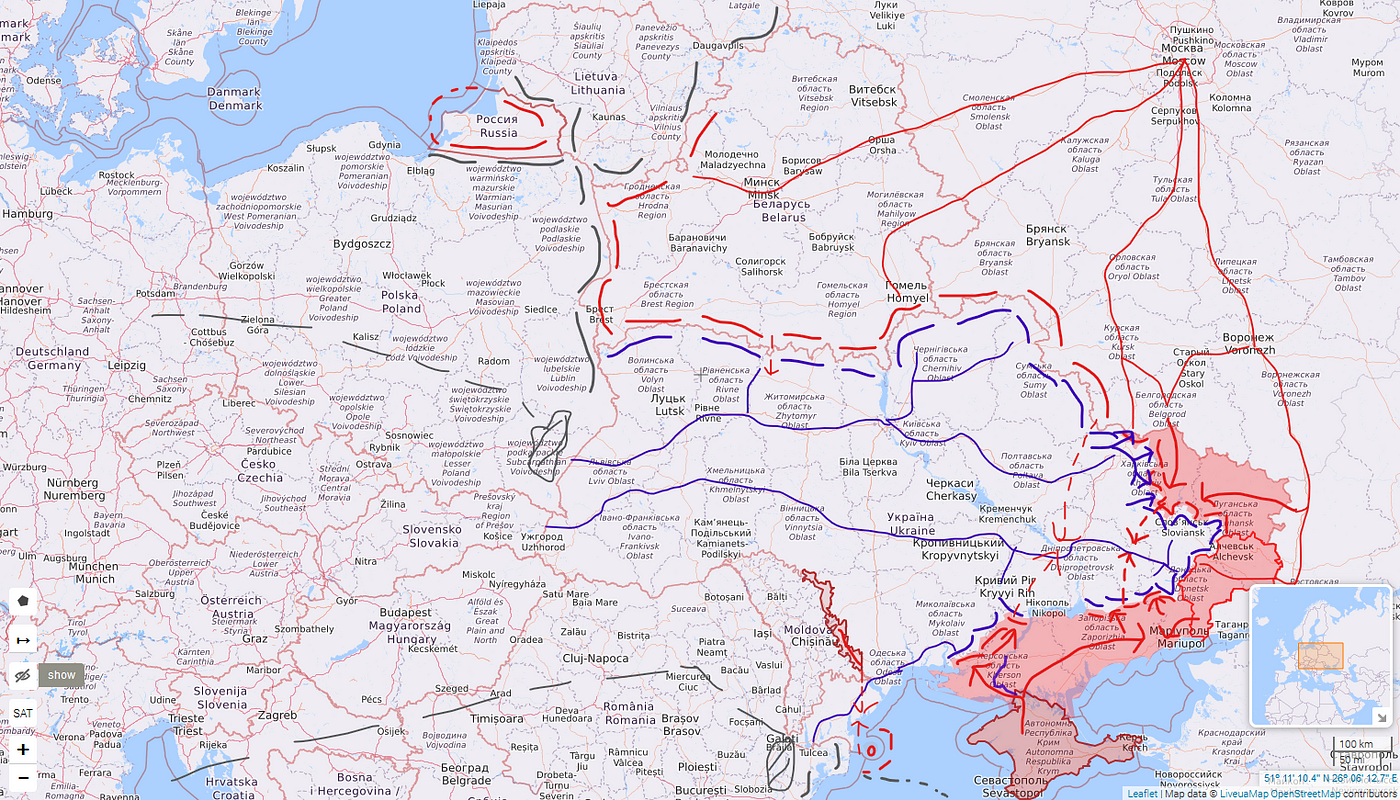
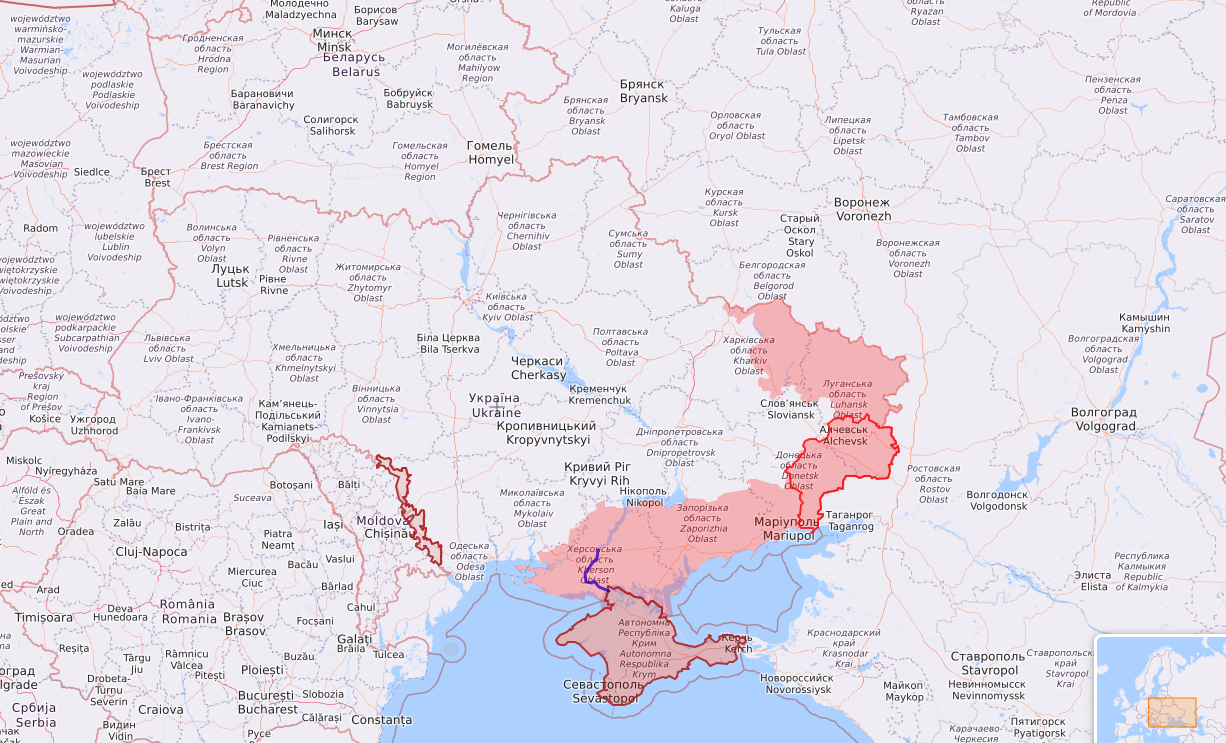
Eastern Front May 10, 2022. Supply lines and approximate front line positions marked in Blue (Ukraine), Red (Russia), Grey (NATO). Red arrows mark Russian offensives so far, partial arrows mark potential offensives. Blue near Kharkiv show Ukraine’s efforts since April to push Russia out of artillery range of the city. Base image from Liveuamap, markups mine.
In the West commentators try to keep score using casualties or military equipment losses as a proxy for winning and losing. But this is a mistake because Putin doesn’t care about Russian casualties. He doesn’t care if NATO military talking heads insist that he’s losing because Russia can’t dominate all of Ukraine’s skies or seize major cities — neither of which is a viable objective in modern warfare anyway.
Unlike most folks in the English-speaking world, I analyze military matters from a systems science perspective that identifies where a fighting force should focus its efforts to achieve its aims at minimum cost. Russia made the catastrophic decision to use military science itself as part of a Maskirovka, a broad deception effort deployed to cloak its true intentions.
This is the kind of too-cute thinking optimistic you expect from intelligence service types and a big part of why Russia’s initial plan went awry in a matter of days. But what most Western analysts are adamantly determined to miss is the fact overall command of the war shifted from the FSB to the regular military about a week after the attack kicked off.
From the moment Putin realized Ukraine was actually going to put up a fight his immediate war aims changed. Kyiv stopped being the primary target and the Russian effort in the south turned deliberately towards isolating Donbas.
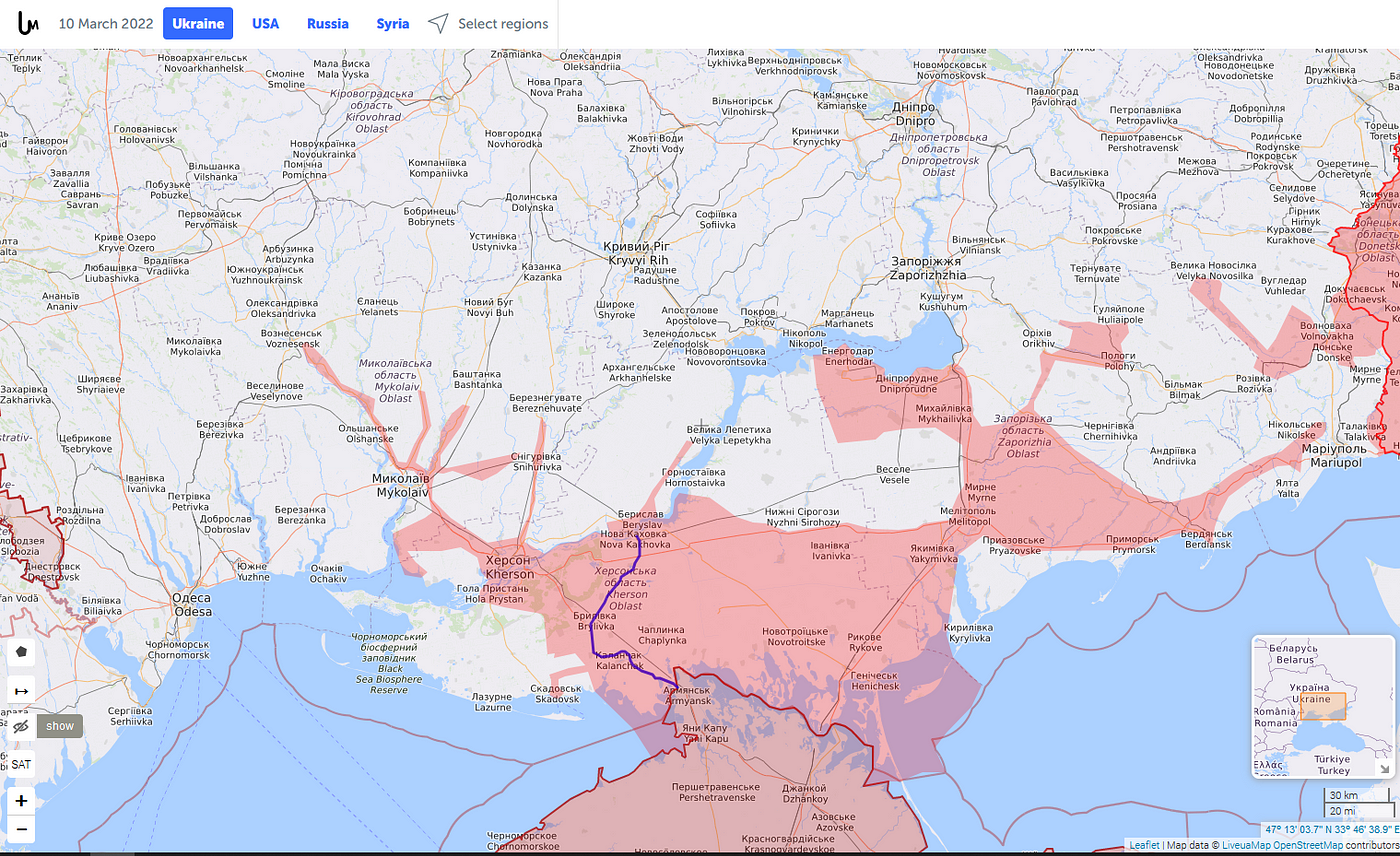
You can see this in the evolution of maps showing how Russian forces changed their direction of advance in Kherson province in the south. After making a reconnaissance in force seeking a path around Mykolaiv to Odesa — the original plan likely being to link up with Transnistria —Russia’s units in Kherson turned east towards Kryviy Rih to threaten the supply lines leading to Donbas.
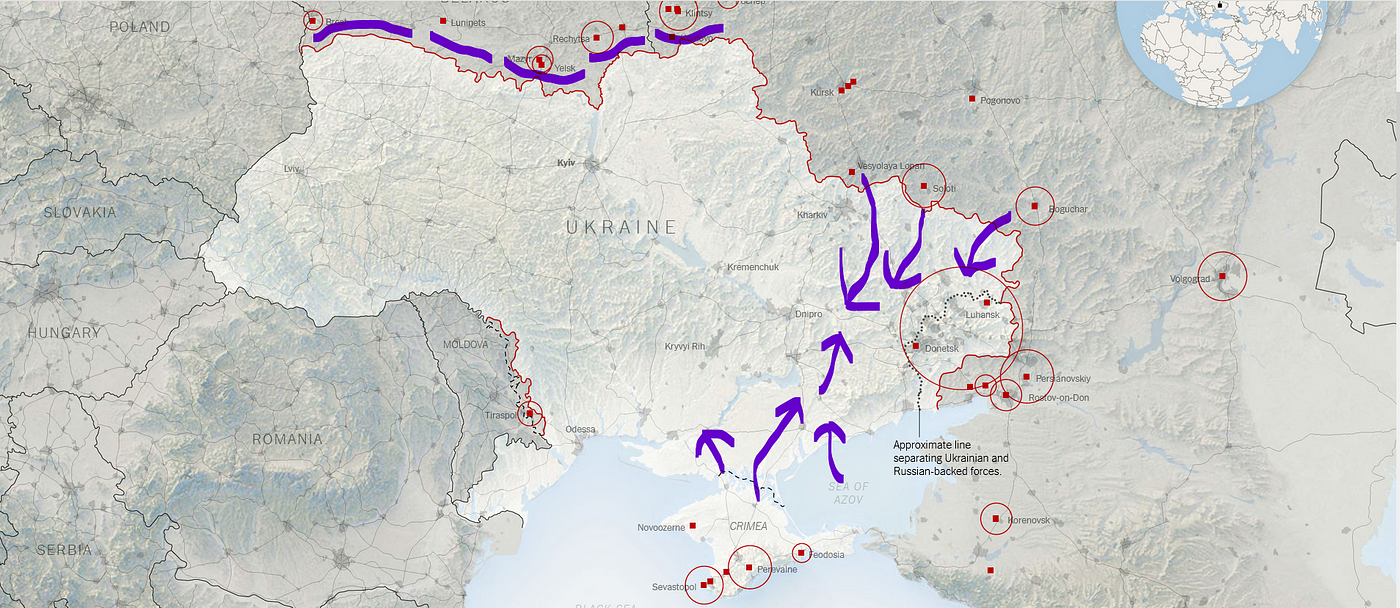
Ukraine was able to stop block this by deploying reserves, but could not halt the march of Russian forces to Melitopol and Mariupol near the coast and through Izyum on the Don river. In these sectors Russian advances have generally tracked my prewar predictions. Here’s what I thought would happen:
Where I thought Russia would attack in the south, broadly speaking. Background image from New York Times, purple marks mine.
Russia got a little further across the Dnieper in Kherson and Ukraine has held on in Donbas, but the shape of the operation in the south is mostly as predicted by terrain and logistics considerations.
As soon as Putin realized the Kyiv op was a bust, encircling Donbas became Russia’s primary military objective. He allowed the forces fighting near Kyiv to try and encircle the city in a secondary attack meant to strain Ukraine’s defense, but it was clear by mid-March that the city was too well protected to take by siege or storm.
It is vitally important to understand that the Russian retreat from the north was well organized, quick, and efficient. This was not a defeated army pulling back in the face of an overwhelming counterattack. It marked the shift from a terrible war strategy to a military campaign dominated by simple rational recognition that Ukraine as a whole could not be occupied with Russia’s available forces.
Since then Russia has been back to its maskirovka games, giving the impression of being caught in a stalemate while commanders train their forces properly and build up for the next big assault. Fighting has been hard along the front lines in Donbas, but Russia has not committed to the kind of all-out assault I anticipated before Victory Day.
Instead Putin used May 9th to mess with his enemies’ desire to gain insight into his thinking. Russia’s military effort is no longer driven by symbolic dates, but by the grim desire to cause as much harm to Ukraine as possible.
A major difference between the Russian and Ukrainian situations is that Russia has a far deeper well of reserves. Sure, it has lost over 600 tanks, up to half of what it committed to the fight in February.
But Russia keeps over 10,000 tanks in storage. Not most modern, perhaps, but most Russian forces can be given junk equipment and essentially sacrificed to clear the way for elite formations equipped with better gear. In fact, only one of Russia’s hundred or so modern T90M tanks has been confirmed destroyed — most losses have been of older Cold War style gear designed to be simple enough for conscripts to use in mass attacks.
The constant information war being waged against citizens of Western countries by our own leadership is blinding people to the harsh reality of what’s happening in Ukraine. Over the past fifty years military and security experts around the world have become positively obsessed with narratives at the expense of hard factors like terrain, supply, and execution.
In their worldview, tainted by the obsession with their own institutional heritage and the demand for officers to act like warrior-scholars, wars are lost when the population on one side loses the will to fight. Morale is what matters, and morale is bolstered, they think, by telling people not in the know happy lies.
In reality. bad morale is an age-old excuse made by failed leaders whenever their plans go awry. After America’s debacle in Vietnam, for example, many military officers and government officials blamed the media for ginning up public opposition to the fight.
But let’s state the truth baldly: information war is a delusion.
It’s just a nice way of saying propaganda, like collateral damage means oops, murdered some civilians. By making military affairs a sacred intellectual space only designated experts are allowed to inhabit, true civilian control over the military is severed and myths replace real military science in the public mind.
This is why, in America, Constitutional rights are always subordinated to the will of the national security state. People like Edward Snowden and Chelsea Manning are treated worse than even foreign agents simply for revealing to Americans what the federal government would prefer to keep hidden from its population.
In a real democracy the people have control over their military — it’s why the Founders originally intended that Congress declare war before raising standing military forces. Defense is truly about defense — protecting the territory of the country from attack, not picking fights abroad. Of course, America is not a real democracy, but an oligarchic anocracy, which explains a lot.
A nonstop information war is underway against quality science by people and outlets like the Institute for the Study of War, Michael Kofman, and Jomini of the West. Their role is to give the news media and general public sound bites and quotes that masquerade as scientific analysis while pushing a convenient narrative powerful people need us to believe is true.
Just as Russian trolls are actively trying to shape how we think about the war, NATO trolls are too.
Information war is fundamentally self-destructive and anti-democratic because it erodes trust between civilians and the military when the former realize they’re getting played, as they eventually do — check out the Pentagon Paperssometime. Information warfare has become an excuse for individuals willing to toe the establishment line to boost their career prospects and audition for jobs in future administrations.
Adherents to the D.C. foreign policy Blob adamantly refuses to admit a simple, awful truth: Putin is winning his war.
Not the broader war to subdue Ukraine — but that was always just an excuse for old Vlad anyway.
No, in his mind this has always been a fight between NATO and Russia. And in this epic contest Putin is more than happy to trade a few tens of thousands of dead young Russians if this means blowing up the world system his enemy’s power depends upon.
The American century is over. Pax Americana is dead. It’s a multi-polar world now, and America’s leaders are woefully unprepared for the complexity of this kind of operating environment
What pundits in the Anglosphere don’t seem to understand is that the effort to push a united global front against Russia has failed. Most countries around the world are looking at rapidly rising food and fuel prices with horror, not Mariupol. Sri Lanka’s government appears to have fallen already and more are sure to follow —people in most of the world don’t care about Russia’s war on Ukraine because they can’t.
Meanwhile the Western sanctions regime is disproportionately harming regular Russians and people in poorer countries Russia has long traded with, not the regime. Just as Iran’s government has found workarounds to sanctions, Russia’s will too, because too much of the world needs Russian exports — for all Europe’s anger at Russia, note how slowly most European countries are to pull back from Russian oil.
The unprecedented act of freezing Russian assets abroad has had the unintended effect of destabilizing the US dollar. The days of the dollar serving as the global reserve currency are almost done in part because countries are now justifiably worried about a future American government deciding to wage financial war against them.
Add to this the rank hypocrisy of the Biden Administration and NATO, which refused to give Ukraine enough support to deter Putin’s attack over winter then slow-played the delivery of major military gear for over two months. Even worse, efforts to speed deliveries of new aircraft to NATO allies so they could give Ukraine their old Mig-29 fighters went nowhere in part because production of American combat jets can’t ramp up fast enough to cover the shortfall.
NATO unity? Paper thin, and you can tell by how often officials insists otherwise — sure, Sweden and Finland are joining but both have been NATO partners already for a long time. Only once members realized Russia can’t sustain major operations against the Baltics or Scandinavia at the same time it’s bogged down in Ukraine did they start pushing heavy equipment to Kyiv. Almost three months into this war, Ukrainian troops and pilots could have been completing training on NATO-standard tanks and jets by now had a pipeline been set up back when I advocated for it.
Meanwhile, in Russia, Putin reigns supreme. Russians feel attacked by the rest of the world, Moscow’s information war capturing their minds just as Washington’s has taken over America’s. The Russian military appears bitterly angry by the loss of so many soldiers, dramatically hardening its stance towards NATO. Neither Putin nor the Russian military can afford to lose, meaning Donbas must be taken whatever the cost.
The Battle for Donbas has been underway for a few weeks now, and the lack of Russian progress on the ground is being taken as a sign of military exhaustion by the usual talking heads. I suspect this is a grave error, however.
It now appears the upswing in violence after Orthodox Easter was at least partly a feint: Russian forces have been conducting an extended effort to shape the battlefield ahead of the big push. Rochan Consulting published an assessment about a week ago showing that the area southwest of Izyum is being blanketed by Russian drones.
Fighting has been raging nonstop and probing attacks continue all along the front lines, but these could well be only intended to hold Ukrainian forces in place and exhaust them, slowly draining their supplies. What people don’t realize about warfare is that rest is absolutely critical. Most soldiers on the front lines aren’t standing there in the mud staring over rifle sights all day long. A few keep watch while the others rest or work on improving their positions. Some raids are launched to gain intelligence and disrupt the enemy’s plans to the degree possible, but otherwise, defenders have to sit and wait.
Only when they believe an attack is imminent do all the soldiers in a unit rush to their fighting positions. Forcing them to go through this over and over before the main fight begins is part of a typical assault plan assuming you have the time to spare, because it exhausts the defenders as well as forces them to make movements that reveal where their fighting positions are hidden.
That lets artillery and aircraft pound them night and day, which wears on even the most veteran fighter. This appears to have been Russia’s main focus across Donbas, especially near Izyum, where Ukraine has been holding the line with admirable skill.
I hope that their efforts are wearing Russian forces out. But I am concerned the Russian military is reverting to form: maintain constant pressure along a long line before an overwhelming assault breaches it along a narrow front. Air strikes are not intended to maintain constant control of the skies, but to hit targets of opportunity and suppress the opposition. Missile attacks hit deep in the enemy’s rear areas to degrade defenses and organization.
It is impossible to know with any certainty what is happening locally or the shape the combatants are in. Russian operations won’t follow any schedule western officials lay out. They have every incentive to disguise their plans to the degree possible. The fairly fixed nature of the lines over the past couple weeks is less evidence of Ukraine stopping the main Russian attack cold and more that Russian forces playing a deliberate game to gain the element of operational surprise before committing fully to any particular axis of attack.
A lot is being made of Ukraine’s counterattacks near Kharkiv, but these are only pushing back Russian forces whose main job keeping Kharkiv’s defenders busy away from Donbas and are vulnerable to counterattack the closer they get to the border. Russian operations around Snake Island and the threats of new attacks from Belarus or Moldova being dragged into the war are most likely serving the same purpose.
The simple truth is that as hard as Ukraine has been fighting, its defenders are still outgunned and outnumbered. Talk of broad counteroffensives to reclaim lost territories in the south and east is just that for the time being— talk. Ukraine has clearly been fighting very hard to disrupt Russia’s plans through artillery strikes on command centers, but this alone can not be decisive.
Defending is just much, much easier than attacking, and Ukraine needs a different class of gear to win. To successfully throw Russian forces out of Ukraine Kyiv has to get the full arsenal of modern, high tech equipment. Ukraine’s allies have to stop playing this weird mod of Command & Conquer where each subsequent level-up gives fighters access to a fancy new weapon with the good stuff being withheld until the final mission.
Despite receiving some howitzers and old armored personnel carriers Ukraine needs so much more to actually win. Every now and again a journalist interviews a soldier fighting in Ukraine and every one asks for better weapons.
Why aren’t they getting them? Because NATO leaders, particularly Joe Biden, are still terrified of Putin.
They know full well he retains the ability to end the world at a moment’s notice. Despite his overthrow or death being now necessary for the war to ever end, NATO won’t go there. Truth be told Biden and Johnson want Putin to stay right where he is. They really do want Ukraine to bleed forever without letting it into NATO or the EU. It’s all a sick game to these hacks, which is why Eastern Europe and Scandinavia need to be prepared to go it alone in the near future.
You do not want to be dependent on the United States. Its future is bleak and its leaders utterly craven — Perfidious Albion 2.0.
The leaders of the Anglosphere have completely lost the initiative, too caught up in their own self-congratulatory nonsense to understand that, for Putin, the outbreak war itself was a major victory.
Putin is well aware that domestic political strife in the lands of his enemies is all but guaranteed as prices rise for basic goods. He knows that most countries not already firmly allied to Russia or NATO don’t trust either — and he will weaponize that mistrust.
All he has to do is hang on, drag out the fighting indefinitely, and not lose. Chaos benefits Putin, plain and simple. The world is in a place thanks to the Covid pandemic and climate change where chaos will more likely than not magnify itself throughout the coming decade.
I predicted back in early 2021 that Russia or China would press the United States hard during Biden’s term. They almost had to — America’s covid disaster has done more to its reputation around the world than Americans realize, too happy to forget it ever happened and bury the trauma of the survivors.
China doesn’t want to destroy the world — it can arrange a showdown in the South China Sea or over Taiwan to prove its might over fading America if that proves necessary. However, Russia is more than happy to burn everything down.
If Putin can’t have his restored Soviet Union, then he’ll do exactly what Hitler did: destroy his own country to get back at the rest of the planet. Dragging the world down with you is the very soul of Pyrrhic victory, and Putin will accept no less.
The simple truth is that this conflict has been building for a very long time. Ukraine was trapped and has been shattered by the games of great powers as has occurred so many times across history. Now all of Ukraine is a murder scene.
And even the CIA is right for once: this war has only just begun. Russia is digging in for a long fight because it has no place to go, and if Russia is to fall then its leaders are certain to take America with it, one way or another.
Oft-told these days is the story of Putin, as a boy, cornering a rat that turns around and attacks him. Western pundits completely miss the point of this tale.
Putin identifies with the rat not because he personally feels his back is to the wall. No, he identifies with it because he knows that in the moment a creature commits to violence it gains power. Small as it might be, its enemies experience a moment of terror because they don’t know if its rabid or willing to fight to the death. The rat thereby gains a degree of freedom it can achieve no other way — the same lust for power drives school shooters, too, who attack not random people in the street, but their own peers.
Putin reigns supreme in the sole realm he cares about: Russia. No opposition threatens him — his only peers are those with the power to rebuff him. Russia’s military is bound to him through this war, even more so now that it has been revealed to all the world they are no less cruel than the Wehrmacht was.
It can’t lose, so neither can he, and so the war will go on. It may never end.
Sadly, the violence only gets worse from here. If Putin truly is the new Hitler then he must be defeated at any cost. He’ll never stop coming after the countries he doesn’t think should exist to build his sick farcical Russian World.
But NATO will never go this far. Its military power is almost as much of a bluff as Russia’s. A single wave of missile strikes hitting the right targets would cripple it for months if not years. NATO stocks of precision weapons aren’t that much deeper than Russia’s and take months if not years to replenish once used.
And Putin can always go nuclear. If he’s truly ill, that may even be inevitable now.
The bottom line is this: Putin has lost Ukraine, but as far as the broader war with NATO goes, he’s winning. Or at least, he thinks he is. And this makes him far more dangerous than he was before a quarter of his army got blown up on the road to Kyiv.
Uma dessas mudanças repentinas nas relações internacionais, nos livros de história, na posição internacional da Finlândia, e provavelmente em breve da Suécia.
Finland’s Position Is One of the Big Surprises of the Ukraine Invasion
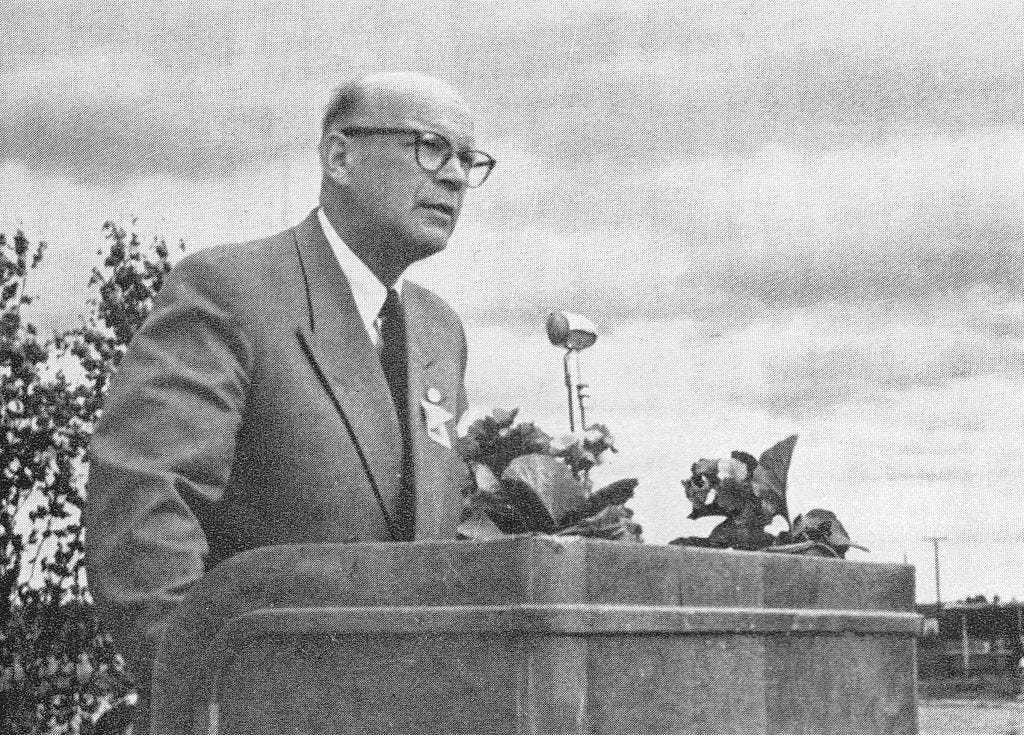
Presidential candidate Kekkonen speaking in Kuusamo in 1955. Unknown author, Public domain, via Wikimedia Commons.
For decades, my country has had to walk a fine, fine line between USSR/Russia and Europe. How do we become a developed country and a part of Europe, without angering these guys on the eastern border that could just come back and invade us at any moment?
In the Cold War, that delicate dance gave us and the international media a new concept: Finlandization. It described how a nation gave up on a part of its sovereignty to maintain its independence. Kind of keeping it in name, but sacrificing all important decisions to what Khrushchev or the Politburo wanted. If we got a thumbs down, like we did in the Night Frost Crisis of 1958 or the Note Crisis of 1961, we retreated.
Our President Urho Kaleva Kekkonen was the leader in charge of Finlandizing our foreign policy, and he remained in power for 26 years, from 1956 to 1982. In my opinion, no president has fresh ideas to improve his country for a quarter cetruy, but at least he was on good terms with the Kremlin.
We’ve since implemented a two-term limit for the presidency and gotten rid of the electoral college, so I guess we can sort of thank Kekkonen for overstaying his welcome. And the truth is, had Finland not done what the USSR wanted in those days, we might not have been able to keep our country.
Things do sometimes change for the better, if you wait them out. In the Cold War decades, Finland went from a backward and largely rural country that had just lost a terrible war, to a prosperous Nordic welfare state. Inching closer to Europe, little by little.
After the Soviet Union disintegrated we were finally ready to make our new position official, and in 1995 we joined the EU.
But we’ve always remained on good terms with the Russians, careful to not anger our important trading partner who just might, you know, one day decide to invade us again.
Changing Positions
As long as I can remember, our NATO position has been an issue in every Finnish election. Political candidates have been asked about their opinions toward the organization — and toward Russia — but it still hasn’t been a topic people seriously considered.
Why? Because us Finns, like much of the rest of Europe, have spent the past couple of decades under the impression that Russia could somehow be managed or kept under control. That modern-day Russia isn’t the same as the Russian Empire or the Soviet Union.
Well, that changed in a matter of days in February of this year.
I’ve personally always been against NATO membership, thinking it was unnecessary and wouldn’t really help if times truly got tough. I’m not sure I still think being part of the defensive alliance would help, but what’s become clear in these past two months is that Finns are now overwhelmingly in favor.
Even the Green Party, traditionally against expanding military spending, is now looking at the US-led military alliance for safety guarantees. All this is happening despite Russia’s dire warnings that it might cause the Kremlin to “rebalance the situation.”
Finnish decision-makers of all political colors have been under fire lately for their relationships with Russia. In a very “gotcha” way, reporters have been dragging out old statements from politicians, demanding answers about why they were so wrong.
President Tarja Halonen, a social democrat who maintained a friendship with Vladimir Putin, has been criticized for not evaluating the situation correctly, while former center-right PM Alexander Stubb has taken great pleasure in Finland’s new position.
Current PM Sanna Marin has lamented that Finland remains dependent on Russian gas and is forced to finance the war. The truth is that appeasing Russia is our long-standing policy. Many of us wanted to believe Putin could be dealt with. That Russia could become something different from what it has always been.
But guess who didn’t agree? The guy in his bunker, who doesn’t really care about our modern-day Finlandization.
How About a European Defense Alliance?
Another interesting thing about the last two months is that, thanks to the people of Ukraine, the EU is becoming popular again.
It’s no secret for anybody following European politics that there have long been important Euro-skeptic factions. This phenomenon is as old as the EU, and not just limited to Brexit.
Many consider the EU as unnecessary spending. Others, including the far-right, consider the intermission of a supranational entity in our affairs as a threat to our independence. “They’re trying to build a European Federation,” ultra-nationalist factions warned.
Um, so what? It’s not like Europe was always a continent with fifty independent states? Political and economic structures are never eternal. And, as a person born and raised in a borderless Europe, I can say the EU is pretty damn convenient.Especially for young people who want to travel and see other cultures.
Anyway, a European defense system would always have been out of the question when even the smallest concessions to the Union were seen as a threat to our sovereignty. Now, I don’t see it (or this interesting idea of an Eastern European one) as an impossible affair anymore. Especially if we don’t achieve NATO membership due to resistance by current members, such as Orbán’s Hungary, or we find it doesn't solve our problems when we need it.
Because right now, the threat to Finland and other countries bordering Russia is real, and we’re finally taking it seriously.
And because those brave, determined Ukrainians have shown us that what we have is worth it. That Europe is not just about convenient travel and work opportunities. It’s also about ideals, and freedom. Things Ukraine has been fighting for, non-stop, since Euromaidan. We owe them so much.
This is the opposite of Finlandization. It’s the end of appeasement. It’s a choice.