Temas de relações internacionais, de política externa e de diplomacia brasileira, com ênfase em políticas econômicas, viagens, livros e cultura em geral. Um quilombo de resistência intelectual em defesa da racionalidade, da inteligência e das liberdades democráticas. Ver também minha página: www.pralmeida.net (em construção).
The war is slipping out of Putin’s hands, and it’s never been more apparent.
Here’s the problem: Russia relies on siege-style warfare from the Soviet Era.
It has a simple formula. Stand outside enemy range. Bomb them to smithereens. Then send in infantry to clean up.
But now, that plan is backfiring. I’ll explain.
The terms of battle have changed
Javelins and drones still matter in a big way, but we are now in an artillery battle in Eastern Ukraine.
The US has sent anti-artillery radars that trace incoming artillery shells.
Every time Russia fires, they reverse engineer the trajectory of an incoming round and point to a map and say, “Aim here.”
Author via (UAF — labeled for reuse)
Ukrainians are pairing fantastic intelligence with US howitzer cannons that have a range of 18 miles. Germany also sent 7 PZH 2000s cannons, which are the most powerful tube artillery in the world, with a range of 25 miles.
When going tit-for-tat, they can strike from well outside the range of Russian artillery.
Even further, Russia is in unfriendly territory. Every time they attempt to move, they are subject to ambushes. Citizens in nearby homes are calling intelligence in to Ukraine’s Armed forces.
Additionally, Russia’s equipment repositions much slower than Ukraine's. Russian forces move like a bloated and discoordinated barge.
Even worse, Russia cannot supplement its forces properly with air support.
Ukraine has an obscene amount of anti-aircraft weaponry at its disposal. Every day, more weapons flow across its border.
Ukraine Strikes Back
Howitzers can be quickly reloaded and adjusted.
It fires a single round that is accurate within 30 feet from 12 miles away, and its explosion has a kill radius of 50 meters (kill radius means 50% of people in that radius will be killed).
Via US army (Public Domain)
It can also be quickly repositioned before the enemy can reset and refire.
The US has sent 90 Howitzers alongside 72 transport units to reposition them quickly. Several Ukrainian squads have already flown to the US and been trained on this equipment and are now training other peers while using the cannons.
When artillery arrives in Ukraine, it is ready out of the box.
Russia’s problem(s): the tale of two logistics
What’s incredible is how fast the US delivers weapons systems, heavy artillery, and supplies into Ukraine. It is making Russia’s logistics look like amateur hour.
Russia’s mobile artillery is extremely fuel consuming, and they go through a huge volume of rounds that need to be carted in.
For context, the US also sent 180,000 rounds of artillery (a single round weighs 95 lbs — you can’t just throw 500 rounds in a bag).
Ukraine’s artillery is now hitting Russia’s supply routes with ruthless accuracy from miles outside of their range. This is part of what is stalling Russia’s efforts.
Allied intelligence and satellite imagery are painting a vivid picture of enemy movements in Ukraine and Russia. In many cases, Russian forces don’t know what hit them.
Ukraine is also striking fuel supplies just over the Russian border (though they refrain from directly admitting this).
There has also been a string of mysterious fires in Russia, either because of sabotaging or infiltrating soldiers.
Oil Depot in Russia that was being used to refuel Russian tanks. (Via Kyiv News — Open use)
Russians are getting mauled in the east
Ukraine is reclaiming territory, pushing 40 KM deeper into the Kharkiv region in the past week.
Any minor gains Russia claims are simply because Ukraine redirects forces with greater precision, applying pressure in thoughtful and strategic ways.
Russia’s attempts to push towards Odessa have stalled at Mykolaiv. Their desire to create a land bridge from Crimea to Moldova is doomed. Why?
You need good forward artillery spotters (including drones and other intelligence) to advance on defensive positions to then place shots properly and move forward.
This matters because most artillery battles use “shoot and scoot” tactics.
When you fire at the enemy, you can assume the enemy will roughly know where you are and return fire. Agility matters. Ukraine has it. Russia does not.
In an artillery battle, whoever can find and target enemy artillery the fastest, with the most accuracy, tends to be the one who wins.
Additionally, artillery is particularly vulnerable to ambush attacks with NLAWs and Javelins. Like tanks, artillery isn’t designed to fight alone, and Russia has done a piss poor job of protecting their equipment.
The final problem
Infantry combat is intimate and deadly. If your soldiers aren’t motivated and morale is down, you’ll have to use cow prodders to move them forward.
Russian losses are catastrophic. Seven (possibly 10) generals have been killed because they were in forward positions trying to motivate soldiers.
We’ve heard multiple hacked phone calls of soldiers complaining about morale and footage of Russian citizens firebombing recruiting stations to avoid conscription.
Russia’s advantages have turned into its weaknesses. They now face a better version of themselves in the east of Ukraine. Kamikaze drones are diving out of the sky at will. Ukrainian artillery is outperforming their own.
If your men don’t want to fight in infantry combat, and you can’t win in ranged combat, what are you left with? Threatening nuclear strikes.
You don’t threaten nuclear strikes when you are winning a war.
Every day that goes by results in Ukraine getting more equipment, training, intelligence, and funding to fight off Russia. It’s only a matter of time.
Nenhum país que se pauta pelo Direito Internacional pode aceitar fronteiras impostas pela força. Não se pode, portanto, aceitar a anexação de territórios tomados à força por uma potência invasora. NEM O BRASIL DO ESTADO NOVO ACEITOU O ESBULHO. Em 1939 e 1940, o Brasil não reconheceu a apropriação ILEGAL de territórios da Polônia e dos três países bálticos e pelas décadas seguintes NUNCA RECONHECEMOS a suserania soviética sobre os três bálticos. O caso da Polônia foi diferente, pois que ela foi "restaurada" como Estado "independente" em 1945, ainda que com governo transportado de Moscou e com fronteiras radicalmente transformadas, com sua parte oriental incorporada à Republica Federativa Socialista da Bielorússia (ou seja, império soviético), e com terras arrancadas a oeste da Alemanha (Prússia oriental, na RDA). O Brasil deveria ter emitido uma nota, em 2014, quando a Rússia incorporou a Crimeia ilegalmente, mas não o fez, pois Dilma Rousseff NÃO HONROU a tradição diplomática brasileira de pleno respeito ao direito internacional. Não pode agora o governo Bolsonaro reconhecer o esbulho de Putin de territórios ucranianos e sua incorporação à Rússia. Se o fizer, estará rasgando cláusulas constitucionais de relações internacionais e a adesão do Brasil à Carta da ONU.
Em 1939, o governo brasileiro não reconheceu conquistas efetuadas pela força, não reconhecendo, portanto, os territórios ocupados pela força pela Alemanha hitlerista e pela União Soviética stalinista, o que pode ser lido no Relatório do MRE de 1939, publicado em 1943, p. 4-5. Em 1943, o governo brasileiro declarava sua adesão à Declaração sobre o Não-Reconhecimento de Espoliações e Expropriações pelas Potências do Eixo em territórios ocupados pelo inimigo e seus aliados. O Brasil não mantinha relações com a União Soviética desde 1918.
Paulo Roberto de Almeida
CONFLITO GLOBAL
G7 diz que não reconhecerá fronteiras impostas pela Rússia
há 14 hora
Ministros do Exterior dos sete países mais industrializados do mundo afirmam que apoiarão decisão de Kiev sobre Crimeia e prometem intensificar sanções contra Moscou, além de manter envio de armas à Ucrânia.
Deutsche Welle, 15/05/2022
O G7, grupo dos sete países mais industrializados do mundo, afirmou neste sábado (14/05) que jamais reconhecerá as fronteiras que a Rússia pretende impor à força com a guerra na Ucrânia e prometeu ampliar as sanções contra Moscou visando setores vitais da economia russa.
"Não reconheceremos nunca as fronteiras que a Rússia está a tentando mudar por meio da agressão militar e mantermos nosso compromisso no apoio à soberania e integridade territorial da Ucrânia", afirmaram os ministros do Exterior do G7 numa declaração divulgada após o fim da reunião de três dias no norte da Alemanha.
Além da Alemanha, o Canadá, Estados Unidos, França, Itália, Japão e Reino Unido fazem parte do G7. A reunião contou ainda com a presença do chefe da diplomacia da União Europeia (UE), Josep Borrell, e os ministros do Exterior da Ucrânia e da Moldávia.
Na declaração em conjunta, os ministros prometeram ampliar as sanções contra Moscou para incluir setores do qual o país é dependente, além de continuar fornecendo armas à Ucrânia. "Reafirmamos nossa determinação de aumentar ainda mais a pressão econômica e política sobre a Rússia", destaca o texto.
Os chefes da diplomacia dos países do G7 se comprometeram em "acelerar os esforços" para "acabar com a dependência da energia russa". O grupo instou ainda a China a não "minar" essas medidas e pede que o país asiático não apoie à Rússia no ataque à Ucrânia. Na declaração, eles reiteraram o apelo a Belarus para que "pare de facilitar a intervenção da Rússia e respeite os seus compromissos internacionais".
Os ministros reiteraram também a exigência para que a Rússia "ponha fim à guerra que começou sem provocação (por parte da Ucrânia) e ao sofrimento trágico e a perda de vidas humanas que ela continua provocando". Na declaração, condenaram ainda "as ameaças irresponsáveis de utilização de armas químicas, biológicas ou nucleares" feitas pelo presidente russo, Vladimir Putin.
Anexação da Crimeia
Ao ser questionada se o grupo deseja que a Rússia devolva a Crimeia, anexada em 2014, para a Ucrânia, a ministra do Exterior da Alemanha, Annalena Baerbock, disse que essa decisão cabe a Kiev. "É território deles e vamos apoiar cada medida e cada passo que tomarem para garantir que o povo ucraniano possa viver como todos os outros na Europa: em paz, mas também em segurança e liberdade em seu próprio país", destacou.
Baerbock considerou que a resposta da comunidade internacional nesta altura "será decisiva para o futuro". A ministra alemã anunciou ainda que o G7 estabelecerá um mecanismo para desmascarar a propaganda russa que tenta culpar o Ocidente por problemas de abastecimento de alimentos no mundo devido às sanções impostas contra o país.
A ministra afirmou que o grupo trabalha para encontrar soluções para o escoamento de commodities que estão armazenadas na Ucrânia antes das próximas colheitas. O país é um dos grandes produtores de trigo do mundo. Cerca de 25 milhões de toneladas de grãos estão atualmente bloqueados nos portos ucranianos, causando restrições a milhões de pessoas no mundo, sobretudo na África e no Oriente Médio.
Os ministros do Exterior do G7 participaram de um encontro de três dias na cidade balneária de Weissenhaus, no norte da Alemanha, país que ocupa atualmente a presidência anual rotativa do grupo. No centro da agenda da reunião, estavam os problemas ligados à invasão russa na Ucrânia, como a segurança alimentar e energética.
Lançada em 24 de fevereiro, a ofensiva russa já deixou mais de 3 mil civis mortos, segundo a ONU, que alerta para a probabilidade de o número real ser muito maior. A guerra já obrigou mais de 13 milhões de ucranianos a deixarem suas casas. Destes, mais de 6 milhões buscaram refúgio no exterior. A invasão russa foi condenada pela comunidade internacional, que respondeu com o envio de armas para a Ucrânia e sanções econômicas e políticas contra Moscou.
Já se disse que quando a China despertaria novamente, o mundo estremeceria. Ou talvez se pudesse perguntar: quando a África estiver com todo o seu potencial demográfico, há chances de grandes mudanças na geopolítica mundial? Não tenho certeza.
Once you realize it’s scale, there is no global trend as dramatic today as the revolution in Africa’s demography.
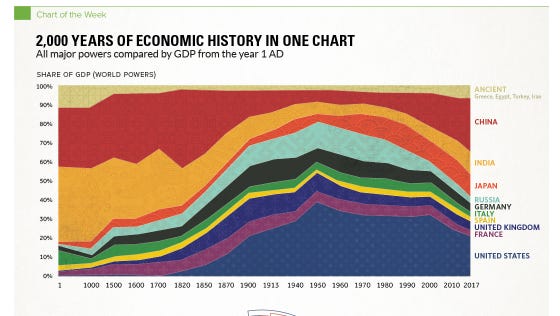
Asia’s return to the center of the world economy dominates the headlines. But in the grand sweep of history that is a rebalancing or restoration not a revolution. Until the 18th century, the Pacific and Indian Oceans were the heart of sophisticated economic activity. That balance was grossly distorted in the “centuries of humiliation” by the rise of the West. Now, thanks to Asian economic growth, the centers of economic activity and population are realigning.
The same cannot be said for Africa. Despite optimism in recent years, the relative lack of economic growth in Africa is well-known. Less well-appreciated is the extraordinary historical novelty of it demographic development.
In 1914 according to the best estimates, Africa’s entire population was 124 million and that includes North Africa. Today it is 1.34 billion. Compared to Africa’s roughly elevenfold increase in population, Asia’s population increased by “only” between 3 and 4 times - China’s merely tripled and India’s increased by 4.5 times. Furthermore, whereas Asia’s population is beginning to stabilize - led by that of India and China - Africa’s population will, barring disasters, reach 2.4 billion by 2050 and will go on growing.
Longer term projections are hazardous, but a world with somewhere between 9 and 11 billion total population and close to 4 billion people living in Africa is what current trends would lead one to expect. That means that by 2100 the African share of global population will likely be between 35 and 40 percent. And in 2100 the population of several African countries - Chad, Mali, Niger, Nigeria, and South Sudan - is likely still to be growing.
That is something new under the sun. It means that in sheer quantitative terms Africa’s story increasingly drives world history.
As Edward Paice spells out in his excellent book Youth Quake which I reviewed yesterday in Foreign Policy, our long-range predictions for global population basically depend on the outlook for Africa. Variation in estimates for Africa drive variations in the global total. Spelled out in demographic statistics this is a point of universal significance.
Making those estimates is an uncertain and volatile business because so many large countries in Africa are bucking the pattern of rapid demographic transitions we have recently seen in Latin America and Asia.
One of the things I really appreciate about Paice’s book is the way that it renders the succession of demographic estimates and the discourse about African population as history. We see how estimates are made, how they have been criticized and why they have been modified over time. That debate continues every day in the pages of journals like The Lancet with teams of modelers arguing over assumptions and functional linkages between population, investment, education and fertility.
Through the lens of African demographic modeling Paice explores what to me is one of the most basic dilemmas of orientating ourselves in our turbulent contemporary world. We can’t live with our big quantitative indicators and statistical estimate. Numbers like GDP, global population 2100 etc. are endlessly frustrating in their crudity, their rough approximations, their entanglements with power. And so often they are just plain wrong and misleading. On the other hand we can’t live without those numbers either. Quantitative nihilism or all-encompassing skepticism, whether motivated by mere laziness or radical critique, is not a practical option either. We are much better off having some estimate of where the economy stands or where population will end up, or what the rate of exploitation is, than not. So we need to work hard at getting the numbers as right as we can, even if we doomed to get them wrong.
If it helps with motivation, think of it as a low-key statistical version of a tragic predicament. We have to keep rolling the ball up the hill. We have to keep training our judgement. We can learn to use the numbers intelligently, appreciating both what they cannot be made to say, and where confidence and certainty is growing.
In light of experience, some estimates for Africa’s future population have been adjusted downwards. But in the largest and most significant cases, as Paice shows, the tendency is in the opposite direction. In particular, confidence has grown around the estimate of a population for Africa of 2.4-2.5 billion by 2050. Why? Because of one quiet, but dramatic fact. A large number of the mothers whose children will drive growth to 2050 have already been born. And so, barring utterly unprecedented discontinuities in fertility behavior of which there is no sign in Africa, we can estimate the number of their children and their children’s children and so on.
What Paice’s treatment reveals is something I did not appreciate about contemporary history. In demographic terms, the last ten to twenty years in Africa were, in fact, decisive for global population history. We have been waiting for the demographic transition to arrive, as it has in Asia and Latin America. It has in many societies in North Africa and in South Africa and in some cases in East Africa, but not in many of the largest and most rapidly growing societies across central and West Africa. The sheer size of Ethiopia and Egypt and the momentum of Nigeria, DRC, Tanzania and a handful of others carries us to 2.4-5 billion by 2050 and to even higher numbers by later in the century.
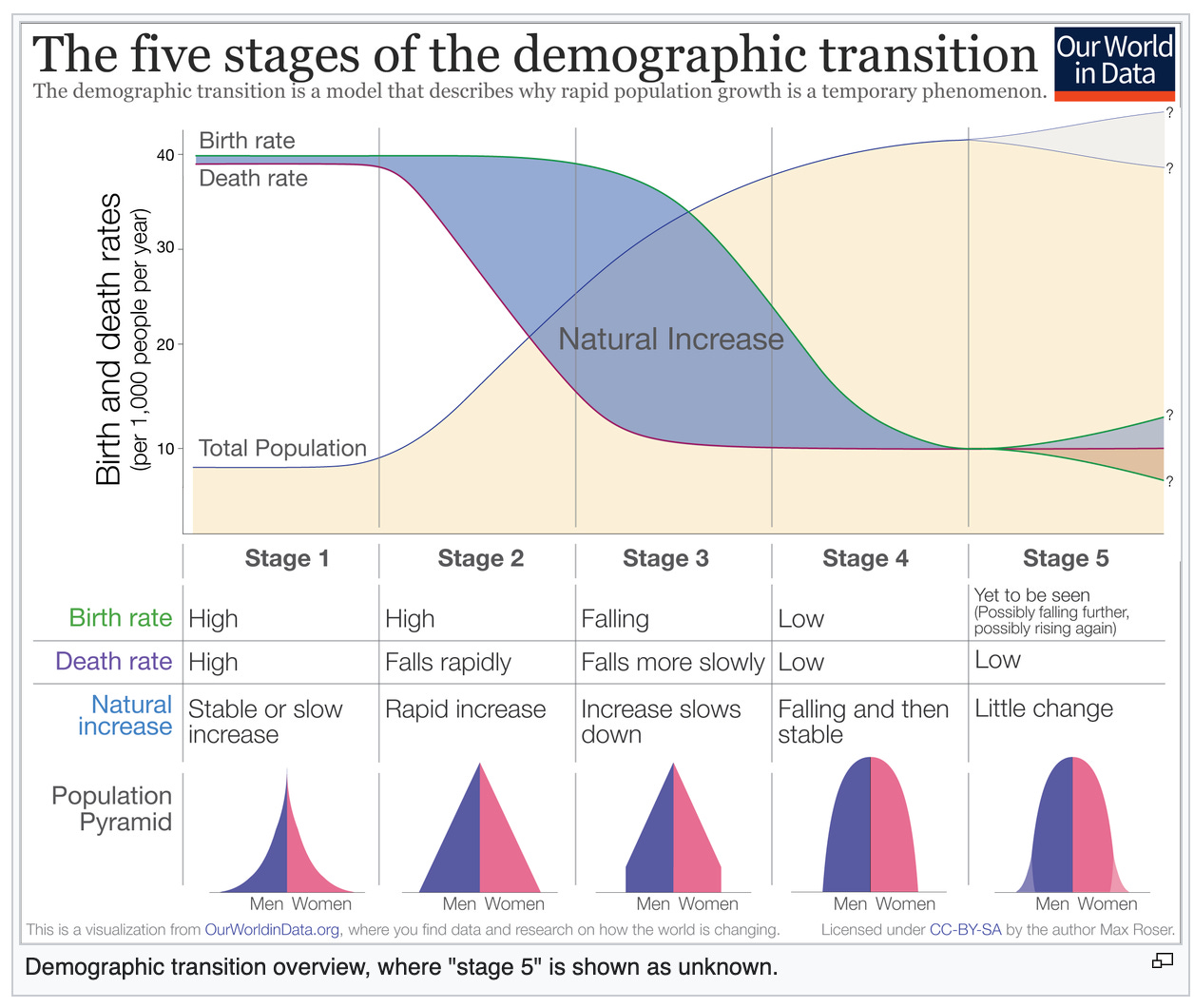
One of the questions that Paice poses is: What is going on with our understanding of the demographic transition?
The model of the demographic transition is a low-profile, but essential building block in our “kitchen sink” models of modernization.
Death rates fall as societies modernize and develop economically. So population growth accelerates. Then, at some point, fertility declines, so population growth slows down. Eventually, it may even go negative as fertility falls below the replacement rate of 2.1 children per woman.
It is a heuristic that has served us well as a device for organizing demographic history. It is a mechanism that has seemed to be speeding up, in Latin America, Southern Europe, North Africa and Asia. The discovery of the last few decades is that in many African societies it is operating far, far more slowly and that is what dictates the future.
This isn’t uniform. Paice is excellent in refusing to treat “Africa” as a block and constantly differentiating between regions and countries, between town and countryside and, even, between different cities. Addis in Ethiopia, for instance, where family sizes are shrinking rapidly has a demographic trajectory different from the rest of a huge country. The strength of the latest generation of population predictions lies in the fact that they are not based on generalizations about the entire continent, but on case by case estimates for each country and region.
Why then is the demographic transition not taking place? In part it is due to the failure to achieve the necessary preconditions for transition above all female education and empowerment. But as Paice tells it, it goes beyond that. African women and African men, in very unequal ways, appear to be making choices to have large families in a way that is unusual by international comparative standards.
This is highly contentious terrain. Theories of power are engaged. Sexist, racist and colonial stereotypes lurk everywhere. I was actually asked to correct a line in the original FP piece by one of the magazine’s regular Africa contributors. We did make a change, but only to state more clearly what Paice has to say on pages 177 and 178. Choice matters. All the evidence suggests that men and women in Nigeria are making different choices about fertility than men and women in Thailand, for instance.
I take the point being made by Paice to be analytical. We thought we had a solid understanding of accelerating demographic transition. This was based on data from Europe, Latin America and Asia fitted into a schematic model. That model is itself so influential that it shapes policy by guiding development policy. In Africa what we are seeing is that that model is not working as expected so we have to dig deeper into the data to understand better what is going on. This leads us to the recalcitrant but undeniable conclusion that choices matter, choices being made by large groups of people. The point is one about choices and agency and the contingency and analytical puzzlement they create. Of course, that agency in fertility choices is exercised is circumstances constrained by hierarchies of power, poverty etc. But the element of agency remains.
The next question is how we can track and gain a better understanding of the choices being made. One of the things I learned from Paice is how much data we actually have about men and women’s fertility and contraceptive choices around the world. The Demographic and Health Survey - the Nigerian 2018 report is available here - is an absolutely remarkable resource, which collects data on astonishing range of intimate details across large population samples that can be broken down by gender, region, income level, occupation, education level etc. It tracks not just social facts but also attitudes and preferences.
It tells us, for instance, that in a sampled population of 12955 Nigerian women of fertile age with no formal education, 94.8 percent were using no contraceptive methods, either traditional or modern and that in a sample of 2788 Nigerian women with more than secondary education the share using contraception rises. But even with higher education 66.7 percent of Nigerian women in 2018 used no contraception. One is tempted to add “still used”, but that is precisely the question. How relevant are the teleological assumptions of modernization theory? If you divide the population in terms of wealth quintiles it follows a similar gradient. Urbanization appears to make a difference. Amongst Nigerian women in Lagos, across all social categories, the share using no contraception falls to 50 percent.
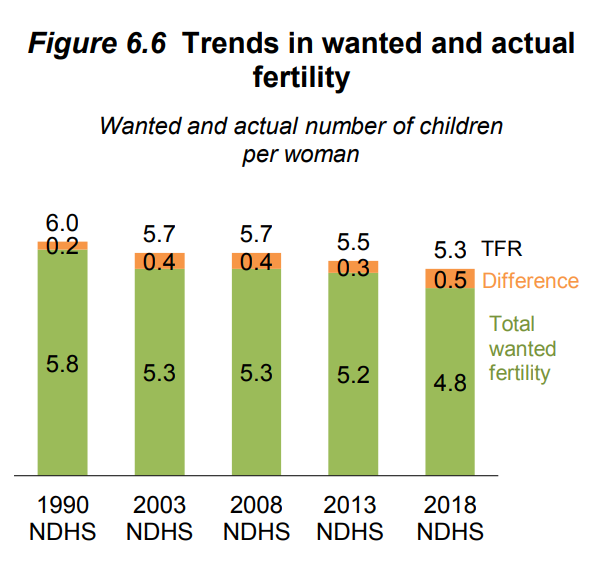
Why do Nigerian women use so little contraception? There are no doubt many constraining factors but the clear message of the DHS data is that they use little contraception, because they want large families and they are, in their own way, quite successful at matching actual fertility to desired fertility.
As the desired total fertility has gradually fallen between 1990 and 2018 the gap between actual and desired fertility has somewhat widened, but not by a huge amount. It was barely larger in 2018 than it was in 2003.
I would love to know more about the compilation of DHS data. They cover an astonishing range of issues from malaria incidents to domestic violence in remarkable breadth and detail. Taken at face value the DHS data are an astonishing resource for tracking global social change. I am sure they are open to question and argument in many way, but they are a monument to the effort to track and understand our collective development.
The sheer scale of Africa’s demographic acceleration makes it a vastly significant megatrend, which will relativize the dominance of Asia by the mid-century. But it is all the more significant because of the questions it begs about economic development and attendant on that about environmental sustainability.
Given the huge strides in economic development across Asia and the rapid slowdown in population growth notably in India, it is tempting to think of the problem of absolute poverty and its remediation as a residual. India, like other once poor countries, is progressively rolling out basic services to its entire population. In a perverse way, even the COVID epidemic confirmed that. India did a comprehensive lockdown, as did Pakistan and Bangladesh. And India, by way of the Serum institute, was key to the global vaccination effort. At the risk of complacency, across much of Asia, escape from the most extreme forms of poverty seems a matter of time and will become easier as population growth slows.
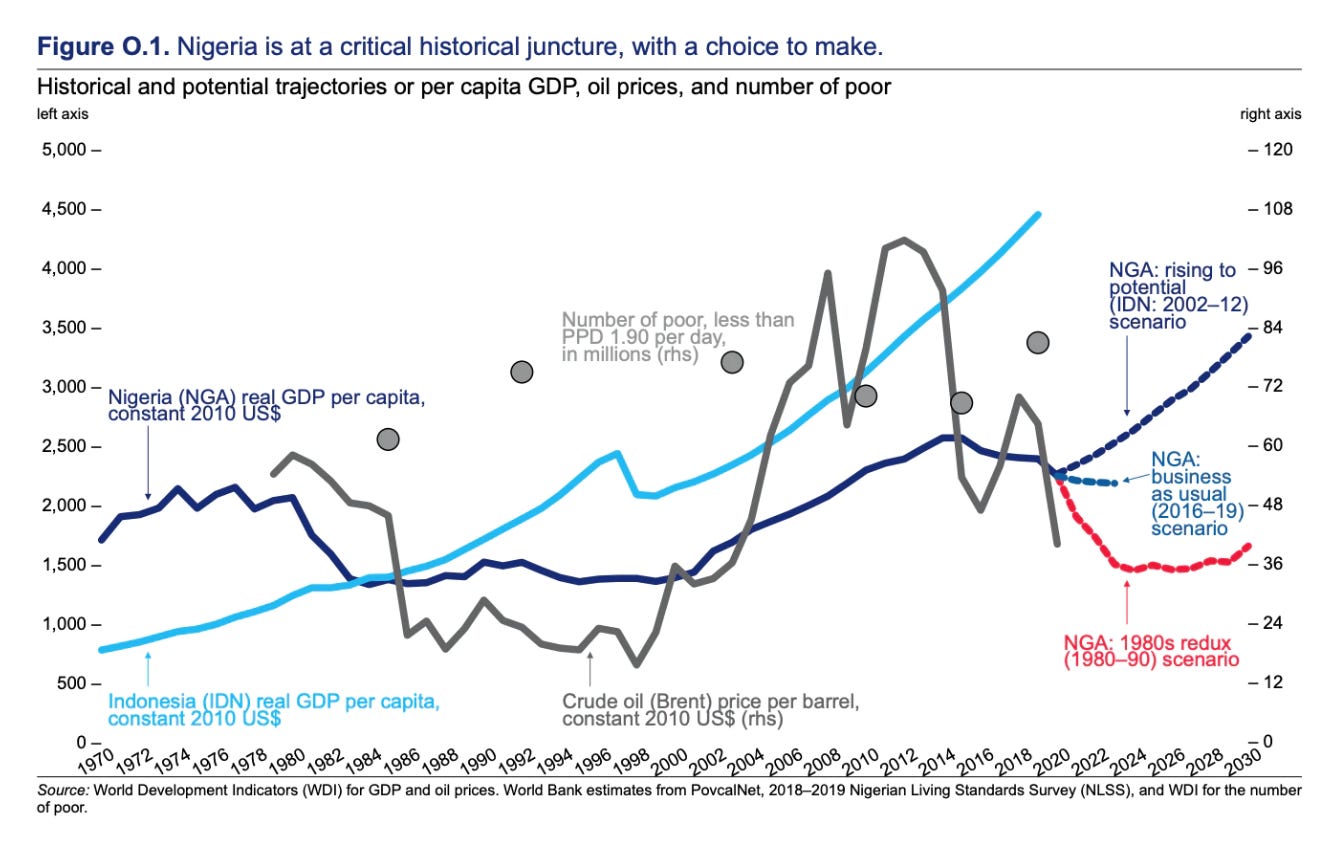
The same cannot be said for much of Africa. It is the combination of fitful and intermittent economic development with the huge dynamic of demographic growth that make the situation so dramatic. In world-historic shift, Nigeria in 2019 counted more absolutely poor citizens than India. COVID temporarily reversed that but the trend is unmistakeable.
This is the graph of Nigeria’s growth in gdp per capita from Chartbook #10tells the story.
It is the combination, which was once common to large parts of the world but is now increasingly unique to Africa, of very large-scale demographic growth combined with continued mass poverty that gives extreme urgency to calls for infrastructure spending and human development through education.
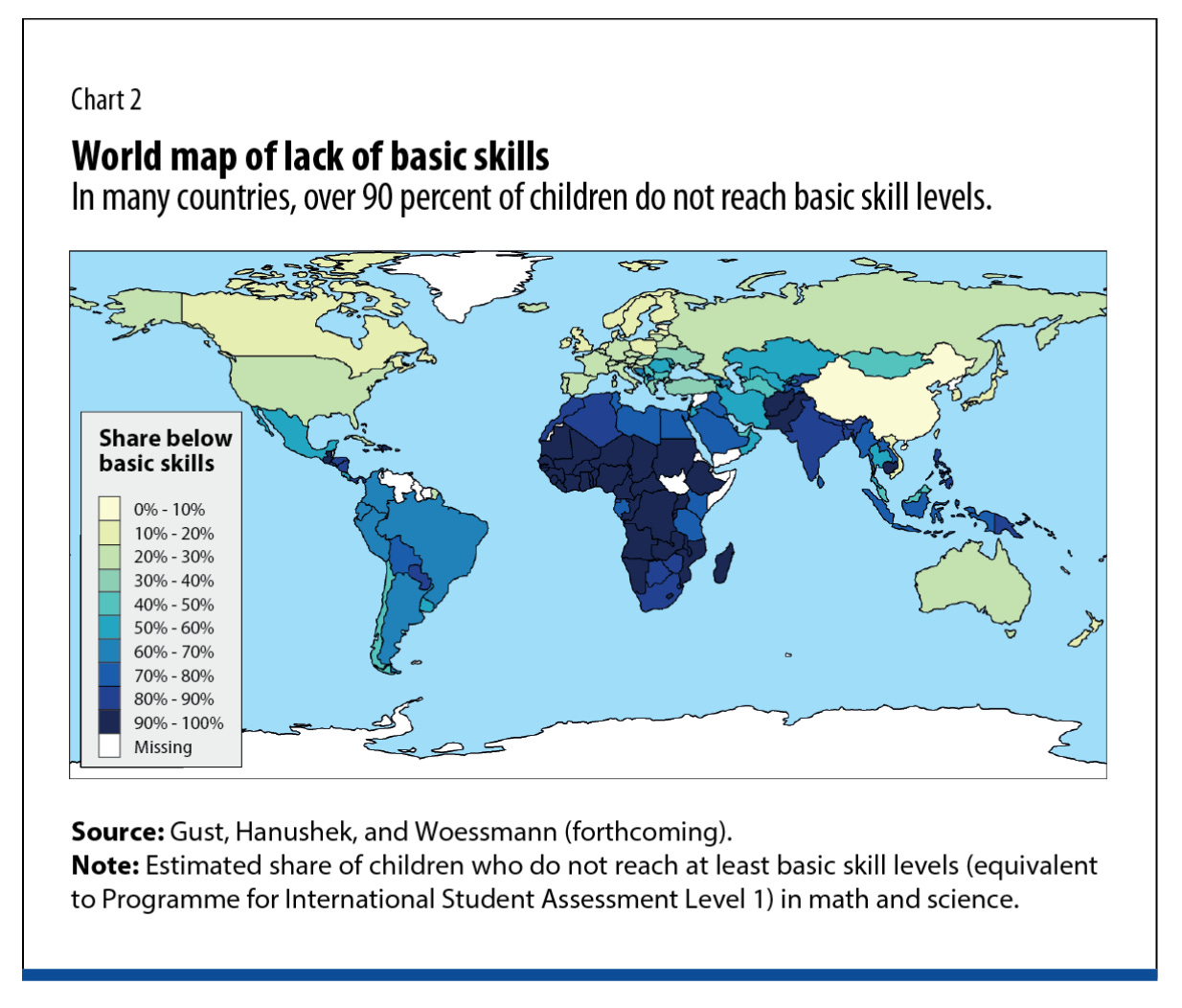
A recent report on basic skills that are essential for economic growth from the IMF paints a stark picture.
In the podcast, Cameron and I discussed repeated European efforts to launch development programs that seem to be spinning their wheels. The global sustainable development goals of 2015 take on their real urgency when you imagine Nigeria or DRC as the challenge.
****
Speaking in medias res, you may wonder whether as a middle-aged white guy who has only been to Africa twice and has no claim to expertise I feel comfortable writing about the contraceptive choices of young African women. No - let me reassure you - I do not! Clearly it is not my place, or anyone like me, to be either authoritative or prescriptive. So what I am doing here is simply to relay and amplify the message.
That, of course, begs another question. Is it coincidental that it is me, middle-aged white guy who is in a position to do that relaying? No it is not! Should it be African voices and African women’s voices addressing this topic? Evidently yes. They speak with far more power and authority, but also at the risk of having the topic pigeon-holed as a matter of particular interest to them, as Africans, as women, whereas, the point that Paice so convincingly makes is precisely that African demography is a matter of truly universal importance. We should all care about the nitty gritty of that DHS data! And that is something it is useful for someone like myself to say.
For me what is at stake is what this remarkable demographic development implies for our understanding of world history. On quantitative grounds alone - let alone qualitative - 21st century history is going to look completely unlike any previous epoch. Africa and Africans will be at the heart of the story.
In this transition, the role that folks like me can perhaps usefully serve is to convey a message that goes something like this:
“African issues, which I suspect you, like me, may previously have not had squarely at the center of your picture of the world, are actually huge and getting huger. When someone comes along who really seems to know their stuff on this topic, pay attention. If you want to have a view of what the world as a whole is going to look like and what, retrospectively, that reveals about our recent past, we are going to have to wrap our minds around this!”
I conclude the FP piece quoting Howard W. French.
“How Africa’s population evolves, and how the continent’s economies develop, will affect everything people near and far assume about their lives today.”a passage from.
That is surely right.
===================
Review
It’s Africa’s Century—for Better or Worse
Asia gets the attention, but the real economic revolution is the inevitable growth of an overlooked continent.
Adam Tooze
By Adam Tooze, a columnist at Foreign Policy and director of the European Institute at Columbia University.
In the coming decades, we face a revolutionary shift in the balance of world affairs—and it is likely not the one you are thinking of.
Since the 1990s, the idea that we might be entering an “Asian century” has preoccupied and disorientated the West. However, once we take in view the long sweep of history, the return of China and India to the center stage of world affairs is less a revolution than a restoration.
For most of the last 2,000 years, the great Chinese and Indian empires were the center of world trade and home to the most sophisticated civilizations. Their growing influence in the world today is the rectification of the anomaly that arose in the 1700s as a result of the yawning divergence in per capita income between “the West” and “the rest.” Successive industrial revolutions and waves of colonial conquest created a world in which economic and military power was radically misaligned with population.
Estratégia eleitoral: como Bolsonaro planeja rebater as críticas sobre a relação Brasil-Rússia
Por Rodolfo Costa, Brasília
Gazeta do Povo, 13/05/2022
O presidente Jair Bolsonaro (PL) está confiante de que tem argumentos suficientes para rebater os críticos da política externa do Itamaraty antes e durante a corrida presidencial. Seus principais conselheiros para assuntos externos entendem que a reaproximação entre Brasil e Estados Unidos é um sinal de que mesmo a criticada posição brasileira sobre a Rússia em relação à guerra na Ucrânia está correta e ajuda a ampliar o capital político e diplomático do governo.
Diplomatas defendem que, com o passar do tempo, a posição em relação à Rússia — classificada pelo Itamaraty como de "equilíbrio", não neutralidade — se mostrou acertada. O Brasil condenou os ataques russos na Assembleia-Geral e no Conselho de Segurança da Organização das Nações Unidas (ONU), mas se absteve pela suspensão russa no Conselho de Direitos Humanos e na cooperação entre Moscou e a Organização Internacional do Trabalho (OIT).
O entendimento no Itamaraty é de que o Brasil condenou a invasão russa nos fórunscabíveis a fim de defender a paz e o diálogo, mas que não poderia alijar a Rússia. "Não faz sentido 'eliminar' quem quer que seja", sustenta um diplomata brasileiro. A reaproximação com os Estados Unidos, agora, mesmo após críticas ao posicionamento brasileiro, reforça a leitura interna de que a política externa acertou no tom e na execução, e abre caminho para o governo explorar isso.
A leitura feita por diplomatas é respaldada por militares em funções no governo, que defendem um estratégico uso político e eleitoral da política externa ao longo do ano. Militares das Forças Armadas também endossam a visão. O comandante da Marinha, Almir Garnier Santos, cumpriu uma agenda de viagens na Itália, Turquia e em Cabo Verde entre o fim de abril e o início de maio e, segundo afirmam interlocutores, a comitiva foi recebida com "tapete vermelho" nos países visitados.
Segundo apurou Gazeta do Povo com fontes da Marinha, o presidente da Turquia, Recep Erdogan, demonstrou, inclusive, o interesse em dialogar a inclusão do país no Brics, grupo de países que inclui o Brasil, a Rússia, Índia, China e África do Sul. O presidente turco, inclusive, tem adotado esforços para mediar um cessar-fogo e um acordo de paz no Leste Europeu.
Entre março e abril, Erdogan conversou com os presidentes da Rússia, Vladimir Putin, da Ucrânia, Volodymyr Zelensky, e o secretário-geral da ONU, António Guterres. "Ao contrário do que uma parte da imprensa tenta colocar, a gente é recebido fora do país com tapete vermelho. O desejo do Erdogan em colocar um país com uma posição estratégica como a Turquia no Brics só reforça nossa posição [sobre a guerra], que está certa", destaca um oficial militar.
Militares e diplomatas estimulam Bolsonaro a ir à Cúpula das Américas Diplomatas e militares entendem que o Brasil deve manifestar sua ambição de participar da governança mundial. Interlocutores do Itamaraty preveem que a situação geopolítica seguirá ditando a agenda internacional e sustentam que a pasta manterá seu posicionamento atual. Eles ponderam, porém, que o país já tinha e continua a ter mais condições de exercer um papel de relevância.
A fim de ampliar o capital político e diplomático brasileiro, militares e diplomatas mais próximos de Bolsonaro o estimulam a ir à 9ª edição da Cúpula das Américas, em junho, nos Estados Unidos, para consolidar a reaproximação com o governo norte-americano sob a presidência de Joe Biden. O ministro das Relações Exteriores, Carlos Alberto França, avalia que o discurso presidencial estará respaldado pela segurança que tem na valorização da política externa.
A análise do chanceler é apoiada por diplomatas brasileiros, ministros e assessores militares do Palácio do Planalto, como Braga Netto, ex-ministro da Defesa. A leitura feita é de que Bolsonaro pode usar a Cúpula das Américas como o pontapé que pode impulsionar a projeção internacional da política externa brasileira em sessões e reuniões nos demais fóruns internacionais ao longo do ano.
O objetivo do governo é transmitir nos mais diferentes organismos multilaterais a imagem de um Brasil "forte", "sereno", "prudente" e que dialoga com o mundo buscando atuar ativamente em uma política externa que valorize os laços com o mundo sem "fechar portas". Para isso, além da Cúpula das Américas, o Itamaraty deve enviar representantes em pelo menos outros sete fóruns, além de reuniões na área do Brics.
Ainda em maio, o Brasil terá representantes em um evento organizado nacionalmente em parceria entre os ministérios do Meio Ambiente e das Relações Exteriores sobre o mercado de créditos de carbono, que deve reunir líderes internacionais para discutir como seria a implementação de um mercado global. Os ministérios da Economia e de Minas e Energia também participarão.
Entre o fim de maio e início de junho, o Brasil participa de uma Reunião Ministerial do Conselho da Organização para a Cooperação e Desenvolvimento Econômico (OCDE). No mesmo mês, também enviará representantes para a 12ª Reunião Ministerial da Organização Mundial do Comércio (OMC), em Genebra, Suíça.
Em julho, o Brasil assume a presidência rotativa mensal do Conselho de Segurança da ONU. No Itamaraty, é dito que o chanceler, Carlos França, participará de ao menos uma sessão. Entre agosto e setembro, o governo enviará representantes à Conferência da ONU de Biodiversidade (COP-15), onde defenderá um novo marco global sobre a biodiversidade. O evento está previsto para acontecer em Kunming, na China, mas devido ao novo surto de Covid-19 no país, é possível que seja transferido para o Canadá.
Em setembro, o governo comparecerá à Assembleia-Geral da ONU. É uma praxe diplomática o presidente da República sempre abrir oficialmente o evento com um discurso. Mesmo se tratando de um período eleitoral, é padrão o presidente comparecer. Em novembro, o governo também estará presente na Conferência da ONU sobre Mudanças Climáticas (COP-27), em Sharm El-Sheikh, no Egito.
Como o governo planeja assumir protagonismo com sua política externa A expectativa no governo é de que, com sua postura de equilíbrio na política externa, o Brasil possa atingir algum nível de protagonismo no debate internacional e usar seu capital político e diplomático "acumulado", como sustentam alguns diplomatas, para defender diferentes demandas.
O principal pleito para este ano é a ascensão à OCDE. Em janeiro deste ano, o chamado "clube dos países ricos" aprovou o convite para o Brasil negociar sua entrada.
O governo tem adotado as medidas possíveis para avançar as tratativas. Em março, o ministro da Economia, Paulo Guedes, viajou a Paris para uma reunião com o secretário-geral da organização, Mathias Cormann, para tentar azeitar a aprovação de um "roteiro" que deve orientar a negociação de adesão, segundo informou o jornal Valor Econômico.
A expectativa do governo é de que esse roteiro possa ser aprovado em junho na Reunião Ministerial da OCDE. Uma vez feito isso, o país precisará se posicionar sobre todas as recomendações feitas pelo clube dos países ricos. Quanto mais rápido o Brasil responder as recomendações contidas no roteiro, mais rápidas as negociações tomam corpo.
O Brasil está em uma posição mais avançada em relação a outros candidatos para negociar sua ascensão à OCDE. Mesmo Argentina e Peru, na América Latina, como Romênia, Bulgária e Croácia, estão em posições menos privilegiadas na mesa de negociações. Um compromisso que o país precisa firmar é o de proteção do meio ambiente e de ações em favor do clima, incluindo para desacelerar o desmatamento.
Diplomatas brasileiros entendem que a pressão ambiental é exercida principalmente por países da União Europeia, com quem o Brasil e o Mercado Comum do Sul (Mercosul) tem tido dificuldades em selar o acordo de livre comércio entre os dois blocos. Entretanto, o Itamaraty tem explorado o apoio de diferentes países que compõem a OCDE, sejam do Ocidente, como os Estados Unidos e o Reino Unido, e do Oriente, especialmente os da Ásia.
Além da ascensão à OCDE, diplomatas brasileiros também entendem que o Brasil pode explorar seu capital diplomático para provocar debates sobre reformas do Conselho de Segurança da ONU, da OMC e da Organização Mundial da Saúde (OMS). São pautas já defendidas pela chancelaria e a ideia é reforçar os pleitos.
Na Assembleia-Geral da ONU no ano passado, o ministro Carlos França se reuniu com os chanceleres de Alemanha, Índia e Japão, que, junto com o Brasil, compõem o chamado G4, grupo formado por países que defendem a urgência da reforma do Conselho de Segurança. Os quatro países têm como objetivo comum alcançar um assento permanente no organismo multilateral.
Diplomatas brasileiros entendem que o Conselho de Segurança tende a uma postura de inércia diplomática e que se move à base de "abalos sísmicos", mais externos do que internos. Há, portanto, o entendimento de que a guerra na Ucrânia propicia a discussão de uma reforma e que o Brasil possa assumir um protagonismo no debate.
A análise é de que a política externa adotada durante a guerra reforça as relações com membros permanentes do Conselho de Segurança, como Rússia e China, sem fechar as portas para Estados Unidos e Reino Unido. A França, porém, que reelegeu o presidente Emmanuel Macron, desafeto do governo, pode oferecer maior resistência.
Diplomatas analisam, no entanto, que essa discussão pode ficar para um segundo momento, quando "abaixar a poeira" no Leste Europeu.
Já as reformas da OMS e da OMC são vistas como mais tangíveis em um curto prazo por diplomatas. Na OMC, uma defesa é a de redução de subsídios para bens agrícolas.
O Brasil tem buscado protagonismo no debate sobre a crise alimentar e, inclusive, propôs a adoção de corredores alimentares e de insumos para fluir produtos agrícolas nos mercados globais, a despeito de sanções à Rússia. Na OMS, a defesa é por respostas mais ágeis para surtos de doenças e pela universalização das vacinas, deinsumos e equipamentos médico-hospitalares.
Quais as chances de o governo assumir o protagonismo almejado O especialista em relações internacionais Ricardo Mendes, sócio-diretor da consultoria Prospectiva, entende que o governo queira mostrar os resultados de sua política externa durante a campanha eleitoral e tente obter um protagonismo internacional maior. Sobretudo após o ex-presidente Luiz Inácio Lula da Silva (PT) voltar a ser reconhecido como importante líder mundial pela revista americana Time, ainda que a agenda exterior não tenha muito peso eleitoral.
Porém, o consultor avalia que falta um pouco de capital político para o Itamaraty conduzir a agenda com a robustez almejada. "Não é que esteja com o capital queimado, mas é um pouco de movimentação eleitoral para criar narrativa para a torcida interna, o Brasil não tem, nem agrupou capital político para ser visto como liderança e discutir grandes temas", analisa.
Sobretudo em se tratando de uma reforma do Conselho de Segurança da ONU, Mendes entende que o Brasil não tenha "ressonância" para discutir como uma liderança internacional de destaque. "Vai tentar levar a discussão, mas falta um pouco de aderência dessa proposta no contexto internacional e o capital político, a distribuição de poder é outra", reforça.
O sócio-diretor da Prospectiva entende que, para as reformas da OMS e da OMC, o Brasil possa, sim, ser ouvido como um player importante no cenário internacional, mas não com um papel de protagonista. "Temos respeito de um grupo grande de países, talvez a maior parte dos países do mundo, mas liderar é complicado", analisa. Para ele, a ascensão à OCDE é uma missão mais factível, sobretudo com a possibilidade de Lula ganhar a eleição.
"Vejo bastante movimentação em torno disso. É um tema que ganha tração e mobiliza muitos grupos de interesse fora do Brasil, Washington, Europa, pois veem oportunidade de exigir mudanças em algumas regulamentações no Brasil não só para alinhar com a OCDE, mas usar como moeda de barganha uma demanda por mudanças na política ambiental, por exemplo", pondera Mendes.
Já o especialista em relações internacionais Welber Barral, sócio-fundador da BMJ Consultores Associados, concorda parcialmente com as defesas feitas por militares e diplomatas sobre a política externa do governo por entender que, de fato, há uma mudança no cenário internacional e o Brasil tem papel relevante. Porém, ele entende que o ritmo dessa mudança não é rápido.
Para Barral, mesmo a aproximação com os Estados Unidos não se consolida em um ano eleitoral. "Você tem uma mudança, mas o ritmo de implementação depende de fatores e falamos de uma mudança institucional. Muito provavelmente os EUA vão esperar para saber com que governo vão negociar no ano que vem", destaca.
O sócio-fundador da BMJ Consultores aponta, ainda, que a reaproximação com os Estados Unidos não é exclusiva do Brasil, e que há uma preocupação e mudança de postura da gestão Biden em relação à América Latina em geral, inclusive com a Venezuela.
"Para muitos países, inclusive os EUA, o Brasil não é visto como uma entidade sozinha, mas parte de uma política para a América Latina. Então, Washington provavelmente vai criar iniciativa de mais investimentos, mas para a região. O quanto o Brasil vai se aproveitar disso vai depender dos esforços da política externa", sustenta.
A lógica apontada por Barral também vale para as demandas do Brasil nos organismos multilaterais. Para o especialista, o Brasil seguirá sendo cobrado por mudanças na área ambiental, pelos EUA e Europa, e precisará honrar os compromissos acordados. Só assim, na opinião do especialista, poderá ampliar seu capital político e sua relevância no cenário internacional para pleitear suas demandas.
O conselheiro da BMJ aponta, porém, que mesmo pautas como reformas da OMC e OMS não são rápidas. "Uma reforma da OMC vai levar até 5 anos, estamos falando de algo a médio prazo. A do Conselho de Segurança talvez mais ainda", alerta. "Reformas institucionais são lentas, são longos processos de negociação. Vão ter cobranças, vai precisar de articulação não só do Itamaraty, mas do governo, da sociedade civil e do setor privado para que tenha postura internacional de melhorar a imagem internacional", acrescenta.
Lideranças do Congresso defendem política, mas pedem mais avanços O deputado federal Cláudio Cajado (PP-BA), presidente nacional em exercício do partido e presidente do Grupo Parlamentar Brasil-Ucrânia, elogia a política externa adotada pelo Brasil e acredita que há avanços que respaldam o otimismo do Itamaraty em relação à agenda internacional.
"Penso que a nossa posição, nossa dimensão e a nossa tradição são, sim, atrativos para que possamos estar cada vez mais envolvido em posições como a do convite da OCDE, que acho ser fundamental para o Brasil, importantíssimo para que consigamos cada vez mais aprimorar nossa governança em termos de gestão pública", analisa.
Membro titular da Comissão de Relações Exteriores e Defesa Nacional (CREDN) da Câmara, Cajado entende que, tão logo surjam as oportunidades para avançar nas negociações por reformas dos organismos multilaterais, o Brasil irá discutir com um papel relevante. "E se forem medidas que aprimorem e melhorem o funcionamento [dos organismos], não tenho dúvidas de que poderemos, sim, nos aliar aos países que desejam fazê-lo", pondera.
O parlamentar defende, ainda, a política externa feita pelo chanceler e entende que a posição de equilíbrio e imparcialidade do Brasil permite a construção de relações políticas e comerciais de "boa vizinhança" com outros países no plano "mais elevado" possível. "O Itamaraty com o ministro Carlos França está indo muito bem, bem melhor do que antes", destaca.
O deputado federal Fausto Pinato (PP-SP), presidente das frentes parlamentares Brasil-China e do Brics, classifica França como um "craque" da política externa. "De certa forma, ele vem tentando reparar alguns erros mortais que foram feitos pela linha 'terra plana' do ex-ministro das Relações Exteriores [Ernesto Araújo]", declara.
Embora entenda que os impactos, declarações e ações na gestão anterior estejam minimizadas, Pinato avalia, porém, a gestão de França ainda não fez acenos mais significativos à China. "Que gesto efetivo foi feito em relação à China depois de tantos ataques da gestão anterior? Inclusive, não vimos um gerenciamento para tentar, de certa forma, buscar a nomeação do novo embaixador da China", critica.
A embaixada da China está sem um representante oficial desde que o ex-embaixador, o diplomata Yang Wanming, deixou o cargo em 5 de março. Pinato defende que o Brasil tenha atenção com o governo chinês e dialogue com a representação chinesa um sucessor. "Falta racionalidade e pragmatismo para fazer negócios, melhorar a exportação e, consequentemente, gerar empregos e elevar a arrecadação", destaca.
Pinato pondera que a prioridade para o país é combater a inflação com medidas para diminuir o valor do combustível, do botijão de gás e dos alimentos, e e entende que a política externa do Itamaraty pode ter um papel preponderante para auxiliar os esforços do governo nessa missão. "Discutir política externa também é discutir combustível e insumos para o agronegócio", justifica.