segunda-feira, 9 de março de 2026

A Strategic Learning Deficit: Western Military Institutions Ignored Ukraine War Lessons - Mick Ryan (Futura Doctrina)

The Big Five

A Strategic Learning Deficit: Western Military Institutions Ignored Ukraine War Lessons.

The Big Five, Futura Doctrina, 8 March edition

My weekly update on war and strategic competition. This week, ignoring Ukraine war lessons hurts, battlefield and long-range strike, PLA operations in the Pacific and my Big 5 reading recommendations.

Mick Ryan

Futura Doctrina, Mar 08, 2026 - https://mickryan.substack.com/p/a-strategic-learning-deficit-western

Ukrainians have been fighting against “shahed” drones for years now, and everyone recognizes that no other country in the world has this kind of experience. We are ready to help, and we expect that our people will also receive the support they need. Protecting life must be a shared priority, and it is very important to coordinate for security both in Europe and in the Middle East. President Zelenskyy, 8 March 2026.

The week of 2–8 March 2026 continued to show that the war in Ukraine has a level of dynamism that is not reflective of the ‘frozen conflict’ narratives popular in some areas. On the frontline, Ukrainian ground forces demonstrated a quiet resurgence while continuing to hold the line against the Russian offensive machine. Long range strike forces executed one of the most operationally significant maritime strikes of the war.

Diplomacy collapsed under the weight of a new Middle East war. 300 Ukrainian prisoners of war returned home, and, President Zelenskyy visited his frontline soldiers again - something Putin has shown no inclination to do, and no courage to do, in the past four years.

In the Pacific, Taiwan is focussed on integrating its defences within a larger First Island Chain defensive strategy, and China halted its aerial incursions into Taiwan’s airspace for a week.

Welcome to this week’s update and Big Five!

Ukraine

Image: Wild Hornets

Interceptor Drones and the Systemic Learning Deficit in Western Military Institutions. This week revealed fully just how poor western and Middle East military institutions have been at learning from the war in Ukraine. I have written several times about how western military organisations have shown a lack of humility in learning from Ukraine, but the past week has provided the best evidence yet of that phenomenon.

Therefore, it was an extraordinary development this week when the United States formally asked Ukraine for help defeating Iranian drones. When the U.S. and Israel launched their attack on Iran on 28 February, Iran responded with a barrage that included over 500 ballistic missiles and approximately 2,000 unmanned aerial systems in the first five days, according to US Central Command. American air defences — designed for the threat environments of the late 20th century — struggled with the volume of cheap, slow-moving Shahed-type drones. A strike in Kuwait killed six American servicemembers. Drone strikes damaged the US Fifth Fleet headquarters in Bahrain. The Washington Post reported on 5 March that both the United States and its Middle Eastern allies had approached Ukraine seeking expertise and practical support in countering Iranian drones.

Zelenskyy responded shrewdly. He confirmed that Ukraine would provide assistance, directed officials to present options, and announced that Ukrainian specialists and technology would be deployed to the region. He then offered a proposition that was equal parts pragmatic and diplomatically elegant: Kyiv offered to send its best drone interceptors to the Gulf — in exchange for Patriot air defence missiles. ‘It is an equal exchange,’ Zelenskyy said.
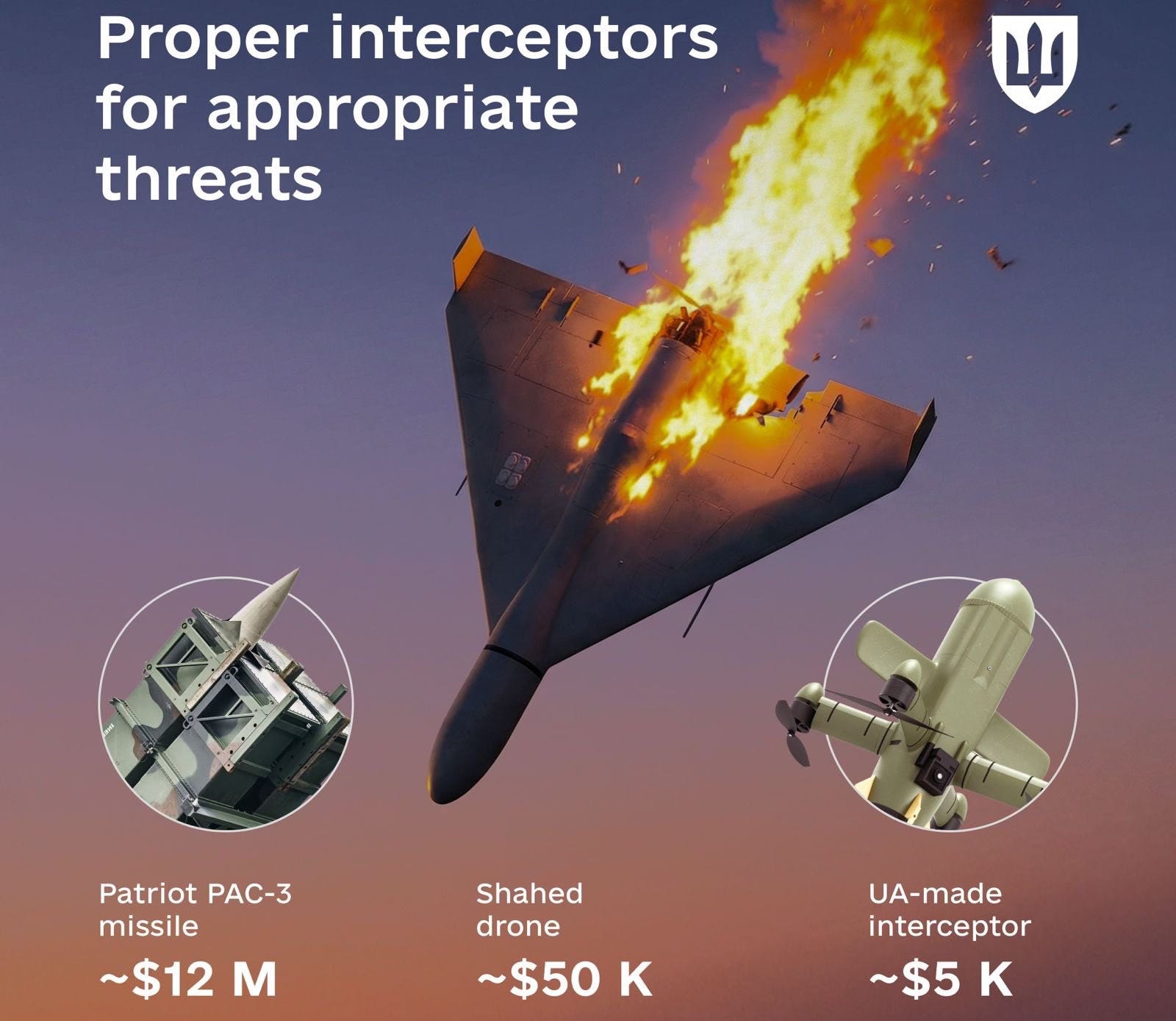
Image: @DefenceU

The irony is huge. Ukraine has been defending itself against Shahed drones since 2022. Russia initially imported them from Iran; Iran has since supplied an estimated 5,000 to 10,000 of the weapons to Moscow, with Russia also producing modified variants (the Geran) domestically. Ukraine has built a layered, cost-effective counter-drone architecture over four years of trial and error. For at least a year, Ukraine has employed low-cost drone interceptors, which are an order of magnitude cheaper than Shaheds, as part of this air defence system. It is exactly what the United States and some of its partners lack in the Gulf. CNN reported on 7 March that the US had also decided to deploy its Merops anti-drone system — proven in combat against Russian drones in Poland and Romania — to the Middle East, citing lessons learned from the Ukrainian theatre.

This was a highly predictable threat from Iran which was not paid sufficient respect by the Americans and others, and as a result, they were unprepared. But at least the U.S. military demonstrated some capacity for learning by using Shahed copies (the LUCAS drones) against Iran. The situation is much worse in other countries (particularly Australia), where these has been a systemic effort to downplay or ignore learning from Ukraine. It is an example of a systemic learning deficit in western military organisations which has bitten America and countries in the Middle East.

Just in case we are led to believe that the drone interceptors are the only example of a lack of learning, there was another good example of this systemic learning deficit during the week. A British politician visiting Ukraine tweeted from a previously undeclared maintenance site for British military equipment. For four years, both Ukraine and Russia have employed simple and widely available geolocation from social media posts (and images / videos in those posts) to prime their targeting process. How had they not learned this? As a result, it is highly likely the Russians will target this location, and more lives might be put at threat. At the minimum, the site will have be relocated.

In conclusion, ignoring lessons of modern wars - in an era when war has never been more visible - will hurt you at some point. America and Middle East nations found this out the hard way during the week. What other nations out there have also engaged in willing ignorance of what Ukraine can teach us?
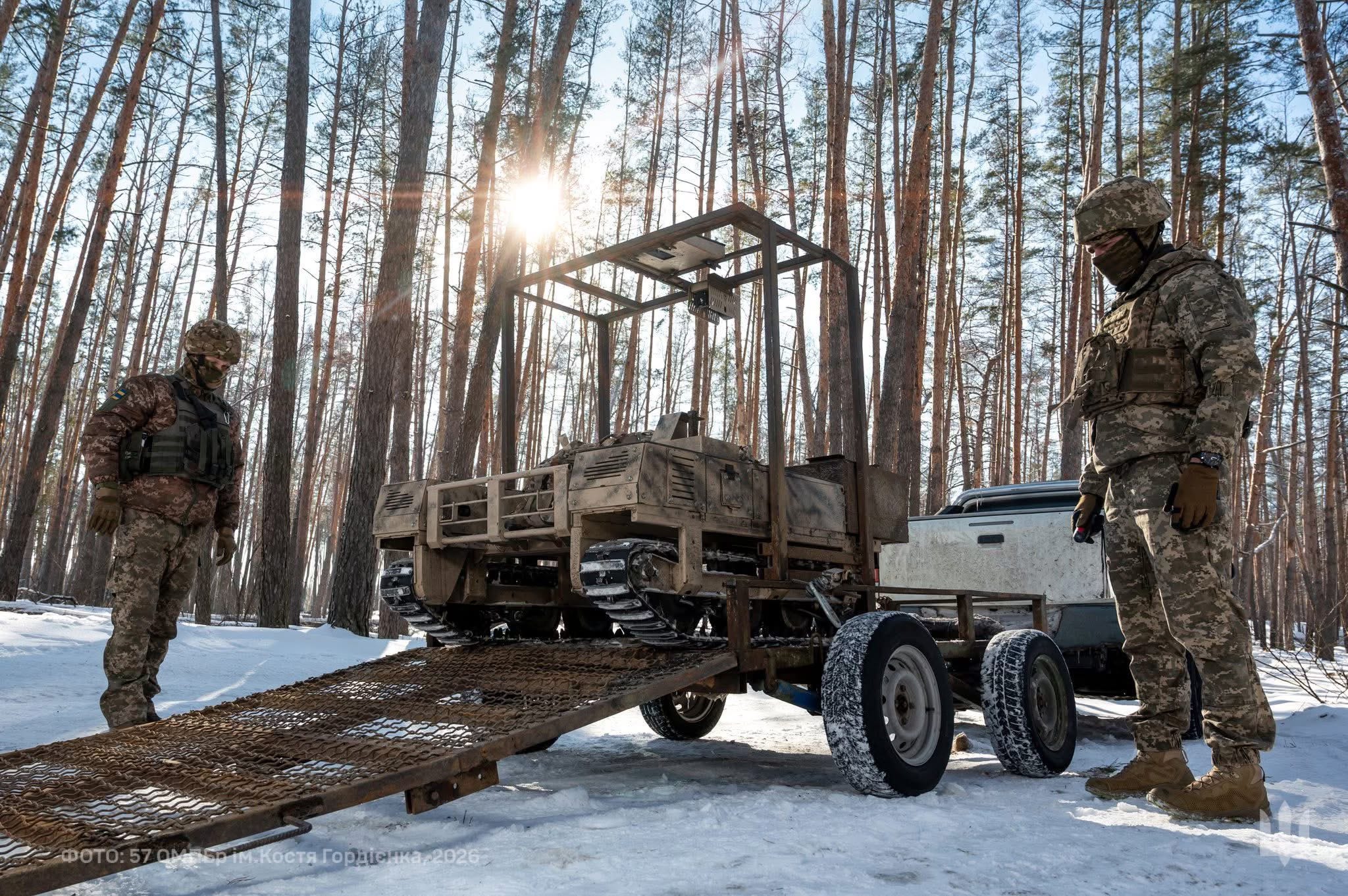
Image: @DefenceU

Ukraine Armed Forces Strategic Research Priorities 2026. This week, the Ukrainian Armed Forces released its research priorities for the coming year. The briefing provided a look back at 2025, noting that:

The main change in 2025 is the transition from chaotic developments to a holistic state system…Last year, the Armed Forces of Ukraine completed the formation of a holistic system that allows them to respond instantly to the challenges of war. The key principle is feedback.

The key priorities for research funding (and percentage of research funding received) in 2025 were:

  • UAV – 28%.

  • Robotic systems (RCS) – 15%.

  • Communication and information protection – 11%.

  • Electronic warfare and countermeasure systems – 8%.

This year, the Ukrainian Armed Forces will focus on four strategic areas:

  1. Improvement of the innovation management system.

  2. Scaling of research activities.

  3. Deep implementation of Artificial Intelligence technologies.

  4. Further development and integration of unmanned systems in all branches of troops.

Reckoning in the South: The Ground War. This week Ukraine’s Commander-in-Chief, General Syrskyi reported that Ukrainian forces captured more territory in February 2026 than Russian forces were able to seize during the same period. This represents the best relative territorial performance for Ukraine’s ground force since the Kursk operation in August 2024. He described it as having survived a ‘difficult battle of the winter.’

This matters because the pattern of Russian winter advances has been consistent (and often demoralising) in the past couple of years. The Ukrainian gains have broken that pattern, at least for 2026. According to Russia Matters, which cross-references ISW data, Russian forces gained just 46 square miles of Ukrainian territory in the period from 3 February to 3 March 2026 compared with 123 square miles in the previous four-week period. Russian monthly gains of Ukrainian territory have nearly collapsed from their late-2025 peak.

The most consequential Ukrainian gains occurred in the south — in the Zaporizhzhia and Dnipropetrovsk oblasts. ISW’s assessment of 6 March assessed that Ukrainian forces have liberated 244 square kilometres in the Hulyaipole and Oleksandrivka directions since 1 January 2026, while Russian forces seized 115 square kilometres in the same region and time period. This is a net Ukrainian gain of nearly 130 square kilometres on this axis of advance. Ukrainian forces cleared Russian positions west of the Haichur River and likely liberated the settlements of Ternuvate and Kosivtseve.

Along the northern and eastern regions of the frontline, the picture was mixed. ISW’s daily assessments throughout the week tracked Ukrainian advances in the Kostyantynivka-Druzhkivka tactical area and near Kupiansk, while Russian forces continued to press their advance on the Pokrovsk and in the Slovyansk axes of advance. The grinding combat on the ground in Donetsk continues.

Long Range Strike. Russia has probably failed to achieve the objectives it set for its Winter 2025–2026 long-range missile and drone campaign against Ukrainian energy infrastructure. This assessment is supported by an ISW report from the week, which also noted that the Russian military command ‘continues to operate in an alternate reality, setting wildly unrealistic deadlines that do not match Russia’s actual battlefield capabilities.’

President Zelenskyy also warned this week that Russia intends to shift its strike campaign toward Ukrainian logistics and water infrastructure as spring arrives — a potentially significant escalation that could threaten civilian supply chains and Ukraine’s ability to sustain frontline forces. He issued that warning in ISW’s 2 March assessment, and Ukrainian authorities have since been taking steps to harden railway junctions and water facilities against attack.

The most significant long range strike event of the week occurred on 2 March, when Ukrainian forces executed a large-scale drone strike against the Russian Black Sea Fleet’s primary operating base at Novorossiysk. It was a complex, large-scale attack of a type we must all learn from.

According to Ukrainska Pravda, citing sources within the Security Service of Ukraine (SSU), the operation involved approximately 200 aerial and maritime drones, coordinated across multiple Ukrainian agencies including Special Operations Forces, the State Border Guard Service, Defence Intelligence, and the Unmanned Systems Forces. The Ukrainians claim to have hit Russian naval vessels, air defence systems, as well as energy infrastructure at the Sheskharis oil terminal.

The key strike was against the frigate Admiral Essen, which is a Burevestnik-class warship carrying eight Kalibr cruise missilesUNITED24 Media reported that the frigate’s midsection superstructure was hit, triggering an 18-hour fire. The SSU stated that: ‘The ship sustained critical damage that significantly limits its ability to use Kalibr cruise missiles. At present, the frigate cannot carry out strikes on the territory of Ukraine.’

This is a good outcome. The Admiral Essen has been a persistent source of Kalibr strikes against Ukrainian cities since 2022. Its effective removal from the Russian strike fleet — even temporarily — has operational consequences. The same strike also damaged the minesweeper Valentin Pikul, the anti-submarine corvettes Yeysk and Kasimov, hit a guidance radar from an S-300PMU-2 air defence system, and set fire to six of seven oil loading arms at the Sheskharis terminal.

Later in the week, the Ukrainians hit a key Russian Shahed drone hub near Donetsk Airport. The site was used to store, prepare, and launch strike UAVs against Ukraine.

The broader strategic significance of these strikes is that another Russian Black Sea Fleet refuge is no longer a safe harbour for the Russian Navy. Ukraine’s ability to strike deep into Russian rear areas with significant air, missile and drone defences by using complex multi-domain drone swarms represents one of the most important military developments of this war. The Ukrainian long range strike capability, something I have written about for three and a half years, continues to mature.

And it offers many insights for other military institutions – if they are willing and humble enough to learn.

Diplomacy Interrupted. The diplomatic track of the Ukraine War, which had been dragging on with little progress across the Coalition of the Willing summit in Paris in January and three rounds of US-brokered talks, came to an abrupt halt this week as the war against Iran commenced.

A fourth round of trilateral talks between Ukrainian, Russian, and American representatives had been scheduled for 5–6 March in Abu Dhabi. Bloomberg reported on 5 March that Zelenskyy formally confirmed the talks were postponed indefinitely. “For now, because of the situation with Iran, the necessary signals for a trilateral meeting haven’t come yet. As soon as the security situation and the broader political context allow us to resume the trilateral diplomatic work, it will be done.”

The venue for the talks was part of the problem. The UAE, which had hosted two prior rounds of talks, had largely closed its airspace as Iranian ballistic missiles and drones targeted Gulf states. Indeed, as I write this, another strike against the Dubai airport occurred. Modern Diplomacy reported this week that Ukrainian officials were exploring alternative venues for the talks, including Turkey and Switzerland, both of which have previously hosted negotiations related to the conflict. But the deeper problem with the talks now is not geography — it is political bandwidth.

The Trump administration, which had been the primary diplomatic driver of the Ukraine peace process, is now absorbed by its war against Iran. American attention, American assets, and American political capital have been redirected. Zelenskyy was direct about the risk: speaking to Novaya Gazeta Europe, he warned that a prolonged U.S.-Iran war could deprive Ukraine of key air defence systems it needs to intercept Russian missiles, as Washington would prioritise supplying the Middle East with Patriots and other interceptors.

The Kremlin quickly exploited the disruption. ISW’s 5 March assessment noted that Kremlin officials are ‘using the escalation in the Middle East to set conditions to blame the United States for any future failures in negotiations for a peace in Ukraine.’ Russian officials are working to rhetorically place Russia and the United States in opposition, attempting to discredit U.S.-led mediation efforts by painting Washington as an aggressive power unfit to serve as a neutral broker.

Peace in 2026 is looking even more unlikely – and I began the year with low hopes for this.
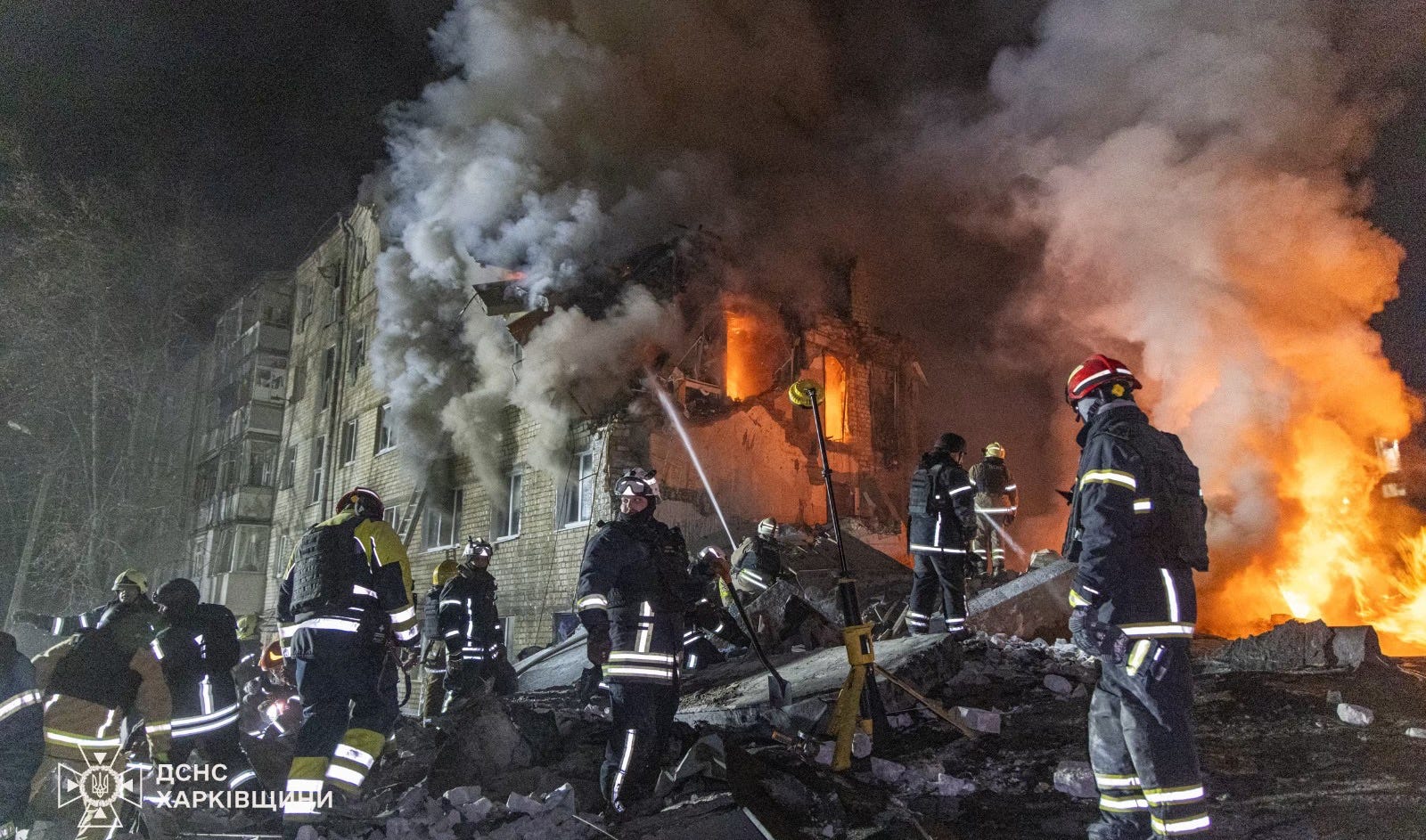
Despite the war in Iran, the war in Ukraine continues. Image: @ZelenskyyUa

Strategic Assessment. Ukraine is performing better on the battlefield than the narrative of inevitable victory from Russia describes. As I noted in a piece this week, strategic narratives are not strategy. Russia, likely to launch its spring offensives soon, will be doing so having failed to achieve its strategic objectives for winter. Diplomacy, interrupted by the war in Iran and a global security environment that is changing rapidly, is unlikely make significant progress in the short term.

Three conclusions are worth noting.

First, Ukrainian military performance is holding up and in some areas improving. The Novorossiysk strike, and the counter attacks in the south (now largely halted because of clearer weather) all point to a force that is learning, adapting, and finding ways to strike the Russians in new ways. This is an army that continues to take punches but remains standing and continues hitting back. We can learn from that.

Second, the diplomatic window is narrowing. The Iran War has not killed the Ukraine peace process, but it has disrupted it at a critical point. Russia still shows no signs of genuine compromise on the territorial question that is the heart of any potential settlement, however. The United States remains a crucial broker but is currently otherwise occupied.

Finally, the new Iran War shows that Ukraine’s hard-won expertise has global strategic value. Kyiv is leveraging it intelligently to extract air defence resources from Middle East nations, and to maintain its relevance in a Washington increasingly consumed by a different war. Whether this translates into meaningful gains — Patriot systems, continued military support, sustained American diplomatic engagement — remains to be seen.

The Middle East

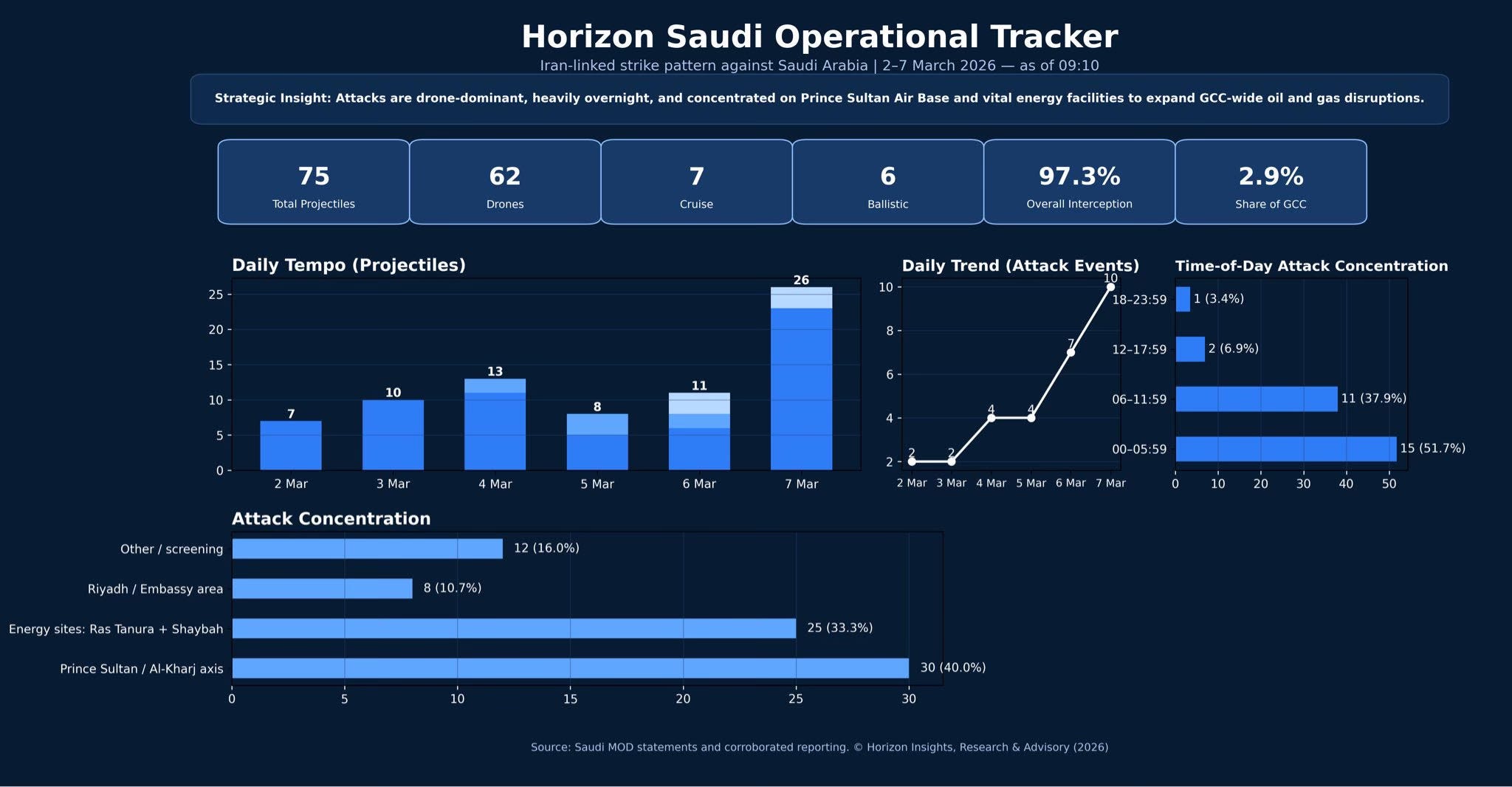
Because I have published a few articles on this topic throughout the week, I will focus on the statistics of the war for this section of the update. The first is an update from the UAE Ministry of Defence (as at 7 March) that covers the drone and missiles strikes against the country since the start of the new Iran War.
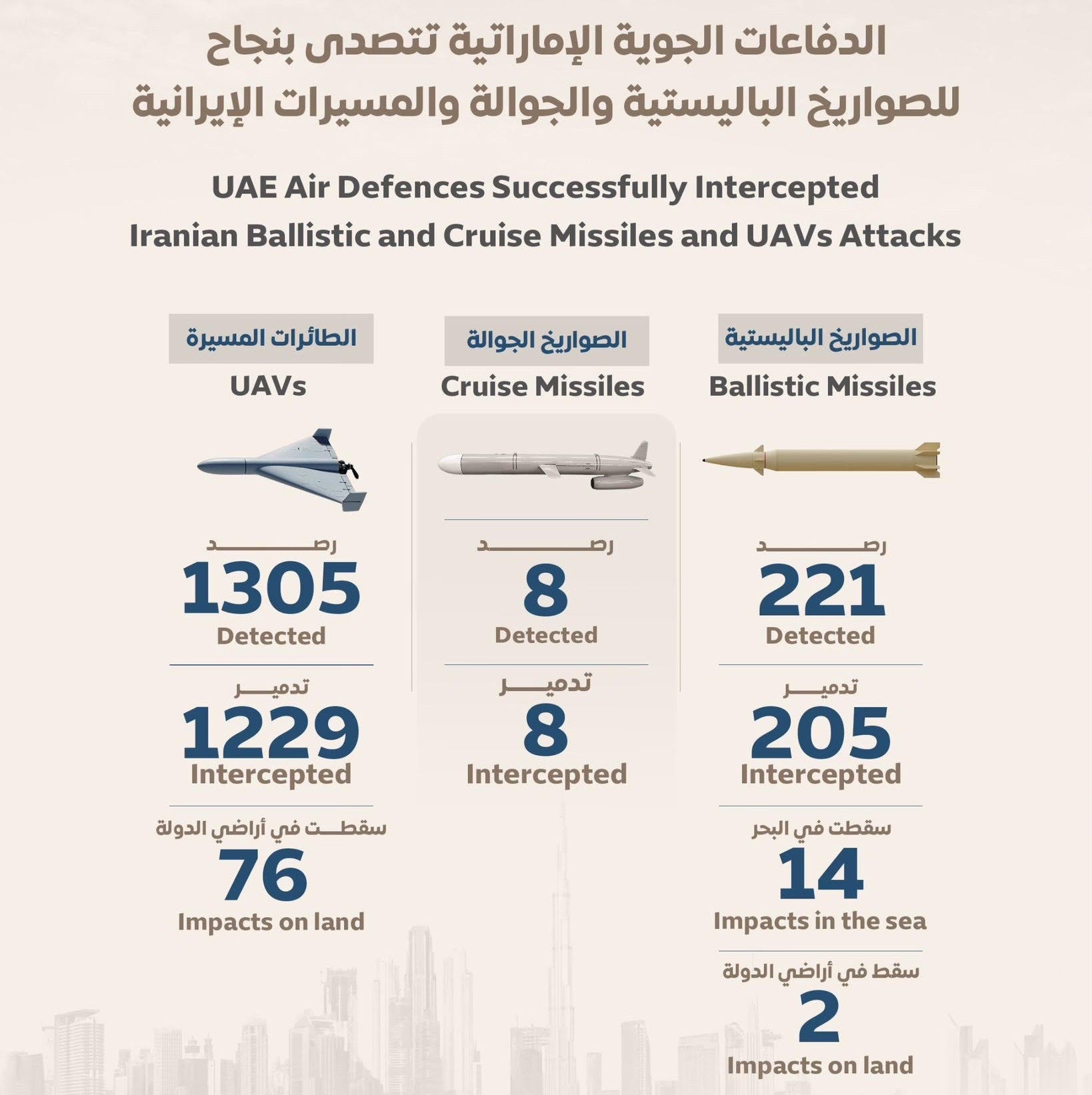
Next, is the update from Saudi Arabia that contains similar data. Attacks on Saudi Arabia are an order of magnitude lower than those in UAE. However, just a few well placed drones and missiles hitting oil production facilities can reverberate around the world.
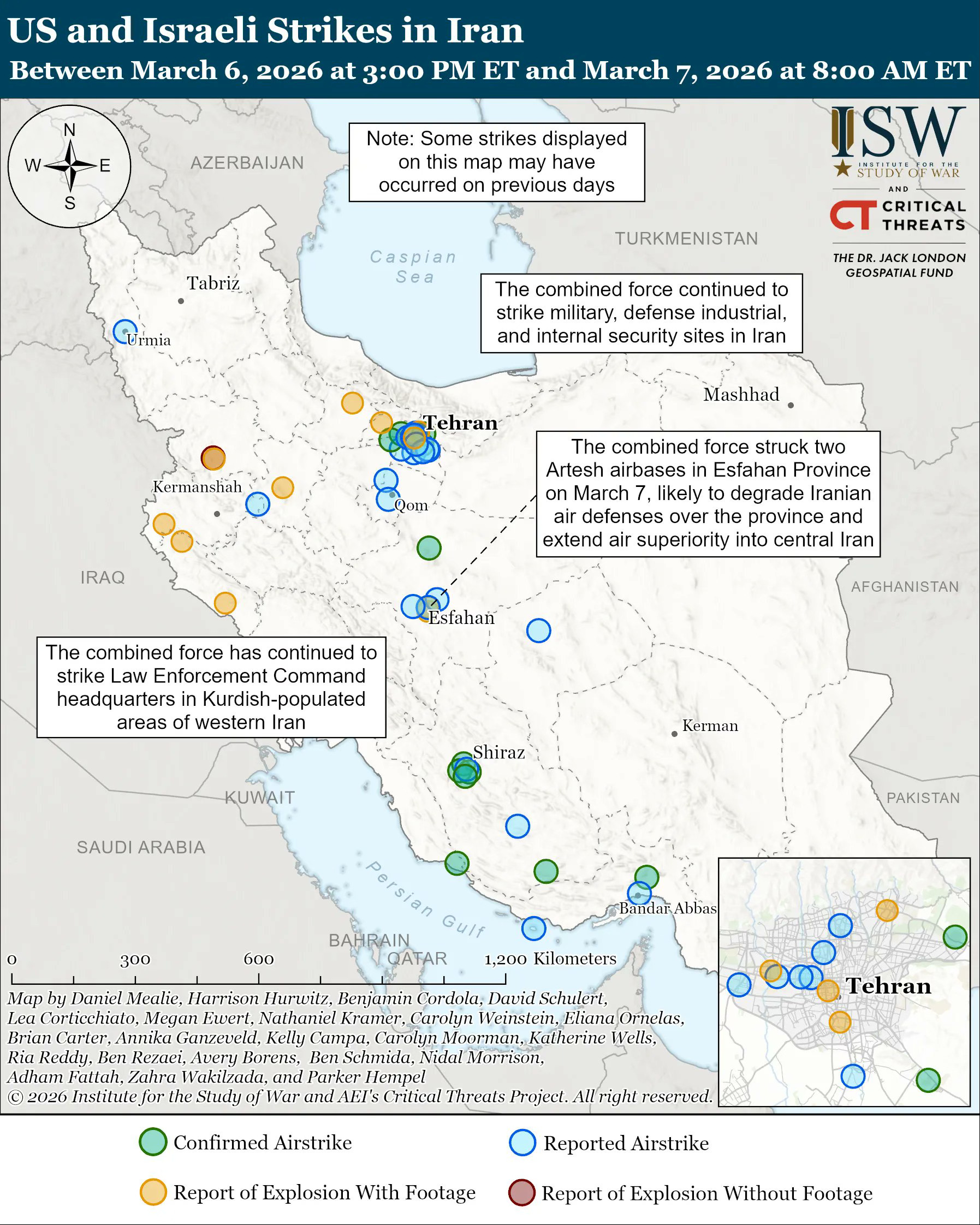
Finally, the latest info-graphic from The Institute for the Study of War covering where U.S. and Israeli forces have conducted strikes against Iran in the past 24 hours.
The Pacific
Image: @INDOPACOM

First Island Chain Integration Strategy. Taiwan Foreign Minister Lin Chia-lung’s interview with The Japan Times articulated a diplomatic strategy acknowledging changed strategic circumstances. Lin argued that effectively deterring China’s expansion into the Pacific requires embedding Taiwan more fully into Indo-Pacific security frameworks, particularly with First Island Chain partners. This represents not just political announcements but recognition that Taipei cannot rely solely on bilateral U.S. security commitments given contemporary American strategic ambiguity.

Foreign Minister Lin called for enhanced cooperation in intelligence-sharing, joint exercises, defense-industry tie-ups, data links, and dealing with hybrid threats such as China’s grey-zone activities. The emphasis on mini-lateral frameworks reflects Taiwan’s assessment that distributed deterrence through multiple partnership nodes offers greater resilience than dependence on a single alliance relationship.

Yet this strategy confronts structural constraints: Taiwan lacks formal diplomatic recognition from most First Island Chain states, limiting the depth and transparency of security cooperation.

China’s Low Tempo Air Operations Around Taiwan. This week, PLA aircraft activity near Taiwan showed a fascinating pattern. After an eight-day absence of detected flights—the longest such stretch since systematic tracking began—Chinese military aircraft resumed operations on 7 March. The pause has generated speculation about causes ranging from mechanical maintenance cycles to deliberate strategic signalling. Taiwan’s Defense Minister Wellington Koo cautioned legislators that absence of air incursions should not imply absence of PLA activity, noting that sea-based operations continued without pause.

An analysis of this lack of PLA aerial activity by the Taiwan Security Monitor noted that:

This pause naturally sparked speculation, however many popular theories are as of yet unsupported by observable patterns and regional events. Observers have forwarded several possible explanations, to include the ongoing operations in Iran, the upcoming summit between President Trump and Xi, an inability to operate routinely following a series of major officer purges, and domestic politics in Taiwan.

You can read their full analysis on this pause (which is now over) at this link.

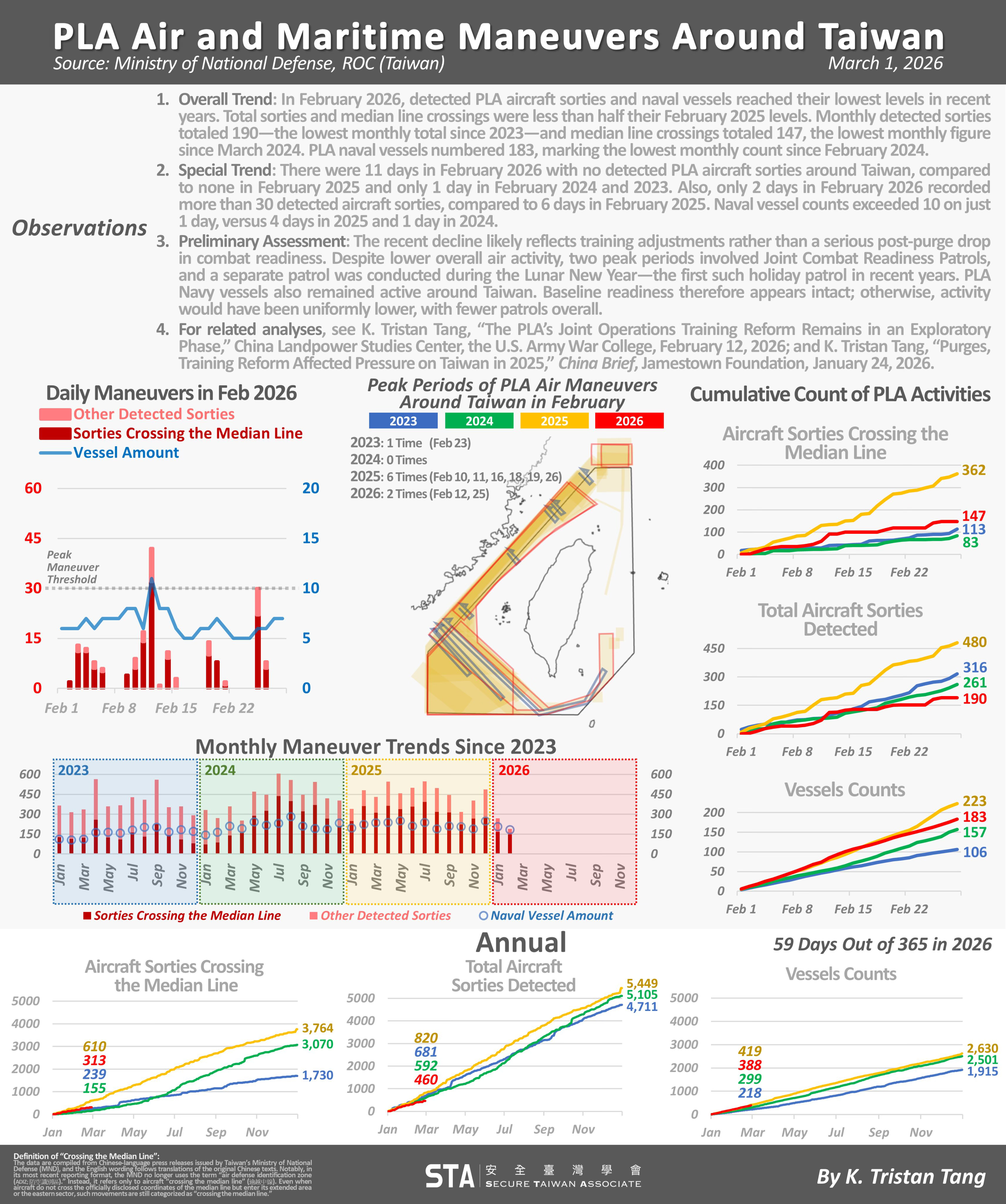
Monthly Update on PLA Air and Maritime Maneuvers Around Taiwan. During the week, @KTristanTang released his latest monthly update on Chinese activity around Taiwan. His conclusion: “PLA air and maritime activity around Taiwan has declined, but this does not necessarily imply that combat readiness has been seriously weakened by the recent purges. Rather, it appears to reflect a shift in training planning toward exploring joint operational modes.”
Middle Power Security and Carney’s Asia-Pacific Visit. This week the Canadian Prime Minister visited the Pacific region, including stops in Australia, India and Japan. Pitching a middle power approach to regional security, he seeks to address the fundamental question confronting Pacific security affairs. Is a network of distributed, minilateral security agreements a viable substitute for weakened bilateral alliance credibility. Manila, Tokyo, Canberra, and Taipei are building networked relationships precisely because long-standing hub-and-spoke arrangements in the region, of which America is a critical component, appear insufficient.

Yet networked resilience of the type discussed this week depends on each nations’ individual capability and collective coordination. The transition from American-guaranteed stability to a more distributed form of deterrence against Chinese aggression will either produce more robust security or dangerous gaps. This week suggests allies and partners understand the challenge, but have not yet invested in solving it.

Japan’s defence spending has doubled from 1% to 2% of GDP, and the current Japanese PM is looking at further enhancements to the budget as well as constitutional change. Unfortunately, few other countries in the region, including Canada or Australia, have shown an inclination to drastically increase defence spending or a willingness to take more strategic risk in seeking to deter China.

*******

This week, I published a couple of articles on Futura Doctrina.

First, I published an article on 2 March which examined initial insights and questions from the initial phase of the new U.S.-Israeli military campaign against Iran. You can read that article here.

Next, I published a piece yesterday that explored what Putin and Xi might be learning from the war in Iran. Called Selective Belligerence and Unconditional Surrender, you can read this article at the following link.

*******

It’s time to explore this week’s recommended readings.

In this week’s Big Five, I have included an excellent new report from RAND that examines Chinese perspectives on the military applications of AI. There are also articles on how the Chinese leader might approach his upcoming summit with President Trump, insights into how AI will impact on army officers and a good piece of FICINT from Peter Singer and August Cole.

As always, if you only have the time available to read one of my recommendations, the first is my pick of the week.

Happy reading!

1. PLA Perspectives on AI
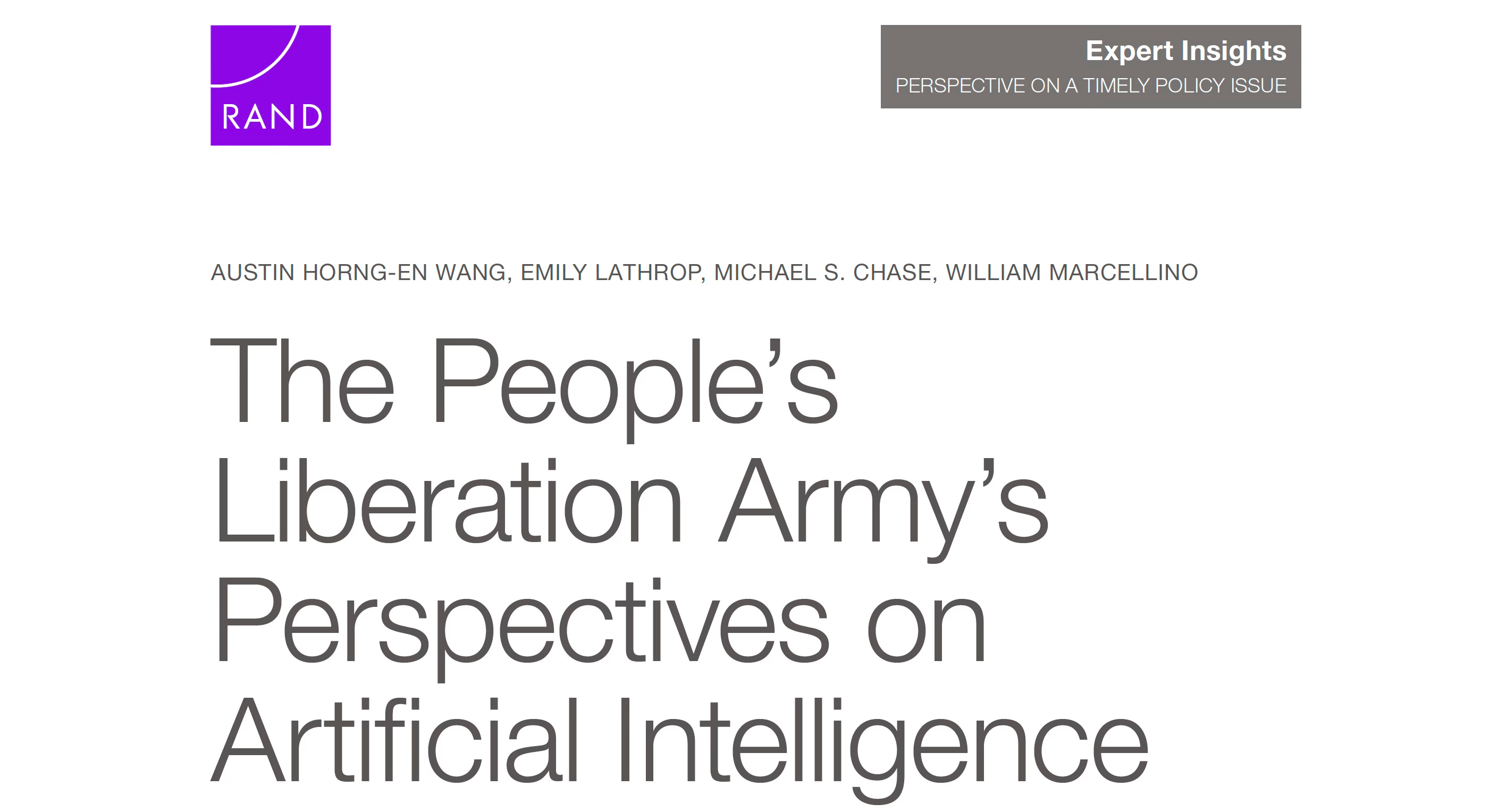
In this new report from RAND, the authors explore integration into the PLA from the perspective of Chinese military leaders. The review indicates that the PLA will use AI to enhance its kill chains by strengthening joint AI integration, multi-agent collaboration, and improved, secure data transmission. There is also examination of the use of AI in military logistics. Finally, the authors propose several targetable vulnerabilities in the PLA approach to AI implementation. You can read the full report at this link.

2. Will China Overplay Its Hand?
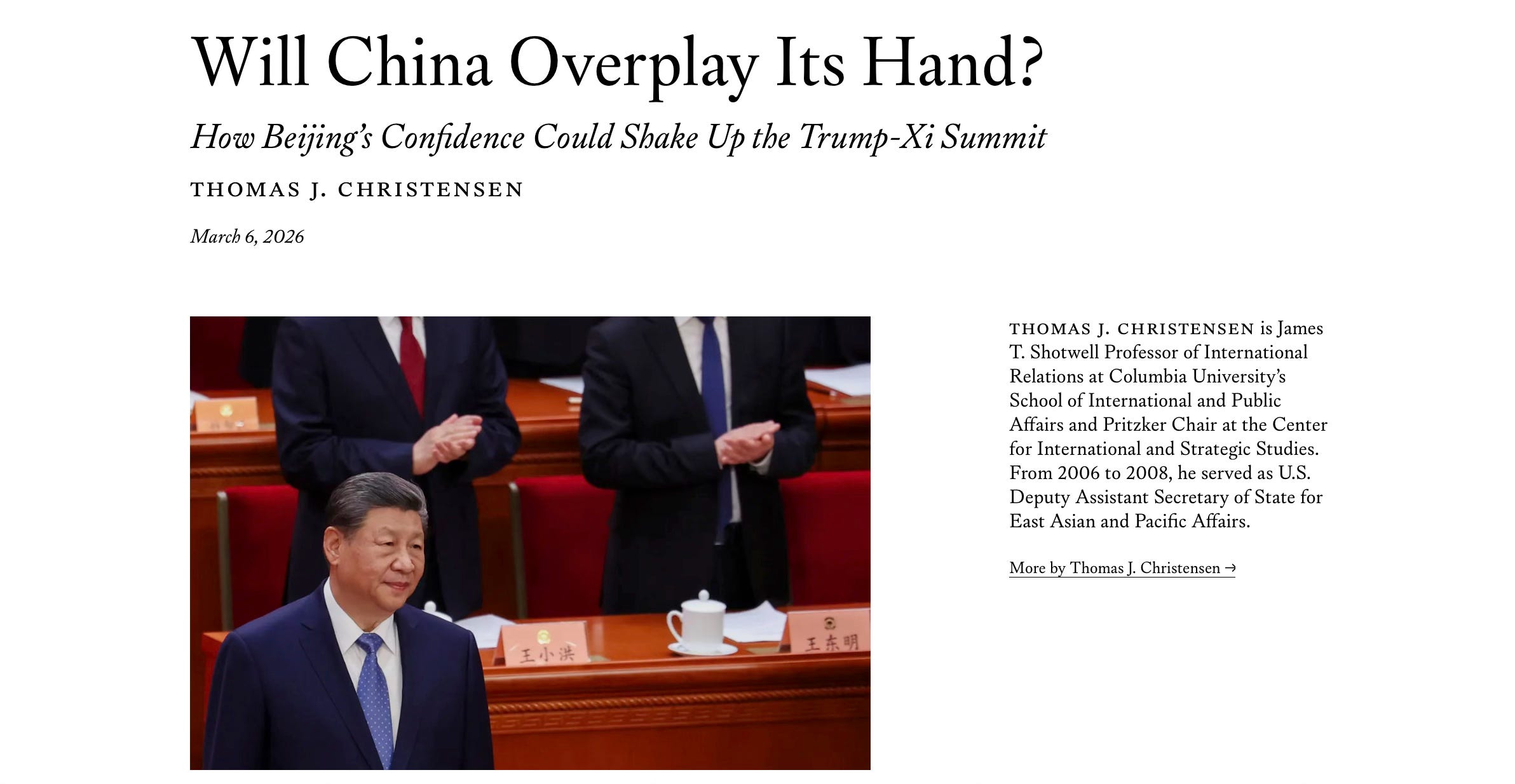
In this article published by Foreign Affairs, the author examines how the Chinese leader might approach the forthcoming summit with President Trump. The author notes that “the most significant factor that will shape the upcoming Trump-Xi meetings will be Beijing’s perception of its own apparent success in 2025 in responding to U.S. threats with resolute counterthreats…Many Chinese experts believe that Beijing, unlike other capitals subjected to Trump’s threats, managed to back Washington into a corner and that this outcome signaled China’s arrival as a global power on par with the United States.” How this will influence the coming summit remains to be seen. You can read the full article here.

3. Effects of Private Quantum Encryption
Peter Singer and August Cole have been working with Defense One this year to produce a series of short stories that examine key national security and military issues. This FICINT (fictional intelligence) is designed to be an accessible yet thought-provoking means to drive conversions in government and beyond about the impacts of new technologies on national security and societies more broadly. The latest story, The Quantum Curtain, has just been published and can be read at this link.

4. The Impact of AI on Army Officers
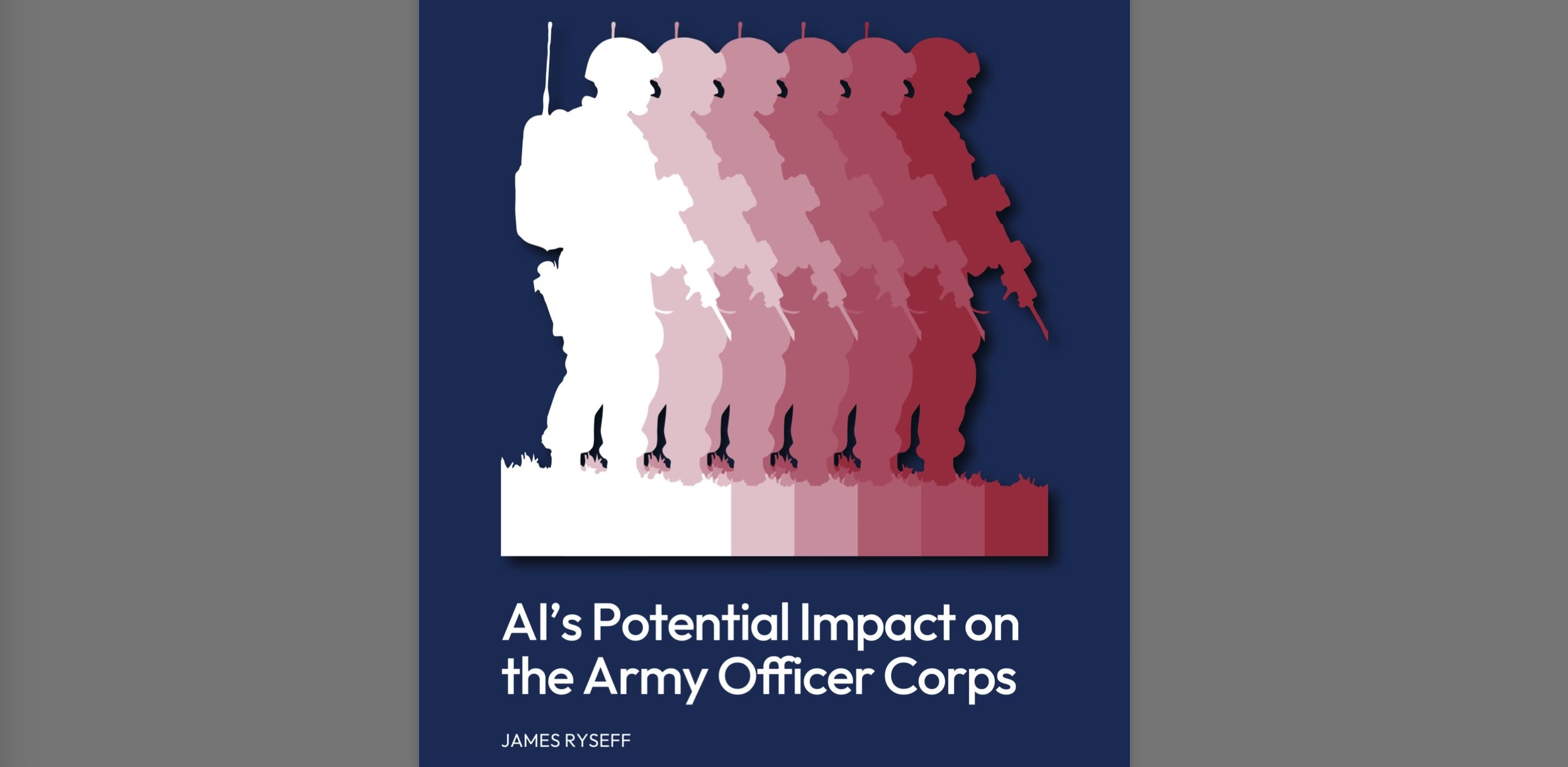
A new report was released by the Special Competitive Studies Project (SCSP) that explores the impact of AI on Army officers and the army profession more generally. As the author of the report notes, “these changes will affect not only which jobs warfighters perform, but how they perform them, requiring the U.S. military to rethink how it organizes, trains, and equips its future workforce, as well as how it designs its forces.” You can read the full report at this link.

5. Responsible Procurement of AI in Military Institutions
This report from the Stockholm International Peace Research Institute (SIPRI) explores the intersection of military procurement and responsible use of military AI. The authors propose that procurement process can be a mechanism for states to implement political commitments and legal obligations, and therefore, also a mechanism for implementing responsible use of AI in military institutions. You can read their full report here.

Share

Futura Doctrina is a reader-supported publication. 


Entrevista, Alberto Almeida: ‘Lula é favorito para perder, e caso Master afeta mais a esquerda que a direita’ - Thiago Prado O Globo

Entrevista | Alberto Almeida (ex-marqueteiro de Lula e do PT):

‘Lula é favorito para perder, e caso Master afeta mais a esquerda que a direita’

Thiago Prado
O Globo, domingo, 8 de março de 2026

Entrevista com o sociólogo e escritor, que aponta a necessidade do presidente melhorar a avaliação para ser reeleito.

O cientista político e sociólogo Alberto Carlos Almeida costuma ser uma voz que a esquerda considera relevante ouvir para tomar decisões. Antes de lançar seus últimos dois livros, foi recebido em Brasília por petistas como o presidente Lula, os ministros da Casa Civil, Rui Costa, e da Secretaria das Relações Institucionais, Gleisi Hoffman, e os senadores Jaques Wagner e Humberto Costa.

A mão e a luva: o que elege um presidente” enaltece a importância dos resultados econômicos para um governante ser bem avaliado e, consequentemente, se reeleger. “A cabeça do brasileiro, vinte anos depois: o que mudou” lança luz sobre o perfil conservador do eleitor brasileiro. Em entrevista para a newsletter “Jogo Político”, Almeida explica por que considera em risco a reeleição de Lula em outubro mesmo com o petista na liderança das pesquisas.

O caso Master atinge ministros do Supremo Tribunal Federal, o PT da Bahia, o Centrão e parte da direita. Na corrida presidencial entre Lula e Flávio Bolsonaro, quem sairá como o maior prejudicado?

O Lula. O Caso Master atinge o sistema como um todo e, hoje, quem simboliza tudo isso é o presidente, e não o Jair Bolsonaro e o seu filho. O escândalo reforça percepções como “todo político é ladrão, nada muda no Brasil”. As denúncias no INSS vão pelo mesmo caminho, é tudo ruim para o governo. Agora, ainda não é possível dizer que corrupção será o grande tema da eleição, teremos que ficar atentos naquela pergunta típica das pesquisas: “Qual a sua maior preocupação?”. Esse dado oscila. Em 2005, por exemplo, o mensalão durou como escândalo que impactou a avaliação do Lula de meados do ano até novembro. Depois, o presidente passou a recuperar a popularidade, e venceu a eleição.

No fim de fevereiro, o presidente do PT, Edinho Silva, falou que Flávio Bolsonaro é a “essência do fascismo”.. É repetindo a estratégia de 2022 contra a direita que o Lula vai vencer a eleição de outubro?

É bobagem essa estratégia de chamar Flávio dessas coisas. Venho dizendo e reafirmo: ele é um candidato mais difícil de ser batido do que o Tarcísio de Freitas (governador de São Paulo). O Tarcísio teria que ficar fazendo sinais para a direita o tempo todo para se mostrar confiável e isso teria impacto na rejeição. O Flávio não precisa de nada disso, pode passar o ano inteiro se vendendo como moderado e sinalizando ao centro desde já. Lula versus Flávio será uma disputa sobre quem vai ter menos rejeição. Como estratégia, o melhor para o PT será jogar o Flávio para dentro do sistema também. Lembrar que ele é político, que é senador, que os aliados dele estão envolvidos no caso Master, lembrar a rachadinha. É por aí, e não falando de fascismo.

Mesmo assim, você tem dito nas redes que o Lula também vai precisar melhorar a própria popularidade para ganhar a eleição. Por quê?

Neste momento, o Lula é favorito para perder. Há anos, utilizo o dado de avaliação do governo em ótimo ou bom como régua. Lula fechou o ano na casa dos 30% neste quesito em várias pesquisas, mas os últimos levantamentos nas mãos do governo estão indicando o presidente na casa dos 25% e 26%. Pelo histórico brasileiro de eleições, ele precisa ter mais de 35% de ótimo ou bom se quiser vencer.

Mas o Lula tinha subido nas pesquisas no segundo semestre do ano passado com o discurso da soberania contra Donald Trump e a condenação do ex-presidente Jair Bolsonaro. O que está acontecendo agora para que pareça uma volta ao cenário do primeiro semestre de um presidente fragilizado?

Esses são fatos isolados, eventos de cobertura de mídia que, claro, balançaram a popularidade do Lula positivamente. É parecido com o exemplo do Barack Obama nos EUA. Quando o Osama Bin Laden foi capturado e morto, em 2011, a popularidade dele subiu nos Estados Unidos. Depois, caiu de novo. O ponto é que, passados quatro anos, o eleitor brasileiro continua achando que o governo não o atende, que não está fazendo diferença na sua vida. Falamos muito de queda da inflação nos últimos meses, mas há um elemento que talvez tenhamos que prestar mais atenção: a carestia. A verdade é que as coisas continuam muito caras para a população.

Renato Meirelles, em artigo no GLOBO essa semana, fala sobre essa tema com a seguinte provocação: “A inflação recuou nos índices, mas a Dona Maria não consulta o IPCA antes de ir à feira. Ela lembra que o frango custava metade”...

É isso. As pessoas não conseguiram aumentar a quantidade de coisas que compram, o salário deixou de dar conta. A isenção do Imposto de Renda, pelo visto, não está significando percepção de melhoria de vida das pessoas.

A repercussão ruim do desfile da Acadêmicos de Niterói com uma ala ironizando a “família em conserva” teve algum impacto?

Não acredito que uma ala de escola de samba faça as pessoas mudarem de ideia sobre o que pensam a respeito de um governo. Isso é uma afronta à inteligência do eleitor. Lula já é pior avaliado entre os evangélicos desde sempre, o desfile não alterou esse quadro.

E o que Lula pode fazer faltando tão pouco tempo para a eleição?

Não vai adiantar só comunicação, não. Para não ficar na dependência de eventos midiáticos aleatórios, as pessoas vão precisar sentir a melhoria de vida na veia. O que fez o Bolsonaro em 2022? Baixou o preço dos combustíveis com canetadas. Ele estava numa situação muito pior que a do Lula neste momento e quase ganhou a eleição naquele ano.

O senhor está sugerindo que só vai restar ao Lula ser populista para vencer?

Sim. Vai precisar gastar mais, baixar os juros. Não basta falar que é defensor do fim da pauta 6x1 que pode vir a acontecer um dia. Vai precisar de medidas na área econômica para que a população perceba efeitos agora. E, de preferência, medidas que não precisem da autorização do Congresso. Porque pode ser que desta vez deputados e senadores não queiram mais aprovar nada a favor do governo.

Na sua opinião, Lula 3 está sendo pior que Lula 1 e 2?

Acho que há duas diferenças cruciais. A primeira, econômica. O Lula não fez os movimentos dos outros mandatos que é o de começar contendo gastos e fazendo ajustes para chegar no fim do governo expandindo. Ele deixou a Presidência em 2010 crescendo 7%. Desta vez, os dois primeiros anos terão crescimento superior aos dois finais. A segunda coisa é que ele não pegou um grande partido do centro e transformou em um grande aliado como foi o MDB lá atrás. Eram outros tempos, claro, mas trazer Geraldo Alckmin para vice e dar ministérios periféricos para o Centrão foi insuficiente. Acabou sendo um governo que ampliou pouco e que ficou muito vinculado à esquerda. Não adiantou ter escondido a Janja um pouco mais nos últimos meses, a cara do Lula 3 ainda continuou sendo essa: a de ser um governo muito petista e bastante exclusivista.

Várias dessas análises estão em seus livros e postagens na internet. Afinal, a esquerda gosta de te ouvir, mas não segue seus conselhos?

Acho que no fundo eles não leem as coisas que eu escrevo, não. O Lula foge de determinadas discussões até, mas já o PT, nada. A cartilha que o partido segue é insana. Dizer que pardo é preto? Dizer que a mulher é dono do seu corpo na questão do aborto? Ser contra privatizações, sendo que o brasileiro a apoia se o serviço melhorar? É tudo uma loucura na esquerda.

Após boa virada de ano, é hora da diplomacia - Rolf Kuntz (O Estado de S. Paulo)

 Opinião

Após boa virada de ano, é hora da diplomacia
Depois das notícias positivas na economia que marcaram a passagem de 2025 para 2026, é essencial cuidar da incerteza externa
Rolf Kuntz
O Estado de S. Paulo, 08/03/2026
https://www.estadao.com.br/opiniao/rolf-kuntz/apos-boa-virada-de-ano-e-hora-da-diplomacia/

Emprego e renda bateram recordes na virada do ano, segundo balanço divulgado na quinta-feira, mas o principal destaque, nos grandes órgãos de comunicação, foi o ex-banqueiro Daniel Vorcaro. Acusado de golpes financeiros, ele foi trancado numa cadeia no interior de São Paulo. Grandes títulos foram dedicados também à tentativa de suicídio, em Belo Horizonte, de seu cúmplice Luiz Phillipi Machado de Moraes Mourão, conhecido como Sicário.
O destaque a figurões do crime é tão justificável quanto útil, mas o prosaico noticiário econômico também pode merecer alguma atenção, especialmente num país ainda em busca do desenvolvimento.
Notícias positivas marcaram a passagem de 2025 para 2026. O rendimento real dos trabalhadores cresceu, o desemprego diminuiu e a ocupação aumentou, num cenário prejudicado por uma inflação distante do centro da meta, fixado em 3% para períodos de 12 meses.
A massa de rendimento habitual dos trabalhadores, de R$ 370,3 bilhões, foi recorde da série histórica. A população ocupada – 102,7 milhões de pessoas – foi recorde. Além disso, os 5,9 milhões de pessoas desocupadas no trimestre encerrado em janeiro formaram o menor contingente da mesma série. Esse grupo correspondeu a 5,4% da população economicamente ativa.
Os dados de emprego e de rendimento valorizam o crescimento de 2,3% do Produto Interno Bruto (PIB) em 2025. Essa taxa pode ser – ou parecer – modesta para uma grande economia ainda classificada como emergente. Mas indica, juntamente com o avanço do emprego, certa melhora das condições experimentadas por dezenas de milhões de pessoas. Essas condições permanecem modestas, num país onde a formação da mão de obra é deficiente e a renda continua muito concentrada.
Mas há sinais de progresso, como a expansão do consumo nos últimos anos, a formação melhor e mais ampla da mão de obra e sensível diminuição da pobreza extrema. Entre 2021 e 2024, a parcela das famílias com renda domiciliar inferior a US$ 6,85 por pessoa diminuiu de 36,8% para 23,1%. Aquelas com renda pessoal menor que US$ 2,15 passaram de 9% para 3,5% nesse período. Os números são do Instituto Brasileiro de Geografia e Estatística (IBGE).
A melhora na virada do ano de nenhum modo garante um avanço duradouro ao longo de 12 meses. Esse avanço depende tanto da expansão econômica e da evolução do emprego quanto da variação dos preços, isto é, do quadro de inflação. Por enquanto, algumas projeções apontam perspectivas favoráveis. Segundo as estimativas coletadas para o boletim Focus, elaborado semanalmente pelo Banco Central, a inflação deve recuar para 3,91% em 2026. Será um ganho para os consumidores e para a ordenação da economia, mas esse resultado ainda ficará bem acima da meta oficial.
Além da inflação em queda, o boletim aponta um dólar cotado a R$ 5,40 no fim do ano. Qualquer projeção referente ao câmbio é muito arriscada, num período de muita instabilidade na política internacional. Mas a expectativa de um dólar mais contido combina bem com um quadro de inflação declinante. Esse quadro comporta alguma redução dos juros. A taxa básica deve cair, segundo a mediana projetada no boletim, para 12%. Se essa estimativa estiver correta, o crédito ainda será muito caro, mas, ainda assim, a redução poderá produzir resultados apreciáveis.
A melhora nos juros, no crédito e na disposição dos empresários dependerá em grande parte da condução da política econômica pelo governo. Os dirigentes do Banco Central (BC) têm mostrado boa vontade e disposição de cooperar com o Executivo, mas também têm reafirmado o compromisso de manter prudência nas decisões sobre sua política. Parece muito improvável, neste momento, um afrouxamento monetário significativo sem uma clara demonstração de prudência pelo presidente da República. E Luiz Inácio Lula da Silva continua devendo essa demonstração, embora tenha apresentado, em algumas ocasiões, um discurso promissor.
Do lado externo, as contas do Brasil continuam satisfatórias. Mas o quadro internacional é marcado por graves conflitos e por muita insegurança. A guerra no Oriente Médio já evidenciou perigos para o comércio global e para o fluxo de matérias-primas importantes, por exemplo, para a agricultura brasileira. A diplomacia de Brasília tem preservado a tradição de equilíbrio e de conciliação, mas desafios significativos podem surgir a qualquer momento.
O governo do presidente Lula tem mantido bom entendimento com as autoridades americanas e de outras áreas importantes, como a Europa Ocidental, a Rússia e a China. Mantido o cenário global, o trabalho diplomático de Brasília será tão relevante, no curto e no médio prazos, quanto o dos ministérios econômicos. Embora permaneça a boa relação com os Estados Unidos e, de modo especial, entre os chefes de governo dos dois países, um surto belicoso do presidente Donald Trump poderá complicar todo o cenário. O ataque americano ao Irã, nos últimos dias, mostra a importância de levar em conta essa hipótese.
Opinião por Rolf Kuntz

domingo, 8 de março de 2026

Por qué la dictadura cubana caerá antes de 2027 - Carrlos Malamud (El Mundo)

Carlos Malamud me envia seu mais recente artigo:


Remito enlace del artículo "Por qué la dictadura cubana caerá antes de 2027" publicado hoy, 8/III, en El Mundo, que inicia mi colaboración mensual en el dicho periódico.

Tablero global
Por qué la dictadura cubana caerá antes de 2027
La sensación de fin de época es manifiesta, y se ve reforzada por carencias en los servicios básicos y el combustible
Carlos Malamud
El Mundo, 8/03/2026
https://www.elmundo.es/opinion/2026/03/08/699842ffe85ece59318b459a.html

La película El hundimiento (Der Untergang) de Oliver Hirschbiegel, de 2004, nos sitúa en la recta final del Tercer Reich, con una guerra definitivamente perdida y algunos gerifaltes nazis, especialmente los más fanáticos, dispuestos a resistir hasta el final en el búnker del Führer. La mayoría de ellos, resignados, veían cómo su proyecto estaba definitivamente agotado y que, de una forma u otra, no solo iban a ser arrastrados por la caída de Hitler, sino que también pronto serían parte de un recuerdo poco o nada glorioso.

Salvando todas las distancias entre la Alemania nazi y la Cuba revolucionaria, que son muchas, las calles degradadas hasta el infinito en algunos barrios de La Habana tienen una cierta reminiscencia con las calles devastadas de Berlín y otras ciudades alemanas. Esto se hace más visible, ironías al margen, cuando cae la noche y los apagones prolongan las alargadas sombras de la desesperanza por fuera de unas viviendas que prácticamente ya no son refugio de casi nada.

Una de las grandes diferencias entre Berlín y La Habana es que mientras una había sido homogéneamente destrozada por los bombardeos aliados, en la otra sus élites políticas, económicas y militares mantienen unos elevados niveles de consumo, visibles no solo en sus barrios y en sus coches eléctricos, alimentados con paneles solares, sino también en su acceso a bienes inalcanzables para el común de los cubanos. Esto es posible gracias a su control de las mipymes (micro, pequeñas y medianas empresas), emprendimientos que florecen gracias a sus conexiones políticas y familiares con el establishment «revolucionario».

La sensación de fin de época es manifiesta. Esta se ve reforzada por la falta de combustible, y su correlato en electricidad y transporte; por el desabastecimiento de alimentos y medicinas; por el aumento de la represión y de la delincuencia; por las carencias de unos servicios básicos como sanidad y recogida de basuras. El rebrote de algunas enfermedades infecciosas, como el dengue y la chikungunya -popularmente, «el virus»-, no hacen más que resaltar unas imágenes sencillamente pavorosas.
Yirmara Torres Hernández, ex presidenta de la Unión de Periodistas de Cuba (UPEC), señaló de forma irónica y contundente que «para tener apagones hay que tener electricidad» y a Matanzas como «una ciudad de zombis», dado el andar «doblado y adolorido» de buena parte de la población contagiada por el virus. En esas condiciones no se vive sino que se malvive o se sobremuere. Todas estas carencias, en medio de la oscuridad, sobredimensionan unos fogones colectivos montados en las calles para cocinar, comer caliente y tener algo de luz, incluso quemando muebles en desuso.

Durante décadas la cúpula castrista, apelando a la ortodoxia revolucionaria, condenó y persiguió cualquier forma de iniciativa privada, considerada un promotor de desigualdad. Este ambiente de fin de ciclo potenciado por la manifiesta falta de solidaridad de sus élites acentúa entre el grueso de la población la sensación de haber sido traicionada por la Revolución. El mal sabor de boca aumenta cuando se constata que en medio del naufragio ha llegado al momento del «sálvese quien pueda».

Si a este cóctel explosivo le sumamos la presión del Gobierno de Donald Trump, que alcanzó uno de sus puntos más álgidos tras su control del crudo venezolano y su afirmación del 11 de enero de que «no habrá más petróleo ni dinero para Cuba», la conclusión es una debacle inminente. Sin embargo, la decadencia del régimen cubano es previa al regreso de Trump a la Casa Blanca y, en buena medida, responsabilidad exclusiva del régimen imperante durante casi 70 años. No se olvide que la mayor parte de los problemas ya estaban presentes a fines de 2024, aunque en el último año el deterioro se ha incrementado.

Hace un mes el Wall Street Journal anunció que la Administración Trump buscaba activamente un cambio de régimen antes de fin de año. Y que, con el propósito de activarlo, estaba negociando con las personas más idóneas para reemplazar al sistema comunista y hacerse cargo del poder. Atendiendo al precedente venezolano, esas personas deberían tener una clara proximidad al poder. Ahora bien, de aplicarse este precedente, más allá de la vigencia del Corolario Trump- Monroe, es difícil pensar que en Cuba, al menos en los meses iniciales, se produzca algo parecido a un cambio de régimen o que se inicie abiertamente una transición de la dictadura a la democracia. Las consecuencias migratorias de una coyuntura descontrolada, que empezarían a sentirse en Florida, llevan a incrementar las cautelas para impedir un desenlace violento.

La negociación en marcha es la salida esperada por el secretario de Estado, Marco Rubio. Por razones obvias no se informa de esas conversaciones, aunque conocer con certeza la identidad de los interlocutores permitiría reflexionar con mayor base sobre la amplitud del relevo en la cúpula, sobre el perfil del grupo o los grupos que serían apartados del poder y, como consecuencia de lo anterior, sobre los responsables del nuevo gobierno. ¿Será un militar, como algunos especulan, con un perfil similar al de Delcy Rodríguez, o será algún miembro más abierto y con buenos contactos internacionales de la familia Castro?

Antes del verano o de finales de año, por las buenas o por las malas, como dijo un amigo cubano, con presión internacional o sin ella, es probable que la dictadura caiga. Su subsistencia en el futuro inmediato sería un verdadero milagro. De ahí que, en las actuales circunstancias, lo más lógico sería dejar de infligir más daño a la población. En ningún caso será un proceso limpio, pero de todas formas será necesario y bien recibido por la mayoría de la población.

En 2020 el trovador Ray Hernández compuso El bucanero, una descarnada descripción de las penurias que atravesaba el régimen, al que comparaba con un viejo velero: «La línea de flotación está llena de agujeros y roto el palo mayor», «se oxidó el ancla... y no hay una pata de palo que no tenga comején». Si bien más tarde dulcificó sus críticas, se declaró comunista y leal al Gobierno y a la Revolución y fue un feroz censor de las movilizaciones de julio de 2021, hay una frase de su canción que describe el momento actual sin dejar lugar a engaño: «Olvídense del tesoro porque perdimos el mapa». Ante la magnitud de la catástrofe la pregunta es si hay en el horizonte algún cartógrafo capaz de dibujar un nuevo mapa que permita a la sociedad cubana navegar en las aguas procelosas que le tocará recorrer en el futuro inmediato y volver a ser la Perla del Caribe.

Carlos Malamud es investigador principal del Real Instituto Elcano y catedrático de Historia de América en la UNED. Su último libro es Golpe militar y dictadura en Argentina (1976-1983) (Catarata, 2026)

La Pologne, en première ligne face à la guerre hybride menée par la Russie - Le Monde

La Pologne, en première ligne face à la guerre hybride menée par la Russie

Par Jakub Iwaniuk (Legionowo [Pologne], envoyé spécial) Publié aujourd’hui à 06h30

https://www.lemonde.fr/international/article/2026/03/08/la-pologne-en-premiere-ligne-face-a-la-guerre-hybride-menee-par-la-russie_6669955_3210

    Enquête

    Depuis l’invasion de l’Ukraine, Moscou conduit une guerre de nouvelle génération contre le camp occidental. A coups d’opérations d’influence, de cyberattaques, de sabotages, de désinformation de masse et de provocations frontalières, son objectif est d’amener à une dislocation de l’OTAN et de l’Union européenne. Sur le front, Varsovie tente de faire face à ces nouvelles formes de conflictualité.

    Vu de l’extérieur, le complexe militaire impose par sa taille, mais sans impressionner : au milieu des barres HLM de la ville de Legionowo, à 30 kilomètres de Varsovie, la grisaille des infrastructures évoque encore l’époque communiste. C’est pourtant là que se trouve le centre de commandement des forces de défense du cyberespace de l’armée polonaise (Wojska Obrony Cyberprzestrzeni, WOC), un des lieux les plus sécurisés du pays. Les engins de chantier vont et viennent, les installations se développent et se modernisent à grands pas.

      https://img.lemde.fr/2026/03/03/0/0/2668/4000/572/0/75/0/d3bc3b1_upload-1-zlbpntvdeukw-11-02-2026-cyberattacks-in-poland-anna-liminowicz-for-le-monde-248363.jpg

    Au centre de commandement des forces de défense du cyberespace de l’armée polonaise, à Legionowo (Pologne), le 11 février 2026.  

    Ce site constitue le bouclier polonais contre les cyberattaques en provenance, majoritairement, de Russie et de Biélorussie. Dans la foulée de l’invasion de l’Ukraine par Moscou, le 24 février 2022, le nombre d’agressions informatiques visant la Pologne a explosé. Entre 2021 et 2022, sur les seuls réseaux militaires, celui-ci a été multiplié par cinq, selon l’armée. En 2024, 4 200 incidents majeurs ont été recensés ; en 2025, 7 100.

    S’agissant des structures stratégiques civiles, publiques ou privées, ces incidents se comptent, chaque année, en dizaines de milliers. Les attaques touchent d’abord les infrastructures critiques avec pour objectif la subtilisation du maximum d’informations et la provocation de paralysies. « Concernant les réseaux militaires, les Russes ne parviennent pas à leurs objectifs, malgré leur immense potentiel. Nous sommes particulièrement bien armés », assure le lieutenant-colonel Przemyslaw Lipczynski, porte-parole du WOC.

    Il vous reste 92.94% de cet article à lire. La suite est réservée aux abonnés.


    Trump encourages Latin American leaders to use military action to help US fight cartels (Associated Press)

    Trump encourages Latin American leaders to use military action to help US fight cartels

    By The Associated Press and AAMER MADHANI, JOSHUA GOODMAN and ALANNA DURKIN RICHER
    Associated Press, March, 8, 2026
    https://www.kjct8.com/2026/03/07/trump-looks-turn-attention-western-hemisphere-least-moment-americas-summit/

    DORAL, Fla. (AP) — President Donald Trump said Saturday that the United States and Latin American countries are banding together to combat violent cartels as his administration looks to demonstrate it remains committed to sharpening U.S. foreign policy focus on the Western Hemisphere even while dealing with five-alarm crises around the globe.

    Trump encouraged regional leaders gathered at his Miami-area golf club to take military action against drug trafficking cartels and transnational gangs that he says pose an “unacceptable threat” to the hemisphere’s national security.

    “The only way to defeat these enemies is by unleashing the power of our militaries,” Trump said. “We have to use our military. You have to use your military.” Citing the U.S.-led coalition that confronted the Islamic State group in the Middle East, the Republican president said that “we must now do the same thing to eradicate the cartels at home.”

    The gathering, which the White House called the “Shield of the Americas” summit, came just two months after Trump ordered an audacious U.S. military operation to capture Venezuela’s then-president, Nicolás Maduro, and whisk him and his wife to the United States to face drug conspiracy charges.

    Looming even larger is Trump’s decision to launch a war on Iran with Israel one week ago, a conflict that has left hundreds dead, convulsed global markets and unsettled the broader Middle East.

    Trump’s time with the Latin American leaders was limited: Afterward, he set out for Dover Air Force Base, Delaware, to be on hand for the dignified transfer of the six U.S. troops killed in a drone strike on a command center in Kuwait, one day after the U.S. and Israel launched their military campaign against Iran.

    Trump called the American deaths a “very sad situation” and praised the fallen troops as “great heroes.”

    With the summit, Trump aimed to turn attention to the Western Hemisphere, at least for a moment. He has pledged to reassert U.S. dominance in the region and push back on what he sees as years of Chinese economic encroachment in America’s backyard.

    Trump also said the U.S. will turn its attention to Cuba after the war with Iran and suggested his administration would cut a deal with Havana, underscoring Washington’s increasingly aggressive stance against the island’s communist leadership. “Great change will soon be coming to Cuba,” he said, adding that “they’re very much at the end of the line.”

    Cuban President Miguel Díaz-Canel on Saturday described the summit as “small, reactionary, and neocolonial.” He wrote in a social media post that the U.S. has committed right-wing governments from the region “to accept the lethal use of US military force to resolve internal problems and maintain order and tranquility in their countries.”
    Who was there

    The leaders of Argentina, Bolivia, Chile, Costa Rica, the Dominican Republic, Ecuador, El Salvador, Guyana, Honduras, Panama, Paraguay, and Trinidad and Tobago joined the Republican president at Trump National Doral Miami, a golf resort where he is also set to host the Group of 20 summit later this year.

    The idea for a summit of like-minded conservatives from across the hemisphere emerged from the ashes of what was to be the 10th edition of the Summit of the Americas, which was scrapped during the U.S. military buildup off the coast of Venezuela last year.

    Host Dominican Republic, pressured by the White House, had barred Cuba, Nicaragua and Venezuela from attending the regional gathering. But after leftist leaders in Colombia and Mexico threatened to pull out in protest — and with no commitment from Trump to attend — the Dominican Republic’s president, Luis Abinader, decided at the last minute to postpone the event, citing “deep differences” in the region.

    The Shield of the Americas moniker was meant to speak to Trump’s vision for an “America First” foreign policy toward the region that leverages U.S. military and intelligence assets unseen across the area since the end of the Cold War.

    To that end, Ecuador and the United States conducted military operations this week against organized crime groups in the South American country. Ecuadorian and U.S. security forces attacked a refuge belonging to the Colombian illegal armed group Comandos de la Frontera in the Ecuadorian Amazon on Friday, authorities reported.

    This joint fight against drug traffickers “is only the beginning,” said Ecuador’s president, Daniel Noboa.

    Notably missing at the summit were the region’s two dominant powers — Brazil and Mexico — as well as Colombia, long the linchpin of U.S. anti-narcotics strategy in the region.

    Trump grumbled that Mexico is the “epicenter of cartel violence” with drug kingpins “orchestrating much of the bloodshed and chaos in this hemisphere.”

    “The cartels are running Mexico,’ Trump said. “We can’t have that. Too close to us. Too close to you.”
    The challenge from China

    Trump made no mention of his administration’s insistence that countering Chinese influence in the hemisphere is a top priority for his second term.

    His national security strategy promotes the “Trump Corollary” to the 19th century Monroe Doctrine, which had sought to ban European incursions in the Americas, by targeting Chinese infrastructure projects, military cooperation and investment in the region’s resource industries.

    The first demonstration of the more muscular approach was Trump’s strong-arming of Panama to withdraw from China’s Belt and Road Initiative and review long-term port contracts held by a Hong Kong-based company amid U.S. threats to retake the Panama Canal.

    More recently, the U.S. capture of Maduro and Trump’s pledge to “run” Venezuela threatens to disrupt oil shipments to China — the biggest buyer of Venezuelan crude before the raid — and bring into Washington’s orbit one of Beijing’s closest allies in the region. Trump is scheduled to travel to Beijing later this month to meet with Chinese President Xi Jinping.

    For many countries, China’s trade-focused diplomacy fills a critical financial void in a region with major development challenges ranging from poverty reduction to infrastructure bottlenecks. In contrast, Trump has been slashing foreign assistance to the region while rewarding countries lined up behind his crackdown on immigration — a policy widely unpopular across the hemisphere.

    China’s Foreign Minister Wang Yi said on Sunday its diplomacy in the region wasn’t targeted at any third party, but “nor should it be interfered with by any third party.”

    “The international stage of the 21st century should no longer be a stage for the old dramas of the 19th century,” he said.

    Secretary of State Marco Rubio then hosted the leaders for a working lunch after Trump left for the event in Delaware. The lunch gave Kristi Noem, whom Trump fired as homeland security secretary on Thursday, the chance to make her debut in her new role as a special envoy for the “Shield of the Americas.”

    “We want our hemisphere to be safer, to be more sovereign, and to be more prosperous,” Noem told the leaders.
    ___

    Durkin Richer reported from Washington. Associated Press writers Gabriela Molina in Quito, Ecuador, Dánica Coto in San Jose, Costa Rica and Huizhong Wu in Beijing contributed.

    Copyright 2026 The Associated Press. All rights reserved.

    The destruction of Venezuela by its leaders - Alexander Busch

     We must read all the reports of this journalist, and I beg him to send me all his new comments. What Trump has done is wrong, but the country was on the brink of total collapse. PRA


    A personal account about Venezuela, by Alexander Busch:

    “Last week, I was in Venezuela researching a new chapter in the country's turbulent history.

    I happened to pass by the house where I lived with my family from 1964 to 1969. It's very close to Plaza Francia in Altamira. From there, I walked to kindergarten every day and went later by bus to the German school. The same travel agency that was there 60 years ago is still on the ground floor.

    That's an amazing continuity. Back then, Venezuela was a stable democracy and prosperous thanks to its oil wealth. The decline began a quarter of a century ago.

    When I returned to Venezuela almost every year from the mid-1990s onwards as a correspondent for South America, the country was still a democracy and more or less wealthy, but it was already in decline.

    After Hugo Chávez was elected president in 1999, his left-wing government survived the first ten years thanks to historically high oil prices. This masked the corruption, catastrophic mismanagement, and increasing repression.

    From 2014 onwards, this was no longer possible. The severe economic crisis and Maduro's incompetence drove eight million people out of the country. Today, Venezuela, with a population of just under 30 million, a country larger than France and Germany combined, today has an economic output (GDP) not much bigger than that of Frankfurt.

    But since Maduro's fall on January 3, something has changed in the country. Many people are optimistic that the US under Donald Trump will lead the country out of economic and political isolation.

    I hope that I will now be able to report on Venezuela's resurgence in the coming years. My reports will be published in the coming days.”

    Postagem em destaque

    Visita do candidato da extrema-direita a Mister DJT: minhas respostas a questões colocadas por um órgão da imprensa - Paulo Roberto de Almeida

    Visita do candidato da extrema-direita a Mister DJT: minhas respostas a questões colocadas por um órgão da imprensa Paulo Roberto de Almeida...