segunda-feira, 18 de dezembro de 2023

O desmonte do planejamento orçamentário - Editorial O Globo, Paulo Roberto de Almeida

 Nas democracias, é comum congressistas influírem na alocação de recursos com emendas que beneficiam seus redutos. No Brasil, porém, elas perderam a proporção: o total foi multiplicado por nove desde 2015. E o Parlamento tem feito o possível para tornar o pagamento obrigatório, reduzindo a autonomia do Executivo para cumprir a missão constitucional de executar o Orçamento. Num momento em que o próprio Congresso clama por harmonia entre os Poderes, deveria saber se conter, preservando a função precípua de votar o Orçamento, mas evitando hipertrofia nos próprios recursos. (Editorial do Globo)

Paulo Roberto de Almeida:

Já não existe no Brasil planejamento orçamentário para o crescimento, apenas uma espécie de estupro orçamentário conduzido pelos parlamentares para finalidades puramente paroquiais. Uma tragédia para o futuro da nação.

Na origem dos grandes problemas mundiais, os equívocos de dirigentes nacionais - Paulo Roberto de Almeida

Na origem dos grandes problemas mundiais, os equívocos de dirigentes nacionais

Paulo Roberto de Almeida 

Não existe uma fatalidade geopolítica para cada problema da comunidade internacional. Cada tragédia nacional deriva especificamente de desatinos nacionais. 

A geopolítica não pode ser responsabilizada pelos desatinos dos dirigentes nacionais. Ninguém obrigou Perón a ser fascista e a criar uma república sindical. Ninguém obrigou JK a construir Brasília e a provocar a inflação que desestabilizou o Brasil, mais do que a ameaça comunista. Ninguém obrigou os militares a darem golpe em 1964. Ninguém obrigou os peronistas a afundarem a Argentina. Ninguém obrigou Lula a se aliar a autocratas e a apoiar ditaduras execráveis. Ninguém obrigou Trump a desmantelar o multilateralismo. Ninguém obrigou Putin a invadir a Ucrânia duas vezes, ao contrário. Ninguém obrigou Lula a cortejar o ditador medíocre da Venezuela. 

Dirigentes são responsáveis pelas bobagens e tragédias que cometem. Não culpem a geopolítica, pois seria um equívoco monumental.

Paulo Roberto de Almeida 

Brasília, 18/12/2023

Prognóstico não muito otimista quanto ao futuro da nação - Paulo Roberto de Almeida

Prognóstico não muito otimista quanto ao futuro da nação

Paulo Roberto de Almeida 

O Brasil enfrenta o ano de 2024 com uma “Argentina” inteira de aposentados (40 milhões de dependentes de trabalhadores ativos, em redução progressiva) e uma outra “Argentina” de dependentes da ajuda oficial, e que ainda se caracteriza por uma baixíssima produtividade em seu capital humano. 

Parece muito dificil que um país assim conformado consiga crescer economicamente e se desenvolver adequadamente. A baixa poupança privada, a despoupança estatal, uma educação de massas de péssima qualidade, uma casta política predatório, um mandarinato estatal totalmente descompromissado para com as necessidades da maioria da população, fazem com que nossa trajetória atual e no futuro de médio prazo não seja muito promissora.

Sorry pelo realismo duro no confronto com os votos otimistas que normalmente se fazem a cada final de ano.

Paulo Roberto de Almeida

Brasília, 18/12/2023

Foreign Affairs some of the best books on international relations


The Economic Government of the World, 1933–2023


By Martin Daunton

Daunton’s sweeping narrative assesses the history of international economic cooperation and the institutions that organize and sustain it.

READ THE REVIEW

Daunton has written a sweeping history of international economic cooperation and of the meetings and institutions through which it is organized. The author’s original design for this book, many years in the making, was evidently to begin his narrative with the London Economic Conference of 1933, which failed to preserve an open international order, and conclude with the more successful G-20 summit in London in 2009, which mobilized international efforts to contain the 2008 global financial crisis and stabilize the world economy. Whereas the first of these conferences was sunk by doctrinal disagreements and international political disputes, the second benefited from the intellectual and political convergence that followed the fall of communism and the end of the Cold War. Developments in the past decade, however, have thrown the author’s optimistic narrative a series of curve balls: the resurgence of populism, tensions between China and the United States, and Russia’s invasion of Ukraine, which put an end to political convergence and inaugurated what some call a “new Cold War.” Progress in strengthening global governance, it turns out, is not inevitable. Institutions such as the International Monetary Fund and the World Trade Organization retain a role in fostering international cooperation, but Daunton insists that they must not interfere too extensively in domestic policy choices lest they spark a backlash. To sustain international cooperation, governments must complement openness with policies that create good jobs, provide social insurance, tax footloose corporations, and avoid destabilizing capital flows.

From Amazon.com:

An epic history of the people and institutions that have built the global economy since the Great Depression.

In this vivid landmark history, the distinguished economic historian Martin Daunton pulls back the curtain on the institutions and individuals who have created and managed the global economy over the last ninety years, revealing how and why one economic order breaks down and another is built. During the Great Depression, trade and currency warfare led to the rise of economic nationalism―a retreat from globalization that culminated in war. From the Second World War came a new, liberal economic order. Squarely reflecting the interests of the West in the Cold War, liberalism faced collapse in the 1970s and was succeeded by neoliberalism, financialization, and hyper-globalization.

Now, as leading nations are tackling the fallout from COVID-19 and threats of inflation, food insecurity, and climate change, Daunton calls for a return to a more just and equitable form of globalization. Western imperial powers have overwhelmingly determined the structures of world economic government, often advancing their own self-interests and leading to ruinous resource extraction, debt, poverty, and political and social instability in the Global South. He argues that while our current economic system is built upon the politics of and between the world’s biggest economies, a future of global recovery―and the reduction of economic inequality―requires the development of multilateral institutions.

Dramatic and revelatory, 
The Economic Government of the World offers a powerful analysis of the origins of our current global crises and a path toward a fairer international order.”


Neal’s highly entertaining biography of the writer Carleton Beals, whose work on Latin America foreshadowed later anti-imperialist critiques, sheds light on the United States’ relationship with the ruling elites of Latin America throughout the twentieth century.

READ THE REVIEW

Neal admires the fierce intellectual independence and penetrating, skeptical eye of Carleton Beals, who died in 1979 at the age of 85. Beals was a remarkably prolific freelance writer of some 40 books and innumerable magazine articles that skewered the ruling elites of Latin America and their U.S. sponsors. As recorded in Neal’s highly entertaining biography, Beals’s best books, enriched by his extensive travels, offered colorful, often acerbic portraits of the leading political and intellectual figures of the day. His biggest scoop, a 1928 exclusive interview with Augusto Sandino, pictured the Nicaraguan guerrilla fighter as a romantic patriot battling against a misguided U.S. military intervention. Something of a celebrity in progressive intellectual circles, Beals foreshadowed the later anti-imperialist critiques of William Appleman Williams and Noam Chomsky and the popularity in academic circles of dependency theory, the notion that globalization impoverishes poorer countries. Like many left-leaning, politically engaged writers, Beals wavered between demanding that the U.S. government keep its hands off Latin America and urging Washington to put its thumb on the scales for progressive democrats.

In this splendid, well-balanced history of an extraordinary but seldom studied period in inter-American relations, Herman argues that pragmatic accords between the United States and Latin American countries enabled a brilliant if brief chapter of solidarity in the Western Hemisphere throughout World War II.

READ THE REVIEW


In this wide-ranging and shrewd analysis of the Chinese state, Huang predicts that the crackdown on freedom under Chinese leader Xi Jinping’s modernized version of imperial rule may bring an end to the country’s brief spurt of dynamism.

READ THE REVIEW


domingo, 17 de dezembro de 2023

Alberto da Costa e Silva (1931-2023) - Celso Lafer (OESP)

Grande Alberto da Costa e Silva, homenageado por um outro grande.


Carmen Lícia

ESPAÇO ABERTO

Celso Lafer

Professor emérito da USP, ex-ministro das Relações Exteriores (1992 e 2001-2002) e presidente da Fapesp, Celso Lafer escreve mensalmente na seção Espaço Aberto


Alberto da Costa e Silva (1931-2023)

O diplomata alargou os horizontes da política externa brasileira ao elaborar na sua prática e na sua reflexão o papel de uma diplomacia de cultura e de conhecimento

Por Celso Lafer

17/12/2023 | 03h00


A perspectiva é um dos componentes organizadores da realidade, indicativa da circunstância do lugar em que estamos e nele nos localizamos para adquirir a mobilidade transformadora da razão e da sensibilidade.

Recordo essa lição de Ortega y Gasset porque ela tem grande pertinência para pensar a política externa como um ponto de vista sobre o funcionamento do mundo e a sua incidência num país. Um país operacionaliza seu ponto de vista no trato oficial com outros países por meio de seu corpo diplomático.

Alberto da Costa e Silva, na sua condição de diplomata na operacionalização deste ponto de vista, foi um paradigma de tato, inteligência e zelo, que o tornaram um dos grandes quadros do Itamaraty.

Alberto observou que “o diplomata, como o poeta, trabalha com as palavras”. No seu caso, verificou-se uma dialética de fecunda complementaridade entre as duas palavras, pois a sua experiência diplomática alentou, sem cisões, a criatividade da sua grande obra de intelectual. Por isso, integrou com alta envergadura a Academia Brasileira de Letras.

Alberto organizou o volume O Itamaraty na Cultura Brasileira, publicado em 2001 na minha gestão no Ministério das Relações Exteriores. Como ele diz na apresentação do volume, na prática do ofício o diplomata “é o que se representa”.

A representação não se circunscreve à articulação e à negociação de interesses. Tem um componente de exprimir o potencial da vis atractiva do que um país pode significar para os demais numa dada conjuntura histórica. Por isso, um diplomata deve conhecer bem o seu país para poder bem representá-lo. Cabe, também, a um diplomata promover relações amistosas com o país no qual está acreditado e, assim, na medida do possível, transformar fronteiras-separação em fronteiras-cooperação.

O tato e a inteligência com que Alberto exerceu o ofício a que se dedicou acabaram sendo poderoso estímulo para a criatividade de sua obra de grande intelectual. Adensou, para o benefício de todos, o seu entendimento do nosso país. Alargou os horizontes da política externa brasileira ao elaborar na sua prática e na sua reflexão o papel de uma diplomacia de cultura e de conhecimento.

A dedicação à África foi um tema recorrente do seu percurso de diplomata.

Da experiência de embaixador na Nigéria e no Benin, não só guardou, como dizia, “gratidão enternecida”. Foi um estímulo para aprofundar o seu interesse pela África e a sua percepção de que era necessário conhecer os africanos para melhor entender o Brasil, nas palavras da historiadora Marina de Mello e Souza.

Do que ele chamou “o vício da África” resultou uma excepcional obra de historiador que descortinou com rigor e paixão a história da África, a África no Brasil, o Brasil na África e a dinâmica do circuito da escravidão. Alberto, com o impacto de sua obra, trouxe a África como campo próprio de estudo em nosso país.

A obra de Alberto abre a nossa sensibilidade às memórias provenientes da África, que se somam, como ele diz, a outros enredos da vida brasileira – aos europeus que sempre estiveram nos currículos de nossas escolas e aos ameríndios que nelas deveriam estar.

Alberto dominava igualmente o papel do enredo europeu na vida brasileira.

“Temos a Europa dentro de nós.” É nossa herança, mas, como ele diz, “somos livres para escolher dela o que se ajusta à nossa geografia e o que responde à nossa intuição de destino”.

Serviu em Portugal, país que “de certa forma e ao seu jeito inventou para a Europa os oceanos”. A sua diplomacia de cultura intensificou e ampliou o diálogo Portugal-Brasil. Nesta empreitada, esclareceu com larga visada as características da herança e da presença de Portugal no Brasil e do significado dos fluxos migratórios lusitanos para a construção da múltipla identidade do nosso país. Soube destacar a relevância do idioma comum e do papel da Língua Portuguesa em Portugal e no Brasil, que nos singulariza e aproxima.

Alargou este horizonte para alcançar cinco países africanos que vivem as realidades das suas especificidades para descortinar o potencial de concertação diplomático-cultural que amplia, com um toque próprio, o espaço do Brasil e de Portugal no mundo.

As limitações de espaço não me permitem aflorar a amplitude dos caminhos intelectuais de Alberto. Não posso, no entanto, finalizar sem realçar que as suas memórias são um dos pontos mais altos da memorialística brasileira que de maneira discreta revela a sua estatura humana.

Espelho do Príncipe, cujo subtítulo é ficções da memória, não é propriamente uma autobiografia. Refaz liricamente as vivas lembranças do seu passado de criança. É, como o qualificou Da. Gilda de Mello e Souza, “um solilóquio da infância” que ela toma como um ritual de passagem, uma travessia da infância à idade adulta na qual Alberto, com pequenos toques, de maneira única, vai “impondo uma visão nova das coisas, da sensibilidade da relação com as pessoas, do escoar do tempo”.

Corresponde ao que disse na abertura de seu poema Hoje: gaiola sem paisagem: “Nada quis ser, senão menino. Por dentro e por fora, menino”.

*

PROFESSOR EMÉRITO DA FACULDADE DE DIREITO DA USP, FOI MINISTRO DAS RELAÇÕES EXTERIORES (1992; 2001-2002)

 

Ukraine: 2023 explained - Anton Gerashenko

 From Anton Geraschenko:

“ It is the end of the year and there are many articles, expert opinions, and simply personal conclusions about 2023, which is ending, as well as predictions for the next year, 2024, for Ukraine and the world. 


Here are some of my thoughts about 2023:

The year 2023 was not the year of Victory for Ukraine and our allies, as many believed. Nor did I hope it would be. But it was not a year of defeat either. It was the year of the hardest marathon. A year of dragging out the war. A year of realism and hard work. Another year that Ukraine endured and withstood.

Ukraine didn't get enough aid for a counter-offensive and the war became positional, protracted, and of a trench type. 

Then the conflict in the Middle East erupted. The focus of attention shifted and Ukraine practically disappeared from the agenda of global media. Ukraine started to receive not only less attention but also less aid. 

Russia has made many conclusions this year, changed its tactics and its goals. Russia is learning. If earlier, in February 2022, they were counting on a blitzkrieg, in 2023 Russia has set itself up for a long war: it has completely put its economy on a wartime footing, pushed the military-industrial complex to the maximum, agreed on massive arms deliveries with its allied dictators, and these agreements are not hampered by bureaucracy and deliveries are taking place quickly and regularly.

Putin finally "cleaned up" his entourage after surviving Prigozhin's mutiny. He eliminated Prigozhin, as well as Wagner PMC leadership, and dealt with the generals involved in the mutiny. 

Putin has become more aggressive, confident, and active. He is now permanently bound to the war and his power is directly tied to the war.

Russia openly states that this war is the beginning of the re-division of the world. It is a war not only with Ukraine but with the West and the US. Putin is building an empire. 

Russia has not had any significant victories this year, but it has mobilized, regrouped, and is becoming increasingly dangerous. 

This year Russia has waged the war on many frontlines: cyber wars, wars against civilian infrastructure, information wars (huge bot factories on all social networks), corrupting politicians, journalists, espionage, desecration, interfering in elections, attempting to disunite, sowing panic, sowing discord among allies. Russian propaganda may seem crude and primitive at first glance, but it is not. It has its audience not only in Russia and forms certain moods. The theses of Russian propaganda can be seen in many Western sources. Fighting the propaganda must continue!

Personally for me, this year was a year of heavy losses. My close friends died. 

I shut down my emotions and became much less public. 

In 2022, my main focus was to draw the world's attention to Russia's war crimes in Ukraine. I gave a huge number of interviews and spoke to diplomats, journalists, and philanthropists. 

This year, I focused on improving Ukraine's defense capabilities and on charity projects.

I didn't believe the war would be over quickly. But I am not among those who think that this horror will last forever. All wars end and it is important for us that the conditions for Ukraine are the best possible. 

This year, I've been focused on specific actions and specific things. Without inflated expectations. It's been a year of constant work. For the sake of all who are gone and for the sake of all who will live.

A little later I will write what I expect from 2024 and what we want to achieve. Thank you to everyone who is by our side, who is our friend, who supports Ukraine! I appreciate you all immensely and I am deeply grateful to you all!”

December 17, 2023

Azerbaijão ganha com a guerra Rússia contra a Ucrânia - Adam Tooze

 Someone benefits from Russia’s war

Over at Bloomberg, Marc Champion writes:

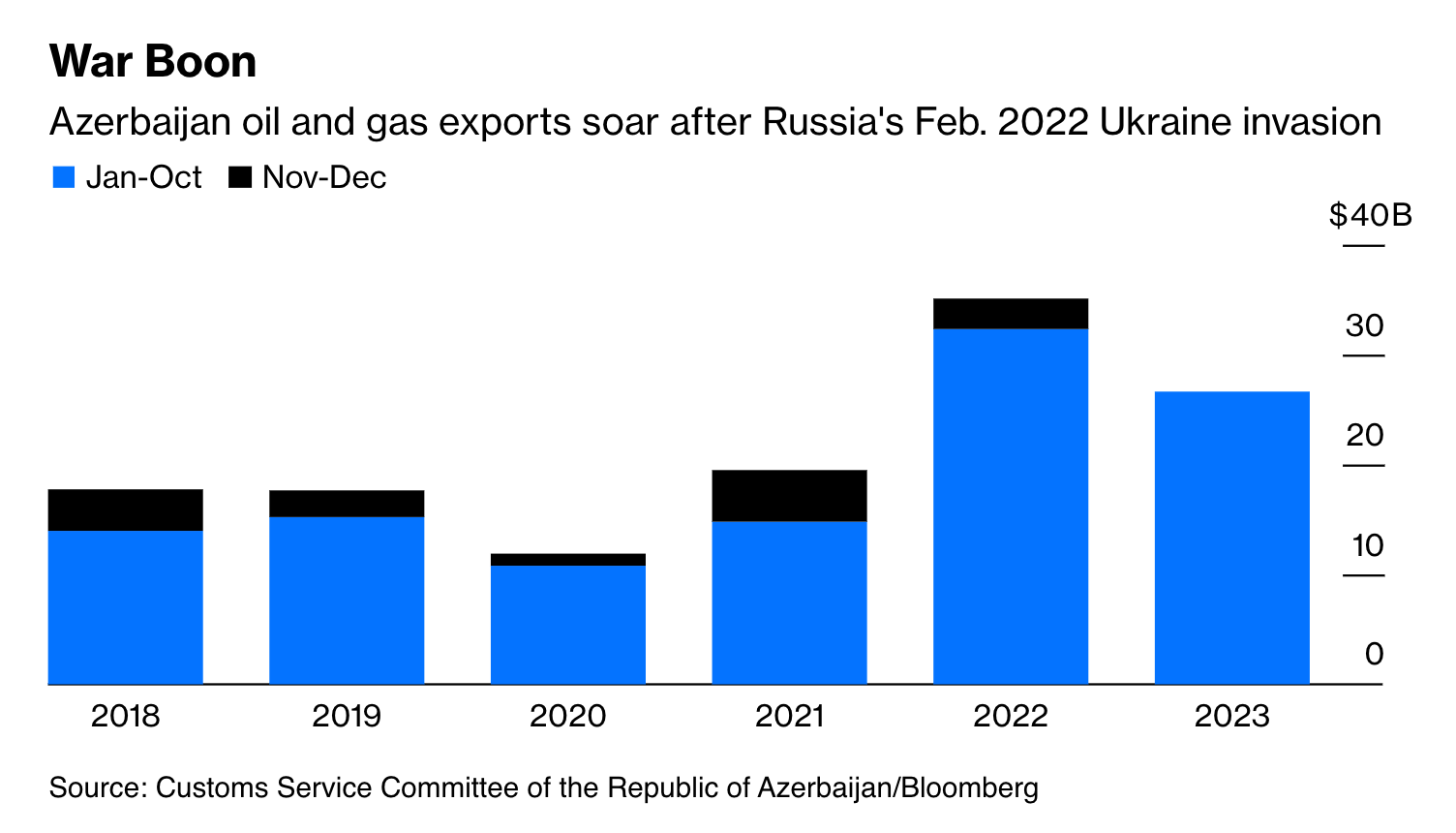
Russia’s invasion of Ukraine didn’t play out the way Vladimir Putin hoped, but it’s proving an unimagined boon for his fellow authoritarian leader in neighboring Azerbaijan. President Ilham Aliyev has never been as politically secure as he is today. Aliyev has won big from Russia’s invasion on multiple fronts. In July last year he signed a deal with the European Union to double natural gas exports to the bloc, as it scrambled for new energy sources to fill the void left by Russian supplies lost to sanctions. New infrastructure has to be built to make that possible, but increased sales and prices together raised revenue from the ex-Soviet nation’s oil and gas sectors from $19.5 billion in 2021, to $35 billion in 2022. Those fossil fuels accounted for more than 92% of Azerbaijan’s exports and over half the state budget.

A distracted Russia, the traditional security provider for Azerbaijan’s arch-rival Armenia, also gave Aliyev the space to overrun the ethnic-Armenian controlled enclave of Nagorno-Karabakh, ending 30 years of war and humiliation with precisely the kind of short and glorious military victory Putin aimed to achieve in Ukraine. From this already high base, things are looking up for Aliyev. Azerbaijan just locked up the right to hold the next global summit on climate change, COP-29.

Postagem em destaque

Livro Marxismo e Socialismo finalmente disponível - Paulo Roberto de Almeida

Meu mais recente livro – que não tem nada a ver com o governo atual ou com sua diplomacia esquizofrênica, já vou logo avisando – ficou final...