quarta-feira, 21 de janeiro de 2026

Academia.edu continua me premiando com meus próprios trabalhos - Paulo Roberto de Almeida


Academia.edu


You read the paper 4939) A politica externa brasileira em face das ameacas ao multilateralismo e.... We found a related paper on Academia:

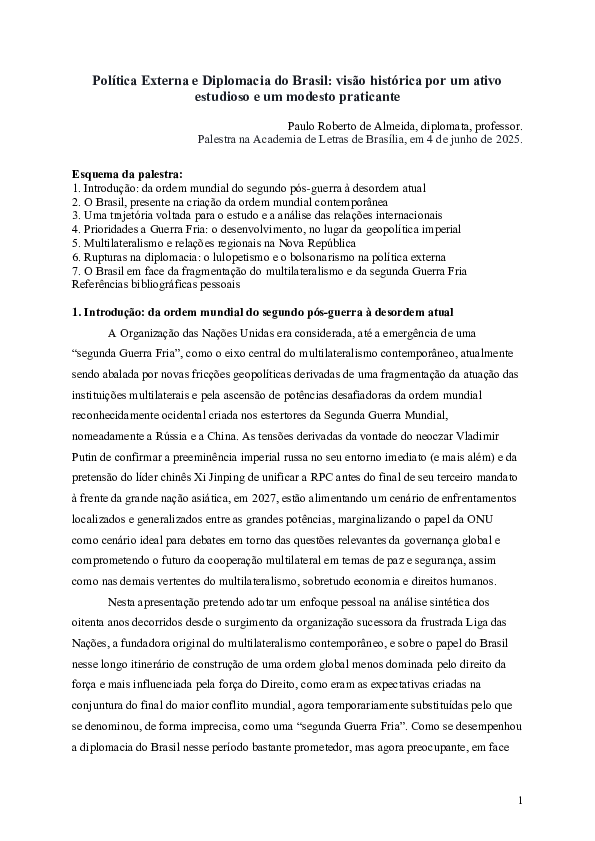
4920) Política Externa e Diplomacia do Brasil: visao historica por um ativo estudioso e um modesto praticante
Paper Thumbnail
Author Photo Paulo Roberto de Almeida
2025, Política Externa e Diplomacia do Brasil: visão histórica por um ativo estudioso e um modesto praticante
View PDF ▸ Download PDF ⬇


ABSTRACT
Política Externa e Diplomacia do Brasil: visão histórica por um ativo estudioso e um modesto praticante Paulo Roberto de Almeida, diplomata, professor. Palestra na Academia de Letras de Brasília, em 4 de junho de 2025. Esquema da palestra: 1. Introdução: da ordem mundial do segundo pós-guerra à desordem atual 2....
read more...

Your recent reading history:
4199) Antiglobalismo (inédito, 2022) - Paulo Roberto de Almeida

A incrível carta de DJT ao primeiro-ministro da Noruega para reclamar não ter ganho o Prêmio Nobel da Paz em 2025 (encaminhado aos embaixadores europeus em Washington) - Heather Cox Richardson (Letters from an American)

A incrível carta de DJT ao primeiro-ministro da Noruega para reclamar não ter ganho o Prêmio Nobel da Paz em 2025 (encaminhado aos embaixadores europeus em Washington)


From: Heather Cox Richardson from Letters from an American <heathercoxrichardson@substack.com>
Date: January 20, 2026 at 1:54:59 AM EST

    Late last night, Nick Schifrin of PBS NewsHour posted on social media that the staff of the U.S. National Security Council had sent to European ambassadors in Washington a message that President Donald J. Trump had already sent to Prime Minister Jonas Gahr Støre of Norway.
    The message read:

“Dear Jonas: Considering your Country decided not to give me the Nobel Peace Prize for having stopped 8 Wars PLUS, I no longer feel an obligation to think purely of Peace, although it will always be predominant, but can now think about what is good and proper for the United States of America. Denmark cannot protect that land from Russia or China, and why do they have a ‘right of ownership’ anyway? There are no written documents, it’s only that a boat landed there hundreds of years ago, but we had boats landing there, also. I have done more for NATO than any other person since its founding, and now, NATO should do something for the United States. The World is not secure unless we have Complete and Total Control of Greenland. Thank you! President DJT”

==========

Faisal Islam of the BBC voiced the incredulity rippling across social media in the wake of Schifrin’s post, writing: “Even by the standards of the past week, like others, I struggle to comprehend how the below letter on Greenland/Nobel might be real, although it appears to come from the account of a respected PBS journalist… this is what I meant by beyond precedent, parody and reality….” Later, Islam confirmed on live TV that the letter was real and posted on X: “Incredible… the story is actually not a parody.”
International affairs journalist Anne Applebaum noted in The Atlantic the childish grammar in the message, and pointed out—again—that the Norwegian Nobel Committee is not the same thing as the Norwegian government, and neither of them is Denmark, a different country. She also noted that Trump did not, in fact, end eight wars, that Greenland has been Danish for centuries, that many “written documents” establish Danish sovereignty there, that Trump has done nothing for NATO, and that European NATO members increased defense spending out of concern over Russia’s increasing threat.
This note, she writes, “should be the last straw.” It proves that “Donald Trump now genuinely lives in a different reality, one in which neither grammar nor history nor the normal rules of human interaction now affect him. Also, he really is maniacally, unhealthily obsessive about the Nobel Prize.” Applebaum implored Republicans in Congress “to stop Trump from acting out his fantasy in Greenland and doing permanent damage to American interests.” “They owe it to the American people,” she writes, “and to the world.”
Former Vice President Dick Cheney’s doctor Jonathan Reiner agreed: “This letter, and the fact that the president directed that it be distributed to other European countries, should trigger a bipartisan congressional inquiry into presidential fitness.”
Today three top American Catholic cardinals, Blase Cupich of Chicago, Robert McElroy of Washington, D.C., and Joseph Tobin of Newark, New Jersey, issued a joint statement warning the Trump administration that its military action in Venezuela, threats against Greenland, and cuts to foreign aid risk bringing vast suffering to the world.
Nicole Winfield and Giovanna Dell’Orto of the Associated Press reported that the cardinals spoke up after a meeting at the Vatican in which several fellow cardinals expressed alarm about the administration’s actions. Cupich said that when the U.S. can be portrayed as saying “‘might makes right’—that’s a troublesome development. There’s the rule of law that should be followed.”
“We are watching one of the wildest things a nation-state has ever done,” journalist Garrett Graff wrote: “A superpower is [dying by] suicide because the [Republican] Congress is too cowardly to stand up to the Mad King. This is one of the wildest moments in all of geopolitics ever.”
In just a year since his second inauguration, Trump has torn apart the work that took almost a century of struggle and painstaking negotiations from the world’s best diplomats to build. Since World War II, generations of world leaders, often led by the United States, created an international order designed to prevent future world wars. They worked out rules to defend peoples and nations from the aggressions of neighboring countries, and tried to guarantee that global trade, bolstered by freedom of the seas, would create a rising standard of living that would weaken the ability of demagogues to create loyal followings.
In August 1941, four months before the U.S. entered World War II, U.S. president Franklin Delano Roosevelt and British prime minister Winston Churchill and their advisors laid out principles for an international system that could prevent future world wars. In a document called the Atlantic Charter, they agreed that countries should not invade each other and therefore the world should work toward disarmament, and that international cooperation and trade thanks to freedom of the seas would help to knit the world together with rising prosperity and human rights.
The war killed about 36.5 million Europeans, 19 million of them civilians, and left many of those who had survived homeless or living in refugee camps. In its wake, in 1945, representatives of the 47 countries that made up the Allies in World War II, along with the Byelorussian Soviet Socialist Republic, the Ukrainian Soviet Socialist Republic, and newly liberated Denmark and Argentina, formed the United Nations as a key part of an international order based on rules on which nations agreed, rather than the idea that might makes right, which had twice in just over twenty years brought wars that involved the globe.
Four years later, many of those same nations came together to resist Soviet aggression, prevent the revival of European militarism, and guarantee international cooperation across the Atlantic Ocean. France, the U.K., Belgium, the Netherlands, and Luxembourg formed a defensive military alliance with the U.S., Canada, Portugal, Italy, Norway, Denmark, and Iceland to make up the twelve original signatories to the North Atlantic Treaty. In it, the countries that made up the North Atlantic Treaty Organization (NATO) reaffirmed “their desire to live in peace with all peoples and all governments” and their determination “to safeguard the freedom, common heritage and civilisation of their peoples, founded on the principles of democracy, individual liberty and the rule of law.”
They vowed that any attack on one of the signatories would be considered an attack on all, thus deterring war by promising strong retaliation. This system of collective defense has stabilized the world for 75 years. Thirty-two countries are now members, sharing intelligence, training, tactics, equipment, and agreements for use of airspace and bases. In 2024, NATO countries reaffirmed their commitment and said Russia’s invasion of Ukraine had “gravely undermined global security.”
And therein lies the rub. The post–World War II rules-based international order prevents authoritarians from grabbing land and resources that belong to other countries. But Russia’s president Vladimir Putin, for example, is eager to dismantle NATO and complete his grab of Ukraine’s eastern industrial regions.
Trump has taken the side of rising autocrats and taken aim at the rules-based international order with his insistence that the U.S. must control the Western Hemisphere. In service to that plan, he has propped up Argentina’s right-wing president Javier Milei and endorsed right-wing Honduran president Nasry Asfura, helping his election by pardoning former president Juan Orlando Hernández, a leading member of Asfura’s political party, who was serving 45 years in prison in the U.S. for drug trafficking. Trump ousted Venezuelan president Nicolás Maduro and seized control of much of Venezuela’s oil, the profits of which are going to an account in Qatar that Trump himself controls.
This week, Trump has launched a direct assault on the international order that has stabilized the world since 1945. He is trying to form his own “Board of Peace,” apparently to replace the United Nations. A draft charter for that institution gives Trump the presidency, the right to choose his successor, veto power over any actions, and control of the $1 billion fee permanent members are required to pay. In a letter to prospective members, Trump boasted that the Board of Peace is “the most impressive and consequential Board ever assembled,” and that “there has never been anything like it!” Those on it would, he said, “lead by example, and brilliantly invest in a secure and prosperous future for generations to come.”
The Kremlin says Putin, whose war on Ukraine has now lasted almost four years and who has been shunned from international organizations since his indictment by the International Criminal Court for war crimes, has received an invitation to that Board of Peace. So has Putin’s closest ally, President Alexander Lukashenko of Belarus, who Ivana Kottasová and Anna Chernova of CNN note has been called “Europe’s last dictator.” Also invited are Hungary’s prime minister and Putin ally Viktor Orbán as well as Javier Milei.
And now Trump is announcing to our allies that he has the right to seize another country.
Trump’s increasing frenzy is likely coming at least in part from increasing pressure over the fact the Department of Justice is now a full month past the date it was required by law to release all of the Epstein files. Another investigation will be in the news as well, as former special counsel Jack Smith testifies publicly later this week about Trump’s role in trying to overturn the results of the 2020 election. Smith told the House Judiciary Committee in December that he believed a jury would have found Trump guilty on four felony counts related to his actions.
Smith knows what happened, and Trump knows that Smith knows what happened.
Trump’s fury over the Nobel Peace Prize last night was likely fueled as well by the national celebration today of an American who did receive that prize: the Reverend Doctor Martin Luther King Jr. The Nobel Prize Committee awarded King the prize in 1964 for his nonviolent struggle for civil rights for the Black population in the U.S. He accepted it “with an abiding faith in America and an audacious faith in the future of mankind,” affirming what now seems like a prescient rebuke to a president sixty years later, saying that “what self-centered men have torn down men other-centered can build up.”
Trump did not acknowledge Martin Luther King Jr. Day this year.
While the walls are clearly closing in on Trump’s ability to see beyond himself, he and his loyalists are being egged on in their demand for the seizure of Greenland by White House deputy chief of staff Stephen Miller, who is publicly calling for a return to a might-makes-right world. On Sean Hannity’s show on the Fox News Channel today, Miller ignored the strength of NATO in maintaining global security as he insisted only the U.S. could protect Greenland.
He also ignored the crucial fact that the rules-based international order has been instrumental in increasing U.S.—as well as global—prosperity since 1945. With his claim that “American dollars, American treasure, American blood, American ingenuity is what keeps Europe safe and the free world safe,” Miller is erasing the genius of the generations before us. It is not the U.S. that has kept the world safe and kept standards of living rising: it is our alliances and the cooperation of the strongest nations in the world, working together, to prevent wannabe dictators from dividing the world among themselves.
Miller is not an elected official. Appointed by Trump and with a reasonable expectation that Trump will pardon him for any crimes he commits, Miller is insulated both from the rule of law and, crucially, from the will of voters. The Republican congress members Applebaum called on to stop Trump are not similarly insulated.
Tonight Danish troops—the same troops who stood shoulder to shoulder with U.S. troops in Afghanistan from 2001 to 2021—arrived in Greenland to defend the island from the United States of America.

Notes:
https://www.theatlantic.com/ideas/2026/01/trump-letter-to-norway/685676/
https://www.theguardian.com/world/2013/nov/22/honduras-elections-leftist-party-libre
https://www.cnn.com/2026/01/19/europe/putin-board-of-peace-gaza-trump-intl
https://www.icc-cpi.int/defendant/vladimir-vladimirovich-putin
https://www.nato.int/en/about-us/official-texts-and-resources/official-texts/1941/08/14/the-atlantic-charter
https://www.nato.int/en/about-us/nato-history/a-short-history-of-nato
https://www.nobelprize.org/prizes/peace/1964/summary/
https://www.nobelprize.org/prizes/peace/1964/king/acceptance-speech/
https://eng.belta.by/president/view/trumps-letter-to-lukashenko-full-text-and-what-it-means-175942-2026/
https://abcnews.go.com/International/wireStory/us-catholic-cardinals-urge-trump-administration-embrace-moral-129346423
https://www.politico.eu/article/denmark-to-boost-military-presence-in-greenland/
https://www.nato.int/en/about-us/official-texts-and-resources/official-texts/1949/04/04/the-north-atlantic-treaty
https://www.nato.int/en/about-us/official-texts-and-resources/official-texts/2024/07/10/washington-summit-declaration
https://fortune.com/2026/01/17/trump-nations-1-billion-membership-payment-peace-board-united-nations/
https://www.bloomberg.com/news/articles/2026-01-17/trump-wants-nations-to-pay-1-billion-to-stay-on-his-peace-board
https://judiciary.house.gov/sites/evo-subsites/republicans-judiciary.house.gov/files/2025-12/Smith-Depo-Transcript_Redacted-w-Errata.pdf
X:
nickschifrin/status/2013107018081489006
faisalislam/status/2013143632522445099
faisalislam/status/2013177130536890877
Bluesky:
joycewhitevance.bsky.social/post/3mcs5zlstp224
ronfilipkowski.bsky.social/post/3mcslnjb2622n
gtconway.bsky.social/post/3mcsmygfb3c2k
vermontgmg.bsky.social/post/3mcsqlpp6ls2g
noelreports.com/post/3mcsndx5qcs2e
antongerashchenko.bsky.social/post/3mcse2pf5js2v

O aviário de Donald Trump - Jorio Dauster (Relatório Reservado)


O aviário de Donald Trump

  • Relatório Reservado, 21/01/2026

  • (Seqüência de “Uma pomba da paz sobrevoa o Planalto”)
    • Share

Tomando conhecimento da minuta do estatuto do Conselho da Paz proposto por Donald Trump a cerca de 60 chefes de Estado, fica claro que a pomba mencionada em meu artigo anterior sobre o assunto ganha características de filhote de urubu.

São os seguintes os mais graves inconvenientes da referida Carta:

  1. ir além das questões relativas a Gaza nos termos da Resolução 2083 do Conselho de Segurança das Nações Unidas ao estabelecer como sua missão, no Artigo 1, “promover a estabilidade, restaurar a governança confiável e legítima e assegurar a paz duradoura em áreas afetadas ou ameaçadas por conflitos”. Ora, tal amplitude de ação faria do Conselho um órgão tão ou mais importante quanto a ONU, criticada indiretamente no preâmbulo por sua falta de efetividade; e
  2. conceder poderes vastíssimos a Trump como presidente do Conselho, dentre os quais: escolher seus membros (artigo 2.1); renovar ou não a participação de qualquer membro após 3 anos caso ele não tenha contribuído com US$ 1 bilhão (2.2.c); criar, modificar e dissolver entidades subsidiárias (3.2.b); designar seu sucessor e só deixar de ser presidente por decisão voluntária ou voto unânime de incapacidade pelo Comitê Executivo cujos membros são de sua escolha (3.3); ter autoridade final com respeito ao significado, interpretação e aplicação do estatuto (7); adotar resoluções e diretivas em nome do Conselho (9); dissolver o Conselho quando achar necessário ou adequado (10.2).

Diante desses sérios defeitos do documento constitutivo do Conselho, como deve o Brasil reagir ao convite que Trump dirigiu a Lula para integrá-lo?  

O primeiro ponto a considerar é que o Conselho de Paz mandatado pelas Nações Unidas efetivamente previa a presidência de Donald Trump sem entrar em detalhes sobre a estrutura e funcionamento do órgão. Sua finalidade, porém, era de fato impedir a continuidade do genocídio conduzido por Israel em Gaza e a anexação pura e simples da Faixa. Como as forças militares israelenses ainda controlam mais da metade daquele território e limitam fortemente os fluxos de assistência aos dois milhões de seres que ali sobrevivem em condições subumanas, não surpreende que Benjamin Netanyahu e seus comparsas da direita radical estejam furibundos com a iniciativa de Trump. Mais certo ainda, uma das milhares de mães palestinas que vive numa tenda e cuida de filhos sem comida suficiente, sem remédios, sem escolas e sem perspectivas não terá um minuto de sua triste existência para dedicar-se às questões geopolíticas em jogo ainda hoje. Nada impedirá que Israel alcance seus terríveis propósitos sem uma ação internacional eficaz.

Por tal motivo, e também pelos outros elementos de juízo que expus no artigo anterior sob o título de “Uma pomba sobrevoa o Palácio do Planalto”, não seria cabível uma negativa peremptória – coisa que até agora só foi feita pela França sem dúvida sob a influência do tratamento humilhante que Trump vem dando à Europa, ameaçando inclusive tomar a Groenlândia à força. Igualmente não caberia apressar-se com um sim sicofântico como tratou de fazer, por exemplo, o áulico Javier Milei. Na realidade, tal como já declarado pelo porta-voz do Kremlin. Putin e dezenas de chefes de Estado em todo o planeta estudam neste momento com seus chanceleres como responder a tão incômodo convite sem sacrificar o futuro dos palestinos em Gaza e sem provocar uma crise política com o vingativo ocupante da Casa Branca.

Durante esse período necessário de reflexão, os agentes diplomáticos devem estar realizando consultas urgentes a fim de tentar conhecer a posição de outros players importantes. Assim, por exemplo, o Brasil teria muito a ganhar caso esteja auscultando as opiniões de Canadá, Austrália, Reino Unido, Alemanha, Arábia Saudita, Egito e Emirados – para só citar algumas das nações que não reagirão de forma amadorística ao se verem confrontadas com situação tão desafiadora. Quem sabe pode até surgir uma resposta coletiva ou coordenada que evite a particularização aceita por Emmanuel Macron em troca de uma possível tarifa de 200% sobre os vinhos franceses nos Estados Unidos. Embora o artigo 12 diga que o estatuto não admite reservas, uma possibilidade consiste em que o Brasil aceite o convite, mas condicione sua entrada no Conselho à efetivação de determinadas alterações no texto plenamente explicadas. Caso tais mudanças sejam rechaçadas por Trump, isso faria com que nossa não participação se devesse a ele próprio.

Enquanto isso, as atenções devem continuar concentradas em buscar conhecer que outras criaturas habitam o estranho aviário de Donald Trump.


O Brasil como potência média - Paulo Roberto de Almeida

 Trecho final de meu artigo sobre o “fim do multilateralismo como o conhecíamos”:

 O mundo ingressou definitivamente em uma nova era, que revive conflitos passados, produtores de desastres humanitários. A diplomacia brasileira não terá qualquer auxílio no contexto do multilateralismo internacional ou regional das últimas décadas, já inoperantes. Sua autonomia decisória em matéria de política externa só poderia ocorrer em coordenação com outras potências médias, independentemente de serem classificadas ao Sul ou ao Norte. Não se tem ainda claro que tal curso de ação possa ter viabilidade prática na atual orientação de uma diplomacia que, no passado não muito distante, adotou um alinhamento irrefletido com as duas grandes potências opositoras da atual ordem global, marcadamente ocidental.

O lulopetismo diplomático apostou num Bric importado a partir de uma ideia (não diplomática) de ganhos financeiros, foi confrontado a um Brics construído a partir das conveniências nacionais daquelas duas superpotências e acabou tendo de acomodar-se a um Brics+ ampliado em favor desses interesses exclusivos, o que produziu efeitos inesperados do ponto de vista dos interesses nacionais do Brasil. Não reconhecer essa involução no plano das relações exteriores do país significa continuar ignorando o saudável patrimônio diplomático acumulado por um planejamento cuidadoso da política externa, substituído por orientações ideológicas em nítido desacordo com as circunstâncias “orteguianas” de nossa geografia política, sempre vinculada à integração regional sul-americana. O novo Ícaro inconsciente do lulopetismo diplomático desprezou o “voo baixo” da integração sul-americana e, tentado pela aliança oportunista com duas superpotências nucleares, enveredou pelo “voo alto” do grande jogo da geopolítica mundial, uma trajetória que pode revelar-se ilusória em médio prazo.

Paulo Roberto de Almeida

Brasília, 14 janeiro 2026, 4 p.”


Ler o artigo completo neste link:

https://bit.ly/49FQk6J 


Ary Quintella atualiza Monsieur Jourdain, de Molière


Mark Carney, Davos Economic Forum (2026), Discurso de estadista,

Discurso de estadista mundial do primeiro-ministro do Canadá, Mark Carney, Davos Economic Forum, January 21, 2026,

It seems that every day we’re reminded that we live in an era of great power rivalry — that the rules-based order is fading, that the strong can do what they can, and the weak must suffer what they must. 

And this aphorism of Thucydides is presented as inevitable, as the natural logic of international relations reasserting itself. And faced with this logic, there is a strong tendency for countries to go along, get along to accommodate, to avoid trouble, to hope that compliance will buy safety.

Well, it won’t. So what are our options?

In 1978, the Czech dissident Václav Havel, later president, wrote an essay called “The Power of the Powerless,” and in it he asked a simple question: how did the communist system sustain itself? 

And his answer began with a greengrocer. 

Every morning, the shopkeeper places a sign in his window: “Workers of the world unite.” He doesn’t believe in it. No one does. But he places the sign anyway to avoid trouble, to signal compliance, to get along. And because every shopkeeper on every street does the same, the system persists — not through violence alone, but through the participation of ordinary people in rituals they privately know to be false.

Havel called this living within a lie. The system’s power comes not from its truth, but from everyone’s willingness to perform as if it were true. And its fragility comes from the same source. When even one person stops performing, when the greengrocer removes his sign, the illusion begins to crack.

Friends, it is time for companies and countries to take their signs down.

For decades, countries like Canada prospered under what we called the rules-based international order. We join its institutions, we praised its principles, we benefited from its predictability. And because of that, we could pursue values-based foreign policies under its protection. 

We knew the story of the international rules-based order was partially false, that the strongest would exempt themselves when convenient, that trade rules were enforced asymmetrically, and we knew that international law applied with varied rigor, depending on the identity of the accused or the victim.

This fiction was useful, and American hegemony in particular helped provide public goods, open sea lanes, a stable financial system, collective security, and support for frameworks for resolving disputes.

So we placed the sign in the window. We participated in the rituals, and we largely avoided calling out the gaps between rhetoric and reality.

This bargain no longer works.

Let me be direct. We are in the midst of a rupture, not a transition. 

Over the past two decades, a series of crises in finance, health, energy and geopolitics have laid bare the risks of extreme global integration. But more recently, great powers have begun using economic integration as weapons, tariffs as leverage, financial infrastructure as coercion, supply chains as vulnerabilities to be exploited. 

You cannot live within the lie of mutual benefit through integration when integration becomes the source of your subordination.

The multilateral institutions on which the middle powers have relied — the WTO, the UN, the COP, the very architecture of collective problem solving — are under threat. As a result, many countries are drawing the same conclusions that they must develop greater strategic autonomy in energy, food, critical minerals, in finance and supply chains. And this impulse is understandable. 

A country that cannot feed itself, fuel itself, or defend itself has few options. When the rules no longer protect you, you must protect yourself.

But let’s be clear-eyed about where this leads. A world of fortresses will be poorer, more fragile, and less sustainable.

And there’s another truth: if great powers abandon even the pretense of rules and values for the unhindered pursuit of their power and interests, the gains from transactionalism will become harder to replicate. 

Hegemons cannot continually monetize their relationships. Allies will diversify to hedge against uncertainty. They’ll buy insurance, increase options in order to rebuild sovereignty, sovereignty that was once grounded in rules but will increasingly be anchored in the ability to withstand pressure.

This room knows this is classic risk management. Risk management comes at a price, but that cost of strategic autonomy, of sovereignty, can also be shared. Collective investments in resilience are cheaper than everyone building their own fortresses. Shared standards reduce fragmentations. Complementarities are positive sum.

The question for middle powers like Canada is not whether to adapt to the new reality — we must. 

The question is whether we adapt by simply building higher walls, or whether we can do something more ambitious.

Now, Canada was amongst the first to hear the wake-up call, leading us to fundamentally shift our strategic posture. Canadians know that our old, comfortable assumptions that our geography and alliance memberships automatically conferred prosperity and security, that assumption is no longer valid. And our new approach rests on what Alexander Stubb, the president of Finland, has termed value-based realism. 

Or, to put it another way, we aim to be both principled and pragmatic. Principled in our commitment to fundamental values, sovereignty, territorial integrity, the prohibition of the use of force except when consistent with the UN Charter and respect for human rights. 

And pragmatic in recognizing that progress is often incremental, that interests diverge, that not every partner will share all of our values.

So we’re engaging broadly, strategically, with open eyes. We actively take on the world as it is, not wait around for a world we wish to be.

We are calibrating our relationships so their depth reflects our values, and we’re prioritizing broad engagement to maximize our influence, given the fluidity of the world at the moment, the risks that this poses and the stakes for what comes next. 

And we are no longer just relying on the strength of our values, but also the value of our strength.

We are building that strength at home. Since my government took office, we have cut taxes on incomes, on capital gains and business investment. We have removed all federal barriers to interprovincial trade. We are fast tracking $1 trillion of investments in energy, AI, critical minerals, new trade corridors and beyond. We’re doubling our defence spending by the end of this decade, and we’re doing so in ways that build our domestic industries. And we are rapidly diversifying abroad. 

We’ve agreed to a comprehensive strategic partnership with the EU, including joining SAFE, the European defence procurement arrangements. We have signed 12 other trade and security deals on four continents in six months.

In the past few days, we’ve concluded new strategic partnerships with China and Qatar. We’re negotiating free trade pacts with India, ASEAN, Thailand, Philippines and Mercosur.

We’re doing something else: to help solve global problems, we’re pursuing variable geometry. In other words, different coalitions for different issues based on common values and interests. So on Ukraine, we’re a core member of the Coalition of the Willing and one of the largest per capita contributors to its defence and security.

On Arctic sovereignty, we stand firmly with Greenland and Denmark and fully support their unique right to determine Greenland’s future.

Our commitment to NATO’s Article 5 is unwavering, so we’re working with our NATO allies, including the Nordic-Baltic Eight, to further secure the alliance’s northern and western flanks, including through Canada’s unprecedented investments in over-the-horizon radar, in submarines, in aircraft, and boots on the ground — boots on the ice.

Canada strongly opposes tariffs over Greenland and calls for focused talks to achieve our shared objectives of security and prosperity in the Arctic.

On plurilateral trade, we’re championing efforts to build a bridge between the Trans-Pacific partnership and the European Union, which would create a new trading bloc of 1.5 billion people on critical minerals. 

We’re forming buyer’s clubs anchored in the G7 so the world can diversify away from concentrated supply. And on AI, we’re cooperating with like-minded democracies to ensure that we won’t ultimately be forced to choose between hegemons and hyperscalers.

This is not naïve multilateralism, nor is it relying on their institutions. It’s building coalitions that work issue by issue with partners who share enough common ground to act together. In some cases, this will be the vast majority of nations. What it’s doing is creating a dense web of connections across trade, investment, culture on which we can draw for future challenges and opportunities.


Postagem em destaque

Nota do Instituto Diplomacia sobre o ataque americano ao Irã, que também menciona o da Rússia contra a Ucrânia

Uma nota sobre mais uma violação do Direito Internacional pelos EUA, ao atacar o Irã, que seguiu a da Rússia contra a Ucrânia...