quinta-feira, 17 de março de 2022

Os artigos da Carta das Nações Unidas que autorizam sanções e até bloqueios contra agressores

Os interessados podem consultar a Carta das Nações para ler o inteiro teor deste documento fundamental das relações internacionais contemporâneas, neste link: https://brasil.un.org/sites/default/files/2021-08/A-Carta-das-Nacoes-Unidas.pdf

Agora imaginem que não fosse nenhum dos membros permanentes do CSNU, ou seja, que possuem poder de veto, o que poderia ser feito contra o país agressor: 

Paulo Roberto de Almeida

Artigo 41 

O Conselho de Segurança decidirá sobre as medidas que, sem envolver o emprego de forças armadas, deverão ser tomadas para tornar efetivas suas decisões e poderá convidar os membros das Nações Unidas a aplicarem tais medidas. Estas poderão incluir a interrupção completa ou parcial das relações econômicas, dos meios de comunicação ferroviários, marítimos, aéreos, postais, telegráficos, radiofônicos, ou de outra qualquer espécie e o rompimento das relações diplomáticas

Artigo 42 

No caso de o Conselho de Segurança considerar que as medidas previstas no artigo 41 seriam ou demonstraram que são inadequadas, poderá levar a efeito, por meio de forças aéreas, navais ou terrestres, a ação que julgar necessária para manter ou restabelecer a paz e a segurança internacionais. Tal ação poderá compreender demonstrações, bloqueios e outras operações, por parte das forças aéreas, navais ou terrestres dos membros das Nações Unidas. 


Ou seja, se o direito de veto fosse suspenso para a Rússia, ela poderia ser estrangulada economicamente. Isso não vai ocorrer, mas deveria.

Paulo Roberto de Almeida 


quarta-feira, 16 de março de 2022

Decisão da Corte Internacional de Justiça deslegitima argumentação russa para invasão da Ucrânia - Artigo de Lucas Lima (O Globo)

Decisão da Corte Internacional de Justiça deslegitima argumentação russa para invasão da Ucrânia

Apesar dos votos dissidentes dos magistrados russo e chinesa, sentença do tribunal da ONU traz à Rússia obrigação jurídica de cumprir medidas cautelares

Corte Internacional de Justiça: decisão sobre alegações de Genocídio - Ucrânia v. Federação Russa

 ALLEGATIONS OF GENOCIDE UNDER THE CONVENTION ON THE PREVENTION AND PUNISHMENT OF THE CRIME OF GENOCIDE - (UKRAINE v. RUSSIAN FEDERATION)

 16 MARCH 2022 - ORDER

___________


ALLÉGATIONS DE GÉNOCIDE AU TITRE DE LA CONVENTION POUR LA PRÉVENTION ET LA RÉPRESSION DU CRIME DE GÉNOCIDE - (UKRAINE c. FÉDÉRATION DE RUSSIE)

16 MARS 2022 -  ORDONNANCE


English version: 

https://www.icj-cij.org/public/files/case-related/182/182-20220316-ORD-01-00-EN.pdf


TABLE OF CONTENTS


Paragraphs

CHRONOLOGY OF THE PROCEDURE 1-16


I. INTRODUCTION 17-23


II. PRIMA FACIE JURISDICTION 24-49

    1. General observations 24-27

    2. Existence of a dispute relating to the interpretation, application or fulfilment of the Genocide Convention 28-47

    3. Conclusion as to prima facie jurisdiction 48-49


III. THE RIGHTS WHOSE PROTECTION IS SOUGHT AND THE LINK BETWEEN

SUCH RIGHTS AND THE MEASURES REQUESTED 50-64


IV. RISK OF IRREPARABLE PREJUDICE AND URGENCY 65-77


V. CONCLUSION AND MEASURES TO BE ADOPTED 78-85


OPERATIVE CLAUSE 86


___________


INTERNATIONAL COURT OF JUSTICE - YEAR 2022

2022, 16 March

General List

No. 182

16 March 2022


ALLEGATIONS OF GENOCIDE UNDER THE CONVENTION ON THE PREVENTION AND PUNISHMENT OF THE CRIME OF GENOCIDE - (UKRAINE v. RUSSIAN FEDERATION)


REQUEST FOR THE INDICATION OF PROVISIONAL MEASURES ORDER

Present: President DONOGHUE; Vice-President GEVORGIAN; Judges TOMKA, ABRAHAM, BENNOUNA, YUSUF, XUE, SEBUTINDE, BHANDARI, ROBINSON, SALAM, IWASAWA, NOLTE, CHARLESWORTH; Judge ad hoc DAUDET; 


Registrar GAUTIER.

The International Court of Justice,

Composed as above,

After deliberation,

Having regard to Articles 41 and 48 of the Statute of the Court and Articles 73, 74 and 75 of the Rules of Court,

Makes the following Order:


(…) 


86. For these reasons,

THE COURT ,

Indicates the following provisional measures:


(1) By thirteen votes to two,

The Russian Federation shall immediately suspend the military operations that it commenced on 24 February 2022 in the territory of Ukraine;

IN FAVOUR: President Donoghue; Judges Tomka, Abraham, Bennouna, Yusuf, Sebutinde, Bhandari, Robinson, Salam, Iwasawa, Nolte, Charlesworth; Judge ad hoc Daudet; AGAINST : Vice-President Gevorgian; Judge Xue;


(2) By thirteen votes to two,

The Russian Federation shall ensure that any military or irregular armed units which may be directed or supported by it, as well as any organizations and persons which may be subject to its control or direction, take no steps in furtherance of the military operations referred to in point (1) above;

IN FAVOUR: President Donoghue; Judges Tomka, Abraham, Bennouna, Yusuf, Sebutinde, Bhandari, Robinson, Salam, Iwasawa, Nolte, Charlesworth; Judge ad hoc Daudet;

AGAINST : Vice-President Gevorgian; Judge Xue;


(3) Unanimously,

Both Parties shall refrain from any action which might aggravate or extend the dispute before the Court or make it more difficult to resolve.


PRA: Pessoalmente considero esta última decisão completamente CAOLHA, uma vez que o agressor é a Rússia, pois a Ucrânia está apenas se defendendo.


"China Engages Latin America: Distorting Development and Democracy?", by Evan Ellis - and my response, Paulo Roberto de Almeida

I have just received a gentle communication from an American partner: 

16 de mar. de 2022, à(s) 19:12, R. Evan Ellis, PhD from Evan Ellis on Latin America and the Caribbean <evanellis@substack.com> 

What I have responded: 

Dear Ellis, 

        China is just following the path started by European colonialism and imperialism centuries ago, and followed by the US over the whole 20th century, imposing and disposing its hegemonic presence over the entire continent, support either democracies, or dictatorships, even helping some military coups when something was not going according to Washington.

China wants to become rich, as Europe and US did in their respective itineraries, and the best form to do that is to perform as the two previous hegemonic powers have done: investments, trade, finance, infrastructure, technical cooperation and so on. China is far behind to what was done by the two previous economic giants and arrogant superpowers, so Latin American countries will seek their own interests, despite all the talk about distorting democracy and development.
If these two criteria were in the forefront of European and American cooperation toward the region, LAC should already have attained a higher degree of economic and social development, and a democratic regime of superior quality. If not, both past and present hegemonic presence in the region was neither functional nor successful. Let’s try the Chinese experiment, which is basically based in trade, not development nor democracy, similar to those previous dominances. In due course, China will also cooperate in S&T and educational undertakings, equal as those conducted by Europe and US. 
There is no more chasse gardée for a single power...

Paulo Roberto de Almeida

Quem são os oligarcas russos com negócios no Brasil? - Leandro Prazeres (BBC News Brasil)

 Quem são os oligarcas russos com negócios no Brasil?


Leandro Prazeres

Da BBC News Brasil em Brasília
16/03/2022

A invasão da Ucrânia pela Rússia fez com que diversos países disparassem uma série de sanções econômicas contra o governo do presidente russo, Vladimir Putin, mas também contra mega-empresários do país conhecidos popularmente como "oligarcas".

Mas não é só na Europa que alguns deles mantêm negócios e, em grande medida, obtêm lucro.

A BBC News Brasil identificou pelo menos quatro bilionários russos com laços empresariais estreitos no Brasil. Um deles foi condecorado pelo presidente Jair Bolsonaro, recentemente.

Dois critérios foram seguidos nessa definição.

O primeiro é terem tido seus nomes incluídos em uma lista divulgada pelo Departamento do Tesouro dos Estados Unidos em janeiro de 2018. A lista não previa sanções. Posteriormente, ela foi alvo de críticas por ser muito similar à lista das pessoas mais ricas da Rússia publicada pela revista Forbes.

O segundo critério foi a inclusão desses empresários na lista de sanções econômicas impostas por países como os Estados Unidos, Reino Unido ou pela União Europeia.

Seus nomes são, segundo os dois critérios, Andrey Andreevich Guryev, Andrey Melnichenko, Dmitry Mazepin. Vietchslav Kantor foi incluído na lista americana, mas não foi alvo de sanções.

Todos atuam no mesmo ramo: fertilizantes agrícolas.

A BBC News Brasil procurou representantes dos quatro. A assessoria de imprensa das empresas de Mazepin e Guryev disse que não poderia fazer comentários sobre as sanções.

A assessoria das empresas de Melnichenko informou que, após as sanções, ele se afastou do quadro de diretores e não é mais seu beneficiário. Os representantes de Kantor não se manifestaram.

A termo "oligarca" vem do grego "oligoi", que significa "poucos", e "arkhein", que significa "governar". Em outras palavras: governo de poucos ou governo para poucos.

Mais recentemente, o termo vem sendo usado para designar um grupo de russos extremamente ricos e politicamente bem relacionados que acumularam suas fortunas após a onda de privatizações que se seguiu ao fim do regime comunista, em 1991.

O ex-conselheiro da presidência dos Estados Unidos sobre as relações com a Rússia e co-fundador do programa de estudos de Rússia, Europa Oriental e Eurásia da Universidade de Yale, Thomas Graham, disse, em entrevista à CNN, que o termo "oligarca" é frequentemente usado para classificar os bilionários russos porque, diferentemente do que ocorreria em outras partes do mundo, esses empresários ficaram ricos por terem conexões estreitas com o governo.

"Você pode ser um empresário rico nos Estados Unidos e não se preocupar com seus contatos no governo. É um pouco diferente na Rússia. A cada decisão empresarial que você toma, você precisa checar com seus contatos no Kremlin", disse.

Em 2018, um porta-voz do governo russo rebateu o uso do termo e disse que não há oligarcas na Rússia, "apenas representantes de grandes empresas".

Ao longo dos anos, esses bilionários começaram a chamar atenção ao investir parte de suas fortunas em países europeus como o Reino Unido, França, Espanha, Itália, entre outros. Além de comprar mansões, carros de luxo e mega-iates, alguns deles chegaram a adquirir clubes de futebol. É o caso do russo Roman Abramovich, que comprou o Chelsea e, mais recentemente, se afastou do seu comando.

Confira abaixo quatro bilionários russos com negócios no Brasil:

Andrey Andreevich Guryev

Andrey Andreevich Guryev, 39, é um dos oligarcas com maior ligação com o Brasil. Ele é presidente do Conselho Empresarial Rússia-Brasil. Em fevereiro deste ano, ele foi condecorado com a medalha da Ordem do Rio Branco dada pelo presidente Jair Bolsonaro, em uma cerimônia realizada em Moscou.

Ele pertence à família Guryev, que controla a PhosAgro, uma das maiores empresas do mundo de fertilizantes à base de fosfato. De acordo com a revista Forbes, a fortuna estimada da família é de US$ 6 bilhões, a 28ª maior da Rússia.

O Brasil é considerado um dos mercados estratégicos pela empresa. Segundo relatórios da companhia, a PhosAgro registrou um lucro de US$ 1,7 bilhão em 2021.

Uma parcela desse resultado positivo ocorreu, segundo a própria empresa, graças à alta demanda por fertilizantes de países como o Brasil.

O Brasil é o quarto maior importador de fertilizantes do mundo e 23% de tudo o que é importado vem da Rússia, exportado por empresas como a PhosAgro. A empresa tem um escritório em São Paulo.

No ano passado, a companhia chegou a fazer uma oferta de 50 mil doses da vacina russa Sputnik contra a covid-19 ao Ministério da Saúde. O uso do imunizante no Brasil, no entanto, nunca foi autorizado pela Agência Nacional de Vigilância Sanitária (Anvisa).

Guryev "Junior", como também é conhecido, foi um dos principais organizadores de um fórum de empresários brasileiros e russos realizado em fevereiro, em Moscou. O evento contou com a presença de Jair Bolsonaro.

Na mesa do evento, ele estava a menos de dois metros de distância do presidente, separado apenas pelo ministro das Relações Exteriores, Carlos França.

O encontro aconteceu oito dias antes do presidente russo, Vladimir Putin, com quem a família Guryev tem proximidade, ordenar a invasão da Ucrânia.

E foi justamente a importância do setor de fertilizantes para a economia russa que fez com que a União Europeia incluísse Andrey Guryev "Junior" na lista de sanções econômicas publicada pelo bloco na semana passada.

De acordo com o bloco, a empresa estaria ligada ao governo russo e suas receitas contribuiriam com as ações da Rússia na Ucrânia.

"Andrey Guryev, na sua qualidade de diretor executivo da PhosAgro, se beneficia das decisões do Governo da Rússia. A PJSC PhosAgro está, em grande medida, ligada ao Governo russo e, por conseguinte, as receitas que gera constituem uma importante fonte de receitas para o Governo russo", diz a União Europeia.

As sanções impostas pela União Europeia preveem o congelamento de bens e ativos que estejam em seu nome ou que estejam à sua disposição nos países do bloco.

A medida foi tomada no dia 9 de março. No dia seguinte, Guryev "Junior" renunciou ao posto de CEO.

Nesta terça-feira, Guryev "Junior" também foi incluído na lista de sanções do Reino Unido. Ele está impedido de entrar no país e seus bens por lá deverão ser congelados.

A BBC News Brasil enviou questionamentos à sede da PhosAgro, mas a assessoria de imprensa da companhia disse que não se pronunciaria sobre o assunto.

Andrey Melnichenko
O empresário Andrey Melnichenko era o oitavo homem mais rico da Rússia em 2021, de acordo com a revista Forbes. Seu nome também constava na lista de oligarcas russos divulgada pelo governo dos Estados Unidos em 2018.

Sua fortuna estava avaliada em US$ 17,9 bilhões. O valor é US$ 1 bilhão a mais que a fortuna do brasileiro mais rico do mundo, o investidor Jorge Paulo Lehmann, com seus US$ 16,9 bilhões.

Melnichenko ficou bilionário atuando no ramo de fertilizantes agrícolas e carvão mineral. Ele era o nome por trás da EuroChem Group, um conglomerado de empresas com negócios em diversos países, inclusive no Brasil.

Em 2016, a EuroChem comprou 51% das operações de uma empresa brasileira que operava no setor de fertilizantes. Em 2020, o grupo anunciou que compraria o restante da companhia. À época, a expectativa era de que o faturamento da empresa girava em torno de R$ 4 bilhões por ano.

Atualmente, ela é uma das principais fornecedoras de fertilizantes à base de fosfato do Brasil.

De olho no agronegócio brasileiro, a EuroChem continuou a expandir suas operações no país.

Em janeiro deste ano, o Conselho Administrativo de Defesa Econômica (CADE), aprovou a proposta feita pela EuroChem para comprar 51% das ações da Heringer Fertilizantes, uma transação estimada em R$ 554 milhões.

Melnichenko foi alvo de sanções impostas pelo Reino Unido e pela União Europeia. Ele teve seus bens e outros ativos financeiros congelados.

Ao justificar sua inclusão na lista de sanções, a União Europeia destacou o fato de Melnichenko ter sido um dos 36 empresários convidados por Putin a participar de um encontro para discutir os impactos das ações russas no dia 24 de fevereiro, quando Putin ordenou o avanço de suas tropas sobre a Ucrânia.

"O fato de ele ter sido convidado para esse encontro mostra que ele é membro do círculo mais próximo de Vladimir Putin e que ele está apoiando ou implementando ações ou políticas que enfraquecem ou ameaçam a integridade territorial, a soberania e a independência da Ucrânia", diz o texto.

Dois dias depois de ser incluído na lista da União Europeia, autoridades italianas apreenderam um mega-iate avaliado em US$ 578 milhões (o equivalente a R$ 2,9 bilhões) que estava na cidade de Trieste.

Na quarta-feira (10/03), a EuroChem Group divulgou um comunicado informando que Melnichenko renunciou ao seu cargo na direção da companhia. O anúncio também disse que Melnichenko se retirou da condição de principal beneficiário da empresa.

Procurada, a assessoria de imprensa da EuroChem Group reforçou o conteúdo de uma nota divulgada pela empresa no dia 10 de março, na qual anunciado o afastamento de Melnichenko da companhia.

"A EuroChem Group, uma líder global na produção de fertilizantes, anuncia que Andrey Melnichenko renunciou da sua posição como diretor não-executivo do quadro de diretores e se retirou como principal beneficiário", diz um trecho da nota.

A nota continua afirmando que "o movimento segue a inclusão do senhor Melnichenko na lista de sanções da União Europeia e foi tomada para assegurar que a EuroChem seja capaz de continuar fornecendo nutrientes para a agricultura a milhões de pessoas ao redor do mundo ajudando a garantir segurança alimentar global".

Dmitry Mazepin
Dmitry Mazepin tem 54 anos e nasceu em Minsk, capital de Belarus, quando o país ainda fazia parte da antiga União Soviética. De acordo com a revista Forbes, Mazepin é dono de uma fortuna avaliada em US$ 1,5 bilhão, o equivalente a R$ 7,7 bilhões.

Em 1992, ele se formou em Economia em uma universidade de Moscou e começou a atuar no setor financeiro e petroquímico, em empresas que haviam surgido após a onda de privatizações que se seguiu à queda do regime comunista.

Em 2007, Mazepin fundou a Uralchem, que depois se tornou uma das maiores produtoras e exportadoras de fertilizantes do mundo.

Assim como seus outros concorrentes, Mazepin também mantém negócios com o Brasil. Além de exportar fertilizantes para o país, o grupo Uralchem vem comprando ativos no país ao longo dos últimos anos.

Em 2021, por exemplo, a Uralkali, uma das empresas sob o comando da Uralchem, anunciou a compra de 100% das ações da UPI Norte, acionista da Fertgrow S.A, líder na distribuição de fertilizantes agrícolas no Brasil.

Mazepin se dedica, além dos negócios, ao esporte. Um dos seus principais investimentos na área vinha sendo o patrocínio à escuderia Haas, da Fórmula 1, onde seu filho, Nikita Mazepin, era piloto.

Além disso, Mazepin se tornou uma figura pública influente na Rússia, inclusive no meio político russo. Ele era frequentemente visto em eventos com o presidente russo, Vladimir Putin.

A proximidade com o Kremlin ficou ainda mais evidente no dia 24 de fevereiro, quando ele fez parte do grupo de empresários chamados por Putin após o início da invasão russa à Ucrânia.

Essa proximidade também foi mencionada pela União Europeia ao incluir Mazepin e seu filho na lista de sanções econômicas. Seus bens nos países do bloco estão congelados.

Dmitry e Nikita também foram incluídos na lista de sanções do Reino Unido, onde estão proibidos de entrar e tiveram seus ativos bloqueados.

Um dia após ser incluído nas sanções da União Europeia, a Uralchem anunciou que Mazepin vendeu 52% das suas ações na companhia, ficando com 48% e, perdendo assim, o controle acionário da empresa.

Ele também renunciou ao cargo de CEO da Uralchem, num movimento que, segundo analistas, visa proteger a empresa das sanções impostas por conta da invasão russa à Ucrânia.

Por conta das sanções, Nikita Mazepin perdeu o posto de piloto da Haas.

Procurada pela BBC News Brasil, a Uralchem disse que não poderia fazer comentários sobre as sanções sobre os Mazepin. A companhia afirmou ainda que o Brasil tem sido "um mercado historicamente importante".

Vyacheslav Kantor
De acordo com a revista Forbes, Vyacheslav Kantor tem uma fortuna avaliada em US$ 4,9 bilhões, o equivalente a R$ 25 bilhões.

Diferentemente de Guryev, Melnichenko e Mazepin, Kantor não foi, até agora, alvo de sanções da União Europeia, Reino Unido ou dos Estados Unidos. Ele também é considerado um empresário próximo a Vladimir Putin.

A maior parte da sua fortuna veio da Acron, outra gigante russa do setor de fertilizantes.

Segundo a agência Bloomberg, em janeiro deste ano ele tinha 94% das ações da empresa. De acordo com a companhia, ele exerce o cargo de presidente do conselho de coordenação da Acron, um cargo não-executivo.

Kantor é judeu e tem nacionalidade russa, israelense e britânica. É em Londres, aliás, que ele vive com sua família.

Assim como ocorre com suas concorrentes no setor, o Brasil é considerado um mercado estratégico para a Acron, que já atua exportando fertilizantes produzidos em suas plantas na Rússia para o país.

A iniciativa mais recente da empresa no país é a negociação com a Petrobras para a compra de uma fábrica de fertilizantes nitrogenados em Três Lagos, em Mato Grosso do Sul.

No dia 4 de fevereiro, o presidente Jair Bolsonaro anunciou que a Petrobras havia fechado um acordo de venda da planta para a Acron. Analistas, no entanto, afirmam que o fechamento do contrato ainda depende da avaliação da área de governança da Petrobras.

As obras da fábrica começaram em 2007 e já teriam consumido pelo menos R$ 3,8 bilhões. O valor da venda ainda não foi divulgado. A estimativa é de que a unidade entre em operação em 2027.

Procurada, a Acron não respondeu aos questionamentos enviados pela reportagem.

https://www.bbc.com/portuguese/brasil-60759080

Russia Inside Putin’s circle — the real Russian elite - Anatol Lieven (FT)

Please use the sharing tools found via the share button at the top or side of articles. Copying articles to share with others is a breach of FT.com T&Cs and Copyright Policy. Email licensing@ft.com to buy additional rights. Subscribers may share up to 10 or 20 articles per month using the gift article service. More information can be found here
https://www.ft.com/content/503fb110-f91e-4bed-b6dc-0d09582dd007?utm_source=pocket_mylist&utm_source=RC+Investigations+Today&utm_campaign=4bb0db1316-EMAIL_CAMPAIGN_2016_11_11_COPY_01&utm_medium=email&utm_term=0_d042379c8d-4bb0db1316-88584170&mc_cid=4bb0db1316&mc_eid=a748c2276c

The Weekend Essay 

Russia Inside Putin’s circle — the real Russian elite 

As the west focuses on oligarchs, a far smaller group has its grip on true power in Moscow. Who are the siloviki — and what motivates them? 

Anatol Lieven 

Financial, Times, March 11, 2022

https://www.ft.com/content/503fb110-f91e-4bed-b6dc-0d09582dd007?utm_source=pocket_mylist&utm_source=RC+Investigations+Today&utm_campaign=4bb0db1316-EMAIL_CAMPAIGN_2016_11_11_COPY_01&utm_medium=email&utm_term=0_d042379c8d-4bb0db1316-88584170&mc_cid=4bb0db1316&mc_eid=a748c2276c

In describing Vladimir Putin and his inner circle, I have often thought of a remark by John Maynard Keynes about Georges Clemenceau, French prime minister during the first world war: that he was an utterly disillusioned individual who “had one illusion — France”. 

Something similar could be said of Russia’s governing elite, and helps to explain the appallingly risky collective gamble they have taken by invading Ukraine. Ruthless, greedy and cynical they may be — but they are not cynical about the idea of Russian greatness. 

The western media employ the term “oligarch” to describe super-wealthy Russians in general, including those now wholly or largely resident in the west. The term gained traction in the 1990s, and has long been seriously misused. In the time of President Boris Yeltsin, a small group of wealthy businessmen did indeed dominate the state, which they plundered in collaboration with senior officials. This group was, however, broken by Putin during his first years in power. 

Three of the top seven “oligarchs” tried to defy Putin politically. Boris Berezovsky and Vladimir Gusinsky were driven abroad, and Mikhail Khodorkovsky was jailed and then exiled. The others, and their numerous lesser equivalents, were allowed to keep their businesses within Russia in return for unconditional public subservience to Putin. When Putin met (by video link) leading Russian businessmen after launching the invasion of Ukraine, there was no question of who was giving the orders. 

The bespectacled Mikhail Khodorkovsky stands behind bars, guarded by men in military attire, in a Russian courtroom Putin critic Mikhail Khodorkovsky, former head of oil company Yukos, on trial in May 2005 for supposed fraud and tax evasion, 

The force that broke the oligarchs was the former KGB, reorganised in its various successor services. Putin himself, of course, came from the KGB, and a large majority of the top elite under Putin are from the KGB or associated state backgrounds (though not the armed forces). This group have remained remarkably stable and homogenous under Putin, and are (or used to be) close to him personally. Under his leadership, they have plundered their country (though unlike the previous oligarchs, they have kept most of their wealth within Russia) and have participated or acquiesced in his crimes, including the greatest of them all, the invasion of Ukraine. They have echoed both Putin’s vicious propaganda against Ukraine and his denunciations of western decadence. As Russia plunges deeper into a military quagmire and economic crisis, a central question is whether — if the war is not ended quickly by a peace settlement — Putin can be removed (or persuaded to step down) by the Russian elites themselves, in order to try to extricate Russia and themselves from the pit he has dug for them. To assess the chances of this requires an understanding of the nature of the contemporary Russian elites, and above all of Putin’s inner core. By way of illustrating the depth of the Russian catastrophe of the 1990s and identifying with all those who suffered from it, Putin has said that at one stage he was reduced — while still a serving lieutenant colonel of the KGB — to moonlighting as a freelance taxi driver in order to supplement his income. This is plausible enough. In 1994, while I was working as a journalist for The Times in Russia and the former USSR, my driver in the North Caucasus was an ex-major in the KGB. “We thought we were the backbone of the Soviet Union,” he said to me bitterly. “Now look at us. Real Chekists!” Despite amassing immense wealth and power, Putin and his inner circle remain intensely resentful of the way the USSR collapsed “Real Chekist” (nastoyashchy chekist) was a Soviet propaganda phrase referring to the qualities of ruthless discipline, courage, ideological commitment and honesty supposedly characteristic of the Cheka, the first Soviet secret police formed by Lenin and his associates. It became the subject of many Soviet jokes, but there is little doubt that Putin and his top elite continue to see themselves in this light, as the backbone of Russia — though Putin, who is anything but a revolutionary, appears to identify much more strongly with the security elites of imperial Russia. An interesting illustration of this comes from Union of Salvation (Soyuz Spaseniya, 2019), a film about the radical Decembrist revolt of 1825, made with the support of the Russian state. To the considerable shock of older Russian friends of mine who were brought up to revere the Decembrists, the heroes of this film are Tsar Nicholas I and the loyal imperial generals and bureaucrats who fought to preserve government and order against the rebels. Although they have amassed immense power and wealth, Putin and his immediate circle remain intensely resentful of the way in which the Soviet Union, Russia and their own service collapsed in the 1990s — and great power mixed with great resentment is one of the most dangerous mixtures in both domestic and international politics. 

Sergei Naryshkin, director of the Russian Foreign Intelligence Service, speaking at a lectern during a meeting of the Russian Security Council at Moscow’s Kremlin in February . . . and at a televised meeting of the National Security Council on the eve of the Ukraine invasion, where he was humiliated by Putin. 

As Putin’s autocratic tendencies have grown, real power (as opposed to wealth) within the system has come to depend more and more on continual personal access to the president; and the number of those with such access has narrowed — especially since the Covid pandemic led to Putin’s drastic physical isolation — to a handful of close associates. Five of Putin’s inner circle Sergei Lavrov, 71, foreign minister Sergei Naryshkin, 67, foreign intelligence chief Nikolai Patrushev, 70, secretary of Russia’s security council Igor Sechin, 61, chief executive of Rosneft Sergei Shoigu, 66, defence minister In his first years in power, Putin (who was a relatively junior KGB officer) could be regarded as “first among equals” in a top elite of friends and colleagues. No longer. Increasingly, even the siloviki have been publicly reduced to servants of the autocrat — as was graphically illustrated by Putin’s humiliation of his foreign intelligence chief, Sergei Naryshkin, at the televised meeting of the National Security Council on the eve of war. Such contemptuous behaviour towards his immediate followers could come back to bite Putin, as it has so many past autocrats. The inner core includes defence minister Sergei Shoigu (former emergencies minister and not a professional soldier); Nikolai Patrushev, former head of domestic intelligence and now secretary of Russia’s National Security Council; Naryshkin; and Igor Sechin, the former deputy prime minister appointed by Putin to run the Rosneft oil company. Insofar as top economic officials with “patriotic liberal” leanings were ever part of this inner core, they have long since been excluded. 

These men are known in Russia as the “siloviki” — “men of force”, or perhaps even, in the Irish phrase, “hard men”. A clear line should be drawn between the siloviki and the wider Russian elites — large and very disparate and disunited congeries of top businessmen, senior officials outside the inner circle, leading media figures, top generals, patriotic intellectuals and the motley crew of local notables, placemen and fixers who make up the leadership of Putin’s United Russia party. 

Among some of the wider Russian elites, unease at the invasion of Ukraine and its consequences is already apparent. Naturally enough, this has begun with the economic elites, given their deep stakes in business with the west and their understanding of the catastrophic impact of western sanctions on the Russian economy. Roman Abramovich, his discomfort clear enough as he sought buyers for Chelsea Football Club, found the sale halted this week when his UK assets were frozen. Mikhail Fridman, chairman of Alfa Group (already severely hit by western sanctions) and one of the surviving former “oligarchs” from the 1990s, has called for an early end to the war, as has aluminium magnate Oleg Deripaska. If there is no peace agreement and the war drags on into a bloody stalemate, the economy declines precipitously and the Russian people see a steep fall in their living standards, then public unrest, state repression and state attempts to dragoon and exploit business will all inevitably increase radically, and so will the unhappiness of the wider elites. These, however, lack the collective institutions and, perhaps more importantly, the collective identities that would allow them to combine easily to unseat Putin. The Duma, or lower house of Russia’s parliament, was succinctly described to me by a Russian friend as “a compost heap full of assorted rotten vegetables”. 

This is a bit too unkind — the Duma does contain some decent people — but it would be futile to look to it for any kind of political leadership. The army, which elsewhere in the world would be the usual institution behind a coup, has been determinedly depoliticised, first by the Soviet state and now by Putin’s, in return for huge state funding. It is also now committed to military victory in Ukraine, or at least something that can be presented as victory. On the other hand, Putin’s ruthless purging of the upper ranks of the military, along with the apparent incompetence with which the high command has steered the invasion of Ukraine, could lead to considerable future discontent in the army, including lower-rank generals. 

This means that while the military will not itself move against Putin, it is also very unlikely to move to save him. Some of the most effective pressure on Putin’s elite may come from their own children. The parents almost all grew up and began their careers in the final years of the Soviet Union. Their children, however, have in many cases been educated and lived largely in the west. Many agree, at least in private, with Elizaveta Peskova, daughter of Putin’s press spokesman Dmitry Peskov, who protested against the war on Instagram (the post was quickly removed). Dinner conversations in the Peskov family must be interesting affairs these days. The siloviki, however, are so closely identified with Putin and the war that a change in the Russian regime would have to involve the departure of most from power, possibly in return for a promise that they would not be arrested and would retain their family’s wealth (this was the guarantee that Putin made with his predecessor Yeltsin). 

I think one reason [the siloviki] steal on such a scale is they see themselves as representatives of the state, and feel that to be poorer than a bunch of businessmen is a humiliation, even an insult to the state.

Yet this change may be a long time coming. The siloviki have been accurately portrayed as deeply corrupt — but their corruption has special features. Patriotism is their ideology and the self-justification for their immense wealth. I once chatted over a cup of tea with a senior former Soviet official who had kept in touch with his old friends in Putin’s elite. “You know,” he mused, “in Soviet days most of us were really quite happy with a dacha, a colour TV and access to special shops with some western goods, and holidays in Sochi. We were perfectly comfortable, and we only compared ourselves with the rest of the population, not with the western elites. “Now today, of course, the siloviki like their western luxuries, but I don’t know if all this colossal wealth is making them happier or if money itself is the most important thing for them. I think one reason they steal on such a scale is that they see themselves as representatives of the state and they feel that to be any poorer than a bunch of businessmen would be a humiliation, even a sort of insult to the state. It used to be that official rank gave you top status. Now you have to have huge amounts of money too. That is what the 1990s did to Russian society.” 

The siloviki are naturally attached to the idea of public order, an order that guarantees their own power and property, but which they also believe is essential to prevent Russia falling back into the chaos of the 1990s and the Russian revolution and civil war. The disaster of the 1990s, in their view, embraced not just a catastrophic decline of the state and economy but socially destructive moral anarchy — and their reaction has been not unlike that of conservative American society to the 1960s or conservative German society to the 1920s. 

In this, Putin and the siloviki have the sympathy of very large parts of the Russian population, who remain bitterly resentful — both at the way they were betrayed and plundered in the 1990s and what they perceive as the open contempt shown towards ordinary Russians by the liberal cultural elites of Moscow and St Petersburg. On one memorable occasion in the mid-1990s, I was asked to give an after-dinner talk at a conference held by a leading western bank for western investors and Russia’s financial elite. The dinner took place at a famous Moscow nightclub. When I ran out of time, there was no question of a polite note from the chairman; instead, a jazzed-up version of a Soviet patriotic song started blaring, and behind me on the stage appeared someone in a bear costume waving the Russian military ensign and leading a line of dancers clad in very abbreviated versions of Russian national dress. The siloviki and the Russian official elite in general are utterly, irrevocably committed to the idea of Russia as a great power Faced with this competition, I didn’t even try to carry on with my carefully considered summing-up, but retired bemused to my table. 

Then, however, I began to get a distinctly cold feeling. I remembered a scene from the 1972 film Cabaret, set in a nightclub in Weimar Berlin not long before the Nazis’ rise to power, in which dancers perform a parody of a parade before a giggling audience to the tune of a famous German military march. I wondered whether in Russia, too, there was going to be a terrible bill to pay for all this jollity — and I fear that Ukraine, and Russian soldiers, are now paying it. One of the worst effects of this war is going to be deep and long-lasting Russian isolation from the west. 

I believe, however, that Putin and the siloviki (though not many in the wider elites) welcome this isolation. They are becoming impressed with the Chinese model: a tremendously dynamic economy, a disciplined society and a growing military superpower ruled over with iron control by a hereditary elite that combines huge wealth with deep patriotism, promoting the idea of China as a separate and superior civilisation. 

 They may well want the west to push Russia into the arms of China, despite the risk that this will turn Russia into a dependency of Beijing. And of course they believe the war in Ukraine will consolidate patriotic feeling in Russia behind their rule, as well as permitting them to engage in intensified repression in the name of support for the war effort. This repression has already begun, with the closing of Russia’s last remaining independent media and laws punishing as treason any criticism of the war. Above all, for deep historical, cultural, professional and personal reasons, the siloviki and the Russian official elite in general are utterly, irrevocably committed to the idea of Russia as a great power and one pole of a multipolar world. If you do not believe in that, you are not part of the Russian establishment, just as if you do not believe in US global primacy you are not part of the US foreign and security establishment. 

Recommended Review; Political books:  ‘Putin’s People: How the KGB Took Back Russia and Then Turned on the West’ Ukraine’s place in this doctrine was accurately summed up by former US national security adviser Zbigniew Brzezinski: “Without Ukraine, Russia ceases to be a Eurasian empire.” The Russian establishment entirely agrees. They have also agreed, for the past 15 years at least, that America’s intention is to reduce Russia to a subservient third-rate power. 

More recently, they have concluded that France and Germany will never oppose the US. “To the west, we have only enemies,” as one establishment intellectual told me in 2019. The Russian establishment sees encouragement of Ukrainian nationalism as a key element in Washington’s anti-Russian strategy. Even otherwise calm and reasonable members of the Russian establishment have snarled with fury when I have dared to suggest in conversation that it might be better for Russia itself to let Ukraine go. They seem prepared, if necessary, to fight on ruthlessly for a long time, and at immense cost and risk to their regime, to prevent that happening. 

'Anatol Lieven is a senior fellow of the Quincy Institute for Responsible Statecraft and author of ‘Ukraine and Russia: A Fraternal Rivalry’ 

Find out about our latest stories first — follow @ftweekend on Twitter

Please use the sharing tools found via the share button at the top or side of articles. Copying articles to share with others is a breach of FT.com T&Cs and Copyright Policy. Email licensing@ft.com to buy additional rights. Subscribers may share up to 10 or 20 articles per month using the gift article service. More information can be found here

Agressão da Rússia contra a Ucrânia: reflexos na oferta agrícola mundial - GZero

 War of the Sunflower Superpowers

GZero Media, March 16, 2022


Vladimir Putin’s decision to wage war has already brought destruction to the places and people of Ukraine, but it could also put millions of people at risk far from cities like Kyiv, Kharkov, and Mariupol. That’s because the war is making key food staples around the world more scarce and pricier, raising the prospect of food shortages and social unrest.

“Countries as far afield as Nigeria, Yemen, and Bangladesh are already feeling the effects of reduced grain exports,” says Peter Ceretti, a senior analyst with Eurasia Group. “But the knock-on effects could be much worse: soaring fertilizer prices, export bans, and a failed planting season in Ukraine could all mean that millions around the world go hungry.”

How bad is it? Prices for basic foodstuffs such as wheat, sunflower oil, and cornhave hit record highs in recent days, as has the UN’s food price index, which measures the cost of several key staples together. With scant near-term prospects for peace, a global food crunch is coming.

The Ukraine war has made a bad situation worse. Even before the Russian invasion, the world was facing higher prices for energyfood, and shipping as post-pandemic demand roared back faster than supplies. The war has compounded all of that.

This is, in fact, a war between two superpowers … of agriculture. The world’s number one exporter of wheat has invaded the world’s number five exporter of the grain – together Russia and Ukraine provide about 30% of wheat in global markets. Ukraine has now banned exports entirely as a wartime security measure, and financial sanctions on Russia are making global buyers wary of purchasing Russian bushels at all.

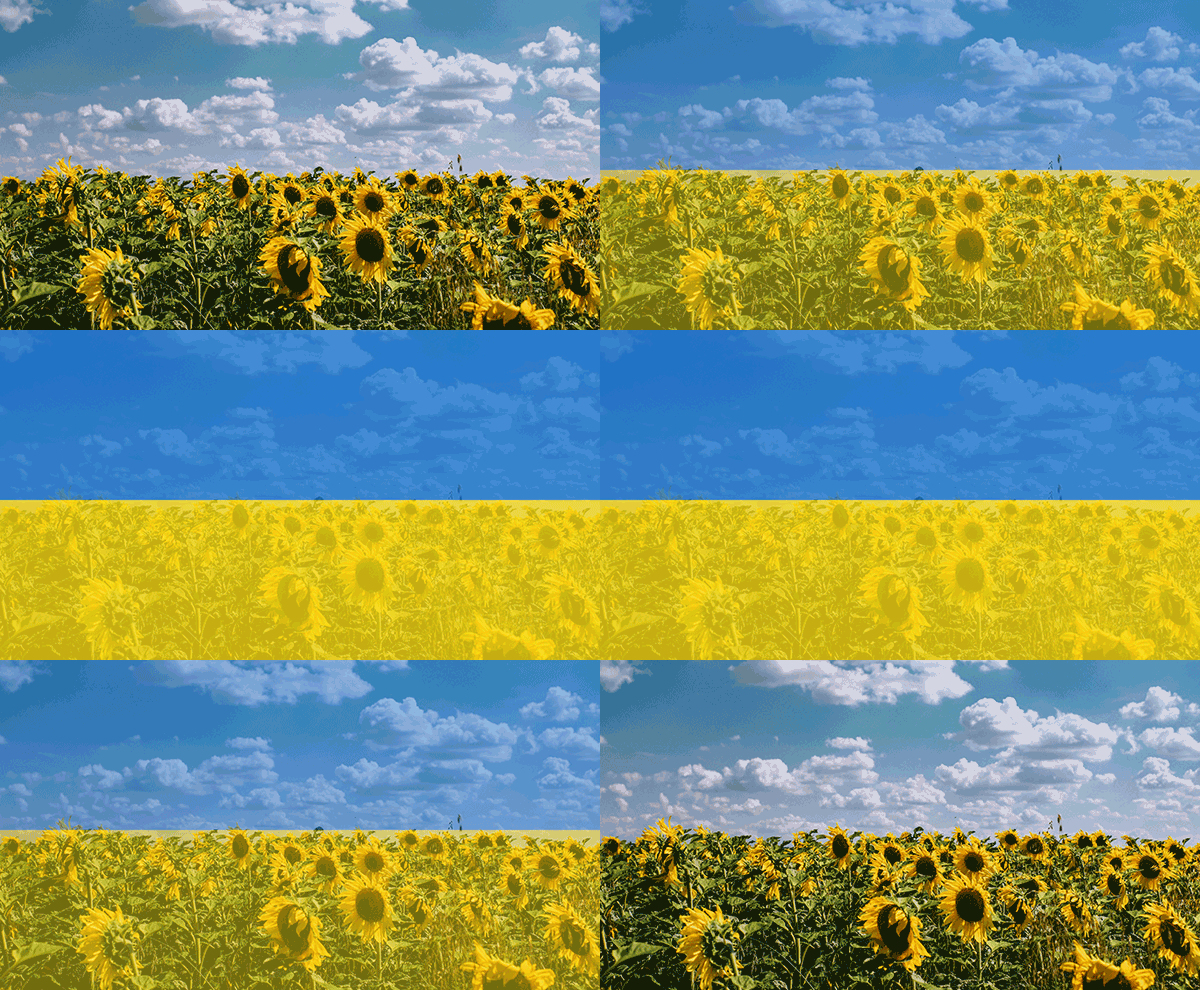
The sunflower side of it. That yellow band on the Ukrainian flag is meant to depict the country’s vast golden fields of sunflowers. Ukraine is the single largest exporter of sunflower oil, accounting for more than 40% of the global supply. Russia isn’t far behind at about a quarter of the market. Sunflower oil is a crucial cooking oil for households in many developing countries (and it’s also the source of the crisp in potato chips.) The war has already halted activity at Ukraine’s sunflower crushing plants, causing a knock-on surge in demand for substitutes like palm oil, which is now also seeing soaring prices.

Fertile soil for a bigger crisis. What do farmers need to produce wheat and other crops? Aside from sun, land, water, and love, they need fertilizer, and lots of it. Who is the number one exporter of fertilizer? Russia. Moscow has already banned fertilizer exports, raising production costs for farmers from Boise to Brazil.

Who gets hurt the most? Higher food prices rattle the kitchen table in all countries, but those on the brink are the most vulnerable. More than 800 million people are already food insecure, says the UN, warning that 44 million people in 38 different countries could be pushed into outright famine this year.

For the Middle East and North Africa, it’s a perfect storm of challenges, says Ahmed Morsy, a Middle East analyst at Eurasia Group. “It’s three or four different pressures at the same time, from food and energy prices to global inflation at large. It’s unlike anything we’ve ever seen.”

As for food, the region is heavily dependent on Russian and Ukrainian grain. In Egypt, the largest single importer of Russian and Ukrainian wheat, market prices for bread have soared 50% already this month, with the government warning that wheat reserves are dwindling. Crisis-wracked Lebanon is facing shortages as well, while Libya, Tunisia, and Algeria are all on edge. War-ravaged Yemen, meanwhile, depends on the two countries for about 40% of its wheat imports, and is already facing famine.

Postagem em destaque

Livro Marxismo e Socialismo finalmente disponível - Paulo Roberto de Almeida

Meu mais recente livro – que não tem nada a ver com o governo atual ou com sua diplomacia esquizofrênica, já vou logo avisando – ficou final...