Temas de relações internacionais, de política externa e de diplomacia brasileira, com ênfase em políticas econômicas, viagens, livros e cultura em geral. Um quilombo de resistência intelectual em defesa da racionalidade, da inteligência e das liberdades democráticas. Ver também minha página: www.pralmeida.net (em construção).
Também concordo em que ambos, aparentemente diferentes – mas só na aparência, da divisão entre uma suposta esquerda e uma alegada direita –, são na verdade irmãos siameses, e isso tem a ver com as suas personalidades autoritárias, o líder bolivariano com um DNA praticamente fascista, o capitão brasileiro uma espécie de Cantinflas da política. Paulo Roberto de Almeida
Chávez e Bolsonaro têm mais coisas em comum do que se pode imaginar, nem todas relevantes. Mas nesta semana que passou, o mito brasileiro deu passos preocupantes seguindo as pegadas do mito bolivariano.
Embora os dois se tenham destacado por posições políticas radicalmente opostas, ambos compartilharam uma formação militar – um coronel com mestrado em Ciência Política e outro capitão que aparentemente parou de estudar. E os dois também compartilharam um ativismo anti-sistema, de caráter plebiscitário e populista. Mas Bolsonaro nunca liderou, como Chávez, um golpe militar – e pelo que se observa, nunca liderou um movimento significativo com uma agenda propositiva – e, ao contrário do líder bolivariano, entrou para a política por meio do voto popular e não pela ação armada.
O processo que levou o mito venezuelano a passar, de presidente eleito, a déspota esclarecido foi longo. Longo, também, sua transmutação, de líder político em figura mística que continua a assombrar, mesmo do além, o regime supostamente socialista, por meios comunicações misteriosas. É um processo demasiado longo e complexo para ser tratado aqui. Minha hipótese é a de que, além da adoção de uma nova Constituição unilateral – graças ao boicote das oposições -, além da opção por uma militarização da sustentação política do governo, e da manipulação populista da política econômica, o passo decisivo para levar o regime chavista ao despotismo foi o recrutamento do judiciário para a causa bolivariana.
A militarização da disputa política, a organização de milícias armadas, a criação de umaNomenklaturacivil e militar, beneficiada pela corrupção nas empresas públicas e privadas, e a manipulação do câmbio para favorecer as elites, não foram suficientes para evitar totalmente a resistência (mesmo simbólica) de uma oposição pulverizada e em grande parte incapaz de unir-se em torno de uma agenda comum. Insatisfeito, Chávez redefiniu a missão do Tribunal Supremo de Justiça – que em 1999 substituiu a antiga Corte Suprema de Justiça – para ter como objeto servir à revolução bolivariana, permitindo, inclusive, a livre nomeação e demissão de seus membros.
Na semana passada, o mito brasileiro se envolveu em uma série de declarações e, o que é mais grave, em atitudes, a respeito do Supremo Tribunal Federal brasileiro. Primeiro, no que tratei aqui como um “Pacto de Narciso”, isto é, um pacto consigo mesmo, com sua própria imagem projetada sobre seus homólogos no cume dos poderes republicanos.
Não escapou a ninguém na mídia brasileira, após tomar conhecimento do conteúdo do pacto alinhavado por Tóffoli, que Bolsonaro estava envolvendo o Supremo em sua própria agenda política. Estava convidando o judiciário, com o assentimento explícito do presidente do Supremo, para submeter seu compromisso com a Constituição a um novo compromisso com a agenda governamental.
Devo admitir que salientei, no mencionado blog, apenas o aspecto narcisístico porque, sabedor dos pactos anteriores de Lula com o judiciário e dos pactos de Dilma com ele própria, julguei, precipitadamente que, a não ser o fato de fugir do assunto, esse novo pacto não daria em nada. Não foi o que aconteceu em menos de uma semana.
Primeiro, o Presidente da República encaixou, em uma reunião com as bancadas femininas das duas casas, isto é, uma reunião de congraçamento político com parlamentares, o agora onipresente Toffoli que, não sendo mulher, nem parlamentar, nem membro do governo, só poderia estar ali por outras razões. Quem matou a xarada foi o próprio Bolsonaro, ao declarar que era bom ter a Justiça a seu lado, isto é, do lado certo.
O próximo passo foi, desta vez, mais explicitamente nas pegadas de Hugo Chávez. Numa reunião com líderes religiosos de denominações evangélicas, após criticar o atual Supremo por decisões supostamente contrárias à sua agenda política e a suas convicções religiosas, e mostrando inconformidade com a hipotética composição da casa em termos de fé religiosa ou filiação eclesiástica de seus membros, o presidente defendeu a nomeação de um evangélico para a corte. E isso, porque o Estado pode ser laico “mas eu sou cristão”, disse ele.
Este conjunto de declarações e atitudes é muito preocupante, porque constitui uma série de passos no rumo do descompromisso com o Estado democrático de direito, e em prol de um estado de direito definido pelas convicções religiosas e políticas pessoais do presidente.
MANDANDO MORO PARA O CHUVEIRO
Quando um jogador de seu time está criando muito problema, a torcida grita para manda-lo mais cedo para o chuveiro. Quando é o “diretor” técnico quem cria problema, a direção do clube declara que ele está prestigiado.
Quando o presidente da República prestigia um seu ministro, prometendo livrar-se dele na primeira oportunidade, tenho dificuldade em entender por que a grande maioria das análises que leio, ouço ou vejo na TV, afirma que Bolsonaro está fazendo um afago em Moro. A razão o alegada é de que, com isso, Bolsonaro o estaria compensando por tê-lo traído abertamente com a derrota que o próprio presidente ajudou a Câmara impor-lhe.
De fato, a emenda que retira da autoridade de Sérgio Moro a COAF – um instrumento estratégico de investigação e combate de corrupção e crimes financeiros, particularmente envolvendo as classes dirigentes – é, para o ministro, uma derrota acachapante. Sobretudo se somada a uma série de outras atitudes de Bolsonaro, cuja consequência é desidratar as prerrogativas do superministério inicialmente alocado ao ex-juiz da Força Tarefa Lava Jato.
Em primeiro lugar, a quem se destinou o recado? Segundo a teoria do afago, seria exclusivamente destinado ao próprio Moro. O qual não reagiu como se tivesse sido contemplado com um afago, mas sido vítima de um embaraço. Além disso, não foi um recado discreto, mas para todos e qualquer um.
O sempre arguto José Nêumanne sugere um alvo específico, Sua Majestade o eleitor, junto ao qual o ex-juiz ainda goza de um prestígio de verdade. Não apenas o eleitor de Bolsonaro, mas todos aqueles que – sem serem admiradores seus, e nem mesmo concordam com o conjunto de sua agenda – esperam dele um desempenho profissional eficiente na área de segurança e justiça. Neste caso, o afago seria dirigido a essa parte do eleitorado que poderia ter ficado decepcionado com a facilidade com que Moro e sua agenda anticorrupção foram jogados às feras da sinistra bancada que julga ser beneficiada com a impunidade de sempre. Para esse eleitor, a agenda de Moro pode parecer ter sido pura e simplesmente traída por Bolsonaro e seu governo.
Em segundo lugar,cui bono? Quem foi particularmente beneficiado com o aviso de que o superministro seria chamado, “na primeira oportunidade”, para ir para o chuveiro e, com isso, proporcionar sua substituição no time? À parte a sinistra bancada dos alvos da lei, convenhamos que diversos segmentos, neste caso não das massas, mas sim das elites, suspiraram aliviados por diferentes razões.
Em primeiro lugar, o seleto grupo dos já previamente ungidos como futuros presidenciáveis, seriam beneficiados com o baque sofrido por um dos pretendentes mais temíveis. Em segundo lugar, o ainda mais seleto grupo do serralho bolsonarense que, com o enfraquecimento de Moro e sua previsível queda, poderia concentrar suas baterias em um menor e menos prestigioso número de supostas sombras sobre o brilho celeste do presidente-mito, sob suspeita de querer tomar o seu lugar a qualquer momento e a qualquer custo.
Acrescente-se, também, os ressentidos com o fato de encontrarem fechada a primeira vaga a ser aberta para o STF, um grupo difuso mas não menos influente do sistema jurídico que agora, diante de um adversário enfraquecido, teria as mãos livres para enfraquecer ainda mais sua hipotética candidatura ao Olimpo do judiciário.
Além disso, quais as consequências imediatas do compromisso, assumido publicamente pelo presidente, de afasta-lo na primeira oportunidade? Do ponto de vista pessoal, depois de tornar-se alvo da inconfidência presidencial, Moro se tornou alvo preferencial de todos os que, seja aleatoriamente, seja de maneira concertada, sonham em vingar-se dos sofrimentos que lhe foram impostos pela lei, mas são atribuídos, de uma forma ou de outra, à sua atuação. A proteção legal e corporativa de que dispunha como magistrado, para distribuir o que considerava justiça, não mais existe, e a proteção legal dada à sua posição governamental é, pelo menos, precária diante do ambiente de insegurança jurídica criado no sistema jurídico como um todo, particularmente pelo ativismo dos tribunais superiores.
Do ponto de vista político, uma vez tornado um simples ministro, dispensável na primeira oportunidade, já não produz temor. Minha hipótese é de que sua carreira, pelo menos enquanto durar o governo Bolsonaro, está condenada a um hiato. Pelo menos na condição de um ator político do sistema, comprometido com a mudança do sistema, mas atuando de dentro do sistema. Esse perfil teria muita dificuldade em acomodar-se no atual sistema partidário que, mal comparando, favorece os candidatos do sistema, comprometidos com a manutenção do sistema ou uns poucos candidatos anti-sistema, comprometidos com a mudança ou mesmo a destruição do sistema, com as armas de que dispuser.
Restariam, por hipótese, duas opções: preparar-se, desde já, para retomar a vida pública mais adiante, para contrapor-se ao previsível fracasso do perfil anti-sistema do atual presidente, ou lançar-se desde já como candidato anti-sistema, e bater Bolsonaro em seu próprio terreno. Isso demandaria outro tipo de perfil pessoal e outro tipo de experiência, para reunir apoio de uma coalizão entre mentes da elite e corações da massa.
Não seria tarefa fácil. A lição que Moro ainda não apreendeu é que a política realmente praticada não é para principiantes.
Moderados e apreensivos: o que pensam os generais que trabalham bem perto do presidente Jair Bolsonaro
Militares do Alto Comando do Exército são os moderados e apreensivos do governo
Vinicius Sassine e Bernardo Mello
O Globo, 02/06/2019 - 04:30
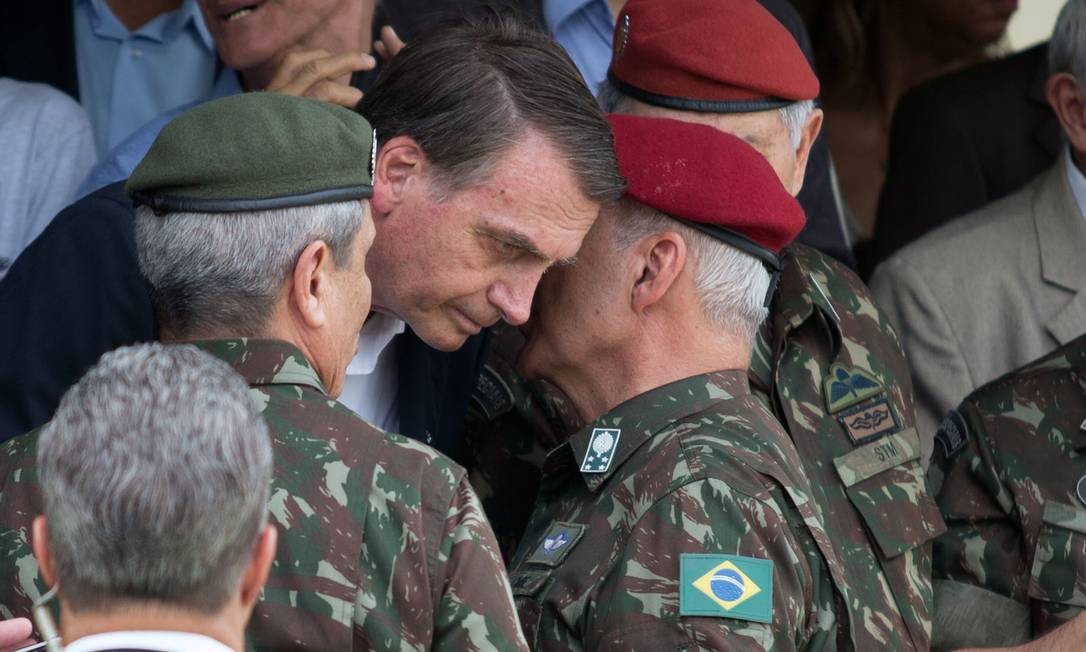
Ao pé do ouvido: O presidente Jair Bolsonaro durante cerimônia militar no Rio de Janeiro, ouve o general Luiz Eduardo Ramos Baptista Pereira, do Comando Militar do Sudeste: graduados temem arriscar conquistas desde a redemocratização Foto: Fernando Souza / AFP
BRASÍLIA E RIO - Umgeneraldo Alto Comando doExército,grupo que mantém interlocução direta e constante com o presidente da República, transmitiu aJair Bolsonaronos últimos dias um pensamento que representa o estado de espírito atual demilitaresque estão perto do poder:
— Jair, serenidade. Você não precisa de radicais. Na cabeça dos generais que ajudam a sustentar o governo Bolsonaro — incluindo aqueles, já na reserva, que ocupam cargos de primeiro e segundo escalões — o temor de uma radicalização caminha ao lado da preocupação de que a responsabilidade por tropeços do presidente recaia nos ombros e nas insígnias das Forças Armadas. Arriscar o processo que fez as Forças Armadas saírem de um período repressivo, de grande desgaste na opinião pública, para a virada das últimas três décadas, quando retomou respeito e reconhecimento por parcela expressiva da população, é uma angústia crucial. Integrados ao governo em grau sem precedentes desde a redemocratização, militares de alta patente ouvidos pelo GLOBO procuram apresentar uma mentalidade distante dos tempos da ditadura militar, época em que muitos se tornaram oficiais do Exército, Marinha ou Aeronáutica. A preocupação em mapear “inimigos” internos ou externos, uma constante no início de suas carreiras, hoje é adormecida. Generais do alto comando contam que, em sua formação, foram “muito impactados por valores democráticos”, uma vez que passaram pelo processo de distensão e abertura na fase final da ditadura militar. Os oficiais do círculo próximo a Bolsonaro abraçam uma tentativa de livrar o Exército de “estereótipos negativos”, em suas palavras. Um general do Alto Comando que conversou com O GLOBO em condição de anonimato, por exemplo, foi taxativo: avaliou que a ditadura cometeu “barbaridades” na repressão aos opositores: — Pagamos um preço muito alto com a ditadura. É uma palhaçada falar em intervenção militar, como ouvimos em alguns protestos. Chega a ser ofensivo. As trocas de cargos no Ministério da Educação (MEC), que levaram à exoneração de diversos militares no seio do governo, não figuram sozinhos na lista de preocupações dos generais. Estão ombro a ombro com temores mais amplos, como a política armamentista do presidente — cabe ao Exército fiscalizar a venda de armas —, os riscos envolvendo a Amazônia, considerada uma reserva natural estratégica, e até a determinação de que os quartéis celebrassem os 55 anos do golpe militar. Sobre as armas, a preocupação central está na flexibilização do porte, desejada — e decretada — pelo presidente. — Para porte, aí sim, é preciso ser perito na coisa. Há preocupação sobre uma proliferação negativa de armas – diz um outro general ouvido pela reportagem, que também pediu anonimato. Como ficariam as Forças Armadas se recebessem a pecha de instituição que autorizou e controlou a disseminação de armas de fogo se as consequências não saírem como o esperado nos planos do presidente? São questionamentos como esse que permeiam os mais graduados. — A gente torce para dar certo — afirmou um general ao GLOBO. — Senão vamos ouvir: “Os militares não disseram sempre que são os salvadores da pátria?” Dois assuntos neste primeiro semestre de governo incomodaram em cheio os militares de alta patente: o episódio do “golden shower”, quando Bolsonaro compartilhou em sua conta no Twitter uma prática sexual a céu aberto, gravada no carnaval de rua em São Paulo — algo impensável para um militar graduado —, e a dubiedade em relação ao ideólogo de direita Olavo de Carvalho, que atacou, com xingamentos, os militares do governo. O compromisso com a “arrumação da casa” de uma instituição que representa o Estado e voltou ao governo após seu período mais desgastante é prejudicado. Em geral, um militar leva de 30 a 40 anos para ascender até o último grau da hierarquia. A maioria dos principais generais do atual governo e dos que compõem o Alto Comando do Exército se formou nas turmas do fim da década de 1970 e do início da década de 1980 da Academia Militar das Agulhas Negras (Aman), em Resende, no Sul Fluminense. O próprio Bolsonaro, egresso da turma de 1977, conviveu com certo grau de intensidade com vários desses generais. O comandante do Exército, general Edson Leal Pujol, é da mesma turma. O porta-voz Otávio Rêgo Barros é de 1981. Enquanto Bolsonaro deixou os quadros da ativa ainda na década de 1980, recém-alçado a capitão, alguns de seus contemporâneos seguiram em formação. — Suas carreiras foram feitas em um ambiente crescente de profissionalização e de processo de “arrumação da casa”, quando houve de fato um esforço para reverter a politização anterior, do regime militar — afirma o antropólogo Piero Leirner, da Universidade Federal de São Carlos (Ufscar).
Aprendizado com missões
Se a década de 1940 ficou marcada, para o Exército Brasileiro, pelo envio de tropas para a Segunda Guerra Mundial, a partir dos anos 1990 se tornou recorrente a participação brasileira em missões de paz da ONU. O Brasil tinha 1,3 mil oficiais no exterior há quatro anos, com atuação principalmente em países africanos e no Haiti, cuja missão foi comandada por três dos atuais ministros de Bolsonaro: Augusto Heleno (Gabinete de Segurança Institucional), Carlos Alberto Santos Cruz (Secretaria de Governo) e Floriano Peixoto (Secretaria-Geral). — A maioria dos generais da atualidade já colocou a boina azul (usada em missões da ONU). É diferente do oficial que era general no regime militar. Era uma época de Guerra Fria, dos atos institucionais. Nem se pensava em mulher no Exército, por exemplo — analisa o general Eduardo José Barbosa, atual presidente do Clube Militar. A experiência das missões de estabilização de países, que são diferentes de conflitos abertos que ocorrem guerras, é um aspecto que contribui para o perfil moderado dos oficiais que participam diretamente do governo.
Generais da atualidade têm formação 'híbrida' entre ditadura e democracia, diz cientista político
Para Mauricio Santoro, transição é fundamental para compreender generais do presente; Institutos militares adaptam tradição a particularidades da nova geração
Bernardo Mello
02/06/2019 - 04:30
Oficiais do Exército na Academia Militar das Agulhas Negras (Aman), em Resende Foto: Marcelo Régua / Agência O Globo
RIO - Os atuaisgeneraissão “híbridos” entre a formação daditadurae os aprendizados doperíodo democrático.Durante sua formação na Academia Militar das Agulhas Negras (Aman), nas décadas de 1970 e 1980, noções de geopolítica e História eram fortemente influenciadas pelo alinhamento do Brasil ao bloco liderado pelos EUA naGuerra Fria.A sequência da formação, no período de reabertura pós-ditadura, já foi marcada por maior integração à sociedade civil e um afastamento da vida política no início dos anos de 1990.
Para o cientista político Mauricio Santoro, que já ministrou cursos e palestras em institutos militares como a Aman, a Escola Superior de Guerra (ESG) e a Escola de Comando e Estado-Maior do Exército (Eceme), a formação “híbrida” é fundamental para compreender a cabeça dos generais do presente. Embora ainda veja dificuldades no grupo em fazer uma autocrítica da ditadura, Santoro destaca que o pensamento dos generais não é formado apenas na caserna.
A bagagem internacional, por exemplo, é um dos fatores que os diferencia do passado. Desde a década de 1990, a participação em missões internacionais de paz se tornou uma maneira de os generais apresentarem seu trabalho à sociedade e tentarem remover estereótipos ligados à ditadura. — O ministro Santos Cruz (Secretaria de Governo) é um exemplo raríssimo de oficial que comandou duas missões de paz, no Haiti e no Congo. Isso significa uma abertura de horizontes, de visão de mundo. O (vice-presidente, Hamilton) Mourão fala inglês e espanhol fluentemente, consegue se sentar com representantes estrangeiros. Isso é incomum no Brasil. Na nossa elite política, quantos têm uma formação tão cosmopolita quanto essa? — questiona Santoro.
Bagagem internacional
Atualmente, a Aman estimula o intercâmbio com militares estrangeiros e conta com 45 cadetes de 16 nações consideradas amigas, como Vietnã, Guatemala e Senegal.
— O que não muda, desde as origens da Aman, são os valores que formamos nos cadetes: lealdade, verdade, responsabilidade e probidade — pontua o general Gustavo Henrique Dutra de Menezes, atual comandante da Aman. — Os cursos da carreira militar vão fornecendo diferentes conhecimentos técnicos e profissionais, mas o amálgama do líder dado aqui segue o mesmo. O caminho para se tornar um general quatro estrelas, mais alta patente militar, passa obrigatoriamente por instituições como a Aman e a Eceme, que aumentaram a abertura a professores civis nos últimos anos. O currículo atual da Aman, por exemplo, tem cadeiras como Filosofia, Direito Internacional, Cálculo e Estatística no início da formação. Em média, segundo Dutra, cada turma com cerca de 400 cadetes deve produzir quatro desses generais no futuro. Santoro, professor da Uerj, foi um dos responsáveis pela criação da cadeira de Relações Internacionais na Aman, no fim da última década. Professores deste departamento na Universidade Federal Fluminense (UFF) também dão aulas nas Agulhas Negras.
Já a ESG se tornou, na avaliação de Santoro, uma espécie de think tank que integra civis e militares, afastando-se do papel de núcleo duro da formação de coronéis e generais da ditadura. Ele pondera que a convivência com civis, ainda recente, tem consequências incertas. Mas a nova geração de militares tende a ser influenciada por novos ares.
— Pelo que ouço dos militares, a formação em outras épocas era muito menos técnica, cuidadosa. Hoje você tem uma preocupação grande, por exemplo, com o bem-estar do cadete, desde a alimentação até a parte psicológica. E o ensino, em geral, está no nível daquele dado numa universidade pública. Ao dissecar as etapas de formação militar, o comandante da Aman compara sua função à de um reitor universitário com foco na graduação. Cita cursos como o da Eceme, último passo antes do generalato, como níveis de uma carreira acadêmica. E afirma que a forma de educar os atuais cadetes mistura a tradição militar com as particularidades da geração Y, os millennials, jovens de até 25 anos mergulhados na internet.
Permissões na academia
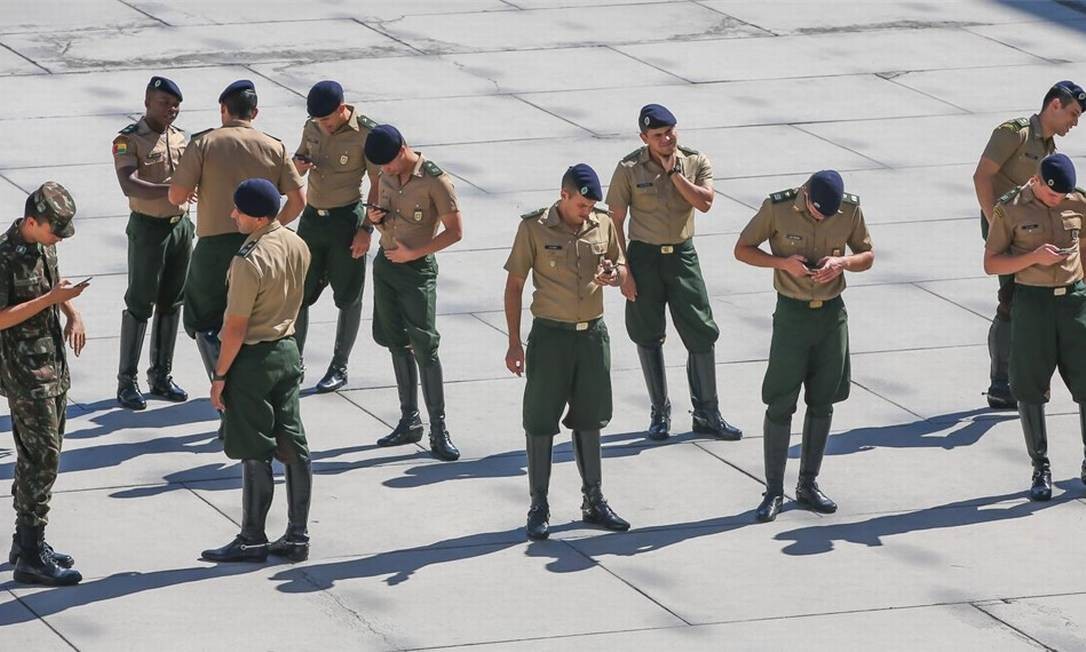
Tatuagens tribais são cada vez mais comuns nas academias militares, assim como alguns brincos, maquiagem e esmalte de unhas para as mulheres, que tiveram em 2018 sua primeira turma na academia. A febre dos smartphones também é visível entre os cadetes, até nos momentos que antecedem a marcha diária no pátio. — As gerações atuais pensam no imediato, e nós precisamos criar uma identidade de longo prazo com a instituição militar. Esse é o desafio. Se nós não evoluirmos de acordo com a maneira que a sociedade evolui, vamos perder o bonde da história — afirma Dutra.
Transcrevo: [...] a diplomacia é a arte de gastar palavras, perder tempo, estragar papel, por meio de discussões inúteis, delongas e circunlocuções desnecessárias e prejudiciais. Balzac, notando um dia que os marinheiros quando andam em terra bordejam sempre, encontrou nisso a razão de se irem empregando alguns homens do mar na arte diplomática. Donde se conclui que o marinheiro é a crisálida do diplomata. Machado de Assis, "Ao Acaso", Diário do Rio de Janeiro, 24 de janeiro de 1865 In: Machado de Assis, Máximas, pensamentos e ditos agudos (São Paulo: Penguin e Companhia das Letras, coleção Grandes Ideias, 2018, p. 29. E mais uma, à propos:
Em nosso país a vulgaridade é um título, a mediocridade um brasão [...]
(idem, p. 13)
A revista Foreign Affairs transcreve excertos de uma reunião pós-massacre de Tiananmen que consolida o poder brutal do PCC contra modernizadores, liberais, democratas e "agentes do imperialismo", ratificando a linha do Comitê Central, e de Deng Xiaoping, de que a única forma de lidar com a dissidência era a repressão dos manifestantes na Praça da Paz Celestial. Depois disso, a China embarcou numa experiência quase "helvética" de alternância no poder entre as diferentes linhas de liderança no Partido, por períodos determinados, o que foi rompido por Xi Jinping, quando ele decidiu retornar ao estilo imperial de dominação política, ou seja, eterna. Não há muita novidade nas declarações dos velhos líderes do PCC, a não ser a repetição de velhos slogans stalinistas, profundamente idiotas, servindo apenas ao reforço da tirania do partido. Paulo Roberto de Almeida
On April 15, 1989, the popular Chinese leader Hu Yaobang died of a heart attack in Beijing. Two years earlier, Hu had been cashiered from his post as general secretary of theChinese Communist Partyfor being too liberal. Now, in the days after his death, thousands of students from Beijing campuses gathered inTiananmen Square,in central Beijing, to demand that the party give him a proper sendoff. By honoring Hu, the students expressed their dissatisfaction with the corruption and inflation that had developed during the ten years of “reform and opening” under the country’s senior leader,Deng Xiaoping, and their disappointment with the absence of political liberalization. Over the next seven weeks, the party leaders debated among themselves how to respond to the protests, and they issued mixed signals to the public. In the meantime, the number of demonstrators increased to perhaps as many as a million, including citizens from many walks of life. The students occupying the square declared a hunger strike, their demands grew more radical, and demonstrations spread to hundreds of other cities around the country. Deng decided to declare martial law, to take effect on May 20.
But the demonstrators dug in, and Deng ordered the use of force to commence on the night of June 3. Over the next 24 hours, hundreds were killed, if not more; the precise death toll is still unknown. The violence provoked widespread revulsion throughout Chinese society and led tointernational condemnation, as the G-7 democracies imposed economic sanctions on China. Zhao Ziyang, the general secretary of the Chinese Communist Party, had advocated a conciliatory approach and had refused to accept the decision to use force. Deng ousted him from his position, and Zhao was placed under house arrest—an imprisonment that ended only when he died, in 2005.
A little over two weeks later, on June 19–21, the party’s top decision-making body, the Politburo, convened what it termed an “enlarged” meeting, one that included the regime’s most influential retired elders. The purpose of the gathering was to unify the divided party elite around Deng’s decisions to use force and to remove Zhao from office. The party’s response to the1989 crisis has shaped the course of Chinese history for three decades, and the Politburo’s enlarged meeting shaped that response. But what was said during the meeting has never been revealed—until now.
On the30th anniversaryof the violent June 4 crackdown, New Century Press, a Hong Kong–based publisher, will publishZuihou de mimi: Zhonggong shisanjie sizhong quanhui “liusi” jielun wengao(The Last Secret: The Final Documents From the June Fourth Crackdown), a group of speeches that top officials delivered at the gathering. New Century obtained the transcripts (and two sets of written remarks) from a party official who managed to make copies at the time. In 2001, this magazine publishedexcerpts fromThe Tiananmen Papers, a series of official reports and meeting minutes that had been secretly spirited out of China and that documented the fierce debates and contentious decision-making that unfolded as the party reacted to the protests in the spring of 1989. Now, these newly leaked speeches shed light on what happened after the crackdown, making clear the lessons party leaders drew from the Tiananmen crisis: first, that the Chinese Communist Party is under permanent siege from enemies at home colluding with enemies abroad; second, that economic reform must take a back seat to ideological discipline and social control; and third, that the party will fall to its enemies if it allows itself to be internally divided.
The speeches offer a remarkable behind-the-scenes look at authoritarian political culture in action—and a sign of what was to come in China as, in later decades, the party resorted to ever more sophisticated and intrusive forms of control to combat the forces of liberalization. Reading the transcripts, one can see serving officials closing ranks with the elderly retired officials who still held great sway in the early post-Mao period. Those who had long feared that Deng’s reforms were too liberal welcomed the crackdown, and those who had long favored liberal reforms fell into line.
The speeches also make clear how the lessons taken from Tiananmen continue to guideChinese leadershiptoday: one can draw a direct line connecting the ideas and sentiments expressed at the June 1989 Politburo meeting to the hard-line approach to reform and dissent thatPresident Xi Jinpingis following today. The rest of the world may be marking the 30-year anniversary of the Tiananmen crisis as a crucial episode in China’s recent past. For the Chinese government, however, Tiananmen remains a frightening portent. Even though the regime has wiped the events of June 4 from the memories of most of China’s people, they are still living in the aftermath.
THE PARTY LINE
Participants in the enlarged Politburo meeting were not convened to debate the wisdom of Deng’s decisions. Rather, they were summoned to perform a loyalty ritual, in which each speaker affirmed his support by endorsing two documents: a speech that Deng gave on June 9 to express gratitude to the troops who had carried out the crackdown and a report prepared by Zhao’s hard-line rival, Premier Li Peng, detailing Zhao’s errors in handling the crisis. (Those two documents have long been publicly available.)
It is not clear who, exactly, attended the Politburo meeting. But at least 17 people spoke, and each began his remarks with the words “I completely agree with” or “I completely support,” referring to Deng’s speech and Li’s report. All agreed that the student demonstrations had started as a “disturbance” (often translated as “turmoil”). They agreed that only when the demonstrators resisted the entry of troops into Beijing on June 2 did the situation turn into a “counterrevolutionary riot” that had to be put down by force. Each speech added personal insights, which served to demonstrate the sincerity of the speaker’s support for Deng’s line. Through this ceremony of affirmation, a divided party sought to turn the page and reassert control over a sullen society.
In analyzing why a “disturbance” had occurred in the first place, and why it evolved into a riot, the speakers revealed a profound paranoia about domestic and foreign enemies. Xu Xiangqian, a retired marshal in the People’s Liberation Army, stated:
The facts prove that the turmoil of the past month and more, which finally developed into a counterrevolutionary riot, was the result of the linkup of domestic and foreign counterrevolutionary forces, the result of the long-term flourishing of bourgeois liberalization. . . . Their goal was a wild plan to overturn the leadership of the Chinese Communist Party, to topple the socialist People’s Republic of China, and to establish a bourgeois republic that would be anticommunist, antisocialist, and in complete vassalage to the Western powers.
Peng Zhen, the former chair of the Standing Committee of the National People’s Congress, echoed those sentiments:
For some time, an extremely small group of people who stubbornly promoted bourgeois liberalization cooperated with foreign hostile forces to call for revising our constitution, schemed to destroy [Deng’s] Four Cardinal Principles [for upholding socialism and Communist Party rule] and to tear down the cornerstones of our country; they schemed to change . . . our country’s basic political system and to promote in its place an American-style separation of three powers; they schemed to change our People’s Republic of democratic centralism led by the working class and based on the worker-peasant alliance into a totally westernized state of capitalist dictatorship.
Others put an even finer point on this theme, evoking the early days of the Cold War to warn of American subversion. “Forty years ago, [U.S. Secretary of State John Foster] Dulles said that the hope for the restoration [of capitalism] in China rested on the third or fourth [postcommunist] generation,” railed Song Renqiong, the vice chair of the party’s Central Advisory Commission. “Now, the state of political ideology among a portion of the youth is worrisome. We must not let Dulles’ prediction come true.”
THE FALL GUY
Many speakers contended that ideological rot had set in under Hu, Zhao’s predecessor. Hu had served as general secretary from 1982 to 1987, when Deng’s reform policy began to introduce foreign trade and investment, private enterprise, and elements of market pricing. Along with these reforms, China had seen an influx of pro-Western ideas among journalists, writers, academics, students, the newly emerging class of private entrepreneurs, and even the general public. The conservatives who had prevailed on Deng to remove Hu from office had blamed Hu for failing to stem this trend. They had hoped that Zhao would do better. Instead, they charged, Zhao did not pay sufficient attention to ideological discipline, and the party lost control over public opinion.
Former Communist Party chief Zhao Ziyang in the garden of his home in central Beijing, China, June 1998
The speakers at the Politburo meeting believed that most of the people who had joined in the demonstrations were misguided but not hostile to the regime. They had been manipulated by “an extremely small number of bad people,” as one put it. Song Ping, an economic planner and Politburo member, even claimed that Zhao and his reformist allies had hatched a nefarious plot to split the party, overthrow Deng, and democratize China. Several other speakers supported this idea, without offering proof.
The speakers also railed against foreign enemies who they alleged had colluded to worsen the crisis. According to Song, “During the student movement, the United States stuck its hands in, in many ways. The Voice of America spread rumors and incitement every day, trying to make sure that China would stay in chaos.” Vice President Wang Zhen expressed a widely shared view that Washington’s interference was just the latest move in a decades-long plot to overthrow communism:
After the October Revolution [of 1917], 14 imperialist countries intervened militarily in the newborn Soviet regime, and Hitler attacked in 1941. After World War II, U.S. imperialists supported Chiang Kai-shek in the Chinese Civil War and then invaded Korea and Vietnam. Now they’d like to achieve their goal the easy way, by using “peaceful evolution”: . . . buying people with money, cultural and ideological subversion, sending spies, stealing intelligence, producing rumors, stimulating turmoil, supporting our internal hostile forces, everything short of direct invasion.
By demonizing domestic critics and exaggerating the role of foreign forces, the victorious conservatives revealed their blindness to the real problems affecting their regime. Prime among them was the alienation that the party’s atavistic methods of political control had produced in students, intellectuals, and the rising middle class. Instead, they blamed the reforms. The party’s now ascendant conservative faction had been worried about Deng’s policies all along, as Zhao recounted in his secretly composed and posthumously published memoir,Prisoner of the State. He had battled conservative critics throughout his tenure as premier (from 1980 to 1987), when he served as the chief implementer of Deng’s vision, and Deng had often been forced to compromise on his ambitions in order to placate hard-liners.
The conservatives who condemned Zhao at the Politburo meeting often did so by attacking policies that were actually Deng’s. Wang, for example, warned that economic reforms were leading China into a convergence with the West, but he pretended that these reform ideas were Zhao’s, not Deng’s. (He and others referred to Zhao as “comrade” because Zhao was still a party member.) Wang said:
We need to acknowledge that the reform and opening that Comrade Xiaoping talked about was different in its essence from the reform and opening that Comrade Zhao Ziyang talked about. Comrade Xiaoping’s reform and opening aimed to uphold national sovereignty and ethnic respect, uphold the socialist road, uphold the combination of planned economy and market regulation, continue to protect the creative spirit of bitter struggle and to direct investment toward basic industries and agriculture. Comrade Zhao Ziyang’s reform and opening was to take the capitalist road, increase consumption, generate waste and corruption. Comrade Zhao Ziyang was definitely not the implementer of Comrade Xiaoping’s reform-and-opening policy but the distorter and destroyer of it.
Speakers also pilloried Zhao for failing to adequately support the People’s Liberation Army, even though military affairs had been under Deng’s control. Marshal Nie Rongzhen defended the military’s centrality to the stability of the state in stark terms:
In recent years, with the relaxation of the international situation and under the influence of the bourgeois liberal thought trend, our awareness of the need for dictatorship [that is, armed force as a guarantee of regime stability] weakened, political thought work became lax, and some comrades mistakenly thought that the military was not important and lashed out at military personnel. There were some conflicts between military units and local authorities in places where they were stationed. At the same time, some of our comrades in the military were not at ease in their work and wanted to be demobilized and return home, where they thought they had better prospects. All this is extremely wrong. I think these comrades’ thinking is clear now, thanks to the bloody lesson we have just had: the barrel of the gun cannot be thrown down!
Although policy disagreements among the party’s leadership had paved the way for the Tiananmen crisis, the armed crackdown did nothing to set a clear path forward. Indeed, the Politburo speeches betrayed the lack of solutions that the party leadership was able to offer for China’s problems, as members fell back on hollow slogans, with calls to “strengthen party spirit and wipe out factionalism” and to “unify the masses, revitalize the national spirit, and promote patriotic thought.” Owing to this paucity of genuine policy thinking, the consensus that formed in the wake of Tiananmen was fragile from the start.
A few days after the Politburo meeting, the party gathered its full 175-person Central Committee, together with alternates, members of the Central Advisory Commission, and high-ranking observers, for the Fourth Plenum of the 13th Central Committee. Zhao’s successor as general secretary, Jiang Zemin, delivered a speech in which he tried to fudge the differences between Deng and the conservatives. He claimed that Deng had never wanted to loosen ideological discipline: “From 1979 to 1989, Comrade Xiaoping has repeatedly insisted on the need to expand the education and the struggle to firmly support the Four Cardinal Principles and oppose bourgeois liberalization. But these important views of Comrade Xiaoping were not thoroughly implemented.” Jiang pledged to unify the party and to seek advice from “the old generation of revolutionaries.”
Despite Jiang’s promises, the former Politburo member Bo Yibo worried that the new leadership would continue to face opposition. “We cannot afford another occurrence” of division, he warned. “In my view, history will not allow us to go through [a leadership purge] again.”
After 1989, the conservatives remained ascendant for three years, until the aging Deng made his attention-getting “trip to the South” in 1992. By visiting “special economic zones” (places where the government allowed foreign-invested, export-oriented enterprises to operate) and issuing statements such as “whoever is against reform must leave office,” Deng forced Jiang and his colleagues to resume economic liberalization. This was Deng’s last political act. It helped usher in rapid economic growth but did nothing to revive political liberalization.
CORE BELIEFS
After coming to power in the wake of the Tiananmen crisis, Jiang spent more than a dozen years as general secretary, from 1989 to 2002. But like Zhao, he was never able to achieve complete control over the party. Indeed, none of Zhao’s successors was able to do so—until Xi. Zhao’s failure on this count was discussed at the enlarged Politburo meeting in a way that reveals why the Chinese system tends toward one-man rule, despite the costs and risks of concentrated power.
The words of President Yang Shangkun are especially interesting because he was Deng’s most trusted lieutenant and personal representative and in that capacity had participated as an observer and mediator in a series of crucial Politburo Standing Committee meetings during the Tiananmen crisis. He also served as Deng’s emissary to the military during the crackdown. Yang faulted Zhao for failing to make himself what would later be called a “core” (hexin) leader—that is, for failing to build a working consensus among all the other senior acting and retired leaders, even though many of them fundamentally disagreed with him. Zhao, he complained, “did not accept the opinions raised by others, nor did he perform any serious self-criticism. On the contrary, he kept the other members at a distance and did things by himself, which pushed the work of the Standing Committee into a situation where there was only a practical division of labor and not a collective leadership. This was a serious violation of the supreme organizational principle of collective leadership of the party.”
What does it mean to establish an effective collective leadership? Peng, the former chair of the Standing Committee of the National People’s Congress, explained how it worked as an ideal:
In the party, . . . we should and must implement complete, true, high-level democracy. In discussing issues, every opinion can be voiced, whoever is correct should be obeyed, everyone is equal before the truth. It is forbidden to report only good news and not bad news, to refuse to listen to differing opinions. If a discussion does not lead to full unanimity, what to do? The minority must follow the majority. Only in this way can the Four Cardinal Principles be upheld, the entire party unified, the people unified.
But the party has seldom, if ever, achieved this ideal. Zhao, his critics agreed, never found a way to work with those who disagreed with him and instead listened to the wrong people. “He took advice only from his own familiar group of advisers,” Song Ping charged. “[We should not] lightly trust ill-considered advice to make wholesale use of Western theories put forward by people whose Marxist training is superficial, whose expertise is infirm, and who don’t have a deep understanding of China’s national conditions.”
Zhao’s detractors complained that instead of trying to persuade them, Zhao would turn to Deng for support. Wan Li, chair of the Standing Committee of the National People’s Congress, complained that at a meeting in December 1988, Zhao ignored critical comments. “Worse,” Wan declared, “he went and reported to Comrade Xiaoping what [the critics] had said, and then . . . bragged about how Comrade Xiaoping supported him. Isn’t this using Comrade Xiaoping to suppress democracy?”
THE CENTER CANNOT HOLD
These vivid portrayals of life at the top—rife with factionalism and backstabbing—demonstrate the dilemma created by the party’s leadership doctrine. The leader must solve problems decisively while also accepting, and even inviting, criticism and dissent from a host of elders and rivals who, given the complexity of China’s problems, are bound to have different ideas about what to do. Mao Zedong did not do so (he purged a long series of rivals instead), and neither did Deng, who contended with powerful equals who frequently forced him to rein in his reform ideas. Deng devised the idea of a core leader after the Tiananmen crisis to encapsulate this demand, reflecting his and other senior leaders’ anxiety that an inability to work together would cripple the leading group going forward, as it had done in the recent crisis.
Although the first post-Tiananmen leader, Jiang, claimed the label of “core,” he did not establish true dominance over the system, and his successor,Hu Jintao, did not even claim the label. Xi has made himself a true core and awarded himself the label in 2016, after four years in office. He achieved that position by purging all possible rivals, packing the Politburo and the Central Military Commission with people loyal to him, creating an atmosphere of fear in the party and the military with an anticorruption campaign that targeted his opponents, and moving quickly to crush any sign of dissent from lawyers, feminists, environmental campaigners, and ordinary citizens. Just as nature abhors a vacuum, the Chinese political system abhors genuine democracy and presses its leaders toward dictatorship.
Yet centralized leadership has not resolved the abiding contradiction between reform and control that generated the Tiananmen crisis 30 years ago. The more China pursues wealth and power through domestic modernization and engagement with the global economy, the more students, intellectuals, and the rising middle class become unwilling to adhere to a 1950s-style ideological conformity, and the more conservative party elites react to social change by calling for more discipline in the party and conformity in society. That tension has only worsened as Xi has raised incomes, expanded higher education, moved people to the cities, and encouraged consumption. China now has a large, prosperousmiddle classthat is quiescent out of realistic caution but yearns for more freedom. Xi has responded by strengthening the state’s grip on the Internet and other media sources, intensifying propaganda, constraining academic freedom, expanding surveillance, fiercely repressing ethnic minorities in western China, and arresting lawyers, feminists, and other activists who dare to push for the rule of law.
Marshal Nie was right when he told the post-Tiananmen Politburo meeting that “the counterrevolutionary riot has been pacified, but the thought trend of bourgeois liberalization is far from being eliminated. The battle to occupy the ideological front will remain a bitter one. We must resolve to fight a protracted battle; we must prepare for several generations to battle for several decades!” The party did indeed prepare, and the battle rages on today, with Xi counting on the power concentrated in his hands to stave off divisions within the party and opposition in society. So far, he seems to have succeeded: economic development has continued, and another episode of dissent on the scale of the Tiananmen incident seems unthinkable today.
Patricia O'Toole.The Moralist: Woodrow Wilson and the World He Made.New York: Simon & Schuster, 2018. Illustrations. xviii + 636 pp. $35.00 (cloth), ISBN 978-0-7432-9809-4; $20.00 (paper), ISBN 978-0-7432-9810-0.
Reviewed byRoss Kennedy (Illinois State University)Published onH-Diplo (June, 2019)Commissioned bySeth Offenbach (Bronx Community College, The City University of New York)
Patricia O’Toole’s new book,The Moralist: Woodrow Wilson and The World He Made, lays out a critical interpretation of the statecraft of one of the most consequential US presidents of the twentieth century. A biography, the volume touches on Woodrow Wilson’s family life, domestic politics, and several foreign and military policies of the Wilson administration. But overwhelmingly the book focuses on Wilson and World War I, so this review will limit itself to discussing that topic. O’Toole portrays the president’s approach to the war and peacemaking as a product of his moralism (hence the book’s title), his faith in American exceptionalism, and his isolated, self-righteous style of decision-making. Her case is engagingly presented; a prolific author of popular works of history, O’Toole is a good writer. She oversimplifies Wilson’s policies toward the war and their underlying rationale, however, which makes her argument unconvincing.
This problem becomes apparent early in the book, in O’Toole’s analysis of Wilson’s neutrality policies. She argues that Wilson’s goal was to stay out of the war so that the United States could mediate an end to it on the basis of a “peace without victory” and the establishment of a worldwide collective security organization (p. 240). This program was rooted in Wilson’s belief in the moral superiority of the United States and his sense of duty; “he justified U.S. neutrality not on grounds of national interest but as a noble response to a senseless war” (p. xvii). According to O’Toole, Wilson’s policy was naïve and “ethereal” because the belligerents never had any interest in the president’s mediation efforts (p. 205). “Lost in dreams of peace” and too stubborn to accept the failure of his policy to produce results, Wilson persisted in his mediation attempts far too long, leaving America unprepared for fighting when Germany forced it into the war (p. 235).
Certainly few historians would disagree that Wilson had a moralistic streak and believed in American exceptionalism. But it is inaccurate to attribute Wilson’s goal of international reform to these factors alone. Security considerations influenced the president too. To Wilson, the war revealed that the United States had lost its ability to isolate itself from the currents of international power politics. On several occasions, for example, he worried that if Germany won the war, the United States would have to expand its military defenses to a point threatening to its democracy. He also repeatedly observed that the war profoundly affected America’s economy and politics and that its scale made neutrality almost impossible to maintain. O’Toole includes some of these statements in her descriptive narrative but does not comment on them. They reveal, though, that Wilson saw the creation of a postwar peace league not just as morally good or as the fulfillment of America’s mission to serve humanity but also as vital to US national security.
It is also problematic to characterize Wilson’s pursuit of mediation as naïve and detached from European political reality. Various scholars have demonstrated that significant factions within the British and German governing class—the targets of Wilson’s mediation efforts—recognized by 1916 that the war might not be winnable at an acceptable cost and that a compromise peace therefore might be worth exploring. Indeed, the months immediately after the United States entered the war witnessed a flurry of peace initiatives in Europe as the Allied military situation deteriorated and Germany’s liberal and socialist parties challenged their government’s war aims. O’Toole displays little interest in these events or the scholarship analyzing them, but they indicate that Wilson’s quest to mediate an end to the war, while facing an uphill climb, was hardly quixotic.[1]
O’Toole’s treatment of Wilson’s policies after April 1917 is similarly cursory. After Germany’s submarine campaign rendered neutrality impossible and Wilson accepted war with the Reich, the president, O’Toole asserts, dedicated himself to defeating its armed forces and destroying its autocracy. Once Wilson accomplished that goal, he still wanted to build a new world order based on a league of nations to provide collective security and on such principles as arms reduction and self-determination. This vision of peace included Germany, O’Toole emphasizes; Wilson’s Fourteen Points Address and other statements “proposed a world order that rested on the equality of all nations” and promised “impartial justice for all,” including Germany (pp. 307, 326). According to O’Toole, Wilson fought for this program at the Paris Peace Conference in the face of intense opposition from the Allies, who, unlike Wilson, thought of peace only in terms of national interest, spoils, and treating Germany “as history’s greatest villain” (p. 392). Unfortunately, Wilson’s moralism, vanity, and poor political skills crippled his ability to gain his ends. His moral self-righteousness was “made for oratory, not negotiation,” O’Toole laments, so his agenda for international reform was “cut to the bone” at Paris (pp. 402, 401).
This is a familiar narrative of Wilson’s wartime goals and peacemaking, echoing one famously put forward by John Maynard Keynes in 1920 (The Economic Consequences of the Peace). It does not accord with the evidence, however. Wilson’s policy toward Germany during the war was complicated and it was not static; it changed over time. In the summer of 1917, the president hoped that the combination of military setbacks and promises of a peace of equality to a democratic Germany would induce Germany’s majority parties in the Reichstag to take power and begin peace talks. He made this nuanced policy clear in his reply to the Vatican’s peace initiative in August 1917—a statement that O’Toole does not mention. By late 1917, however, Wilson began to perceive that Germany’s democratic parties and its autocratic leaders shared a commitment to driving Russia out of the war and expanding the Reich’s power in eastern and southeastern Europe. Beginning in his December 1917 annual message (another key statement that O’Toole does not address) and continuing in subsequent speeches, including the Fourteen Points Address of January 1918, Wilson indicated he did not trust Germany’s democratic parties and would not genuinely negotiate with them if they took power. Instead, prior to any end to the fighting, they had to accept Wilson’s Fourteen Points. While this program included general principles of a new world order and promises of a place of equality for Germany, it also implied Germany would lose some of its 1914 territory and would have to pay reparations to Belgium and France—key parts of Wilson’s peace program that O’Toole leaves unmentioned. Moreover, Wilson suggested that although Germany probably would be allowed into a league of nations whether it democratized or not, it would be subjected to economic coercion to ensure it carried out the terms of the peace treaty.[2]
This shift to a more punitive orientation in Wilson’s German policy did not mean that he had abandoned his goal of international reform; O’Toole is correct in arguing that Wilson remained committed to that objective during and after the war. But the German policy that emerged in December 1917 indicated that the means to attain international reform had changed. In 1915-16, the pathway to a world without power politics lay through a peace without victory; in 1917 it lay through a peace of equals with a democratic Germany. Now, in contrast, it lay through inflicting defeats on the German army not so much to trigger a democratic revolution at home as to show the German people the futility of aggression that they themselves had willingly supported. Ideally, this would lead them to acknowledge their crimes, to work to repair the wrongs they had committed, and to accept some limits on their future power to do harm again. Only through this process could they “redeem” their character, as Wilson put it, and then be welcomed into a new world order.[3]
Consequently, at the Paris Peace Conference, Wilson strove not for lenient treatment of Germany, as O’Toole argues, but for terms that would punish and weaken the Germans while leaving open the possibility of future reconciliation with them. At times this posture did lead to friction with the Allies, as Wilson wanted to avoid terms that he considered excessively harsh and likely to lay the seeds for another war, such as detaching the Rhineland from German sovereignty. Much more frequently, he had no problem imposing penalties on the Germans. He readily supported the treaty’s disarmament provisions, the permanent demilitarization of the Rhineland, France’s annexation of Alsace-Lorraine, the creation of the Polish corridor, the banning of Austrian unification with Germany for the foreseeable future, and the transfer of Saarland coal to France in reparation for Germany’s destruction of French coal. Even before the peace conference began, Wilson decided to exclude Germany from the League of Nations until it had a “decent” government and a demonstrated willingness to observe its international obligations. By weakening Germany’s disposition and capability to pursue aggression while holding out the promise of league membership to it if it behaved—“justice” for Germany in Wilson’s eyes—he could foster an international environment conducive to the new world order he wanted to build.[4]
The last part of O’Toole’s volume, covering Wilson’s failed effort to secure Senate ratification of the Versailles treaty, is more compelling than her interpretation of Wilson’s diplomacy. Here she provides a vivid description of the president’s political miscalculations and health problems, rightly placing the blame for the treaty’s defeat on Wilson himself more than anyone else. Especially after his massive stroke in early October 1919, Wilson became more hostile than ever to the notion of compromising with his opponents, despite the fact he did not have the votes to get the treaty ratified without reservations attached to it. Convinced he was morally right to stand firm, he “held his adversaries in contempt” and let the treaty fail rather than shift course to accommodate political reality (p. 435).
Overall, however,The Moralistis a disappointing book. Attributing Wilson’s statecraft during World War I fundamentally to his personality quirks can make for an entertaining story. But such an interpretation ignores much of the scholarship written on the war and on Wilson in recent decades. It also reduces Wilson to a one-dimensional, almost cartoonish figure. Whatever one’s assessment of the wisdom of Wilson’s approach to the war and peacemaking, it was a complex sequence of policies reflecting a variety of factors, including specific views of US national security, the balance of power between the belligerents, and the character of Germany’s people. To get a grasp of those policies, one also has to pinpoint their connections to Wilson’s overarching goal of international reform and to be alert to how they changed over time. O’Toole’s book does not do that, which makes it of limited value to those interested in learning what Wilson was trying to do and why he did it.
Notes
[1]. David Stevenson,Cataclysm: The First World War as Political Tragedy(New York: Basic Books, 2004), 105-6, 108-11, 212-14, 229-30; Alexander Watson,Ring of Steel: Germany and Austria Hungary in World War I(New York: Basic Books, 2014), 257-64, 416-24, 455-58; Karl E. Birnbaum, Peace Moves and U-Boat Warfare: A Study of Imperial Germany’s Policy towards the United States, April 18, 1916-January 9, 1917(New York: Archon Books, 1970); Daniel Larsen, “War Pessimism in Britain and an American Peace in Early 1916,”International History Review34, no. 4 (December 2012): 795-817; David Stevenson, “The Failure of Peace by Negotiation in 1917,”The Historical Journal34, no. 1 (March 1991): 65-86; and Brock Millman,Pessimism and British War Policy, 1916-1918(London: Frank Cass, 2001).
[2].For the key Wilson statements on Germany, see Woodrow Wilson, “An Address to a Joint Session of Congress,” April 2, 1917, inThe Papers of Woodrow Wilson, ed. Arthur S. Link, vol. 41, January 24-April 6, 1917(Princeton, NJ: Princeton University Press, 1983), 519-27; Wilson to Edward Mandell House, with enclosure (reply to the Vatican), August 23, 1917, inPapers of Woodrow Wilson, ed. Link, vol. 44, August 21-November 10, 1917 (Princeton, NJ: Princeton University Press, 1984), 33-36; Wilson, “An Annual Message on the State of the Union,” December 4, 1917, inPapers of Woodrow Wilson, ed. Link, vol. 45, November 11, 1917-January 15, 1918 (Princeton, NJ: Princeton University Press, 1984), 194-202; Wilson, “An Address to a Joint Session of Congress,” January 8, 1918, in ibid., 534-39; and Wilson, “An Address in the Metropolitan Opera House,” September 27, 1918, inPapers of Woodrow Wilson, ed. Link, vol. 51, September 14-November 8, 1918 (Princeton, NJ: Princeton University Press, 1986), 127-33.
[3]. Wilson, “An Address in the Metropolitan Opera House,” September 27, 1918, inPapers of Woodrow Wilson, ed. Link, vol. 51, September 14-November 8, 1918 (Princeton, NJ: Princeton University Press, 1986), 129. For another, somewhat different interpretation of the changing character of Wilson’s war aims, see John A. Thompson,A Sense of Power: The Roots of America’s Global Role(Ithaca, NY: Cornell University Press, 2015), 56-109.
[4]. Wilson quoted in Ross A. Kennedy,The Will to Believe: Woodrow Wilson, World War I, and America's Strategy for Peace and Security(Kent, OH: Kent State University Press, 2009), 186. On the general point of Wilson’s punitive orientation at the peace conference, see Klaus Schwabe,Woodrow Wilson, Revolutionary Germany, and Peacemaking, 1918-1919: Missionary Diplomacy and the Realities of Power(Chapel Hill: University of North Carolina Press, 1985), 393-402; N. Gordon Levin, Jr.,Woodrow Wilson and World Politics: America’s Response to War and Revolution(New York: Oxford University Press), 123-82; Manfred G. Boemke, “Woodrow Wilson’s Image of Germany, the War-Guilt Question, and the Treaty of Versailles,” inThe Treaty of Versailles: A Reassessment after Seventy-Five Years, ed. Manfred G. Boemke, Gerald D. Feldman, and Elizabeth Glaser(Washington, DC: German Historical Institute), 603-14; and Marc Trachtenberg, “Versailles after Sixty Years,”Journal of Contemporary History17, no. 3 (July 1982): 487-506. For good overviews of the Paris Peace Conference, see Alan Sharp,The Versailles Settlement: Peacemaking in Paris, 1919(New York: St. Martin’s Press, 1991); and Margaret MacMillan,Paris 1919: Six Months That Changed the World(New York: Random House, 2003).
Patricia O’Toole is the author of five books, including The Moralist: Woodrow Wilson and the World He Made, When Trumpets Call: Theodore Roosevelt after the White House, and The Five of Hearts: An Intimate Portrait of Henry Adams and His Friends, which was a finalist for the Pulitzer Prize, the National Book Critics Circle Award, and the Los Angeles Times Book Prize. A former professor in the School of the Arts at Columbia University and a fellow of the Society of American Historians, she lives in Camden, Maine. (Amazon)
Não há pirotecnia; só o ajuste fiscal estrutural abre o caminho para renda e emprego
A economia brasileira recuou 0,2% no primeiro trimestre, em comparação ao quarto trimestre do ano passado.
O péssimo desempenho da economia faz com que vozes se levantem em defesa de medidas de estímulo à demanda agregada.
Considero que não há espaço para política fiscal e parafiscal (crédito de bancos públicos, basicamente) ativas. A inexistência de consenso com relação à solução do conflito distributivo, conosco há muito tempo, impede que o investimento se recupere. Somente com consumo não há espaço para a retomada da economia. Vamos à narrativa.
Vivemos um conflito distributivo desde novembro de 2005, quando a então ministra da Casa Civil disse que “gasto público é vida” e o presidente Lula desistiu do ajuste fiscal estrutural.
Em 2014, o conflito distributivo explicitou-se: o gasto público passou a ser estruturalmente superior à receita.
Em 2015 e 2016, a presidente Dilma não teve apoio do Congresso Nacional para arrumar as contas públicas.
Michel Temer, após o fatídico evento de 17 de maio de 2017 —a divulgação da conversa do presidente com o empresário Joesley Batista em condições muito pouco republicanas—, também perdeu a capacidade de aprovar no Congresso as medidas necessárias para ajustar as contas públicas.
Em 2004, o Congresso não aceitou elevar a tributação sobre os fornecedores de serviços por meio de empresas que operam no regime de lucro presumido. Rejeitou a medida provisória 232, que Palocci enviara. Em 2009, o Congresso não renovou a CPMF. O Congresso dá claros sinais de que não pretende elevar a carga tributária.
O Congresso também dá claros sinais de que não pretende reduzir o gasto público.
Após cinco anos e meio com déficits fiscais seguidos e com a dívida pública em trajetória explosiva, o Congresso Nacional se recusa a arrumar a política fiscal. A reforma da Previdência não anda. Novos impostos não são criados. Enquanto essa questão básica não for atendida, o investimento não voltará.
É possível afirmar que, nos anos 1980, a economia crescia mesmo com inflação. Além de ser um crescimento de péssima qualidade, e muito regressivo do ponto de vista da distribuição de renda, havia um “contrato social”: vigorava a lei do mais forte em se proteger da inflação.
É possível que retornemos a esse contrato social perverso. É possível crescer algum tempo com inflação. Não me parece que hoje teria fôlego longo. A Argentina dos Kirchners cresceu algum tempo com inflação crescente. Em uma década, o fôlego acabou.
De qualquer forma, esse ainda não é o nosso contrato. Hoje não sabemos qual será a solução do conflito distributivo: será resolvido com mais impostos, com menos gastos ou com inflação? Enquanto essa dúvida essencial não for resolvida, o investimento não retornará.
Aumento do gasto público ou algum aumento do gasto parafiscal somente agravam o problema: geram um pequeno alívio na demanda com deterioração permanente na dívida pública e, portanto, com aumento dos prêmios de riscos.
É possível que haja espaço para baixar os juros. Estamos no meio de um choque cambial e de um choque de preços de alimentos. Se houver devolução desses choques, haverá espaço para queda adicional da taxa Selic no segundo semestre. A normal operação do regime de metas de inflação produzirá essa queda.
Assim, não há como nos desviarmos do tema básico. Não há pirotecnia. Somente o ajuste fiscal estrutural abre o caminho para a volta de algum crescimento e geração de renda e emprego.