Prezados amigos,
Tenho a satisfação de convidá-los para o lançamento dos seguintes livros, no âmbito das comemorações do Bicentenário da Confederação do Equador.
Com o abraço cordial deAndré Heráclio do Rêgo

Prezados amigos,
Tenho a satisfação de convidá-los para o lançamento dos seguintes livros, no âmbito das comemorações do Bicentenário da Confederação do Equador.
Com o abraço cordial deOpinião:
Hora da verdade
Os que defendem uma posição equidistante dos radicalismos ideológicos da esquerda e da direita têm uma palavra a oferecer no cenário político nacional
Colaborações a obras coletivas mais recentes:
1581. “Tordesillas, Treaty of (1494)”, Relação de Originais n. 3970.
1582. “Bandeiras”, Relação de Originais n. 3974.
1583. “Bandeirantes”, Relação de Originais n. 3976.
1584. “Andrada e Silva, José Bonifácio de”, Relação de Originais n. 3979.
1585. “Brazil, Independence Movement”, Relação de Originais n. 3980.
in: South America: From European Contact to Independence
H. Micheal Tarver (Anthology Editor); Carlos E. Márquez Petit (Anthology Editor); Online Resources, Bloombury Collections; New York: Bloomsbury Publishing, 2025, 2 volumes
(link: https://www.bloomsbury.com/us/south-america-9781440879142/).
O Brasil no ‘eixo dos hipócritas’
Posicionamento do governo no conflito entre Israel e Irã repete o padrão de críticas seletivas e condescendência com autocracias que conspurca a credibilidade diplomática do BrasilEx-embaixador Ricupero aponta incoerência da diplomacia brasileira sobre Irã e Ucrânia
VEJA+, 24 de jun. de 2025Desalento? Não! Continuo na liça
Não adianta lutar contra tendências fortes da humanidade, ou é muito difícil. A mentira, a besteira, a irracionalidade também podem prevalecer, e levar sociedades inteiras ao desastre. EUA, Rússia, Irã, Brasil, Israel, entre outros países e sociedades, são exemplos disso. Há que lutar para preservar a racionalidade e a dignidade.
Paulo Roberto de Almeida
O Triunfo e a Derrota de Eugenio Gudin
Paulo Roberto de Almeida e André Burguer
Já escrevi bastante sobre o famoso, talvez único debate econômico significativo na história econômica do Brasil, aquele ocorrido em 1944/45 entre Eugênio Gudin e Roberto Simonsen. Meu argumento foi simples: Gudin venceu na lógica, na consistência teórica e nas propostas racionais. Mas o vencedor, na prática, foi Simonsen, pois toda a conjuração de líderes políticos, econômicos, acadêmicos, militares e civis, queriam estatismo, intervencionismo, industrialismo forçado, tudo isso imposto do alto, estilo nacionalismo autárquico. Por isso ainda somos um país “em desenvolvimento”, sempre requerendo soluções pelo alto, inclusive o agro, com subsídios e proteção. Por isso somos o que somos. Gudin venceu e perdeu; continua perdendo, mesmo com o agro triunfante. Sorry guys…
Paulo Roberto de Almeida
=============
André Burguer escreveu:
A VINGANÇA DE GUDIN.
Eugênio Gudin morreu há quase quatro décadas. Viveu um século defendendo algo que, à sua época, parecia heresia econômica: o desenvolvimento do Brasil deveria vir do campo, não da fábrica. Para Gudin, as vantagens comparativas brasileiras estavam na agricultura, onde solo, clima e abundância natural podiam transformar o país num fornecedor global. Seus adversários não pensavam assim.
Durante boa parte do século XX, travou duras batalhas contra o projeto desenvolvimentista-industrialista que marcou a política econômica brasileira. De um lado, Gudin e alguns poucos liberais que enxergavam no mercado externo a oportunidade para o Brasil crescer aproveitando seus recursos naturais. Do outro, os industriais liderados por Roberto Simonsen — então presidente da poderosa FIESP — que viam na indústria o único caminho aceitável para o progresso nacional.
Os métodos industrialistas foram amplos e variados. Montagem artificial de indústrias via empresas estatais, subsídios generosos por meio do recém-criado BNDE (o “S” de social viria depois), protecionismo tarifário, reserva de mercado e convites generosos a multinacionais, como Juscelino fez com a indústria automobilística. Tudo isso regado a discursos de "soberania nacional" e "substituição de importações".
Gudin enfrentou não apenas os industrialistas, mas os populistas de várias matizes — de Getúlio Vargas a João Goulart — e, depois, a tecnocracia desenvolvimentista dos militares pós-1964. Se estivesse vivo hoje, teria novos oponentes: aqueles que, em pleno século XXI, acusam o agronegócio de ser "fascista", "ambientalmente predatório" e "concentrador de renda".
Mas a história, como se vê, pode ser irônica.
O agro resistiu. O agro cresceu. O agro venceu.
Nos últimos 40 anos, o Brasil deixou de ser um importador de alimentos para se tornar um dos maiores fornecedores do planeta. O agronegócio brasileiro cresceu a uma taxa média de 4,07% ao ano nesse período — quase o dobro do crescimento médio do PIB nacional, que foi de 2,3% ao ano. A produção de grãos, por exemplo, saltou 334% nas últimas três décadas, enquanto a área plantada aumentou apenas 71%. Ou seja: mais produção, com menos terra — o que significa produtividade, algo que Gudin sempre pregou.
Em 2023, o setor agropecuário representou 24% do PIB brasileiro, segundo o Cepea/USP. Nas exportações, o agro respondeu por mais de 50% de tudo o que o país vendeu ao mundo. O PIB atual do agronegócio brasileiro — em torno de US$ 600 bilhões — supera o PIB total de países inteiros, como a vizinha Argentina.
Trata-se de um setor que não apenas gera superávit comercial robusto, mas também sustenta o real, alivia as contas públicas e reduz a vulnerabilidade externa do país. É o Brasil competitivo, não o Brasil dependente do BNDES.
E convém ser preciso: quando falamos em agro brasileiro, falamos de tecnologia, de ciência aplicada, de biotecnologia, de manejo racional do solo, de máquinas de última geração, de sementes geneticamente adaptadas, de integração lavoura-pecuária-floresta e de um setor que compete com o que há de melhor no mundo. Este é o agro que sustenta o Brasil.
Muito longe da agricultura familiar romântica de baixa produtividade. E mais distante ainda dos assentamentos do MST, cuja produção é majoritariamente de subsistência ou fortemente subsidiada. O exemplo mais celebrado — e midiático — dessa agricultura foi o arroz orgânico, cuja produtividade é a metade do arroz convencional e cuja produção mal preenche uma fração irrelevante da demanda nacional.
Se o Brasil dependesse da agricultura familiar dos manuais de ONGs e dos assentamentos ideológicos, estaríamos todos na fila da FAO buscando ajuda humanitária.
Mas felizmente havia Eugênio Gudin — e, sobretudo, o Brasil real.
Hoje, as previsões do velho liberal se materializam em cada navio que parte lotado de soja, milho, carnes, açúcar, algodão, café, etanol, celulose. Em cada safra recorde, em cada avanço tecnológico, em cada ganho de produtividade por hectare. O campo, tantas vezes desprezado pelos ecologistas e planejadores do asfalto, ergueu o país e alimenta o mundo.
Gudin venceu. Afinal, a história lhe fez justiça.
Este artigo foi originalmente publicado na Revista Oeste.
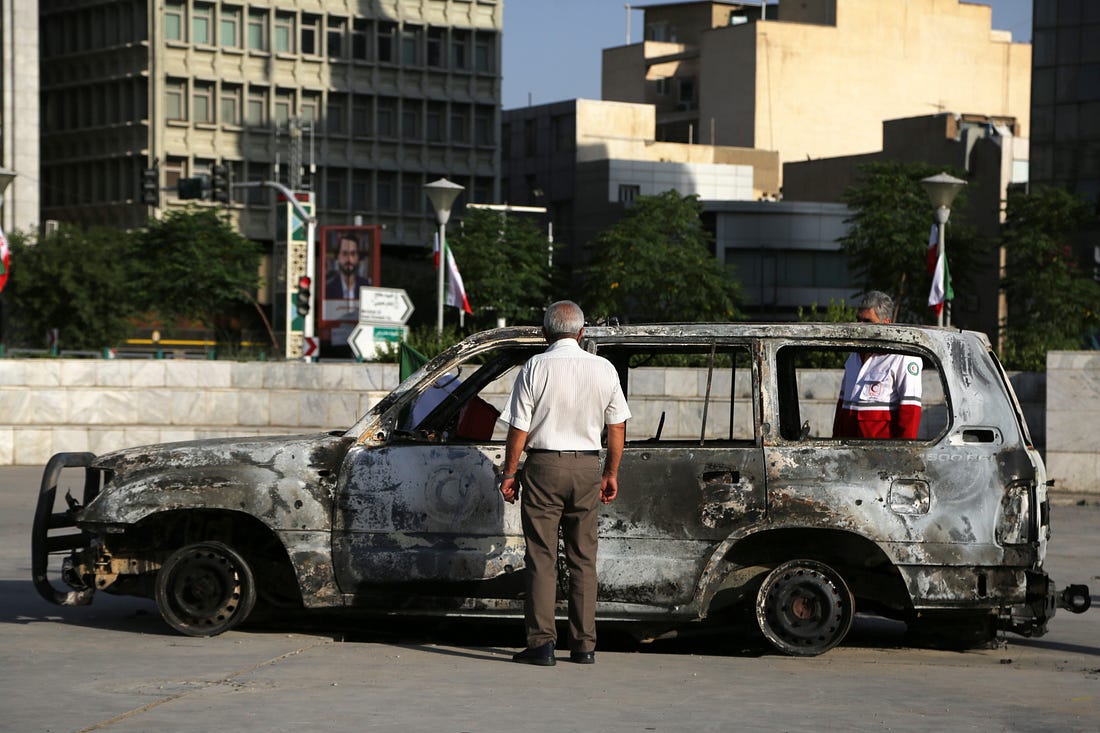
It is hard to avoid the feeling that we are entering a new era in the Middle East. To mark a week since hostilities began, we are publishing two personal essays—one yesterday by our Executive Director, David Hamburger, who found himself in Israel shortly before the war broke out; another today by an anonymous Iranian writer whose family lives in Tehran. —The editors. I am writing from a deep well of grief for my war-torn city, Tehran. It would be a lie to say we didn’t see this coming, especially given the long-standing threats and ambitions of the oppressive Islamic Republic of Iran—a regime that has, for decades, openly sought to annihilate Israel. Even though grief and distress are a giant mass sitting on my chest, they’re not monolithic. They have many layers that hit differently and come with many uncertainties. My entire family lives in Iran, mostly scattered across Tehran. My primary concern is for those in the affected areas. Some were able to leave the city, others stayed behind. Some are too old or ill to evacuate, others are without the means: no car, no money for gas or food. Most banks are closed. If you don’t already have a stack of cash at home, you’re in a dire situation. When I called my aunt after the first strikes on Tehran, which killed several top government officials, she seemed at peace. I asked how she could be so calm in the midst of bombs dropping. Wasn’t she afraid that she and her children might be hit and die?
She said, “We don’t want war. But tonight, knowing that the men who’ve held us hostage for forty-six years, who’ve ransacked our country, raped and killed our daughters and executed our men for asking for their basic human rights, are finally getting what they deserve—that brings me peace.” It’s not easy to hear a loved one speaking so plainly about their own death and destruction. But that’s what over four decades of oppression, pressure, and intimidation have done to the Iranian people. They are shocked and frightened by this war, but, somehow, they also feel like justice is being served. War is an ugly business. Whether you think you’re on the right side or the wrong side, it’s never welcome. Most people seem to be falling into two camps about the Israel-Iran war: those who are against it, and those who are satisfied, or even delighted, with Israel’s attack. Among the first group are Western commentators and social media warriors who seem to be going through moral confusion about what sort of regime the Islamic Republic of Iran is. I constantly hear comparisons between what’s happening in Iran and what’s happening in Gaza. Many of them see Israel solely as a genocidal colonial entity on the wrong side of history. They claim Israel has attacked Iran without any provocation, while the Islamic Republic is innocent and must be left alone. But this ignores that the Islamic Republic has terrorized not only its own people but also countries throughout the region, while funding and arming proxy groups like Hezbollah, Hamas, and the Houthis. Iranian people are stuck in a war imposed on them by their government’s violent rhetoric and actions. I am not pro-Israel in a political sense. I am strongly opposed to the government of Prime Minister Benjamin Netanyahu. But I also believe Israeli people deserve to live peaceful lives, without having to worry that they’re surrounded by regimes calling for their annihilation. The Islamic Republic has openly called for the destruction of Israel and does not recognize Jewish people’s human rights. How do I know this? Every morning for twelve years I stood in a schoolyard in Tehran and was forced to chant: “Death to America! Death to Israel!” Many of those who hold Israel to a higher moral standard than Iran, while refusing to blame the Islamic Republic for its terrorist activities, are progressives with big hearts and good intentions. But they grossly lack nuance and an understanding of the geopolitical situation, regional history, and the struggles that both Iranian and Israeli people have been facing. They view the conflict through their own limited lens of -isms (which I won’t bother unpacking here). They don’t want to be responsible for another mess on their guilty conscience. Even some in the Iranian diaspora have gotten on board and perpetuated the regime’s propaganda, driven by fear and patriotic rage. I don’t blame them—we humans are emotional creatures, and we don’t want to see people suffering, especially our own. But there is deep complexity here that needs to be reckoned with. Is sudden, intense suffering from foreign missiles more merciful than prolonged, systematic oppression at the hands of your own government? When people have endured decades of oppression, does the source of their potential liberation matter as much as the liberation itself? And who bears responsibility when both action and inaction guarantee someone will suffer? These complexities can’t be captured in social media soundbites or simple slogans. They are the impossible calculations that ordinary Iranians are being forced to make. This brings me to the second group—those who support this war because they believe it will eliminate the Islamic Republic once and for all. They naïvely believe that once the regime is weak enough, people will rise up and come together to elect a democratic leader, and all will be well. Maybe that is the case, but here lies the cruel paradox: can we guarantee that this war, which promises to end suffering, will actually deliver on that promise? And at what cost? There are many recent examples of disastrous outcomes following regime change, such as the invasion of Iraq, the twenty-year democracy project in Afghanistan, and the Arab Spring. Even if we assume that this war has the potential to free the people of Iran from the tyranny of the Islamic Republic, one must think about the fallout. What happens once Israel completes its mission and destroys Iran’s nuclear infrastructure? The fears swirl: economic collapse, scarcity of resources, civil war, partition of the country, the rise of an ISIS-like terror regime, and many more that those with expertise can articulate more eloquently than I can. Or the worst-case scenario: the Islamic Republic remains in power—stronger, bloodier, more emboldened—either by holding itself together or through negotiations with the United States. If that happens, the first thing the regime will do is retaliate against its own people by executing thousands in the name of rooting out “spies.” It will expand its oppressive machine, as it always has, by turning inward and crushing people. This is how the Islamic Republic survives: cannibalism. That’s why I hesitate to put my name on this article. Being born under a dictatorship, fear becomes the fourth element in my blood alongside red cells, white cells, and plasma. If this scenario becomes a reality and the Islamic Republic remains standing, I do not want to put my family in any jeopardy. In the past few days, there have been reports that more than a dozen people have been arrested and one person has been executed for being “Israel’s spy.” Whether those reports are true or not, the fear is surely real. And then there is my final concern. Two days ago, I sent my mother a 3D ultrasound image of my unborn child along with “How are you?” A few hours later, I received a voice message: “Hi my dear. They’re hitting us. We can hear the sound of missiles dropping nearby. But nothing has hit us yet. And what a beautiful baby he is. I can’t wait to come see him when he’s born. Don’t worry. We’re fine.” Since then, the Islamic Republic has imposed a nationwide internet shutdown and communication network restrictions. Even landline calls to Iran no longer work. Nobody really knows when or how this war will end, how many lives it will cost, or what the aftermath will mean for the people, the country, and the region. As I write this last sentence, I wonder… was that the last time I will hear my mother’s voice? The author of this article wishes to remain anonymous.
|